
Our readers keep the lights on and my morning glass full of iced black tea. As an Amazon Associate, I earn from qualifying purchases.
Specs are compiled from manufacturer listings and verified buyer reviews and can change over time — please confirm the key details on the product page before buying.
Choosing a basement drain system really depends on three questions: is it a pump that sits in your sump pit, a surface channel that catches water before it reaches the door, or a utility pump you drop in when the water is already there? Get that match right and everything else — horsepower, flow rate, float style — falls into place. Get it wrong and you will own a great pump that solves the wrong problem.
I’m Min — the founder and writer behind Gadgets Feed. This guide is built by comparing the manufacturers’ published specifications and the patterns across verified customer reviews, so you get each pick’s real strengths and trade-offs instead of marketing spin.
Every pick below is sorted by what it actually does — pit pumps, surface channels, and portable units kept separate so you never compare a 59 GPM grate against a 4,400 GPH submersible. By the end you will know exactly which Best Basement Drain Systems pick fits your pit, your driveway, or your laundry room.
Our Picks at a Glance

How To Choose The Best Basement Drain Systems
The fastest way to waste money on this category is to buy before you know what job you are hiring for. A sump pump, a channel drain, and a utility pump all fight water, but they fight it in completely different places. Pick your type first, then fine-tune the numbers.
Start with where the water actually shows up
If water rises inside a pit under your floor, you want a submersible sump pump that lives in that pit permanently. If water sheets across a driveway or patio and creeps toward a door, you want a channel drain that catches it at the surface. If water only appears during an emergency — a burst pipe, a failed appliance, a flooded window well — a portable utility pump you can drop in and pull out is the right tool.
Match the discharge size before you buy
This is the mistake that sends people back to the store. Discharge outlets come in fixed sizes — 1-1/4 inch, 1-1/2 inch, and 2 inch NPT are the common ones here — and your existing pipe or hose has to match. A 2-inch NPT discharge on a sewage pump will not bolt onto a 1-1/4 inch sump line without an adapter.
Check head height, not just flow rate
Maximum head is the tallest vertical distance a pump can push water. A pump rated for 30 feet of head will still move water through a short run, but a pump rated for 16.5 feet may barely trickle if your discharge pipe climbs two stories. Look at both numbers together: the flow rate in GPH tells you how fast it moves water at ground level, and the head rating tells you how much of that speed survives the climb.
Decide how the pump turns itself on
Float styles change behavior. A vertical float in a cage resists debris. A tethered float swings on a cord and needs more room. A pressure diaphragm switch has no moving float at all. Whichever you choose, set it so the pump cycles a reasonable number of times per storm rather than short-cycling every few seconds.
Quick Comparison
Two groups live in this table: pumps sized by flow rate and pumping height, and surface channels sized by flow rate per foot and load rating. Read down the matching group, not across both.
| Model | Best For | Flow Rate | Max Head | Power / Type | Amazon |
|---|---|---|---|---|---|
| Wayne Preassembled Primary & Battery Backup Sump Pump Combo System★ Best Overall | Whole-basement protection with power-outage backup | 5,100 GPH | — | 1/2 HP, includes 12V backup capability | Amazon |
| NDS Pro Series Channel Drain Kit, 5-1/2 in. Deep ProfileBest Value | Driveways, patios, and walkways with light traffic | 59 GPM per foot | — | Surface channel, Class B rated to 175 psi | Amazon |
| Cleartide 1/3 HP Submersible Utility PumpMost Versatile | Portable draining of basements, pools, ponds, window wells | 2790 GPH | 30 feet | 1/3 HP, auto water sensor plus manual mode | Amazon |
| VIVOHOME 3/4 HP Cast Iron Sewage/Effluent Pump | Septic, sewage, and dirty-water removal | 4680 GPH | 16.5 feet | 3/4 HP, cast iron, 2-inch NPT discharge | Amazon |
| Westinghouse Sump Pump 1/2 HP | Narrow sump pits and simple hands-free installs | 4100 GPH | 28 feet | 1/2 HP, epoxy-coated aluminum, vertical float | Amazon |
| LANCHEZ 1HP Submersible Sewage Pump | High-volume sewage and dewatering jobs | 6,600 GPH at 0 ft | 27 feet | 1 HP, cast iron, 2-inch NPT discharge | Amazon |
| VEVOR Utility Sink Pump, 1/3 HP | Laundry sinks, water softener backflush, washing machines | 2900 GPH | 25 feet | 1/3 HP, 6-gallon basin, 1-1/2 inch NPT outlet | Amazon |
| The Basement Watchdog Cast-Iron 1/2 HP Submersible Sump Pump (SIT-50D) | Narrow pits where a side discharge will not fit | 4,400 GPH at 0 ft | 25 feet | 1/2 HP, caged dual float switch | Amazon |
| Trench & Driveway Channel Drain with Galvanized Steel Grate, 3 Pack | Long driveway runs and garage thresholds | — | — | Surface channel, 3 interlocking sections, steel grates | Amazon |
| Little Giant 1/3 HP Cast Iron Submersible Sump Pump | Compact sump pits and A/C condensate lines | 2760 GPH at 5 ft lift | 18 feet shut-off | 1/3 HP, built-in diaphragm switch | Amazon |
| Zoeller M57 Mighty-Mate Submersible Sump Pump | Long-haul reliability in a cast-iron pump | 2580 GPH | — | 3/10 HP, cast iron, vertical float | Amazon |
In‑Depth Reviews
1. Wayne Preassembled Primary & Battery Backup Sump Pump Combo System
Our pick — over 4.5★ from 800+ verified ratings; the strongest balance of quality and price.
A 1/2 HP primary pump plus a 12-volt battery backup in one preassembled unit
If your basement floods during the same thunderstorms that knock out electricity, this is the pick to beat. You get two pumps in one preassembled unit: a 1/2 HP primary that moves up to 5,100 gallons per hour, and a 12-volt backup side that empties a set amount of water on battery power after the grid drops. Wayne rates it at 10,000 gallons evacuated on a single backup charge, and the required 75 AH battery is sold separately.
Installation is the headline for most owners. It arrives preassembled and ready to drop in for a reported setup of 15 minutes or less, with no weep hole to drill, and it fits sump basins 16 inches in diameter or larger. It weighs 44 pounds, which is heavy to lower into a pit but also 7.2 times the 6.15 pounds of the NDS channel drain above — a reminder that these are two completely different animals, one built to sit in water permanently and one to lie flat on a driveway.
The 1/2 HP AC side draws praise for moving water fast while staying nearly whisper quiet, and the system is tested to 1 million cycles. Buyers report the DC backup is genuinely capable in a real emergency: “DC backup excels: empties 18″x30″ sump against 7-ft head in ~30 sec.” The honest catch sits in the mixed feedback on durability and battery life — a small set of owners mention failures after roughly six months of use, and the recurring advice is to run a sealed battery on a separate charger rather than trusting the built-in one with an unsealed cell. The check valve’s plastic and rubber couplings also show up as a minor leak point that a wrench usually fixes. That is the rare tail, not the pattern; the bulk of the feedback centers on how well it performs and how painless the install was.
What buyers keep circling back to
- Primary plus 12V battery backup in one drop-in unit rated for 5,100 GPH
- Described as nearly whisper quiet despite the 1/2 HP motor
- Preassembled with no weep hole to drill and a fit for 16-inch and larger basins
- Tested to 1 million cycles and backed by a 3-year manufacturer warranty
- Ships with an 8-foot SJTW power cord
Where you will spend extra care
- At 44 pounds it takes two hands and some muscle to set into the pit
- Requires a separate Wayne WSB1275 75 AH battery, not included
- A small number of units reportedly failed after about six months
- The check valve’s plastic parts and rubber couplings can seep until you tighten them
Reach for this if: you want primary and backup protection in one box and your sump basin is 16 inches or wider.
Look elsewhere if: you have a tight 11-inch pit or want a single pump without battery maintenance.
2. NDS Pro Series Channel Drain Kit, 5-1/2 in. Deep Profile
A 5-1/2-inch-deep surface channel that catches runoff at the patio edge
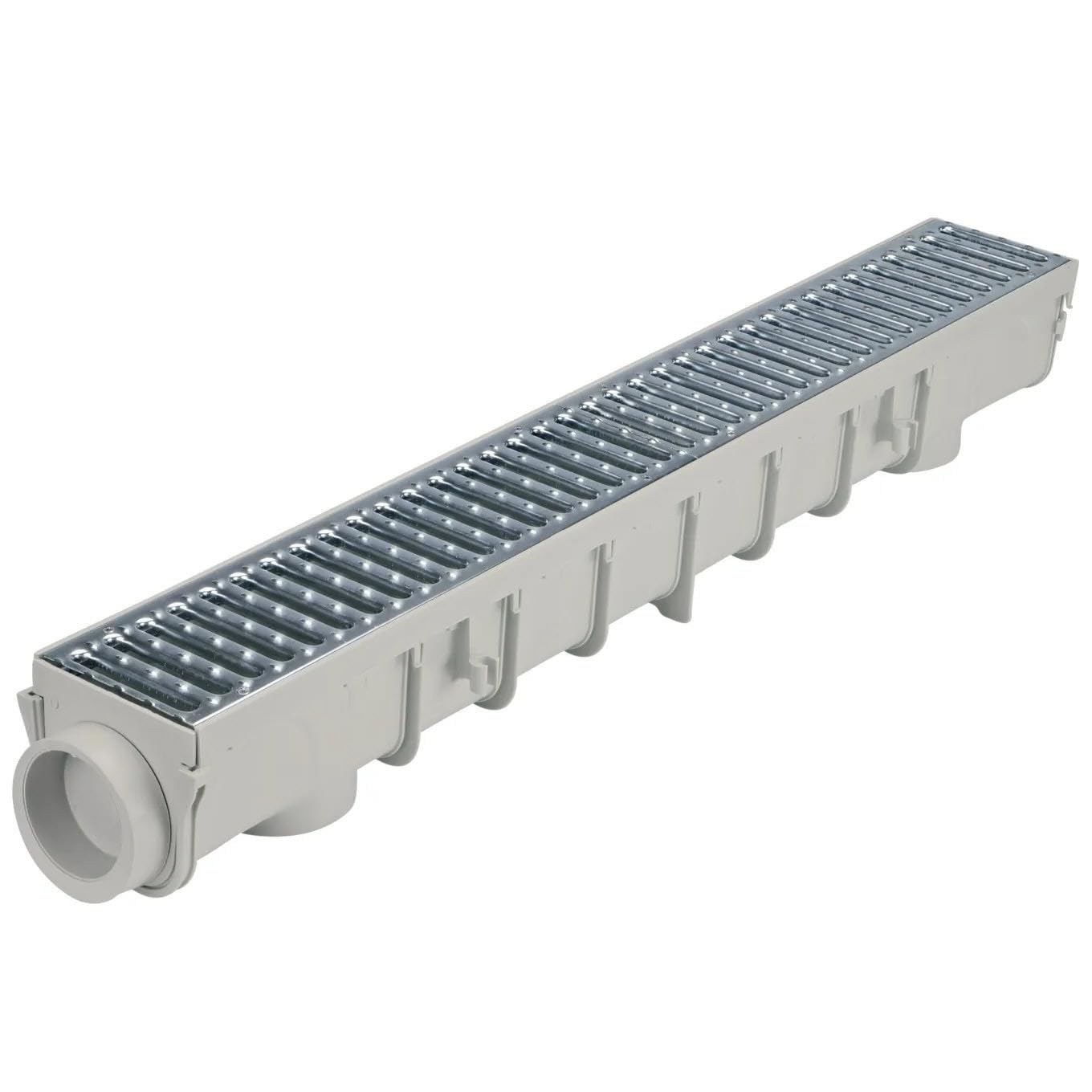
Not every basement flood starts inside the house. If runoff pools at the edge of a patio or where pavers meet the lawn, this deep-profile channel catches it at the surface and carries it away. Each section is 39-3/8 inches long and moves 59 gallons per minute per foot, with 19.32 square inches of open surface area per linear foot. It is the lightest thing on this list at 6.15 pounds, so you can carry a kit to the far side of the yard without a hand truck.
The kit ships complete: the channel, galvanized steel grates, an end cap and outlet, and a second end cap. Connections are flexible, with a bottom outlet that fits 3-inch and 4-inch sewer and drain fittings and side and end outlets that tie into standard pipe. You can snap sections together for a long run or cut them to custom lengths. It also carries a Class B load rating for light traffic up to 175 psi and ADA compliance for pedestrian use, which matters if this crosses a walking path.
What wins people over is the build quality — the units feel solid underfoot, sit still when dogs cross them, and look intentional rather than patched-in. Owners put them to real use: “Used 5 kits off patio edge into garden to drain rain away.” The honest note is corrosion. The galvanized steel grates have a known weak spot where the plating does not bond well to the polypropylene body, so adhesion and long-term grate durability come up as the recurring gripe. A couple of owners also note the polypropylene body offers little for adhesive to grab during grading prep, though it mostly acts as a liner holding the grates anyway.
Who it suits: anyone with a driveway, patio, or walkway that floods and needs a clean surface-level fix.
The real caution: it is a residential-traffic product, so keep it away from heavy vehicle loads and expect to keep an eye on the steel grates over the years.
Good match for: a stone deck edge, garage apron, or paver-to-lawn seam where water always gathers.
Not the one for: a true basement pit — this is a surface channel, not a pump.
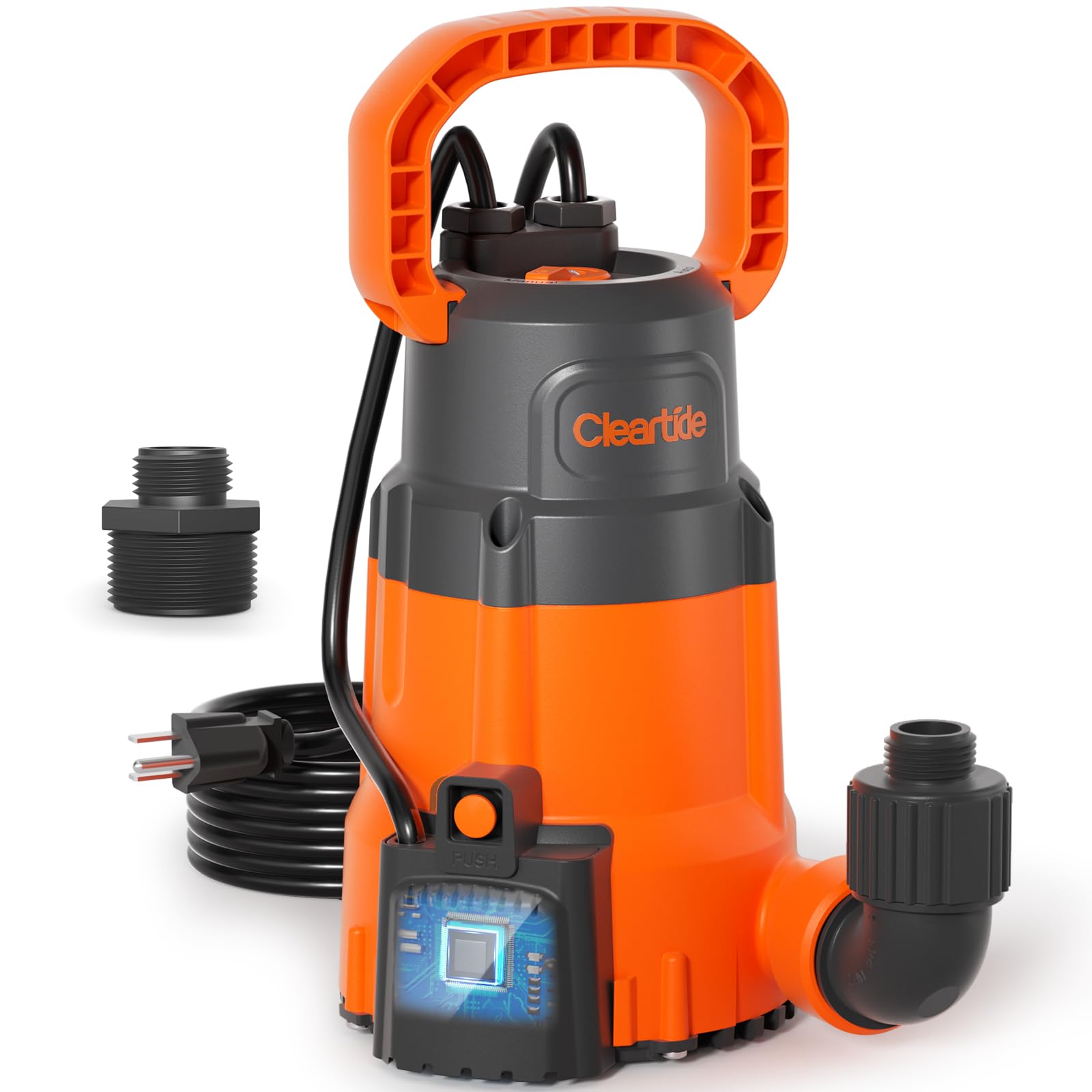
3. Cleartide 1/3 HP Submersible Utility Pump, 2790 GPH
A 1/3 HP utility pump with a 30-foot lift and an auto water sensor
The talent here is range, not raw power. This utility pump moves up to 2790 gallons per hour and lifts water as high as 30 feet — the tallest head ceiling of any pump on this list — which covers a flooded window well, a pond, a hot tub, or a garden hose run that climbs uphill. At 12.16 inches tall it slips into tight spaces, a full 2.1 times shorter than the 15.5-inch Wayne combo in the top spot, so it drops into spots that taller pumps cannot.
The auto water sensor is what separates it. Switch to smart auto mode and the sensor starts the pump at 1-1/5 inch of water and stops it at 1/5 inch, which is exactly what you want in a flooded basement or window well that you do not need to babysit. Switch to manual and it pumps instantly at any level. The 1/3 HP copper-wound motor runs cooler and the thermoplastic housing resists corrosion, and it comes with a 10-foot cord, a 1-1/4 inch NPT elbow, and dual adapters down to a 3/4 inch garden hose, so it connects right from the start.
What wins owners over is how well and how often it simply works — draining duck ponds, swim spas, and window wells during heavy storms. The auto-off is the part people single out; as one owner put it, “Works Great! no more ‘stuck’ floats.” The honest limitation is its ceiling: this is a utility pump meant for shallow, clear water, and it can see-saw cycle when it nears the bottom unless you add a check valve. This is not a sewage or solids pump, and one frustrated buyer reports it kicked on but inconsistently expelled water during major flooding. For deep or debris-heavy water, a dedicated sump or sewage pump is the right tool instead.
The everyday wins
- Auto sensor turns on at 1-1/5 inch and off at 1/5 inch for true hands-free draining
- 30-foot maximum lift clears tall vertical runs
- Handles solids up to 1/8 inch without clogging
- Self-removes air locks and shuts off if it runs dry or tips over
- Ships with hose adapters and a 10-foot cord
Where it stops short
- Can see-saw cycle near the bottom without an added check valve
- Not designed for sewage or heavy solids
- Shallow-water utility use, not a permanent pit solution
The right tool for: anyone who needs one portable pump for pools, ponds, basements, and window wells.
Wrong job for it: a permanent sump pit or a septic line full of solids.
4. VIVOHOME 3/4 HP Cast Iron Sewage/Effluent Pump for Basement, Septic Tank
A 3/4 HP cast iron pump with a vortex impeller for septic and effluent duty
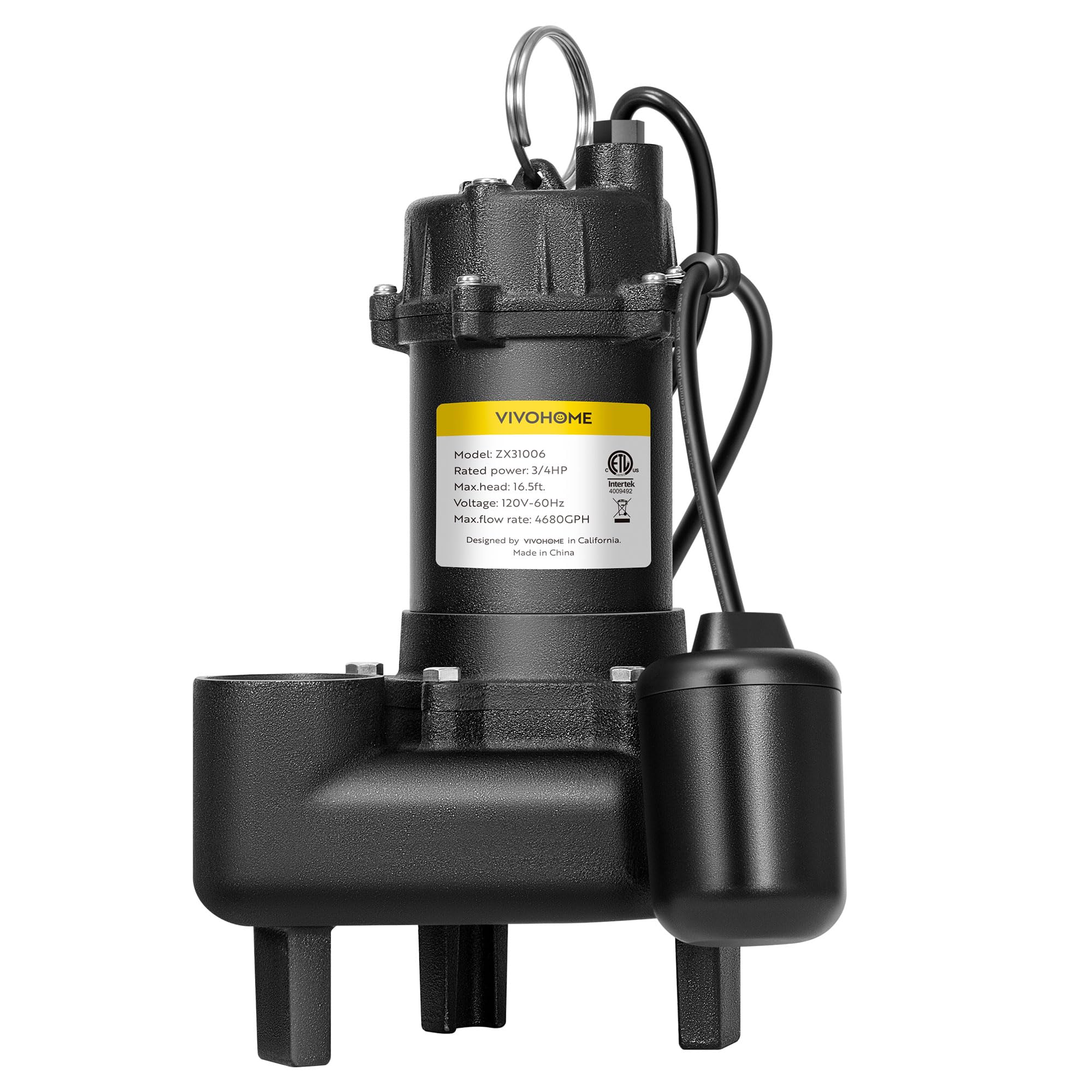
Septic tanks and basement sewage pits call for a different kind of pump, and this is that pump. The 3/4 HP oil-filled split capacitor motor pushes a high flow rate of 4680 gallons per hour and lifts water up to 16.5 feet through a 2-inch NPT discharge, handling solids under 0.79 inch with a non-clogging vortex impeller. The cast iron housing gets an electrophoresis treatment to resist rust, and at 23.1 pounds it stays put in the pit rather than drifting around.
Automation is thoughtful. The adjustable float switch activates when the water reaches 18.5 inches and shuts off at 4.1 inches, so it will not run dry and burn out. A built-in thermal overload protection cuts power at 266 degrees Fahrenheit. The 14.4-foot power cord and piggyback plug mean you can run it in manual or let it run itself, and the top metal ring is there for tying a rope when you lower or lift it. Vivohome warns against lifting it by the cord.
Owners who use it for its intended job — septic and effluent duty rather than a wet basement pit — report strong performance and quiet running. There is also an honest flip side. Durability is the one place opinions split: some units work for months or a year with no trouble, and a smaller number quit within weeks. One owner reports plastic innards inside an otherwise metal pump, and a few mention the impeller is sensitive to debris that makes its way into the intake. For a clean drainage job it earns its place. For a gritty, debris-heavy line, expect more babysitting.
The appeal: true sewage-pump capability — cast iron, vortex impeller, and 2-inch discharge — at a mid-range tier.
The catch to weigh: it is happiest handling dirty but not solid-choked water, so heavy debris loads are a fit mismatch rather than a fault.
Choose it for: septic, effluent, or basement sewage removal where the discharge needs a 2-inch line.
Pick a different one: if all you need is shallow clear-water removal — a utility pump is easier to handle.
5. Westinghouse Sump Pump 1/2 HP 69 GPM Submersible Water Pump
A 1/2 HP pump with a 28-foot lift that fits a five-gallon bucket
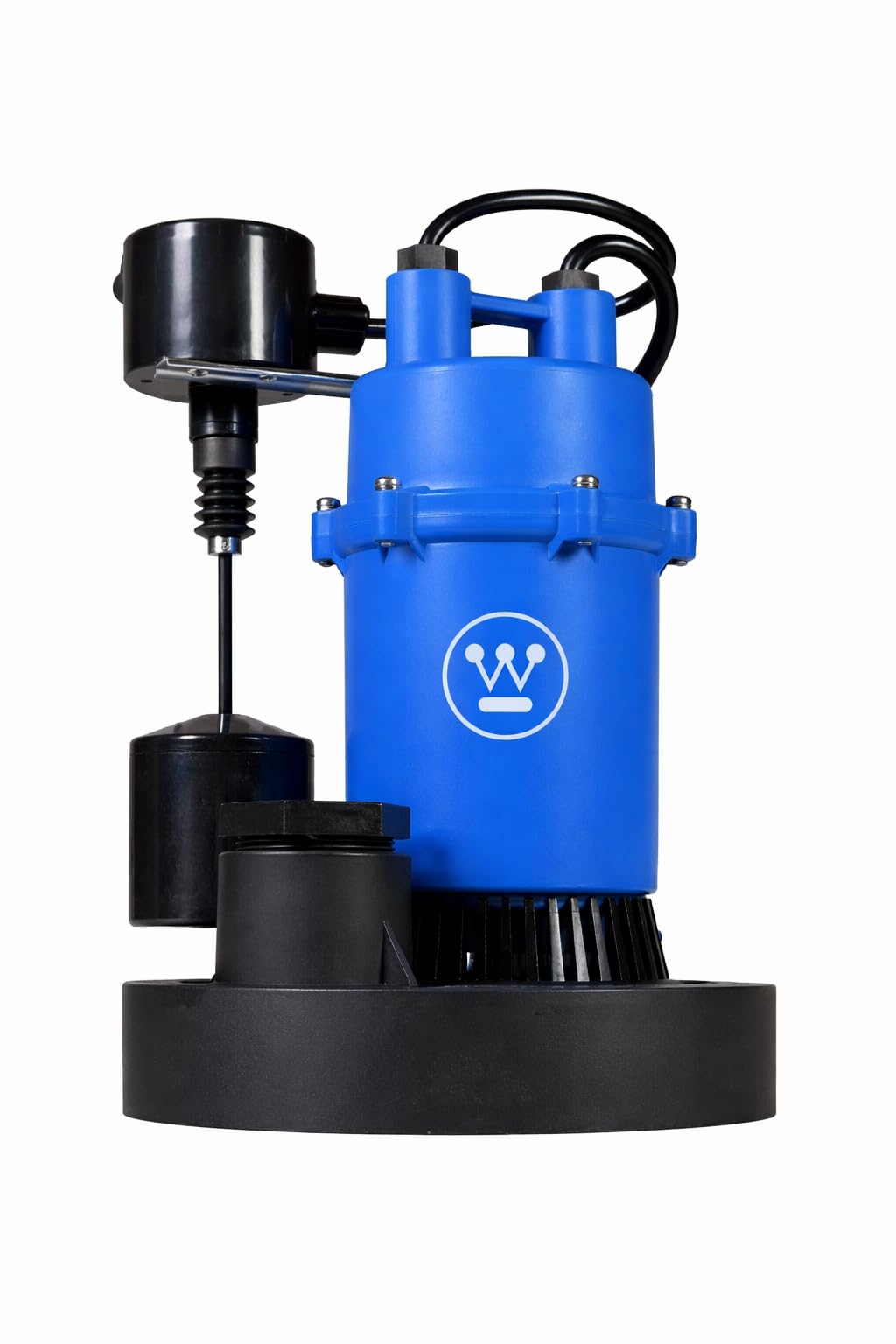
Small pumps are judged by where they will fit, and this one is built for tight corners. The 1/2 HP motor moves up to 4100 gallons per hour with up to 28 feet of vertical lift, and the compact body fits places a full-size pit pump cannot — one owner even runs it inside a 5-gallon bucket used as a makeshift sump pit. That 28-foot head rating also beats the VIVOHOME at 16.5 feet, so it can push water through a longer or taller discharge run.
The integrated vertical float switch activates as water rises, giving you hands-free protection even in narrow sump pits where a swinging float would bind against the wall. The epoxy-coated aluminum housing dissipates heat, and the oil-filled PSC motor carries thermal overload protection to extend life. It connects to 1-1/4 inch or 1-1/2 inch discharge lines, and the top suction anti-airlock system filters debris and keeps flow steady and the pump quieter.
Owners find it starts earlier than other models they have owned and stays quiet doing it, and the pattern of longer-term reports is reassuring — several mentions of it behaving months after install with no trouble. The honest limit: the top plastic housing is the one weak spot. A piece has been known to chip or break off during install on some units, though it does not affect how the pump runs, and it is a fair reminder that this is not an all-steel tank. Treat it gently during the drop-in and it holds up fine.
Why people pick it
- 28-foot vertical lift is the second-highest head rating of the pumps here
- Compact body fits narrow pits, buckets, and crawl spaces
- Vertical float switch works where a swinging float would jam
- Epoxy-coated aluminum housing and oil-filled motor resist heat
Where to be careful
- The top plastic housing can chip during install
- Not a sewage or heavy-solids pump
- Discharge is limited to 1-1/4 or 1-1/2 inch connections
Tailor-made for: narrow pits, crawl spaces, or a bucket-as-sump setup where a big pump simply will not fit.
Skip past it: if you need to move sewage or solids, since this is a clear-water sump pump.
6. LANCHEZ 1HP 6600 GPH Submersible Sewage Pump
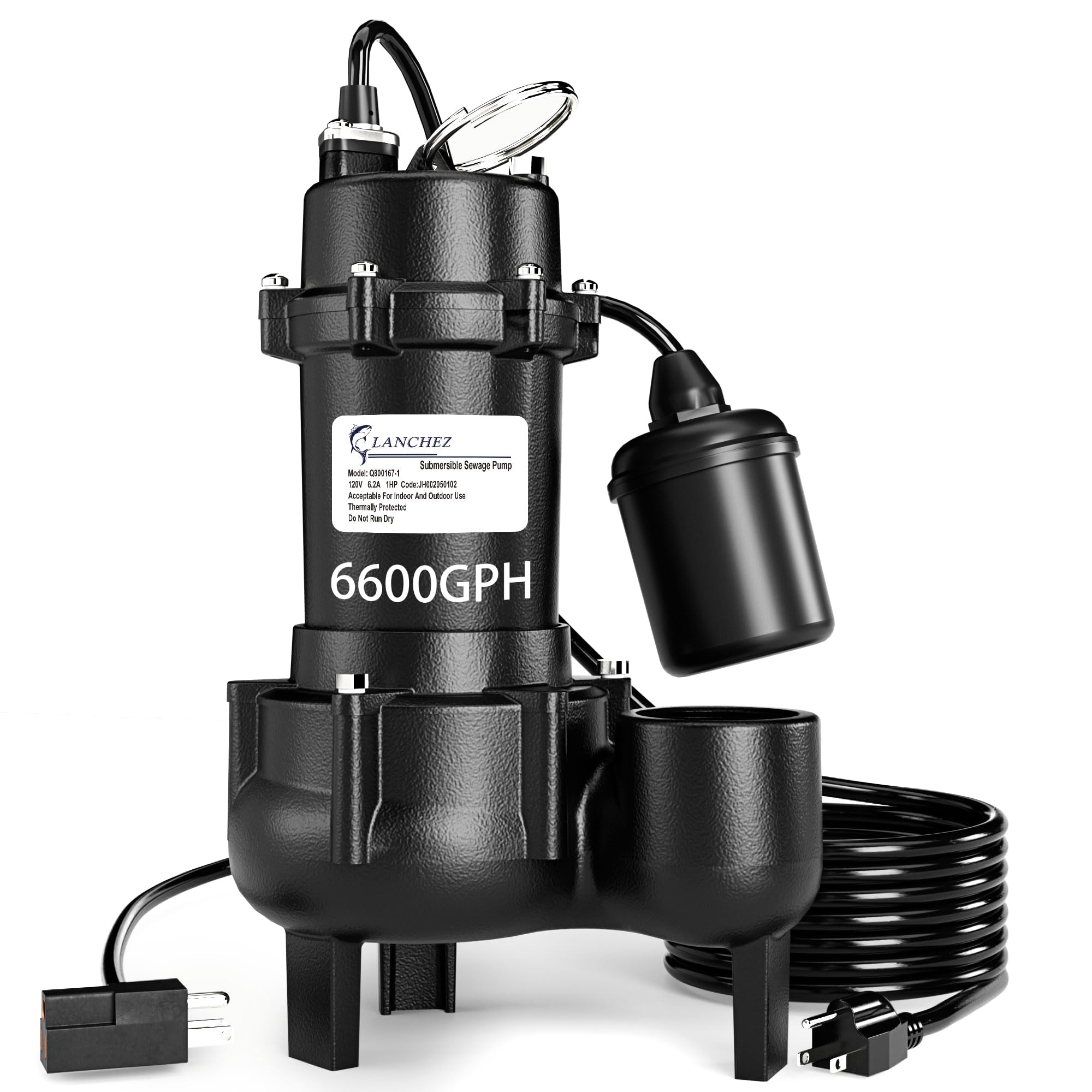
A 1 HP cast iron sewage pump rated 6,600 GPH at 0 feet
When you need brute volume, this is the biggest number on the list. The 1 HP PSC copper motor moves up to 6,600 gallons per hour at ground level, holds 5,644 gallons per hour at a 5-foot height, and lifts water up to 27 feet of vertical height. The cast iron casing resists corrosion and cools better than plastic, and a built-in thermal overload protection stops the motor from burning out if it runs dry. The 2-inch NPT discharge and 10-foot grounded power cord round out a pump built for high-capacity work.
The adjustable tethered float switch turns it on and off based on water level and cuts power when it cannot pump water. The built-in thermal protection and the weight of the cast iron frame also keep it steady in the pit — one owner notes it stays in place rather than tipping. It carries a 3-year technical support warranty from the manufacturer.
Owners who rely on it for high-volume dirty water love the power. “This pump saved my house!” one writes, praising how fast it removes water and calling it strong and durable. The one honest caveat is longevity. Like any high-output sewage pump, it works hard, and reports are split between units that run for a year and a small number that stopped earlier. The tethered float also needs a pit with room for it to swing, and it will not auto-activate unless the float buoy hangs fully vertical. For a wide sump basin or a heavy dewatering job, that trade-off is worth it.
Where it comes out ahead
- 6,600 GPH at 0 feet is the highest flow rating in this guide
- 27-foot maximum lift and 2-inch NPT discharge for high-capacity runs
- Cast iron casing resists corrosion and cools the motor
- Adjustable tethered float and thermal overload protection
The trade-offs to know
- Durability reports are mixed, with a few units failing under a year
- The tether float needs a wide pit to swing freely
- Heavy cast iron is awkward to lower and lift without help
Made for: large sump basins and high-volume sewage or dewatering work where flow beats finesse.
Think twice if: you want a lightweight portable pump or a small, tight pit.
7. VEVOR Utility Sink Pump, 1/3 HP with 6 Gallon Basin

A 1/3 HP pump and 6-gallon basin for laundry drains and water softener backflush
This is a niche hero for a specific headache: a basement laundry sink, washing machine, or water softener that drains too slowly or has no gravity path to the sewer. The 1/3 HP oil-filled copper-wire motor spins at 3500 RPM and moves a maximum flow rate of 2900 gallons per hour with a 25-foot maximum head through a 1-1/2 inch NPT outlet, and it handles particles up to 3/8 inch so lint and grit pass through with the water.
The kit arrives as a system — the pump, a vertical switch, a discharge pipe, and a 6-gallon drainage bucket — and VEVOR says setup is as simple as attaching the pump, switch, and pipe to the bucket. The automatic float switch kicks in the moment water rises and avoids unnecessary stop-starts, which saves energy and extends pump life. It weighs 18.3 pounds and meets ETL standards.
Owners use it for exactly the jobs it is built for — a washer sink, water softener backflush, and a large high-efficiency washer all at once, pushing water up 8.5 feet and across a ceiling to the septic line. The trade-off to plan for is sealing. The internal check valve has been reported to fail to stop backflow, causing extra runs, so some owners add an inline check valve; a few units arrive with a weak seal where the pipe meets the box. It is a small fix if you are handy, and cushioning the pipe keeps the noise down.
Why it earns a spot: a complete under-sink package — pump, basin, and switch — that turns a slow laundry drain into a fast one.
What to plan around: add your own inline check valve and expect to cushion the discharge pipe, since the internal seal is the reported weak point.
Best fit for: a laundry sink, water softener, or washing machine drain that needs help reaching the sewer line.
Wrong job for it: a flooded basement floor or a full sump pit — this is a sink-drain pump, not a pit pump.
8. The Basement Watchdog Cast-Iron 1/2 HP Submersible Sump Pump (SIT-50D)

A 1/2 HP pump with a top-mounted discharge that fits an 11-inch pit
Some pits are simply too narrow for a standard side-discharge pump, and this one solves that. The 1/2 HP copper-wound PSC motor moves 4,400 gallons per hour at ground level and 3,540 gallons per hour at 10 feet, with a maximum lift of 25 feet. Because the discharge sits on top of the pump rather than out the side, it fits snugly into a pit as narrow as 11 inches — a common pain point for older homes. It weighs 20 pounds and stands 11.75 inches tall.
Reliability is built in at the details. Two floats sit inside a protective cage, giving redundancy and keeping debris or loose wires from jamming the switch. Dual carbon-ceramic and one Buna-N shaft seal protect the motor from water, and the cast iron body is made to shrug off years of wet duty. This is a drop-in match for the discontinued PW1050 model, which is why so many replacements land on it.
The thing people rave about is the build and the support behind it. Customers note Glentronics customer service responds fast — one buyer had a damaged controller replaced free, with a check valve thrown in, in a matter of minutes. “Solid U.S. made pump and excellent in-house customer service,” is the sentiment repeated across the reviews. The honest catch: the top-mounted discharge can be trickier to install in tight quarters than an old side-discharge layout, and a couple of owners found it hard to swap out a check valve afterward. In a wide pit, the side-mount alternative is easier to work around.
The reasons it stands out
- Fits pits as narrow as 11 inches thanks to its top-mounted discharge
- 4,400 GPH at 0 feet and 3,540 GPH at 10 feet
- Caged dual float switch resists debris and wires
- Copper-wound PSC motor and triple shaft seals for durability
- A documented drop-in replacement for the discontinued PW1050
Where it demands patience
- Top-mount discharge can be tight to install in cramped pits
- Swapping a check valve afterward is fiddly
- No battery backup included — it is a primary pump only
Built for: narrow sump pits and anyone replacing an old Basement Watchdog unit.
Better to look at the Wayne combo: if you want backup protection in a single purchase.
9. Trench & Driveway Channel Drain with Galvanized Steel Grate – 3 Pack

A three-pack built to stop driveway flooding before it reaches the garage door
If your garage floods every spring because runoff pours down the driveway, this is the surface fix. The three-pack includes three interlocking channels with galvanized steel grates, plus an end cap and an end outlet, so you can build a continuous drainage line and add more sections later. The snap-in steel grates lift out without screws, which means you can clear leaves and grit in a couple of minutes instead of wrestling with a cover.
The channels connect with a bottom outlet that ties into 3-inch and 4-inch drain pipe, so you can route water underground to a safe discharge point. They are rated for residential traffic — driveways and walkways — and hold up through seasonal rain and everyday use. This is the lighter-touch cousin to the NDS kit above, aimed at lighter vehicle traffic rather than ADA pedestrian crossings.
What wins people over is how sturdy and permanent these feel once poured in. Owners install them across full driveways and thresholds, tying them into gutter downspouts, and report water flows perfectly after heavy rain. “They’re made strong, sturdy material and they look like they’ll last a really long time,” one writes, with others anchoring them in concrete around rebar tabs set for pitch. The honest caveat is the grate finish: the galvanized steel can rust in spots where the plating is thin, so plan to keep an eye on the grates over the years. The channels themselves are solid once they are set in concrete.
What makes it a solid buy
- Three interlocking sections with steel grates plus an end cap and outlet
- Snap-in grates lift out without screws for quick cleaning
- Bottom outlet fits both 3-inch and 4-inch drain pipe
- Withstands residential driveway and light vehicle traffic
What to watch for
- Galvanized grates can rust in spots where the plating is thin
- Requires concrete anchoring for best results and a downward grade
- Not rated for heavy commercial or truck loads
The pick for: a driveway, garage apron, or walkway that pools and needs a hard-wearing surface channel.
skip it if: you have a basement sump pit — go with a pump instead of a surface channel.
10. Little Giant 1/3 HP Cast Iron Submersible Sump Pump
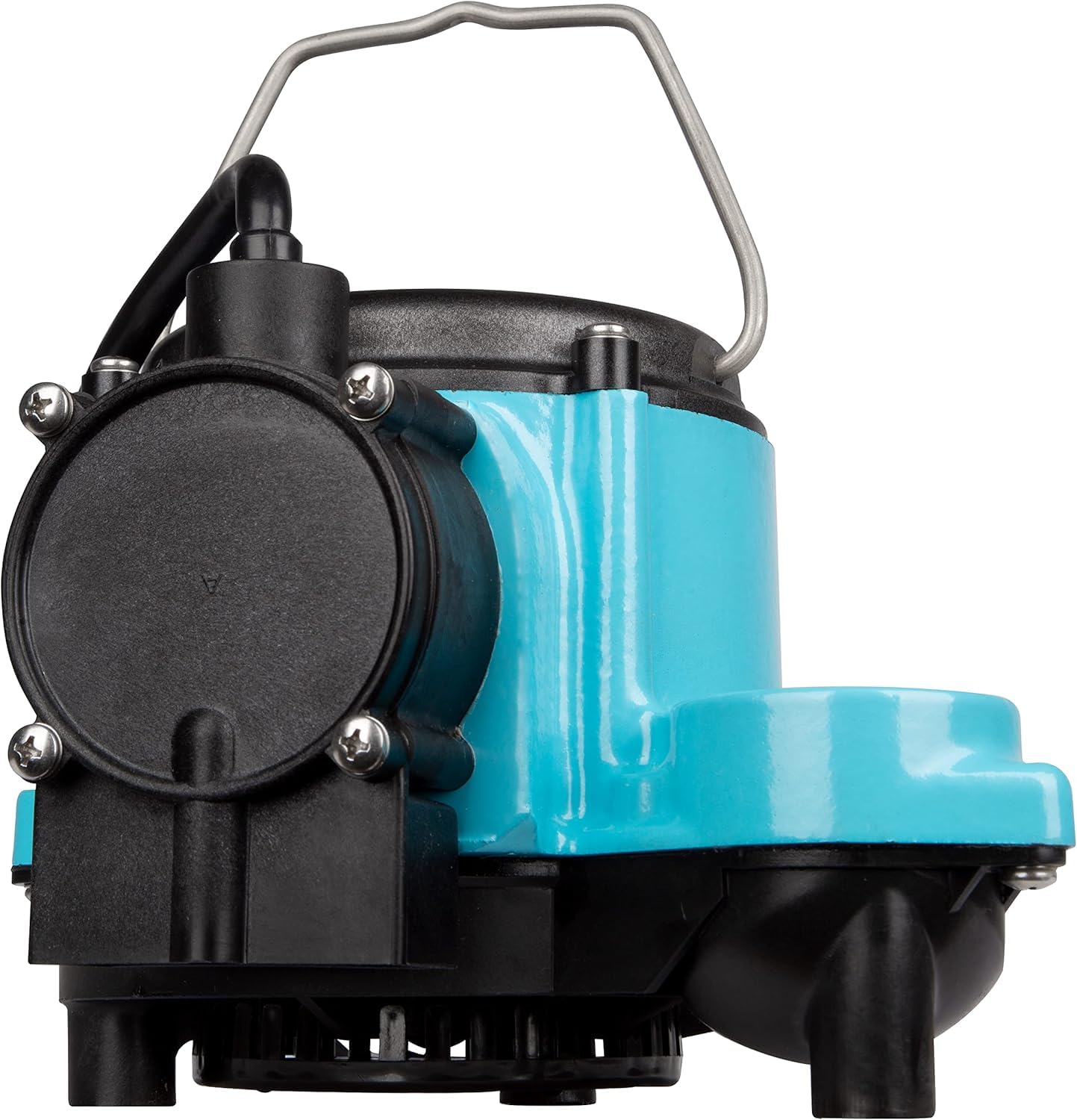
A compact cast-iron pump whose diaphragm switch has no float to stick
This is the quiet, compact workhorse for small sump basins and condensate lines. The 1/3 HP shaded pole motor runs continuously on 9.0 running Amps and 720 Watts, moving up to 2760 gallons per hour at 5 feet of lift with an 18-foot shut-off height and a 1.5 inch FNPT discharge. It is the shortest pump on this list at 6 inches tall, so it slots into shallow basins where taller models bottom out.
The built-in diaphragm switch is the standout feature. Instead of a float that can stick or jam on debris, it is activated by water pressure — non-adjustable, turning on between 7 and 10 inches and off between 1 and 4 inches. That design is why owners describe the pump as relieving them of the classic float headaches; as one review puts it, “The diaphragm level sensor eliminates any issues with a traditional style float.” It is CSA listed in the USA and Canada, and it is rated for a maximum fluid temperature of 140 degrees Fahrenheit.
Owners who keep these in service for years get real mileage out of them, and the diaphragm switch is well regarded. The honest note is that this is explicitly a sump-system pump, not a general dewatering or emergency unit — Little Giant says so directly. Over many years of service, the pressure switch is the part that eventually wears out, though the housing and motor themselves hold up. That is a normal lifespan on a high-cycle pump, not a defect.
The standout: a pressure-activated diaphragm switch that sidesteps the float jams that plague other pumps.
Know before you buy: it is not built for emergency water removal or heavy general dewatering — it belongs in a sump system.
Good for: small sump pits and condensate or humidifier overflow lines that need quiet, compact handling.
Strong fit for this pick: tighter pits and anyone who wants to skip float maintenance.
Bypass it if: you need to pump flooding from a burst pipe or a big yard drain — a utility pump handles that better.
11. Zoeller M57 Mighty-Mate Submersible Sump Pump – 3/10 HP Cast Iron
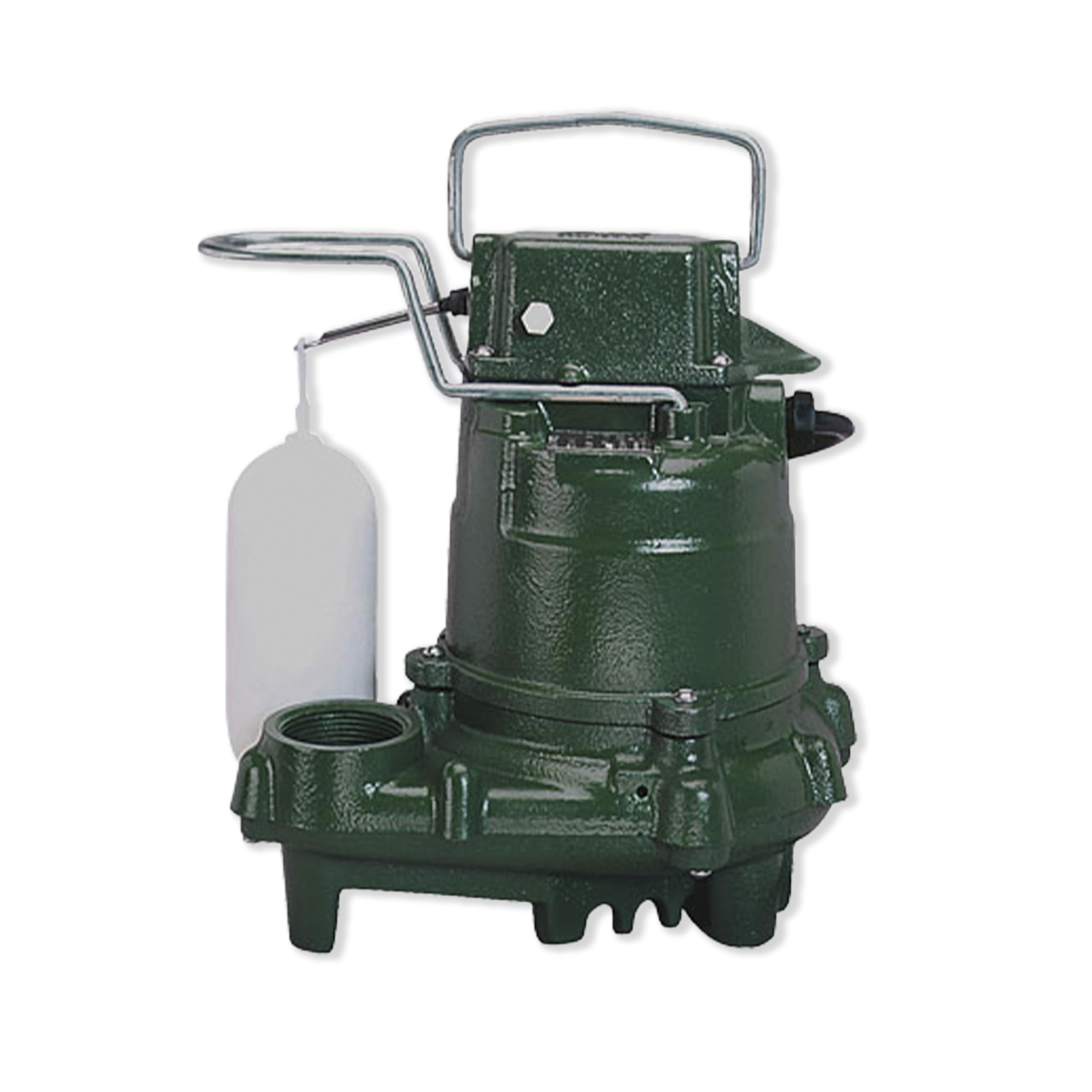
The all-cast-iron classic that owners measure in decades, not seasons
Some pumps are bought on numbers; this one is bought on reputation that has been earned over a long haul. The 3/10 HP oil-filled motor and cast iron housing are built to dissipate heat and keep running, and the non-clogging vortex impeller is also cast iron, so it passes solids instead of choking on them. It moves up to 2580 gallons per hour through a 1.5 inch discharge, and the vertical float is made of solid polypropylene so it cannot become waterlogged the way a hollow foam float can.
The classic Zoeller story is durability. Reviewers point out these running for years on end with little fuss — one account of the same unit going for over 11 consecutive years in a rainy climate without a single failure is the kind of longevity that makes people buy a second one. The 27.1 pounds of cast iron also keep it planted in the pit. Stainless steel hardware, a float guard, and a corrosion-resistant switch arm round out a build that shrugs off damp basements.
The one honest caveat is weight and the initial cost of entry. At 27.1 pounds, it is heavy to lower into a pit and awkward to pull for cleaning, and it costs more upfront than a plastic-bodied pump. But owners consistently see it as the buy-cheap-twice choice — a pump built to stay in the pit and do its job quietly. Some reports note a few units failed early, but the overwhelming pattern is long service life.
Where it earns its keep
- All cast iron construction with a cast iron vortex impeller passes solids easily
- Solid polypropylene float will not become waterlogged
- Operates automatically with a built-in snap action float switch
- Stainless steel hardware, float guard, and switch arm resist rust
The honest limitations
- 27.1 pounds of cast iron is heavy to lift and set in place
- Light on advanced features like built-in backup or alarms
- A few units have reportedly failed early despite the strong reputation
The pump for: buyers who want a heavy-duty cast-iron unit they can install once and largely forget for years.
Look elsewhere if: you need lightweight portability or built-in battery backup.
Understanding the Specs
These are the numbers you will see on every listing. Here is what each one actually changes about how the pump or channel behaves in your basement.
Flow Rate (GPH) vs Head Height
Flow rate is how much water a pump moves per hour at ground level — higher numbers mean faster emptying. Head height is the tallest vertical distance the pump can push water before flow drops to nothing. Always read them together, because a pump can be rated for 6,600 GPH at 0 feet but move far less once the discharge pipe climbs. The LANCHEZ, for example, drops from 6,600 GPH at 0 feet to 5,644 GPH at 5 feet. If your discharge run is tall, pick a pump with a taller head rating, like the Cleartide at 30 feet or the Westinghouse at 28 feet.
Float Switch Types
The float is what tells the pump to start and stop, and each style fits a different pit. A vertical float rises and falls on a rod, which is compact and works in narrow basins. A tethered float swings on a cord and needs a wider pit to move freely — the LANCHEZ uses this style. A pressure diaphragm switch has no float at all and instead triggers on water pressure, like the Little Giant. A caged dual float, as on the Basement Watchdog, adds redundancy and keeps debris away from the mechanism. More starts and stops per storm means more wear, so match the float to your basin size.
Cast Iron vs Thermoplastic Housings
Cast iron housings cool the motor better and add weight that keeps the pump planted at the bottom of the pit — the Zoeller M57 and the VIVOHOME both rely on this. Thermoplastic and polypropylene housings resist corrosion and cut weight, which is why the Cleartide and the Little Giant are easier to lift and carry. There is no wrong answer, only a trade-off: heavy and stable, or light and portable.
Discharge Sizing and Solids Handling
The discharge is the outlet pipe the water leaves through, and its size has to match your plumbing. Common sizes here are 1-1/4 inch, 1-1/2 inch, and 2 inch NPT. Sewage and effluent pumps tend to use a 2 inch discharge because they move larger solids — the VIVOHOME handles solids under 0.79 inch, the LANCHEZ is built for high-capacity waste, and the VEVOR sink pump passes particles up to 3/8 inch. Regular sump pumps move cleaner water and use smaller outlets.
FAQ
What size sump basin does a primary and backup combo pump need?
Can I use a utility pump like the Cleartide as a permanent sump pump?
How high can these pumps push water?
Do I need a battery backup for my sump pump?
What is the difference between a sump pump and a sewage pump?
How does a channel drain differ from a sump pump?
Which float switch is best for a narrow sump pit?
Are cast iron sump pumps better than plastic ones?
What size discharge pipe should a basement drain pump use?
Can a sump pump run dry without being damaged?
Final Thoughts: The Verdict
For most basements, the strongest overall pick is the Wayne Preassembled Primary & Battery Backup Sump Pump Combo System, because it pairs a 5,100 GPH primary pump with a 12-volt battery backup in one preassembled drop-in unit — the kind of redundancy that protects a finished basement when the power dies. If you want a high-volume pump for a wide basin or heavy dewatering, reach for the LANCHEZ 1 HP and its 6,600 GPH flow. If you need to stop water before it reaches the door, the 3-pack driveway channel drain is the surface fix that stands up to real usage.
How We Picked
We do not accept paid placement. Every pick is matched to a real buyer and a real use-case; we do not hands-on test units.
Sources & Methodology
Specifications: manufacturer listings and product documentation. Review insights: verified customer reviews, as of September 2026. Pricing: not shown on this page (it changes often); check the current price via the retailer link.
As an Amazon Associate, Gadgets Feed earns from qualifying purchases. This does not affect which products we feature.