
Our readers keep the lights on and my morning glass full of iced black tea. As an Amazon Associate, I earn from qualifying purchases.
Specs are compiled from manufacturer listings and verified buyer reviews and can change over time — please confirm the key details on the product page before buying.
If your basement is always the coldest room in the house, a mini split heat pump is the fix — one wall-mounted head that both cools in July and heats in January, no ductwork required. The catch most first-time buyers hit is that basements are a different animal from a living room: they sit below grade, they lose heat through cold concrete, and the units sold for upstairs rooms are often sized wrong for the job. This guide walks through thirteen real ductless heat pumps, from compact single-zone heads that fit a finished rec room to multi-zone systems that warm a whole rental basement and the space above it, and explains in plain terms which one actually fits your square footage and your climate.
I’m Min — the founder and writer behind Gadgets Feed. This guide is built by comparing the manufacturers’ published specifications and the patterns across verified customer reviews, so you get each pick’s real strengths and trade-offs instead of marketing spin.
You want heat that reaches the floor, not the ceiling, so start by matching the BTU rating to your actual square footage before anything else — and pick from the picks in this best basement heat pump list with your room size already in hand.
Our Picks at a Glance


How To Choose The Best Basement Heat Pump
Basements behave differently from any upstairs room, so the calculator you’d use for a living room will steer you wrong here. Cold air sinks, concrete walls pull heat out of the space, and humidity settles low — all three mean your unit works harder than the square footage alone suggests. Below are the four decisions that actually lock in whether a ductless heat pump keeps your basement comfortable.
Match the BTU rating to your real square footage
Every mini split is rated in BTU (British Thermal Units — the industry’s measure of how much heat it moves per hour). Match a 9,000–12,000 BTU unit to a finished 400–550 sq ft basement room, an 18,000 BTU model to a 750 sq ft space, and a 24,000–30,000 BTU system to a larger open basement of 1,000–1,500 sq ft. Oversizing wastes money and short-cycles the unit; undersizing means it runs nonstop and still can’t push the thermostat where you want it.
Check the cold-climate heating floor, not just the cooling number
Basements get cold, but so do the shoulder seasons above them. Look at the lowest outdoor temperature the odd unit can still heat in — you’ll see ratings like -4°F, 5°F, or -13°F in the specs. If you live somewhere with real winter, choose a model that heats down to at least -4°F; if you’re in a mild climate, a 5°F heating floor is fine. This single number is the biggest difference between a heat pump that works year-round and one you shut off in December.
Decide between one zone and several
A single-zone system is one indoor head and one outdoor condenser — perfect for a dedicated finished basement room or a workshop. A multi-zone setup runs two or three indoor heads from one condenser, letting you independently control a basement bedroom and the main space above it. Multi-zone costs more upfront but avoids installing two separate outdoor units on the same wall.
Plan the install before you buy
Nearly every mini split heat pump on this list requires a licensed HVAC technician because the lines need vacuuming and the refrigerant system is factory-sealed. Some experienced DIYers handle it with a borrowed or inexpensive vacuum pump, but the warranty status and local codes matter — check both before you skip the pro. Budget the line-set length carefully, since a basement wall run is usually longer than a straight upstairs one.
Quick Comparison
| Model | Best For | Cooling Power | Floor Area | Efficiency | Amazon |
|---|---|---|---|---|---|
| Senville AURA 24000 BTU★ Best Overall | Large finished basement | 24000 BTU | 1250 sq ft | 21.5 SEER | Amazon |
| DELLA Serena 12K BTUBest Value | Compact below-grade room | 12000 BTU | 550 sq ft | 22 SEER2 | Amazon |
| YITAHOME 24000 BTUMost Versatile | Garage and basement combo | 24000 BTU | 1500 sq ft | 18.5 SEER2 | Amazon |
| Pioneer Diamante Pro 18K | Quiet below-grade workshop | 18000 BTU | 750 sq ft | 21.0 SEER2 | Amazon |
| YITAHOME 18K Dual Zone | Two-room basement layout | 18000 BTU | 800 sq ft | 22 SEER2 | Amazon |
| ROVSUN 28000 BTU Tri Zone | Multi-room basement rental | 28000 BTU | 750 sq ft | 20 SEER2 | Amazon |
| Daikin Entra 18K BTU | Sub-grade air quality | 18000 BTU | 1000 sq ft | 18 SEER2 | Amazon |
| Senville LETO 30000 BTU | Big open basement | 30000 BTU | 1400 sq ft | High Efficiency | Amazon |
| Daikin Entra 24K BTU | Very large finished basement | 24000 BTU | 1500 sq ft | 18 SEER2 | Amazon |
| Cooper & Hunter 36K BTU | Light commercial basement | 36000 BTU | 600 sq ft | 19.5 SEER2 | Amazon |
| Goodman GPH1442H41 | Package unit for slab basements | 42000 BTU | — | 14 SEER | Amazon |
| Goodman 3 Ton 15 SEER2 | Whole-house replacement | 36000 BTU | — | 15 SEER2 | Amazon |
| Coleman 46515811 | RV basement bays | 27000 BTU | — | — | Amazon |
In-Depth Reviews
1. Senville AURA Mini Split Air Conditioner, Heat Pump, White, 24000 BTU
Our pick — 4.5★ from 500+ verified ratings; the strongest balance of quality and price.
The 24,000 BTU head that swallows a big concrete basement and barely raises its voice.
A 24,000 BTU (a heating and cooling capacity of 24,000 British Thermal Units per hour) unit paired with a floor area rating of 1,250 square feet is exactly the sizing a large open basement needs. Against the DELLA Serena 12000 BTU, this Senville AURA delivers 24,000 BTU versus 12,000 BTU and hits 1,250 square feet versus 550 square feet — so if you are finishing a whole lower level rather than one room, the numbers sit clearly on one side. It also drops to a 2-ton capacity rating, matching that larger footprint.
What wins people over is performance. One owner running it in a hunting cabin reported the 24,000 BTU head cooled 1,000 sq ft from 84°F to 68°F in about two hours, with Alexa and app control working over a Starlink connection. Another owner swapped out an existing unit and measured a 32°F evaporator output against a 96°F room ambient. In heating mode the system works down to -22°F, so a below-grade room stays warm through a real winter.
Expect a few install realities before you commit. Line-set length can run short for a below-grade wall — a cabin user found the lineset “2 ft too short” — so measure your run carefully. The full system ships as the indoor air handler, outdoor condenser, and a 16ft line set with communication wire, professionally installed.
What Owners Keep Talking About
- Rated for 1,250 square feet — sized for a fully finished large basement
- Heats down to -22°F, so below-grade warmth holds through deep winter
- Runs quiet, with owners calling it practically unnoticeable in a finished space
- Alexa voice and app control let you warm the room before you walk down
Before You Order
- Professional installation is required — Senville states this is not a DIY unit
- A few owners found the included line set came up short for a long wall run
- Efficient operation depends on a proper vacuum and torch-free flare connection at install
Reach For This If: your finished basement is large and you want one head handling both summer and deep winter with voice control.
Think Twice If: you’re hoping for a true plug-and-play setup — this one wants a licensed tech running the lines.
2. DELLA Serena 22 SEER2 12000 BTU Mini Split Heat Pump Works with Alexa
A compact 22 SEER2 workhorse built to warm one below-grade room without a whole-system budget.
Efficiency is the headline with the DELLA Serena — a 22 SEER2 rating (SEER2 is the second-generation Seasonal Energy Efficiency Ratio, a measure of how much cooling you get per unit of electricity). A higher SEER2 means a lower running cost, and 22 is a high number for a 12000 BTU unit. Compared with the Senville AURA 24000 BTU above, this DELLA offers 12000 BTU versus 24000 BTU and 550 square feet versus 1,250 square feet, so it’s the pick for a single finished room, not a whole floor.
Where the DELLA separates itself is quiet operation — it runs as low as 22 dBa in mute mode (22 decibels is roughly a soft whisper, quieter than a normal conversation). Its heating floor reaches 5°F, and the outdoor unit’s bottom heating element helps defrost the coil so it keeps working through cold snaps. A 16.4ft installation kit with standard 1/4″ and 3/8″ copper lines and pre-loaded R32 refrigerant for up to 25 ft is included, so the installer has what they need from the start.
The Comfort Deliverables: smart home integration runs wide here — Alexa or Google Home by voice, the DELLA app by phone, and a remote in hand. Geo-location adjusts the temperature based on where you are, warming the basement before you arrive.
Set Expectations On Heat: temperature control is where feedback splits — some say it keeps the whole building at a perfect temperature while a few report the heat output falling short of the marketing on a very cold day. If your basement gets below 5°F ambient, look at the Senville above instead.
Good Fit If: you want one room conditioned efficiently with smart voice control and a 550 sq ft footprint.
skip it if: your below-grade space regularly sees sub-zero outdoor ambient and you need guaranteed heat output.
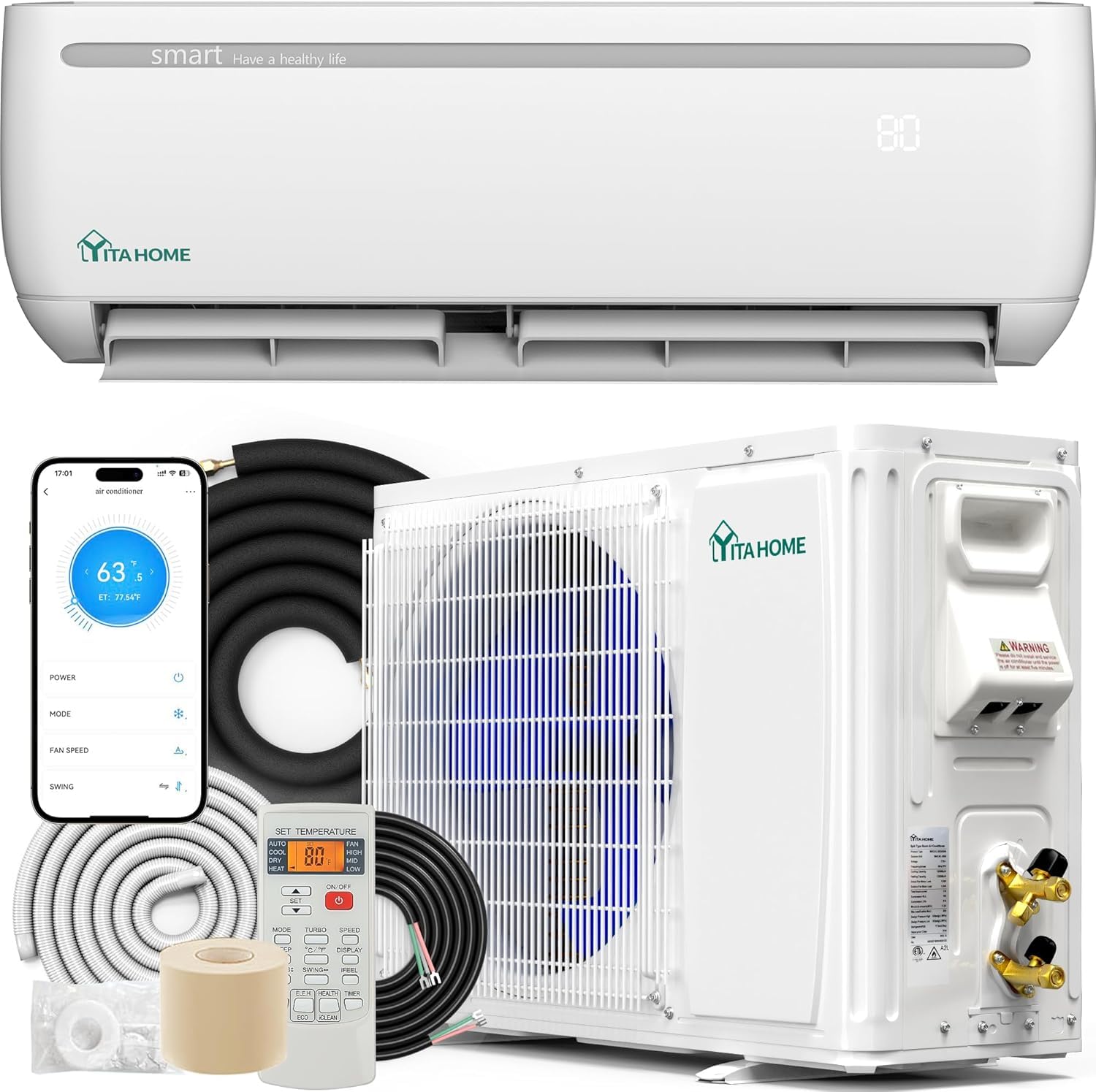
3. YITAHOME 24000 BTU Mini Split AC/Heating System
A 24,000 BTU workhorse that scores highest on cooling, but earns its spot on install-and-run value.
The YITAHOME 24000 BTU system is aimed squarely at the garage-and-basement combo many owners are really trying to cover — one ductless head, 24,000 BTU of cooling power, and a 1,500 square foot coverage estimate that reaches past most single-room mini splits. It runs 7-in-1 modes (auto, cool, heat, dry, sleep, ECO, fan) plus iFeel, HEALTH mode, a 24H timer, and 4D auto swing, and it works with Alexa and Google Home so you can warm the basement before you head down. Air can reach as far as 50 feet across the room, which matters for a long finished space.
Cooling performance is where the strongest feedback lands — One owner reported stable temps in a 14×24 sales shed despite constant customer traffic, and an installer cooled a 16×32 office from 90°F to 66°F in about 90 minutes. Noise stays low too, with the sleep mode dropping to 25 decibels (25 dB is about a soft whisper at six feet).
Two honest caveats stand out. Reliability is a mixed bag in the owner reports — some run without issue and a few hit problems — so factor the value of a good warranty and a nearby HVAC tech into your decision. The app interface received lighter marks from a handful of users, and one installer noted the blower won’t shut off at the set temperature and it sometimes overcools (setting 65°F and hitting 51°F). The system also ships as a factory-sealed pre-charged unit that only a licensed HVAC installer should charge, and it arrives in two boxes that may come separately.
Call For This When: you’re covering a garage or wide basement and want app and voice controls without a premium-brand install price.
Pass On This If: you want blower behavior to shut off exactly at the set temperature — you may need to nudge it manually.
4. Pioneer Diamante Pro Mini Split Air Conditioner, Heat Pump, 18000 BTU, 230V
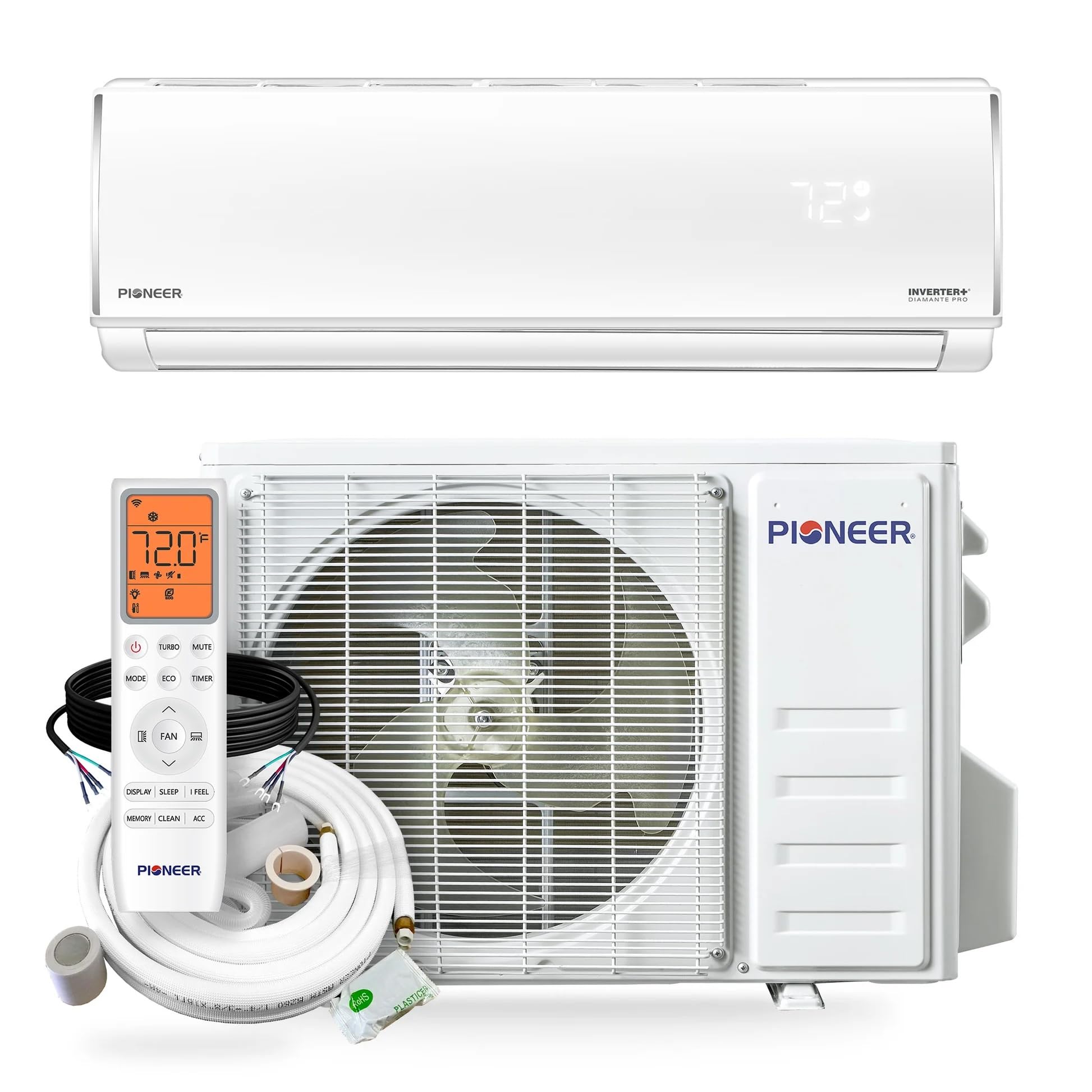
The cold-climate specialist — 18,000 BTU with a -4°F heating floor for basements that never quite warm up.
The Pioneer Diamante Pro is the pick if your below-grade room still feels cool when the outdoor temperature dips hard. It runs to -4°F in heating mode and 122°F in cooling, which is a wider workable window than most units in this class. Add NEEP ASHP recognition (the Northeast Energy Efficiency Partnerships designation for cold-climate variable-speed heat pumps) and you’re looking at a system explicitly rated for cold-weather duty — not something to skip over if the basement is your winter workspace.
Efficiency sits at 21.0 SEER2 with 9.5 HSPF2 (the heating equivalent of SEER2 — Higher the number, the lower the winter running cost) and an 11.0 EER2 at 18,000 BTU. For a 750 square foot below-grade room, that math lines up well. The indoor unit uses motorized up-down and left-right louvers to sweep air, and the remote’s I FEEL sensing detects the temperature near where you’re standing — useful when the top of a basement wall reads warmer than the floor.
Owners who bought for garage and workshop duty are the loudest endorsers. One California owner called it “very efficient,” cooling 1,500 square feet and holding the house near 75°F on a 100°F day. Another installed it in a shop and said it “cools down so quickly and efficiently” — with a few noting the outdoor unit arrived with bent fins or cosmetic sheet metal damage from shipping. Warranty reportedly doesn’t require a licensed contractor install, which is a factor some DIYers weigh.
One thing to plan for: the Pioneer AirLink app control requires a separately sold module, so if app control is non-negotiable, budget for that add-on.
Cold-Weather Ready: -4°F heating floor with a 9.5 HSPF2 efficiency rating means real winter run time, not a fallback to space heaters.
App Control Caveat: the Pioneer AirLink app needs a separately sold module, so plan that purchase if remote-from-phone matters to you.
Built For: cold-climate basements and shop spaces where winter heat is the whole point.
Not The Pick If: you want built-in app control without buying an extra module.
5. YITAHOME 22 SEER2 18K BTU 2 Zone Mini Split AC/Heating System
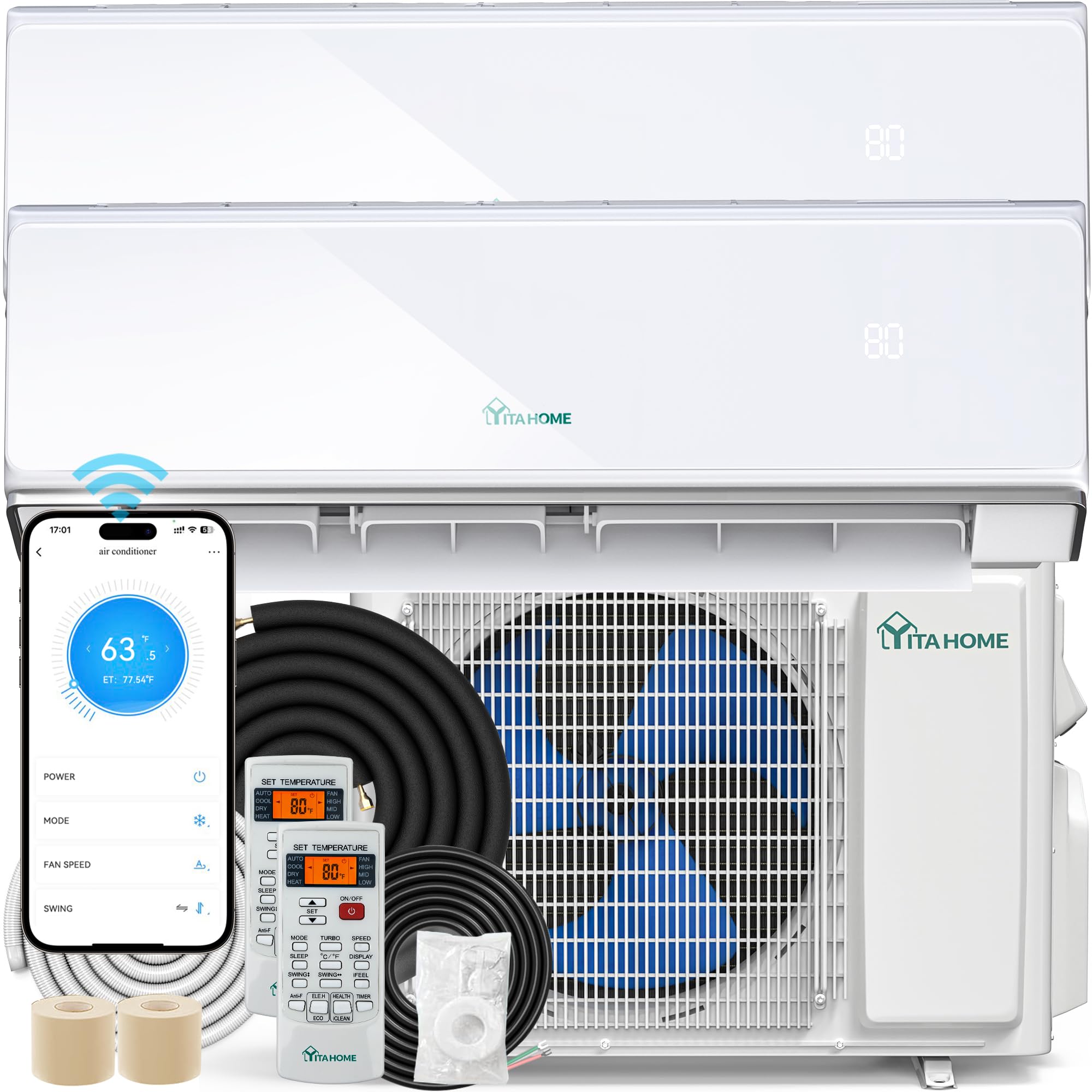
One condenser, two indoor heads — the layout that actually fits a basement bedroom plus a rec room.
A 2 zone split means one outdoor condenser feeding two indoor heads — in this case 9,000 BTU and 9,000 BTU for 18,000 BTU total. That’s the architecture you want when the basement has a distinct sleeping area and a separate hangout space, letting you set each one to its own temperature instead of arguing over a single thermostat. Rated for 800 square feet total and 22 SEER2 (high-efficiency cooling ratio), it beelines straight at a finished lower level with rooms that shouldn’t share a climate.
Both zones address the same lower-level problems: 5°F to 118°F working range, below 40 dB indoor noise, up to 50 feet of airflow distance, plus iFEEL, a 24-hour timer, sleep mode, eco saving, swing, and an off-screen button. Auto defrost keeps the outdoor coil clear in shoulder seasons. The remote covers 60°F to 90°F, and the whole system ships with an indoor unit, outdoor unit, multifunctional remote, and a full install kit.
Installation diaries from owners are frank. One who logged a month of testing said the AC ran quiet and installed easily, but needed extras — wall bracket, disconnect, cable, fuses, a vinyl cover, and Nyloc sealant for the flares — and one of two linesets had to be trimmed. Another ran three of these in a two-story farmhouse and called the app “excellent.” A third strongly suggested a vacuum pump and AC manifold to vacuum the line, pointing out that skipping that step is likely why some owners see units “stop working properly.”
Where It Earns Its Place
- Two independent heads from one condenser — set the basement bedroom and rec room differently
- 22 SEER2 efficiency and 5°F–118°F operating range handle real four-season demand
- Quiet indoors at under 40 dB, suitable for sleeping spaces
What To Know Before Ordering
- Additional install parts are usually needed — plan for bracket, disconnect, cable, fuses, and sealant
- Ships in 5 packages that may arrive separately; one owner received the wrong box entirely
- Professional installation is required — factory-sealed, pre-charged system
Perfect For: a finished basement with two distinct rooms that want separate temperatures from a single outdoor unit.
Be Ready For: coordinating five boxes and a short shopping list of install parts before the tech arrives.
6. ROVSUN 28000BTU Tri Zone Mini Split AC/Heating System
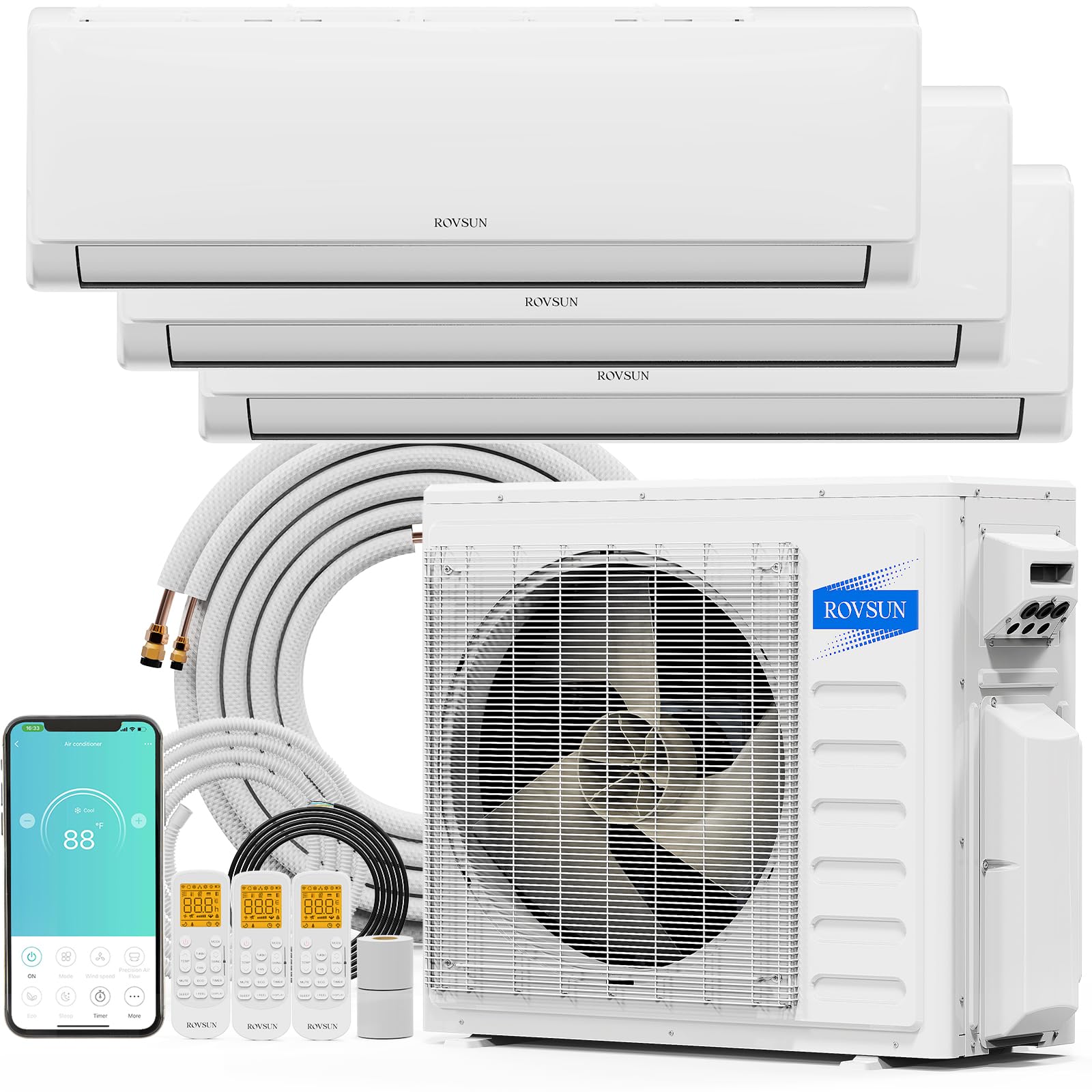
Three heads, one 28,000 BTU condenser — cover a basement rental from top to bottom on one outdoor unit.
If you’re conditioning a multi-room basement — say a finished bedroom, a laundry area, and a playroom — the ROVSUN 28000 BTU Tri Zone drives three indoor heads (9K + 9K + 9K) from one outdoor 28,000 BTU condenser. Each head has an individual controller, so every room gets its own temperature without three separate outdoor units stuck to the same wall. The system works down to -4°F in heating and up to 122°F in cooling, so a below-grade layout stays comfortable year-round.
Efficiency sits at 20 SEER2 with a listed 30% energy savings, and the unit runs at 27–42 dBa (dB is a decibel, the standard measure of sound level — quieter than a normal conversation at the low end). Auto defrost, self-diagnosis, iFEEL mode, a 24-hour timer, 4-way swing, sleep mode, and silent mode come standard, and the pre-charged system ships with 3 indoor units, 1 outdoor unit, 3 remotes, and three 25ft line sets. The condenser should stay upright for 24 hours before installation.
Cold-climate capability stands out in the owner stories. One Vermont owner heated 900 square feet to the upper 70s on negligible power, and reported the unit “ran at -31°F while 3 other-brand units shut down.” A different owner reported that after 8 months a loose connection inside the machine caused an error code and stopped cooling and heating, then cooling returned once the connection was serviced.
Know before ordering: this ships in 7 separate boxes and delivery timing can vary, so don’t schedule the installer until everything has landed. An extra power cord is needed, and professional licensed HVAC installation is recommended.
Cold Snap Champion: a -4°F heating floor plus a documented -31°F run makes this the cold-weather tri-zone pick for a below-grade rental.
Logistics Reality: seven boxes and a mismatched delivery timeline mean you build in slack between purchase and install day.
Pick This When: three basement rooms need independent climate control from one outdoor footprint in a genuinely cold climate.
Wait On This If: your install window is tight — the 7-box shipping split needs breathing room.
7. Daikin 18,000 BTU 18 SEER2 Entra R32 Series Heat Pump Mini Split A/C

A brand-name 18K with a titanium air filter — built for basements that stay closed up and stuffy.
Below-grade rooms trap stale air, and Daikin addresses that directly with a Titanium Apatite Photocatalytic Air Purifying Filter — a filter coating designed to help clean the air passing through the indoor head, which is a distinctive add-on versus every other unit on this list. Beyond air quality, this Entra unit delivers 18,100 BTUs of cooling (range 6,900 to 20,000) and 18,000 BTUs of heating (5,800 to 22,500), rated for up to 1,000 square feet at 18 SEER2, 9 HSPF2, 10.5 EER2, and a 3.30 COP. Steady, efficient year-round output in a single zone.
Temperature range runs 50°F to 115°F in cooling and 5°F to 65°F in heating — well matched to basements without aggressive winter exposure. Advanced features include Powerful Operation, ECO+ for energy efficiency, Blue Fin Protection on the coil, and cold-draft prevention so it doesn’t blow a chill at you during the transition into heating mode. Included in the box: the 18,000 BTU wall-mount indoor fan coil, a smart DC inverter condenser pre-charged with R-32 refrigerant, remote, a 15ft 1/4 x 1/2 Maxwell line set with cable, and the Maxwell wall bracket.
How it’s used in practice: owners are running these in garages and big rooms — one reported a unit that “pours out the heat and cools down” a large space, and another praised it as a “cost effective replacement” for a whole HVAC setup. Others specifically noted using a pump to purge excess air from the line for better efficiency, which is the single install step most tied to long-term performance.
Fits You If: you want a recognized HVAC brand, cleaner basement air, and a 1,000 sq ft single-zone solution you’ll trust for years.
Just Know: the Titanium Apatite filter needs periodic cleaning, and the system has to be professionally installed — the same as the rest of the brand-name tier.
8. Senville LETO Mini Split Air Conditioner, Heat Pump, White, 30000 BTU

A 30,000 BTU powerhouse for the biggest open basement you own — with a 5-year warranty on top.
When the lower level is one big open space, capacity becomes the deciding factor, and 30,000 BTU is the highest cooling rating on this list. Rated for 1,400 square feet (application range 1,250–1,500 sq ft), this Senville LETO will heat and cool a large finished basement or a lower-level apartment in one sweep. It ships as the classic Senville 4-in-1 package — AC, heat pump (down to 5°F), dehumidifier, fan, and turbo mode — with a DC inverter, UL listing, and AHRI certification, plus Alexa and app control so you can prep the space from upstairs.
Five-year parts and compressor warranty (labor not included) backs the whole system. Reliable operation and cooling performance are what owners mention most, and One long-term reviewer logging two years of energy data reported the LETO used about 1.7 kWh of heating energy over 4 hours, far less than their central AC. He also flagged the practical realities — the shipped filter is on the flimsier side, the fan keeps running low instead of shutting off fully, and the flare connections want care during installation. He recommends a 30″ clearance at the wall, a downward-angled hole, and straight drain drops.
Efficiency improvement over a traditional central system is really the LETO’s strongest selling point — one buyer who installed it alongside their existing central AC said the mini split “cools the space very nicely” while cutting runtime on the older system. Note that professional installation is required to keep your warranty intact, and factory-loaded refrigerant covers up to 25 ft of line set with the included 16ft wire run.
The Strong Points
- 30,000 BTU capacity is the highest single-zone rating on this list, rated to 1,400 sq ft
- 5-year parts and 5-year compressor warranty, plus complimentary Senville tech help
- Alexa-enabled, works with app control and pre-set routines
- Genuinely low documented running cost — one logged comparison showed far cheaper operation than central AC
Watch-Outs
- Filter quality on the base unit is modest — plan for periodic replacement
- The indoor fan runs low after reaching temperature rather than shutting off fully
- Flare connections are leak-prone if not installed carefully — spec says professional install
Choose This If: your basement is one large open space and you need the most cooling capacity in the lineup.
Watch That: filter refresh and flare sealing — the two things long-term owners say wear first on this unit.
9. Daikin 24,000 BTU 18 SEER2 Entra R32 Series Heat Pump Mini Split A/C
A 1,500 sq ft brand-name single zone for people finishing a full basement and wanting no compromise.
Daikin’s larger Entra unit takes the same R-32 refrigerant and DC inverter platform as the 18K and scales up to 24,000 BTU of cooling (range 6,900 to 24,200) and 23,000 BTU of heating (5,800 to 27,300) — a size step that reaches up to 1,500 square feet, meaning it will cover a finished basement plus a bonus room above. Efficiency holds at 18 SEER2, 9 HSPF2, 10.5 EER2, and 3.30 COP across that larger capacity, so it’s not coasting on the extra tonnage.
Comes with the same Titanium Apatite Photocatalytic Air Purifying Filter and cold-draft prevention as the 18K, plus Powerful Operation, ECO+, and a self-diagnostics digital display. The 15ft line set uses 1/4″ and 5/8″ Maxwell refrigerant lines, pre-charged with R-32. And the multi-season capability is explicit — Daikin lists 50°F to 115°F cooling and 5°F to 65°F heating, plus a Copper core material throughout the coil and connector assembly.
Owners tell two stories with this one. Long-haul brand loyalists — one specifically on their second Daikin, with the first running four years in a hot/humid climate — call it “extremely quiet and efficient at 24,000 BTUs,” and another reported a 30% cut on their electric bill compared to an old wall unit. Reliability feedback is more divided though: a handful report units that stop working again after running, and one described a compressor overload on startup that led to a lengthy wait for a replacement part. Brand-name strength, but not immune to a bad unit from the start.
The Case For It: 24,000 BTU on a name-brand inverter platform with a titanium air-purifying filter — the top-of-headline option for a truly large finished basement.
Honest Counterweight: this unit has the thinnest review base in the lineup and quality flags are mixed, so if you buy it, buy from a source with easy returns and plan on pro install.
Made For: a very large below-grade space where brand name and air filtration are worth paying up for.
Do Not Rush: pairing this with a licensed Daikin installer is not optional — several rough experiences trace back to parts and startup rather than design.
10. Cooper & Hunter 36,000 BTU 230V Wall Mount Mini Split Heat Pump, 19.5 SEER2

A 36,000 BTU single-zone giant rated down to -13°F, built for large open below-grade spaces.
The 36,000 BTU Cooper & Hunter is the biggest single-zone capacity on the list, and with a 19.5 SEER2 rating and a heating floor of -13°F, it’s the pick for open commercial-style basements, large workshops, or a lower-level apartment that needs a full-size system. It uses Copper core materials, a standard filter, and offers Whisper Technology for quieter operation plus remote control through the C&H smart app. The outdoor condenser arrives pre-charged and the order includes a 16FT insulated copper line set, 16FT communication cable, 16FT drainage extension, and small accessories.
In real installs, owners push this unit harder than any other on the list. One owner reported it cooled a 1,500 sq ft insulated shop to 79°F in 90–100°F+ humidity and left no humidity behind. Another held 82°F inside a 2,000 sq ft metal shop with 14ft walls and a 40ft door at 100°F+ outside, and said the power bill ran about half of what they expected. A third owner uses it for a two-story home and says it heats the whole thing. Cooling performance matches performance as what buyers bring up most.
Two things to plan for that owners flag honestly. First, high-capacity units draw real power — a 240V-only connection (L1/L2/ground) is mandatory, and one DIYer noted you need a standard breaker, not GFCI, for the outdoor unit. Second, the durable-reliability picture is more mixed at the top end of the lineup: one long-term owner reported major component failures within six months, and another reported underperformance after four years in an insulated 1,200 sq ft space. Standard on all units in this tier.
Right For You If: your basement is commercial in size and you need serious BTU with a name-brand-tier warranty behind it.
Line Up First: a licensed electrician for the 240V circuit and a licensed HVAC contractor for the line set — skipping either voids your install protections.
11. 3..5 Ton 14 Seer Goodman Package Heat Pump – GPH1442H41

A stand-alone 3.5-ton package unit that a mason-and-electrician install crew can drop in and fire up.
This Goodman GPH1442H41 is a different animal from the wall-mounted mini splits above — it’s a stand-alone package unit with a 42,000 BTU cooling rating and a scroll compressor, meaning it’s the pick when your basement has a slab-adjacent mechanical space and you want a single boxed system rather than a wall head plus outdoor condenser pair. The 14 SEER efficiency (Seasonal Energy Efficiency Ratio, a single-number efficiency rating) is more modest than the 21 SEER2 Senville AURA above, but this is a package unit designed for whole-space duty rather than a single-room head.
The system ships as a fully assembled unit — an aluminum fin coil, a permanently lubricated motor condenser fan, and a factory-installed bi-flow liquid line filter dryer that protects the refrigerant circuit. It’s a non-inverter (fixed-speed) design with 400 pounds of shipped weight, so this arrives by freight and ends up sitting on your slab or curb, not mounted inside a wall.
Owners of these units tend to be long-haul Goodman buyers. One described a Goodman that’s “my 3rd goodman in 41 years,” with the first two still working on his barn and woodworking shop. Another replaced a 15-year-old Goodman with this larger unit and reported it was installed in about four hours and up and running, boxed and undamaged on arrival. Performance is what owners bring up most, with the occasional flag about labor being excluded from warranty — a practical note for anyone hoping a defect will be a no-cost fix.
Stand-Alone Simplicity: one shipping crate carries the whole system — condenser, fan, filter dryer, and coil — with no wall-mounted head to coordinate inside the room.
Plan The Foundation: one owner’s advice is worth repeating: prepare to build a new curb or modify your existing one before the unit lands, since it sits on a slab rather than hanging on a wall.
The Right Call For: a basement mechanical space with a slab you can set a package unit on, and a buyer who values a proven long-haul brand.
pass on it if: you wanted a wall head inside the finished room — this unit doesn’t mount that way.
12. Goodman 3 TON 15 SEER2 Multi-Position R-32 Heat Pump System with air handler

A 3-ton whole-house replacement rig that quietly anchors a basement mechanical room and covers the floors above.
This Goodman system pairs the GLZS4BA3610 heat pump with the AMST36CU1300 multi-position air handler — making it a whole-home replacement rather than a single-room ductless head. A 3-ton / 36,000 BTU cooling rating combined with a 15 SEER2 efficiency rating and R-32 refrigerant puts it firmly in the “replace the working HVAC, not just add a basement zone” category. If your basement is the mechanical home for the whole-house system, this is the unit class you’d ordinarily write a check to a contractor for.
The air handler is multi-position — meaning it can be mounted upflow, downflow, or horizontal to fit a basement closet — and the system works with the HKSC/HKSX series of heat kits (not the HKR series), which matters if you’re wiring in supplemental electric heat. It’s a split-system installation paired at the house, not a mini split, and linesets, thermostats, and LP conversion kits are sold separately. The advantage holds across its long-life span; Goodman lists a 10-year EU spare part availability duration for this model.
Real owners of this class of Goodman system tend to run them for years, and the practical wins owners mention most are savings and reliability. One Arizona family says the current unit has “saved a month in electric bill” compared to the original that came with the house — a real, tracked dollar figure. Another reported buying a Goodman split system for their workshop that has “worked flawlessly,” and praised Goodman’s warranty. One recurring install gripe is that the valve take-offs on the condensing unit are small and tough to braze — with limited metal to attach the line set to — a note for whoever preps the copper.
Where The Value Sits
- 3-ton / 36,000 BTU capacity pairs heat pump with air handler — whole-house reach from a basement mechanical closet
- Multi-position air handler fits upflow, downflow, or horizontal installations
- 10-year EU spare-part availability window signals parts will stay on the shelf
- Uses R-32 refrigerant — the current-generation, lower-GWP working fluid
Line Up Before Install Day
- Linesets, thermostats, and LP conversion kits are sold separately — budget for the extras
- The valve take-offs on the condenser are small for brazing, which one installer flagged
- Uses the HKSC/HKSX heat kit series — not the HKR series — so verify compatibility first
Ideal For: replacing an aging whole-house heat pump with a modern R-32 system whose air handler can live in the basement closet.
Do Not Assume: that the box comes complete — this is a bare system that needs accessories ordered alongside it.
13. Coleman 46515811 2 Ton A/C Basement
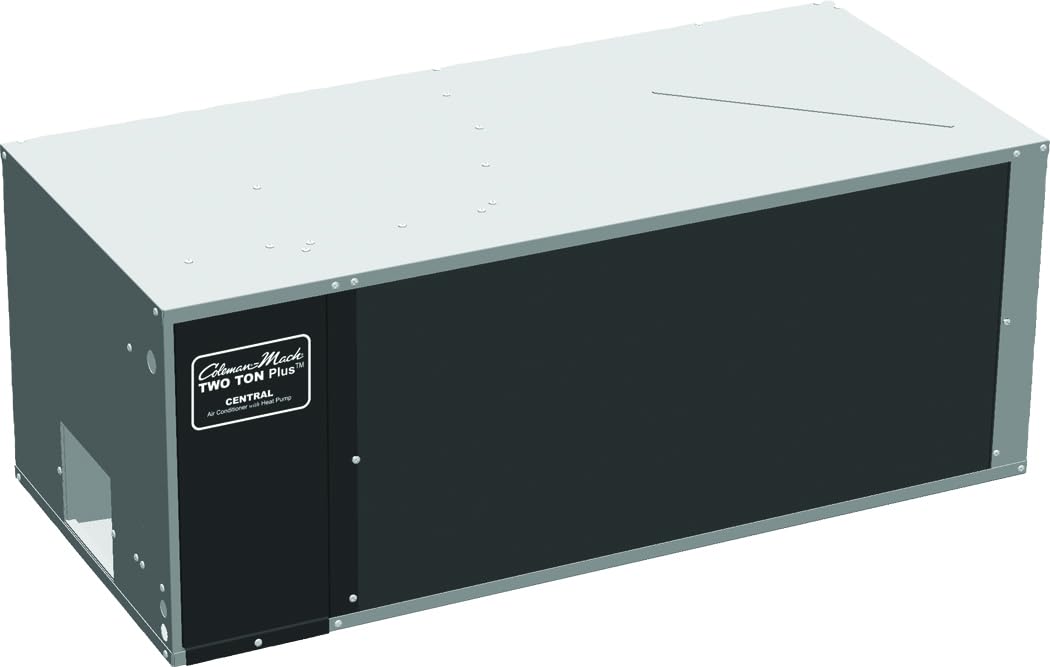
Basement-mount in the literal sense — a 2-ton RV bay unit that swaps in as a near-bolt-in replacement.
This listing’s “basement” is a different basement than the rest of the article — this Coleman 46515811 is a basement-mount split system built for the lower storage bay of an RV or bus, where the A/C lives out of view and ducted up through the coach. It’s rated at 2 tons (27,000 BTU cooling power) with two reciprocating compressors — each rated at 13,500 BTU — running on 120V, and it also includes a heat pump. If you’re not in an RV, this isn’t your unit; but if you are, it’s the exact-fit category to shop.
Wiring is the defining install reality — this runs on 120V only, so the electrical hookup is a single 120vac connection rather than the 208–230V call-out of every mini split above. The unit is without a condensate pump, so drainage planning goes into the install. Physical footprint is length 45-7/8 inch x width 20-7/8 inch x height 18.0625 inch, and the current replacement part number is listed as 36515-011 — useful if you’re cross-referencing an existing bay.
Direct-fit is what owners talk about most. One Prevost bus owner described the Coleman as “almost a direct bolt-in to the original” and called it “extremely satisfied.” Another RV owner said it was “absolutely a breeze to install” and noted that if you “can change a light fixture in your house then you can handle that,” referring to the 120vac cable hookup — minor electrical-skill asks, nothing more. Customer service is a bright spot in the owner stories, with fast shipping updates and one rep who expedited a new unit.
The one real-world issue worth knowing: a 3-star reviewer reported a knocking noise on the heat side after about eight months, believed to be a reversing-valve issue still under warranty — a rare report, not a pattern, and the fix is a manufacturer-warranty call. Also worth noting: this fan is guaranteed only for RV basement bays — it will not drop into a home’s below-grade space.
Buy This If: you’re replacing the basement-bay A/C in an RV, coach, or bus and want a near-bolt-in match with a heat pump function.
Not For You If: your “basement” is the below-grade room in a house — this unit was purpose-built for vehicle bays, not buildings.
Understanding the Specs
BTU and Square Footage
BTU stands for British Thermal Unit — the HVAC industry’s measure of heating and cooling capacity per hour. Every unit on this list carries two BTU numbers, one for cooling and one for heating, and both tell you how much space the system can hold at a set temperature. A 9,000 or 12,000 BTU head suits a small finished basement room; 18,000 BTU fits a mid-size space; 24,000 to 30,000 BTU handles a large open basement; and 36,000+ BTU is for commercial-scale or multi-zone duty. Matching BTU to your actual square footage is the single biggest decision, because oversizing causes the unit to short-cycle and undersizing means it never quite catches up.
SEER2 and HSPF2 Efficiency
SEER2 (Seasonal Energy Efficiency Ratio, 2nd generation) rates how efficiently a system cools across a full season, and HSPF2 is its heating-only equivalent. Higher numbers mean lower running costs, though the practical difference between ratings gets smaller as you climb. Some units on this list also list EER2 (a steady-state, high-temperature efficiency score) and COP (Coefficient of Performance, how much heat output you get per unit of energy in). For a below-grade space used year-round, both the heating and cooling ratings matter — a great SEER2 with a weak HSPF2 will cost you in winter.
Heating Range and Cold-Climate Performance
The lowest outdoor temperature a heat pump can still produce heat at is the number that separates year-round performers from shoulder-season units. Values on this list run from -22°F down to 5°F. If your climate sees real winter, the lower ratings make the difference between keeping the basement comfortable and falling back on a space heater. Below roughly 5°F ambient, non-cold-climate units start to lose heating output — so read the spec carefully and don’t assume the unit’s rated floor matches your climate just because the brand is familiar.
Noise, Zones, and Install Logistics
Indoor noise is measured in decibels (dB) — mute modes are typically in the low 20s, whisper quiet, and standard operation sits in the 25–50 dB band; a conversation is roughly 60 dB. Multi-zone systems let you run several indoor heads off one outdoor condenser, ideal for a basement that has more than one distinct room. Consider shipping reality too — some of these ship in five to seven separate boxes with varying arrival dates, so don’t book an installer until everything has landed.
FAQ
What size heat pump do I need for a basement?
Can a mini split heat pump heat a basement in winter?
Is a ductless mini split better than extending central ductwork into the basement?
Can I install a basement heat pump myself?
How long does the included line set reach and is it enough for a basement?
Do I need a dedicated circuit for a basement heat pump?
Will a heat pump keep my basement dry as well as cool?
How do I choose between a single-zone and a multi-zone basement heat pump?
Do I need to keep the outdoor unit upright before installation?
Does a basement heat pump cost less to run than a window unit or space heater?
Final Thoughts: The Verdict
For most basements, the pick is the Senville AURA Mini Split Air Conditioner, Heat Pump, White, 24000 BTU, because it’s the strongest-balanced option on the list — a 4.5-star score across 540+ reviews, 24,000 BTU of cooling that reaches 1,250 square feet, and heating that works down to -22°F. If your basement is a small finished room rather than a big open floor, reach for the DELLA Serena 22 SEER2 12000 BTU — the higher 22 SEER2 efficiency and whisper-quiet 22 dBa mute mode make it the day-in-day-out favorite for a single zone. And if you’re covering a below-grade rental or a multi-room basement, the ROVSUN 28000BTU Tri Zone splits one condenser into three independent heads, and owners have pushed it through a real -31°F cold snap. Whichever you choose, match BTU to your actual square footage, confirm the heating floor beats your coldest outdoor temperature, and don’t skip the vacuum step — that single install detail is the most reliable predictor of how the system runs five winters in.
How We Picked
We do not accept paid placement. Every pick is matched to a real buyer and a real use-case; we do not hands-on test units.
Sources & Methodology
Specifications: manufacturer listings and product documentation. Review insights: verified customer reviews, as of September 2026. Pricing: not shown on this page (it changes often); check the current price via the retailer link.
As an Amazon Associate, Gadgets Feed earns from qualifying purchases. This does not affect which products we feature.