
Our readers keep the lights on and my morning glass full of iced black tea. As an Amazon Associate, I earn from qualifying purchases.
Specs are compiled from manufacturer listings and verified buyer reviews and can change over time — please confirm the key details on the product page before buying.
Just a few ounces of water can quietly soak into drywall, flooring, and foundation before you spot a puddle. That is why a basement water alarm exists — it screams the instant a leak starts, so you can shut off the source or call a plumber before the repair bill climbs into the thousands. This guide covers seven reliable models, from simple battery-powered screamers to adjustable-volume detectors that also work in attics, under sinks, and inside RVs.
I’m Min — the founder and writer behind Gadgets Feed. This guide is built by comparing the manufacturers’ published specifications and the patterns across verified customer reviews, so you get each pick’s real strengths and trade-offs instead of marketing spin.
Every model below was chosen for its loudness, sensitivity, and ease of placement. You get a complete roundup of the best basement water alarm options you can buy right now.
Our Picks at a Glance


How To Choose The Best Basement Water Alarm
Choosing a water alarm for your basement depends on three things: how loud it must be, if you want a reusable or one-time sensor, and how many leak-prone spots you need to cover. Here is what to look for.
Decibel Output — The Single Most Important Spec
The alarm’s job is to be heard from another floor. A 90 dB alarm (dB is short for decibel, the unit for sound loudness) is roughly as loud as a hair dryer — good for waking you if the alarm is on the same floor as your bedroom. A 120 dB alarm is closer to a rock concert or a jet engine at close range — it pushes sound through closed doors and insulation, so it is the pick for deep unfinished basements. If your basement is finished or your bedroom sits directly above, a 90 dB model will probably wake you. If the basement is deep and unfinished, step up to a 120 dB model so the sound travels through drywall and insulation.
Reusable vs One-Time Use Sensors
Some alarms contain a non-replaceable battery and a sealed sensor — when they go off you toss the whole unit and buy another. Others let you swap in a fresh 9V or AAA battery and dry the sensor board, making them reusable dozens of times. If you want to place alarms under every sink and appliance without restocking every time one activates, pick a reusable model with replaceable batteries.
Sensor Placement and Sensitivity
Most alarms detect water through two metal probes (sensor contacts) that complete an electrical circuit when water bridges them. Some can sense as little as 1/32 of an inch of water (about the thickness of a credit card), while others need a small puddle. If you are placing the alarm in a drip pan under a water heater or AC unit, a highly sensitive probe catches the problem before it becomes a flood. In an area with humidity or occasional condensation, lower sensitivity reduces false alarms.
Number of Sensors Per Pack
A single alarm protects one zone. A five-pack lets you cover the water heater, washing machine, under the kitchen sink, the bathroom vanity, and near the sump pump all at once. Buying a multi-pack is usually cheaper per sensor than buying singles.
Quick Comparison
| Model | Best For | Decibel Level | Battery Type | Reusable | Amazon |
|---|---|---|---|---|---|
| Zircon Leak Alert (2-Pack)★ Best Overall | Floats during floods and long alert time | 90 dB | 1 x 9V (not included) | Yes | $29.99Amazon |
| Water Leak Detector (120dB, 5-Pack)Top Performer | Maximum volume and attic placement | 120 dB | 1 x 9V (not included) | Yes | Amazon |
| Stechro 5-Pack | Adjustable volume with included batteries | 0-120 dB (adjustable) | 10 x AAA (included) | Yes | Amazon |
| GoveeLife 5-Pack | Smart home integration (with gateway) | 105 dB (adjustable) | Internal alkaline (likely) | Yes | Amazon |
| RUIKORING 5-Pack | Super loud with silent mode option | 0-120 dB (adjustable) | 10 x AAA (included) | Yes | Amazon |
| Leak Puppy 3-Pack | Ultra-low water detection and long battery alert | 90 dB | 2 x AAA (included) | Yes | Amazon |
| Honeywell Resideo RWD14 (4-Pack) | Budget entry-level for multiple spots | 85 dB | Built-in Lithium (non-replaceable) | Limited (see reviews) | Amazon |
In‑Depth Reviews
1. Zircon Leak Alert Water Leak Detector (2-Pack)
Our pick — over 4.5★ from 850+ verified ratings; the strongest balance of quality and price.
A two-pack that floats on rising water and keeps screaming for up to 72 hours — so you get alerted even if you are away for a weekend.
Zircon’s Leak Alert is the most straightforward design in the lineup: a white puck with metal contact strips on the back. You set it on its back in a leak-prone area, install one 9V alkaline battery (not included), and it sits silently until water bridges the two metal contacts. When that happens, a 90 dB alarm fires (dB is decibel, the loudness measure — 90 dB is about as loud as a hair dryer). The clever part is the float design — if the water level rises high enough, the detector bobs to the surface and keeps signaling for up to 72 hours, giving you time even if you are away for a weekend.
Customers note that one unit “detected 2 leaks in 5 years (behind washing machine, under bathroom sink)” and that the alarm is “audible throughout house.” The size is compact at 4.34 inches long by 2.42 inches wide, so it slides into tight spots behind the fridge or under the water heater. There is no on/off switch — the alarm stops only when the water dries or the battery dies. Compared to the 120dB Water Leak Detector (product #1), the Zircon is 30dB quieter. Many homeowners find it sufficient when the alarm is on the same floor as the bedroom.
What Makes It Special
- Floats during a flood and signals for up to 72 hours
- Proven track record — buyer caught two real leaks over five years
- Compact 4.34-inch body fits in tight spots
Things To Note
- 90dB is noticeably quieter than the 120dB models
- Battery not included; you need a 9V alkaline
Ideal for: A weekend cabin or finished basement where the alarm sits on the same level as your sleeping area and you want the flood-float safety net.
Not ideal if: Your basement is deep and far from living spaces — you may not hear 90dB through a closed door upstairs.
2. Water Leak Detector, 120dB Loud Siren, 5-Pack
The 120dB siren (as loud as a rock concert) screams louder than any other model in this lineup, so you hear it through a closed door on the second floor.
This is the alarm you want when the basement is far from the bedrooms or when the detector lives inside a cabinet under the sink. At 120dB, compared to the Honeywell Resideo RWD14 (85dB), you will hear it through a closed door on the second floor. The detector uses a 24K gold-plated sensor board (the metal contacts that detect water) that stays sensitive over many uses; just dry it off after an alarm and it is ready for the next leak.
Buyers report that it “has already gone off to alert me to water in the safe pan” in an attic setup. They also note the 37.8-inch cable lets you place the sensor pad far from the alarm body — useful for sump pump pits or behind a washing machine where you need the alarm itself to sit up high. The low-power circuitry claims a standby life of up to 2 years on a standard 9V alkaline battery, though reviewers point out there is no low-battery warning feature, so it is smart to replace the battery annually as a precaution. No WiFi or app needed, so it works even during a blackout.
Why It Wins
- Loudest alarm among the seven picks (120dB)
- Remote sensor pad on 37.8-inch cable reaches tight spots
- Reusable — dry the sensor board and it works again
One Thing To Know
- No low-battery indicator means you must track battery age manually
Who needs this: Anyone with a deep, unfinished basement or an attic AC unit where only a 120dB siren will punch through the floor.
The catch: Without a battery warning light, you need to mark a calendar reminder to swap the 9V cell yearly.
3. Stechro 5-Pack Water Leak Detectors
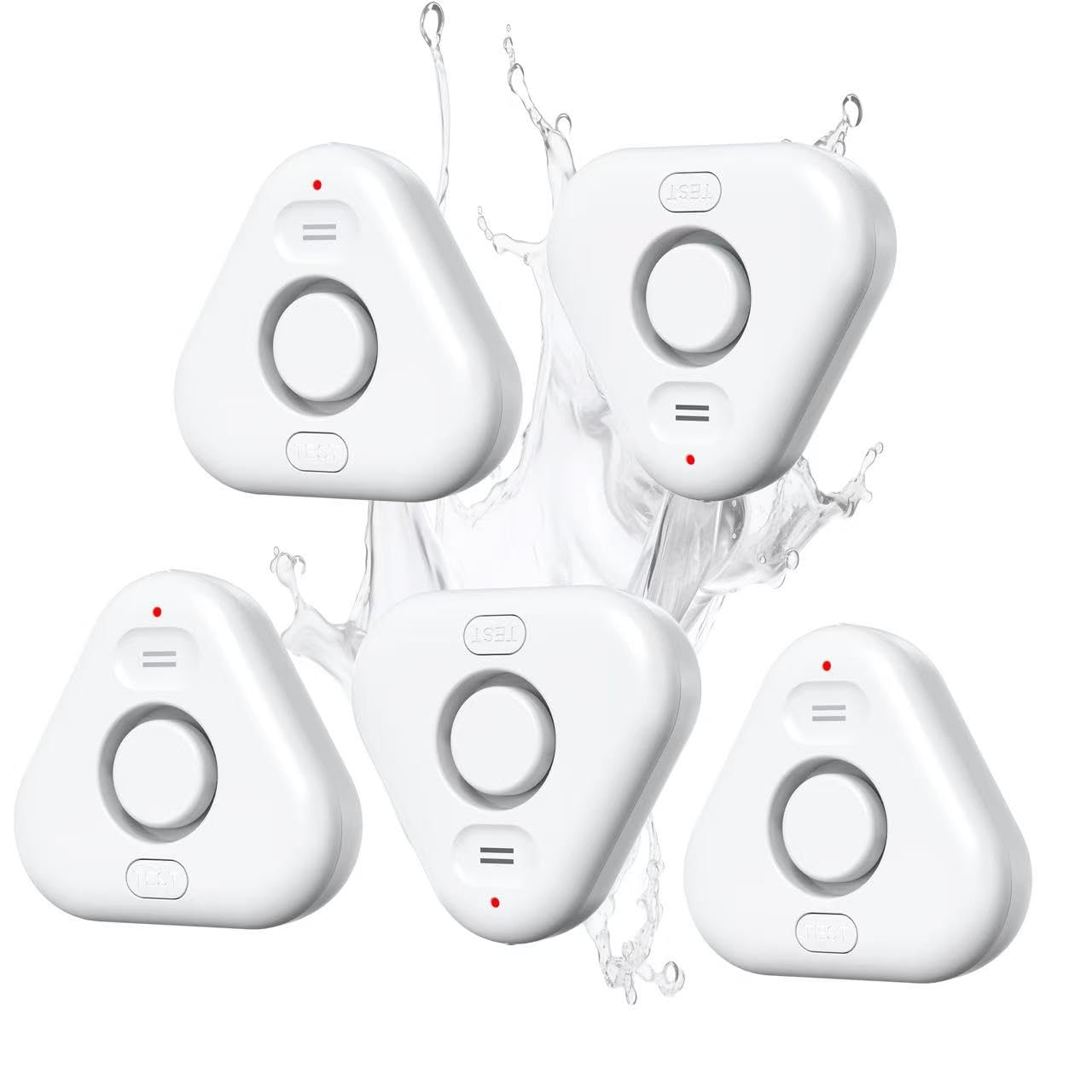
Five leak detectors with four volume levels and batteries already in the box — no extra trip to the store needed.
This pack gives you five detectors and ten AAA batteries right inside the packaging — no extra shopping trip. The standout feature is the 4-level adjustable volume (dB stands for decibel, the sound loudness unit), which goes from 0dB (mute) all the way up to 120dB. That means you can set one to full blast in the basement and another to a lower volume under a guest bathroom sink where a 120dB shriek would be startling. Each sensor has four bottom probes for floor flooding plus one top probe that catches drips from above. The IP66 waterproof rating (IP stands for Ingress Protection; the 6 means completely dust-tight, the second 6 means protected against powerful water jets) ensures these can sit in a damp laundry room or next to a sump pit without failing.
Owners mention these “have saved us 3 times now” — once for an under-sink leak from a clogged pipe, once for a toilet leak from a corroded bolt, and once for a dishwasher connection that came loose. One reviewer specifically recommends them for basements, noting the volume is “great, you will definitely hear it.” The creative triangular shape sits flat where others might tip over. There is no WiFi or Bluetooth, so they are completely standalone.
What Stands Out
- Adjustable volume from silent to 120dB — rare at this price
- Batteries included, so you install and place in under a minute
- IP66 waterproof rating survives humid basements
What To Watch
- Some reviews mention occasional false alarms in very high humidity
Best fit: The homeowner who wants to cover five leak-prone spots with one purchase and customize the volume per location.
Trade-off: In a steamy bathroom or next to a humidifier, you may need to wipe the sensor probes regularly to prevent false triggers.
4. GoveeLife Water Leak Detector 5-Pack
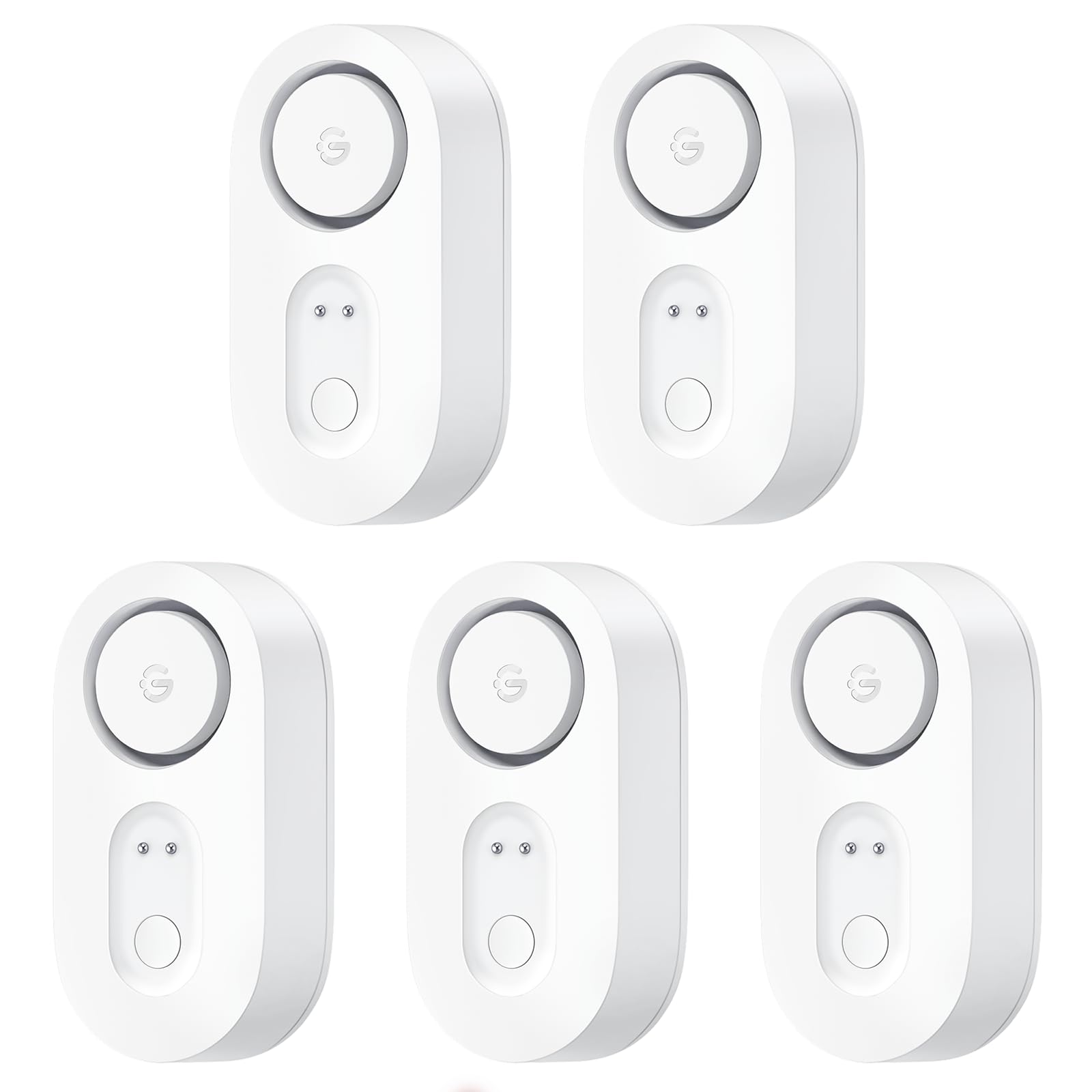
The standalone siren (105dB adjustable) that can grow into a whole-home smart leak system when you add the gateway — so you get both a loud local alarm and phone alerts.
GoveeLife’s H5059 model is a standalone alarm from the start — it screams at 105dB (adjustable across 4 levels) the moment its dual sensor probes (metal contacts that detect water) detect moisture. The IP67 rating (IP is Ingress Protection; the 6 means completely dust-tight, the 7 means it can be submerged in up to 1 meter of water for 30 minutes) means it is fully dust-tight and can survive a flooded sump pit or a burst pipe without dying. It is larger than the others at 3.66 x 2.63 x 1.49 inches, but that size houses a durable build designed for harsh spots.
what separates it is the optional upgrade path. If you buy the GoveeLife H5044 gateway (sold separately, not the H5040 or H5043), these sensors connect to your phone app and Alexa, sending push notifications and text alerts alongside the audible alarm. Reviewers point out that the “alarm, text, and push notification” system works reliably and that “Alexa routines” can automate actions like shutting off a water valve. Without the gateway, 105dB is loud enough for most basements — one reviewer caught a “slow leak under sink” and a “washing machine drainage issue” thanks to the local siren. The sensors cannot be added directly to the app without the correct gateway.
Key Advantages
- IP67 fully waterproof — survives submersion
- Optional smart gateway adds phone alerts and Alexa integration
- 105dB adjustable alarm with four volume levels
Consider This
- Larger footprint than other models, so it may not fit under a low toe kick
- Gateway is required for smart features and is not included
Who should buy: The tech-inclined homeowner who wants audible alerts now and plans to add remote phone notifications later.
The limitation: Without the H5044 gateway these are just standalone alarms — the smart features are not built in.
5. RUIKORING 5-Pack Water Leak Alarm Detector

Five detectors with a volume knob that goes from dead silent (0dB) to teeth-rattling loud (120dB) — so you can tune each one to its location.
RUIKORING’s 5-pack covers the same adjustable-volume ground as the Stechro above but adds a few twists. These detectors have four bottom probes and two top probes — the extra top sensor makes them better at catching a slow drip from a pipe overhead before it pools on the floor. The IP66 rating (IP is Ingress Protection; the 6 means completely dust-tight, the second 6 means protected against powerful water jets) means they can live outside in a covered patio or in a perpetually damp basement corner. Batteries are included: ten AAA cells in the box.
Buyers love the raw volume — one reviewer says “these should come with earplugs” and warns they are “terrifyingly loud” at full blast, recommending ear protection during testing. That extreme loudness is the point: at 120dB, a single detector can wake everyone in the house even if it is tucked inside a cabinet. The 4-level adjustment lets you drop to a lower volume for a guest bathroom or even mute it entirely (0dB) while you investigate. The main caution from the maker is that these can be falsely triggered by “highly humid environments or water mist conduction,” so wipe the probes dry if you place one in a steamy area.
Why Buy This
- Adjustable from 0dB mute to 120dB siren — full range
- Dual top probes catch drips from above
- IP66 dustproof and waterproof for harsh locations
Heads Up
- Extremely loud at max — startlingly so for pets and children
- False alarms possible in very high humidity
Perfect for: The person who wants one volume level for the basement (120dB) and a whisper-quiet mode for a guest bath — all in one pack.
The fine print: Do not place these directly in a steam shower room or next to a humidifier without wiping the probes occasionally.
6. Leak Puppy Water Leak Monitoring Sensor (3-Pack)
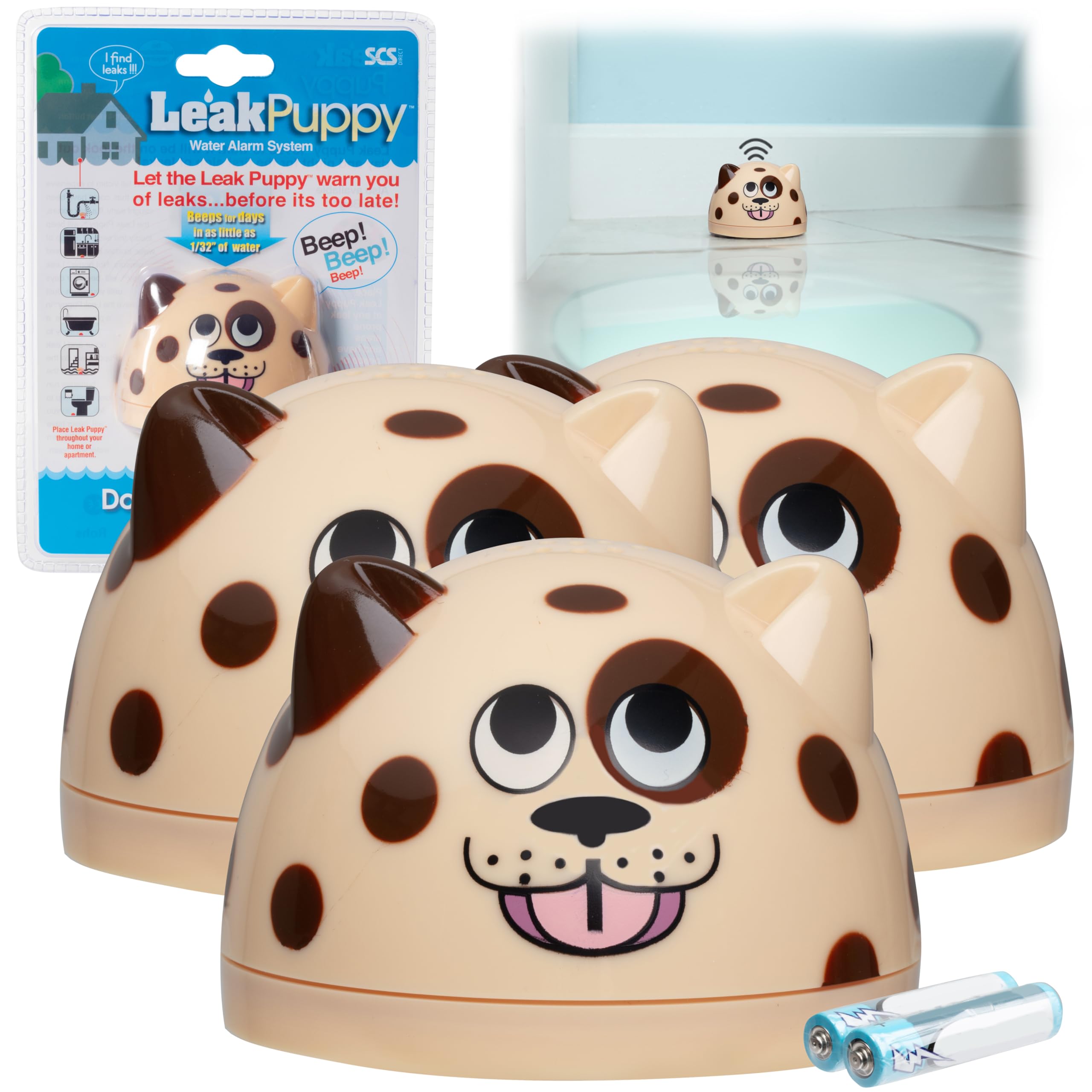
The little sensor that catches just 1/32 of an inch of water (about the thickness of a credit card) before that leak spreads into a flood.
Leak Puppy sells itself on extreme sensitivity — it can sense water as shallow as 1/32 of an inch, which is about the thickness of a credit card. That means it catches a slow, seeping leak from a pinhole in a pipe long before the water spreads across the floor. It runs on two included AAA batteries and sounds a 90 dB alarm (dB is decibel, the loudness measure — 90 dB is about as loud as a hair dryer) when triggered. The sensors also beep continuously when the batteries run low, so you are never left unprotected by a dead cell.
Buyers have real stories about this one. It is not adjustable or waterproof-rated, and the 90 dB is average, not earth-shattering. But for catching the very first sign of moisture, nothing else here beats the 1/32-inch sensitivity — the next most sensitive pick, the Honeywell, uses a larger sensor that needs more water.
What It Does Best
- Detects the smallest amount of water (1/32 inch)
- Low-battery beep ensures you never run on dead cells
- Batteries included — no extra trip to the store
Known Limits
- 90 dB is quieter than adjustable models, not ideal for deep basements
- No waterproof rating — not intended for wet or submerged locations
Best used for: The aquarium owner, the kitchen sink drip magnet, or the washing machine supply line that has sprung a pinhole leak before.
skip it if: You need an alarm loud enough to hear from a separate floor or one that can sit in a wet sump pan.
7. Honeywell Resideo RWD14 Water Alarm (4-Pack)
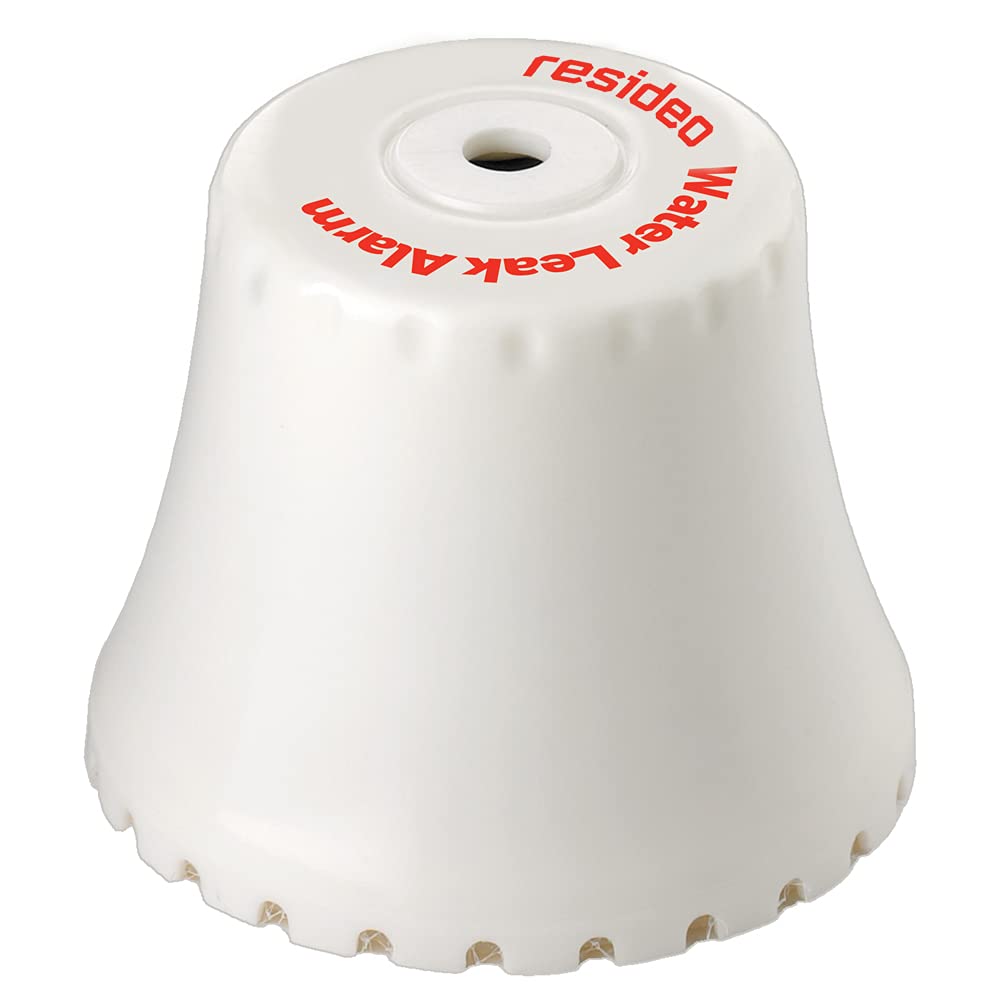
Four tiny, no-maintenance alarms that let you blanket the house for pocket change — just peel, place, and forget.
The Honeywell Resideo RWD14 is the simplest and cheapest per-unit option here. Each alarm is a self-contained, single-use spot detector with a non-replaceable lithium battery built in. You peel off the plastic tab, set it on the floor next to a toilet base or under the sink, and it sits silent until water bridges the sensor. At 85 dB (decibel, the loudness unit — 85 dB is about as loud as a vacuum cleaner), it is the quietest of the seven picks — a full 35 dB quieter than the 120dB models — so it works best in a finished basement or a small laundry room where the alarm is on the same level as you. Each unit weighs just 0.05 pounds and measures about the size of a stack of four quarters.
Buyers have creative tips for these. One reviewer figured out you can reuse them: “remove rubber ring, dry sponge under weight for 5-7 days, reassemble.” Another says they “detected water leak by toilet” and recommends placing them “by windows, washer, basement.” There is no on/off switch — once the alarm sounds, it continues until the battery dies, which can take days. The manufacturer says these are one-time-use devices, but the hive-mind hacks demonstrated by real users suggest you can get multiple cycles out of them if you are patient. For the price of a lunch out, you can protect four spots.
The Good
- Ultra-low upfront cost for a 4-pack — easiest way to cover many spots
- No setup, no wiring, no app — just place and forget
- Built-in battery means nothing to buy or forget
The Compromises
- 85 dB is the quietest — may not be heard from another floor
- Non-replaceable battery means limited lifespan
- No on/off switch — alarm runs until battery drains
For the budget-minded: The cheapest way to put a leak alarm next to every toilet, under every sink, and behind every appliance in your home.
Not the one if: You need a loud alarm that reaches the upstairs bedroom or one you can reuse indefinitely with fresh batteries.
Understanding the Specs
Decibel Level (dB)
This measures how loud the alarm is (dB stands for decibel). Normal conversation is around 60 dB, a vacuum cleaner is about 75 dB, and a hair dryer is 90 dB. A 120 dB siren is about as loud as a rock concert or a jet engine at close range — enough to wake you from a deep sleep on the floor above. A 90 dB alarm is still loud but may not cut through a closed door or thick basement insulation. The higher the decibel number, the farther the sound carries.
Battery Type and Reusability
Some alarms have non-replaceable lithium batteries sealed inside (one-time use), while others run on standard 9V or AAA batteries you can swap yourself. Reusable models let you dry the sensor probe and reset the alarm after it goes off, so you do not have to buy a new unit every time a leak is detected. If you plan to place alarms in many spots, reusable models with replaceable batteries save money over time.
IP Waterproof Rating
This two-digit code (IP stands for Ingress Protection) tells you how resistant the device is to water and dust. The first digit (6) means it is completely dust-tight. The second digit (6 or 7) means it can handle powerful water jets (IP66) or temporary submersion up to 1 meter (IP67). A higher IP rating is important if the alarm will sit in a sump pit, next to a humidifier, or in a laundry room that occasionally floods.
Sensor Probes and Sensitivity
Most water alarms have two metal probes that complete an electrical circuit when water bridges them. Some models have additional top-mounted probes that catch drips from above, which helps detect a leak from a pipe overhead before the water reaches the floor. Sensitivity varies: some alarms can detect as little as 1/32 of an inch of water, while others need a more substantial puddle. Higher sensitivity means earlier detection but also more potential for false alarms in humid environments.
FAQ
What is the difference between 90 dB and 120 dB water alarms?
Can I reuse a water alarm after it goes off?
Will a basement water alarm work during a power outage?
How many water alarms do I need for my house?
What does IP66 or IP67 mean on a water sensor?
Do these alarms work if the water comes from a slow drip or just condensation?
Can I mount a water alarm on the wall or do they have to sit on the floor?
How often should I replace the batteries in my water alarm?
What is a false alarm and how can I prevent it?
Final Thoughts: The Verdict
If you want one dependable pick, the basement water alarm winner is the Water Leak Detector (120dB, 5-Pack) because it delivers the loudest siren and a detachable sensor cable, making it perfect for deep basements and attics while being reusable with a simple dry-off. If you want adjustable volume and batteries in the box, grab the Stechro 5-Pack. And for catching the smallest trace of water before it spreads, the standout is the Leak Puppy 3-Pack with its 1/32-inch sensitivity.
How We Picked
We do not accept paid placement. Every pick is matched to a real buyer and a real use-case; we do not hands-on test units.
Sources & Methodology
Specifications: manufacturer listings and product documentation. Review insights: verified customer reviews, as of July 2026. Pricing: not shown on this page (it changes often); check the current price via the retailer link.
As an Amazon Associate, Gadgets Feed earns from qualifying purchases. This does not affect which products we feature.
Related Guides
Product prices and availability are accurate as of the date/time indicated and are subject to change. Any price and availability information displayed on Amazon at the time of purchase will apply to the purchase of this product. As an Amazon Associate I earn from qualifying purchases.
CERTAIN CONTENT THAT APPEARS ON THIS SITE COMES FROM AMAZON. THIS CONTENT IS PROVIDED "AS IS" AND IS SUBJECT TO CHANGE OR REMOVAL AT ANY TIME.
Amazon and the Amazon logo are trademarks of Amazon.com, Inc. or its affiliates.