
Our readers keep the lights on and my morning glass full of iced black tea. As an Amazon Associate, I earn from qualifying purchases.
Specs are compiled from manufacturer listings and verified buyer reviews and can change over time — please confirm the key details on the product page before buying.
Which sealer actually keeps your basement dry depends on one thing: whether you coat the surface or soak deep into the concrete. If water beads on your walls after a storm, pick a thick liquid rubber coating. If your floor feels cold and clammy and you run a dehumidifier year round, a deep-penetrating sealer does the job a paint film never can. That single split decides most of the choices below.
I’m Min — the founder and writer behind Gadgets Feed. This guide is built by comparing the manufacturers’ published specifications and the patterns across verified customer reviews, so you get each pick’s real strengths and trade-offs instead of marketing spin.
Some jobs call for a flexible rubber membrane that stretches with your foundation as it shifts, and some call for a clear penetrating sealer that seals the concrete from the inside. Knowing which one your wall needs is the whole game, and that is exactly what this breakdown of the basement water sealer category sorts out for you.
Our Picks at a Glance


How To Choose The Best Basement Water Sealer
Two families of product get called a basement water sealer, and they behave nothing alike. One is a rubbery liquid coating that dries into a stretchy skin on top of your wall. The other is a watery penetrating sealer that soaks into the concrete and seals it from the inside. Picking the wrong family is the single most common reason a weekend of work fails after the first hard rain.
Coating or penetrating, that is the first call
A rubber coating is the right tool for an active leak, a hairline crack that seeps, or a wall that gets visibly wet. It bridges gaps and stretches as the wall moves. A penetrating sealer is the right tool for a floor or wall that is not leaking but feels damp and drives up the humidity in the room. It leaves no film and does not change how the concrete looks.
Elongation tells you how much a coating stretches
Elongation is how far a cured coating can stretch before it tears, written as a percentage. A coating rated at 900% elongation stretches a long way with the wall as the seasons push it around, which is what keeps hairline cracks from splitting back open. A lower-stretch paint film simply cracks when the concrete shifts.
Coverage depends on which side of the wall you work on
The same gallon spreads very differently inside and out. The outer face of a foundation is rough, backfilled, and thirsty, so it swallows far more material per square foot than a smooth interior wall. Plan your gallons around where you are actually brushing, not the number on the front of the pail.
Surface prep decides whether it sticks at all
Every sealer here wants a clean, dry, dust-free wall. Old flaking paint, oil stains, and loose mortar have to come off first. If the concrete is crumbling, a penetrating sealer that binds the surface together is often the smarter first move before you coat anything on top.
Quick Comparison
| Model | Best For | Type | Coverage | Cured Finish | Amazon |
|---|---|---|---|---|---|
| Liquid Rubber Foundation Sealant★ Best Overall | Active leaks and interior walls | Liquid rubber coating | 50 sq ft/gal interior (2-3 coats) | Flexible black rubber | Amazon |
| TUFINEIN Rubber Liquid Waterproof SealantMost Versatile | Roofs, gutters and small patching | Flexible rubber coating | 21.4 sq ft at 0.6 mm vertical | Neutral gray rubber film | Amazon |
| AMES Blue Max WhiteBest for Foundations | Below-grade foundations and underlayment | Elastomeric liquid rubber | 1 gal pail (2 coats, 24 hrs apart) | White elastic membrane | Amazon |
| Ames Block & Wall Waterproofer | Block basement walls and planters | Liquid rubber coating | 1 gal (10+ year users report) | Thick white, dries tough | Amazon |
| INSL-X WaterBlock Masonry Waterproofer | Damp concrete walls and floors | Acrylic masonry paint | 75 to 125 sq ft per gallon | Semi-gloss white | Amazon |
| LastiSeal Brick & Masonry Sealer | No-film protection for brick and stone | Penetrating sealer | 30 sq ft per 1/2 gal on porous brick | Clear, invisible, no film | Amazon |
| Lithi-Tek 9500 Ultra Concentrate | Whole floor and wall slabs, mixing your own | Penetrating densifier | Up to 1000 sq ft per coat | Clear, natural finish | Amazon |
| RadonSeal Plus Concrete Sealer | Large basements, moisture vapor | Penetrating silicate | Up to ~1000 sq ft per 5 gallons | Natural, invisible finish | Amazon |
In‑Depth Reviews
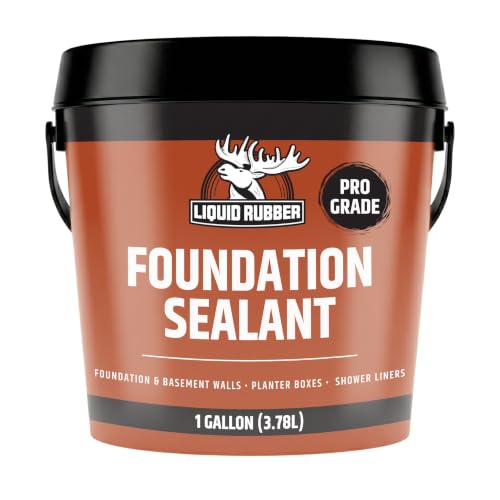
1. Liquid Rubber Foundation Sealant – Basement Waterproof Sealer, Black, 1 Gal
Our pick — over 4.5★ from 3,000+ verified ratings; the strongest balance of quality and price.
The stretchy black rubber that bridges cracks instead of just covering them.
Start with the number that decides almost everything here: 900% elongation. That is how far the cured rubber skin can stretch with your foundation before it splits. Elongation matters because concrete moves through freeze and thaw, and a coating that cannot follow that movement cracks along the same line it was meant to seal. This one follows it. It also cures water-based with zero VOCs, which matters when you are brushing it along interior basement walls with the family upstairs.
Plan your weekend around coverage. Inside, one gallon coats about 50 sq ft across two to three coats. Outside on a rough, backfilled foundation, that same gallon only covers about 20 sq ft across three to four coats — the rough face simply drinks more material. Apply it between 50°F and 90°F. It goes on brown and cures black, so do not panic at the first pass. Pair it with Liquid Rubber Geo-Textile on joints and transitions, and bridge seams, vents, and protrusions where movement happens. If you are digging a trench and patching cracks, among the most detailed fixes on record ran a 25-foot trench, four brush coats with a 24-hour cure between each, and held dry through four months of heavy rain.
liquid rubber for basements
- 900% elongation lets the rubber skin stretch as the wall moves
- Goes on like thick paint with no mixing and zero VOCs
- Sticks to concrete, masonry, wood, metal and foundation surfaces
- The quality of the membrane is what buyers rave about most, with application ease close behind
slow curing time
- Exterior coverage drops to roughly 20 sq ft per gallon on rough concrete
- Cures tacky, so it is not a walking surface
- Drying time splits owners — some say it cures fast, others wait it out
Two honest notes. The high-gloss sheen on the cured surface is the recurring style gripe — it looks wet even when it is dry, so if appearance matters on an interior wall, plan to top-coat it. And the tackiness means you keep it off floors you walk on. Prep is non-negotiable: a well-prepped wall is what makes this thing shine, and a dusty one is what makes any sealer fail.
land this one if: you have a leaking or weeping basement wall and want a flexible rubber membrane that moves with the concrete instead of cracking on it.
order more gallons if: you are sealing the exterior face — that rough backfilled surface eats material at roughly 20 sq ft per gallon.
2. Rubber Liquid Waterproof Sealant, TUFINEIN 53oz/1.5kg Neutral Gray Quick Drying Multi Surface Foundation Leak Repair – Roof Gutters Basement Sealer Waterproof – Indoor & Outdoor Flexible Rubber Paint
A neutral gray rubber that starts curing in two hours and does not care if it is the basement or the roof.
This is the one for the person with three small water problems rather than one big one — a gutter seam here, a hairline crack there, a windowsill that drips. Its flexible rubber starts forming a film in just 2-4 hours, which is fast enough to coat a gutter in the morning and have it set by afternoon. It also survives the temperature swing a roof deals with, staying stable from -40 °C to 80 °C (-40 °F to 176 °F), so the same can covers a basement wall and an outdoor seam without you buying two products.
Coverage numbers here are the tight ones, so buy accordingly. On a vertical concrete foundation it spreads about 2 m² (21.4 ft²) at 0.6 mm thickness. On a flat or low-slope roof, the coats run thicker at 1 mm and cover about 1 m² (10.7 ft²) — the flat surface needs more material, not less. Use polyester fabric at joints and obvious cracks to beef up the waterholding. It is also self-leveling and can be brushed, rolled, scraped, or poured, so uneven walls get an even coat without much fuss.
The flexible rubber formula holds up well where something actually needs a rubbery, stretchy bridge. It also handles jobs the big coatings are not always pointed at: a Tig welder cooling tank interior got a coat and came out highly water-repellent, and a double garage floor where other epoxy paints had failed finally took a coat that stuck. The recurring note across the review pages is that the bucket is smaller than it looks in photos, so measure your square footage before you commit.
reach for this if: you want a fast-drying rubber coating that works indoors and out and covers several small leaks from a single can.
grab extra if: you are doing broad coverage — at roughly 21 sq ft per coat on vertical concrete, one can only finishes a small patch.
3. AMES Blue Max White Liquid Rubber Waterproofer, 1 Gal
A white elastic membrane built for below-grade concrete and the one you would hide plain sight if you dug down to your foundation.
If you are waterproofing the exterior face of an insulated concrete foundation or an underlayment before backfilling, this is the pick built exactly for that job. Its elastic membrane expands and contracts 900% with the surface, so it flexes with the wall instead of cracking as the ground shifts and freezes. The 900% is the same stretch figure the top pick brings, but the difference is the color and the intended surface — this one cures white for below-grade and interior use, and it is the stronger of the two on masonry and wood building surfaces outside.
It brush, rolls, or sprays onto vertical or horizontal surfaces and dry with 24 hours between coats. It is non-toxic, VOC compliant in all 50 states, and made in the USA by a woman-owned, veteran-founded company. The white color has a real advantage over black on an interior wall: it brightens a basement instead of darkening it, and it takes paint if you ever want to change the look.
Application is genuinely forgiving. It cleans up with water, which is unusual for a rubber membrane and matters when you are working flat out. One owner sealed Bilco basement door seams and had zero leaks after heavy rain. Another applied it with an airless paint sprayer to a sub-grade wall that used to get damp after a hard rain, and reported it went on beautifully. The coverage is listed per pail without a stated square-foot rate, though, so on a big exterior wall you should plan for a second bucket.
trusted ames brand
- 900% elongation flexes with the wall as ground freezes and shifts
- White finish brightens interior walls and takes paint
- Water cleanup from a non-toxic, VOC-compliant formula
- Works on concrete, wood, metal and masonry surfaces
needs two coats
- Needs a full 24 hours between coats, so it is a slow weekend project
- Durability reports split — some see it hold for years, others less
- Coverage is sold per pail with no per-sq-ft number to budget against
pick this for: exterior foundation faces, insulated concrete, and any below-grade job where a white, paintable elastic membrane beats a black one.
think twice if: you have no time cushion — this one is built around that 24-hour gap between coats.
4. Ames Block & Wall Liquid Rubber Waterproofer Multi-Purpose Coating & Sealant – 1 Gallon

Thick enough to fill cracks like frosting, and the one long-haul owners keep reordering.
This is the heavy brush-on coating for block basement walls that seep, and its reputation was built over a long stretch of time — one owner reports using it for 10+ years and waterproofing an entire basement with it. It goes on thick, like cake frosting, and does not run, which is exactly what you want on a vertical cinderblock wall where a thin product would just streak down the face. The low odor is a genuine plus, and it dries tough rather than rubbery-slick.
Application rewards a little patience. Spread it too thick and it will not cure properly, so two honest coats beat one heroic one. Bright white, easy to control, and it cleans up without a fight. The sealing performance is what buyers praise most about it, with application ease not far behind. If you are sealing around a basement door, a full pour, or a planter bed against cinderblock, it fills the pores and leaves a tight surface.
The thickness cuts both ways on coverage. A can that goes on this substantially will not stretch the same square footage as a thin penetrating sealer, so budget for more material than the pail size suggests. One owner sealed a full pour and a leak area plus an outside skirt and stayed bone dry through a downpour even with a broken gutter overhead. Another used it in a tornado shelter and called the application nice and smooth. Just hold back the trowel-thick passes — the product asks for restraint.
this is your match if: you have block or cinderblock basement walls that seep and want a thick, crack-filling coating with a low smell.
ease off if: you would rather slap down one heavy coat — this one insists on two even passes that fully cure.
5. INSL-X WaterBlock Acrylic Masonry Waterproofer Paint, White, 1 Gallon

A water-based acrylic that rolls on bright white and resists water pushing hard from the other side.
Here is the number that separates this from the rubber coatings: it withstands up to 12 psi hydrostatic pressure. That is water pushing through the wall from outside, and a coating rated for it holds the line where a decorative paint would blister off. It also resists alkali up to pH-13, which matters on fresh concrete and cinder block, where ordinary paint fails. And with 75 to 125 square feet of coverage per gallon, it is one of the friendliest spreads on this list.
Roll it on and it goes bright white and semi-gloss, which lifts the light in a dim basement. The catch is technique: a brush gives poor coverage on these thick masonry paints, so use a long-nap roller and keep the coats even. Rushed or thin application is where water gets through. Two coats is the recommendation, and the wall should be fully dry after each. It goes on only when surface and air temperatures sit between 50°F (10°C) and 90°F (32.2°C), so a cold snap means waiting.
What buyers keep confirming is that it works on damp walls when other paints quit — a note that it “worked where the popular brands failed” shows up in the review history. The honest limit is what it can and cannot fix: it handles minor-to-medium wall and floor leakage, but not footer water intrusion or a major foundation failure.
roll this on if: your walls are damp and you want a bright white acrylic with a real 12 psi water-push rating and generous coverage per gallon.
look elsewhere if: your water is coming in at the footer — no interior coating on this list fixes that.
6. LastiSeal Brick & Masonry Sealer – Deep-Penetrating Sealer for Brick, Concrete, Stone & Masonry – 1 Gallon

The sealer that sinks in and vanishes, strengthening crumbly brick instead of coating it.
Some walls should not be painted at all — a brick or stone basement wall you want to keep looking like brick. This is the pick for that. Unlike the rubber coatings and acrylics above, it forms no film. It soaks below the surface, seals the pores from inside, and leaves a flat, natural look that will not peel, chip, yellow, or fade because there is nothing on top to peel in the first place. The maker lists a 15-year service life, and buyers report a 10-year warranty.
It is a strength-builder too. It binds the pores together, which is why it is a favorite for flaking, dusty basement chimney brick that no other product would prime. Spray or roll it on, and it dries in under 30 minutes at 50°F. One coat often does it — a second starts beading off the surfaced you already sealed. On porous brick the spread is roughly 30 sq ft per half gallon, so a full gallon goes reasonably far on thirsty masonry but tightens up fast on smooth stone.
What owners prize most is how reliably it seals brick and masonry — many have used it for years, including from a single application, and it keeps rain and moisture out. On a concrete patio it left water beading with no dirty spots after three weeks. On a brick chimney sprayed with two coats, the musty smell in the room above went away. Be honest with yourself about the trade-off, though: this is a penetrating sealer, so it will not bridge an active crack or stop water sheeting through a hole — it protects the surface and the pores, not a structural opening.
choose this if: you want your brick or stone wall to keep its natural face while water stops soaking into the pores.
not for you if: you have an active crack or gap — this is a penetrating sealer, not a flexible crack-bridging coating.
7. Lithi-Tek 9500 Ultra Concentrate – 1 Gallon (Makes 5 GALLONS) Penetrating Concrete Sealer, Waterproofer Plus Densifier
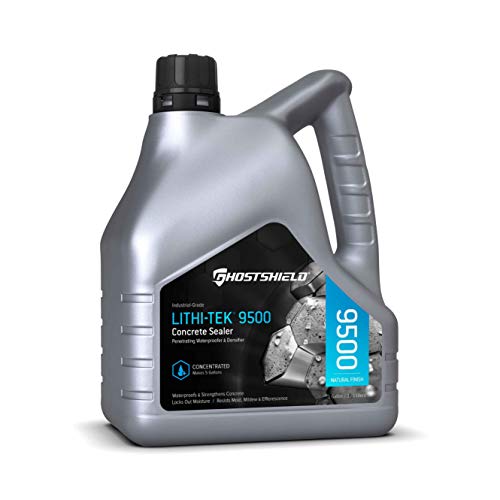
One jug that becomes five gallons and treats a thousand square feet per coat.
This is the value play in the penetrating world, and the math is the whole story. The concentrate mixes one gallon with four gallons of water to make five gallons of sealer, and that covers up to 1,000 sq ft of concrete per coat. It densifies as it seals — a chemical reaction inside the concrete strengthens it up to 50% while blocking water and vapor. It also blocks water vapor transmission and moisture intrusion, and it prevents efflorescence, the white salt bloom on damp basement walls and floors.
Application is genuinely DIY-friendly. Mix it four to one, spray with a garden sprayer, and it soaks in fast. The one rule that trips people up: apply the second coat while the first is still wet, or the surface beads and the sealer will not penetrate. Work in small sections, stay out of the sun, and it goes simply. Two coats is the standard for a floor. It dries to a clear finish with little odor — no color change to worry about on a basement floor.
The drying is a bit different from a rubber coating. Because it is absorbed rather than filmed, good airflow matters, especially in a sealed crawlspace — a dehumidifier is a real help while it cures. In cool, low-airflow spots it can sit damp for days and drum up humidity for a while. Push it onto polished concrete and a heavy spray leaves white mineral deposits, while on brushed or broomed concrete it just soaks in and works. It is best suited to porous, absorptive concrete, not a slick sealed floor.
take this route if: you have a large basement floor or walls to treat and want maximum coverage from minimal material.
stay clear if: your concrete is polished or sealed — this needs a porous surface to soak into, or it beads up and leaves deposits.
8. RadonSeal Plus Concrete Sealer – Deep Penetrating Waterproofing for Basement Floors & Foundation Walls (5 Gallon)

A five-gallon dose of deep-penetrating sealer built to treat a whole basement in one go.
For a large basement floor and foundation walls, buying five gallons at once is the practical move, and this is the pick that arrives in bulk. It penetrates deep into the concrete and reacts inside the pore structure to seal capillaries, which is what blocks moisture vapor from creeping up through an unsealed floor. Unlike a coating that sits on the surface and can peel or blister off, this forms the seal from inside, so there is no film to wear away. It also chemically densifies weak concrete, reducing dusting and improving resistance to salts and freeze-thaw cycles. It covers up to roughly 1,000 sq ft per five gallons, depending on how porous your concrete is.
Ease of application is what buyers praise most — spray, roll, or brush the water-based formula on a clean, dry floor, and it soaks in and cures internally. It is paintable and coating-compatible, so it acts as a moisture-blocking primer under epoxy or paint if you plan to finish the surface. On poured concrete and concrete block foundations it is the right tool for reducing moisture vapor movement. The finish is invisible: no gloss, no darkening, no film, so your floor looks untouched.
Now the honest part, because this is the one pick where results clearly depend on your surface. Moisture control is the job it does best — owners mention humidity dropping, and a dehumidifier that used to run forever now shuts itself off on the humidity setting. Water beads pour off a sealed surface, and paint still adheres over it without peeling. But on cinder block walls specifically, the experience splits sharply: on a poured-wall basement it performs, while on block the sealing results get mixed, and it is meant to be paired with a companion product on block. Preparation matters and is heavy — grinding old walls before application is real labor.
radon blocking sealer
- Seen-most aspect is application ease — water-like, low odor, easy sprayer cleanup
- Up to ~1,000 sq ft per five gallons on a large basement
- Internal seal that will not peel, blister, or wear off the surface
- Doubles as a moisture-blocking primer under epoxy or paint
higher price point
- Results on cinder block are mixed and often need a companion product
- Prep can demand grinding on an old, painted, or damaged wall
- Best on a porous, clean, oil-free surface — a slick floor does not absorb it
buy the big bucket if: you have a large poured-concrete basement floor or wall set and want one bulk application that blocks floor moisture.
pair it up if: you are sealing concrete block — this one is meant to work alongside a companion product there, not on its own.
Understanding the Specs
Elongation: how far it stretches
Elongation is a percentage that tells you how far a cured coating can flex before it tears. A coating rated at 900% elongation stretches a long way with the wall, which is what keeps a hairline crack from splitting back open as the concrete moves through freezing and thawing. A paint-like film with low stretch simply cracks when the surface shifts, so on a wall with any movement you want the high-elongation rubber coating over a rigid acrylic.
Hydrostatic pressure: what psi means
Hydrostatic pressure is the force of groundwater pushing against your wall from outside. It is measured in psi (pounds per square inch), and a coating rated at 12 psi is designed to hold back water at that pressure. A plain masonry paint has no such rating and will blister off once water starts pushing behind it. That single number is what separates a real waterproofer from a decorative finish.
Coverage: why interior and exterior differ
Coverage is written in square feet per gallon, and it is never one fixed number because the same gallon spreads differently across surfaces. A smooth interior wall takes far less material than the rough, backfilled outer face of a foundation. That is why one exterior product lists 50 sq ft per gallon inside but only 20 sq ft per gallon outside — the rough face absorbs more. Budget your gallons around the surface you will actually be brushing.
Penetrating sealer: seal from the inside
A penetrating sealer is a watery liquid that soaks into the concrete and reacts inside the pores instead of forming a film on top. It will not bridge an active crack, but it does not peel or wear off either, and it leaves the surface looking unchanged. It is the right choice for a floor or wall that is damp rather than leaking, and many can double as a moisture-blocking primer under paint or epoxy. It needs a porous, clean, dry surface to soak into to work at its best.
FAQ
Will a water sealer stop an active leak in my basement wall?
Can I seal my basement walls from the inside only?
How many coats does a basement water sealer need?
Why did my water sealer peel off the wall?
Can I use a water sealer on brick or cinder block?
How long does a basement water sealer last?
Do I need a vapor barrier or is a sealer enough for a damp basement floor?
Will these sealers work in a cold or hot basement?
Is a sealer safe to use around kids and pets indoors?
Can I paint over a basement water sealer?
Final Thoughts: The Verdict
For most people dealing with a leaking or sweating basement wall, the strongest overall pick remains the Liquid Rubber Foundation Sealant. The 900% elongation is what puts it ahead — it flexes with the wall instead of cracking on it, it cleans up with water, and it carries zero VOCs for interior work. It is the crowd favorite here, holding a 4.6-star mark across thousands of owners, and the only real care is budgeting exterior gallons — a rough backfilled wall burns through material at roughly 20 sq ft per gallon.
If your walls are brick or stone and you want them to keep their natural look, reach for the LastiSeal Brick & Masonry Sealer — it sinks in, leaves no film, and hardens flaking masonry rather than coating it. If you are treating a large poured-concrete floor for dampness rather than a leak, the RadonSeal Plus is the one that blocks floor moisture vapor from the inside. Match the product to what your wall is actually doing — moving and leaking, or just damp and clammy — and you will not waste a weekend.
How We Picked
We do not accept paid placement. Every pick is matched to a real buyer and a real use-case; we do not hands-on test units.
Sources & Methodology
Specifications: manufacturer listings and product documentation. Review insights: verified customer reviews, as of September 2026. Pricing: not shown on this page (it changes often); check the current price via the retailer link.
As an Amazon Associate, Gadgets Feed earns from qualifying purchases. This does not affect which products we feature.