
Our readers keep the lights on and my morning glass full of iced black tea. As an Amazon Associate, I earn from qualifying purchases.
Specs are compiled from manufacturer listings and verified buyer reviews and can change over time — please confirm the key details on the product page before buying.
That damp, musty smell when you open the basement door is more than unpleasant—it is a signal that humid, stale air is sitting still down there. A basement window ventilation system works by mounting a fan directly into your window frame to push that stale air out and pull fresh air in, controlling moisture and odors at their source.
I’m Min — the founder and writer behind Gadgets Feed. This guide is built by comparing the manufacturers’ published specifications and the patterns across verified customer reviews, so you get each pick’s real strengths and trade-offs instead of marketing spin.
You need a fan that matches your window size and airflow needs, so here is how to choose the right basement window ventilation system for your home.
Our Picks at a Glance


How To Choose The Best Basement Window Ventilation System
To pick the right fan, first measure your window’s width and height so the unit fits snugly. Then match its airflow power (measured in CFM, or cubic feet per minute) to your room’s size—higher CFM clears stale air faster. Finally, check the noise rating (in decibels) so it runs quietly enough that you forget it is on.
Measure Your Window Frame First
This is the step that saves the most headaches. Whether you have a sliding window or a traditional crank-out style, you need the exact inner frame height and width before you buy. A fan that is too small leaves gaps that let humid air back in; one that is too big simply won’t fit.
Match the CFM to Your Space
CFM, or cubic feet per minute, tells you how much air the fan moves. A higher number means more air exchange, which is vital for a damp basement. For a small crawlspace or window, a lower CFM may suffice, but a larger, wetter space demands a fan with more power to make a real difference.
Consider Automation Features
Look for a built-in humidistat, which senses the humidity level and turns the fan on or off automatically to keep your space within your chosen range. This “low-maintenance” approach is far more efficient than running a fan manually all day.
Quick Comparison
| Model | Best For | Airflow (CFM) | Control Type | Window Fit | Amazon |
|---|---|---|---|---|---|
| Durablow 220 CFM★ Best Overall | Corrosion Resistance | 220 cfm | Knob Control | 18″ x 9″ Opening | Amazon |
| ALORAIR 540CFMAlso Great | Maximum Airflow | 540 cfm | Humidistat & Thermostat | Standard Foundation Vent | Amazon |
| AC Infinity AIRTITAN T8 | Smart Automation | 240 cfm | WiFi & Bluetooth App | 18″ x 9″ Backplate | Amazon |
| Elite-Air FAT2 | Field-Replaceable Parts | 220 cfm | Humidistat | Block Wall Vent | Amazon |
| CADPXS Crawlspace Fan | Quiet Operation | 220 cfm | Knob Control | 18″ x 9″ Opening | Amazon |
| AMCHIXIN Vertical Fan | Sliding Window Fit | 98 cfm | Stepless Speed | 23.6″-25.6″ Height | Amazon |
| QJSZMEI Vertical Fan | Sliding Window Fit | 98 cfm | 10-Level Speed | 17.8″-19.7″ Height | Amazon |
In‑Depth Reviews
1. Durablow 220 CFM Air-Out Stainless Steel Vent Fan
Our pick — 4.5★ from 350+ verified ratings; the strongest balance of quality and price.
A rust-resistant stainless steel workhorse built for the dampest environments
In a humid basement, rust is your fan’s worst enemy, which is why this model uses 100% Stainless Steel 304 grade for its panel and housing. It delivers solid 220 CFM of airflow to exhaust damp, stale air, and its dual-fan design keeps things moving. It also comes with foam seals to help create a snug fit in a standard 18″ x 9″ vent opening.
The built-in dehumidistat operates within a 20%-80% relative humidity range, automatically turning the fan on and off at your preset level. A freeze protection thermostat shuts the unit off below 35°F to prevent damage in cold weather. Installation is straightforward—just plug in its 7-foot grounded cord, set the knob control, and let it work.
Owners mention the fan “works amazingly well and was surprisingly easy to install,” with strong airflow and quiet operation making an immediate difference. The main note is that some find it a bit loud, with a constant hum that sounds like white noise, though this is often masked by louder HVAC equipment.
The Strong Points
- Stainless Steel 304 resists corrosion in humid spaces
- Built-in dehumidistat for automatic moisture control
- Comes with a 7-foot cord and foam seals for easy setup
- UL-certified for safe continuous operation
The Weak Points
- Constant hum may be noticeable in quiet areas
- Requires measuring your vent opening before buying
Best for: Damp crawlspaces and foundations where corrosion resistance and automatic humidity control are the top concerns.
Who should pass: Anyone who needs truly silent operation, since the constant hum is part of the deal for this airflow level.
2. ALORAIR 540CFM Crawl Space Ventilator Fan
The heavy-hitter with a massive 540 CFM that clears damp basements fast
This is the fan you bring in when you are serious about banishing basement moisture for good. Powered by a massive 540 cfm airflow, it dramatically outpaces the other fans here—moving over five times the air of the 98 cfm vertical window fans—making it the undisputed champion for large crawlspaces and stubborn damp zones.
Its 8.7-inch blade is housed inside an aluminum zinc shell with an IP-55 rating, which means it shrugs off dust and water jets as it pulls humid air out. It features a dehumidistat that turns the fan on and off automatically within a 10%-80% relative humidity range, so it only works when needed. A built-in freeze protection thermostat stops operation below 35°F, protecting the unit in cold weather.
Buyers report it is powerful and well-built, with some noting it solved a nagging crawlspace problem and knocked out musty smells within 48 hours. The trade-off is noise: at under 55dB, it is not silent, and buyers mention you will hear a clear hum, especially on high. It is a fair exchange for the drying power it delivers.
What Wins People Over
- Massive 540 CFM airflow for large spaces
- Dehumidistat and freeze protection for hands-off operation
- IP-55 rating stands up to humid environments
- Faceplate can be trimmed to fit non-standard openings
The Honest Trade-Off
- Noise is the recurring gripe; it is audible on high
- Requires a nearby outlet, and sometimes an electrician
- Blade length of 8.7 inches is smaller than the footprint suggests
The go-to choice: Perfect for large, persistently damp basements or crawlspaces where serious airflow is the priority over silence.
Think twice if: You need a whisper-quiet fan for a bedroom-adjacent space, as the constant hum may bother light sleepers.
3. AC Infinity AIRTITAN T8 Ventilator Fan

The tech-forward fan you can monitor and control from your phone anywhere
The AC Infinity AIRTITAN T8 pushes 240 CFM of exhaust airflow while letting you program dynamic temperature, humidity, and VPD (vapor pressure deficit) settings. You can set timers, cycles, and schedules to match your home’s needs automatically.
Connect it to your phone via WiFi or Bluetooth through the AC Infinity app to check climate data, adjust automation, and receive alerts when conditions change. It is rated at a very quiet 32 dB, so it runs quietly in the background. Its 18 x 9 x 1.6-inch backplate installs permanently into your vent opening to continuously exchange stale basement air.
The smart features are the standout here—owners appreciate the controller and sensor performance and the super quiet operation. Some note that reversing the fan direction requires unscrewing the fans, and a few found the top speed settings more of a jump than a smooth ramp. Even so, the build quality and automation make it a favorite for tech-savvy homeowners.
Why it stands out: The app-driven automation is leagues ahead of simple knob controls, letting you fine-tune ventilation based on real-time conditions.
The main caveat: The smart features and 32 dB quiet operation come with a premium price tag, and the setup takes more time than a plug-and-play unit.
Reach for this if: You enjoy monitoring and adjusting your home’s climate from your phone and want a powerful, quiet fan with deep automation.
Look elsewhere if: You just want a simple, passive fan to run continuously without app setup or programming.
4. Elite-Air FAT2 220 CFM Crawl Space Ventilator

A dependable 220 CFM fan with field-replaceable parts for long-term ownership
This fan is specifically designed to withstand damp environments, making it a solid, value-minded choice for basement moisture control. It moves a hearty 220 CFM of air to exhaust humid, stale conditions, and its design includes field-replaceable parts, so you can maintain it over time rather than replacing the whole unit.
Owners find it moves a lot of air and effectively controls humidity under the house, with one noting it completely dried up condensed vapor puddles. It features a built-in humidistat for automatic operation and a maximum rotational speed of 220 rpm. For installation, it fits block wall vent openings and includes lag bolts, though some buyers swap in Tapcon screws for a sturdier hold.
The most common feedback is that it is noisy—a consistent theme for high-CFM units—but the moisture control results outweigh the sound for most. It is a reliable pick for a summer camp, boathouse, or any space where you want a heavy-duty fan without a heavy-duty price.
Value leader: It delivers the same 220 CFM airflow as pricier competitors while being designed for easy repairs down the road.
Consider this: The fan is noticeably audible, so it is best suited to spaces away from living areas.
The smart buy for: Those who want proven 220 CFM performance and the ability to service the fan over time without replacing it entirely.
Not ideal if: Noise is a dealbreaker, as this unit runs noticeably loud at full speed.
5. CADPXS Crawlspace Ventilation Fan

A 220 CFM dual-fan unit praised for its surprisingly low hum
This is a great pick if you want strong performance without the roar. The CADPXS dual-fan design moves 220 CFM to ventilate wet crawlspaces, and its special quiet operation feature means the fans produce a nice low hum rather than an intrusive drone. It runs on AC power with a 6.56-foot grounded cord for flexible placement.
The built-in dehumidistat works within a 20%-80% relative humidity range, and the knob control panel makes it simple to set your desired level and let the fan work automatically. Like other quality units here, it has a freeze protection thermostat that stops operation when outdoor temperatures dip below 35°F.
The praise centers on its sturdiness and quiet motor, with owners happy about the great length on the power cord. A few note the controls face the crawlspace by default—reversible with 16 screws—and some buyers add rubber gaskets to reduce noise further. It may not be powerful enough to dry a dirt-floor crawlspace, but for a vented space, it works beautifully.
What Stands Out
- Quiet operation with a nice low hum
- Sturdy construction and high-quality installation hardware
- Automatic dehumidistat with 20%-80% RH range
- 6.56-foot cord provides flexible positioning
What to Note
- Controls face the crawlspace by default, requiring screws to reverse
- Not enough power to dry a fully dirt-floor crawlspace
- Flange may be too small to cover larger openings
The right fit: Homeowners who want 220 CFM of ventilation with a pleasant, low hum rather than a loud fan noise.
The trade-off: Its quieter motor means less sheer force, so it is not the pick for severe dampness or large dirt-floor spaces.
6. AMCHIXIN Vertical Window Fan for Sliding Windows
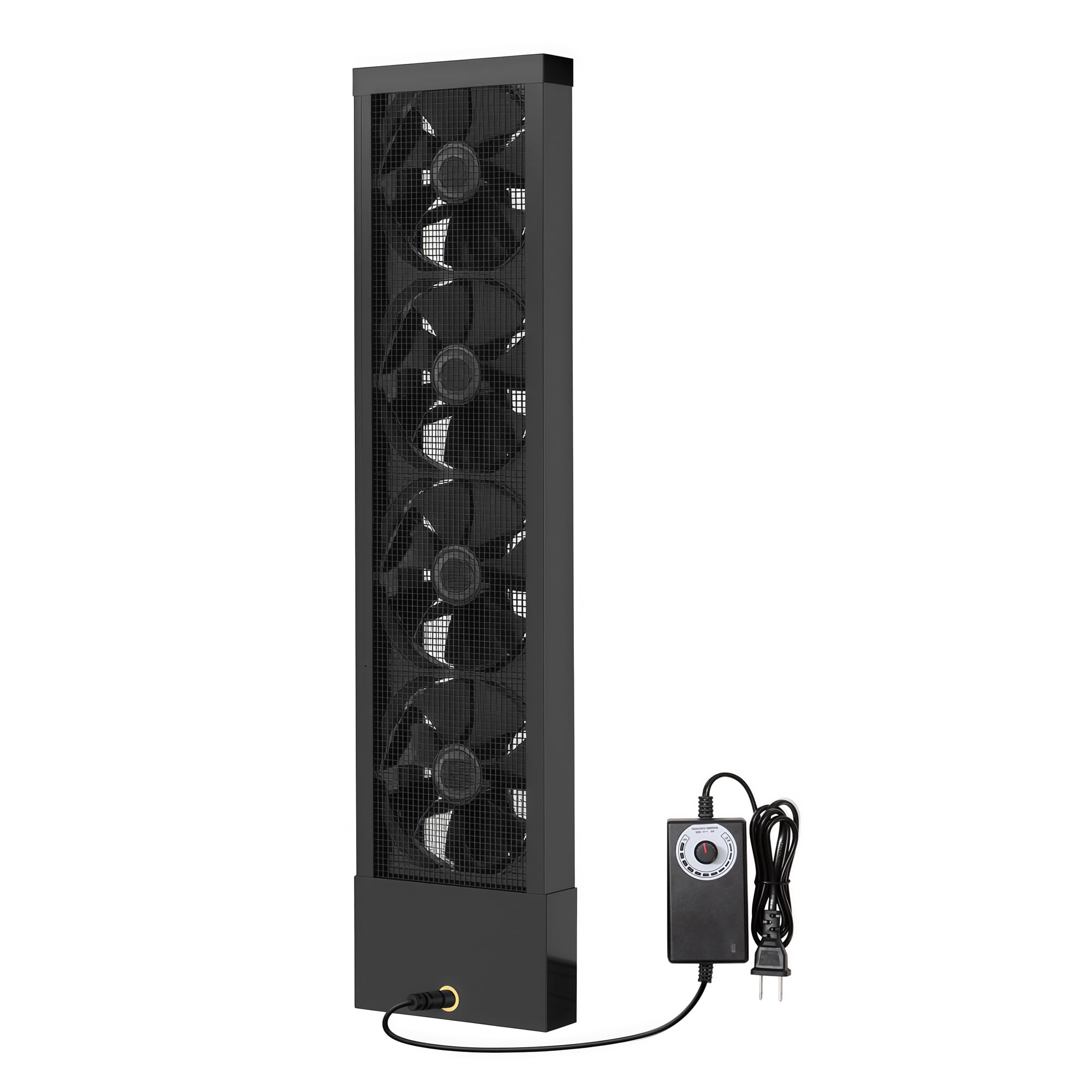
A 30-second, no-tools install with four fans for sliding window frames
If you have a sliding window and want a fast, damage-free solution, this fan is built for you. It is designed specifically for sliding windows with a 23.6″-25.6″ inner frame height, using a spring-loaded aluminum alloy frame that grips the window firmly. Installation takes about 30 seconds—no tools, just extend, insert, and tighten.
It features four powerful fans behind a stainless steel mesh, providing 98 CFM of exhaust airflow. The stepless speed control adjusts airflow from a gentle breeze to a powerful flow. Its slim design sits flush against the frame, so it does not interfere with normal window operation at all.
Buyers find it performs well and moves air efficiently, though opinions split on power—some report great extraction, while others feel it “barely pushes air” compared to traditional window fans. It has a 5-6 ft cord, is quiet at low speeds, and is best for removing smoke or odors from a single room rather than drying out a whole basement.
Why It Appeals
- Tool-free installation takes 30 seconds
- Slim design doesn’t block window operation
- Quiet at lower speeds
- Stainless steel mesh keeps insects out
Where It Falls Short
- 98 CFM is modest; some find airflow underwhelming
- Exhaust-only, no intake or reversible function
- Opinions are divided on value and sturdiness
Good for: Quick odor and smoke removal in a room with a sliding window, where tool-free convenience matters more than raw airflow.
Think twice if: You need to dry out a genuinely damp basement—this fan’s 98 CFM is not in the same league as the crawlspace units above.
7. QJSZMEI Vertical Window Fan for Sliding Windows
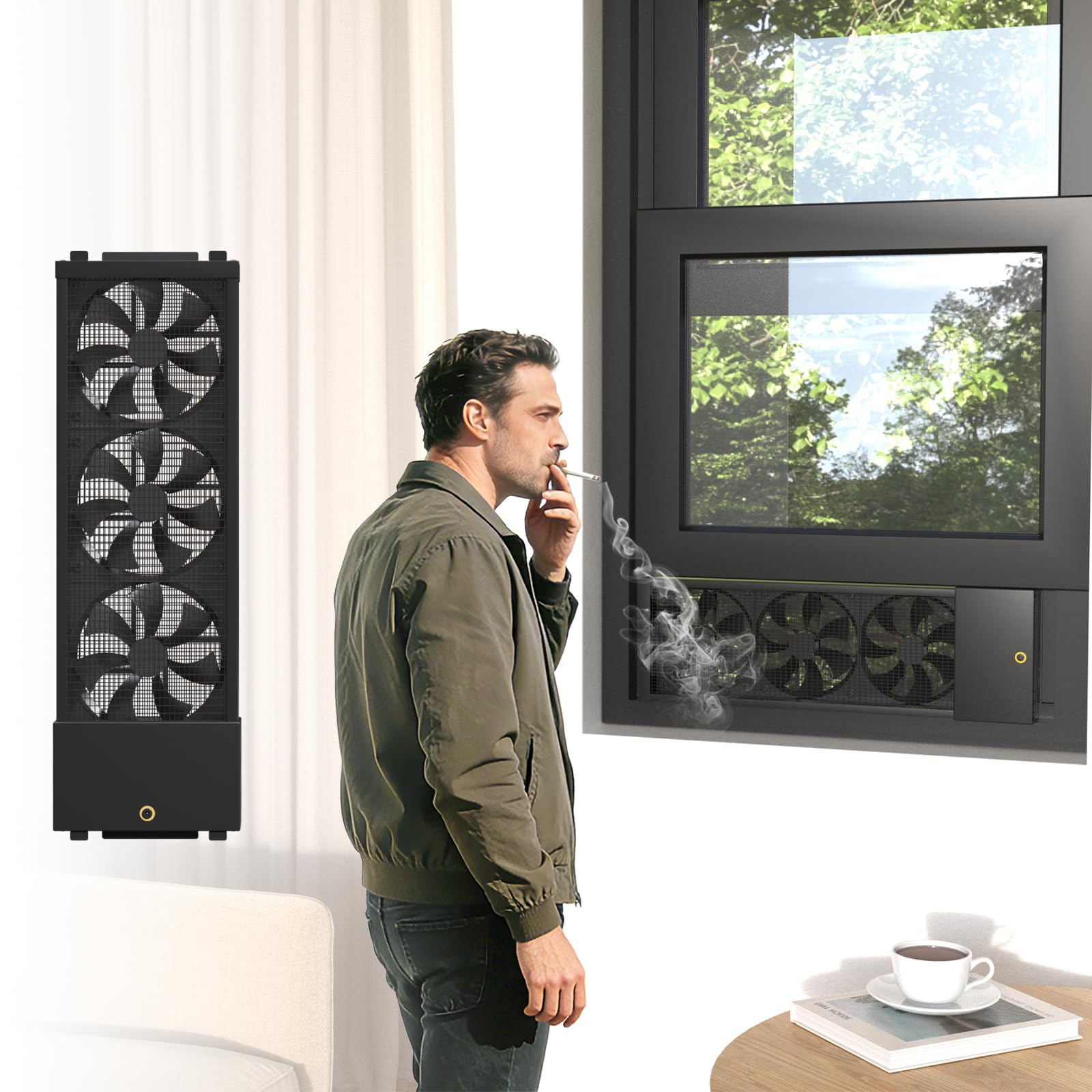
A super-thin aluminum fan with 10 wind speeds for narrower sliding windows
This compact fan is built for sliding windows with a 45-50cm (17.8-19.7 inch) frame, using a three-stage caliper structure with reinforced springs for a secure fit. Its aluminum alloy frame with double-sided stainless steel mesh blocks insects effectively, and the slim 1.57-inch body means it never interferes with opening or closing your window.
It offers a stepless speed control with 10 levels of wind speed adjustment, letting you dial in exactly the airflow you want while saving energy. The hydraulic bearing brushless motor reaches a maximum speed of 2800 RPM, delivering powerful yet low-noise output. It can be easily disassembled and washed directly with water to remove dust.
The quiet operation is the standout feature, with buyers noting it works wonderfully for venting a gas stove and is very quiet. Most of the praise centers on its effectiveness and build quality. However, some find it overpriced for what feels like three computer fans behind a mesh, and it is exhaust-only with no reversible function, which limits its versatility.
The Highlights
- Extremely quiet operation, soothing for sleep
- 10-level stepless speed control for fine tuning
- Super-thin 1.57-inch body doesn’t block window
- Washable aluminum and stainless steel build
The Drawbacks
- Exhaust-only; cannot reverse airflow direction
- Some buyers feel the build feels cheap for the cost
- Modest 98 CFM power output
Best suited for: Light venting tasks like clearing kitchen fumes or pet odors from a room with a narrower sliding window, where silence is a priority.
skip it if: You need serious basement drying power or a dual-direction fan that can both exhaust and intake air.
Understanding the Specs
CFM (Cubic Feet per Minute)
This is the core measure of a fan’s power—how much air it moves each minute. For a basement, higher CFM means faster air exchange, which clears humidity and odors more quickly. A 98 CFM fan works for small rooms, but a 540 CFM unit like the ALORAIR is what you need for a genuinely damp, large crawlspace. Match the number to the size of your space.
Humidistat & Freeze Protection
A humidistat is a sensor that detects the moisture level in the air and automatically switches the fan on or off to stay within your set range, saving energy and preventing over-ventilation. Freeze protection is a thermostat that shuts the fan down when outdoor temps drop too low—typically below 35°F—to keep the motor and housing from freezing and cracking in winter.
FAQ
How do I choose the right fan for my basement window size?
What is a good CFM rating for a basement ventilation fan?
Can I install a basement ventilation fan myself?
Are basement ventilation fans noisy?
Will a ventilation fan reduce radon gas in my basement?
What is the difference between an exhaust fan and an intake fan?
How does a humidistat save energy?
Can these fans be used in a garage or attic as well?
How do I maintain or clean my basement window fan?
Are these fans weatherproof for outdoor exposure?
Final Thoughts: The Verdict
Across the board, the basement window ventilation system winner is the ALORAIR 540CFM because its massive 540 CFM airflow and automatic humidistat make it the most effective at banishing deep, stubborn dampness. If you want smart app control and whisper-quiet operation, grab the AC Infinity AIRTITAN T8. And for a corrosion-resistant, hands-off option in a standard vent, the Durablow 220 CFM is the one to reach for.
How We Picked
We do not accept paid placement. Every pick is matched to a real buyer and a real use-case; we do not hands-on test units.
Sources & Methodology
Specifications: manufacturer listings and product documentation. Review insights: verified customer reviews, as of August 2026. Pricing: not shown on this page (it changes often); check the current price via the retailer link.
As an Amazon Associate, Gadgets Feed earns from qualifying purchases. This does not affect which products we feature.