
Our readers keep the lights on and my morning glass full of iced black tea. As an Amazon Associate, I earn from qualifying purchases.
Specs are compiled from manufacturer listings and verified buyer reviews and can change over time — please confirm the key details on the product page before buying.
You want a game night that starts fast, where nobody has to read a novel-length rulebook and everyone from age 8 to 80 is in on the fun by the second round. The best basic board games skip dense manuals for mechanics you can explain in under a minute. Quick rounds and minimal setup keep the conversation flowing and the laughs coming.
I’m Min — the founder and writer behind Gadgets Feed. This guide is built by comparing the manufacturers’ published specifications and the patterns across verified customer reviews, so you get each pick’s real strengths and trade-offs instead of marketing spin.
If you’re hunting for a crowd-pleaser that works for mixed ages, the clearest path is to focus on basic board games that prioritize easy rules, flexible player counts, and quick playtimes over deep mechanical complexity.
Our Picks at a Glance


How To Choose The Best Basic Board Games
The best basic games respect your time. They get you playing within minutes, not after a 20-minute rules lecture. When you scan a game box, you want to make sure three things line up with your crowd: how many people can play, how long a round takes, and whether the challenge comes from luck or your own choices.
Match the player count to your table
Check the box for the player range before you buy. A game built for 2 to 4 players feels cramped when six relatives show up, while a game that supports 2 to 8 players adapts to almost any gathering. For a pair of players, a dedicated two-player game often gives a sharper, more balanced experience than a large-group game played shorthanded.
Weigh luck against strategy
Know the balance you want. Pure-luck games level the field so kids can beat adults, which is perfect for young families. Games that blend luck with a meaningful choice give everyone something to think about without punishing newcomers. If a game is described as “strategy,” expect more decisions per turn; if it’s “action” or “party,” expect chaos and speed instead.
Quick Comparison
| Model | Best For | Players | Play Time | Age Range | Amazon |
|---|---|---|---|---|---|
| magilano SKYJO★ Best Overall | Large family card games | 2-8 | 30 min | 8+ | Amazon |
| Winning Moves Rack-ONostalgia Pick | Number sequencing | 2-4 | Quick rounds | 8+ | Amazon |
| TOMY Pop Up PirateToddler Favorite | Toddler suspense | 2-4 | Variable | 4+ | Amazon |
| Hasbro Bed Bugs | Motor skill races | 2-3 | 20 min | 4+ | Amazon |
| Winning Moves Yahtzee Words | Word-building fans | 2+ | 30 min | 8+ | Amazon |
| Hasbro Don’t Break The Ice | Preschool classic | 2-4 | 30 min | 3+ | Amazon |
| Smirk and Dagger BOOP | Two-player strategy | 2 | 20 min | 10+ | Amazon |
| Mattel Giant UNO | Oversized party fun | 2-10 | Variable | 7+ | Amazon |
| Hasbro Jenga | Solo or group stacking | 1+ | Variable | 6+ | Amazon |
In‑Depth Reviews
1. magilano SKYJO
Our pick — over 4.5★ from 75,500+ verified ratings; the strongest balance of quality and price.
The crowd favorite whose low-score twist keeps the whole table begging for one more round.
SKYJO wins people over with its brilliantly simple goal: collect as few points as possible by flipping, swapping, and discarding numbered cards. The catch is that the round only ends once a player has revealed all their cards, so you are always watching your rivals to see how close they are to finishing. The gameplay earns the top praise by a wide margin, with ease of use a strong second—why it’s a family-gathering fixture.
The box stretches to 2 to 8 players, which makes it unusually flexible for a card game, and a round runs about 30 minutes. It is also quietly educational, helping you practice adding up two-digit numbers to 100 and getting a feel for probability as you decide which cards to keep. A few owners mention the cards start stiff and that color-coding them serves no real purpose, but neither slows anyone down.
Buyers report playing it with groups as small as 2 and as large as 7 in a single weekend and having a great time — the kind of testimonial that sums up its whole appeal. If you want one game that works for a big crowd, spans ages, and never overstays its welcome, this is the one. It is bigger than the Rack-O box at 7.64 x 3.98 x 1.38 inches, yet still slips into a bag for trips.
Why It Fills The Table
- Supports up to 8 players, the most flexible count here
- Teaches quick math and probability without feeling like school
- Fast to learn with picture-based instructions
Small Trade-Offs
- Cards arrive stiff and need breaking in
- English language not guaranteed on the manual
Reach for this if: you host big family nights and want one game that everyone from 8-year-olds to grandparents can play together.
The honest caveat: a round still takes a full 30 minutes, so it is not a two-minute filler.
2. Winning Moves Rack-O Retro Edition
A 1956 classic that turns a simple number rack into a sneaky race to sequence 10 cards.
Rack-O’s charm is how it makes ordering numbers feel like a genuine competition. Each player is dealt 10 cards and must arrange them from a low card in the #5 slot up to a high card in the #50 slot, drawing and exchanging along the way. The first player to line up all ten correctly scores 75 points — 5 per card plus 25 for going Rack-O — which is the whole strategic heart of the game.
What wins people over is how the gameplay blends skill and chance, keeping kids once they know their numbers while still engaging adults. It is a favorite low-effort, casual game for family vacations, brewery visits, or any time you want to keep a conversation going with something to do with your hands. A quick game that doesn’t take forever makes it perfect for a weeknight, and buyers across generations describe playing it together — an 8-year-old granddaughter and a grandparent being a typical pairing.
One honest note: the card quality comes in for occasional criticism, and the box at 8.75 x 8.75 x 1.75 inches takes up noticeably more shelf space than the compact SKYJO (7.64 x 3.98 x 1.38 inches). The included rack and 60-card deck still give you everything you need right in the box for 2 to 4 players.
Nostalgia Done Right: the retro edition is cute, and the bold numbers are easy to read across the table.
The Fine Print: it is capped at 4 players, so larger gatherings will need a second copy or a different pick.
Pick this for: a grandparent-friendly game that sharpens number sequencing and sparks childhood memories.
skip it if: your group regularly runs larger than four people.
3. TOMY Pop Up Pirate
The nerve-jangling suspense game where nobody knows which slot launches Pirate Pete into the air.
Pop Up Pirate is pure anticipation. Players take turns slipping colorful plastic swords into a brown barrel, and the last one to avoid launching Pirate Pete wins. Each game hides the pop in a different slot, so the tension never goes stale — the thing everyone raves about is just how much fun the suspense delivers.
For a 4-year-old, the rules are instantly graspable, and many parents note that small children can play it independently without any setup. The box includes 1 barrel, 1 pirate, and 24 swords, with no batteries required. The sword insertion needs a slight twist to line up a notch, and the barrel can topple if pushed too hard — minor quirks kids forgive instantly.
The honest trade-off is durability. The popping mechanism is the recurring gripe, with some owners finding it stops working after a few months of enthusiastic use, though many report an easy fix. It is a cheap thrill built for the youngest crowd, and for that purpose, it delivers disproportionately large laughs.
The Thrill Factor
- Randomized pop slot keeps every round fresh
- No batteries and no real setup
- 4-year-olds can play without help
The Reality Check
- Pop mechanism can fail after rough months of play
- No sword storage — the barrel won’t fit in the box with swords inside
Best for: the preschool set — a first real “game” that toddlers can own and win.
Think twice if: you expect it to survive years of daily play, because the mechanism is its weak spot.
4. Hasbro Bed Bugs
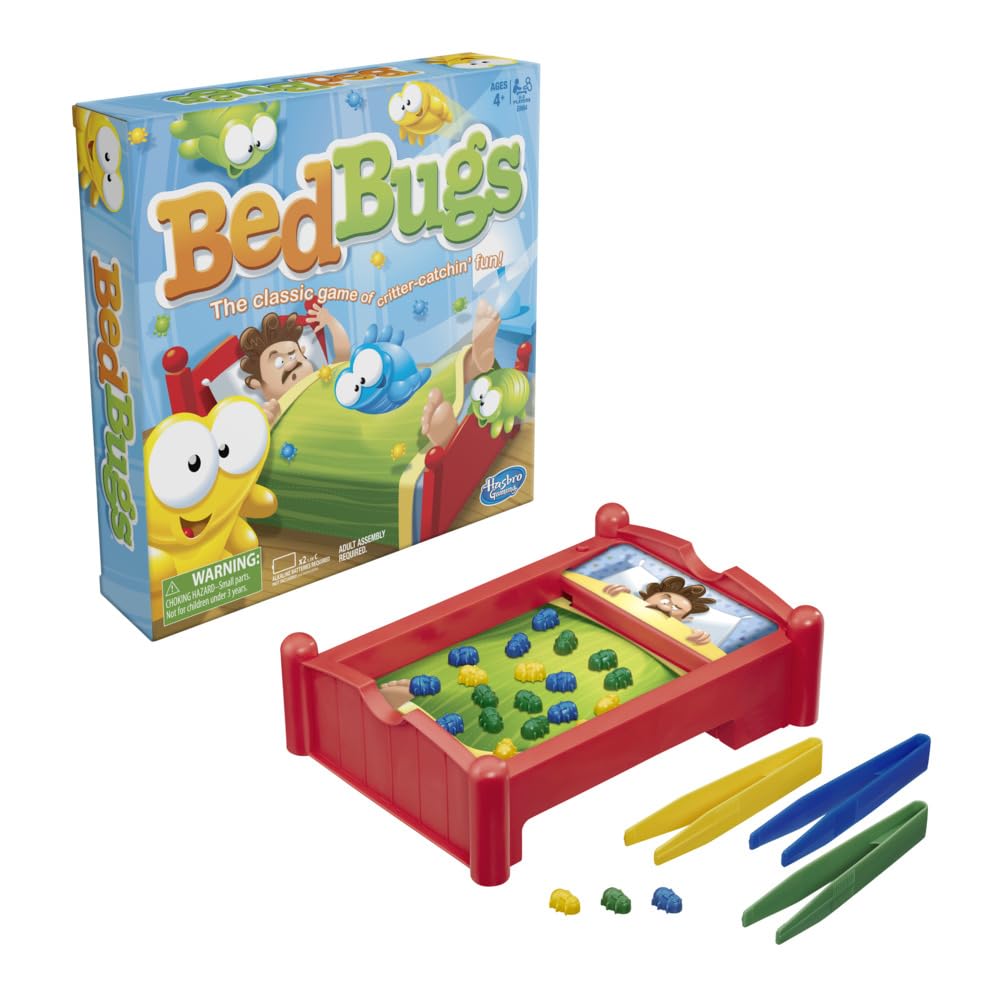
A vibrating bed, 36 hopping bugs, and three tongs turn color-matching into a frantic reflex race.
Bed Bugs is all about speed and coordination. The motorized gameboard vibrates to send plastic bugs bouncing, and players race with tongs to catch every bug of their matching color — blue, yellow, or green. The first to clear their color out of the bed wins, and a full round lasts about 20 minutes.
The gameplay takes the top praise, and parents love that it builds hand-eye coordination and fine motor skills through pure play. It is genuinely durable too, holding up to rough treatment from 4 and 6-year-olds. As an aside, it doubles as sneaky counting and comparing practice, since kids naturally tally up their catches.
The honest limitation is the player count, capped at 2 to 3, so it suits playdates and one-to-one time more than big family nights. Functionality gets mixed reactions — the vibration can stop if the board is pressed too hard, and opinions vary on how tricky the bug-catching actually is. For the right age band, though, it is a hit.
Toddler Training Wheels: the tongs and bouncing bugs quietly build fine motor skills while kids just think they are playing.
Know Before You Go: with only 2-3 players and a board that dislikes heavy pressure, this is a small-group or one-to-one game.
Reach for this if: you have a preschooler who needs to burn energy and build hand control at the same time.
Look elsewhere if: you need a game that seats the whole extended family.
5. Winning Moves Yahtzee Words

All the familiar Yahtzee scoring, but with 7 letter dice that demand your vocabulary, not just your luck.
Yahtzee Words takes the beloved scoresheet and swaps numbers for letters. Instead of matching dice combinations, you roll 7 letter dice to spell 2 to 6 letter words, chase All Consonants and All Vowels, and dream of the extremely rare 7-letter-word Yahtzee. The Upper and Lower sections work just like the original, right down to chasing that Upper Bonus.
The gameplay earns the top praise by a wide margin, and fans find it easy to learn yet note it plays considerably harder than regular Yahtzee. It stretches your vocabulary and word-jumble skills, so it has a natural educational pull for kids learning spelling. For 2 or more players aged 8 and up, it fits family nights and friend gatherings alike.
The pace draws mixed reactions — some love a round taking about 15-20 minutes, while others find it slow-paced. The scorecards themselves get occasional criticism, and the basic set feels like it could offer a little more value. But for word-game lovers, owners mention ordering multiple copies as gifts after falling for it themselves.
The Wordy Appeal
- Familiar Yahtzee structure means instant understanding
- Builds vocabulary and spelling through play
- Plays with 2 or more, no hard ceiling
The Wordy Catch
- Harder than classic Yahtzee, which can frustrate casual players
- Pacing splits opinion — some find rounds slow
Pick this for: word nerds and Scrabble fans who want a fresh twist on a dice classic.
pass on it if: you want the pure luck and speed of original Yahtzee.
6. Hasbro Don’t Break The Ice

Tap out ice blocks one by one and keep Phillip the Penguin from going ker-plop in this ages-3-plus classic.
Don’t Break The Ice is the timeless preschool test of nerve and fine touch. Players use two mallets to tap out ice blocks one at a time while keeping Phillip the Penguin on top — one wrong block and he plunges through. The gameplay is overwhelmingly the top praise, and it remains a beloved classic that takes adults straight back to childhood.
The box includes 2 mallets, an ice tray frame with 4 legs, 1 large ice block, 32 small ice blocks, and the Phillip the Penguin figure. It is built for 2 to 4 players, and the 30-minute estimated playtime fits neatly into a young family’s evening. Parents describe kids aged 3 to 7 playing it together happily, and even siblings up to age 13 stay engaged.
The friction point is assembly. Setup and teardown get genuinely mixed reviews — the box is compact, but fitting all 32 blocks back in the tray frame is fiddly, and a missing block means the whole structure won’t stand properly. It is also a little loud for a classroom setting. Durability lands in the middle, so it is best treated as a home favorite rather than a road warrior.
The Fan Favorite: the suspense of watching the penguin wobble keeps kids on the edge of their seats every single round.
The Real Friction: expect to do the assembly yourself — the small blocks and tray frame are finicky to set up each time.
Best for: the youngest players in your house — it is one of the few true classics that starts at age 3.
Account for this: the setup is the chore you’ll do every time, and it’s not a game to pack for trips.
7. Smirk and Dagger BOOP

32 adorable wooden cats and a quilted bed board turn a two-player strategy duel into pure charm.
BOOP is the rare abstract strategy game that makes you smile while you think. Every kitten placement creates chain reactions that push adjacent pieces across the soft quilted game board, so lining up three in a row is never as simple as it looks. The mechanic blends elements of checkers, connect four, and Othello into something that plays in about 20 minutes.
The gameplay is the top praise, with the pure cuteness of the wooden cat pieces running a close second. It is quick to learn — rules take a few minutes to explain — and it works for ages 10 and up, though an 8-year-old can grasp the normal rules. A kid variant is even included for younger players. No reading is needed, which makes it instantly accessible.
The framework is intentional: it is strictly a 2-player game, so it will not seat a group. Difficulty draws mixed reactions since the emergent strategy can surprise newcomers, and a rare defect like a two-headed cat piece slips through occasionally. Yet owners describe cat lovers and strategy fans both finding their perfect match in this box.
The Charm Offensive
- 10-20 minute rounds fit snugly into any evening
- Wooden cat pieces are genuinely delightful to handle
- Zero reading required, so anyone can jump in
The Solo Rule
- Hard-capped at 2 players, no group mode
- Strategy depth can surprise casual players
Reach for this if: you want a sharp, fast, beautiful two-player game for date nights or introducing kids to strategy.
Look elsewhere if: your game nights regularly involve more than two people.
8. Mattel Games Giant UNO

Cards three times the usual size turn everybody’s favorite party game into an unmissable spectacle.
Giant UNO takes everything you love about matching colors and numbers and blows it up to a comic scale. The cards are roughly triple the size of a standard deck, so every Draw Two and Wild becomes a dramatic, laugh-out-loud moment. The gameplay gets the top praise, and the sheer card size is the second-biggest topic owners rave about.
This version holds a genuinely thoughtful upgrade: the color-blind accessible deck uses special graphic symbols on every card, so players with any form of color blindness can identify colors easily. It also includes 2 blank Wild Cards you can customize for your own house rules. Designed for 2 to 10 players ages 7 and up, it is the most inclusive pick in this lineup.
The one consistent gripe is shuffling — cards that big are genuinely awkward to shuffle, and some owners find them difficult to handle mid-game. Durability draws praise, holding up well to regular play. If you host parties, this is the game that anchors the evening, with buyers describing endless laughter every time it hits the table.
The Crowd Magnet: the oversized cards immediately become the centerpiece of any party or family reunion.
The One Annoyance: shuffling is a two-hand workout — plan on it being part of the fun.
Best for: hosts who want a guaranteed conversation-starter that seats up to 10 people.
Be ready for: the awkward shuffle, which is the unavoidable price of cards this big.
9. Hasbro Gaming Jenga

The original wood block game where steady hands and nerves decide who brings the whole tower down.
Jenga needs no introduction — pull a block, place it on top, and pray the tower holds. What improve this version is how the challenge builds as the tower grows, keeping experienced players genuinely engaged rather than bored. The gameplay tops the praise charts, with the handy tube-shaped storage box running as the second-most-appreciated feature.
The set includes 54 precision-crafted hardwood blocks and a stacking sleeve that helps you build the tower straight. It plays with 1 or more players, so it works solo when nobody else is around. The easy “put away” tube package with a handle makes cleanup and carrying genuinely painless, a detail owners consistently appreciate.
The recurring criticism focuses on the packaging rather than the game itself — one owner found the tube harder to repack than other sets they have owned. For ages 6 and up, it doubles as a stealth learning tool for geometry and stability concepts. If you want one game that is timeless, sturdy, and works as well for one person as for a party, this is the safest bet in the lineup.
The Enduring Draw
- Works for 1 player solo or a full party
- Tube storage with handle makes cleanup simple
- Increasing difficulty keeps skilled players hooked
The Minor Flaw
- Tube packaging can be fiddly to repack neatly
- Requires steady hands, so very young kids may struggle
Pick this for: a universally loved game that works solo, with kids, or as a party centerpiece.
Note this: the packaging is the weakest link, not the wooden blocks themselves.
Understanding the Specs
Player Count
The number on the box tells you how many people the game is actually balanced for. A 2-player game like BOOP gives each person a tight, fair duel, while a 2 to 8-player game like SKYJO scales to handle a full family reunion. The catch is that more flexibility often means less tactical depth per player, so you are choosing between inclusivity and sharpness.
Estimated Playing Time
This is your pacing gauge. A 20-minute game like Bed Bugs or BOOP fits into a quick evening slot, while a 30-minute game like SKYJO or Don’t Break The Ice still stays manageable. Look for games advertised around 30 minutes when you want a real game night, and stick to shorter rounds when you just want a filler between conversations.
FAQ
What makes a board game “basic” versus a complex strategy game?
How many players should I look for in a family game?
What is the difference between a luck-based and a strategy-based basic game?
Can basic board games really be educational for kids?
How long should a basic board game take to play?
Is a higher age rating a strict requirement?
Which basic game is best for a large crowd?
Do these games come with everything needed to play?
What is the best basic board game for a couple?
Final Thoughts: The Verdict
If you want one game to rule your game shelf, the basic board games winner is the magilano SKYJO because it scales from 2 to 8 players, teaches quick math through play, and earns unanimous praise for its addictive low-score twist. For a nostalgic number-sequencing race, grab the Winning Moves Rack-O. And when a couple wants thoughtful strategy in under 30 minutes, the Smirk and Dagger BOOP is the one to reach for.
How We Picked
We do not accept paid placement. Every pick is matched to a real buyer and a real use-case; we do not hands-on test units.
Sources & Methodology
Specifications: manufacturer listings and product documentation. Review insights: verified customer reviews, as of August 2026. Pricing: not shown on this page (it changes often); check the current price via the retailer link.
As an Amazon Associate, Gadgets Feed earns from qualifying purchases. This does not affect which products we feature.