
The hardest part of buying a first camera isn’t the price tag—it’s the noise. Megapixel counts, sensor sizes, and lens jargon flood every listing, drowning out the only question that matters: *Will this camera help me learn without getting in my way?* The right starter body puts the controls where your muscle memory expects them, delivers sharp enough images to keep you motivated, and grows with you instead of holding you back after six months.
I’m Min — the co-founder and writer behind Gadgets Feed. I’ve spent countless hours cross-referencing technical specifications, decoding real user experiences, and weighing trade-offs across entry-level DSLR and mirrorless bodies so you can skip the analysis paralysis and pick a camera that actually suits your learning curve. this guide covers the best basic camera for beginners across multiple platforms and price tiers.
How To Choose The Best Basic Camera For Beginners
Picking a first interchangeable-lens camera comes down to understanding a handful of specs that directly affect how you’ll shoot and learn. Let’s break down the most important ones.
Sensor Size: The Foundation of Image Quality
APS-C sensors are the sweet spot for entry-level cameras. They’re larger than the 1-inch sensors found in many point-and-shoots, giving you better dynamic range and noticeably cleaner images when light drops. Full-frame sensors, found on premium models here, offer even better low-light performance and shallower depth of field—but you pay for it. For learning composition, aperture, and exposure, APS-C is more than enough.
Autofocus System: How the Camera Finds Your Subject
Phase-detection autofocus is faster and more reliable for moving subjects than contrast-detection alone. Cameras with more focus points—especially ones covering a wider area of the frame—make it easier to track a running kid or a pet without losing the shot. Entry-level bodies often have 9 to 49 points, while mirrorless models like the Canon EOS R100 pack 143 zones for better coverage.
Kit Lens Versatility: What Comes in the Box
The standard 18-55mm or similar zoom lens covers wide-angle to short telephoto, which handles landscapes, portraits, and everyday snapshots. A lens that starts at f/3.5 lets in more light at the wide end, while a lens that stretches to 140mm gives you more reach without swapping glass. Most beginners will stick with the kit lens for months, so its focal range and stabilization are crucial.
Quick Comparison
On smaller screens, swipe sideways to see the full table.
| Model | Category | Best For | Key Spec | Amazon |
|---|---|---|---|---|
| Canon EOS R8 | Mirrorless | Full-frame entry | 24.2MP, 6K oversampled 4K60p | Amazon |
| Sony a7 III | Mirrorless | Low-light performance | 24.2MP BSI, 693 phase-detection AF | Amazon |
| Canon EOS RP | Mirrorless | Travel & vlogging | 26.2MP full-frame, 5-stop IS | Amazon |
| Nikon D7500 | DSLR | Action & sports | 20.9MP, 51-point AF, 8fps burst | Amazon |
| Panasonic LUMIX G85 | Mirrorless | Stabilized video & stills | 16MP MFT, 5-axis IBIS | Amazon |
| Sony ZV-E10 | Mirrorless | Vlogging & streaming | 24.2MP APS-C, 425 phase-detection AF | Amazon |
| Canon EOS R100 | Mirrorless | First mirrorless step | 24.1MP APS-C, Dual Pixel CMOS AF | Amazon |
| Canon EOS Rebel T7 Bundle | DSLR | All-in-one kit | 24.1MP, 9-point AF, Wi-Fi | Amazon |
| Nikon D3500 | DSLR | Pure beginner experience | 24.2MP, 5fps, 3.0in 921k-Dot LCD | Amazon |
| Nikon D3300 | DSLR | Budget SLR learning | 24.2MP, 50 AF points | Amazon |
| Nikon D3200 | DSLR | Lowest-cost starter | 24.2MP, EXPEED 3, 11 AF points | Amazon |
In‑Depth Reviews
1. Canon EOS R8 Mirrorless Camera

The Canon EOS R8 brings the same DIGIC X processor and 24.2-megapixel full-frame sensor found in the flagship R6 Mark II into a body that’s hundreds less. You get Dual Pixel CMOS AF II covering 100 percent of the frame, uncropped 4K video oversampled from 6K, and 40fps electronic shutter with full autofocus tracking. For a beginner stepping straight into full-frame, there’s no better value-to-feature ratio at this tier.
Its 0.39-inch OLED viewfinder refreshes at up to 120fps, making manual exposure adjustments feel fluid. The vari-angle touchscreen is the same 1.62-million-dot panel used on Canon’s pricier bodies, and the body itself is the lightest full-frame RF-mount camera Canon has ever built. For travel, street, or studio work, the weight savings add up fast.
There are tradeoffs: no in-body stabilization, a single SD card slot, and a smaller LP-E17 battery that manages roughly 500 shots per charge. The mechanical shutter maxes out at 6fps, and 4K60p recording can trigger thermal limits after about 30 minutes. None of these are dealbreakers for a beginner learning manual modes and composition, but they’re worth factoring into your workflow.
Why it’s great
- Same core sensor and processor as the R6 Mark II at a much lower price point
- Uncropped 4K60p with 6K oversampling delivers professional-level video quality
- Dual Pixel CMOS AF II with deep-learning subject detection tracks people, animals, and vehicles
Good to know
- No in-body image stabilization; relies on lens-based IS
- Battery life is around 500 shots with the LP-E17 pack
- Overheating may occur during extended 4K60p recording sessions
2. Sony a7 III Full-Frame Mirrorless Camera

The Sony a7 III remains a benchmark for full-frame mirrorless even years after its launch. Its 24.2-megapixel back-illuminated Exmor R sensor reads data 1.8 times faster than its predecessor, and the 693 phase-detection autofocus points cover 93 percent of the frame. Silent shooting at 10fps with AE/AF tracking means this body handles fast-moving subjects without jarring shutter noise—ideal for a beginner who wants to shoot candids or street scenes.
The 15-stop dynamic range and 14-bit uncompressed RAW output give you generous latitude for exposure correction in post. ISO ranges from 50 to 204,800, so you can push into very dim environments without immediate noise penalties. The included 28-70mm f/3.5-5.6 kit lens is a competent starting point, though its variable aperture struggles in truly low light.
The menu system is famously dense—Sony’s older interface requires some hunting to find buried settings. That said, once you set up custom buttons and the Fn menu, you rarely need to dive deep again. Battery life is excellent for a mirrorless (roughly 710 shots with the NP-FZ100), and the dual SD card slots offer peace of mind for backup.
Why it’s great
- Outstanding 15-stop dynamic range and clean high-ISO performance
- 693-point phase-detection AF covers almost the entire frame
- Silent 10fps burst shooting with full autofocus tracking
Good to know
- Menu navigation is complex and takes time to learn
- Kit lens lacks a bright aperture for low-light work
- Single UHS-II slot; second slot is UHS-I only
3. Canon EOS RP Full-Frame Mirrorless Camera

The Canon EOS RP is the lightest and most affordable full-frame mirrorless camera in Canon’s RF lineup, and it’s a natural upgrade path from entry-level DSLRs. The 26.2-megapixel full-frame CMOS sensor paired with the DIGIC 8 processor delivers sharp detail with pleasing color science straight out of camera. The Dual Pixel CMOS AF covers a wide area and includes eye-detection for stills and video.
It ships with the RF 24-105mm f/4-7.1 IS STM lens, which has optical stabilization good for up to 5 stops—enough to shoot handheld in moderate indoor light. The vari-angle touchscreen and lightweight body (just 485g) make it a strong candidate for travel photographers and vloggers who want full-frame depth without carrying a heavy kit.
Battery life is modest—the LP-E17 pack averages around 250-350 shots—so a spare battery is recommended for a full day out. The continuous shooting speed is 5fps, fine for portraits and landscapes but not for fast action. The kit lens is well-regarded for its range but can be soft at the edges wide open; stopping down to f/8 cleans it up considerably.
Why it’s great
- Full-frame image quality in the lightest RF-mount body available
- RF 24-105mm f/4-7.1 IS STM kit lens offers 5-stop stabilization
- Intuitive touchscreen interface and simple menu layout
Good to know
- Battery life is below average, around 300 shots per charge
- Burst rate of 5fps limits action photography
- 4K video has a 1.7x crop and no Dual Pixel AF
4. Nikon D7500 DSLR Camera

The Nikon D7500 inherits the same 20.9-megapixel sensor, EXPEED 5 processor, and 181K-pixel metering sensor from the flagship D500, making it a performance outlier in the mid-range DSLR segment. The 51-point autofocus system includes 15 cross-type sensors, and Group Area AF works reliably for tracking moving subjects. Burst shooting at 8fps cements its status as an action-ready body for beginners who shoot sports or wildlife.
The 18-140mm f/3.5-5.6 ED VR kit lens is a standout—it covers wide-angle to medium telephoto with effective vibration reduction, so you don’t need a second lens for everyday walk-around shooting. The 3.2-inch 922K-dot tilting touchscreen supports touch-to-focus during live view, and the optical viewfinder is bright and clear.
Downsides include the single SD card slot and the fact that it lacks the D500’s pro-grade build. The resolution is lower than many competitors at 20.9MP, though in practice the image quality—particularly dynamic range—exceeds what the number suggests. The button layout takes some acclimation, but once learned, it’s fast and tactile.
Why it’s great
- D500-derived sensor and processor in a more accessible body
- 8fps continuous shooting with 51-point AF for action shots
- 18-140mm VR kit lens is one of the most versatile starter zooms
Good to know
- Only one SD card slot—no immediate backup for important shoots
- Lower 20.9MP resolution compared to many peers
- No built-in flash; external flash is required
5. Panasonic LUMIX G85 Mirrorless Camera

The Panasonic LUMIX G85 punches way above its price bracket thanks to a feature you rarely see at this level: 5-axis in-body image stabilization. That IBIS works with the 12-60mm Power O.I.S. lens to produce remarkably steady handheld footage, making it a top pick for beginners who want to shoot video without buying a gimbal. The 16-megapixel Micro Four Thirds sensor ditches the low-pass filter for a modest gain in fine detail.
4K video recording at QFHD 3840×2160 is accompanied by Panasonic’s 4K Photo and Post Focus modes, which let you extract 8-megapixel stills from a 30fps burst and change focus points after the shot. The 0.39-inch OLED live viewfinder (2.36 million dots) and the 3-inch tilt-and-touch LCD (1,040K dots) give you clear composition options in any light.
The magnesium alloy front panel and weather-sealed body make the G85 more durable than most plastic-bodied budget cameras. Autofocus can be sluggish in low light during 4K recording, and the 16-megapixel sensor is out-resolved by the 24MP APS-C competition for stills. But for a hybrid shooter who values stabilization over pure resolution, this is a steal.
Why it’s great
- 5-axis in-body stabilization delivers gimbal-like handheld video
- Weather-sealed magnesium alloy build exceeds typical entry-level toughness
- 4K Photo and Post Focus modes are creative tools no other tier offers at this price
Good to know
- 16MP MFT sensor has less resolution for stills than 24MP APS-C alternatives
- Autofocus hunts more in low light during 4K video
- Battery life is average; a spare is recommended for a full day
6. Sony Alpha ZV-E10 Vlog Camera
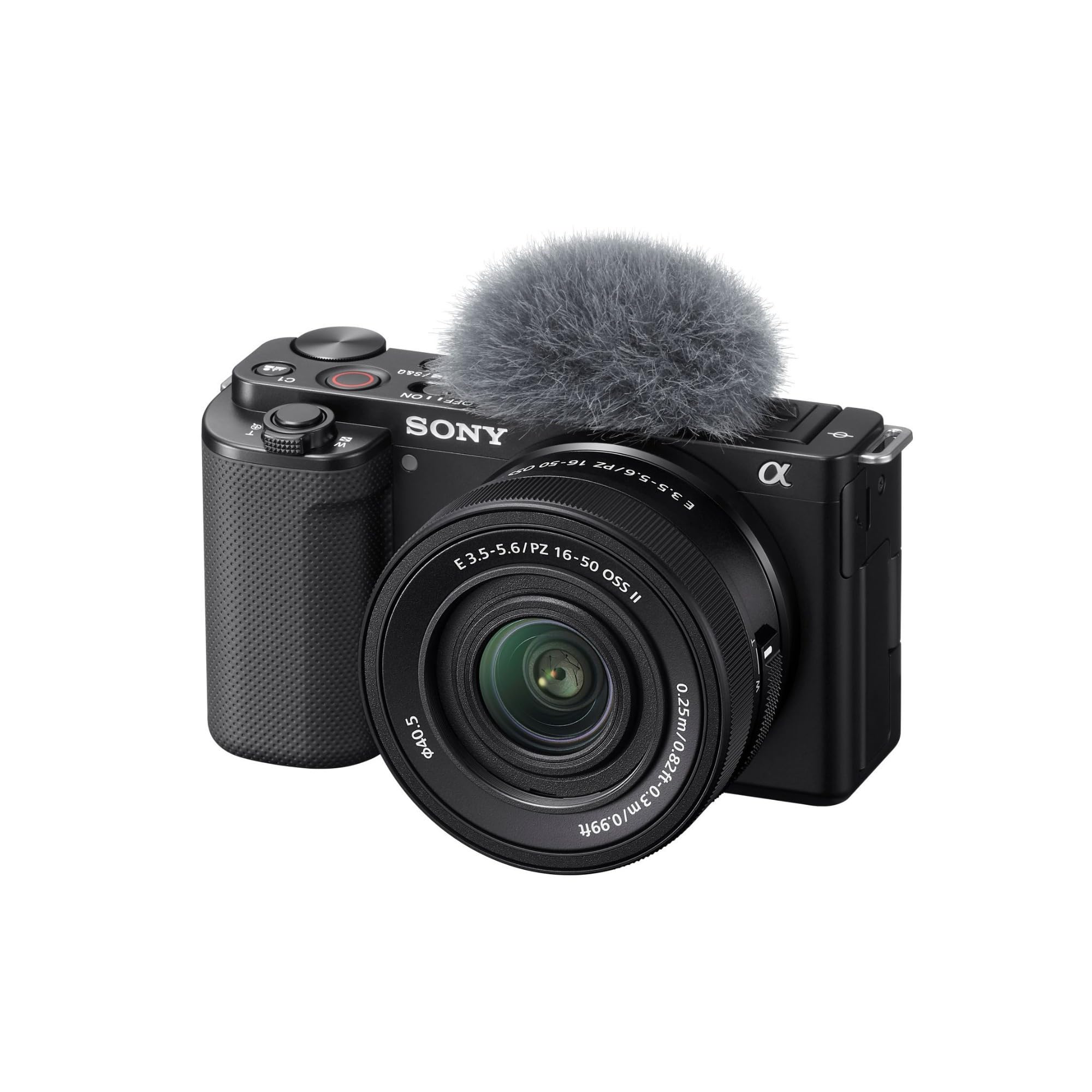
The Sony ZV-E10 is built from the ground up for content creators. It uses the same 24.2-megapixel APS-C Exmor CMOS sensor and BIONZ X processor as the a6400, but wraps them in a body optimized for video. The Product Showcase Setting transitions focus instantly from a face to an object held in front of the lens—perfect for makeup reviews or cooking demos. The Background Defocus button toggles shallow depth of field on and off with one tap.
4K video is oversampled from 6K, giving you more detail than standard 4K capture. The 425-point phase-detection autofocus system with Real-time Eye AF for humans and animals is class-leading. You can live-stream directly via a single USB cable with no additional hardware, and the directional 3-capsule microphone picks up clear audio for talking-head footage.
The kit lens is the 16-50mm f/3.5-5.6 OSS II, which is decent but not exceptional—the variable aperture means you’ll want faster prime glass as you progress. The electronic viewfinder is missing entirely on this model, which limits composing in bright sunlight. The battery is the smaller NP-FW50, so carry spares for extended shoots.
Why it’s great
- Product Showcase Setting and Background Defocus button are purpose-built for video creators
- 4K video oversampled from 6K with excellent face and eye tracking
- USB live-streaming without extra software or capture cards
Good to know
- No electronic viewfinder; rely on the rear LCD for composition
- Kit lens aperture is slow; consider upgrading to a faster prime for low light
- NP-FW50 battery has limited stamina for long recording sessions
7. Canon EOS R100 Mirrorless Camera

The Canon EOS R100 is the most affordable entry point into Canon’s RF mirrorless system, and it doesn’t compromise on the basics. The 24.1-megapixel APS-C CMOS sensor captures sharp images with natural color reproduction, and the DIGIC 8 processor enables 4K video recording at 24fps. Dual Pixel CMOS AF covers 143 zones with human and animal eye detection—a level of autofocus capability that was once reserved for much pricier bodies.
It’s the smallest and lightest body in the EOS R series, making it effortless to toss into a bag for everyday carry. The included RF-S 18-45mm f/4.5-6.3 IS STM lens has image stabilization and a compact retractable design that collapses down for storage. The touchscreen interface is intuitive, and the menu system mirrors Canon’s user-friendly DSLR layout.
4K video is limited to 24fps, and the 18-45mm kit lens starts at a dark f/4.5 at the wide end. There’s no in-body stabilization, so you’ll rely on the lens IS for handheld shots. The battery is the LP-E17, which delivers around 310 shots per charge. For a pure beginner who wants mirrorless simplicity and Canon’s ecosystem, it’s a strong foundation.
Why it’s great
- Smallest and lightest EOS R body, ideal for travel and daily carry
- Dual Pixel CMOS AF with animal and vehicle detection
- User-friendly touchscreen and Canon menu system
Good to know
- 4K video maxes out at 24fps with no higher frame rate options
- Kit lens begins at f/4.5, limiting low-light performance
- No in-body image stabilization; image quality relies on lens IS
8. Canon EOS Rebel T7 DSLR Bundle
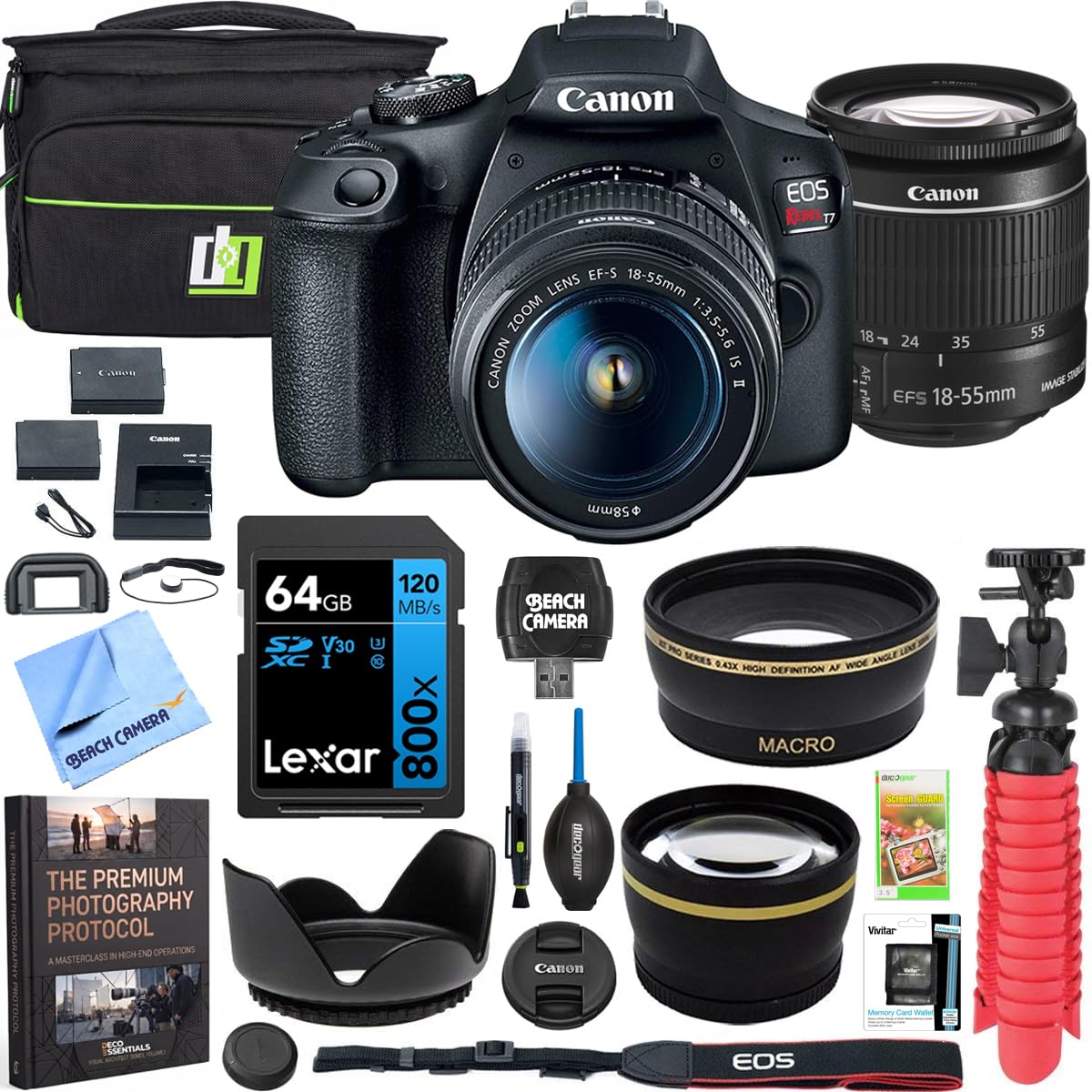
The Canon EOS Rebel T7 is the quintessential entry-level DSLR, and the value proposition of this bundle is hard to beat. Beyond the camera body and 18-55mm f/3.5-5.6 IS II kit lens, you get a full-size tripod, a tabletop tripod/grip, an extra battery, a 64GB memory card, a sensor cleaning kit, and UV/CPL/ND8 filters. For someone walking into photography for the first time, this bundle covers the essential accessories you’d buy separately anyway.
The 24.1-megapixel APS-C sensor with a 14-bit DIGIC processor delivers fine image quality and good noise control up to ISO 3200. The 9-point autofocus system with a cross-type center point is basic but functional for still subjects. Built-in Wi-Fi and NFC allow quick transfers to your phone for social sharing. The optical viewfinder gives a direct, lag-free experience for learning the exposure triangle.
The 9-point AF system is noticeably dated compared to 50-point alternatives, and burst shooting at 3fps is sluggish for action. The included tripod and filters are definitely entry-level in build quality, but they work well enough to teach you the value of stabilization and filter effects. The bundle’s sheer volume of gear makes it a safe starting point for a complete beginner.
Why it’s great
- Everything-in-one-box bundle includes tripod, extra battery, memory card, and filters
- 24.1MP APS-C sensor with Wi-Fi for easy smartphone sharing
- Optical viewfinder for lag-free, traditional DSLR learning
Good to know
- 9-point AF system is limited for tracking fast subjects
- Burst rate of 3fps struggles with action photography
- Bundled accessories are functional but budget-tier in build quality
9. Nikon D3500 DSLR Camera

The Nikon D3500 is the textbook beginner DSLR because of one feature: Guide Mode. This on-screen tutorial overlay walks you through every scene and setting in plain language, explaining what aperture, shutter speed, and ISO do while you adjust them. No other camera in this lineup teaches you the exposure triangle as patiently. The 24.2-megapixel DX-format CMOS sensor omits the optical low-pass filter for slightly sharper images than the D3400.
The AF-P DX NIKKOR 18-55mm f/3.5-5.6G VR kit lens includes vibration reduction and a quiet stepping motor that focuses smoothly during video recording. The 3.0-inch 921K-dot LCD is clear, and the optical pentamirror viewfinder offers a bright, accurate framing experience. Battery life is exceptional at 1,550 shots per charge—you can shoot for a full weekend without worrying about power.
The 11-point autofocus system is basic and doesn’t cover much of the frame, making off-center subjects trickier to track. There’s no touchscreen and no Wi-Fi built in; you’ll need the optional SnapBridge adapter for wireless transfers. The lack of 4K video (max 1080p at 60fps) is a notable omission if you plan to shoot modern content.
Why it’s great
- Guide Mode teaches exposure fundamentals step-by-step on the LCD
- Exceptional 1,550-shot battery life for long days in the field
- Sharp 24.2MP DX sensor without an optical low-pass filter
Good to know
- 11-point AF system is limited in frame coverage
- No touchscreen, no built-in Wi-Fi, and no 4K video
- Requires optional accessory for wireless image transfer
10. Nikon D3300 DSLR Camera (Renewed)

The Nikon D3300 offers a surprising spec for its budget-friendly tier: a 50-point autofocus system. That’s dramatically more focus coverage than the 11-point systems found on the D3200 and D3500, giving you better ability to compose off-center without needing to focus-recompose. The 24.2-megapixel DX-format CMOS sensor still produces clean, detailed images that compete with far newer models.
The 18-55mm Nikkor kit lens is optically solid for a starter zoom, and the Expeed 4 processor enables smooth 1080p video at 60fps. The 3.0-inch 921K-dot LCD is bright enough for outdoor review. The body is compact and lightweight for a DSLR, and the pentamirror viewfinder provides a clean optical path. Battery life is strong—around 700 shots per charge in normal use.
This particular unit is a certified refurbished model, meaning it’s been tested and cleaned with a 90-day warranty. Some users have reported minor cosmetic wear or missing genuine accessory straps, which is consistent with the refurbished category. It lacks Wi-Fi and has no built-in flash, so plan to use an SD card reader for image transfers.
Why it’s great
- 50-point AF system provides far better coverage than other budget DSLRs
- 24.2MP DX sensor with Expeed 4 for clean images and 1080p60 video
- Small, lightweight body with strong battery life
Good to know
- Certified refurbished unit may show minor cosmetic wear
- No built-in Wi-Fi and no built-in flash
- No touchscreen capability on the rear LCD
11. Nikon D3200 DSLR Camera (Renewed)
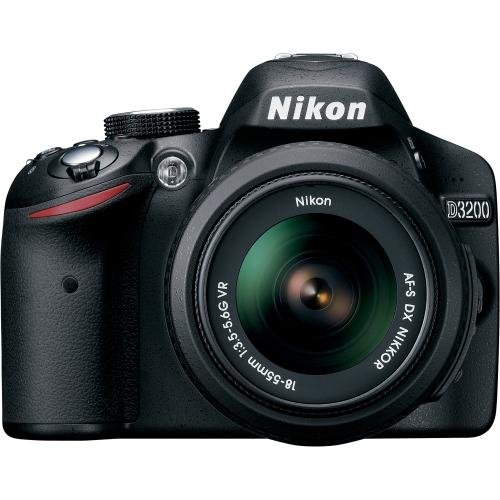
The Nikon D3200 is the defining budget-tier entry into interchangeable-lens photography. Its 24.2-megapixel DX-format CMOS sensor paired with the EXPEED 3 processor produces image quality that punches well above the cost—shot well, these images can easily hang with cameras costing three times as much. The 18-55mm f/3.5-5.6 AF-S DX VR kit lens includes vibration reduction, letting you shoot handheld at slower shutter speeds.
One-touch Full HD 1080p video recording is a welcome convenience for a body this old, and the 3.0-inch 921K-dot LCD is sharp and responsive. ISO sensitivity ranges from 100 to 6400 (expandable to 12800), giving you usable performance in moderate low light. The refurbished unit comes with a 90-day warranty and the original accessories, making this a low-risk way to start shooting.
Its 11-point autofocus system is the most basic in this lineup, requiring you to focus-and-recompose for off-center subjects. There’s no Wi-Fi, no touchscreen, and no 4K video. The D3200 deliberately leaves you wanting a faster AF system and wireless convenience—which is exactly how it hooks you into the hobby. If your goal is maximum camera for minimum money, this is the definition.
Why it’s great
- 24.2MP DX sensor and EXPEED 3 processor produce surprisingly high image quality for the cost
- VR kit lens enables handheld shooting in dimmer conditions
- Certified refurbished with warranty makes it the cheapest path to a dedicated camera
Good to know
- 11-point AF system limits off-center composition flexibility
- No Wi-Fi, touchscreen, or 4K video capability
- Refurbished unit may have minor cosmetic blemishes or generic accessories
FAQ
What does the kit lens focal range mean for a beginner?
Should I buy a refurbished camera for my first body?
What is the difference between DSLR and mirrorless for a beginner?
How many megapixels do I really need as a beginner?
Final Thoughts: The Verdict
For most users, the best basic camera for beginners winner is the Canon EOS R8 because it delivers full-frame image quality, professional-grade autofocus, and 4K60p video in the lightest RF-mount body available—all at a price that undercuts comparable full-frame competitors. If you want a stabilized hybrid body for video and stills, grab the Panasonic LUMIX G85. And for absolute budget entry, nothing beats the Nikon D3200 for putting a 24-megapixel DSLR in your hands at the lowest possible cost.