
A basic printer should be a tool you forget exists until you need it. Instead, most cheap inkjets turn into expensive paperweights the moment you stop printing for two weeks — clogged nozzles, dried cartridges, and driver conflicts that waste a Sunday afternoon. The right choice for a basic printer is the one that eliminates those predictable failures before they happen.
I’m Min — the co-founder and writer behind Gadgets Feed. I’ve spent hundreds of hours cross-referencing real customer experiences across budget inkjets, laser monochrome workhorses, and all-in-one wireless units to isolate which models actually survive the first six months of ownership without frustrating their owners into a replacement purchase.
Whether you need to print homework assignments, shipping labels, or tax forms a few times a month, finding a reliable basic printer means looking past advertised page-per-minute claims and focusing on real-world setup ease, ink or toner cost sustainability, and connectivity that doesn’t degrade after a firmware update.
How To Choose The Best Basic Printer
When shopping for a basic printer, the biggest mistake is assuming all sub- models deliver similar reliability. The real differentiators are print engine type (laser vs. inkjet), running cost per page, and connectivity consistency over time. Here are the four factors that separate a keeper from a frustration purchase.
Print Technology: Inkjet vs. Laser
Inkjets dominate the entry-level space because the hardware is cheap to manufacture — the business model recoups margin on consumables. If you only print a few black-and-white pages per week, a monochrome laser printer like the HP LaserJet M207dw avoids dried ink clogs entirely and delivers sharper text at a lower cost per page. Inkjets remain the right choice if you need occasional color prints or borderless photos.
Total Cost of Ownership Beyond the Box
Starter cartridges included in the box typically hold 40-60% of the ink or toner a standard cartridge contains. This means your effective cost per page doubles after the first replacement. Models using four separate color cartridges (cyan, magenta, yellow, black) let you replace only the depleted color instead of discarding a combined unit that still holds usable ink of another color.
Wireless Reliability and App Ecosystem
Many budget printers rely on proprietary apps for setup and daily use. The best basic printers in this segment maintain stable Wi-Fi connections without requiring a router reboot every few weeks. Look for units that support AirPrint and Mopria out of the box — these standards eliminate the need for a brand-specific app on mobile devices.
Automatic Document Feeder vs. Flatbed Only
An Automatic Document Feeder (ADF) transforms an all-in-one from a single-page scanner into a tool that digitizes multi-page contracts or receipts without babysitting. If you scan invoices or homework packets regularly, a 20- to 35-sheet ADF justifies its footprint. If your scanning needs are occasional, a flatbed-only model saves space and cost.
Quick Comparison
On smaller screens, swipe sideways to see the full table.
| Model | Category | Best For | Key Spec | Amazon |
|---|---|---|---|---|
| Brother MFC-J1360DW | Color Inkjet All-in-One | Home office with light color printing | Automatic duplex + 16 ppm B&W | Amazon |
| Epson WorkForce Pro WF-3823 | Color Inkjet All-in-One | Heavy home workloads | 21 ppm B&W + 35-page ADF | Amazon |
| Canon PIXMA TS7720 | Color Inkjet All-in-One | Compact home photo printing | 15 ppm B&W + 2.7″ touchscreen | Amazon |
| Canon PIXMA TR7120 | Color Inkjet All-in-One | Budget-friendly duplex scanning | ADF + automatic duplex + OLED | Amazon |
| HP LaserJet M209d | B&W Laser | Reliable monochrome printing | 30 ppm B&W, wired USB only | Amazon |
| Brother MFC-J1410DW | Color Inkjet All-in-One | Full-featured home office | 2.7″ touchscreen + ADF + fax | Amazon |
| HP LaserJet M207dw | B&W Laser Wireless | Small office with wireless needs | 28 ppm B&W + dual-band Wi-Fi | Amazon |
In‑Depth Reviews
1. Brother MFC-J1360DW
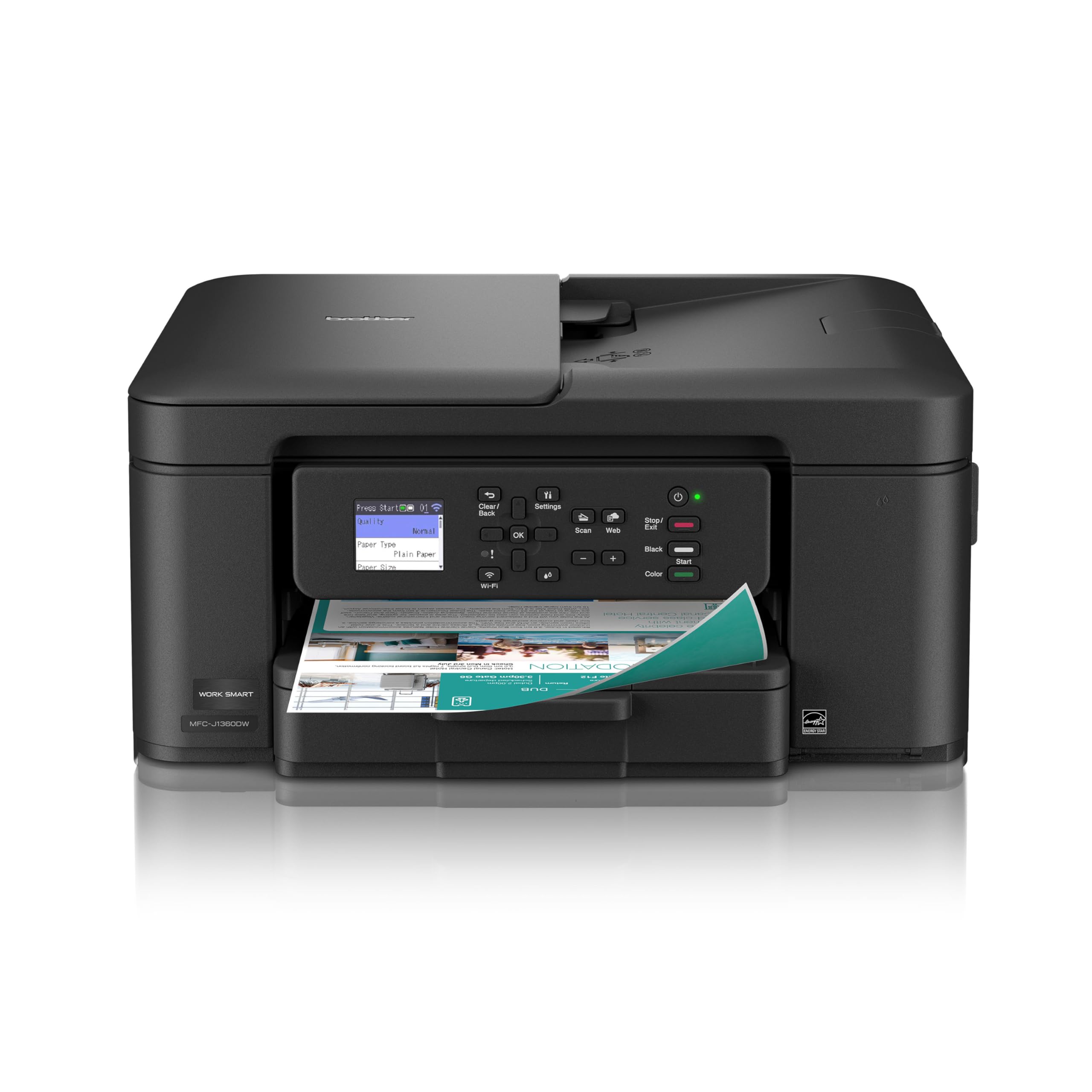
The Brother MFC-J1360DW delivers the best balance of features, reliability, and ink economics in the sub- inkjet category. Its automatic duplex printing and 20-sheet ADF make multi-page document handling genuinely productive, and the 1.8-inch color display simplifies cloud app navigation for scanning to Google Drive or Dropbox. Customers consistently rate its print quality as crisp for both text and color, and the wireless connectivity — once configured — holds stable without periodic reconnection headaches.
The 150-sheet input tray handles a typical week of home office output without constant refilling, while the 16 ppm black and 9 ppm color speeds feel adequate for a printer at this tier. The included starter cartridges deliver enough volume to evaluate real-world yield before committing to standard LC501 replacements, which are reasonably priced compared to competing ink families. The initial setup process requires downloading the full driver package rather than relying solely on the quick-start software, but the Brother Mobile Connect app provides ongoing management that owners find intuitive.
For a basic printer that covers print, copy, and scan duties with minimal drama, the J1360DW earns its position through the combination of duplexing, cloud connectivity, and a support ecosystem that doesn’t abandon users after a firmware push. It’s not the fastest inkjet on this list, but it is the most consistently dependable at its price point.
Why it’s great
- Automatic two-sided printing is rare at this price
- Competitive ink cost with LC501 cartridges
- Stable wireless connectivity after initial setup
Good to know
- Setup requires full driver package, not plug-and-play for all users
- Touchscreen is smaller than premium models
2. Epson WorkForce Pro WF-3823

The Epson WorkForce Pro WF-3823 is built around PrecisionCore Heat-Free Technology, which delivers the fastest print speeds in this roundup at 21 pages per minute in black and 11 in color. The 250-sheet paper capacity and 35-page ADF are noticeably higher than typical entry-level inkjets, making this a printer that can handle small-office volumes without paper tray anxiety. The 2.7-inch color touchscreen and Epson Smart Panel app provide responsive control for navigation and scanning workflows.
DURABrite Ultra instant-dry pigment inks produce professional-quality prints that resist smudging on plain paper, a significant advantage if you handle documents immediately after printing. The auto-duplex printing is standard, and Ethernet is included alongside wireless and Wi-Fi Direct, giving you flexibility in office network configurations. Customer feedback highlights that the starter cartridges last well over 100 pages, providing a genuine evaluation period before investing in standard-yield T822 replacements.
The main trade-off is that some units experience paper feed inconsistencies in the ADF, with occasional multi-page pulls during scanning. Additionally, Epson’s firmware strongly enforces genuine cartridge usage, and non-genuine ink can void the warranty. For users who prioritize speed and paper handling over absolute reliability in the document feeder, the WF-3823 delivers premium throughput at a mid-range price.
Why it’s great
- Fastest print speed in this comparison
- Large 250-sheet paper tray reduces refill frequency
- Instant-dry pigment inks prevent smearing
Good to know
- ADF may pull multiple pages on some units
- Starter setup instructions could be clearer for non-technical users
3. Canon PIXMA TS7720

Canon’s PIXMA TS7720 occupies a specific niche: a compact, white-bodied all-in-one designed for home users who prioritize design aesthetics and a large touchscreen interface. The 2.7-inch LCD touchscreen is the best display in this price tier, providing clear menus for switching between print, copy, and scan modes without digging through a phone app. Print speeds of 15 ppm black and 10 ppm color are competitive for the category, and the two-cartridge hybrid ink system (PG-285 black, CL-286 color) reduces the number of replacements you need to stock.
The automatic duplex printing works reliably, and the flatbed scanner handles documents and photos with adequate resolution for home archiving. Setup takes around 25 minutes if you use the USB cable (not included), though the wireless setup can be finicky for users who rush through the process. Customer reviews consistently note that running a weekly print cycle prevents nozzle clogging, a common complaint with infrequently used inkjets across all brands.
The trade-off for the low entry price is that starter cartridges deplete quickly — several users report the initial set running out after only a few days of moderate use. Standard-yield replacements must be purchased sooner than expected, so the total six-month cost of ownership is higher than the box price suggests. For buyers who need occasional color prints and appreciate a large screen, the TS7720 delivers the best interface experience in the entry-level segment.
Why it’s great
- Best-in-class 2.7-inch touchscreen interface
- Sleek, compact design fits small workspaces
- Two-cartridge system simplifies ink management
Good to know
- Starter cartridges run out quickly
- Wireless setup can be inconsistent
4. Canon PIXMA TR7120

The Canon PIXMA TR7120 packs automatic duplex printing and a 20-sheet ADF into a compact white chassis at a price that undercuts most competitors with the same feature set. The 1.42-inch monochrome OLED screen provides glanceable ink level and status information without the power draw of a full color LCD. Print speeds of 14 ppm black and 9 ppm color are adequate for typical home or hybrid worker output, and dual-band Wi-Fi (2.4 GHz and 5 GHz) gives you flexibility in congested wireless environments.
The four-cartridge hybrid ink system (cyan, magenta, yellow, black) means you replace only the depleted color individually, a significant cost advantage over two-cartridge designs that force you to discard usable ink. The Canon PRINT app supports AirPrint and Mopria for driverless mobile printing, and initial customer reports indicate very few “printer offline” errors compared to earlier Canon generations. The paper tray holds approximately 100 sheets, and users report zero jams through several hundred printed pages.
The trade-off is that replacement ink costs are higher than third-party options, and Canon’s firmware actively discourages non-genuine cartridges. For light to moderate home use — especially if scanning multi-page documents via the ADF is a regular task — the TR7120 offers the most feature-dense package for the money. It is not a high-volume machine, but for a basic printer that handles occasional duplex copying and scanning, the value proposition is hard to beat.
Why it’s great
- ADF and duplex at a very competitive price
- Individual color cartridges reduce waste
- Compact footprint fits tight desks
Good to know
- Starter ink depletes faster than standard yield
- OLED screen is monochrome and small
5. HP LaserJet M209d
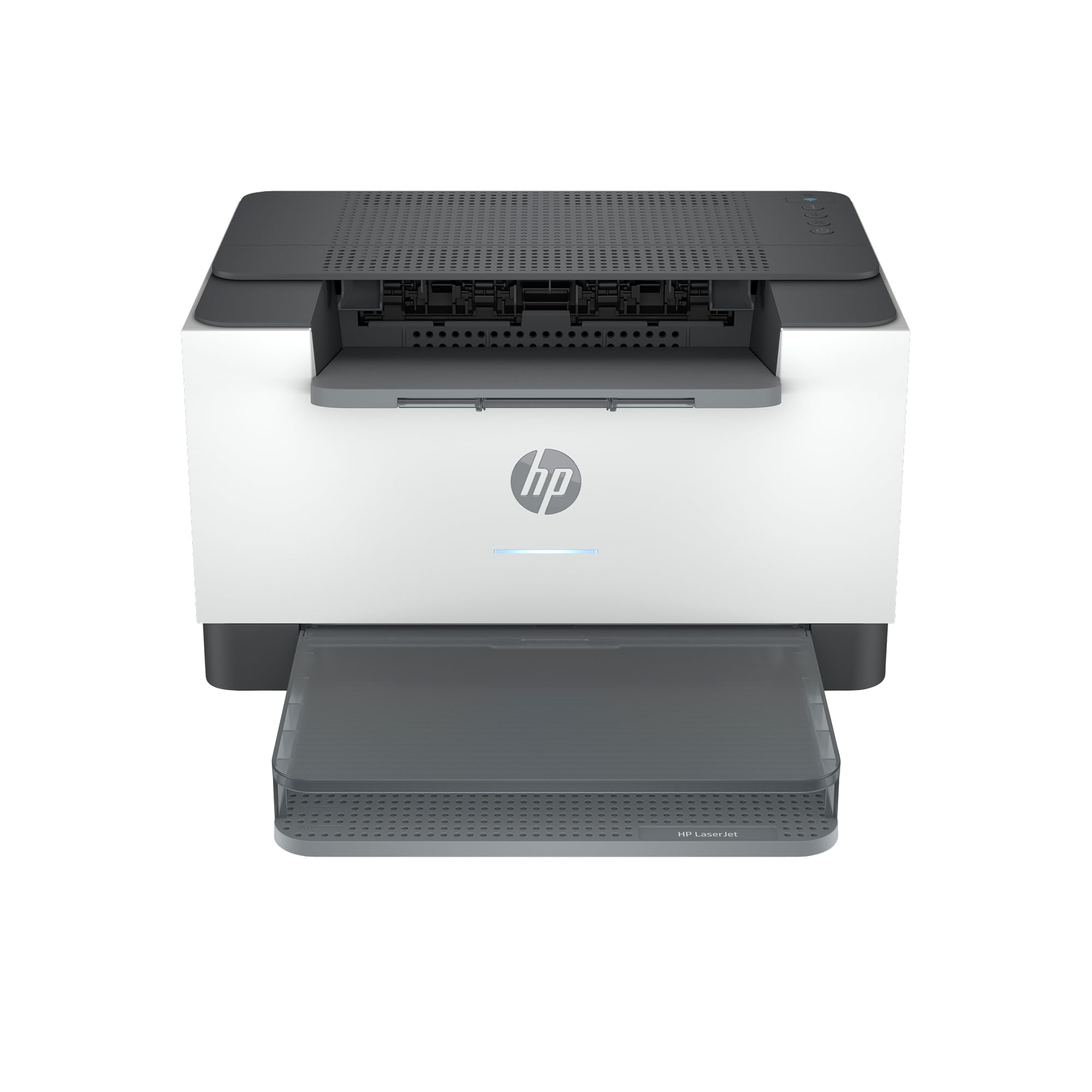
The HP LaserJet M209d is the antithesis of complicated wireless inkjets: a wired-only monochrome laser printer that connects via the included USB cable and just works. It produces 30 pages per minute in black, making it the fastest printer in this comparison, and automatic duplexing is standard. The absence of Wi-Fi is deliberate — it eliminates the most common source of printer frustration (network connectivity drops) and makes this ideal for dedicated single-PC setups or environments where security-conscious users prefer a hardwired connection.
The compact footprint (8.07 inches wide by 11 inches deep) fits comfortably on a small shelf, and the 150-sheet input tray handles moderate monthly volumes without constant refilling. Sharp text output on plain paper is a hallmark of laser technology, and the toner cartridge yields significantly more pages than any inkjet starter set before requiring replacement. HP’s smart-guided buttons and LCD display make walk-up operations intuitive, and the printer includes a dust cover to protect the paper path between uses.
The critical limitation is Mac compatibility — the M209d does not support macOS versions 12 and later according to multiple verified customer reports, so this is effectively a Windows-only or Linux-only device unless you run a virtual machine. Additionally, the printer lacks any network interface, so sharing across multiple computers requires physical USB switching. For Windows users who want a reliable monochrome laser that never suffers ink clogs or Wi-Fi resets, the M209d delivers uncompromising print reliability at a premium price.
Why it’s great
- Fastest print speed at 30 ppm B&W
- No wireless connectivity issues ever
- Low cost per page with standard toner
Good to know
- USB-only, no wireless or Ethernet
- Not compatible with Mac OS 12 and later
6. Brother MFC-J1410DW
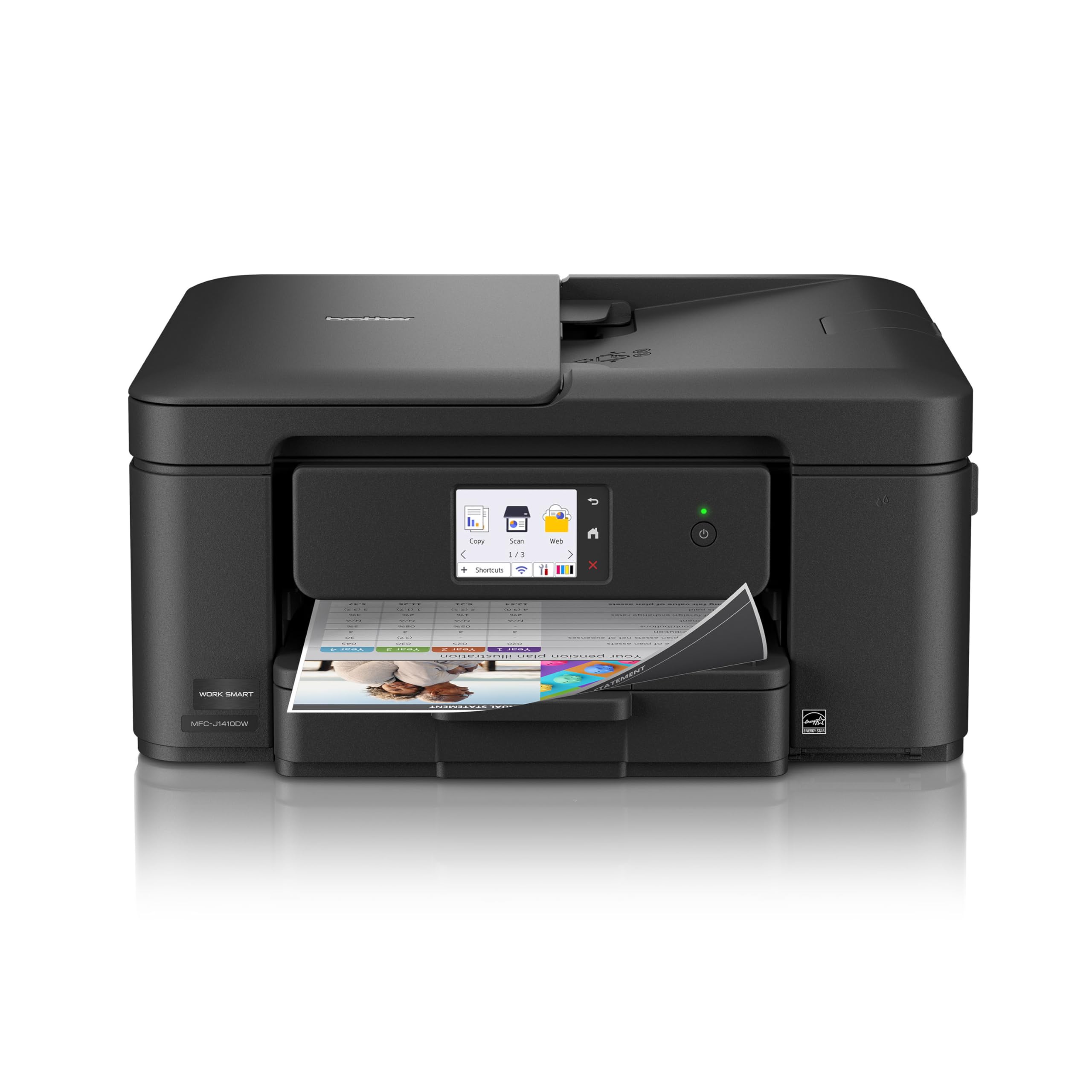
The Brother MFC-J1410DW is the most fully-featured all-in-one in this lineup, adding fax capability to the standard print, copy, and scan functions while upgrading the display to a 2.7-inch color touchscreen. This is the same cloud app integration found on the J1360DW — printing from and scanning to Google Drive, Dropbox, OneDrive, and Box — but with a larger, more responsive interface that reduces menu navigation time. The 20-sheet ADF handles multi-page documents, and automatic duplex printing is included.
Print speeds match the J1360DW at 16 ppm black and 9 ppm color, but customers report that the J1410DW runs quieter during operation and produces first-page-out times that feel snappier in practice. The 150-sheet paper tray is adequate for home office use, and the Brother Mobile Connect app provides ongoing ink level monitoring via the Page Gauge feature. Over six months of moderate use, some owners report the initial cartridges still have ink remaining, suggesting the starter yield is generous compared to other brands.
The main concern from verified purchasers is quality control inconsistency — a small but vocal set of customers experienced paper jams or functional failure within weeks, and Brother’s customer service response times were slow in those cases. The operating noise is also slightly higher than the Canon inkjets, noticeable during batch printing. For buyers who need fax capability in a basic printer and value the cloud integration ecosystem, the J1410DW offers the broadest feature set in this comparison, albeit with a slightly higher gamble on individual unit reliability.
Why it’s great
- Largest 2.7-inch color touchscreen in this tier
- Includes fax function for legacy office needs
- Generous starter cartridge ink yield
Good to know
- Quality control can be inconsistent between units
- Audible printing noise during operation
7. HP LaserJet M207dw

The HP LaserJet M207dw solves the main limitation of the M209d by adding dual-band Wi-Fi with a self-reset feature that automatically detects and resolves connectivity drops. It prints 28 pages per minute in black and white, just two pages shy of the wired M209d, and the automatic duplex printing is the fastest in its class for two-sided output. The printer supports printing from any device via AirPrint, Mopria, Android, Chromebook, and Windows, making it the most universally compatible model in this comparison.
Security-conscious buyers will appreciate the built-in protection features that guard against network-based attacks, a consideration often overlooked in basic printers. The 150-sheet input tray and integrated Ethernet port provide wired redundancy if wireless performance degrades. Customer reviews consistently highlight the setup as extremely straightforward — several users report printing within minutes of unpacking without needing to download a bloated software suite. The compact black chassis fits small offices without dominating the workspace.
The trade-offs are specific to power users: the printer forces duplex printing from iPhones without a simple manual override option, there is no legal-size paper tray, and envelope loading requires following a multi-step process that is poorly documented in the quick-start guide. The included toner cartridge is standard-yield rather than high-capacity, so heavy users will need a replacement sooner than expected. For a small office or home that needs reliable monochrome laser printing without Wi-Fi headaches, the M207dw is the best wireless-enabled basic printer in this segment.
Why it’s great
- Dual-band Wi-Fi with auto-reset for stable connectivity
- Universal mobile printing support
- Fast two-sided laser output
Good to know
- No legal-size paper tray
- iPhone duplex can’t be turned off
FAQ
How often should I print to prevent inkjet nozzle clogs?
Why does my basic printer show offline even though it’s connected to Wi-Fi?
What is the difference between starter ink cartridges and standard-yield cartridges?
Can I use third-party ink cartridges in my basic printer?
Final Thoughts: The Verdict
For most users, the best basic printer winner is the Brother MFC-J1360DW because it combines automatic duplex printing, a 20-sheet ADF, and stable wireless connectivity at a price that doesn’t punish you on replacement ink costs. If you want a pure monochrome workhorse that never clogs, grab the HP LaserJet M207dw for wireless laser reliability. And for the best feature-per-dollar ratio in an all-in-one with duplex scanning, nothing beats the Canon PIXMA TR7120.