
A basic programmable thermostat should be the easiest upgrade you make to your home — set it once, and it quietly manages your heating and cooling on autopilot. The problem is that many models bury simple scheduling behind menus designed by engineers, turning a five-minute job into a frustrating session with a manual. The best models in this category prioritize immediate usability alongside reliable temperature swings, letting you define weekday and weekend comfort windows without a learning curve.
I’m Min — the co-founder and writer behind Gadgets Feed. I’ve spent countless hours combing through real customer feedback and technical datasheets to separate the genuinely straightforward thermostats from those that just look simple on the box.
If you want to walk away from this guide knowing exactly which model delivers hassle-free programming for your single-stage system, you’ve landed on the right resource for finding the best basic programmable thermostat.
How To Choose The Best Basic Programmable Thermostat
For a single-stage forced-air system, the thermostat’s job is simple — hold a schedule and switch between heat and cool reliably. But a few spec-level decisions separate a seamless experience from one that leaves you tweaking settings every season. Focus on system compatibility first, then on the scheduling type that fits your routine.
System Compatibility: Single-Stage vs. Everything Else
Every thermostat in this guide is designed for conventional single-stage systems (1H/1C). None support multistage heat pumps, electric baseboard heating (120–240V), mini-splits, or dual-fuel hybrid setups. Before buying, verify your furnace or air handler matches the R, C, W, Y, G terminal labeling. If you see terminals labeled W2, Y2, O/B, or E, you need a different thermostat entirely. Most basic models also require a maximum of 2–5 wires; 6–8 wire setups indicate a need for a more advanced unit.
5-2 Day vs. 7-Day Programming
A 5-2 day thermostat lets you set one schedule for Monday through Friday and a separate schedule for Saturday and Sunday. This covers roughly 90% of household routines — you wake, leave, return, and sleep at similar times on workdays. A 7-day model (like the Lux LTX100E) is better if your schedule shifts daily. Note that more days often mean more button presses to set up; 5-2 tends to be faster to program and less prone to user error.
Quick Comparison
On smaller screens, swipe sideways to see the full table.
| Model | Category | Best For | Key Spec | Amazon |
|---|---|---|---|---|
| Honeywell Home RTH20B | Premium | Easiest 5-2 setup & filter reminders | 5-2 Day Schedule | Amazon |
| Emerson 1F78-151 | Mid-Range | Durable, proven 5-2 reliability | ±1°F Accuracy | Amazon |
| Honeywell TH2110DV1008 | Premium | Simple vertical design, bright green backlight | 4 Periods/Day | Amazon |
| Lux LTX100E | Mid-Range | 7-day scheduling with keypad lock | 7-Day Programmable | Amazon |
| Suuwer S705 | Budget | 5-1-1 day with separate heat/cool swings | 0.2–2°F Swing | Amazon |
| Heagstat H701W | Budget | Ultra-simple non-programmable, large display | 4.5-inch LCD | Amazon |
| Miuputake 3001-Blue | Budget | Simple non-programmable, elderly-friendly | ±1°F Accuracy | Amazon |
In‑Depth Reviews
1. Honeywell Home Programmable Thermostat RTH20B
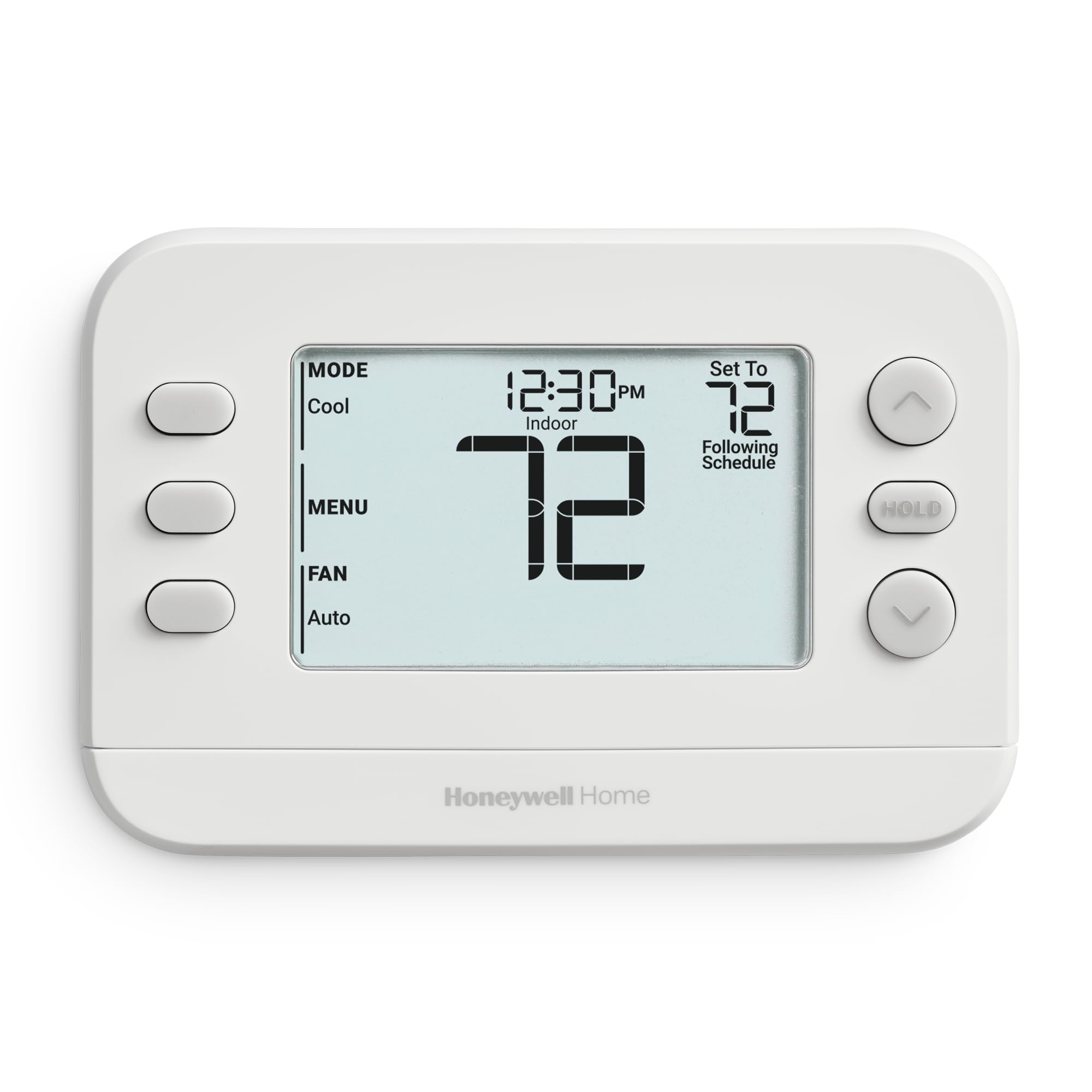
The Honeywell RTH20B earns the top spot by delivering the cleanest programming experience among all models here. Its 5-2 day schedule is set via clear on-screen prompts, and the Universal Wall Plate (UWP) makes swapping an old thermostat a tool-friendly process — no wall anchors to re-drill in most cases. The large, easy-to-read display and customizable settings like change filter reminders add real value without complexity. It’s a direct replacement for the older RTH2300, so long-time Honeywell users will feel right at home.
Performance-wise, the RTH20B handles single-stage forced air, hot water heat (750 mV), and gas/oil/electric furnaces with equal stability. The extended 32°F low-heat setpoint is a welcome touch for colder basements or vacation homes. Users consistently note the backlit display is sharp in both daylight and dark hallways. The only common criticism is that the “smart” adaptive recovery feature can overshoot slightly — easily disabled in the menu for those who prefer strict scheduled start times.
At this price range, you’re getting Honeywell’s refinement edge — the menu logic is more intuitive than the Suuwer or Lux offerings, and the build quality feels denser than the Heagstat or Miuputake units. If you want a single-stage thermostat that disappears into your wall and just works, this is it.
Why it’s great
- Universal installation plate simplifies swap from almost any brand
- Air filter reminder helps keep HVAC maintenance on track
- Backlit display with large, clear fonts for easy reading
Good to know
- Adaptive recovery may turn on HVAC earlier than scheduled time
- Clock text is relatively small on the display
- Requires 2 AA batteries (not included)
2. Emerson Thermostats 1F78-151 Single-Stage Programmable
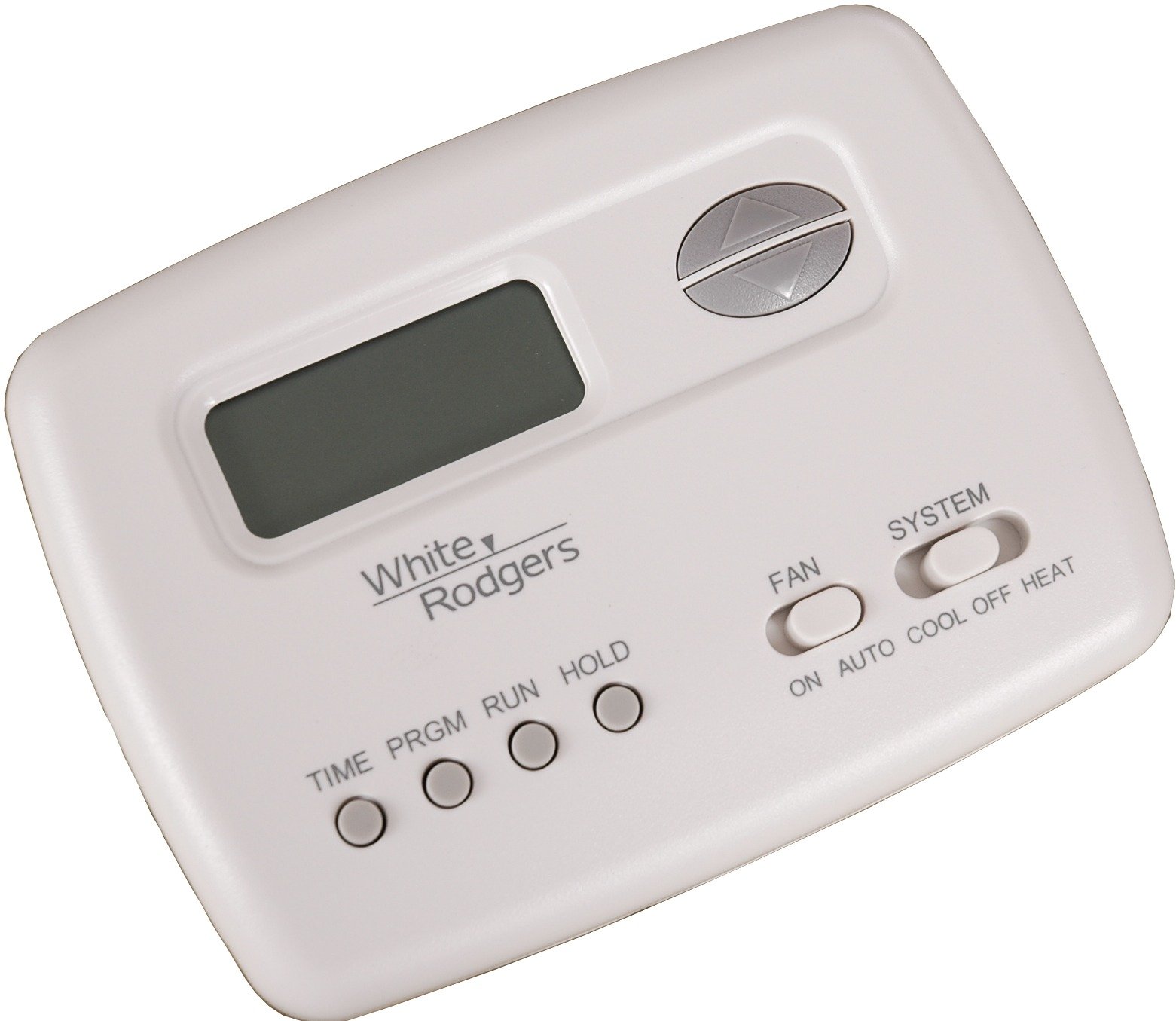
The Emerson 1F78-151 has been a staple in the basic programmable category for years, and its longevity on the market is a testament to reliable engineering. The 5-2 day scheduling is straightforward: you program four periods (Wake, Leave, Return, Sleep) for weekdays and a separate set for weekends. The gray LCD with amber backlight is easy on the eyes at night without being overly bright. It runs on two included AAA batteries, so no C-wire is needed.
Temperature accuracy is rated at ±1°F, and the Energy Management Recovery (EMR) feature calculates when to start heating or cooling to reach your set temperature exactly at the scheduled time. The terminals are a bit cramped — users with thicker 18-gauge wires may struggle — but once connected, the unit holds its schedule through power outages without losing settings. Many users report decade-long lifespans with zero issues.
What keeps the Emerson from the top spot is the lack of a backlight on some units (the amber glow is present but dim compared to modern LEDs) and the 5-2 limitation if you need a fully custom 7-day schedule. For a rock-solid, no-nonsense 5-2 experience, though, this remains a gold standard.
Why it’s great
- Proven durability with many units lasting over 5 years
- EMR feature auto-adjusts start times for comfort and efficiency
- Battery-powered with included AAA batteries
Good to know
- Wiring terminals are small and can be fiddly
- Backlight is amber and relatively dim
- Only 5-2 day scheduling, not 7-day
3. Honeywell TH2110DV1008 PRO 2000 Vertical Programmable

The PRO 2000 series from Honeywell is built for pros who value a no-fuss install — and it shows in the vertical form factor that fits tight spaces near door frames. The TH2110DV1008 supports up to 4 programmable periods per day with a 5-2 schedule split. The display defaults to showing the current room temperature, and a bright green backlight makes it readable from across the room in total darkness. Many users upgrading from older Honeywell non-programmable models report the mounting plate matches perfectly, allowing a 10-minute swap.
This thermostat is strictly for single-stage 1H/1C systems and heat pumps without auxiliary heat. It does not require a C-wire, running on battery power alone (two AA batteries). The programming interface is more utilitarian than the RTH20B — you hold down buttons to enter setup mode — but it’s consistent and once set, rarely needs adjustment. Customer reviews highlight its accuracy and reliability, with multiple units running for years without recalibration.
The main trade-off is the lack of advanced features like filter reminders or swing adjustments. If you want the simplest possible 4-period programmable that looks clean and supports a vertical orientation, this Honeywell delivers exactly that without bloat.
Why it’s great
- Quick DIY swap from older Honeywell models using same mounting plate
- Bright green backlight visible in pitch-dark rooms
- Compact vertical design saves space on small walls
Good to know
- No filter change reminder or advanced swing settings
- Programming requires holding down buttons — not as intuitive
- Battery-only power (no optional 24VAC input)
4. Lux LTX100E Programmable 7 Day Thermostat

The Lux LTX100E stands alone in this list as the only model offering true 7-day programming at the same price point as many 5-2 competitors. Each day can have 2 or 4 periods, giving you maximum flexibility if your daily schedule shifts. The backlit display is clean and clearly legible, and the keypad lock (passcode-protected) is a rare bonus for this price tier — useful in rental properties or households where you want to prevent unauthorized temperature changes.
Setup is straightforward via button navigation, though the menu system for advanced settings (like the 0.5°F calibration offset) is numbered rather than labeled, requiring a manual look-up. Customers report the unit works reliably for years; one review noted it running correctly after nearly a decade. It supports single-stage systems 1H/1C and is battery-operated (2 AA batteries).
The biggest drawbacks are the lack of a real-time display showing the set temperature — you must enter programming mode to see it — and the restriction to whole-degree increments (no 0.5°F set points even though internal circuitry supports it). For users who need 7-day granularity on a budget, though, this is unmatched.
Why it’s great
- Full 7-day programming at an entry-level price
- Keypad lock with passcode protects settings from tampering
- Backlit display is bright and easy to read
Good to know
- Set temperature not shown on main screen — must enter menu
- Only sets whole degrees, not half-degree increments
- Advanced settings menu uses numbered codes, requires manual
5. Suuwer S705 5-1-1 Day Programmable Thermostat

The Suuwer S705 uses a 5-1-1 schedule format — separate programs for weekdays, Saturday, and Sunday. This is a small but meaningful upgrade over a basic 5-2 if your Saturday and Sunday routines differ significantly. It offers 4 program periods per day (Wake, Leave, Return, Sleep) and features separate heating and cooling swing adjustments from 0.2°F to 2°F, allowing you to fine-tune how often the system cycles. The blue backlight provides good contrast, and the large digital numbers are senior-friendly.
The dual power option (24VAC or 2 AAA batteries) means it works on systems without a C-wire, though heat-only or cool-only systems still require a common wire. The built-in filter change reminder and compressor delay protection (selectable 5-minute delay) are value-adds typically found on pricier units. Installation is straightforward for standard 4-wire systems, and the included mounting hardware is adequate.
Where the Suuwer falls short is the menu navigation — entering the advanced settings by holding the “Tech” button reveals parameters that require a bit of research to understand. The plastic build feels lighter than the Honeywell or Emerson alternatives. But for the price, you get more scheduling flexibility and cycle control than any other unit near this price tier.
Why it’s great
- 5-1-1 schedule for differentiated weekend programming
- Adjustable swing from 0.2°F to 2°F for cycle tuning
- Filter change and low battery reminders included
Good to know
- Advanced menu hidden behind Tech button, not beginner-friendly
- Plastic housing feels less substantial than premium models
- No backlight timeout customization
6. Heagstat H701W Non-Programmable Thermostat
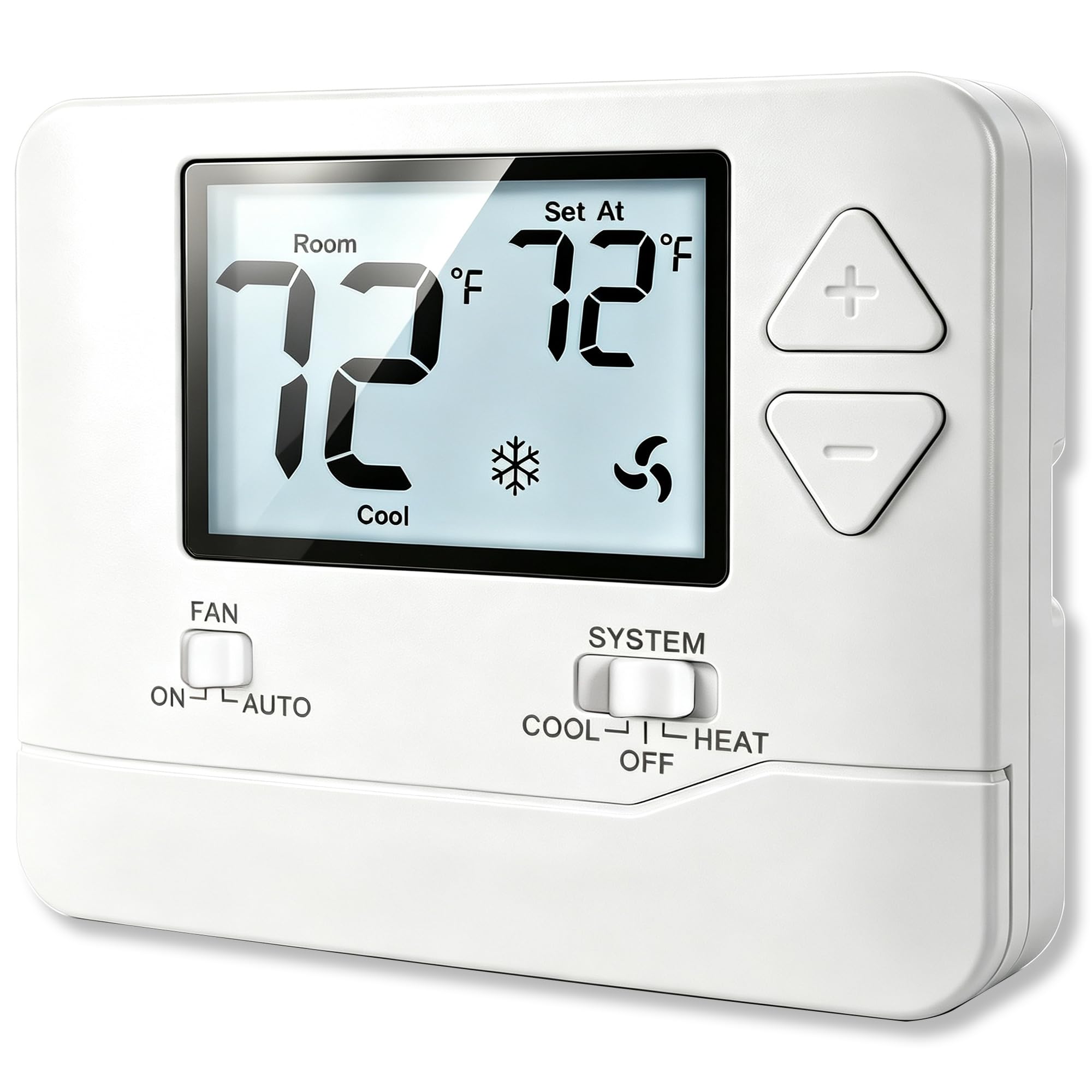
Sometimes the best “programmable” thermostat is one that doesn’t program at all — just a simple Heat/Off/Cool rocker and a giant temperature readout. The Heagstat H701W fills exactly that niche with a 4.5-inch backlit LCD screen that’s arguably the most readable display in this entire roundup. Its minimalist off-white body blends into any wall, and the dual power design (24VAC or 2 AAA batteries) means it works on nearly any single-stage system without a C-wire.
For landlords or households where elderly users or tenants found previous smart thermostats confusing, this model is a relief. The ±1°F accuracy is standard for the class, but the separate heating and cooling swing adjustment (0.2°F–2°F) is unusual for a non-programmable unit. The 5-minute compressor delay protection is also selectable. Calibration is adjustable from -4°F to +4°F, helpful if the wall location runs warm or cool.
The trade-off is obvious: no schedule means you have to manually adjust the temperature each time you want a change. This can lead to wasted energy if you forget to lower the setpoint before leaving. But for users who prioritize dead-simple operation over automated savings, the Heagstat delivers the best visual clarity and easiest physical interaction of any thermostat here.
Why it’s great
- Massive 4.5-inch LCD is the most readable display tested
- Heat/Off/Cool switch — no menu digging to change mode
- Cycle rate adjustments available even in non-programmable format
Good to know
- No scheduling — must be adjusted manually for energy savings
- Only supports 1H/1C single-stage systems
- 2 AAA batteries not included
7. Miuputake 3001-Blue Non-Programmable Thermostat
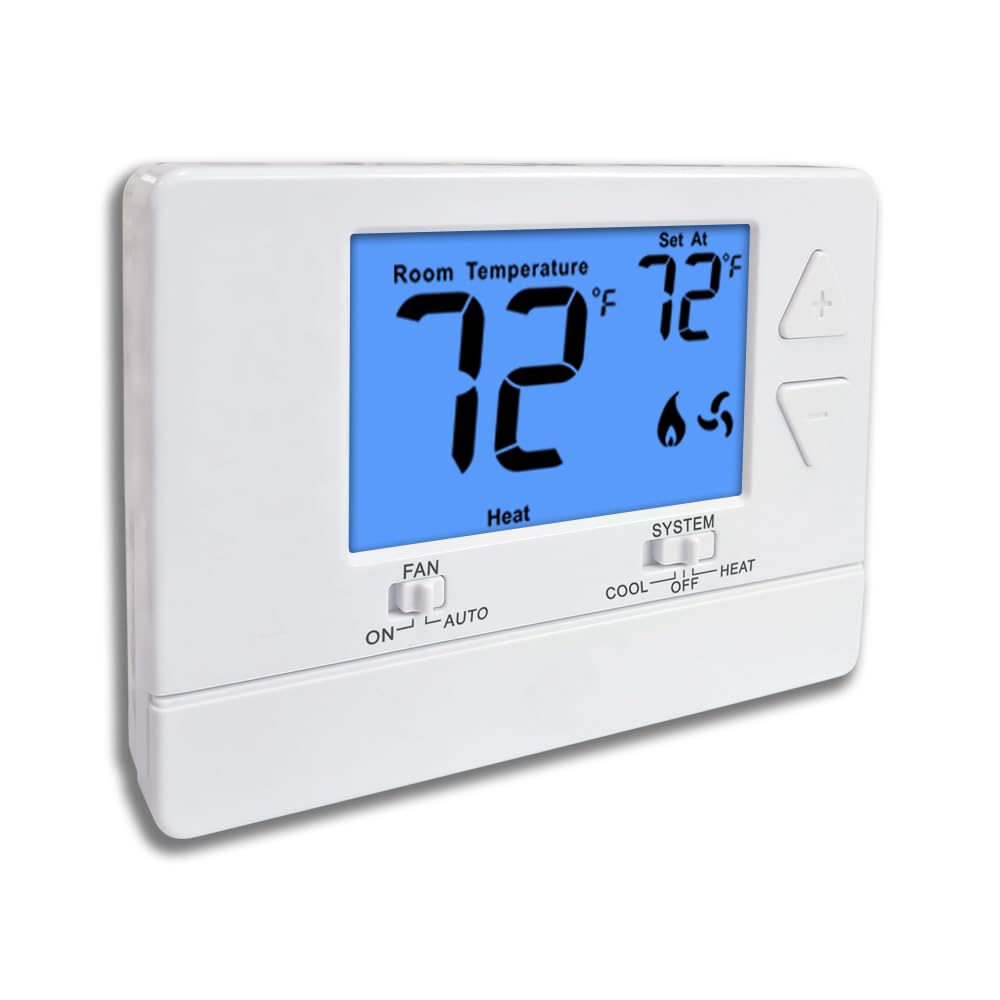
The Miuputake 3001-Blue is the most affordable option in this guide, and it shows exactly where corners are cut — and where they’re not. The trade-off is simplicity: this is a non-programmable thermostat with an up/down rocker and a clear LCD with blue backlight. It runs on 24VAC or 2 AA batteries, and the large terminal blocks with labeled wiring diagrams make it one of the easiest models to install for a first-timer. The screen dims automatically when not in use, which is a nice touch at this price point.
System compatibility is limited to single-stage 1H/1C setups, and the wiring base only supports 2–5 wires (no 6+ wire connections). It features separate heating and cooling swing adjustments, a low battery indicator, and compressor delay protection. The ±1°F accuracy is consistent with the category, and the temperature control range runs from 44°F to 90°F. Several reviews mention this unit replaced problematic smart thermostats and immediately solved confusion for elderly family members.
The main downsides are the lack of any programming ability and the matte plastic finish that shows fingerprints. The push-button controls are responsive but offer no tactile click feedback. If you need a reliable drop-in replacement for a basic non-programmable thermostat and you don’t care about scheduling, this is the best deal available.
Why it’s great
- Lowest entry point with reliable ±1°F accuracy
- Clear wiring labels make DIY installation approachable
- Auto-dimming backlight conserves battery and reduces night glare
Good to know
- No scheduling — entirely manual temperature control
- Matte plastic surface shows smudges easily
- Only accepts 2–5 wires, not suitable for complex systems
FAQ
Can I use a basic programmable thermostat with a heat pump?
Do I need a C-wire for a basic programmable thermostat?
Why does my thermostat show the wrong temperature?
Final Thoughts: The Verdict
For most users, the best basic programmable thermostat winner is the Honeywell Home RTH20B because it combines the most intuitive 5-2 programming experience with useful extras like filter reminders and a truly simple wall plate installation. If you want a proven workhorse that has been reliable for years, grab the Emerson 1F78-151. And for a dead-simple non-programmable option with the biggest, clearest display, nothing beats the Heagstat H701W.