
Our readers keep the lights on and my morning glass full of iced black tea. As an Amazon Associate, I earn from qualifying purchases.
Specs are compiled from manufacturer listings and verified buyer reviews and can change over time — please confirm the key details on the product page before buying.
Here is the short answer: buy a basin that is thick enough to hold its shape when the soil presses in and big enough to swallow your pump, its float, and the water that arrives in a rush. That is the whole decision. The catch is that most listings bury the two numbers that matter — opening diameter and capacity — under photos of a basin that is not the one in the box. This guide sorts them out so you dig once and never reopen the pit.
I’m Min — the founder and writer behind Gadgets Feed. This guide is built by comparing the manufacturers’ published specifications and the patterns across verified customer reviews, so you get each pick’s real strengths and trade-offs instead of marketing spin.
Every pit has one permanent constraint — the hole you cut in your slab or your crawl space floor. Choosing the right basin for sump pump duty means matching capacity to your pump’s float and the space you actually have.
Our Picks at a Glance


How To Choose The Best Basin For Sump Pump Duty
A sump basin is not a bucket. A bucket holds water because it has nowhere else to go. A sump basin holds water so a pump can move it, and it has to survive being buried in wet soil with a pump vibrating inside it for years. Get the two sizing numbers right and the rest is detail.
Opening Diameter vs Outside Diameter
This is the single most common mistake. When a listing says 18-inch basin, it usually means the outside rim is 18 inches across. The inside — where your pump and its float actually sit — is narrower. If you have a pump with a wide tethered float, a narrow inside diameter can mean the float hits the wall and never trips. Measure your pump first, then look for a basin whose inside opening clears it with room to spare.
Perforated Walls or Solid Walls
A perforated basin has holes already cut in the sides and bottom, so groundwater seeps in from every direction. A solid basin has nothing but an open top, which means you drill the holes yourself wherever you want them. Solid gives you control over where water enters and lets you route a discharge line out the side. Perforated saves you that labor but locks you into the hole pattern the factory chose.
Capacity and Your Outage Plan
Capacity matters most when the power is out. A bigger basin buys you time before the water rises to the rim. If you run a primary pump plus a battery-backup pump, the larger basins give both units room and keep their floats apart so they do not tangle. For a single pump in a low-water area, a medium basin does the job without requiring a boulder-sized hole in your floor.
Quick Comparison
| Model | Best For | Capacity | Opening / Diameter | Lid Included | Amazon |
|---|---|---|---|---|---|
| Parts2O FPW73-19 18-Inch Sump Basin★ Best Overall | Tethered-float pumps in tight pits | 20 gallons | 18″ opening diameter | No — sold separately | Amazon |
| Zoeller 31-0444 Sump Basin, 22-GallonBest for Dual Pumps | Dual-pump setups with backup | 22 gallons | 22″ top rim | No — sold separately | Amazon |
| Mindoub 13 x 10.2 x 15” Medium Perforated Basin and Lid Combo | Kitchen sinks and small crawl spaces | Medium (13″ x 10.2″ x 15″) | 13″ base width | Yes — pre-cut openings | Amazon |
| Memorywuu Sump Pump Basin with Lid Holes | Sewage and utility pump wells | 18.5″ x 16.9″ x 15.7″ basin | 48 drilled holes at 5/16″ | Yes — two 1.7-inch cover holes | Amazon |
| JACKEL SF22A Sump Basin | Radon and odor control with custom drilling | 22.5 gallons | 18″ ID x 24″ H | No — order separately | Amazon |
| JACKEL SF22A-DR Drilled Sump Basin | Commercial-grade primary sump pits | 22.5 gallons | 18″ ID x 24″ H | Optional — fits flush | Amazon |
| Crawl Space DIY 15 Gallon Perforated Basin with Lid | Low-clearance crawl spaces and yard drainage | 15 gallons | 18″ tall profile | Yes — snap-on | Amazon |
In‑Depth Reviews
1. Parts2O FPW73-19 18-Inch Sump Basin
Our pick — over 4.5★ from 100+ verified ratings; the strongest balance of quality and price.
A 20-gallon structural foam pit that resists soil pressure and holds its shape in a wet crawl space.
If your pump uses a tethered float — the kind that dangles on a cord and swings up to trigger — this is the basin that gives it room. The 18-inch opening diameter is specified against exactly that setup, so the float has clearance to rise without scraping the wall. Structural foam is the material here, which is a molded plastic with a dense cellular core rather than a thin rotomolded shell. At 2 pounds it is light enough to lower into a hole by hand.
The 20-gallon capacity is the reason it holds up under dual-duty setups. Owners run one of these in a crawl space with a 1/3 HP Zoeller pump feeding a battery backup on the side, backfilling with rock over filter paper, and it takes the load without bowing. The customer reviews are remarkably consistent on the sturdiness: the pit is stiff enough that it does not deform under the weight of the soil around it.
Here is the catch, and it is worth stating plainly. The basin arrives with no pre-cut holes. You drill them yourself. Buyers also report that the depth runs deeper than the listing advertises — “This basin is actually 20″ deep, and not the same as this picture.” Plan your pit depth around the physical basin, not the spec sheet.
Where it earns its keep
- 18-inch opening clears a tethered float without interference
- Structural foam resists soil pressure better than thin plastic buckets
- 20-gallon capacity handles a primary pump plus backup
What to plan around
- No pre-cut holes — bring a hole saw and drill your own pattern
- Actual depth runs deeper than the listing suggests
- No matching manufacturer grate — a third-party cover needs to be sourced
Reach for this if: you want the highest-rated basin on this list — 4.6 stars across 100+ ratings — for a crawl space pit with a tethered-float pump and you are willing to drill your own drainage holes.
Look elsewhere if: you want a basin that arrives with holes already in it, or you need a matching lid from the same manufacturer.
2. Zoeller 31-0444 Sump Basin, 22-Gallon
A 22-gallon polyethylene pit with a 20-inch inside diameter — room for a primary and a backup pump side by side.
Fitting a primary pump and a battery-backup pump in one basin usually means tangled floats. This basin is built for that setup. The 22-gallon polyethylene shell (polyethylene is a tough, rust-proof plastic) has a top rim diameter of 22 inches and an inside diameter of 20 inches, so a primary pump and a battery-backup unit can sit side by side without their floats tangling. Owners run the Wayne WSS30VN system — a 1/2 HP primary pump with battery backup — in exactly this arrangement and report the floats have space to work freely.
This basin is molded from polyethylene, a plastic that will not corrode the way a steel pit does. That matters in a wet pit, where a rusty steel basin becomes a slow-motion failure. It is smooth, and owners who pack gravel around the outside note that it holds its shape instead of collapsing inward under the backfill.
The honest gap: no lid. “My only complaint is the lid is sold separately,” reads one review, and that is the recurring theme across the review pages. For a finished floor where you want the pit covered and odor-controlled, budget for a cover. The 22-inch opening is also wide enough that in a small mechanical room it may not leave you space to walk around it.
What owners keep coming back to: the shell strength. The sturdiness is the trait reviewers raise most, and the phrase “stronger than big-box plastic basins” is the way several of them frame it.
This is the one if you are running a primary pump plus a battery backup and want both units in a single 22-inch pit that will not corrode.
Consider a different pick if you need a lid bundled in, or if your pit sits in tight quarters where a 22-inch opening is more floor than you can spare.
3. Mindoub 13 x 10.2 x 15” Medium Perforated Sump Pump Basin and Lid Combo
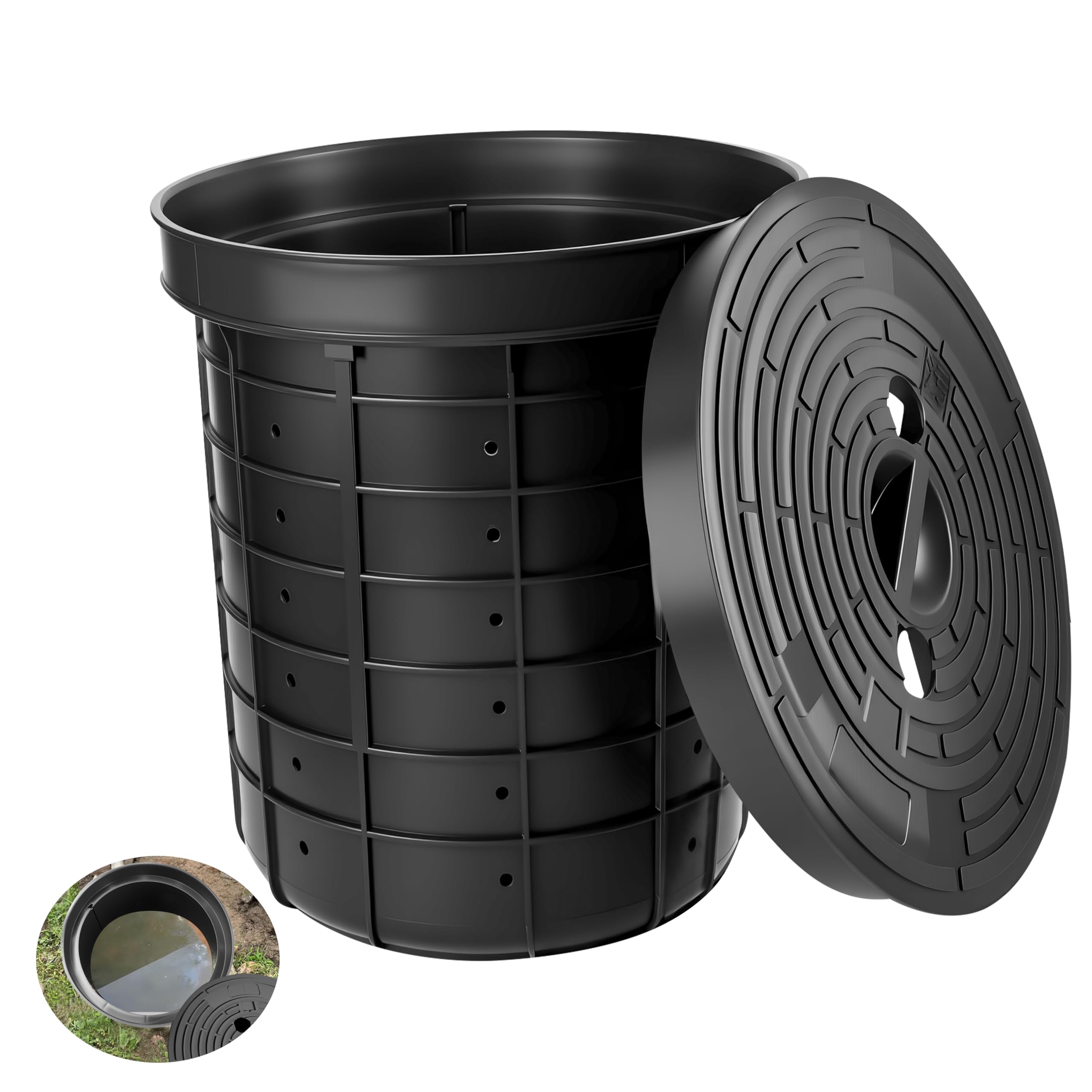
A 13 x 10.2 x 15-inch perforated basin with 40 factory holes and a fitted lid — sized for kitchen sinks and tight crawl spaces.
Not every job needs a 22-gallon pit. This one labels itself compact for a reason: the manufacturer lists the external dimensions as 13 inches wide by 10.2 inches deep by 15 inches tall, with a 13-inch base width. Forty pre-drilled holes surround the walls and floor for 360-degree water intake, and the basin comes with a lid that has pre-cut openings for your discharge pipe and power cord. That combination — holes plus lid, in one box — is the whole point of this pick.
The manufacturer describes it as heavy-duty corrosion-resistant plastic with integrated structural ribs to resist lateral soil pressure. It is aimed at the smaller jobs a full-size pit would overwhelm: kitchen sink drainage, sewage pump wells, irrigation valve boxes, and crawl space pits where square footage is the constraint. For anyone tired of hacking a five-gallon bucket into a pit, it is a step up in rigidity and in hole quality.
The friction is in the fit, not the build. Buyers report the printed dimensions do not match the basin in the box. As one review puts it: “The listing shows the top being 17 3/4” but the basin I received is 18 1/4” wide.” A second reviewer says the basin system is safer than a bare hole but admits their pump was too large and they had to buy a smaller one. Measure your pump before ordering.
Why it fits tight jobs
- 40 factory holes mean no drilling on arrival
- Lid with pre-cut cord and discharge openings included
- Compact footprint fits small crawl spaces and sink drainage
Before you order
- Reported dimensions differ from the listing
- Small size will not swallow a large pump or a wide float
Best matched to a small pit under a kitchen sink or in a low-clearance crawl space where you want factory holes and a fitted lid out of one box.
Wrong fit for a large-frame pump with a wide tethered float — check your pump’s base before you order.
4. Memorywuu Sump Pump Basin with Lid Holes, Black
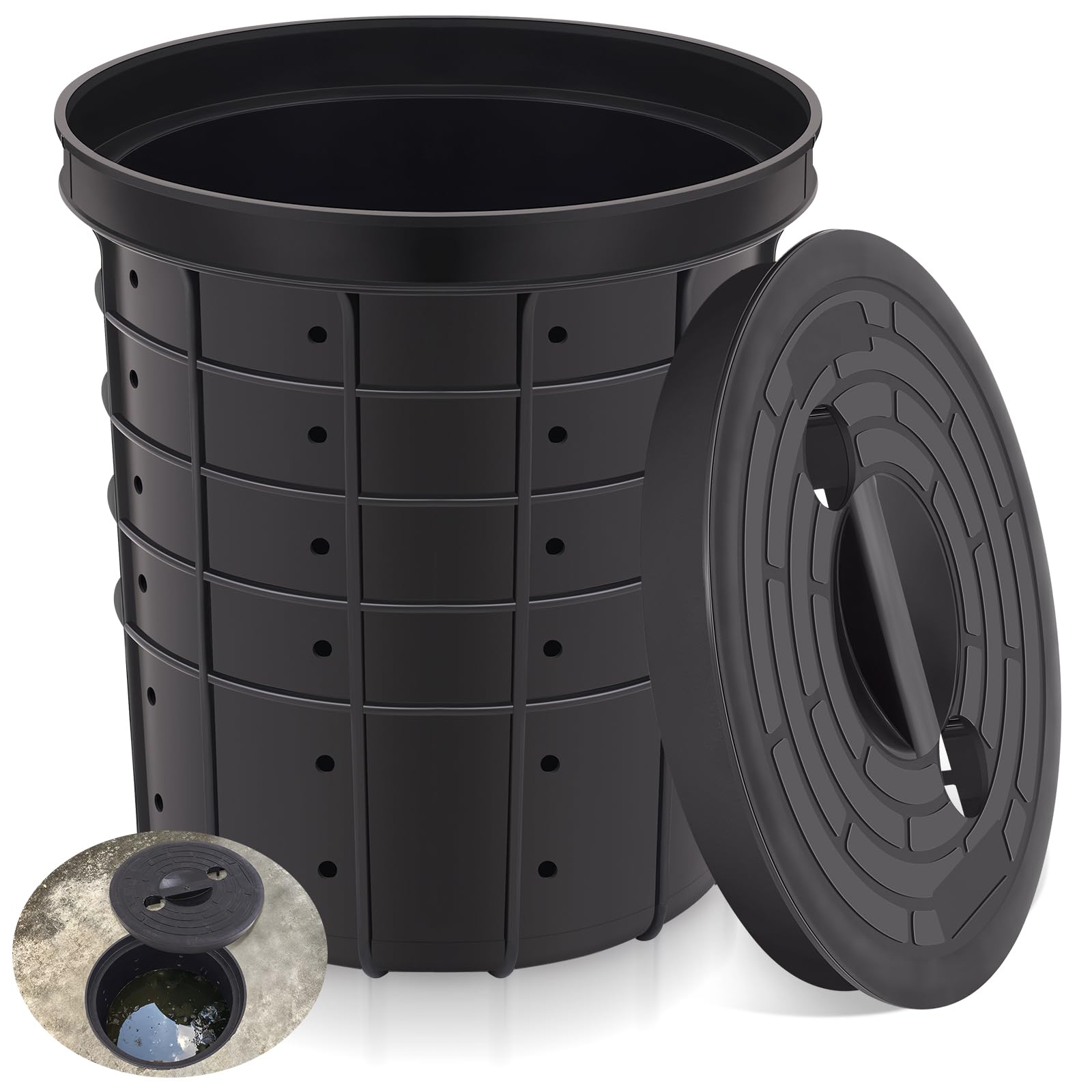
Forty-eight 5/16-inch pre-drilled holes and a lid that nests flush on the internal rim — no drilling required.
The pre-drilled-hole argument ends here. This basin arrives with 48 holes already bored into it, each one 5/16 inch across, plus a lid with two 1.7-inch openings sized for a discharge pipe and a power cord. If you do not want to spend an afternoon with a hole saw, the drilling is done. The lid nests onto an internal rim and rests flush with the top of the container, which owners describe as neat and secure.
This basin fits a mid-sized square footprint: 18.5 inches long, 16.9 inches wide, and 15.7 inches tall. That size suits sewage pump wells, utility pump pits, and irrigation valve control boxes as well as a standard basement sump. It is molded from a hard plastic shell with no lid gaps visible in the factory spec, so debris and gravel stay out of the basin.
Two realities to weigh. It is a plastic pail at heart, and one owner calls it out bluntly: “over priced for a glorified plastic pail with a lid.” The other is size — a second reviewer writes “Too small for the sump pump if you get much water,” which is the recurring limit on any mid-size basin in a high-inflow pit. If your water table fluctuates or your primary pump runs frequently during storms, size up.
Where it shines: the plug-and-play convenience. Forty-eight holes cut and a flush-nesting lid eliminate the two most annoying manual steps in a basin install.
Made for anyone who wants a pit with drainage holes already cut and a lid that closes flat — no drill required.
Pass on it if you expect high water volume; mid-size basins run out of buffer when the inflow is heavy.
5. JACKEL SF22A Sump Basin 22 Gallon Capacity
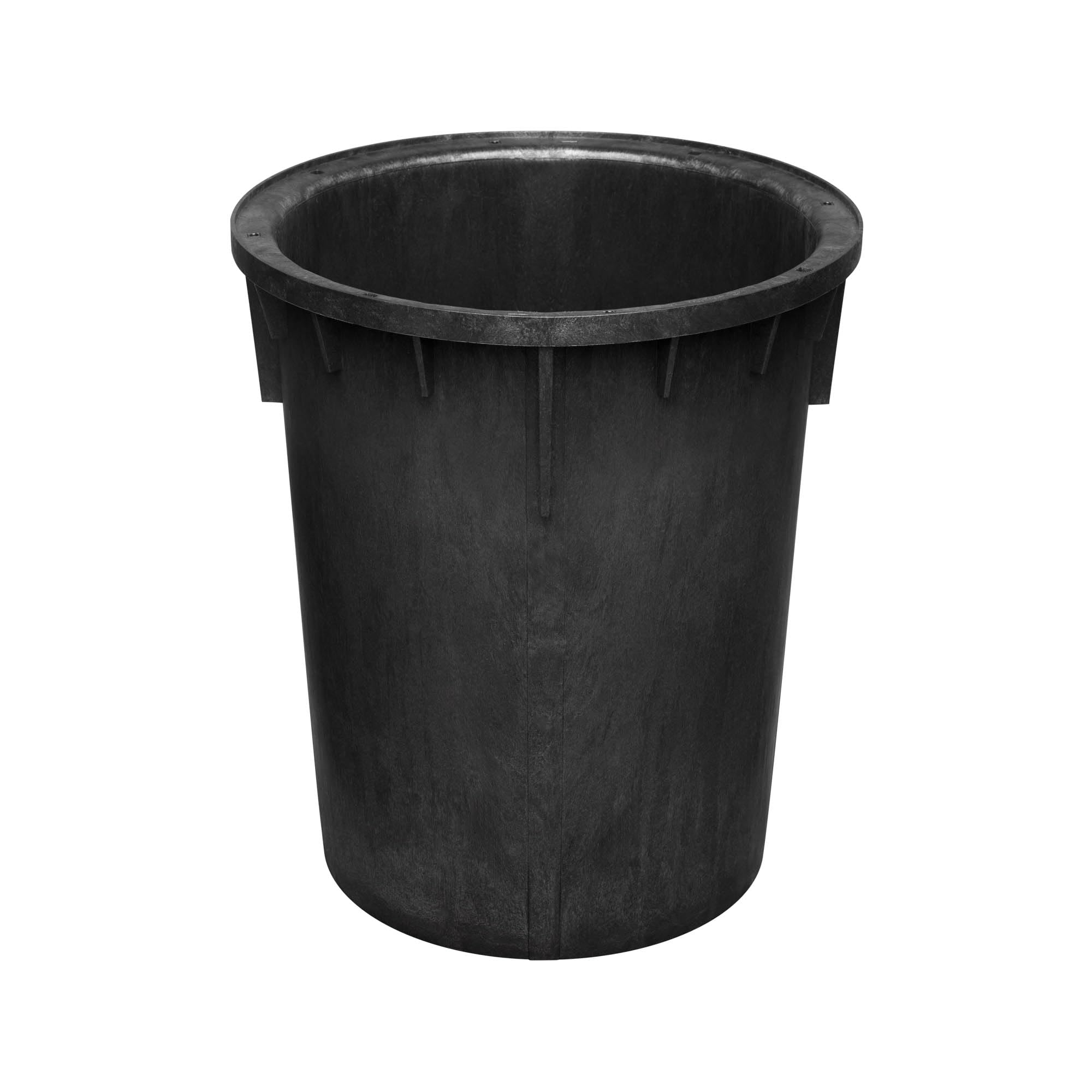
A 22.5-gallon solid-wall HDPE basin with no factory holes — you cut the openings and seal gases and radon out of a finished basement.
Two words define this basin: gas and radon tight. Both are listed by the manufacturer alongside odor free, which is the reason it exists for a finished basement where a radon vent system ties into the pit. The basin is 22.5 gallons in capacity with an 18-inch inside diameter and a 24-inch height. Unlike the pre-drilled basins above, this one ships as a solid shell with no drainage holes, so you choose which side the water enters and which side the discharge line exits — no factory pattern to work around.
It is molded from HDPE structural foam, a dense high-density polyethylene, and it weighs five pounds. That stiffness is the trait owners describe most — thick walls, tough under soil pressure, holds its shape after backfill. In Florida sand, where loose soil can collapse lighter basins, owners note these hold up. The 18-inch inside diameter also gives a tethered-float pump room to swing without hitting the wall.
The trade-off stack is real. No lid is included, and the manufacturer specs the cover as a separate 20.5-inch part you have to source. More than one owner mentions drilling every hole themselves — that is by design, but it is labor. It is also heavier and larger than a mid-size basin, so the hole you dig is bigger. This is a basin for someone who wants to control every variable, not someone who wants a box-to-ground install.
What makes it worth drilling
- Gas and radon tight — designed to pair with a basement vent system
- HDPE structural foam holds shape under soil and sand pressure
- You control exactly where water enters and the discharge exits
The work it asks of you
- No pre-drilled holes — every opening is yours to cut
- Lid is a separate purchase in a specific 20.5-inch size
- Larger footprint means a bigger pit to dig
Best for a finished-basement pit tied into a radon or soil-gas vent, where you want to cut only the openings you need.
Skip the effort if you want holes and a lid already included — this basin makes you supply both.
6. JACKEL SF22A-DR Drilled Sump Basin 18 in. ID x 24 in. H

The same 22.5-gallon HDPE shell as the SF22A, with drainage holes drilled at the factory.
Here is where the two JACKEL basins split. The SF22A above is a solid shell you cut yourself for full control. This one — the SF22A-DR — is the same 18-inch inside diameter, 24-inch height shell with the drainage holes drilled at the factory. Same 22.5-gallon capacity, same HDPE structural foam molded as one single piece. If you were drawn to the JACKEL build but did not want to drill, this is the version that saves you the hole saw.
The detail that separates it is the fastening. The cover screws into non-corrosive nylon encapsulated threaded inserts (metal threads sealed inside nylon), so the bolt holes will not strip out or rust the way a bare plastic thread does after a few winters. A factory cover sits flush with a concrete floor and, per owner reports, supports the weight of a person standing on it. The basin is made in the USA.
The shell thickness is the trait owners praise most — heavy-duty, thick walls, commercial grade. That heft has a cost: it is a large basin, and as one owner warns, “be prepared to dig.” The recurring minor gripe is the lid, which is an optional purchase. If your pit is already poured and sized tight, measure twice before ordering.
Where it wins: the factory-drilled shell plus threaded inserts. You get JACKEL’s stiffness without the drilling labor, and the lid bolts into metal threads instead of cutting into plastic.
The right call for a primary sump pit where you want a heavy commercial-grade shell that arrives ready to drop in.
Weigh the dig if your hole is already cut to a smaller footprint — the 18-inch inside diameter needs clearance.
7. Crawl Space DIY 15 Gallon Perforated Sump Pump Basin with Lid
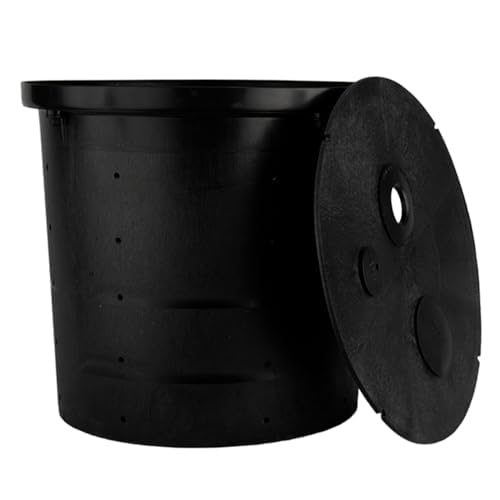
A 15-gallon perforated basin, 18 inches tall and 18.5 inches long, sized for low crawl space headroom.
The 18-inch tall, 18.5-inch long profile is what makes this one different. It is sized to slide under a crawl space with real clearance problems, where a taller basin will not stand upright. The 15-gallon capacity is smaller than the big pits above, but in a crawl space with modest water the shallow footprint is the point. Evenly spaced pre-drilled perforations let groundwater seep in from all sides to reduce hydrostatic pressure, and a snap-on lid keeps debris, gravel, and pests out while still allowing pump access for maintenance.
The lid does a second job that owners notice. It helps muffle the pump noise, which in a house where the crawl space sits under a living area is worth the included cover alone. One owner drained six inches of standing water from a crawl space with a submersible pump dropped into this basin and reported it handled the job.
Placement is the honest limit. This basin is designed for a crawl space or foundation pit, not for an open yard. One buyer found that out the hard way: placed in a yard and weighed with concrete blocks, the basin floated sideways and the pump shut off. It is a pit basin, not a yard basin — respect its intended setting and it performs well.
The real advantage: the snap-on lid. It keeps debris and pests out and helps quiet the pump, and it comes included rather than as a separate purchase.
Reach for this if you are working inside a crawl space with limited headroom and want a basin plus lid that is ready to seat.
Leave it for the pit if you plan to bury a basin in an open yard — this one is built for a sheltered floor pit, not open ground.
Understanding the Specs
Capacity in Gallons
Capacity is the volume the basin holds before water reaches the rim. It is written as gallons, and it decides how much buffer you have when your pump is off or struggling. A 20-gallon pit holds more slack than a 15-gallon pit, which matters most when the power is out and only a backup pump is running. Bigger capacity usually means a bigger hole to dig and a bigger footprint in the floor.
Inside Diameter vs Listed Diameter
The listed diameter of a basin is often the outside rim. The inside diameter — the actual open space where the pump and float sit — is narrower. A tethered float needs room to swing up to trigger, so if the inside diameter is tight, the float can snag the wall and the pump never fires. Always look for the inside measurement, or measure the basin opening itself before you commit.
Perforated vs Solid Shells
A perforated basin has holes cut at the factory so groundwater flows in from the surrounding soil. A solid basin has no holes and lets you decide where water enters and where a discharge pipe exits. Perforated saves drilling time; solid gives you control over the water path and lets you route a line out the side of the pit. Neither is better in every case — it depends on your soil and how you want the water to reach the pump.
Structural Foam and Polyethylene
Structural foam and HDPE polyethylene are dense plastics with a stiff cellular structure, different from the thin plastic of a five-gallon bucket. They resist soil pressure and hold their shape when backfilled with gravel. Polyethylene will not corrode the way a steel pit does in a wet hole. The trade-off is weight — the thicker shells weigh more and cost more to ship, but they take a beating underground.
FAQ
How do I know which basin size my sump pump needs?
Does a sump pump basin need a lid?
Should I buy a pre-drilled basin or drill my own holes?
How long does a sump pump basin last?
Can a basin be too big for a sump pump?
Why does my measured basin differ from the listed dimensions?
Does a perforated basin still need gravel around it?
Can I run a primary pump and a backup pump in the same basin?
Is a plastic sump basin better than a steel or concrete one?
What size hole do I need to dig for a sump basin?
Final Thoughts: The Verdict
For most homes, the basin for sump pump winner is the Parts2O FPW73-19 18-Inch Sump Basin, because its 20-gallon structural foam shell clears a tethered float, holds its shape under soil, and carries the highest rating on this list at 4.6 stars. If you are running a primary pump plus a battery backup, grab the Zoeller 31-0444 with its 22-inch rim and 22-gallon body. And for a crawl space with low overhead, the Crawl Space DIY 15 Gallon Perforated Basin is the one to reach for, because its short 18-inch profile and included snap-on lid fit where a taller pit will not stand.
How We Picked
We do not accept paid placement. Every pick is matched to a real buyer and a real use-case; we do not hands-on test units.
Sources & Methodology
Specifications: manufacturer listings and product documentation. Review insights: verified customer reviews, as of September 2026. Pricing: not shown on this page (it changes often); check the current price via the retailer link.
As an Amazon Associate, Gadgets Feed earns from qualifying purchases. This does not affect which products we feature.