
A trolling motor that runs out of steam mid-afternoon turns a promising day on the water into a frustrating paddle back to the ramp. The right deep-cycle marine battery is the silent partner every bass boat needs, yet the choice between lead-acid, AGM, and lithium iron phosphate (LiFePO4) remains the most confused decision in the sport. Weight, cycle life, and usable capacity are the three metrics that separate a battery that works from one that transforms your boat’s performance.
I’m Min — the co-founder and writer behind Gadgets Feed. I’ve spent countless hours cross-referencing manufacturer spec sheets, analyzing third-party capacity tests, and combing through real-user reports to understand exactly how each marin battery chemistry performs under the demanding conditions of tournament and recreational bass fishing. This guide distills that research into a clear, actionable recommendation.
Whether you are upgrading to save fifty pounds of dead weight or running electronics that demand clean, stable 12-volt power, understanding the key specifications of the best bass boat batteries is the first step toward a faster, more reliable day on the lake.
How To Choose The Best Bass Boat Batteries
Selecting the right battery for your bass boat is less about brand loyalty and more about matching three core attributes to your fishing style and electrical load. Lead-acid and AGM batteries still work, but the shift to LiFePO4 is driven by undeniable advantages in weight, cycle life, and usable capacity. Beginners often overrate amp-hour ratings without understanding that lead-acid batteries deliver only half their rated capacity before voltage drops unusably low.
Chemistry: LiFePO4 vs. Lead-Acid vs. AGM
Lithium iron phosphate (LiFePO4) weighs about one-third of a comparable lead-acid battery and provides 95 to 100 percent of its rated amp-hours. A 100Ah LiFePO4 battery delivers a true 100Ah of usable energy. A 100Ah lead-acid or AGM battery delivers roughly 50Ah before the voltage sags below the cutoff for a trolling motor or fish finder. The price premium for lithium is offset by a lifespan of 3,000 to 15,000 deep cycles versus 200 to 500 for lead-acid, making the per-cycle cost significantly lower over a decade of use.
BMS and Protection Features
The Battery Management System (BMS) is the brain inside every lithium battery. It monitors voltage, current, and temperature to prevent overcharging, over-discharging, short circuits, and thermal runaway. For bass boaters, low-temperature cut-off is a critical feature. Charging a LiFePO4 battery below freezing (32°F / 0°C) can cause permanent damage. A BMS with low-temperature protection automatically stops charging until the battery warms up, saving you from an expensive mistake.
Group Size and Weight
Battery group sizes (Group 24, Group 27, Group 31) define the physical dimensions of the case. Most bass boats with dedicated battery trays accept Group 24 or Group 31 batteries. The weight savings of lithium are dramatic. A Group 31 lead-acid battery weighs around 63 pounds. A Group 31 LiFePO4 battery weighs between 22 and 31 pounds. Removing 30 to 40 pounds of dead weight from the stern of a bass boat improves hole-shot acceleration and can add two to four miles per hour to your top speed.
Series and Parallel Configuration
Many bass boat trolling motors run on 24V or 36V systems, requiring batteries wired in series. Most modern LiFePO4 batteries support series connections up to 48V, and parallel connections to increase total amp-hour capacity. Before buying, confirm the battery supports the configuration you need (typically 2S for 24V or 3S for 36V). The manual should explicitly state the maximum number of batteries in series and parallel.
Quick Comparison
On smaller screens, swipe sideways to see the full table.
| Model | Category | Best For | Key Spec | Amazon |
|---|---|---|---|---|
| Litime 12V 100Ah TM | Premium | Built-in TVS for trolling motors | 22.16 lbs / Group 31 | Amazon |
| Battle Born BB10012 | Premium | 10-year warranty & support | 31 lbs / Group 27 & 31 | Amazon |
| Power Queen 12V 100Ah | Mid-Range | Lighter than AGM alternatives | 24.25 lbs / Group 31 | Amazon |
| DC HOUSE 12V 100Ah | Mid-Range | Bluetooth monitoring | 23.8 lbs / Group 24 | Amazon |
| GrenerPower 12V 100Ah | Mid-Range | Cylindrical cells & low price | 22.57 lbs / Group 24 | Amazon |
| Dumfume 12V 100Ah | Budget | Lowest price entry to LiFePO4 | 22.05 lbs / Group 31 | Amazon |
| Yeagulch 2 Pack 12V 100Ah | Budget | Best value twin-pack | 22.04 lbs each / Group 31 | Amazon |
In‑Depth Reviews
1. Litime 12V 100Ah Trolling Motor LiFePO4 Battery

This is the LiFePO4 battery built specifically for trolling motors, and it shows in the details. The built-in TVS (Transient Voltage Suppression) diode protects the battery and your motor from voltage spikes generated by brushed trolling motors running at full throttle, a common failure point in less specialized lithium batteries. At only 22.16 pounds, it shaves roughly 40 pounds off the stern compared to a lead-acid Group 31, directly translating to a faster hole shot and a measurable 4 mph top speed gain reported by bass boat owners running a 36V Minnkota Ultrex.
The BMS includes a low-temperature cut-off that stops charging below 32°F and discharging below -4°F, a critical safety feature for anglers who fish in early spring or late fall. The battery meets the ABYC E-13 standard for marine electrical systems, adding a layer of verification for salt-spray and water resistance that most competing batteries lack. Users consistently report running a 45- to 80-pound thrust trolling motor for four to eight hours on a single charge with capacity to spare.
LiTime offers a five-year warranty and responsive customer service that users praise for resolving issues within one to two days. The flat discharge curve of LiFePO4 means the battery holds voltage above 12.8V through nearly the entire discharge, so your trolling motor runs at full power until the battery is nearly empty. This is the battery to buy if you want maximum runtime, proven marine protection, and a brand that backs its product.
Why it’s great
- TVS protection for trolling motor voltage spikes
- Low-temp cut-off for cold weather charging safety
- Ultra-light 22.16 lbs improves boat performance
Good to know
- Packaged with M8 terminal bolts sized 16mm, verify your cable lugs fit
- Requires LiFePO4-compatible charger for full charge
2. Battle Born 100Ah 12V LiFePO4 Battery
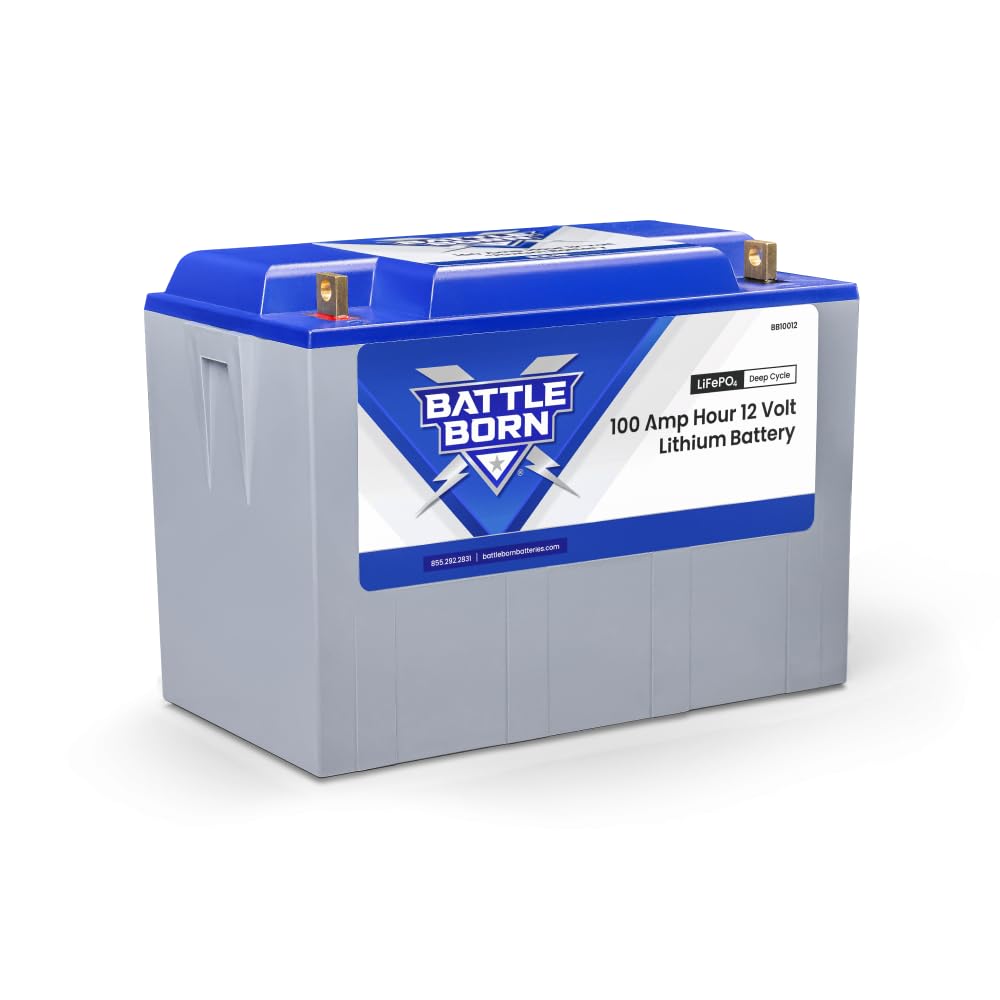
Battle Born is the established premium name in the LiFePO4 marine market, and the BB10012 is their flagship 100Ah unit. At 31 pounds, it is heavier than the Litime or DC HOUSE options, but that weight partly comes from a more robust internal architecture and a thicker ABS case that many installers prefer for the peace of mind it provides in a vibration-heavy bass boat environment. The battery fits both Group 27 and Group 31 trays, making it a versatile drop-in replacement.
The internal BMS provides low-temperature protection, high and low voltage cut-offs, and short-circuit prevention. The build quality is genuinely industrial-grade, with side-mounted terminals that stay clean and corrosion-free. Users consistently highlight the reliable performance over years of use, with one report showing a single battery powering an RV fridge and lights for 28 hours compared to 8 hours with the lead-acid it replaced. The 10-year warranty is the longest in this category, and the Nevada-based support team is responsive.
There are two things to know before buying. First, a firmware update or charger replacement may be needed if your existing charger does not stop at the correct absorption voltage for LiFePO4. Second, the warranty claim process requires shipping the battery back at your expense (roughly to depending on location), and some users report a slow 6-to-8-week turnaround. Despite this, the build quality and brand reputation make this a strong choice for anglers who want the long-term reliability of a premium battery.
Why it’s great
- 10-year warranty and US-based customer support
- Industrial-grade build with side terminals
- Proven 28-hour runtime on heavy loads
Good to know
- Heavier than direct lithium competitors at 31 lbs
- Charger compatibility may require verification before purchase
3. Power Queen 12V 100Ah LiFePO4 Battery
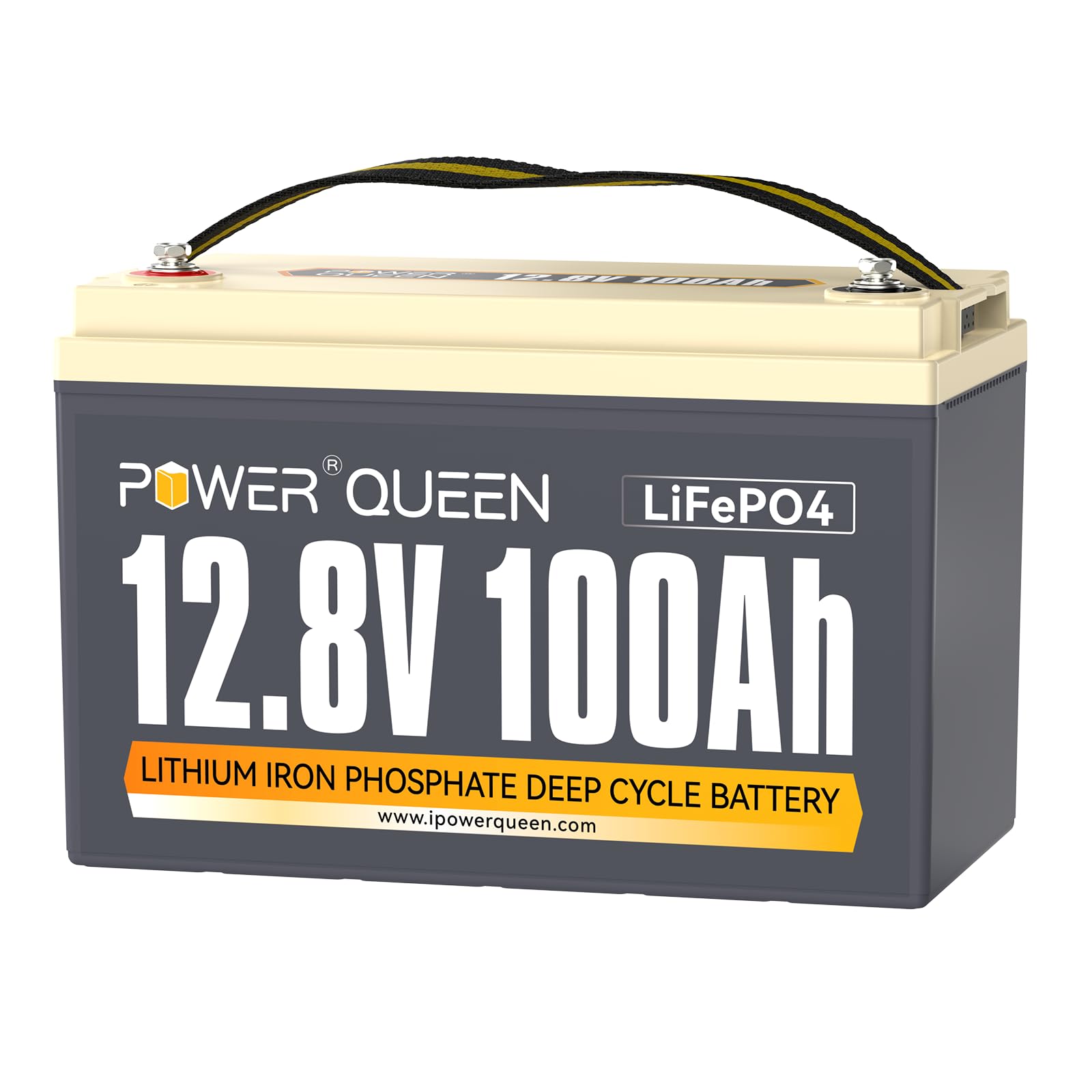
Power Queen occupies the sweet spot between price and performance for the bass boater who wants a genuine Group 31 footprint without the premium price tag. At 24.25 pounds, the weight savings over lead-acid is substantial, and the battery supports up to 4P4S configurations (four in parallel and four in series) for building a 48V 400Ah 20.48kWh system if your energy needs grow. The 100A BMS covers the standard protections — overcharge, over-discharge, over-current, and short circuit.
Users report that the battery performs exactly as rated, delivering the full 100Ah of usable capacity. One common use case is replacing two 6V golf cart batteries in a camper or bass boat, reducing total weight by 80 pounds while doubling usable capacity. The bolt-in terminal connections are a practical design detail that makes wiring multiple batteries in parallel clean and secure. The five-year warranty provides a safety net that is competitive with most mid-range options.
One quirk reported by a few users: the BMS can cut off charging at approximately 14.2V, preventing the charger from reaching its full CV-mode target of 14.6V. In practice, this means the battery may stop charging a minute or two before it is technically full, resulting in a resting voltage of roughly 13.4V. This is a rare issue and does not affect runtime significantly. For the price, this battery is a solid mid-range choice for running electronics and a medium-power trolling motor.
Why it’s great
- Full Group 31 drop-in fit at a competitive price
- 5-year warranty included
- 4P4S expandable for large power systems
Good to know
- Some users report BMS cut-off before full charge
- Requires minimum 6-gauge wire for proper connection
4. DC HOUSE 12V 100Ah Trolling Motor Lithium Battery
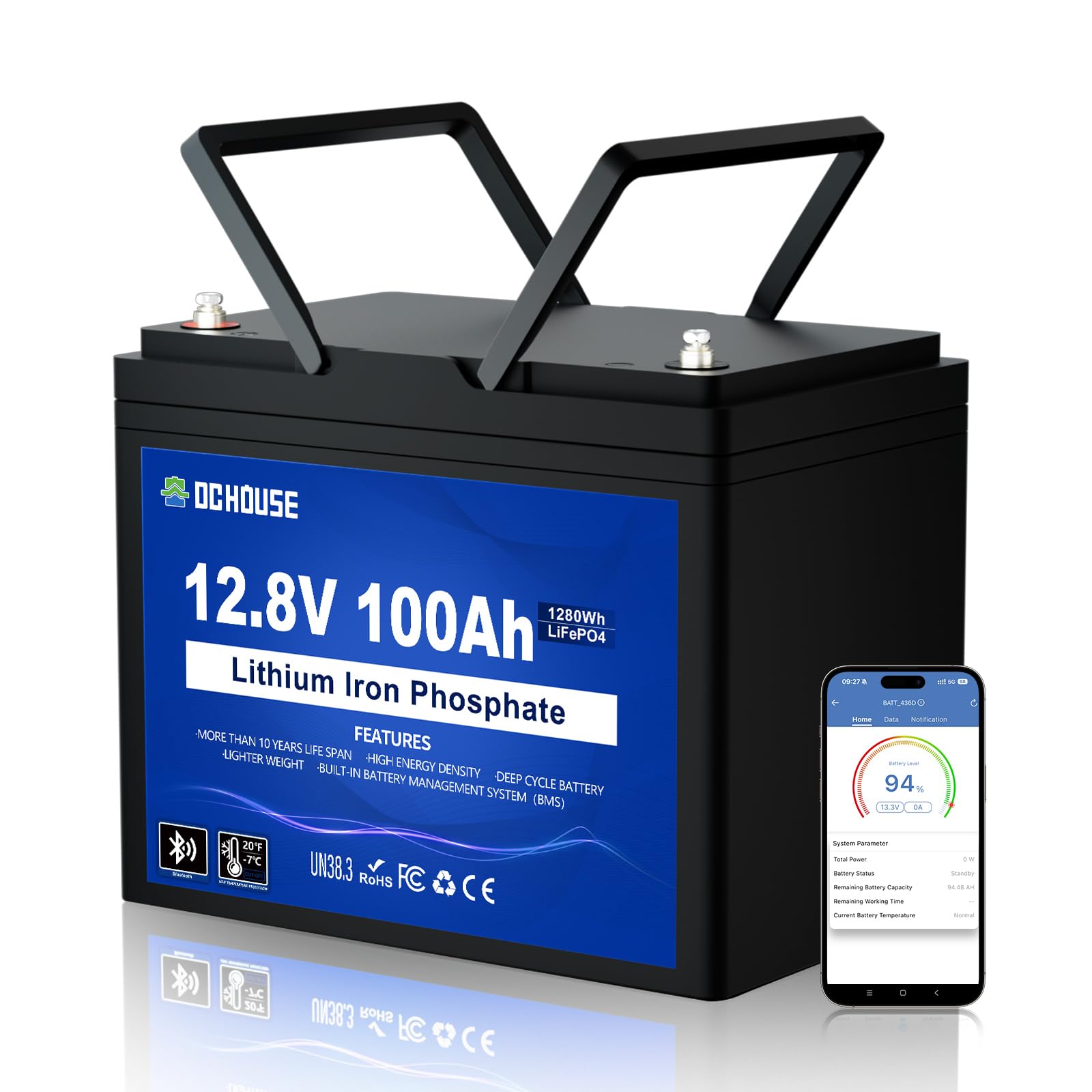
The DC HOUSE 12V 100Ah lithium battery distinguishes itself with built-in Bluetooth that connects to the DC HOUSE smartphone app. This allows you to monitor state of charge (SoC), voltage, current draw, and individual cell voltages in real time from up to 30 feet away. For a bass angler running multiple batteries for a trolling motor, fish finders, and electronics, the ability to check each battery’s status without opening a compartment is a genuine quality-of-life improvement.
The low-temperature protection engages at 19.4°F for charging (-4°F for discharge), which is a tighter threshold than the industry-standard 32°F. This provides an extra margin of safety for winter storage and early-spring fishing. The battery uses Class A LiFePO4 cells certified to UL and UN38.3 standards, meaning the internal cell quality meets high safety benchmarks. It weighs 23.8 pounds, sits in a Group 24 footprint (roughly 0.3 inches taller than standard), and supports up to 4S4P configurations.
Users praise the battery’s performance: one runs it year-round on a trolling motor and reports it outperforms the previous lead-acid battery while weighing half as much. Another runs it for weekend camping trips, powering a CPAP machine overnight and using only 25-30 percent of capacity. The three-year warranty is shorter than the five-year coverage offered by LiTime or Power Queen, and some users have experienced slow customer service responses. The Bluetooth, however, is a differentiator that many tech-forward anglers will value.
Why it’s great
- Bluetooth app monitoring for real-time stats
- UL-certified cells with low-temp cut-off
- Lightweight Group 24 footprint saves weight
Good to know
- Bluetooth range is limited (roughly 10 meters)
- Customer service response can be slow
5. GrenerPower 12V 100Ah LiFePO4 Battery
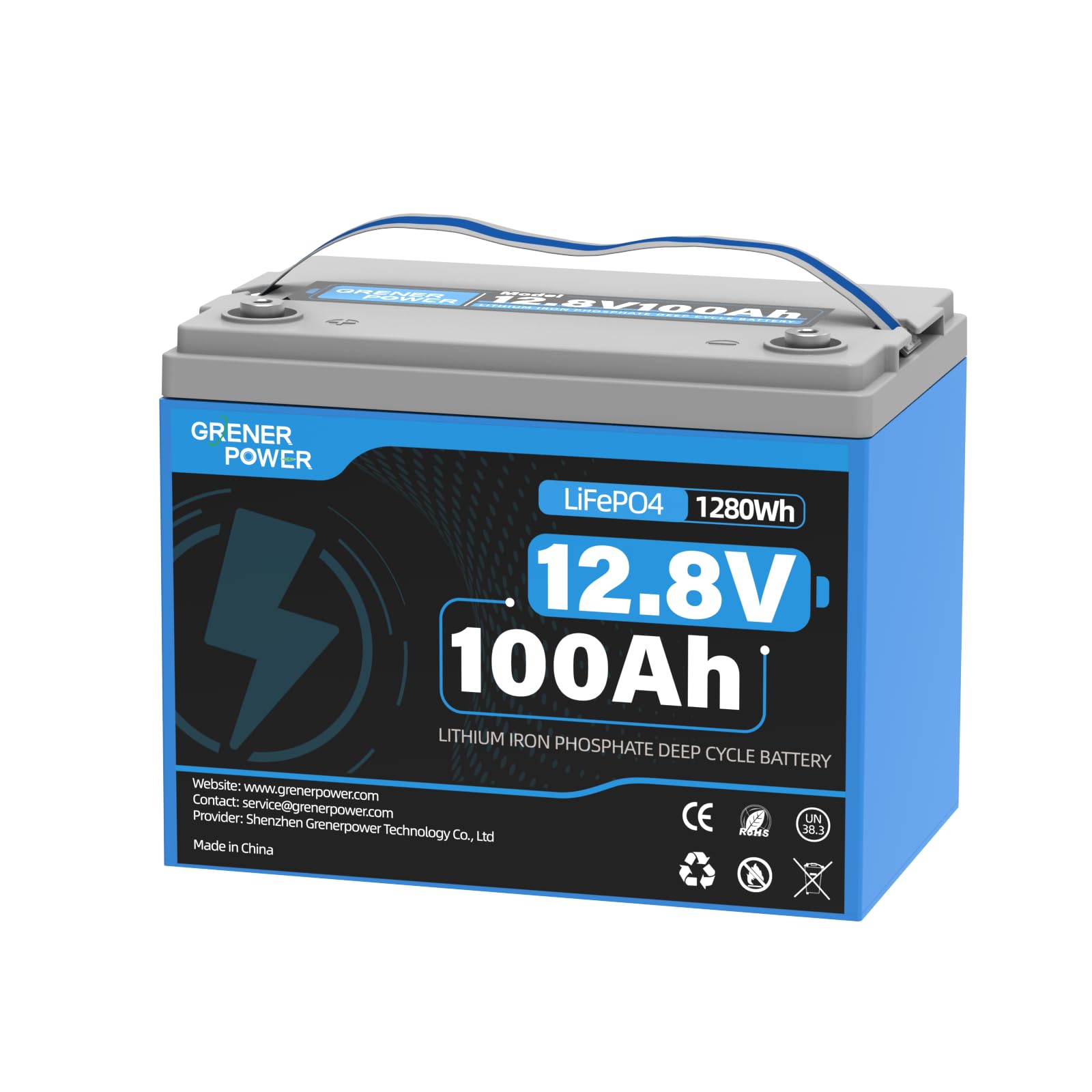
GrenerPower’s 100Ah battery uses Grade A+ cylindrical LiFePO4 cells, a design that some battery engineers prefer over prismatic cells for better heat dissipation and more consistent internal pressure. The 100A BMS provides a five-layer protection suite covering overcharge, over-discharge, short circuit, over-current, and overheat. At 22.57 pounds, it is one of the lightest 100Ah options available for a Group 24 footprint, and the foldable handle makes carrying it from the truck to the boat a one-hand job.
Real-world capacity testing by a buyer found the battery delivered the rated 100Ah after a proper break-in charge, and users running low-power trolling motors (30 to 70 lb thrust) report excellent runtime. The battery supports up to 4S4P configurations, meaning you can replace three or four lead-acid batteries with a single GrenerPower unit in many setups. The five-year warranty is printed directly on the product page, providing a competitive safety net at this price point.
A few users noted that the BMS on some units arrived with cells needing a balancing charge before reaching full capacity. In practice, this meant charging each battery individually with a LiFePO4 charger for one full cycle to balance the cells. After that initial procedure, the batteries held voltage within 0.1V of each other in parallel. If you are willing to spend a few minutes on an initial top-charge cycle, the GrenerPower provides exceptional value for its price tier.
Why it’s great
- Cylindrical cell design for even heat distribution
- Ultra-light 22.57 lbs with foldable handle
- 5-year warranty at a mid-range price point
Good to know
- Some units need initial balancing cycle
- Box dimensions are Group 24, verify tray fit
6. Dumfume 12V 100Ah LiFePO4 Lithium Battery

Dumfume delivers the lowest price of entry into the LiFePO4 market among batteries that still use genuine Grade A cells and a 100A BMS. The battery offers 1.28kWh of energy in a standard Group 31 case that weighs just 22.05 pounds — roughly one-third the weight of a comparable lead-acid battery. The BMS covers overcharging, over-discharging, short circuits, overheating, and overcurrent, providing all the essential protections a bass boat electronics system requires.
Capacity testing from real buyers confirms the battery delivers the full 100Ah. One buyer tested it with a discharge load and measured the full capacity, confirming it matches the specification. The ABS casing is impact-resistant, heat-resistant, and weather-resistant, though the product explicitly states it is not waterproof, so mounting it in a dry compartment is essential. The battery supports up to 4S4P connections for scaling capacity.
The primary limitation of this budget option is the lack of advanced features — no Bluetooth, no low-temperature cut-off, and no ABYC certification. The BMS will protect against cold-charging damage only if the internal temperature sensor detects it; Dumfume recommends verifying temperature suitability before purchase. The manufacturer advises that battery performance requires temperatures above 41°F. For a budget build on a Jon boat or as a secondary house battery for a fish finder and lights, this is a remarkably capable option.
Why it’s great
- Lowest price among certified LiFePO4 100Ah batteries
- 44% weight savings over lead-acid
- Full capacity tested and confirmed by users
Good to know
- No low-temperature cut-off for charging
- Not waterproof, must be kept in a dry compartment
7. Yeagulch 2 Pack 12V 100Ah LiFePO4 Lithium Battery
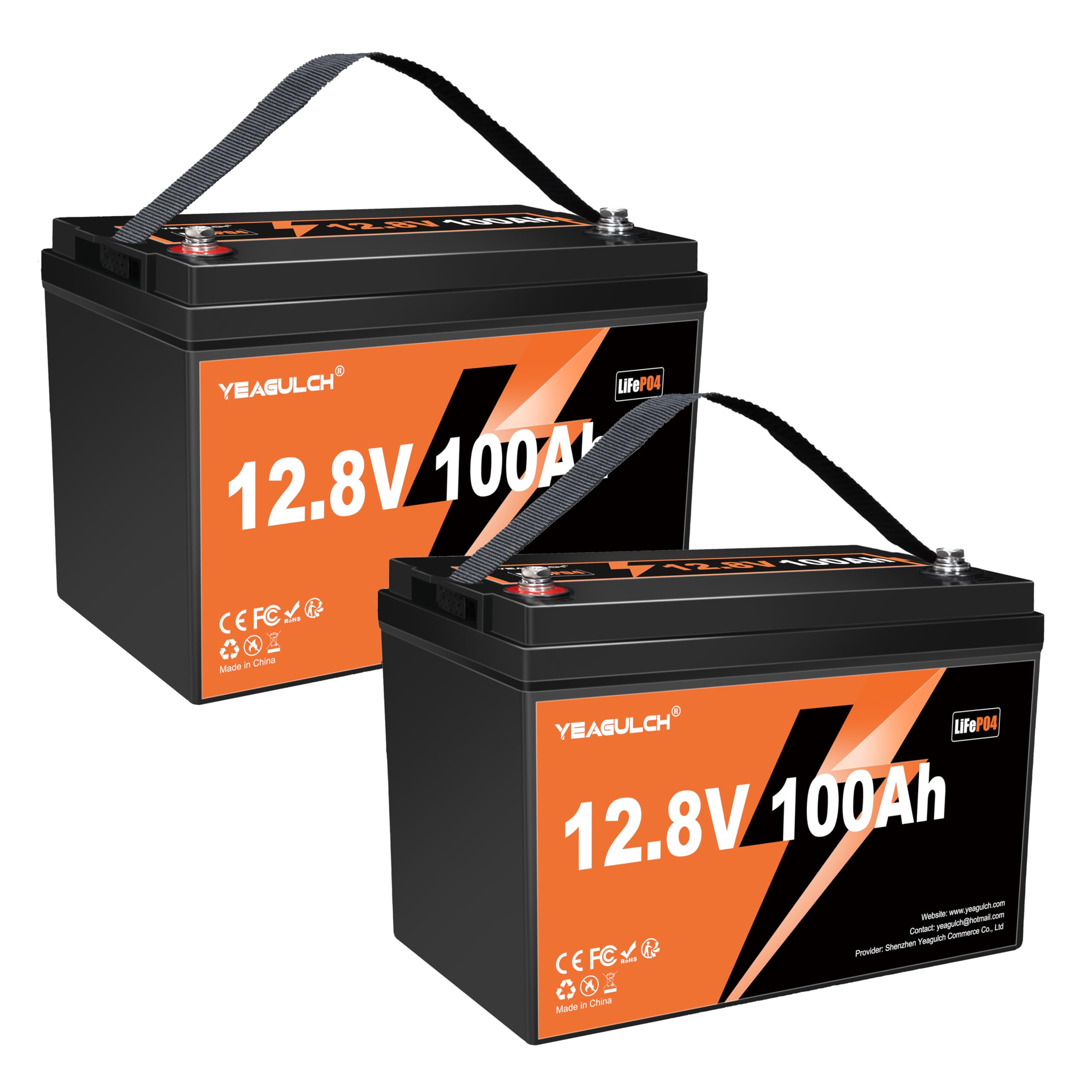
The Yeagulch twin-pack provides two 100Ah LiFePO4 batteries at a price per unit that beats almost every single-battery competitor. Each battery weighs 22.04 pounds and holds 1.28kWh of energy, and the pack comes in a single box with two batteries and two sets of M8 terminal hardware. This is a natural fit for a bass boater who needs two batteries for a dual-bank trolling motor setup or one battery for the trolling motor and one for electronics and accessories.
Performance reports are generally positive. One user runs an 80-pound thrust trolling motor on a 10-foot pontoon boat and reports noticeable speed improvement from the voltage advantage of LiFePO4, plus multiple outings without needing a recharge. Another user replaced a 600Ah lead-acid bank with these two 100Ah batteries and found they worked perfectly for off-grid refrigerator and solar setup. The rated cycles are 4,000 at 100% DOD and 6,000 at 80% DOD, which translates to roughly 10 years of typical use.
The major caveat is the lack of Bluetooth BMS, which makes it hard to monitor individual cell health. A small number of users reported inconsistent performance in parallel, with one battery dropping out after the first use. The manufacturer advises against using this battery with a trolling motor exceeding 700W. For the price of a single premium battery, the Yeagulch twin-pack offers unmatched capacity per dollar for bass boaters who can verify their system’s power draw stays within the battery’s limits.
Why it’s great
- Two 100Ah batteries for less than one premium unit
- 22.04 lbs each dramatically cuts stern weight
- Supports 4P4S expandability
Good to know
- No Bluetooth BMS for cell monitoring
- Recommended for trolling motors under 700W
FAQ
Can I use a starting battery or dual-purpose battery for my trolling motor?
What size battery do I need for a 24V or 36V trolling motor?
How much weight will I save switching from lead-acid to LiFePO4?
Do I need a special charger for LiFePO4 batteries?
Can I charge a LiFePO4 battery in freezing temperatures?
Final Thoughts: The Verdict
For most users, the best bass boat batteries winner is the Litime 12V 100Ah TM because it combines ABYC E-13 safety certification, built-in TVS protection for trolling motors, and low-temp cut-off in a package that shaves over 40 pounds from your boat’s stern. If you want Bluetooth monitoring and detailed cell data while you fish, grab the DC HOUSE 12V 100Ah. And for budget-conscious anglers building a dual-bank system, nothing beats the capacity-per-dollar value of the Yeagulch 2 Pack.