
Low-frequency performance from PC speakers has long been a compromise — either you get a thin, tinny sound signature that leaves action scenes and bass-heavy tracks feeling hollow, or you battle a muddy, boomy mess that drowns out vocals and detail. The market is flooded with promises of deep bass, but few deliver the tight, controlled low-end that makes a listening experience truly immersive without distortion.
I’m Min — the co-founder and writer behind Gadgets Feed. I’ve spent countless hours dissecting driver sizes, amplifier power specs, DSP tuning philosophies, and enclosure materials to separate the genuinely capable 2.1 and 2.0 systems from the ones that just rattle the desk. This guide focuses on the concrete metrics — like wattage RMS, woofer diameter, frequency response extension, and signal-to-noise ratio — that actually determine whether a speaker can reproduce bass that feels clean and punchy versus bass that sounds like cardboard.
Whether you are a gamer looking for explosions with impact, a music lover who wants sub-bass extension without distortion, or just someone tired of dinky desktop sound, this analysis of the best bass pc speakers will help you find the set that actually delivers the low-end performance you are looking for.
How To Choose The Best Bass PC Speakers
Finding speakers that deliver satisfying low-end output for your desktop setup means looking past marketing hyperbole. The key lies in three interconnected areas: the physical design of the subwoofer or woofer, the amplifier’s ability to drive it cleanly, and the digital processing that shapes the final sound signature. Each plays a role in whether you get tight, articulate bass or a loose, resonating hum.
Subwoofer Size and Enclosure Type
The diameter of the subwoofer driver — typically between 4 and 6.5 inches for PC-oriented 2.1 systems — directly correlates to the volume of air it can move, which defines its ability to generate pressure at low frequencies. A 6.5-inch driver can produce noticeably deeper, more forceful sub-bass than a 4-inch unit, but enclosure design matters just as much. Ported enclosures (those with a vent or tube) boost output at a specific frequency range, often making the bass sound louder, while sealed enclosures tend to produce tighter, more controlled response. For a desktop environment, a well-tuned ported subwoofer around 5 to 6.5 inches typically offers the best mix of rumble and precision.
RMS Power and Headroom
Continuous RMS (Root Mean Square) wattage is the only honest measure of a speaker system’s sustained output capability. Peak power numbers, often printed boldly on boxes, are meaningless for real-world listening because they represent instantaneous bursts that the system cannot maintain. A system rated for 30 to 50 watts RMS will comfortably fill a small to medium room with clean, distortion-free bass, whereas a system that only lists peak power or uses vague wattage claims will likely struggle to maintain composure at moderate volumes.
DSP Tuning and Frequency Response Extension
Digital Signal Processing (DSP) is the hidden layer that can make or break a budget-to-mid-range bass speaker system. Good DSP properly manages the crossover between the satellite speakers and the subwoofer, preventing the sub from playing frequencies that make vocals sound muddy. Some systems allow you to adjust bass and treble independently, which is a valuable feature for tailoring the output to your room acoustics and listening preferences. Look for a frequency response spec that reaches down to at least 40 to 60 Hz without a massive bump — that indicates the subwoofer can genuinely reproduce deep tones rather than just boosting a narrow mid-bass hump to simulate depth.
Quick Comparison
On smaller screens, swipe sideways to see the full table.
| Model | Category | Best For | Key Spec | Amazon |
|---|---|---|---|---|
| Mackie CR3.5 | Premium 2.0 | Audiophile clarity & mixing | 3.5″ woofer + silk dome tweeter, tone knob | Amazon |
| ZQMMSPK 2.1 System (6.5″) | Premium 2.1 | Deepest sub-bass, home theater | 100W RMS, 6.5″ subwoofer, wood cabinet | Amazon |
| Bluedee 2.1 System | Mid-Range 2.1 | Balanced bass, RGB aesthetic | 80W peak, Bluetooth 5.4, RGB lighting | Amazon |
| MEVOSTO DS19 | Premium 2.0 | Customizable EQ, wood finish | 36W RMS, 5″ woofer, remote control | Amazon |
| OHAYO 60W 2.0 | Mid-Range 2.0 | Compact size, clear mids | 60W peak, carbon fiber drivers | Amazon |
| Saiyin Soundbar + Sub | Budget 2.1 | TV/PC hybrid, space saving | Wireless subwoofer, 3 EQ modes | Amazon |
| Cinnkeyi CK-5212 | Budget 2.1 | Entry-level 2.1, Bluetooth | Passive bass diaphragm, USB powered | Amazon |
In‑Depth Reviews
1. Mackie CR3.5 Creative Reference Powered Studio Monitors

Mackie brings genuine studio-monitor DNA into a compact, desktop-friendly form factor with the CR3.5. The combination of a 3.5-inch woven woofer and a silk dome tweeter delivers a remarkably flat, transparent frequency response that casual speakers cannot match, while the unique tone knob allows you to dial in additional bass and treble sparkle without losing clarity. The result is clean, articulate low-end that punches above its physical size, especially when you engage the location switch for desktop nearfield listening.
The connectivity suite — TRS and RCA inputs plus a 3.5mm front jack and headphone output — is purpose-built for creators and serious listeners who need to hook up audio interfaces, gaming consoles, and PCs simultaneously. The foam isolation pads are included in the box, a thoughtful inclusion that reduces desk resonance and tightens bass response further. However, the CR3.5 is a 2.0 system and lacks a dedicated subwoofer, so the bass extension rolls off earlier than a 2.1 setup can deliver.
Reviews consistently highlight the exceptional build quality, with the black vinyl wrap and metal front baffle feeling significantly more premium than the price suggests. The soundstage is wide and detailed for a 3.5-inch monitor, and users report that after a brief break-in period, the low-end opens up considerably — making this a standout choice for anyone who prioritizes audio accuracy over sheer volume or sub-bass rumble.
Why it’s great
- Studio-grade sound with adjustable tone knob for bass boost without muddiness.
- Location switch optimizes response for desktop nearfield vs bookshelf distance.
- Includes foam isolation pads and high-quality cables for immediate setup.
Good to know
- 2.0 design — no built-in subwoofer means limited sub-60 Hz extension.
- Requires an external subwoofer (like Mackie CR8SBT) for deep cinema-style bass.
2. ZQMMSPK 2.1 Gaming Speaker System (6.5″)
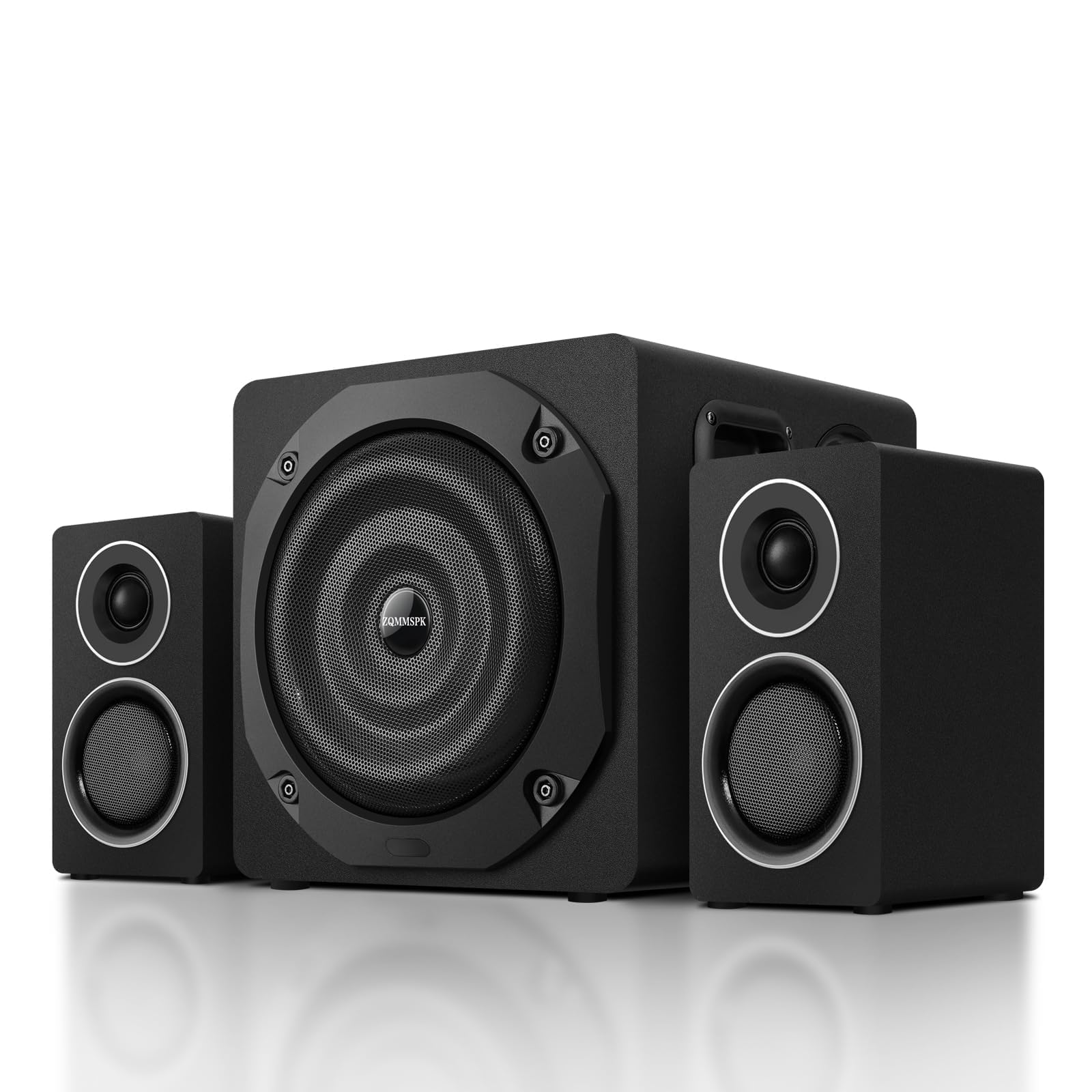
This 2.1 system is built around a 6.5-inch subwoofer housed in a wooden cabinet, which immediately sets it apart from plastic-enclosure competitors by reducing cabinet resonance and standing-wave artifacts. The RMS power rating of 100 watts gives it genuine headroom for filling a small to medium room with clean, deep sub-bass that you feel in your chest. The satellite speakers use a 3-inch midrange driver paired with a 1-inch silk dome tweeter, ensuring that the boosted low-end does not come at the expense of vocal clarity or high-frequency detail.
Connectivity is the most versatile in this roundup: Bluetooth 5.3, AUX, RCA, optical, and coaxial inputs are all present, making it compatible with PCs, gaming consoles, TVs, and turntables without an adapter. The wooden cabinet construction and iron mesh grilles add durability and a more mature aesthetic compared to many gaming-centric designs. That said, the subwoofer only outputs low frequencies and cannot operate alone — the satellite speakers must be connected, and the 40 Hz lower limit means the deepest organ notes or synth sub-bass are attenuated.
Customer feedback praises the sound quality, noting that the system delivers “excellent sound quality (mids, highs, bass)” and that the walnut finish looks upscale. However, a recurring criticism is that all controls — including volume, bass, and treble — are located on the subwoofer, which on a floor placement is inconvenient to adjust without a remote, which is not included. This is the primary reason it ranks second rather than first, despite its superior bass extension and power.
Why it’s great
- 6.5-inch subwoofer with 100W RMS delivers the deepest, most powerful bass in this lineup.
- Solid wood cabinet reduces resonance for cleaner low-end and better transient response.
- Extensive input options including optical and coaxial for high-fidelity digital audio.
Good to know
- All controls are on the subwoofer — no remote control, which makes volume adjustments impractical.
- Satellite speakers are hardwired to each other, limiting placement flexibility.
3. Bluedee Computer Speakers with Subwoofer 2.1 System
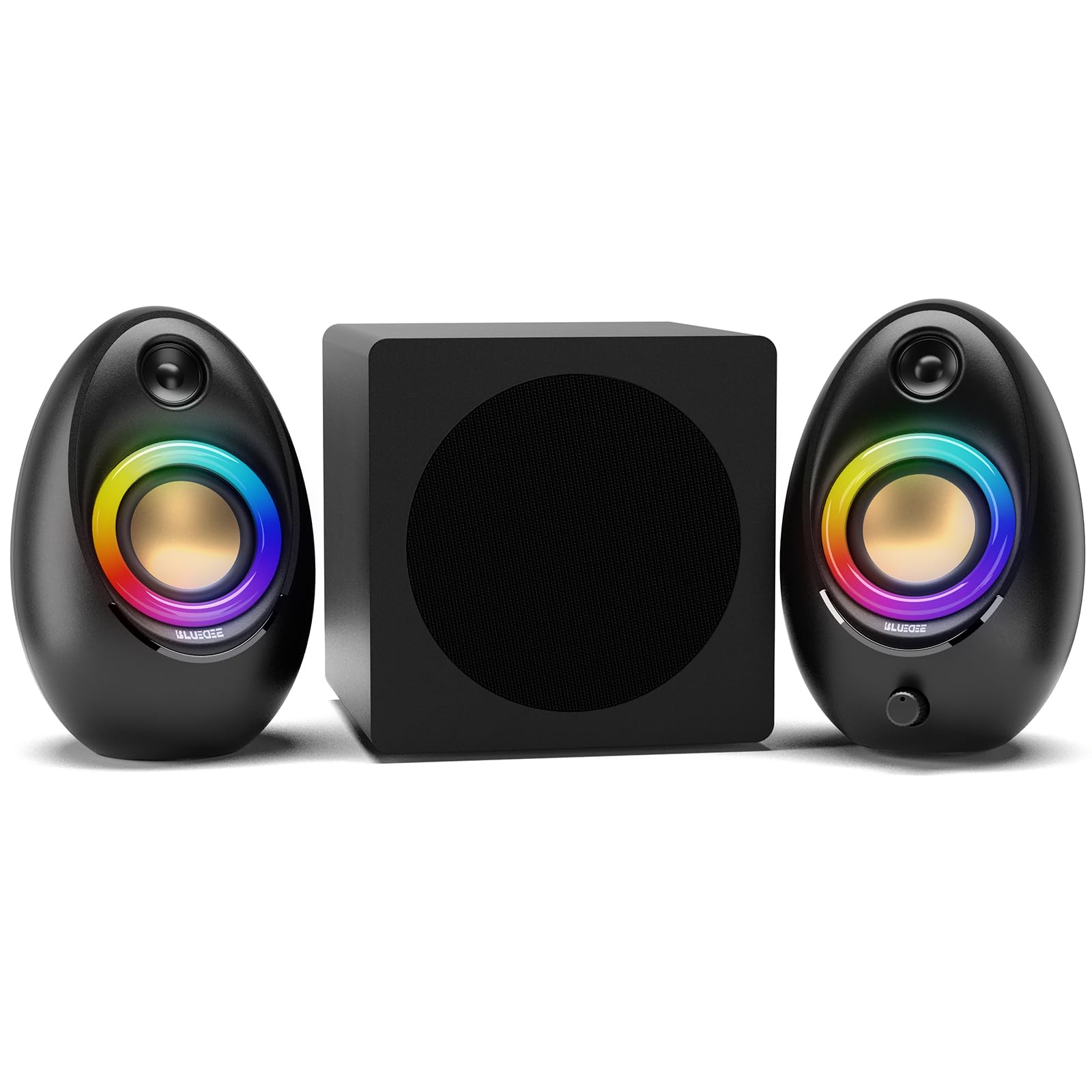
The Bluedee 2.1 system strikes an excellent balance between bass performance and modern desktop aesthetics. Its dedicated subwoofer handles low frequencies independently, which prevents the satellite speakers from distorting when you push the volume. The built-in DSP tuning reduces harshness in the upper frequencies, resulting in a smooth, non-fatiguing sound signature that works well for long gaming sessions or work-from-home use. Users consistently describe the bass as punchy and controlled rather than boomy or overpowering.
Connectivity is forward-looking with Bluetooth 5.4, along with USB-A, USB-C, and 3.5mm AUX inputs, making it one of the most adapter-friendly options for modern laptops that lack USB-A ports. The all-in-one control knob handles volume, playback, lighting effects, and input switching with tactile precision. The RGB lighting is desk-friendly — you can cycle through dynamic color modes or settle on a static glow — adding visual appeal without being garish or distracting from the audio experience.
Several reviewers who replaced larger 5.1 systems with this Bluedee setup noted that the 80W peak power is sufficient for small to medium rooms and that the system “punches well above its weight class.” The compact satellite speakers and subwoofer footprint fit easily on a standard desk without crowding. The only trade-off is the plastic enclosure, which, while not detrimental to sound quality at this price, lacks the resonance-dampening qualities of a wooden cabinet found in more premium competitors.
Why it’s great
- Dedicated subwoofer provides clean, punchy low-end without muddying the midrange.
- Bluetooth 5.4 plus USB-A and USB-C inputs for broad compatibility with modern devices.
- Customizable RGB lighting adds desk flair without being distracting during use.
Good to know
- Plastic enclosures for the satellites and subwoofer can resonate at higher volumes versus wood cabinets.
- Bass extension is good for the price but does not match the depth of a 6.5-inch subwoofer system.
4. MEVOSTO DS19 Active Bookshelf Speakers

The MEVOSTO DS19 ups the ante for 2.0 bookshelf-style PC speakers by pairing a 5-inch bass driver with a 1-inch silk dome tweeter in a wood-finish enclosure. The 36-watt RMS rating (which is higher than many competitors in this form factor) powers a surprisingly full-bodied sound signature that can fill a medium room with authority. The 5-inch woofer moves significantly more air than the 3.5-inch drivers found in most compact monitors, giving the DS19 a genuine low-end presence that sounds closer to a small 2.1 system.
One of the standout features is the 10-level adjustable bass and treble controls, accessible via both the front knobs and the included remote control. This granularity allows you to tailor the frequency response precisely to your room and content, whether you need a bass lift for action movies or a flatter profile for music production. Connectivity covers RCA, AUX, and USB — with the USB connection functioning as a built-in sound card that auto-switches audio output when the speakers are powered on, a thoughtful integration for desktop use.
User reports emphasize the build quality, noting that the wood cabinet is solid and attractive, and that the sound is “clear and clean with adequate, controlled bass and good presence.” The Bluetooth 5.4 connection pairs instantly and maintains a stable link even across rooms. The main limitation is that the DS19 does not have a subwoofer output, so you cannot expand it to a 2.1 system later. The default bass setting is also described as potentially overwhelming, so the adjustable EQ is necessary to tame it for balanced listening.
Why it’s great
- 5-inch woofer delivers bass depth that rivals many budget 2.1 systems.
- 10-level adjustable bass and treble controls plus a remote for convenient tuning.
- Wood cabinet construction reduces resonance and adds a premium aesthetic.
Good to know
- No subwoofer output means you cannot add a dedicated subwoofer later.
- Default bass setting is strong — you will likely need to dial it down for a balanced sound.
5. OHAYO 60W Computer Speakers 2.0

The OHAYO 60W speakers bring a bookshelf-style approach to the desktop, with a 0.75-inch carbon fiber silk dome tweeter and a 3-inch carbon fiber full-range driver housed in a premium MDF wooden enclosure. The use of carbon fiber for the drivers is unusual at this price point — it contributes to stiffness and reduces distortion compared to paper or polypropylene cones. The rear bass port is tuned to extend the low-end response, giving these compact 2.0 speakers a surprising amount of mid-bass punch that most comparable plastic competitors lack.
Input versatility is a strong point: Bluetooth 5.3, RCA, AUX, and USB inputs are all available, with the USB connection functioning as a built-in sound card that bypasses potentially noisy PC audio jacks. An experienced audiophile reviewer noted that this speaker picks up “-20Hz to 22.8kHz” and that the wood construction enhances sound quality noticeably. The separate treble and bass dials on the front panel give you direct control over the tonal balance, allowing you to boost the low-end without affecting the mids excessively.
Where the OHAYO falls short is in absolute sub-bass extension — the 3-inch driver simply cannot move enough air to reproduce frequencies below roughly 60 Hz with authority. Users who listen to EDM, hip-hop, or action-heavy game soundtracks may find the bass satisfying at moderate volumes but lacking in visceral impact compared to a 2.1 system with a dedicated subwoofer. For a 2.0 setup focused on clarity and musicality rather than room-shaking rumble, however, it performs admirably.
Why it’s great
- Carbon fiber drivers and MDF cabinet reduce distortion for cleaner, more detailed sound.
- Multiple inputs including Bluetooth 5.3, USB, RCA, and AUX for versatile connectivity.
- Separate treble and bass knobs allow precise tonal adjustment on the fly.
Good to know
- 3-inch driver limits sub-bass extension — not suitable for deep, room-filling low-end.
- Rear bass port needs a few inches of clearance from the wall to function optimally.
6. Saiyin Sound Bar with Subwoofer 2.1

The Saiyin 2.1 soundbar system takes a different approach to PC audio by combining a compact 17-inch soundbar with a wireless subwoofer. The soundbar itself houses the drivers and an amplifier, while the subwoofer connects via an analog wire to the main unit (not wireless between sub and soundbar, despite the naming). This form factor is ideal for users who want to minimize desk clutter — the soundbar sits in front of or under the monitor, freeing up the desk surface that satellite speakers would occupy.
The system offers three equalizer modes — News, Movie, and Music — that adjust the frequency response to suit different content types. The subwoofer, while not massive, provides enough low-end presence to make action sequences and music tracks feel fuller than any soundbar can achieve alone. The 28-degree sound dispersion angle helps maintain a consistent listening sweet spot, whether you are sitting close to the monitor or leaning back. The LED indicator lights clearly show the current input mode — optical (purple), Bluetooth (blue), or auxiliary (green).
Where this system excels is in value for the price, offering a 2.1 configuration that reviewers consistently call “great sound for the price” and “surprisingly good for a small system.” The main limitations are the lack of Dolby or DTS support, requiring you to set your TV or PC audio output to PCM/Stereo, and the subwoofer connectivity — it uses a wire rather than true wireless. The soundbar itself is not compatible with Roku TV remotes without a specific remote request, and some users note that the 17-inch width may be too wide for very narrow monitor stands.
Why it’s great
- Subwoofer adds genuine low-end to a space-saving soundbar form factor.
- Three EQ modes and color-coded LED indicators make mode switching intuitive.
- Includes optical and AUX cables, plus a remote control for convenient operation.
Good to know
- No Dolby/DTS support — audio source must be set to PCM output.
- Subwoofer connects via analog wire, not true wireless, limiting placement options.
7. Cinnkeyi CK-5212 USB 2.1 Computer Speakers
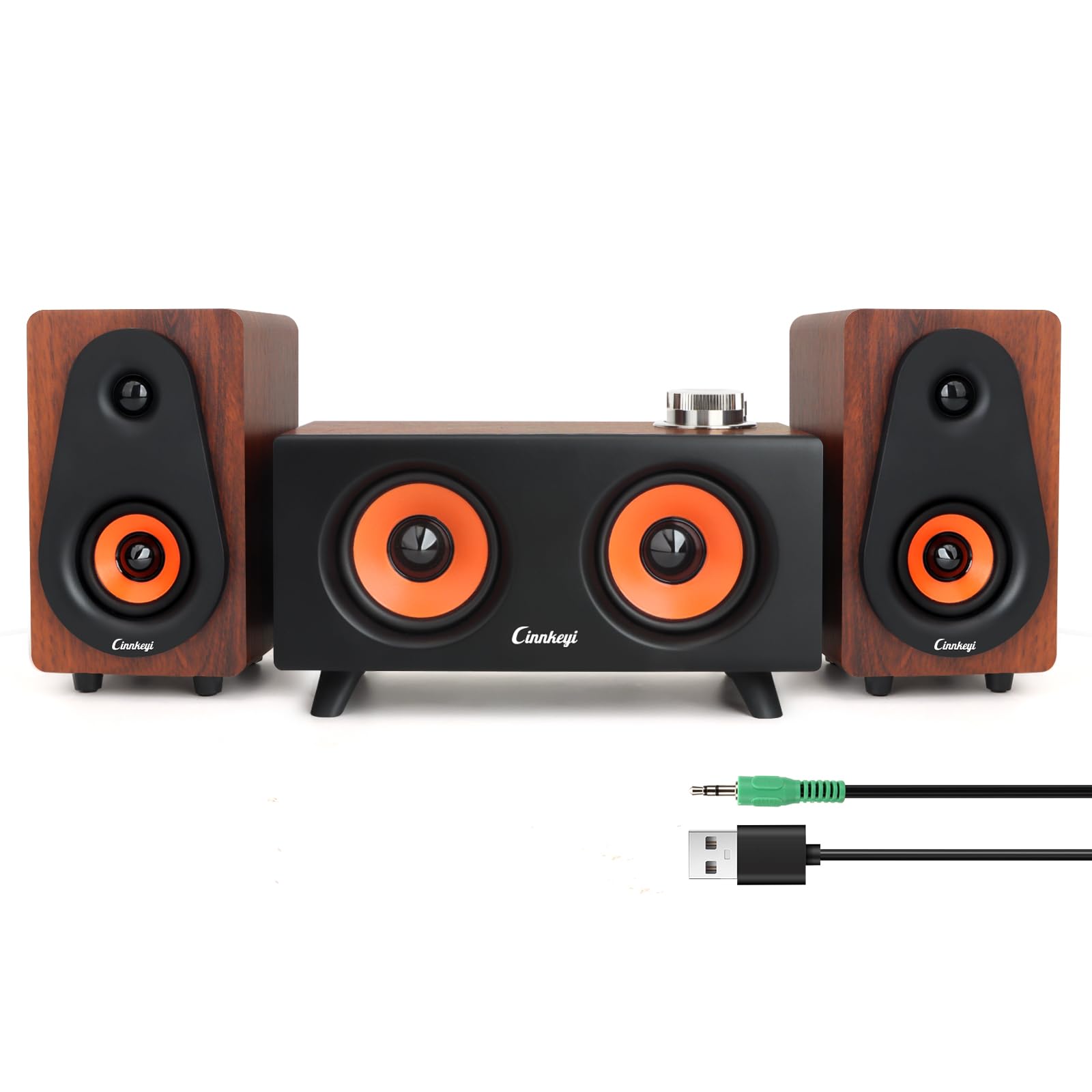
The Cinnkeyi CK-5212 is the most affordable 2.1 system in this guide, but it earns its place by offering a genuine three-piece setup — two satellite speakers and a subwoofer unit — at an entry-level price point that normally yields only a 2.0 configuration. The system uses a passive bass diaphragm in the subwoofer cabinet to produce low frequencies rather than an actively driven driver, which means it cannot reach the depths of a powered subwoofer, but it does add noticeable body to the sound compared to satellite-only speakers.
Power and audio are delivered via a single USB cable in PC mode, which simplifies the connection to just one wire for both duties — though it requires a USB port that can supply sufficient current (3.2A recommended, per user feedback). The multifunction knob handles volume, mode switching between PC, Bluetooth, and Line-In, and power on/off. The system supports Bluetooth for wireless streaming from phones or tablets, and the 3.5mm Line-In mode allows connection to TVs or game consoles independent of USB power.
Customer feedback is mixed but largely positive for the price category, with several users praising the “great sound at a great price” and noting that the speakers are excellent for a small room or bedroom setup. The biggest complaints involve the short speaker cables and inconsistent volume levels — some units are described as having low output, which may correlate with insufficient USB power delivery. For buyers on a strict budget who want 2.1 bass without needing a wall outlet, this is the functional entry point.
Why it’s great
- True 2.1 system with a subwoofer unit at an entry-level price point.
- Single USB cable handles power and audio for simple, cable-managed setup.
- Three audio modes — PC, Bluetooth, and Line-In — for broad device compatibility.
Good to know
- Passive bass diaphragm cannot match the depth of a powered subwoofer driver.
- Performance is dependent on a high-current USB port — low-output ports cause weak audio.
FAQ
Will a 2.0 bookshelf speaker ever produce as much bass as a 2.1 system with a subwoofer?
Do I need a subwoofer if I listen to music with clean bass like electronic or hip-hop?
What does DSP tuning do for bass PC speakers and why does it matter?
Can I use PC gaming speakers with my TV or console for better bass?
Final Thoughts: The Verdict
For most users, the best bass pc speakers winner is the Mackie CR3.5 because its studio-grade clarity, tone knob control, and location switch deliver bass that is articulate and adjustable — perfect for desktop nearfield listening where accuracy matters more than room-rattling volume. If you want deep, chest-thumping sub-bass that transforms gaming and movies, grab the ZQMMSPK 2.1 system with the 6.5-inch subwoofer for its genuine 100W RMS power and versatile connectivity. And for a budget-friendly 2.1 entry point with Bluetooth, the Bluedee 2.1 system offers punchy, DSP-controlled bass without sacrificing modern connectivity or desk-friendly RGB lighting.