
A bass reflex speaker isn’t just a box with a hole in it — that carefully engineered port is what transforms a timid enclosure into a chest-thumping, low-frequency machine. When the rear wave of the driver is tuned to reinforce the front wave, you get deeper extension and more efficient output than a sealed cabinet of the same size can deliver. But not all ports are created equal, and the quality of the driver, cabinet bracing, and crossover design determines whether you experience tight, articulate bass or a one-note thud that pollutes the midrange.
I’m Min — the co-founder and writer behind Gadgets Feed. By analyzing hundreds of user reviews and cross-referencing measured frequency response curves, driver sizes, amplifier power, and cabinet construction, I’ve separated the genuine performers from the overhyped ported boxes in this space.
This guide evaluates nine models spanning outdoor all-weather units, powered desktop monitors, passive bookshelf speakers, and dedicated subwoofers to help you find the best bass reflex speaker that matches your specific listening environment and budget.
How To Choose The Best Bass Reflex Speaker
A bass reflex design uses a tuned port to extend low-frequency response, but the engineering details separate a clean performer from a muddy mess. Pay close attention to driver quality, cabinet rigidity, and port design — these three pillars determine whether your speakers disappear into the soundstage or call attention to themselves with port noise and rattling panels.
Driver Size and Cone Material
Larger drivers move more air, but a well-designed 5.25-inch aramid fiber woofer can outperform an 8-inch polypropylene cone if the motor structure, suspension, and cabinet alignment are optimized. Look for cones made from woven aramid, aluminum, or treated paper — materials that balance stiffness for low distortion with damping for smooth breakup. A driver’s excursion capability (how far it can move linearly) directly dictates how loud and deep it can play before hitting mechanical limits.
Port Tuning and Placement
The port’s length and diameter determine the tuning frequency — the point where the port output reinforces the front wave. A port tuned too high creates a boomy, one-note bass effect; tuning too low may sacrifice output above the tuning point. Front-firing ports are easier to place near walls, while rear-firing ports need breathing room to avoid chuffing and boundary coupling. Look for flared port openings, which reduce turbulence noise at high output levels.
Cabinet Construction and Bracing
A bass reflex speaker’s cabinet must be inert — any panel resonance colors the midrange and blurs imaging. MDF or plywood cabinets with internal braces prevent the enclosure from flexing under high SPL. Sealed joints, non-parallel internal walls, and constrained-layer damping are signs of serious engineering. A cheap, thin-walled cabinet lets the port dominate in a bad way; the entire structure should feel dead when you knock on it.
Quick Comparison
On smaller screens, swipe sideways to see the full table.
| Model | Category | Best For | Key Spec | Amazon |
|---|---|---|---|---|
| Yamaha NS-AW194BL | Outdoor Bookshelf | Weather-resistant patio audio | 6.5″ woofer, sealed crossover | Amazon |
| Edifier R1280T | Powered Bookshelf | Desktop/TV stereo pair | 42W RMS, 4″ woofer | Amazon |
| Audio-Technica AT-SP3X | Powered Bookshelf | Compact turntable setup | Bluetooth, 2.75″ full-range | Amazon |
| Polk Audio Atrium 8 | Outdoor Single | Pool/patio high-fidelity | 6.5″ poly+dual 1″ tweeters | Amazon |
| Polk Monitor XT12 | Powered Subwoofer | Home theater bass foundation | 12″ driver, 100W Class A/B | Amazon |
| ELAC Debut 3.0 DB53-W | Passive Bookshelf | Critical music listening | 5.25″ aramid, 48Hz extension | Amazon |
| Yamaha HS5 Pair | Studio Monitor | Flat-response mixing/reference | 5″ woofer, bi-amp 70W | Amazon |
| Klipsch R-820F | Floorstanding Tower | High-output home theater | Dual 8″ woofers, Tractrix port | Amazon |
| SVS SB-1000 Pro | Powered Subwoofer | Tight, musical sub-bass | 12″ driver, 325W RMS | Amazon |
In‑Depth Reviews
1. ELAC Debut 3.0 DB53-W Bookshelf Speakers
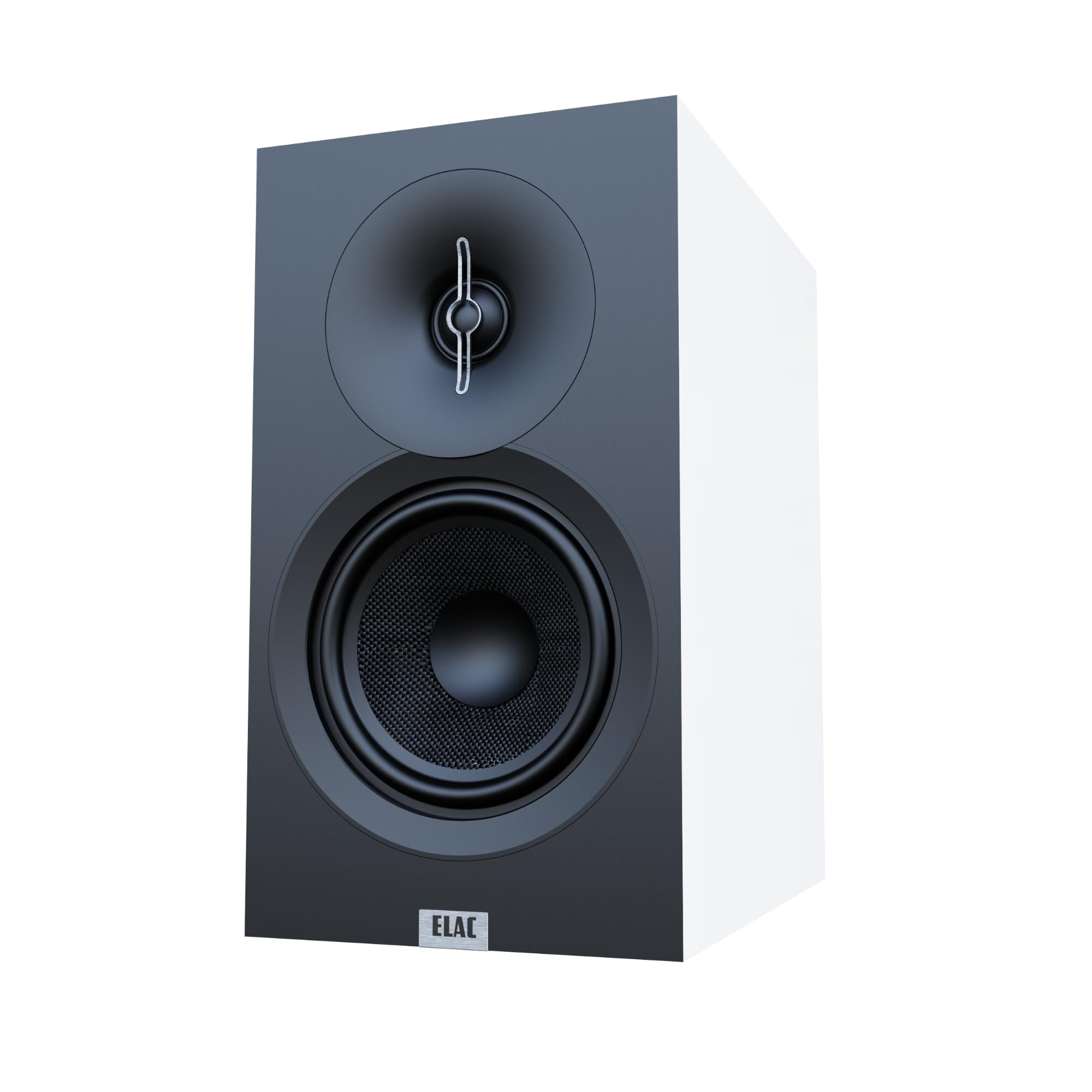
The ELAC Debut 3.0 series redefines what a mid-tier passive bookshelf speaker can deliver. The 5.25-inch woven aramid-fiber woofer provides stiffness that paper or polypropylene cones simply cannot match, yielding a controlled, extended low end that reaches down to 48Hz without sounding sluggish. The 1-inch aluminum dome tweeter with a custom wave guide and phase plug widens the sweet spot and eliminates the harshness that plagues lesser metal tweeters.
Internally braced MDF cabinet construction ensures the enclosure does not sing along with the music — a critical detail for a bass reflex design where cabinet resonance can blur the port output. Users consistently report exceptional imaging and the ability to reveal mastering details that remain hidden on lesser speakers. At normal listening levels in a medium room, these speakers project a holographic soundstage that makes them hard to beat at this level.
The 6-ohm impedance makes them reasonably easy to drive, but they reward a quality amplifier with 50-100W per channel. For listeners who prioritize accuracy, dynamics, and genuine bass extension without a subwoofer, the ELAC DB53-W represents the most balanced implementation of the bass reflex principle in this guide.
Why it’s great
- Aramid fiber woofer delivers exceptionally clean, extended bass with low distortion
- Rigidly braced MDF cabinet prevents port-induced coloration
- Magnetically attached grilles for a clean aesthetic without hardware
Good to know
- Requires an external amplifier or receiver (not powered)
- May benefit from a subwoofer for aggressive EDM or theater LFE content
2. Klipsch Reference R-820F Floorstanding Speaker

The Klipsch R-820F is a tower speaker that leverages dual 8-inch spun-copper IMG woofers and a rear-firing Tractrix port to produce authoritative bass that fills a room with minimal amplifier effort. The 90×90 square Tractrix horn-loaded 1-inch aluminum LTS tweeter delivers the signature Klipsch high-frequency efficiency, making dialogue and vocal details cut through even at moderate volumes.
With the port located on the rear, these speakers require at least 6-8 inches of clearance from the wall to allow the port to breathe properly. When placed optimally, the dual woofers combine to move substantial air, delivering punchy, dynamic low end that excels in home theater explosions and rock music kick drums. Users note that a powerful receiver (120W+ per channel continuous) unlocks their full dynamic range without strain.
For listeners who want floorstanding presence without stepping into the four-figure range, the R-820F offers a muscular bass reflex implementation that prioritizes output and efficiency. Adding a subwoofer like the R-120SW extends the bottom octave, but even standalone, these towers produce satisfying depth for most content.
Why it’s great
- Dual 8-inch woofers move massive air for dynamic home theater and music playback
- High-efficiency horn tweeter produces clean output with lower amplifier power
- Sturdy cabinet with magnetic grille for a clean, premium look
Good to know
- Rear-firing port requires careful placement away from walls
- 8-inch woofers may still leave the deepest sub-bass octave (sub-30Hz) on the table
3. Edifier R1280T Powered Bookshelf Speakers
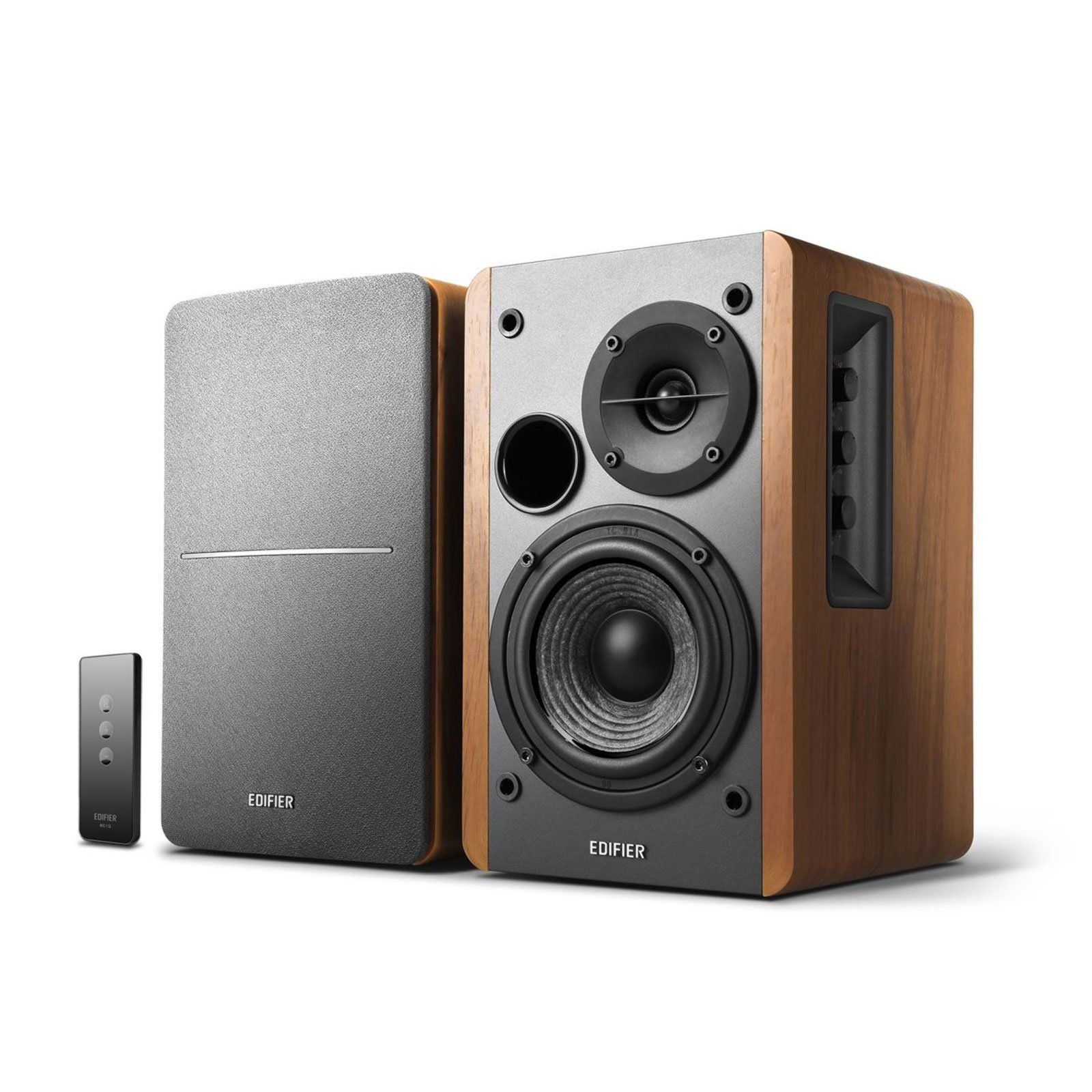
The Edifier R1280T has become the default recommendation for entry-level powered speakers for good reason: the combination of a 4-inch bass reflex woofer and a 13mm silk dome tweeter, driven by 42W RMS of internal amplification, produces a sound that punches far above its dimensional footprint. The wooden MDF cabinet with vinyl finish looks more premium than its price suggests and provides a sufficiently inert enclosure for the ported design.
Bass and treble controls on the side panel let users tailor the frequency response to room acoustics without requiring an external equalizer. The dual RCA inputs allow simultaneous connection to a computer and a turntable or TV — the simplicity of switching sources without unplugging cables is a genuine convenience. Remote control adds further usability for desktop or small-room setups.
While the 4-inch driver cannot match the low-end extension of larger speakers, the port tuning is well-executed, delivering punchy, present bass that works for pop, rock, and acoustic music. For the listener who wants a complete stereo system in a box with no amplifier shopping, the R1280T delivers excellent bass reflex value in a compact package.
Why it’s great
- Built-in amplifier eliminates need for external receiver
- Adjustable bass and treble controls for room-specific tuning
- Dual RCA inputs for multi-device connectivity without switching
Good to know
- No Bluetooth or wireless connectivity
- 4-inch woofer limits deep sub-bass compared to larger models
4. SVS SB-1000 Pro Subwoofer
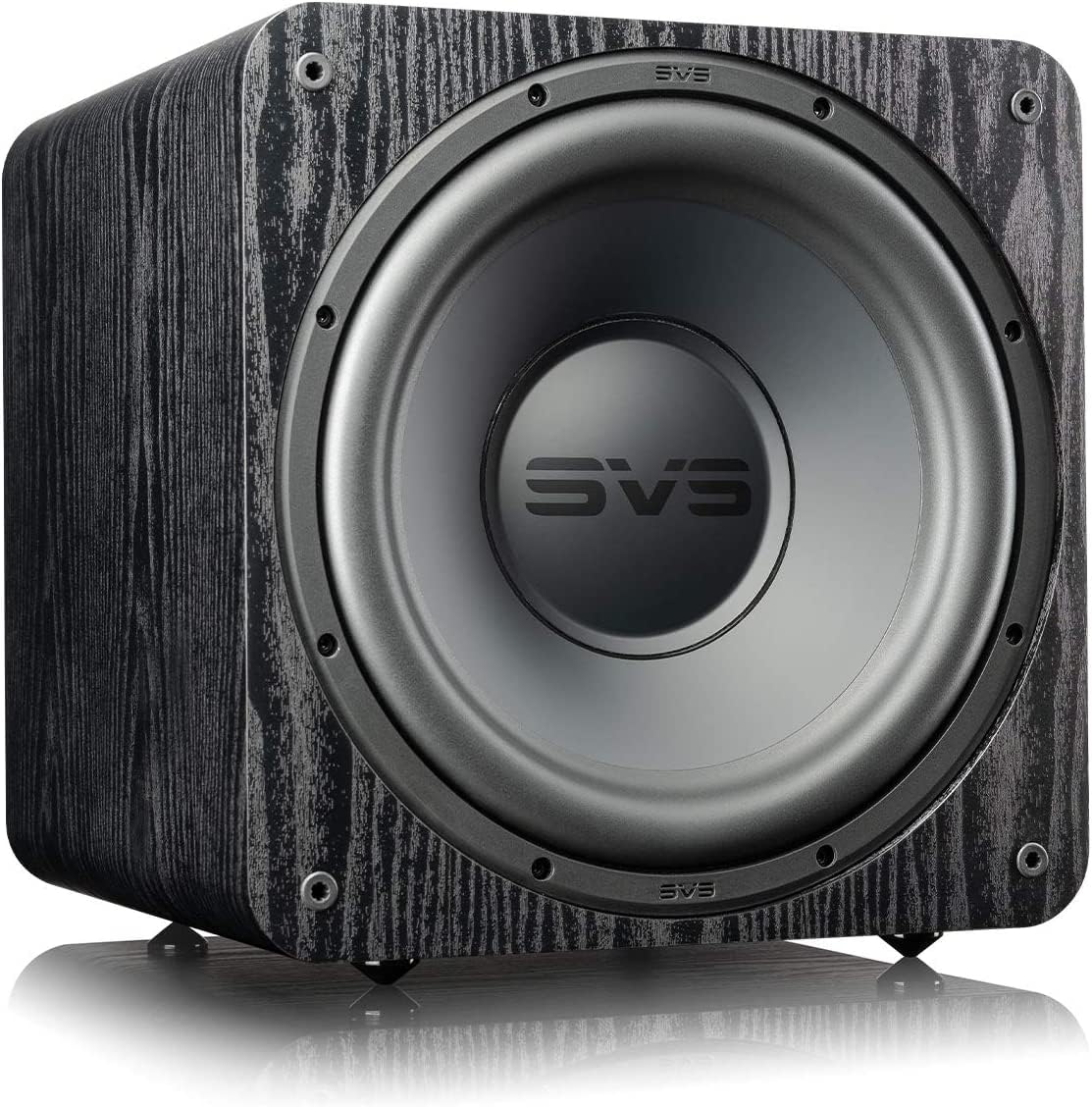
The SVS SB-1000 Pro uses a sealed cabinet rather than a port, but its inclusion here is essential because it represents the alternative approach to bass extension — and one that many listeners prefer. The 12-inch high-excursion driver powered by a 325W RMS Sledge STA-325D amplifier delivers deep, articulate bass down to 20Hz with vanishingly low distortion, all from a compact sealed box that integrates into tight spaces.
The 50MHz Analog Devices DSP and the SVS smartphone app provide parametric EQ, volume control, custom presets, and in-room tuning adjustments that make the SB-1000 Pro one of the most flexible subwoofers on the market. Users consistently praise the app for enabling seamless fine-tuning from the listening position without requiring a separate processor.
For music lovers who value tight, fast bass — the kind that reproduces a double bass or kick drum with attack and decay rather than a sustained thrum — the sealed SB-1000 Pro outperforms many ported competitors. Adding a second unit eliminates room nulls and produces evenly distributed bass across the entire listening area, making this an upgrade path rather than a dead end.
Why it’s great
- 325W RMS amplifier delivers massive, clean output from a compact sealed cabinet
- Smartphone app provides parametric EQ and system integration unmatched at this level
- Tight, musical bass suits critical music listening better than most ported subs
Good to know
- Sealed design trades some maximum SPL for articulation compared to ported equivalents
- Auto-on feature can be inconsistent with low-level signals on some receivers
5. Yamaha HS5 Pair Studio Monitors

The Yamaha HS5 is an industry-standard nearfield monitor precisely because its bass reflex design prioritizes accuracy over flattery. The 5-inch woofer and 1-inch dome tweeter are driven by separate 70W bi-amplified power sections, ensuring each driver receives clean, dedicated power without intermodulation distortion. The port is carefully tuned with Yamaha’s noise-reduction technology to minimize chuffing at high output levels.
Response controls on the rear panel allow fine-tuning for room acoustics, including a room control switch that attenuates low-end buildup when the monitors are placed near walls. The result is a flat, honest frequency response that reveals mix flaws and recording artifacts without hyping any region — exactly what producers, engineers, and critical listeners need.
For pure music enjoyment, some listeners may find the HS5 too dry compared to consumer speakers with boosted bass, but that neutrality is the point. When paired with a subwoofer like the SVS SB-1000 Pro for the deep low end, an HS5-based system provides transparency that few other setups at this level can match.
Why it’s great
- Bi-amplified design provides clean, separate amplification for woofer and tweeter
- Room control and high-trim switches adapt response to placement
- Industry-standard flat response trusted for critical mixing decisions worldwide
Good to know
- Intentionally flat bass may sound lean to listeners used to consumer tuning
- XLR and TRS inputs only — no RCA or Bluetooth connectivity
6. Polk Audio Atrium 8 Outdoor Speaker

The Polk Atrium 8 is engineered specifically for outdoor use without sacrificing the bass reflex advantage. A 6.5-inch Dynamic Balance polypropylene woofer is paired with two 1-inch anodized aluminum dome tweeters in a configuration that can be switched between single-speaker stereo operation and standard left/right pairing. The port and drivers are housed in an all-weather cabinet with powder-coated grilles and sealed internal circuitry.
Users consistently report that these speakers deliver rich, full-range sound that can cover a patio, pool area, or quarter-acre yard with ease — a feat many outdoor speakers fail to achieve due to compromised bass response. The Speed-Lock mounting system allows one-handed installation and flexible vertical or horizontal orientation, making placement decisions much less restrictive.
The trade-off for weather resilience is that the Atrium 8 cannot match the refinement of indoor-only speakers in the same price range. The polypropylene cone and sealed tweeters trade some detail for durability, but for outdoor use where exposure to sun, rain, and temperature swings is a given, the Atrium 8’s bass reflex implementation is best-in-class.
Why it’s great
- All-weather construction withstands extreme temperatures, rain, and UV exposure
- Dual tweeter array with SDI switch enables flexible installation configurations
- Speed-Lock bracket allows tool-free, one-handed mounting
Good to know
- Requires connection to an external amplifier or receiver
- Polypropylene woofer lacks the detail of woven aramid or metal cone drivers indoors
7. Audio-Technica AT-SP3X Bookshelf Speakers

The Audio-Technica AT-SP3X delivers impressive full-range sound from a remarkably compact bookshelf enclosure. The 2.75-inch dynamic driver with a bass reflex port produces bass that defies the speaker’s footprint — users describe the low end as punchy and substantial, especially given the small cabinet volume. The built-in Bluetooth with multipoint pairing allows seamless switching between a turntable and a phone.
Setup is streamlined: connect the included speaker cable between the left and right units, plug in the AC adapter, and pair via Bluetooth or connect RCA sources. The front-panel power button with LED indicator and volume dial keep operation simple. The inclusion of international plug adapters makes this speaker genuinely travel-friendly for global use.
While the 2.75-inch driver cannot physically displace enough air to compete with larger speakers for deep bass in a big room, the port tuning is optimized for nearfield desktop or bookshelf placement. For the listener building a compact system around a turntable, the AT-SP3X offers a satisfying bass reflex experience in a footprint that fits anywhere.
Why it’s great
- Compact form factor with surprisingly robust bass output
- Bluetooth multipoint allows simultaneous connection to two devices
- International plug adapters included for global travelers
Good to know
- Small driver unable to produce sub-60Hz bass in larger rooms
- Plastic enclosure may resonate at higher volumes compared to MDF cabinets
8. Polk Monitor XT12 Powered Subwoofer

The Polk Monitor XT12 adds serious low-frequency extension to any system without requiring flagship-level investment. A 12-inch Dynamically Balanced long-throw woofer is powered by a 100W Class A/B amplifier, delivering clean output down to 24Hz — deep enough to reproduce the floor-shaking effects in modern action films. The rigidly braced MDF cabinet keeps resonances under control even at high output levels.
Connection options include line-level RCA and LFE inputs, making integration with any home theater receiver straightforward. Variable crossover (80-160Hz) and phase polarity controls allow precise blending with main speakers. Users consistently report that the XT12 transforms the theater experience, producing tactile bass that makes movies and games immersive without distortion.
While 100W Class A/B is modest by modern subwoofer standards, Polk’s driver design and cabinet tuning extract excellent performance from the available power. In a medium-sized room, this sub delivers satisfying output levels. For those who want room-rattling extremes, adding a second XT12 or upgrading to a higher-powered model is the natural next step.
Why it’s great
- 12-inch long-throw woofer produces deep, clean bass down to 24Hz
- Class A/B amplifier delivers warm, controlled sound without digital harshness
- Variable crossover and phase controls enable seamless system integration
Good to know
- 100W amplifier may struggle for headroom in very large rooms or at extreme volumes
- Large cabinet requires planning for placement and living room integration
9. Yamaha NS-AW194BL All-Weather Speakers

The Yamaha NS-AW194BL offers a straightforward outdoor bass reflex solution at an accessible price point. The two-way design uses a 6.5-inch woofer and a balanced tweeter in a weatherproof cabinet with powder-coated grilles and UV-resistant materials. These speakers are designed to live outside permanently — users report years of service on uncovered fence posts with only cosmetic yellowing and no degradation in sound quality.
Sound quality is described as full and efficient for the size and price, with adequate bass for background music on a patio or in a small yard. The supplied mounting brackets allow flexible installation on walls, eaves, or posts. As a passive speaker, it requires connection to an external amplifier or receiver, which gives users freedom to choose their amplification source.
Compared to the Polk Atrium 8, the Yamaha NS-AW194BL delivers less output and refinement, but at a significantly lower investment. For covering a small outdoor space with music at reasonable volume levels, these speakers provide reliable weather resistance and satisfactory bass reflex performance that justifies their place as the entry-level outdoor option.
Why it’s great
- True weatherproof construction withstands prolonged outdoor exposure
- Flexible mounting brackets included for easy installation
- Yamaha reliability with consistent performance over many years
Good to know
- Bass output is adequate but notably less than indoor speakers of similar size
- Plastic cabinet may yellow or crack with long-term direct sun exposure
FAQ
What is the difference between a bass reflex and a sealed enclosure?
Can I place a rear-port bass reflex speaker directly against a wall?
Why does my bass reflex speaker buzz at certain frequencies?
Final Thoughts: The Verdict
For most users, the bass reflex speaker winner is the ELAC Debut 3.0 DB53-W because its aramid fiber woofer and rigidly braced cabinet deliver controlled, extended bass with imaging that competes with speakers costing twice as much. If you need a powered solution for desktop or small-room listening, grab the Edifier R1280T. And for outdoor durability without compromising the bass reflex principle, nothing beats the Polk Audio Atrium 8.