
Our readers keep the lights on and my morning glass full of iced black tea. As an Amazon Associate, I earn from qualifying purchases.
Specs are compiled from manufacturer listings and verified buyer reviews and can change over time — please confirm the key details on the product page before buying.
The subwoofer is the one speaker that decides whether your movies feel like a night at the theater or a night at your laptop. Most buyers get it wrong the same way: they buy on wattage alone, then wonder why the bass sounds like a muddy rumble instead of a clean, chest-tight thump. What actually matters is the combination of driver size, cabinet design, and the frequency range the unit can genuinely reach — get those three right and everything else falls into place.
I’m Min — the founder and writer behind Gadgets Feed. This guide is built by comparing the manufacturers’ published specifications and the patterns across verified customer reviews, so you get each pick’s real strengths and trade-offs instead of marketing spin.
From studio-grade sealed cabinets to budget ported boxes that punch far above their class, here are the picks worth your money for the best bass speaker woofer.
Our Picks at a Glance


How To Choose The Best Bass Speaker Woofer
The biggest mistake buyers make is chasing the biggest wattage number on the box. Wattage tells you how much power the built-in amplifier can send to the driver, but it says nothing about how deep or how clean the bass actually sounds. A well-designed 70W sub can outperform a poorly-tuned 200W unit in a small room.
Driver size and what it does for you
The driver is the moving cone that pushes air — the bigger it is, the more air it moves, and the deeper the bass you feel. An 8-inch driver works well for small rooms, desktops, and bookshelf systems. A 12-inch driver moves noticeably more air and suits larger living rooms and home theaters where you want bass you can feel in your chest, not just hear.
Frequency response: the number that reveals real depth
Frequency response tells you the lowest note the sub can reproduce. A sub rated down to 22Hz or 24Hz reaches deeper than one that bottoms out at 35Hz. For movie soundtracks with rumbling explosions, lower is better. For music — especially acoustic, jazz, or anything where tightness matters more than extension — a sub that hits 35Hz cleanly often sounds more musical than one stretching to reach lower at the cost of control.
Room size dictates what works
A large sub in a tiny room becomes boomy and hard to tame. A small sub in a large room runs out of headroom and distorts when pushed. Match the sub’s design and cabinet size to the space — a compact sealed cabinet for a bedroom or office, a larger ported cabinet for an open-plan living room or dedicated theater.
Quick Comparison
| Model | Best For | Driver Size | RMS Power | Low Frequency | Amazon |
|---|---|---|---|---|---|
| Yamaha HS8 Studio Subwoofer★ Best Overall | Studio monitoring | 8 inches | 150W | 22Hz | Amazon |
| SVS SB-1000 ProTop Performer | Premium home theater | 12 inches | 325W | — | Amazon |
| Sonos Sub 4Wireless Favorite | Sonos system owners | 5 inches | — | — | Amazon |
| Polk Audio Monitor XT12 | Mid-range home theater | 12 inches | 100W | 24Hz | Amazon |
| JBL SUBBP12AM | Car audio | 12 inches | 150W | 35Hz | Amazon |
| ALTO TS12S | Live events and DJ | 12 inches | — | — | Amazon |
| Dayton Audio Classic CS1000 | Budget home theater | 10 inches | 180W | 28Hz | Amazon |
| Edifier T5s | Desktop and bookshelf | 8 inches | 70W | 35Hz | Amazon |
| Rockville Rock Shaker 8″ | Budget starter sub | 8 inches | 200W | — | Amazon |
In‑Depth Reviews
1. Yamaha HS8 Studio Subwoofer, Black
Our pick — over 4.5★ from 350+ verified ratings; the strongest balance of quality and price.
The studio sub that finishes a mix without ever announcing itself
If you mix music on Yamaha HS5 monitors and keep hearing a gap where the low end should be, this is the sub that fills it. The 8-inch bass-reflex driver (a cone paired with a tuned air vent that reinforces low notes) reaches all the way down to 22Hz — deep enough that synthesizer bass and kick drums land with weight instead of disappearing. The built-in 150W amplifier pushes clean output without strain, and the LOW CUT control (80–120Hz in the data alongside the HIGH CUT) lets you hand off the bottom octave from your main monitors so they stop working so hard.
What wins owners over is the sound quality — it is the single most-praised thing about this sub, and the reviewers describe accurate, noise-free reproduction that reveals room acoustics rather than coloring them. One buyer who had gone through multiple defective 10-inch subs called this Yamaha “high quality” after the switch. A bass player running synths through a studio setup found it took pressure off his monitors entirely. Pairs are common too — HS5 buyers report near-perfect blending, and the XLR connectivity routes signal cleanly through the sub to the speakers. There is real value here too, though a few owners acknowledge the price stings for a sub this size.
The honest catch: reliability and controls both come back mixed in owner feedback, and the rear heat sink is physically crowded enough that angled XLR plugs can bump into it — straight connectors and a quick read of the manual solve both issues. This is a mixing tool, not a party sub. If you want the bass to rattle a living-room wall, look elsewhere. If you want to hear exactly what is in your track, this is it.
Where It Delivers
- 22Hz low end catches every kick and synth bass line in the mix
- 150W amp stays clean and noise-free at working volume
- LOW CUT and HIGH CUT controls blend smoothly with HS-series monitors
- XLR signal routing produces accurate, uncolored bass
What To Anticipate
- Price is steep for a sub this cabinet size
- Rear heat sink crowds angled XLR connectors
- Studio tuning, not party output — small rooms only
- Controls and reliability come back mixed in long-term owner feedback
Built for: studio producers and critical listeners who need accurate low-end translation, not boom.
Think twice if: you want a sub to shake a large living room — the cabinet output is tuned for nearfield work.
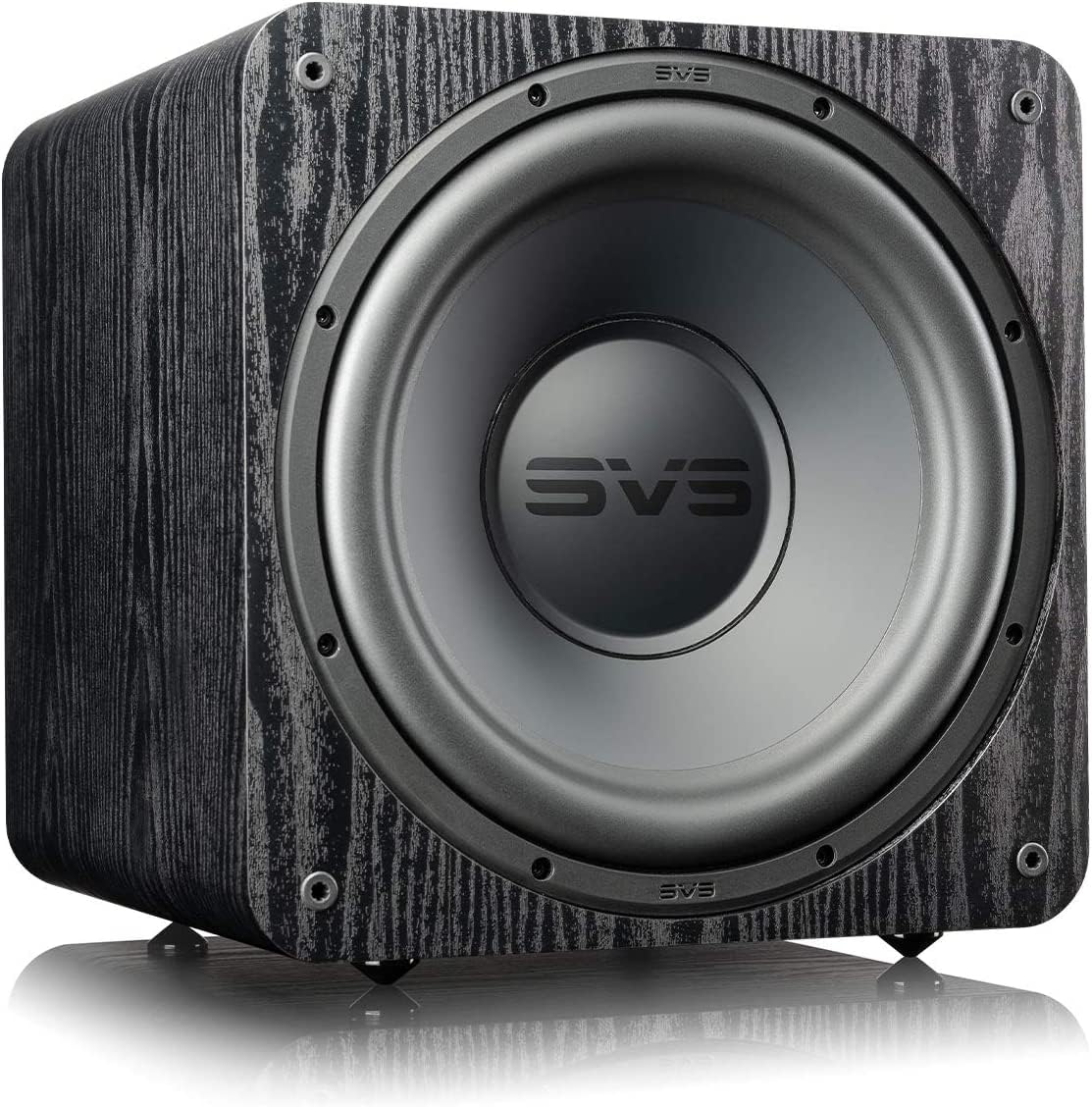
2. SVS SB-1000 Pro Subwoofer (Black Ash)
A sealed 12-inch brute you fine-tune from your phone
The SB-1000 Pro packs 325W RMS and 820+ watts peak through its Sledge STA-325D amplifier, driving a 12-inch high-excursion driver in a sealed cabinet. Because the cabinet is sealed rather than ported, the bass rolls off gently and stays tight — owner after owner describes it as non-boomy and articulate. It reaches down into the low 20s and fills a room from a cabinet compact enough to tuck into a corner. Where this sub separates itself from the field is control: the 50MHz Analog Devices DSP (a chip that corrects the sub’s output in real time) and the SVS smartphone app let you adjust volume, crossover, and parametric EQ from your listening position.
Owners overwhelmingly agree the app is the star of the show, and the customizability it open up — real-time tuning, multiple presets, PC-level EQ control — lets them blend the sub smoothly with whatever speakers they already own. A dual-SB-1000 setup in opposing corners eliminated directional bass entirely and reached 20Hz in one home. Music listeners praise it for EDM and near-field desktop systems; movie watchers note that the ported PB-1000 in the same family digs deeper for big-room cinema use. If you want a sub that disappears into your room while completely changing how it sounds, this is the one.
The one honest limit: the sealed cabinet is smaller than its ported sibling, which gives it a physical advantage in tight spaces but means it trades absolute output for precision. Heavy action-movie enthusiasts who want sub-20Hz rumble that moves furniture might miss a ported design. For everyone else, this is the most flexible sub in the roundup.
Editor’s pick rationale: The 325W RMS amplifier paired with the app’s EQ control gives you more tuning authority than anything else at this level, and the sealed cabinet stays compact enough for real apartments.
Who thrives here: music-first listeners with a mixed movie habit who want deep but controlled bass and are willing to spend an evening dialing it in.
Pick this if: you want room-filling bass the app lets you sculpt without hauling a tower into your living room.
Look past it if: your setup demands ported-style raw output for a home theater the size of a garage.
3. Sonos Sub 4 – Wireless Subwoofer – Black
The sub that vanishes into the room — no wires, no rattle, no fuss
If you already own a Sonos soundbar or speaker, this is the upgrade that turns the system into something you feel. The Sub 4 uses dual Sonos-engineered force-canceling drivers — two cones mounted so they fire in opposite directions and cancel out each other’s vibration — inside a ported enclosure. The result is deep bass with virtually no buzz or rattle, even at volume. It stands upright or lies flat under a sofa, connects over Wi-Fi so you can place it anywhere in the room, and sets up through the Sonos app with a single power cable.
What buyers rave about most is the total elimination of distortion and the flexibility of going wireless — no subwoofer cable to run across a floor. Owners pairing it with a Sonos Arc Ultra describe cinematic bass that snaps them into the movie, tighter dialogue, and better instrument separation in music across genres. The Trueplay tuning via the app handles room correction automatically, which is exactly what you want if you do not want to become a hobbyist. The one thing buyers keep coming back to: some consider it steeply priced, others consider it worth every cent for what it does to a Sonos system.
The limitation is that this is a Sonos-only sub — it will not work with an AV receiver or third-party speakers. If your system is not built around Sonos components, look to the Polk XT12 or SVS SB-1000 Pro instead. But if you are inside the Sonos ecosystem, the Sub 4 is the natural completion of it, and the design is one of the few subs in this roundup you would happily leave visible in a living room.
Why Sonos Owners Choose It
- Dual force-canceling drivers eliminate vibration, buzz, and rattle
- Wi-Fi connection lets you place it anywhere in the room
- Sonos app and Trueplay handle tuning automatically
- Sculptural design fits upright or flat under furniture
The Trade-Offs
- Only works with Sonos systems — no receiver compatibility
- Premium pricing draws mixed reactions from owners
- Requires the Sonos app for any real control
Made for: Sonos households pairing with an Arc Ultra, Arc, or Beam who want complete wireless bass without touching a crossover knob.
Skip if: your setup runs through an AV receiver or non-Sonos speakers — this sub speaks only Sonos.
4. Polk Audio Monitor XT12 12″ Powered Subwoofer

The 12-inch theater sub that hits like it costs several times the sticker
For a home theater where you want to feel the LFE channel, the Monitor XT12 brings a long-throw 12-inch dynamically balanced woofer and a 100W Class A/B amplifier together with bass extension down to 24Hz. It sits in a rigid, critically braced MDF cabinet (a heavy wood composite that reduces resonance) with a removable grille, and it pairs with the latest Dolby Atmos and DTS:X AV receivers. Cross the crossover at 80–160Hz (variable), dial the phase polarity to 0 or 180 degrees, and let the sub take over the bottom octave your bookshelves cannot reach.
Owners describe the bass as deep, clean, and controlled — one compared the performance to gear costing three to four times as much. Action scenes transform: dialogue stays crisp up top while explosions and hits get real punch down low. The XT12 replaces subs like the pricier Velodyne with ease in the experience of owners, and auto-on works well as long as you cap the LFE range on the receiver. It is weighty but not a monster — the cabinet size is manageable for mid-sized rooms.
Where to be careful: in a very small room, the XT12 can put out more bass than you need, and getting it to sound clean demands a little tuning (volume, crossover, and possibly phase). Several owners note the gain balance sits around 40–50% — push past 85% and the sound drifts toward boomy. If you have a big, open living room and want serious bass output with a matching brand-name pedigree, this is the one.
Real-world impact: The 12-inch driver paired with the braced MDF cabinet means even at moderate gain the low end feels physically present, not just audible.
The honest caveat: Auto-on power takes a strong signal to trigger, so quiet listening sessions may want the sub left on manually.
Standout pick for: mid-to-large living rooms where you want theater-credible bass without crossing into flagship territory.
Not ideal for: tiny apartments — the output is generous enough that a smaller sealed sub will fit better.
5. JBL SUBBP12AM 12″ Amplified Subwoofer

One box, one amp, real bass — the trunk-filler built for factory systems
If you want strong bass in a car without building a component system, the JBL SUBBP12AM is the shortcut. It combines a 12-inch polypropylene woofer with a built-in amplifier rated at 150W RMS or 450W peak, and it plays from 35–120Hz with a Slipstream port (a flared opening that eliminates the chuffing noise a normal port makes at high output) keeping distortion low when you crank it. A remote control is included for adjusting sub level from the driver’s seat, and the polypropylene cone — a tough plastic composite — resists humidity and heat, which is why it survives trunk living.
The sound quality and the value are the two things owners mention most, and one describes bass that pulls buried low-end out of older music you thought you knew. Install is genuinely simple enough that owners bolt it in themselves and go; it fits across a Subaru Impreza trunk, a Challenger trunk, a Tahoe, a Murano, and an MDX, and it can vibrate the rearview mirror at half volume. It is an all-in-one package with no separate amp to wire up, which is exactly why it keeps ending up in cars with factory head units.
The honest limitation: it is not a competition-grade sub, and a few owners note the amp can fail within months — a warranty matter, not a universal experience. And because the 12-inch driver is exposed when mounted free-standing, buying a speaker grill is a smart add-on. If you want chest-pounding bass without a custom install, this is the fastest route there.
What Makes It Work
- 150W RMS / 450W peak amp built right into the enclosure
- Slipstream port keeps bass clean at high volume
- Fits most car trunks with a simple install
- Remote control for sub level at the driver’s seat
- Polypropylene cone handles trunk heat and humidity
Where It Falls Short
- Durability of the internal amp comes back mixed from owners
- Not competition-level output
- Exposed 12″ driver benefits from an added grill
Built for: drivers with factory stereos who want big bass without an amp rack and a fistful of wires.
Consider alternatives if: your goal is competition-tier SPL and you are prepared to run a separate amplifier.
6. ALTO TS12S 2500W 12″ Powered PA Subwoofer
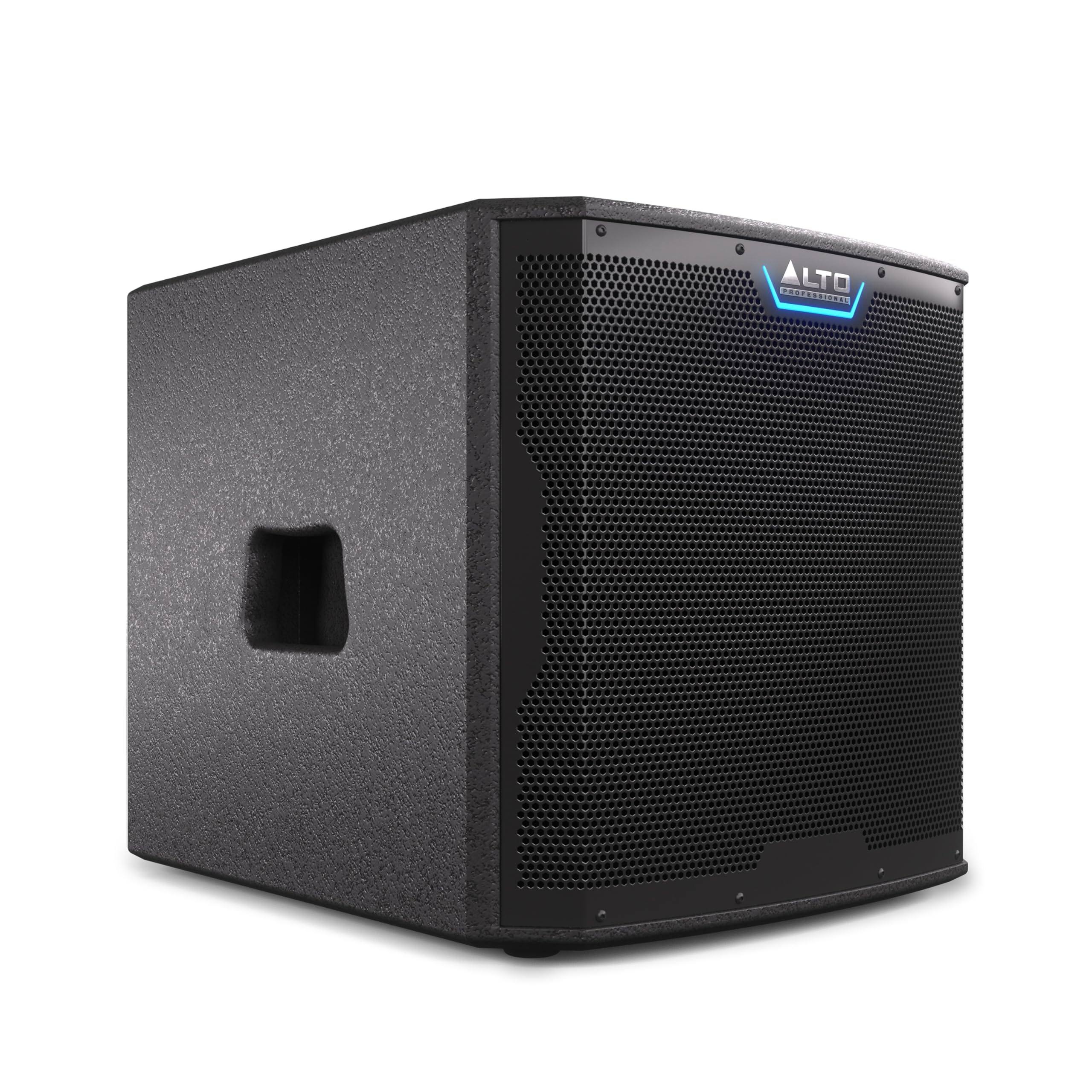
A PA sub that brings the thump to DJ sets and small venues
This is not a living-room sub — it is a powered PA sub rated at 2500W peak through a high-efficiency Class D amplifier driving a 12-inch driver with a 3-inch voice coil. It reaches 130dB of output, which is genuinely loud enough to anchor a small-to-mid venue, and it weighs 57.1 pounds so one person can move it without a dolly. The cabinet is internally braced, front-ported MDF with a mark-resistant splatter-spray finish, an integrated 36mm pole socket for stacking a top speaker, and electronic clip, thermal, and transducer overdrive protection built in.
Three DSP EQ modes — EQ Off, Live, and DJ — let you shape the response to the room, and phase alignment control compensates for low-frequency cancellation when the sub is placed near the tops. Twin XLR plus 1/4-inch inputs and twin XLR outputs make chains and loops simple, provided you feed both inputs. For DJs and small bands on a working budget, this sub extends the bottom end cleanly enough that a pair of tops paired with it sounds like a full system — owners call it “perfect for DJs on a budget” and note it fills in the low end beautifully.
The catch to plan around: this sub is unhappy being pushed near its limit at very low volume — some owners mention the crossover between quiet and loud feels abrupt below 45% volume, so it wants a properly set input level rather than a whisper-quiet signal into the mixer. It is also bulky enough that small cars will complain. If your gigs involve transporting gear, factor that in. For stationary installs in bars, studios, or event spaces, the size stops mattering.
What it does for a crowd: The 130dB output and DSP EQ modes give you enough clean low end to feel the kick drum across a medium room — the kind of bass that changes how the audience moves.
The fixed-location assumption: At 57.1 pounds with a front-ported cabinet this size, the TS12S is best treated as an install that occasionally travels, not a piece you throw in the trunk nightly.
Right for: mobile DJs, small bands, and venues that need PA-grade low end they can move occasionally, not nightly.
Wrong for: apartment listening or any setup that wants a compact, invisible home sub.
7. Dayton Audio Classic CS1000 10″ 180W Powered Subwoofer
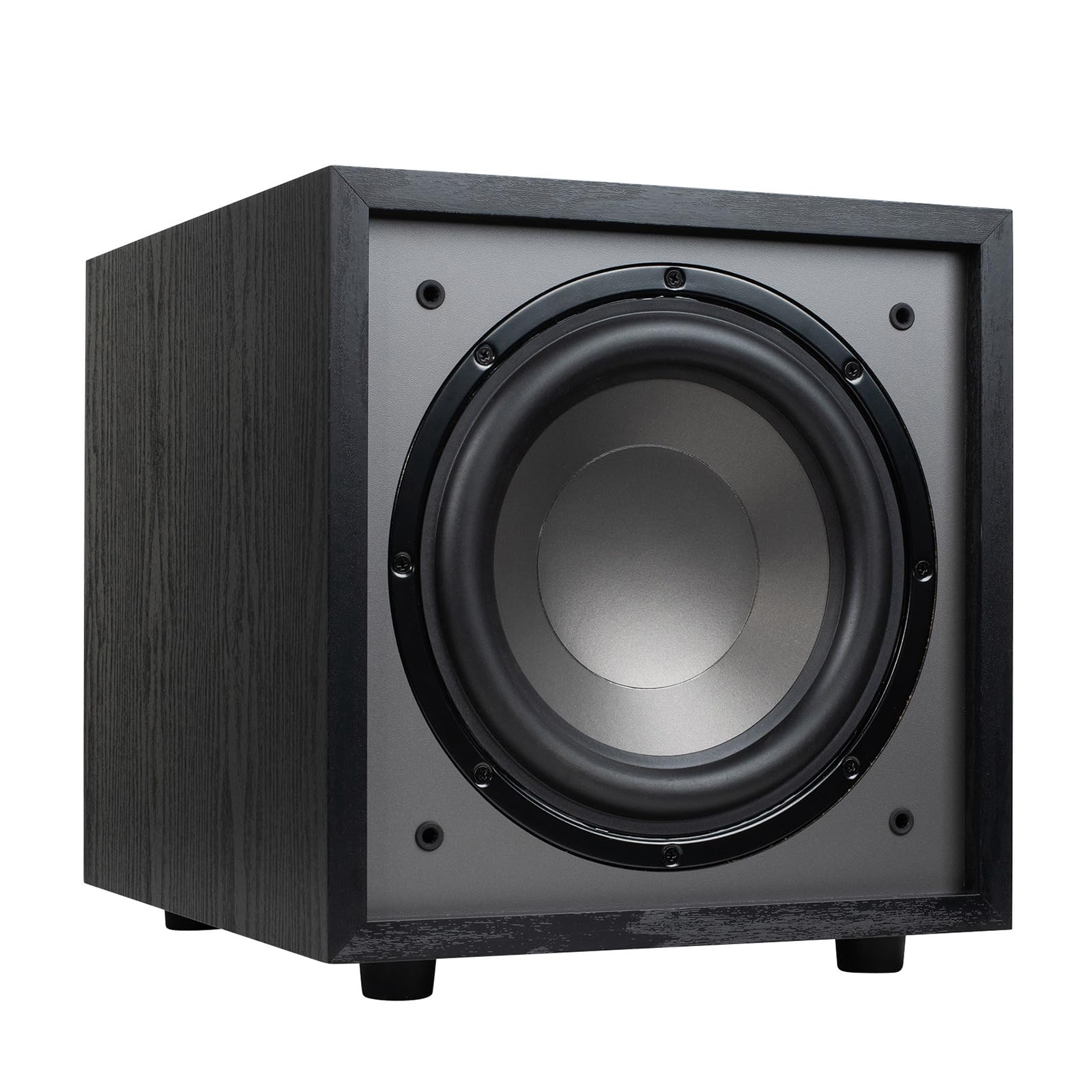
The braced-cabinet bargain that makes small systems sound twice their size
Dayton Audio’s Classic CS1000 pairs a 10-inch driver with a 180W Class-D amplifier inside a rigid, braced cabinet with a swappable grille and a 5-year warranty. Bass reaches down to 28Hz, and the connections cover the usual bases — stereo RCA, LFE, and speaker-level inputs — so it slots into a system with or without a dedicated sub out. Setup is quick: hook the RCA in, set the gain, dial the crossover and phase, done.
Two things consistently earn praise from owners: the sound quality, which is consistently described as tight and articulate rather than muddy, and the build quality. One buyer set gain to 50% as the balance for music, then crept to 65% for movies — above 85% the bass heads toward boomy but still holds together with no distortion. Another reports the sub cleanly filled a room with air pressure he could feel, not just hear, using the LFE input. In 5.1 systems with budget speakers, the CS1000 completes the bottom end with authority.
Two honest notes: the auto-on feature needs a reasonably strong signal to trigger, so quiet sources may not wake it up — keep it on manually for music-first listening. And the built-in crossover knob reads slightly higher than it sounds, so some owners prefer crossing at the receiver at 80Hz instead. Neither is a deal-breaker, and the warranty is the strongest in the roundup. If you have a sub-out port, gain, and a medium room, this sub earns its keep.
The Case for This One
- 180W Class-D amp into a braced cabinet for clean, non-boomy bass
- RCA, LFE, and speaker-level inputs cover nearly every system
- 28Hz extension reaches lower than most budget subs
- 5-year warranty leads the roundup
Plan Around This
- Auto-on needs a strong signal to trigger
- Built-in crossover reads higher than labeled
- Above 85% gain, output becomes boomy
Chosen by: buyers who want a genuinely capable theater sub on a lean budget and can handle a little calibration at setup.
Pass if: you need a sub that turns itself on from very quiet sources without intervention.
8. Edifier T5s Powered Subwoofer
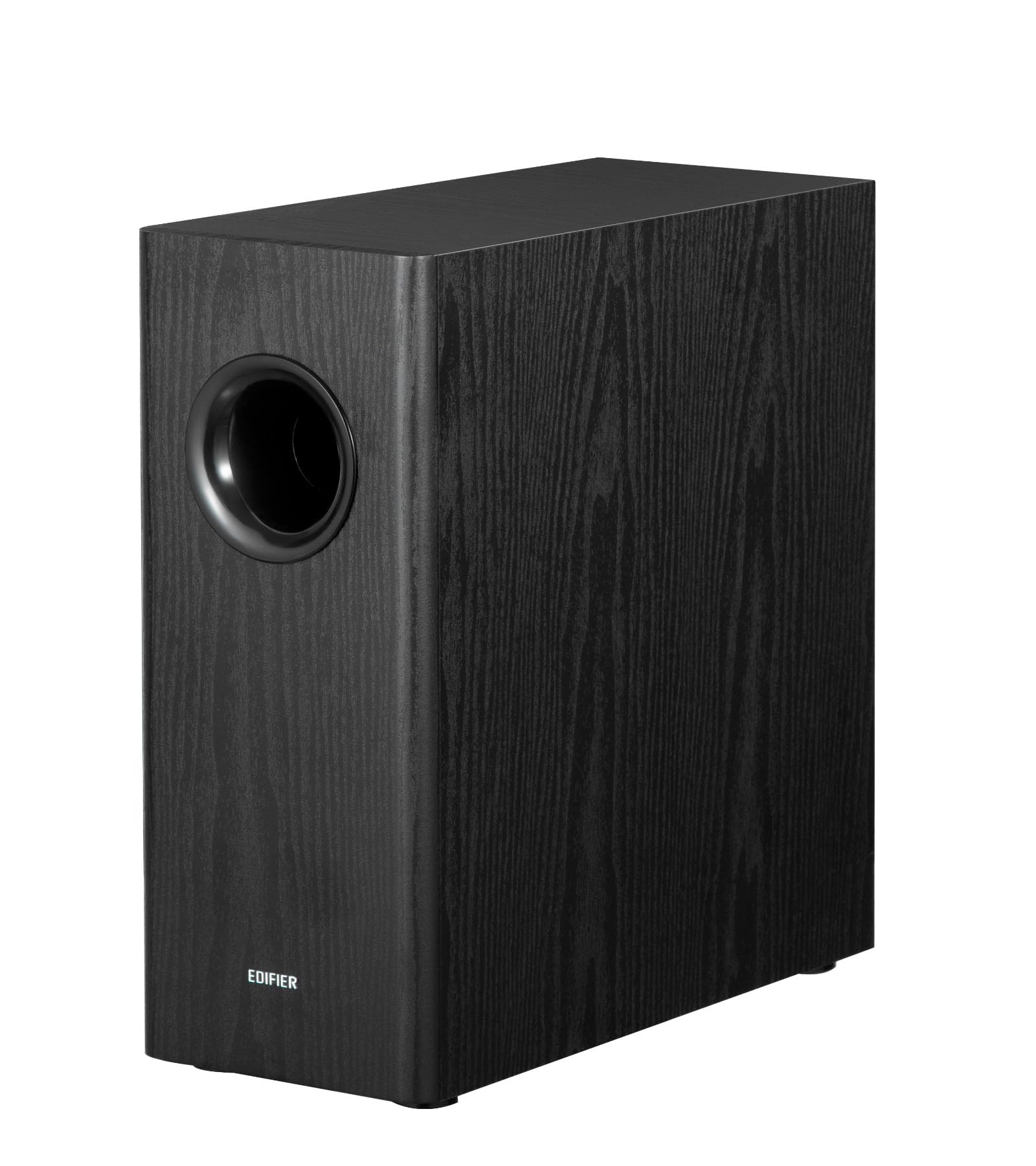
Compact, tiny-footprint bass that wakes up the moment audio hits it
The T5s is built for people who do their listening at a desk. It uses an 8-inch long-throw woofer with a 70W RMS Class-D amplifier and reaches down to 35Hz, all packed into a slim 18mm MDF cabinet with a front-firing driver and right-firing acoustic port. The low-pass filter is adjustable from 30Hz to 160Hz, the phase selector toggles between 0 and 180 degrees, and auto-standby cuts power after 15 minutes of inactivity. Setup is simple: 3.5mm-to-RCA and RCA cables are included, and there is no receiver needed.
Owners praise it for sounding far bigger than its size — a desktop-system set of speakers gets bass extension that feels like a whole new room. One organist noted the T5s handled sub-sonic pedal pipe tones and made the floor rumble “as any concert hall would.” Sensitivity is a standout: the auto-on triggers at the very first volume notches on a DAC or amp, so quiet evening listening still gets the low end — something many pricier subs miss. In a small-to-medium room, customers note the walls shake at low volume.
Compatibility is the one place to check the manual before buying. The T5s is designed to work smoothly with the Edifier speakers officially listed by the brand, and wiring it to a non-Edifier setup is possible but demands an RCA or sub-out connection on the source. If your system does not have a sub-out or the series-connection workflow described, another sub in the roundup may be the easier fit. For Edifier desktop owners, it is a near-perfect match.
What stands out: The auto-on sensitivity is the highest in the roundup — it triggers at DAC volume level 1, so even quiet desktop listening gets bass without needing to crank the source.
The relevant limit: The 70W amplifier and 35Hz low-end suit rooms and nearfield listening; larger open spaces will hit its ceiling before others on this list.
Ideal for: desktop and bookshelf listeners — especially Edifier owners — who want compact bass without a sub-out cable puzzle.
Look elsewhere if: you need large-room output or your source lacks an RCA or sub-out hookup.
9. Rockville Rock Shaker 8″ Powered Subwoofer

The entry-level box that wakes up small speakers overnight
For anyone running modest bookshelf or desktop speakers with a budget amp, the Rock Shaker 8″ is the lowest-cost way to get real low end. It pairs an 8-inch high-excursion driver with a Y30 magnet and a 1.5-inch 4-layer voice coil, driven by 200W RMS / 400W peak from a built-in Class D amp inside an MDF cabinet. RCA and speaker-level inputs and outputs mean it hooks up to a wide range of amps and receivers, and the compact black cabinet fits neatly behind or under furniture.
The sound quality is what owners talk about most — one added the Rock Shaker to a pair of small kitchen speakers and called the result “night-and-day,” with tight controlled bass that blends into the music without dominating it. Another reports it is a step up over a subwoofer costing over ten times more at retail, which is unusual praise for a sub in this bracket. The bang-for-buck is genuinely strong for anyone not ready to spend on a premium model.
Two honest cautions. The first is durability: a chunk of the review signal flags the amp failing after a period of use, which is a pattern to weigh — though plenty of units run daily without any problem, and buyers can always lean on the warranty. The second is the cabinet — it feels light and thin relative to premium subs, and the crossover knob is unmarked and clickless, making it a little hard to dial in precisely. For a starter system, workshop, gaming room, or small theater where the goal is more bass without commitment, the Rock Shaker delivers.
Why It’s Worth Considering
- 200W RMS / 400W peak Class D amp provides real punch for the tier
- RCA and speaker-level I/O cover legacy amps without a sub out
- Compact MDF cabinet fits behind or under furniture
- Reviewers point out a dramatic upgrade over bare bookshelf speakers
Where To Set Expectations
- Long-term amp reliability shows up as a recurring concern
- Cabinet feels light and thin next to premium subs
- Unmarked clickless crossover knob takes patience to tune
Best fit for: hobbyists and hobby-room listeners wanting a cheap, immediate upgrade in bass without stepping up a tier.
Know before you commit: if your listening spans many hours a day and reliability is essential, spending up to the Polk or Dayton tier is the safer path.
Understanding the Specs
RMS Power vs Peak Power
RMS power (root mean square) is the wattage the amplifier can genuinely sustain day in and day out — it is the number that tells you how much clean, continuous output you are actually buying. Peak power is a momentary burst figure that looks impressive on a box but speaks little about real-world performance. When comparing subs, weight the RMS number heavily: a 70W RMS sub with a well-designed driver can sound deeper and tighter than a 200W RMS sub with a cheap cabinet and a casual build.
Frequency Response and Low-End Extension
Frequency response tells you the lowest note a subwoofer can actually reproduce. A sub that reaches 22Hz or 24Hz goes below what most human ears can hear individually but can still feel as room pressure — critical for movie soundtracks with deep rumble. A sub that stops at 35Hz sounds genuinely strong but will not reproduce the lowest octave of a theater explosion. For music listening, extension matters less than tightness; for film, extension is what separates “nice bass” from “walls shaking.”
Sealed vs Ported Cabinets
A sealed cabinet (no air vent) delivers tighter, more accurate bass that rolls off gradually — the trade-off is lower absolute output because the air inside the box resists the driver’s motion. A ported cabinet uses a tuned vent to reinforce low-end output, giving you more boom for the same driver at the cost of some tightness and a sharper cutoff. Sealed suits music and small rooms; ported suits home theater and larger spaces where you want maximum output per driver.
Driver Size and Voice Coils
Driver size — usually 8, 10, or 12 inches — determines how much air the sub can move, which directly shapes how much perceived bass you get. A voice coil (the tube of wire wrapped around the driver’s magnet) does the electrical-to-mechanical conversion; a larger coil handles more power without overheating. An 8-inch driver in a small room can feel just as powerful as a 12-inch in a large room, so match driver size and cabinet design to your space before assuming bigger is always better.
FAQ
Will a subwoofer work with my existing AV receiver?
Does a bigger driver always mean deeper bass?
Can I add a subwoofer to a Sonos system without Sonos hardware?
Is a sealed or ported subwoofer better for movies?
Will a subwoofer rattle my apartment neighbors?
How do I set the crossover on my subwoofer?
Do I need a separate amplifier for a powered subwoofer?
Where should a subwoofer be placed in a room?
How long should a subwoofer last?
Can I use a home subwoofer in my car?
Final Thoughts: The Verdict
For most people shopping for the best bass speaker woofer, the winner is the Yamaha HS8 Studio Subwoofer, because its 22Hz low-end extension, clean 150W amplifier, and accurate tuning make it the most trustworthy sub in the roundup for anyone mixing or listening critically — and it holds the top score here at 4.8 stars across 300+ ratings.
If you want room-filling home theater bass and a sub that doubles as a music performer, the SVS SB-1000 Pro at 325W RMS with its app-based tuning is the more flexible upgrade. If you already run Sonos gear, the Sonos Sub 4 is the one that disappears into the room without a single cable. And if you want serious theater output without paying flagship money, the Polk Audio Monitor XT12 hits down to 24Hz and outpunches its bracket.
Match the sub to your room size and your source first — everything else is a detail. Get those two right and you will stop hearing the bass and start feeling it.
How We Picked
We do not accept paid placement. Every pick is matched to a real buyer and a real use-case; we do not hands-on test units.
Sources & Methodology
Specifications: manufacturer listings and product documentation. Review insights: verified customer reviews, as of September 2026. Pricing: not shown on this page (it changes often); check the current price via the retailer link.
As an Amazon Associate, Gadgets Feed earns from qualifying purchases. This does not affect which products we feature.