
Our readers keep the lights on and my morning glass full of iced black tea. As an Amazon Associate, I earn from qualifying purchases.
Specs are compiled from manufacturer listings and verified buyer reviews and can change over time — please confirm the key details on the product page before buying.
Adding a subwoofer to your car changes everything. Suddenly, you feel the kick drum in your chest, and the low-end rumble transforms a flat factory system into something you actually want to listen to. But the search for solid bass can get confusing fast — enclosure types, power handling, shallow vs. standard mounts — it is easy to pick something that sounds great on paper but won’t fit behind your seat or won’t match your amplifier.
I’m Min — the founder and writer behind Gadgets Feed. This guide is built by comparing the manufacturers’ published specifications and the patterns across verified customer reviews, so you get each pick’s real strengths and trade-offs instead of marketing spin.
Whether you are after chest-thumping competition SPL or just clean, accurate low end for daily driving, the right bass subwoofer for car boils down to understanding power, fit, and enclosure design.
Our Picks at a Glance


How To Choose The Best Bass Subwoofer For Car
Picking a car subwoofer is about matching three things: how much power you can feed it, the space you have to house it, and the type of bass you actually want to hear. Here is a breakdown of the key specs that separate a satisfying upgrade from a disappointing one.
Power Handling — RMS is the Real Number
Every subwoofer lists a peak power number (often huge, like 1200W) and an RMS number (a fraction of that, like 300W). The RMS rating tells you how much power the sub can handle continuously — that is the number you match to your amplifier’s output. Overpower a sub with a big amp and you risk blowing the voice coil. Underpower it and the bass stays thin. A good rule is to choose a sub whose RMS rating falls within 75-100% of the amplifier’s RMS output (at the same impedance).
Enclosure Type — Sealed vs. Ported vs. Powered
A sealed box gives you tight, accurate bass that drops off steeply at very low frequencies — it is great for music like rock and jazz where precision matters. A ported (vented) box extends the low-end output, making it louder for a given power level, which rap and EDM fans appreciate — but it is physically larger. A powered subwoofer has the amplifier built directly into the box, saving you from buying a separate amp and wiring it. That all-in-one convenience matters if you want a simple, clean upgrade.
Size and Fit — Measure First
An 8-inch subwoofer fits under a seat or in tight trunks and delivers punchy mid-bass, but it won’t play the deepest frequencies at high volume. A 10-inch sub offers a good blend of depth and space efficiency. A 12-inch sub can move more air for that chest-thumping feeling but demands a bigger enclosure. Before buying, look up the enclosure dimensions and compare them to your vehicle’s trunk or cargo area. A shallow-mount sub is the answer if you are tucking it behind a seat in a pickup or coupe.
Quick Comparison
| Model | Best For | Size | Power Handling (RMS) | Enclosure Type | Amazon |
|---|---|---|---|---|---|
| KICKER 48CDF104★ Best Overall | Trunk-friendly bass with cargo space | 10 inches | — | Down-firing sealed | Amazon |
| Pioneer A-Series TS-A2500LS4Space Saver | Shallow spaces behind seats | 10 inches | 300W | Shallow-mount (requires separate box) | Amazon |
| Rockville RVB12.1ABest Value | Plug-and-play powered solution | 12 inches | 300W | Powered (built-in amp) | Amazon |
| Kicker 43CVR124 CompVR | Aggressive output with dual voice coils | 12 inches | 400W | Requires separate box | Amazon |
| Rockville Punisher 12D2 | Competition-level SPL builds | 12 inches | 1400W | Requires separate box | Amazon |
| MTX Audio RT8PT | Compact powered tube for tight spaces | 8 inches | 120W | Powered vented tube | Amazon |
| American Bass XFL 12 | High-power output for serious listeners | 12 inches | 1500W | Requires separate box | Amazon |
| JBL SUBBP12AM | Clean powered bass in a compact sealed box | 12 inches | 150W | Powered sealed | Amazon |
| Pioneer TS-WX1210A | Rich powered bass with easy factory integration | 12 inches | 300W | Powered sealed | Amazon |
In‑Depth Reviews
1. KICKER 48CDF104 Comp 10″ Subwoofer in Down Firing Enclosure
Our pick — over 4.5★ from 200+ verified ratings; the strongest balance of quality and price.
The trunk-friendly down-firer that lets you load cargo right on top.
This KICKER solves the classic problem of sacrificing cargo space for bass. The down-firing enclosure directs bass through the floor rather than out the front, so you can stack gear, grocery bags, or even tools directly on top of it. The 10-inch driver uses a stiff injection-molded cone with 360-degree back bracing to keep distortion at bay, and full perimeter venting helps the voice coil stay cool during long drives.
What wins people over here is the sound quality — especially how it fills in the low frequencies that factory systems miss. The result is a balanced stage rather than a one-note boom. The box itself is built from thick MDF (medium-density fiberboard) with internal bracing and custom embroidery, so it feels solid under load. Buyers report pushing it with a KICKER 500.1 amp at about 60 watts over the recommended RMS for two years without any failure — that is a tough little driver.
The Defining Strengths
- Down-firing design saves trunk space — you can load cargo on top of the enclosure without damaging the sub.
- Clean, accurate bass that works at low volume, not just when you crank the gain.
- Built from thick MDF with internal bracing, so the box itself resists rattling.
The Realistic Trade-off
- The 10-inch driver caps ultimate low-end output — it cannot hit the deepest sub-bass like a 12-inch competition sub can.
- Mounting depth might still be an issue in very small coupes or trucks with limited under-seat clearance.
Reach for this if: You want noticeable bass improvement without turning your trunk into a one-box cargo zone.
Think twice if: Your goal is extreme SPL (sound pressure level) for competitions — you need a ported 12-inch setup instead.
2. Pioneer A-Series TS-A2500LS4 Shallow-Mount 10″ Subwoofer
The shallow-mount that punches above its slim profile.
Pioneer designed this 10-inch sub for vehicles where space is the enemy — behind a truck seat, under a rear seat in a coupe, or inside a custom slim enclosure. The shallow-mount frame (Glass-Fiber and Mica Reinforced IMPP cone) keeps the overall depth tight while the 1200W max / 300W RMS power handling delivers bass that owners describe as hitting hard without bursting windows. The 4-ohm single voice coil (SVC) makes wiring simple: pair it with a mono amp and you are done.
Many owners draw a direct comparison to Pioneer’s own D-series, saying this A-series is “just as good” and handles 20Hz playback without issues. That is unusual for a shallow sub, which typically trades low-end extension for thinness. The dense foam surround feels durable, and the trim ring gives the install a clean, factory-like look. The crowd favorite praise focuses on sound quality — clear, not boomy — and build quality that feels premium for the price point.
The real fit note: This is a pure woofer — no enclosure included. You need to build or buy a sealed box with the correct air volume (typically 0.5 to 0.8 cubic feet for a 10-inch shallow). The shallow depth helps the box stay small, but you still need to account for that space. If you are looking for a quick drop-in with a box, go with a powered combo instead.
Grab it for: A truck, coupe, or convertible where every inch of mounting depth matters.
skip it if: You prefer an all-in-one box-and-sub package and do not want to source a separate enclosure.
3. Rockville RVB12.1A 500W Active 12 Inch Car Subwoofer with Enclosure
The all-in-one 12-inch that skips the amp shopping nightmare.
Rockville bundles the subwoofer and a Class AB amplifier into a single hatchback-shaped enclosure, so you just run power and ground wires and plug in RCA cables. The 12-inch driver handles 500W peak / 300W RMS — significant output for a sub that costs a fraction of a premium component setup. The adjustable low-pass crossover (30Hz to 150Hz) and the bass boost EQ let you tune the sub to your musical taste without touching a separate amplifier’s dials.
The 300W RMS figure itself is the crowd favorite talking point: owners who have run this sub for up to ten years say it delivers clean, defined low bass that outperforms what you expect at this price tier. The anti-vibration braced MDF cabinet (covered in blue-and-black aviation-grade tweed carpet) keeps rattling to a minimum. The recurring advice from experienced buyers: match it with a 4 Farad capacitor to keep your car’s alternator from straining during heavy bass passages.
Honest caveat: This is not a competition SPL sub — the bass is described as “defined” rather than “rumbly,” and a few units have developed rattling after being moved between vehicles. If you want chest-caving output at the expense of everything else, look at the dedicated high-power options below.
Best for: A first-time buyer who wants big 12-inch bass without the complexity of buying and wiring a separate amplifier.
Not for: Enthusiasts who already have a high-power external amp and want to squeeze every last dB from a dedicated competition sub.
4. Kicker 43CVR124 CompVR CVR12 Sub 12″ 400 Watt RMS

The dual-voice-coil Kicker that thrives on abuse.
You get wiring flexibility with this 12-inch CompVR sub because it uses a dual 4-ohm voice coil (DVC — two separate wire coils on the same speaker). That lets you present either a 2-ohm or 8-ohm load to your amplifier, so you can pull maximum wattage from a mono amp without straining it. The injection-molded polypropylene cone keeps weight low while staying stiff, and the 86.9 dB sensitivity rating means the sub turns amplifier power into sound efficiently — so you need less wattage to reach the same volume.
One owner reports running this sub for over three years on a 1000-watt Kenwood Excelon amp — more than double its 400W RMS rating — and says it “still hits as hard as when it was first broken in.” That over-powering headroom shows Kicker’s conservative RMS ratings and strong motor structure. The shockproof construction, listed in the specs, helps the sub survive clipping (distortion from an overdriven amp) that would destroy weaker drivers.
Durability is mixed: many owners mention years of trouble-free use, but a small number say the sub stopped working after a couple of months. That variance likely depends on enclosure design (a bad box can kill any sub) and amplifier tuning. Overall, the CompVR is a proven middle ground between entry-level and full competition hardware — pass on it if you need competition-level SPL, but it is a solid step up from budget subs.
Choose this if: You need a 12-inch sub that can handle a big amp without flinching, and you want DVC wiring flexibility for your setup.
Pass on it if: You want an all-in-one box — this is a raw driver requiring a separate enclosure.
5. Rockville Punisher 12D2 12″ Dual 2-Ohm Competition Car Audio Subwoofer

The 1400W RMS monster built to slam, not just play.
Rockville’s Punisher line targets the SPL (sound pressure level) crowd without demanding a budget-breaking spend. This 12-inch driver is rated at 5600W peak / 1400W RMS — massive power handling backed by a 246-ounce magnet and a 3-inch 4-layer OFC (oxygen-free copper) voice coil. The dual 2-ohm voice coils allow wiring down to a 1-ohm load, which is where high-current competition amplifiers operate at peak efficiency.
The non-pressed paper cone with foam surround and reinforced stitching is a classic high-excursion design. With a 28mm Xmax (the distance the cone can travel before distortion), this subwoofer moves a lot of air. Reviews confirm exactly that: owners describe the bass as “slamming hard” and report using ported boxes tuned to around 35 Hz with 3000-watt amplifiers, producing output that surprises even experienced listeners. The rigid cast aluminum basket reduces unwanted resonance, keeping the sound cleaner at high drive levels.
The real consideration: This is a raw driver with no enclosure — and at 1400W RMS, you need a properly built ported box, a high-output alternator, and thick power wiring (0 AWG recommended). The Punisher is not a casual weekend upgrade; it demands a complete electrical system to reach its potential.
Built for: The competitor or serious enthusiast who already has the amplifier (mono, 2000W+) and enclosure ready to go.
Not for: Anyone using a factory electrical system or a small sealed box — you will starve this sub of the air and current it needs to perform.
6. MTX Audio RT8PT 8 Inch 240 Watt Powered Tube Subwoofer
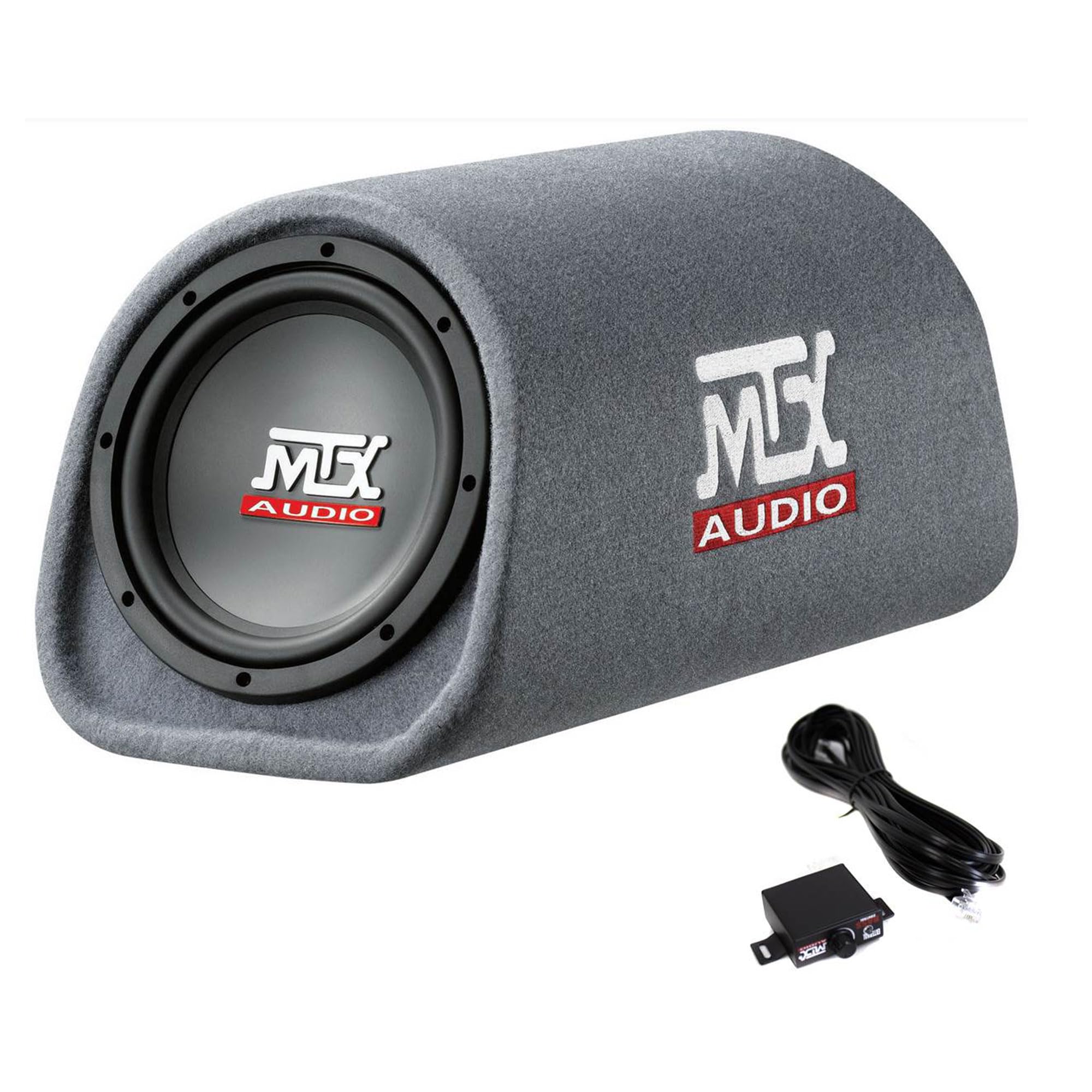
The 8-inch tube that fits where a box never could.
MTX’s powered tube is the answer for vehicles with zero square-footage to spare — boats, small cars like the PT Cruiser, or truck cabs where even a shallow-mount box is a tight squeeze. The cylindrical enclosure is just 21.25 inches long and less than 10 inches in diameter, and it comes with mounting straps for secure installation under seats or against cargo-cave walls. The built-in amplifier delivers 240W max / 120W RMS to the 8-inch driver, and the vented design boosts output beyond what a sealed tube of this size would produce.
The external bass control knob lets you dial in the level from the driver’s seat without reaching into the trunk. Owners consistently praise the easy installation and the way it fills in missing low-end for a factory stereo, especially in a Tacoma or Highlander where aftermarket sub space is limited. The butyl rubber surround and aviation-grade carpet add durability in environments where the sub might face bumps or temperature swings. That said, the 8-inch driver cannot hit frequencies below 35 Hz effectively — rap and EDM tracks with deep sub-bass will lack the lowest octave.
Ideal for: A compact SUV, boat, or cabin where preserving cargo space matters more than shaking your mirrors.
Look bigger if: You primarily listen to music that relies on very low (sub-35Hz) frequency content — the 8-inch simply cannot move enough air for that.
7. American Bass XFL 12 Inch Car Subwoofer – 4 Ohm 3000 Max Watts
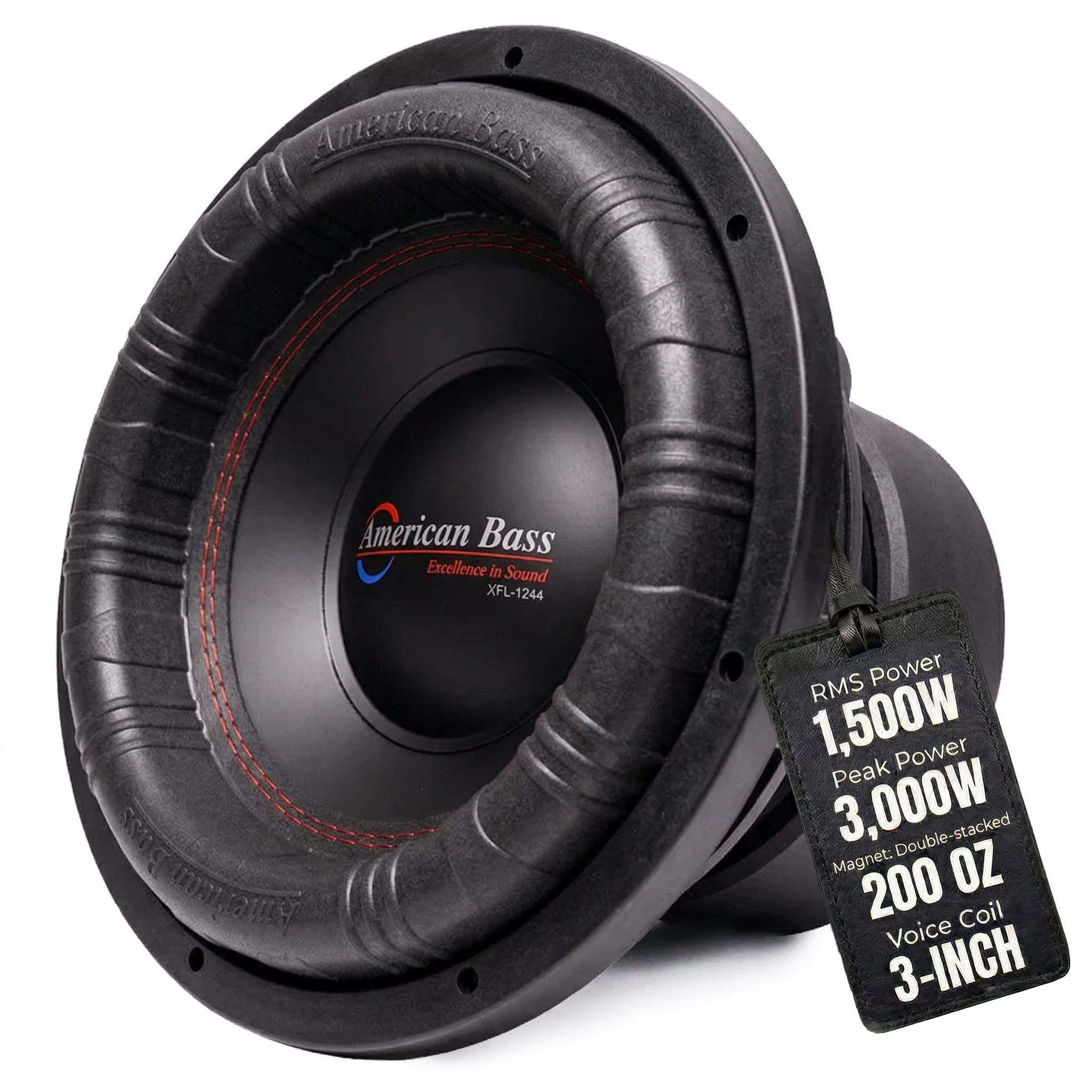
The 36-pound beast that shakes your mirrors from a block away.
American Bass are known in the SPL community for subs that handle serious power, and the XFL 12 is a textbook example. It carries a 200-ounce ferrite magnet and a 3-inch voice coil, pushing its RMS rating to 1500W. The dual 4-ohm voice coils let you wire the sub to a 2-ohm or 8-ohm load — most competitors wire it to 2 ohms on a 1500W mono amplifier and the sub delivers without overheating or smelling.
Owners describe the XFL 12 as “beastly” and “hits like a tank.” One detailed build uses two XFL 12s in a ported box tuned to 32 Hz, powered by 1500W of Precision Power amplification, with the owner noting the subs stay cool even after extended play. The black cast-aluminum basket and direct 8-gauge wire leads are a design update from earlier versions, improving long-term reliability. The consensus is that this sub offers competitive output at a price far below comparable brands — it is for buyers who want near-competition output without paying competition prices.
Honest constraint: At 36 pounds just for the driver, this sub requires a well-built enclosure and adequate bracing. It also demands significant electrical upgrades (high-output alternator, heavy-gauge wiring). The surrounds on some early units separated after a year — owners recommend a quick refoam or reinforcement with glue if you plan to drive it hard daily.
Buy it for: A dedicated SPL build where raw output and power handling are the top priorities.
Avoid it if: You want a plug-and-play solution — this sub needs a custom box, big amp, and upgraded electrical system to shine.
8. JBL SUBBP12AM – 12″ Amplified Subwoofer with Sub Level Control

The JBL that brings clean, loud bass with zero amp-hunting.
JBL bundles a 12-inch driver and a perfectly matched amplifier into a single sealed enclosure — the built-in amp supplies 150W RMS / 450W peak to the polypropylene cone. The sealed design means the bass stays tight and accurate, making it a great match for rock, pop, and metal where precision matters more than endless subsonic rumble. A Slipstream port eliminates port noise (a common issue with cheaper vented subs), and the included remote level control lets you dial bass up or down from the driver’s seat.
Owners consistently call the sound “clean” and “loud” for a 150W system. A specific install in a 2022 Challenger R/T produces enough output to vibrate the rearview mirror through the thick back seat — impressive for a powered unit. The size of the enclosure receives mixed feedback: some find it compact enough for a trunk, while others call it too tall for their specific space (a 2020 Mazda 6 owner noted it fit, but just barely). The JBL brand reliability shows in the reviews, with most owners calling it a worthwhile upgrade over unpowered alternatives.
Great for: A clean upgrade in a sedan or SUV where you want quality bass — not just loudness — and you value JBL’s reputation for sound accuracy.
Consider spacing if: Your trunk has limited vertical clearance — measure the enclosure height first, as it is taller than some other powered units.
9. Pioneer TS-WX1210A Powered 12″ Subwoofer with Enclosure 1300W Max

The Pioneer powered sub that works with factory radios — no cut wires.
Pioneer designed the TS-WX1210A specifically for people who want deep bass without replacing their head unit. The built-in Class D amplifier delivers 300W RMS (rated, though owners estimate real-world output around 180-190W based on the 20A fuse) to a 12-inch driver in a sealed enclosure. The high-level input accepts speaker wire directly from a factory amplifier or radio, so you add bass without splicing into complex harnesses. The adjustable low-pass filter, phase control, and variable bass boost (0 to +12 dB, sweepable from 40Hz to 100Hz) give you real tuning flexibility.
The sound quality is the most-praised feature — a sealed 12-inch in a compact box provides punchy rock bass, clear bass guitar lines, and enough low-end to “rattle the rear deck” as many owners put it. The random cutout issues noted by some owners (a 5-10 second drop with a flickering blue light) appear to be related to intermittent ground or mounting bracket contact. The advice from experienced installers is to use the RCA inputs for the cleanest signal separation.
The real-world take: This is an excellent way to add bass to a stock system. However, the 300W RMS rating is optimistic — real continuous power is closer to 180W, which is still enough to fill a SUV or sedan with clean, audible bass. Below 30Hz the output drops off fast, so deep rap sub-bass may feel underwhelming compared to a larger ported setup.
Perfect for: A family vehicle or daily driver where you want to keep the stock radio and just add bass without a complex install.
Pass on it if: You need headroom for very low subsonic frequencies — this unit cuts off sharply below 30Hz and a ported custom box would serve you better.
Understanding the Specs
RMS vs. Peak Power
The peak power number (often shown as “1200W Max”) is what the sub can handle for a split second. The RMS number is what it handles continuously — that is the real spec. If your amplifier outputs 400W RMS at 4 ohms, choose a sub with an RMS rating around that same figure. Pairing a 100W RMS amplifier with a 1000W RMS sub will just sound weak and under-driven.
Sealed vs. Ported vs. Powered Enclosures
A sealed box produces tight, accurate bass with a natural roll-off (the bass fades smoothly at very low frequencies). A ported (vented) box extends low-end output for more SPL (sound pressure level — how loud the bass feels) but needs more air space and a longer enclosure. A powered enclosure has the amplifier built in — you just supply power and signal. The trade-off is less flexibility to upgrade later, but the convenience for a first install is class-leading.
FAQ
Can I install a car subwoofer myself?
What size subwoofer fits in a sedan trunk?
What is a shallow-mount subwoofer?
What does RMS mean in subwoofers?
Can I use a subwoofer from my car in my home?
What is the difference between single voice coil and dual voice coil?
How long do car subwoofers last?
What is a down-firing subwoofer?
Do I need a capacitor for my subwoofer?
What gauge wire do I need for a car subwoofer?
Final Thoughts: The Verdict
Across the board, the bass subwoofer for car winner is the KICKER 48CDF104 because it preserves trunk space while delivering clean, balanced bass you can feel. If you have a tight space behind a seat, grab the Pioneer A-Series TS-A2500LS4 shallow-mount. And for a true no-fuss powered upgrade in a sedan or SUV, the Pioneer TS-WX1210A offers deep bass that integrates with a factory radio — no separate amp needed.
How We Picked
We do not accept paid placement. Every pick is matched to a real buyer and a real use-case; we do not hands-on test units.
Sources & Methodology
Specifications: manufacturer listings and product documentation. Review insights: verified customer reviews, as of July 2026. Pricing: not shown on this page (it changes often); check the current price via the retailer link.
As an Amazon Associate, Gadgets Feed earns from qualifying purchases. This does not affect which products we feature.