
A subwoofer isn’t just about adding noise — it’s about feeling the pressure wave of an explosion in a movie or the fundamental low-end weight of a kick drum in your favorite track. The difference between a muddy, one-note thud and tight, articulate bass that integrates seamlessly with your speakers comes down to driver design, amplifier quality, and cabinet construction. Finding the right unit means understanding how these components work together to deliver clean, room-filling low frequencies without distortion.
I’m Min — the co-founder and writer behind Gadgets Feed. I’ve spent countless hours analyzing amplifier topologies, driver excursion limits, DSP tuning capabilities, and real-world customer feedback across dozens of models to identify the subwoofers that genuinely deliver on their low-frequency promises.
Whether you’re building a dedicated home theater or upgrading a two-channel music system, this guide breaks down the critical specs and real-world performance of the best bass subwoofer options available today.
How To Choose The Best Bass Subwoofer
A subwoofer’s job is to reproduce the lowest octaves of sound — typically from 20 Hz to 80 Hz — that your main speakers can’t handle. The right choice depends on your room size, listening habits, and system goals. Start with these critical factors.
Amplifier Power: RMS Is the Real Number
Peak power ratings are marketing figures; RMS (continuous) power is what determines your subwoofer’s ability to sustain deep bass without distorting. For small to medium rooms (up to 300 square feet), 100–200 watts RMS is sufficient. Larger rooms or those wanting chest-thumping output should target 300 watts RMS or more.
Driver Size and Cabinet Type
An 8-inch driver can produce tight, musical bass for near-field listening, while a 10-inch or 12-inch driver moves more air for deeper extension. Sealed cabinets offer tighter, more controlled bass with better transient response, ideal for music. Ported (vented) cabinets provide higher output at the tuning frequency, delivering more slam for home theater use but can sound boomy if not well-designed.
Connectivity and Room Integration
Line-level RCA and LFE inputs are standard. Speaker-level inputs are useful for older receivers without subwoofer outputs. Adjustable crossover (LPF) and phase control (0/180 degrees) let you blend the subwoofer with your main speakers. Premium models with smartphone DSP apps — like SVS’s — allow parametric EQ and room gain adjustment from your listening position.
Quick Comparison
On smaller screens, swipe sideways to see the full table.
| Model | Category | Best For | Key Spec | Amazon |
|---|---|---|---|---|
| SVS SB-2000 Pro | Sealed | Music & Home Theater | 550W RMS, 12″ driver, DSP app | Amazon |
| SVS SB-1000 Pro | Sealed | Compact high-output music | 325W RMS, 12″ driver, DSP app | Amazon |
| Klipsch SPL-120 | Ported | High-output home theater | 600W peak, 12″ Cerametallic woofer | Amazon |
| Klipsch R-101SW | Front-firing | Premium home theater blend | All-digital amp, 10″ spun-copper woofer | Amazon |
| Polk Monitor XT12 | Ported | Deep extension in mid-sized rooms | 100W RMS, 12″ driver, 24Hz extension | Amazon |
| Polk Audio PSW10 | Ported | Budget-friendly music systems | 50W RMS, 10″ Dynamic Balance woofer | Amazon |
| Dayton Audio CS1000 | Ported | Value-driven small systems | 180W RMS, 10″ driver, 28Hz extension | Amazon |
| Rockville Rock Shaker 10 | Ported | Maximum output on a budget | 300W RMS, 10″ driver, Class-D amp | Amazon |
| Rockville Rock Shaker 8 | Ported | Desktop and small-room systems | 200W RMS, 8″ driver, RCA/speaker inputs | Amazon |
In‑Depth Reviews
1. SVS SB-2000 Pro

The SVS SB-2000 Pro sets a benchmark in the sealed subwoofer category with 550 watts RMS of discrete MOSFET power feeding a high-excursion 12-inch driver. This combination delivers deep, controlled bass down to 20 Hz with vanishingly low distortion, making it equally adept at rendering the lowest pipe organ pedal tones as it is at producing tight, punchy kick drum transients.
The onboard 50MHz Analog Devices DSP provides pinpoint frequency response, and the SVS smartphone app gives you real-time control over volume, parametric EQ, and custom presets from your listening position. The rigidly braced sealed cabinet with an extra-thick MDF front baffle eliminates resonance, ensuring every note remains clean even at high output levels.
Users consistently praise its ability to integrate seamlessly with both music and movie systems, noting that it blends rather than overwhelms. While the 550-watt amplifier isn’t the absolute highest in this roundup, the combination of DSP precision and driver quality makes this a top-tier choice for audiophiles and home theater enthusiasts who prioritize accuracy over raw SPL.
Why it’s great
- 550W RMS discrete MOSFET amp delivers massive clean headroom
- DSP smartphone app enables precise in-room tuning from your seat
Good to know
- Sealed design means less maximum output compared to ported subs of similar cost
- Piano gloss finish requires careful handling to avoid scratches
2. SVS SB-1000 Pro
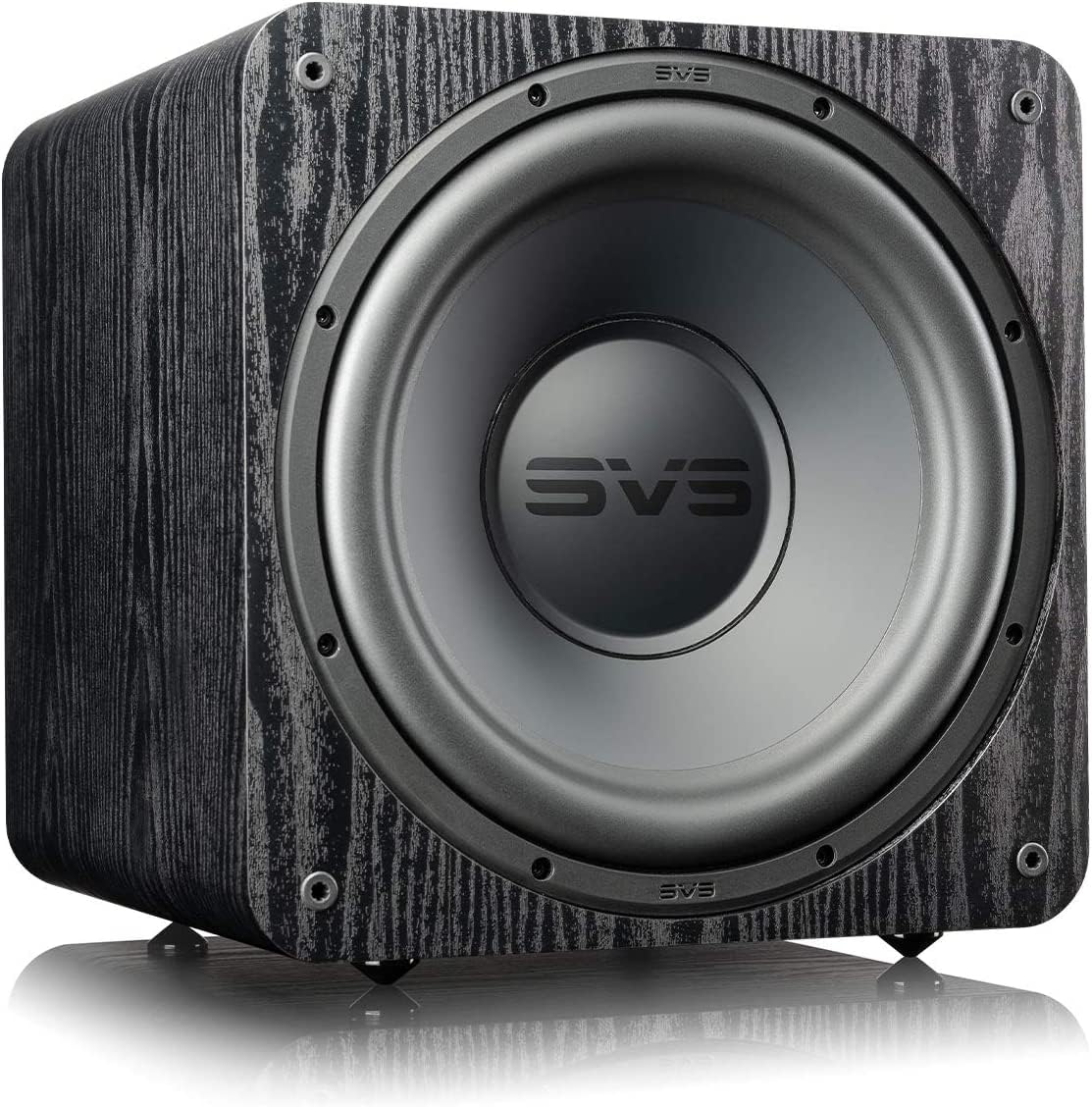
The SVS SB-1000 Pro packs 325 watts RMS and over 820 watts peak power into a remarkably compact sealed cabinet. Its 12-inch high-excursion driver, featuring a dual ferrite magnet motor assembly and long-throw parabolic surround, produces room-filling bass with the finesse and control expected from a sealed design. The Analog Devices DSP ensures accurate frequency response, while the SVS app lets you adjust volume, crossover, and parametric EQ on the fly.
Despite its smaller size compared to ported alternatives, the SB-1000 Pro reaches down to 20 Hz with authority, making it a strong choice for music lovers who want tight, articulate bass without a massive cabinet dominating the room. The acoustically inert, rigidly braced enclosure prevents coloration, and the auto-on/off feature simplifies daily use.
User feedback highlights its near-field performance with bookshelf speakers and its ability to transform a small apartment system into an immersive experience. The logarithmic volume falloff on the app is a minor quirk, but the overall value proposition — a DSP-controlled 12-inch subwoofer with app integration at this output level — is tough to beat.
Why it’s great
- Compact sealed cabinet fits small spaces while delivering deep extension
- Smartphone app with parametric EQ enables precise room correction
Good to know
- Sealed design produces less output at tuning frequency than ported subs
- App volume control has a logarithmic curve that can feel limited at low levels
3. Klipsch SPL-120
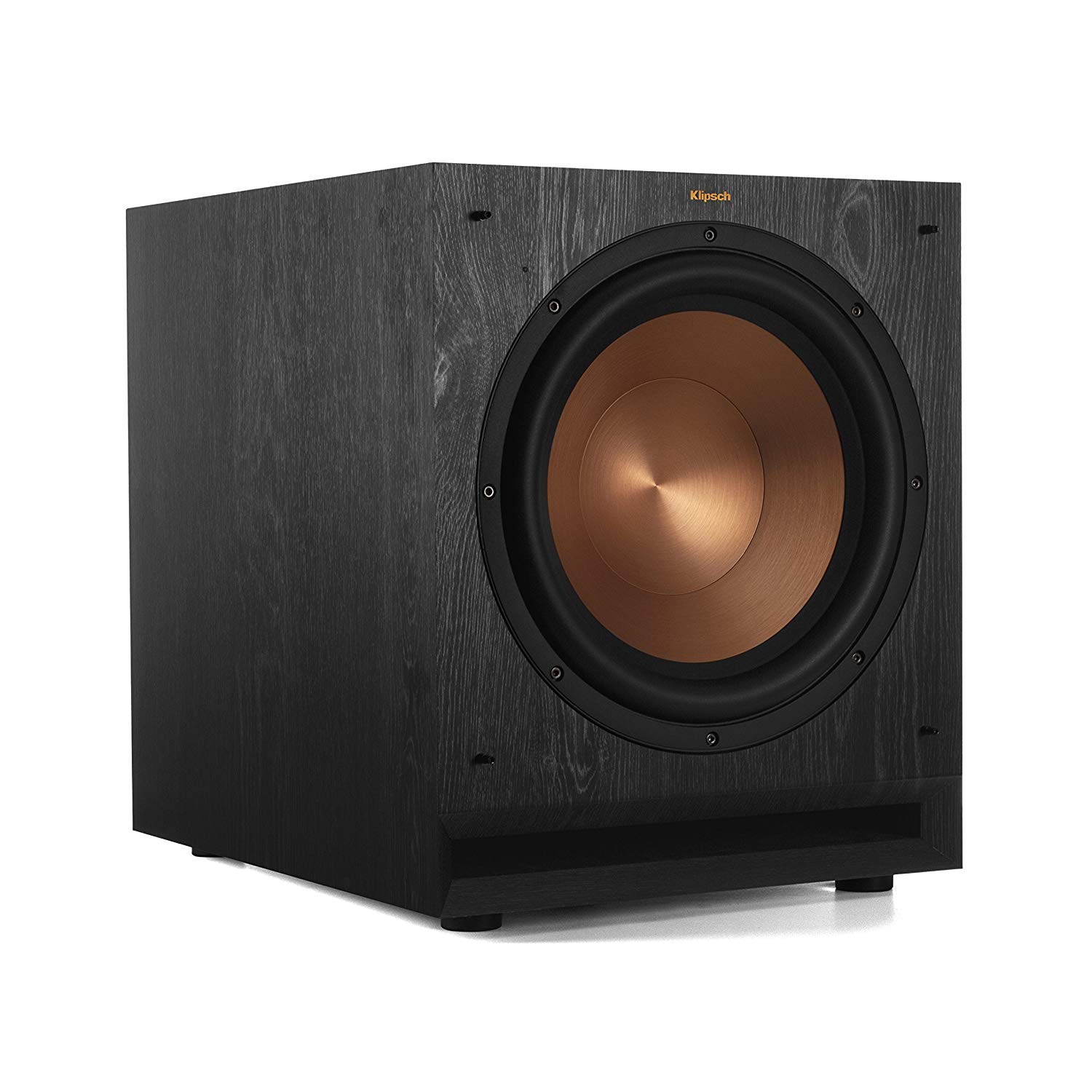
The Klipsch SPL-120 is a ported subwoofer designed for maximum acoustic output, hitting 118 dB with its 12-inch Cerametallic woofer and 600-watt peak amplifier. This is a subwoofer built for home theater impact — explosions hit with physical authority, and low-frequency effects press against your chest with minimal compression. The Cerametallic driver is exceptionally light and rigid, reducing cone breakup and distortion even at elevated volumes.
The front-firing design simplifies placement, and the adjustable low-pass crossover and phase control let you blend it with main speakers effectively. The MDF enclosure is finished in a scratch-resistant ebony veneer that looks and feels solid. Optional wireless connectivity via the Klipsch WA-2 transmitter kit adds placement flexibility without running long cables.
Reviews consistently note that the SPL-120 outperforms significantly more expensive competitors, with one user reporting it replaced a Boston Acoustics subwoofer with no regrets. The bass is described as tight and impactful rather than boomy, integrating naturally with both Klipsch and non-Klipsch speaker systems. It’s a dedicated SPL performer that does not sacrifice musicality.
Why it’s great
- 118 dB peak output provides chest-thumping home theater impact
- Cerametallic woofer minimizes distortion even at high drive levels
Good to know
- Peak power rating of 600W; continuous RMS rating not explicitly listed
- Wireless capability requires separate Klipsch WA-2 accessory purchase
4. Klipsch Reference R-101SW

The Klipsch Reference R-101SW features a new 10-inch spun-copper thermoformed crystalline polymer woofer paired with an all-digital amplifier. This combination delivers high efficiency and accurate reproduction with minimal cone breakup, even at elevated drive levels. The front-firing driver and low-pass crossover with phase control allow flexible placement while maintaining seamless integration with Klipsch or other speakers.
The all-digital amplifier topology contributes to the subwoofer’s ability to produce deep, rumbling bass without the distortion often associated with budget-friendly digital amps. The 10-inch driver is exceptionally light, enabling fast transient response that works well for both musical passages and explosive movie sequences. Line/LFE inputs ensure compatibility with any modern AV receiver.
Customer reviews frequently mention that the R-101SW dramatically outperforms expectations for its size and price point, with one user noting it replaced a subwoofer costing three times as much. The bass is described as deep, clear, and forceful — capable of rattling windows in a medium-sized room. It trades a bit of raw decibel output for refined, articulate low-end reproduction.
Why it’s great
- Lightweight spun-copper polymer woofer provides fast, accurate transient response
- All-digital amplifier delivers high efficiency with low distortion
Good to know
- Peak RMS power not explicitly detailed by Klipsch
- May not satisfy those wanting extreme SPL levels in large rooms
5. Polk Monitor XT12

The Polk Monitor XT12 combines a 12-inch Dynamically Balanced woofer with a 100-watt RMS Class A/B amplifier, housed in a rigid, critically braced MDF cabinet. This ported design extends down to 24 Hz, delivering authoritative low-end for both movies and music. The long-throw, high-excursion driver ensures clean output at the lowest frequencies without bottoming out.
Compatibility with Dolby Atmos and DTS:X AV receivers is a given, and the rear panel offers volume, variable crossover (80–160 Hz), and phase polarity (0/180) controls. Dual 5-way binding post inputs and LFE input provide flexible connectivity. The removable precision-fit grille minimizes sonic interference, and the timbre-matched design pairs naturally with other Monitor XT speakers.
Users consistently highlight the XT12’s clean, controlled bass that transforms home theater experiences without overwhelming the room. The large cabinet may require careful placement planning, but the trade-off is deep extension typically found in more expensive models. It’s a strong choice for those who want a single subwoofer to handle both music and movies in mid-to-large spaces.
Why it’s great
- 24 Hz extension delivers deep sub-bass for authentic low-frequency effects
- Rigid MDF cabinet with bracing minimizes unwanted resonances
Good to know
- Large cabinet dimensions require dedicated floor space
- 100W RMS amplifier may be insufficient for very large rooms or extreme SPL needs
6. Polk Audio PSW10

The Polk Audio PSW10 is a long-standing budget-friendly reference in the subwoofer world. Its 10-inch Dynamic Balance woofer and built-in 50-watt RMS Class A/B amplifier provide clean, musical bass that integrates well with bookshelf speakers in small to medium rooms. The front-firing ported design is tuned for accuracy rather than sheer output, making it a favorite among budget-conscious music listeners.
The continuously variable 80–160 Hz crossover and phase toggle switch allow reasonable integration, and the included line-level and speaker-level inputs ensure compatibility with older receivers. The detachable grille and compact footprint (14.5 inches wide by 15.9 inches tall) make it easy to place in existing cabinets or under desks.
Customer reviews consistently note the PSW10’s musicality — it’s described as accurate, smooth, and non-bloated, complementing rather than overwhelming the main speakers. Some users report front grille buzz at high volume (easily removed) and suggest keeping gain below 50% to avoid distortion. For music-focused systems in compact spaces, this remains a solid, proven choice.
Why it’s great
- Musically accurate bass that blends naturally with bookshelf speakers
- Compact footprint and flexible connectivity suit small to medium rooms
Good to know
- 50W RMS limits output and headroom for larger spaces
- Front grille can buzz at higher output levels; removal may be needed
7. Dayton Audio CS1000
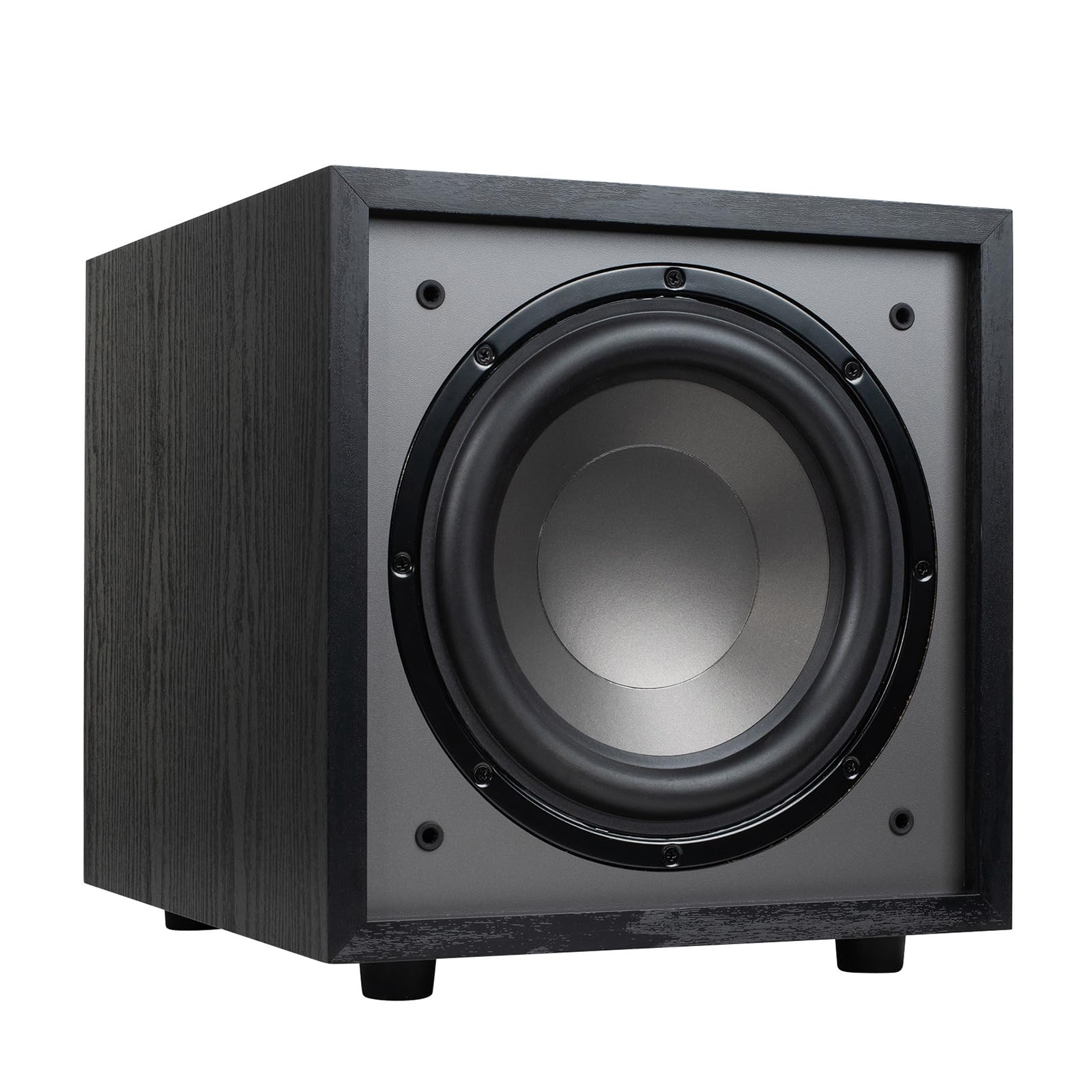
The Dayton Audio CS1000 brings 180 watts RMS of Class-D amplification to a 10-inch driver, housed in a rigidly braced cabinet that extends down to 28 Hz. This is a modern entry-level subwoofer that punches above its price class in both output and build quality. The Class-D amplifier provides clean power efficiently, while the braced enclosure keeps cabinet resonance under control even at higher volumes.
Connectivity includes stereo RCA, LFE, and speaker-level inputs, with auto-on functionality for hassle-free operation. A swappable grille allows some cosmetic customization — the black grille is included, with gray available separately. The 5-year warranty from Dayton Audio adds peace of mind for budget-conscious buyers.
Reviews note that the CS1000 delivers clean, tight bass that is accurate rather than boomy, with one user calling it the best value 8-inch (the CS1000’s reported smaller sibling) subwoofer available. Placement is critical to getting the best performance, and the sub-30 Hz extension is limited compared to larger ported designs. For a small-to-medium room system needing sub-bass reinforcement without breaking the bank, the CS1000 is a strong contender.
Why it’s great
- 180W RMS Class-D amp provides clean power and good headroom for its size
- 5-year warranty backs the product at an approachable price point
Good to know
- Sub-30 Hz extension is limited compared to larger ported designs
- Placement is critical — poor positioning can lead to a boomy response
8. Rockville Rock Shaker 10

The Rockville Rock Shaker 10 offers 300 watts RMS (600W peak) from a 10-inch Class-D amplified subwoofer in a ported MDF enclosure. This is a budget-focused design that prioritizes output — customers report room-shaking bass at just 50% gain, making it a strong candidate for those wanting maximum thump for minimal investment. The built-in Class-D amp is matched to the woofer and cabinet for efficient, distortion-free operation.
Adjustable volume, crossover, and phase controls give you some room integration flexibility, while RCA and speaker-level inputs ensure compatibility with most receivers. The detachable foam grille and durable vinyl finish contribute to a presentable appearance. At 10 inches and 300 watts RMS, it occupies a sweet spot between the ultra-compact 8-inch models and the larger 12-inch options.
User reviews highlight its ability to shake living rooms and fill 30-by-30-foot spaces with ease. Some describe the bass as slightly loose compared to more expensive studio subs, but the value proposition — a 10-inch, 300W RMS powered subwoofer — is undeniable. It pairs well with Rockville bookshelf speakers and Fosi Audio amplifiers for an ultra-budget complete system.
Why it’s great
- Room-shaking output at 50% gain for dramatic home theater impact
- 300W RMS Class-D amp provides significant headroom for a 10-inch driver
Good to know
- Bass can sound slightly loose compared to more refined subwoofers
- Crossover control is implemented as a shelf rather than a true low-pass filter
9. Rockville Rock Shaker 8

The Rockville Rock Shaker 8 proves that small subwoofers can still produce meaningful low-frequency output. Its 8-inch driver is powered by a 200-watt RMS (400W peak) Class-D amplifier, and the MDF cabinet with fire-resistant poly fill helps maintain cleaner bass than its compact size suggests. The Y30 magnet and 1.5-inch 4-layer voice coil contribute to punchy, responsive performance that belies its footprint.
Connectivity includes both RCA and speaker-level inputs and outputs, making it easy to integrate with a variety of audio sources — from home theater receivers to vintage turntable setups. The 11.8-inch width and 13.8-inch height allow it to fit under desks, on bookshelves, or beside a media console. It accepts 110–240V power, so international use is straightforward.
Reviews consistently note the Rock Shaker 8’s ability to add tight, controlled bass to small desktop or living room systems, with some users purchasing a second unit for a stereo subwoofer configuration. While it doesn’t pressurize large rooms, it delivers a night-and-day improvement over small speakers alone. The unmarked crossover knob and lightweight cabinet are minor compromises at this price tier.
Why it’s great
- Compact size fits in tight spaces while delivering meaningful bass extension
- RCA and speaker-level inputs offer broad compatibility with various systems
Good to know
- Crossover knob lacks markings, making precise adjustment difficult
- Lightweight MDF cabinet may not be as acoustically inert as heavier designs
FAQ
Does a higher wattage subwoofer always sound better?
Should I get a 10-inch or 12-inch subwoofer for my room?
What is a crossover and how do I set it?
Can I use a subwoofer with a stereo receiver that lacks a subwoofer output?
What does a DSP smartphone app do for a subwoofer?
Final Thoughts: The Verdict
For most users, the best bass subwoofer winner is the SVS SB-2000 Pro because its combination of 550W RMS discrete amplification, DSP smartphone app control, and a rigid sealed 12-inch cabinet delivers reference-level performance for both music and movies. If you want a compact, budget-friendly option for a desktop or small living room, grab the Rockville Rock Shaker 8. And for pure home theater impact — chest-thumping output that rivals subs costing twice as much — nothing beats the Klipsch SPL-120.