
Our readers keep the lights on and my morning glass full of iced black tea. As an Amazon Associate, I earn from qualifying purchases.
The single biggest worry for a T-ball parent is watching your kid swing and miss, over and over, because the bat feels like a telephone pole in their hands. The right bat for T-ball solves that problem on day one — it is light enough to swing all the way through, has a barrel wide enough to make contact, and is built to the right safety standards so it is legal in every league. You do not need a power hitter’s bat for a five-year-old; you need something that matches their size and strength so they actually connect with the ball and have fun.
I’m Min — the founder and writer behind Gadgets Feed. This guide is built by comparing the manufacturers’ published specifications and the patterns across verified customer reviews, so you get each pick’s real strengths and trade-offs instead of marketing spin.
Whether you are buying for a three-year-old picking up a bat for the first time or a seven-year-old already swinging confidently, this roundup of the best bat for t-ball options focuses on the drop weight, barrel size, and overall feel that matter most for young players just learning the game.
Quick Picks
- Easton Hype FIRE T-Ball Bat — Top Performer
- Victus Vibe Pencil Tee Ball Bat — Best Value
- Easton Boys MAXUM T-Ball Bat — Best Overall
- Mizuno HOT METAL T-Ball Bat — Lightest Alloy
- Rawlings Remix T-Ball Bat — Budget Champion
- Louisville Slugger Natural Youth Teeball Bat — Wood Bat Pick
How To Choose The Best Bat For T-Ball
The right T-ball bat makes the game fun instead of frustrating. Here are the three specs that matter most when you are shopping for a young player just starting out.
Drop Weight: How Light Is The Bat?
The drop weight is the bat’s length in inches minus its weight in ounces. For example, a 26-inch bat with a -12 drop weight weighs 14 ounces (26 minus 12). For T-ball, a higher negative number (like -12 or -13) means a lighter bat. A lighter bat lets young kids swing faster and follow through fully, which means more solid hits and less frustration. A bat that is too heavy forces a slow, choppy swing that misses the ball entirely.
Barrel Diameter: The Sweet Spot Surface
A T-ball bat barrel is typically either 2 1/4 inches or 2 5/8 inches wide. The wider 2 5/8-inch barrel gives a bigger hitting surface, so even off-center contact has a better chance of sending the ball into play. For beginners, that extra margin for error is far more important than barrel material or brand name. The narrower 2 1/4-inch barrel is lighter overall — some parents choose it for three-year-olds who need the absolute lightest option.
Construction Material: Alloy vs. Composite vs. Wood
Most T-ball bats are one-piece aluminum alloy — durable, affordable, and perfectly fine for this age group. Composite bats (carbon fiber) are even lighter and can feel more lively off the barrel, but they cost more. Wood bats (like maple) are the heaviest and least forgiving; they teach a better mechanical swing for older kids but can be discouraging for a beginner. Stick with alloy or composite for T-ball; save the wood bat for when your child is hitting from a pitcher.
Quick Comparison
On smaller screens, swipe sideways to see the full table.
| Model | Best For | Drop Weight | Barrel | Material | Amazon |
|---|---|---|---|---|---|
| Easton Hype FIRE | Ultra-light feel | -13 | 2 5/8″ | Composite | $89.99Amazon |
| Victus Vibe Pencil | Premium build + balance | -11 | 2 5/8″ | Aluminum Alloy | $69.99Amazon |
| Easton MAXUM | Durability for 6-8 yrs | -11 | 2 5/8″ | Alloy Steel | $55.99Amazon |
| Mizuno HOT METAL | Smallest players (3-5) | -13 | 2 1/4″ | Aluminum | $50.00$55.00Amazon |
| Rawlings Remix | Lightweight starter | -12 | 2 1/4″ | Aluminum | $33.26Amazon |
| Louisville Slugger Natural | Wood bat experience | N/A (wood) | N/A | Maple Wood | $34.99Amazon |
In‑Depth Reviews
1. Easton Hype FIRE T-Ball Bat

The lightest swing in T-ball for the smallest players.
The Easton Hype FIRE is built with Hyperlite Composite — Easton’s lightest material — so a 4-year-old who struggled to finish a swing with a metal bat can swing all the way through. With a -13 drop weight (a 25-inch bat weighing just 12 ounces), it is dramatically lighter than most alloy bats, which helps young kids generate bat speed and makes solid contact. One buyer report noted their 4-year-old went from missing everything to hitting consistently after switching to this bat.
Unlike the alloy bats on this list, the Hype FIRE uses carbon fiber, which gives a slightly livelier barrel feel on contact. That “pop” helps the ball travel farther even when a little kid is just learning to swing. At 12 ounces it is barely heavier than the Mizuno below, but the 2 5/8-inch barrel is noticeably wider, giving a larger sweet spot. The one trade-off is price — this is the most expensive bat on this list, and composite bats can be slightly more prone to cracking if left in extreme cold.
Reviewers also mention the bright yellow/orange/red finish gets excited reactions from kids, which counts for a lot at this age. It is USA Baseball certified and only approved for tee balls, so do not use it with regulation hard baseballs.
Why it’s great
- Lightest swing weight of any bat here at -13 drop
- Composite construction gives more pop off the barrel
- Perfect for the smallest and youngest beginners (3-5)
Good to know
- Most expensive option on this list
- Composite material can be temperature-sensitive
Best for: The youngest or smallest player who needs the absolute lightest bat to swing all the way through.
Skip if: You want a durable bat that can be passed down through siblings over many seasons — composite costs more and can chip.
2. Victus Vibe Pencil Tee Ball Bat
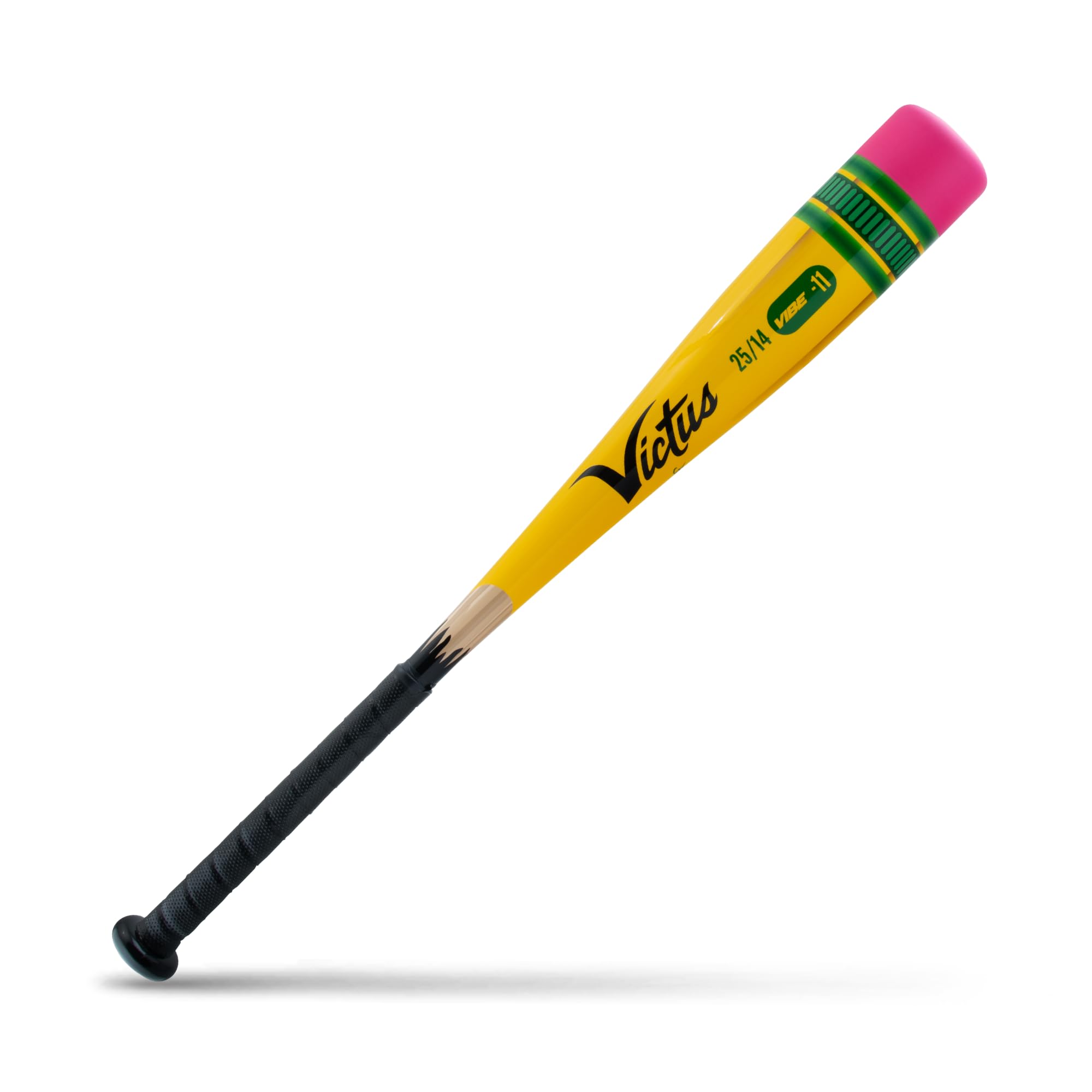
Balanced feel that 8-year-olds and 3-year-olds both love.
The Victus Vibe Pencil has a mid-balanced swing weight (balanced M.O.I.) — meaning the weight is evenly distributed along the bat rather than being end-loaded — so it feels natural and easy to swing for kids who are still learning their timing. At 24 inches and 13 ounces, it has a -11 drop weight, which is slightly heavier than the -13 bats but still very manageable for beginners. One buyer report on a 3-year-old grandson noted the weight was “on point” and the bat was a good fit for small hands.
Where this bat stands out against the Easton MAXUM (which also has a -11 drop) is the micro-perforated grip, which is softer and tackier than a standard grip. That matters for T-ball kids who tend to lose their grip mid-swing. The VXP alloy barrel at 2 5/8 inches is identical in diameter to the MAXUM, so both offer a similarly large sweet spot. But the Victus costs more, putting it in the premium tier alongside the Hype FIRE. Reviewers coaching 8 and 9-year-olds said kids on their team “absolutely raked” with this bat, though some noted the barrel might be too thick for certain T-ball league rules.
Why it’s great
- Micro-perforated grip prevents tiny hands from slipping
- Mid-balanced swing weight is super forgiving for beginners
- Certified USA Baseball for all T-ball leagues
Good to know
- Cost is higher than alloy bats with similar spec
- Barrel width may not be legal in every local T-ball league
Best for: A young player who needs a comfortable, non-slip grip and a balanced swing feel to learn proper mechanics.
Skip if: You need the absolute lightest bat for a 3-year-old — the -11 drop is a bit heavier than the -13 options.
3. Easton Boys MAXUM T-Ball Bat

The workhorse alloy bat for the 6-to-8-year-old crowd.
The Easton MAXUM is built with ALX100 Military Grade Alloy — a thicker, tougher aluminum than the standard alloy used in the Rawlings or Mizuno bats. That makes it notably more dent-resistant when kids inevitably hit the tee or the ground instead of the ball. With a -11 drop weight and a 2 5/8-inch barrel, it offers the same large sweet spot as the Victus but at a lower price. One buyer report called it “a great bat for 6-8 year olds” and said it was perfect for coach pitch as well as T-ball.
The big difference between this and the Hype FIRE is weight: the MAXUM at 26 inches weighs about 15 ounces (26 minus 11), which is 3 ounces heavier than the similar-length Hype FIRE. That extra weight can help a 7-year-old drive the ball farther once they have decent swing mechanics, but a 4-year-old may find it heavy. The concave end cap and cushioned All-Sports grip do make it more comfortable than older alloy bats, but the grip is standard rubber, not soft-touch like the Victus.
Why it’s great
- ALX100 military-grade alloy is extremely dent-resistant
- Largest barrel (2 5/8″) of any mid-range T-ball bat
- Very strong price-to-performance ratio
Good to know
- At -11 drop, it is heavier than the -13 composite bats
- Some 4-year-olds may find the swing weight too much
Best for: A 6-to-8-year-old who needs a durable, affordable bat that can handle hard use and still drive the ball.
Skip if: Your child is 4 or younger — the added weight will slow their swing down instead of helping.
4. Mizuno HOT METAL T-Ball Bat
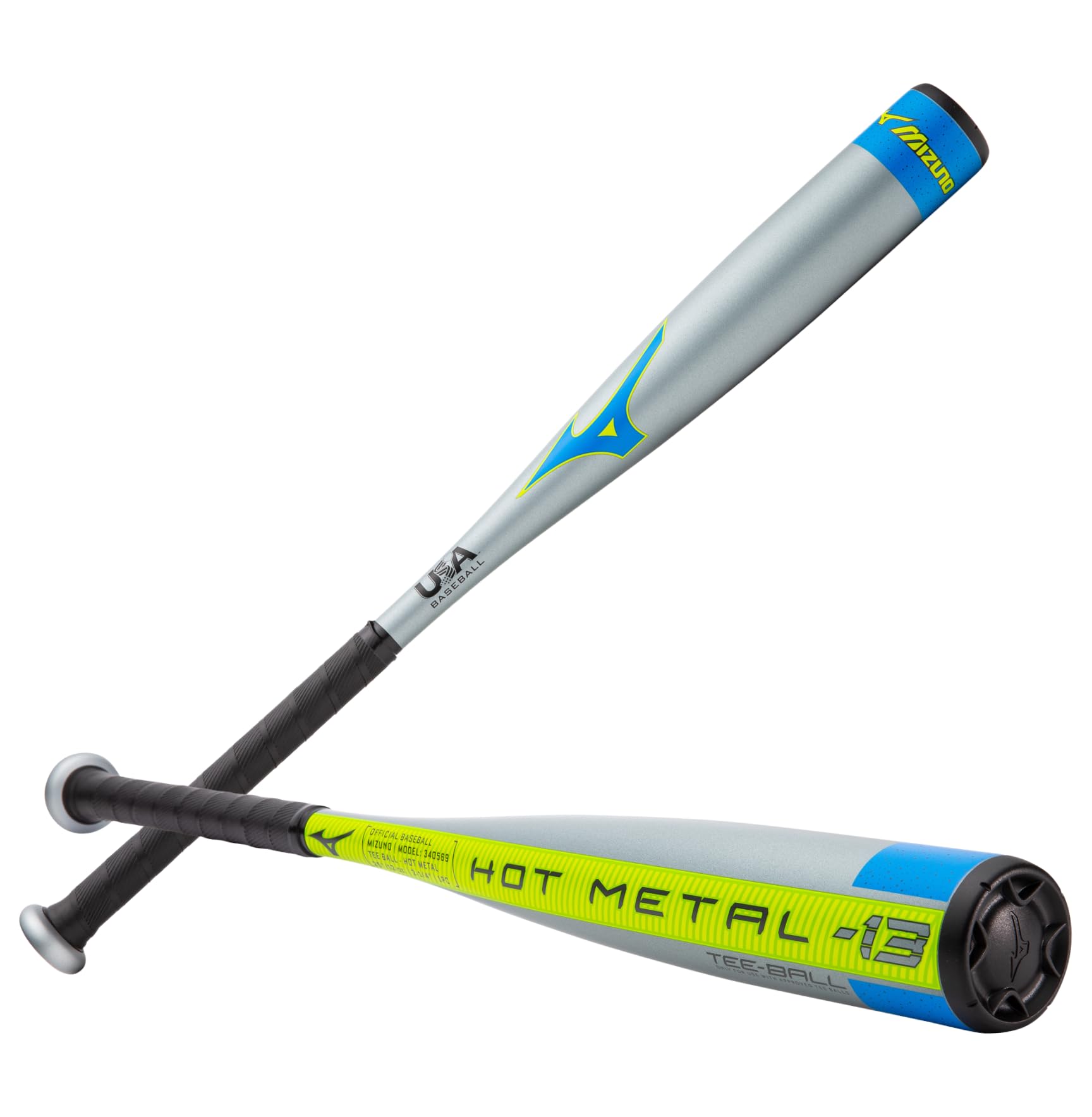
The go-to for three-year-olds who are the smallest on the team.
The Mizuno HOT METAL has the same -13 drop weight as the Easton Hype FIRE, meaning it is just as light, but it uses a one-piece aluminum barrel instead of composite. That makes it a bit cheaper while staying very light — a 25-inch bat at 12 ounces. Where it differs from the Hype FIRE is the barrel diameter: the Mizuno uses a 2 1/4-inch barrel instead of the wider 2 5/8-inch barrel. That narrower barrel is actually a benefit for the absolute smallest beginners because the bat feels lighter overall and easier to control.
One buyer specifically mentioned their 3-year-old grandson, the youngest and smallest on his T-ball team, used this bat perfectly. The Speed-Helix Grip (a spiral-textured grip) adds a little extra tackiness, though it is not as advanced as the Victus micro-perforated grip. The key trade-off vs the Rawlings Remix below is that the Mizuno is lighter (-13 vs -12) but comes in a single length option (25 inches), while the Rawlings offers a 24-inch version for even smaller kids.
Why it’s great
- One of the lightest alloy bats at 12 ounces (25-inch)
- Speed-Helix Grip gives good control for small hands
- Durable one-piece aluminum construction
Good to know
- 2 1/4-inch barrel is narrower — less forgiveness on mishits
- Only available in 25-inch length
Best for: The absolute smallest T-ball player (age 3-4) who needs the lightest possible bat in a compact size.
Skip if: Your child is over 5 — they will outgrow the narrow barrel and the 25-inch length quickly.
5. Rawlings Remix T-Ball Bat

The affordable starter bat that gets the job done from age 3 to 7.
The Rawlings Remix offers a -12 drop weight with a 2 1/4-inch barrel, making it slightly heavier than the Mizuno (-13) but lighter than the Easton MAXUM (-11). At 24 inches, it is one of the shortest bats on this list, which is a big advantage for a 3 or 4-year-old who is still figuring out how to stand at the plate. Reviewers consistently call it “lightweight,” “well-balanced,” and “durable” — one reviewer noted it held up well with only minor scuffing after heavy use by a 4-year-old.
Compared to the Mizuno, the Remix is about 1 ounce heavier (12 ounces for Mizuno vs about 12.5 ounces for the Rawlings at the same length), but it comes at a lower price point and offers a broader age range — buyers report it works well from 3 up through 7 years old. The one-piece aluminum construction is simple and durable, and the black/white/metallic silver finish is understated compared to the bright neon of the Mizuno or the Hype FIRE. Some buyers mentioned it is also great for coach-pitch transition, unlike the pure T-ball bats with composite barrels.
Why it’s great
- Lowest starting length (24″) for the youngest players
- Very durable — one buyer mentioned only minor scuffing after heavy use
- Works for both T-ball and early coach pitch
Good to know
- Slightly heavier than the -13 drop bats (Mizuno and Hype FIRE)
- Narrow 2 1/4-inch barrel offers a smaller sweet spot
Best for: A budget-conscious starter bat for a 3-to-5-year-old that can also be used for early coach pitch later.
Skip if: Your child is 5 or older and already hitting consistently — a 2 5/8-inch barrel will give them more margin for error.
6. Louisville Slugger Natural Youth Teeball Bat

A real wood bat for a kid who wants to swing like the pros.
The Louisville Slugger Natural is a genuine maple wood bat made for T-ball — not an alloy or composite. At 26 inches, it has a balanced swing weight (cupped at the end to reduce overall mass), but it is substantially heavier than any of the -11 or -13 drop alloy bats. The data does not specify a drop weight because wood bats are not sold by drop ratio the way alloy and composite bats are; the feel is simply heavier, with a smaller barrel.
Owners mention it has a “good balanced feel” but also a “skinny grip” that may need added grip tape. One owner reported it helped a 7-to-10-year-old hit farther than with a lighter bat — the added mass can drive the ball if the kid has good mechanics. But for a 4-year-old beginner, a wood bat is generally too heavy and unforgiving. This is really for an older T-ball or coach-pitch player who is working on form, or as a display piece — one review even admitted it was bought for a sports room.
Why it’s great
- Real maple wood gives a classic feel and look
- Cupped design adds some balance despite the weight
- Good for teaching proper swing mechanics to older kids
Good to know
- Much heavier than alloy or composite T-ball bats
- Skinny grip may need a tape wrap for small hands
Best for: An older T-ball or coach-pitch player (7-10) who is working on proper swing mechanics with a wooden bat.
Skip if: Your child is a T-ball beginner under age 6 — the weight will make it very hard to swing consistently.
Understanding the Specs
Drop Weight
This number is the bat’s length in inches minus its weight in ounces. For example, a 26-inch bat with a -11 drop weighs 15 ounces (26 – 11 = 15). In T-ball terms, a higher negative number (like -13) means a lighter bat that is easier for a small child to swing fast and fully. A lower negative number (like -10 or -11) means a heavier bat that can drive the ball farther once the player has good swing mechanics.
Barrel Diameter
The width of the hitting surface at the thickest part of the bat. T-ball bats come in two sizes: 2 1/4 inches (narrower, lighter overall) and 2 5/8 inches (wider, bigger sweet spot). A wider barrel gives more room for error — even off-center hits can still produce solid contact. That matters a lot for beginners. Some local leagues have restrictions on barrel width, so check your league rules before buying.
FAQ
What does the drop weight on a T-ball bat mean?
Should I get a 2 1/4 or 2 5/8 inch barrel for T-ball?
What length T-ball bat should I buy for my 5-year-old?
Is a composite bat better than an aluminum bat for T-ball?
Can my child use a T-ball bat for coach pitch baseball?
Are wood bats good for T-ball?
How do I know if a bat is too heavy for my child?
What does USA Baseball certified mean for a T-ball bat?
Can a 7-year-old use a 26-inch T-ball bat?
Should I buy a one-piece or two-piece T-ball bat?
Final Thoughts: The Verdict
For the majority of shoppers, the best bat for t-ball is the Easton MAXUM because it combines a forgiving 2 5/8-inch barrel, durable military-grade alloy, and a very fair price into a package that works for the widest range of T-ball ages. If you want the absolute lightest swing for a tiny beginner, grab the Easton Hype FIRE. And for a premium balanced feel with a grip that tiny hands actually hold onto, the Victus Vibe Pencil is a worthy step up.
How We Picked
We do not accept paid placement, and we did not hands-on test every unit. Instead, we match each pick to a real buyer and use-case by comparing the manufacturers’ published specifications against the patterns in verified customer reviews — so you get each pick’s real strengths and trade-offs instead of marketing copy.
Sources & Methodology
Specifications: manufacturer listings and product documentation. Review insights: verified customer reviews, as of June 2026. Pricing: not shown on this page (it changes often); check the current price via the retailer link.
As an Amazon Associate, Gadgets Feed earns from qualifying purchases. This does not affect which products we feature.
Product prices and availability are accurate as of the date/time indicated and are subject to change. Any price and availability information displayed on Amazon at the time of purchase will apply to the purchase of this product. As an Amazon Associate I earn from qualifying purchases.
CERTAIN CONTENT THAT APPEARS ON THIS SITE COMES FROM AMAZON. THIS CONTENT IS PROVIDED "AS IS" AND IS SUBJECT TO CHANGE OR REMOVAL AT ANY TIME.
Amazon and the Amazon logo are trademarks of Amazon.com, Inc. or its affiliates.