
Hearing scratching in your attic at dusk or finding droppings on your porch is the unmistakable signal that bats have claimed your space as their own. Unlike rodents that nest in walls, bats wedge into eaves, soffits, and ridge vents, creating noisy colonies that stain wood and leave behind guano that carries fungal spores. An ultrasonic device designed specifically for chiropteran deterrence targets the sensitive hearing range bats rely on for echolocation, disrupting their navigation without poisons or exclusion nets.
I’m Min — the co-founder and writer behind Gadgets Feed. I’ve spent countless hours analyzing ultrasonic frequency ranges, decibel outputs, and coverage claims across dozens of bat-specific repellent devices to separate the units that genuinely clear roosts from those that merely hum in the outlet.
This guide cuts through the marketing noise to deliver the most reliable assessment of what actually makes a bat repellent device work — covering frequency agility, electromagnetic shielding, and real-world placement strategies that determine whether your colony relocates or ignores the sound entirely.
How To Choose The Best Bat Repellent Device
Selecting a device that actually drives bats out requires understanding three core technical pillars: the frequency range it emits, whether it cycles frequencies to prevent adaptation, and the coverage pattern relative to your roost location. Bats hear between 20 kHz and 100 kHz, so a unit that sweeps across 25–65 kHz with random pattern shifts keeps their nervous system from habituating to a single tone.
Frequency Agility and Sweep Modes
A static ultrasonic tone is useless after a week; bats simply adjust their echolocation around it. Look for devices that offer multiple modes — TEST, ULTRA, TRANS, DUO — or that incorporate random frequency stepping. The more unpredictable the sound pattern, the longer the device remains effective without requiring recalibration.
Coverage Area Versus Real-World Obstruction
Manufacturers advertise coverage in open areas, but ultrasonic waves cannot penetrate drywall, studs, or insulation. A unit rated for 5,000 square feet of open space will barely reach the next room. For attics with trusses and HVAC ducts, plan one device per enclosed cavity. Units with dual speakers or horn-loaded drivers project sound more directionally, which helps when targeting a specific roost point like a ridge vent or gable end.
Electromagnetic and Dual-Technology Features
Premium devices add an electromagnetic circuit that uses the home’s existing wiring as an antenna, creating a repelling field inside the walls themselves. Bats often move between wall cavities and attic spaces; an electromagnetic layer prevents them from simply shifting deeper into the structure. This secondary deterrent is invisible, silent to humans, and operates continuously without consuming significant power.
Quick Comparison
On smaller screens, swipe sideways to see the full table.
| Model | Category | Best For | Key Spec | Amazon |
|---|---|---|---|---|
| BugWomp BEU-W Stealth White Edition | Premium | Stubborn attic colonies | 7,000 sq ft coverage + electromagnetic wiring | Amazon |
| HF-WY-THR Bat Exclusion System | Premium | Single-room targeted removal | 5,000 sq ft / twin scanning speakers | Amazon |
| BORHOOD Rodent Repellent for Cars | Mid‑Range | Vehicle engine bay protection | Battery / USB / DC car power modes | Amazon |
| Briidea Bat Away System | Mid‑Range | Open garages and barns | Dual speakers / 7,000 sq ft open area | Amazon |
| RevolMax ZRM-27 4‑Pack | Mid‑Range | Multi‑room general pest coverage | 20–65 kHz auto‑cycling / 1,600 sq ft per unit | Amazon |
| Tryfire Ultrasonic Mouse Repellent | Budget | Small rooms with mild bat activity | 4 modes / LED strobe / 4,000 sq ft | Amazon |
| JahyElec 2‑Pack Ultrasonic Bat Repellent | Budget | Entry-level two-zone coverage | 5,000 sq ft per unit / dual‑pack | Amazon |
In‑Depth Reviews
1. BugWomp BEU-W Stealth White Edition
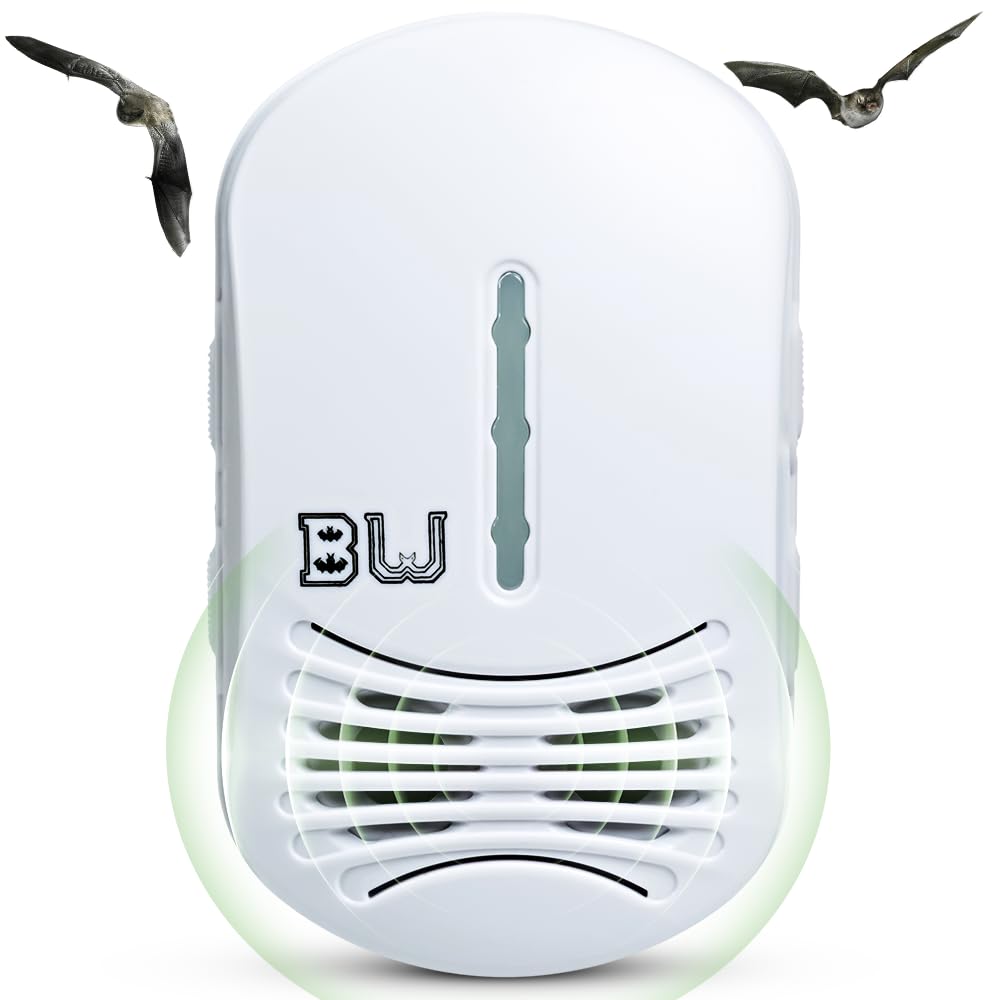
The BugWomp BEU-W Stealth White Edition delivers the most complete bat-specific feature set on the market. Dynamic Bat Repelling Technology cycles ultrasonic frequencies randomly, preventing the neural habituation that renders static-frequency devices useless after two weeks. The dual high-powered speakers project sound across 7,000 square feet of open coverage — enough to flood even a sprawling attic or workshop.
What sets this unit apart is the integrated electromagnetic repelling circuit. When plugged into a 110–120V outlet, it uses the home’s internal wiring as a broadcast antenna, creating a repellent field inside wall cavities where bats travel between roost and exit. Multiple owners report colony clearance within 48 to 72 hours, particularly when the device is aimed at the primary entry point like a gable vent or ridge gap.
The slider-switch setup lets you dial in pitch and output without removing the unit from the wall, and the included Pest Fix Program offers direct troubleshooting if stubborn bats remain after three weeks. Build quality is solid with a compact footprint that fits flush against baseboards, making it unobtrusive in living spaces while focusing its energy where bats actually hide.
Why it’s great
- Electromagnetic wiring repellent blocks bats moving inside walls — no other device at this price offers that layer
- Dual speakers produce overlapping sound fields that eliminate dead zones in large attic spaces
Good to know
- Requires a 110–120V outlet; not compatible with 220V systems without a step-down transformer
- Premium pricing reflects the electromagnetic feature — budget units lack this wall-cavity protection
2. HF-WY-THR Bat Exclusion System
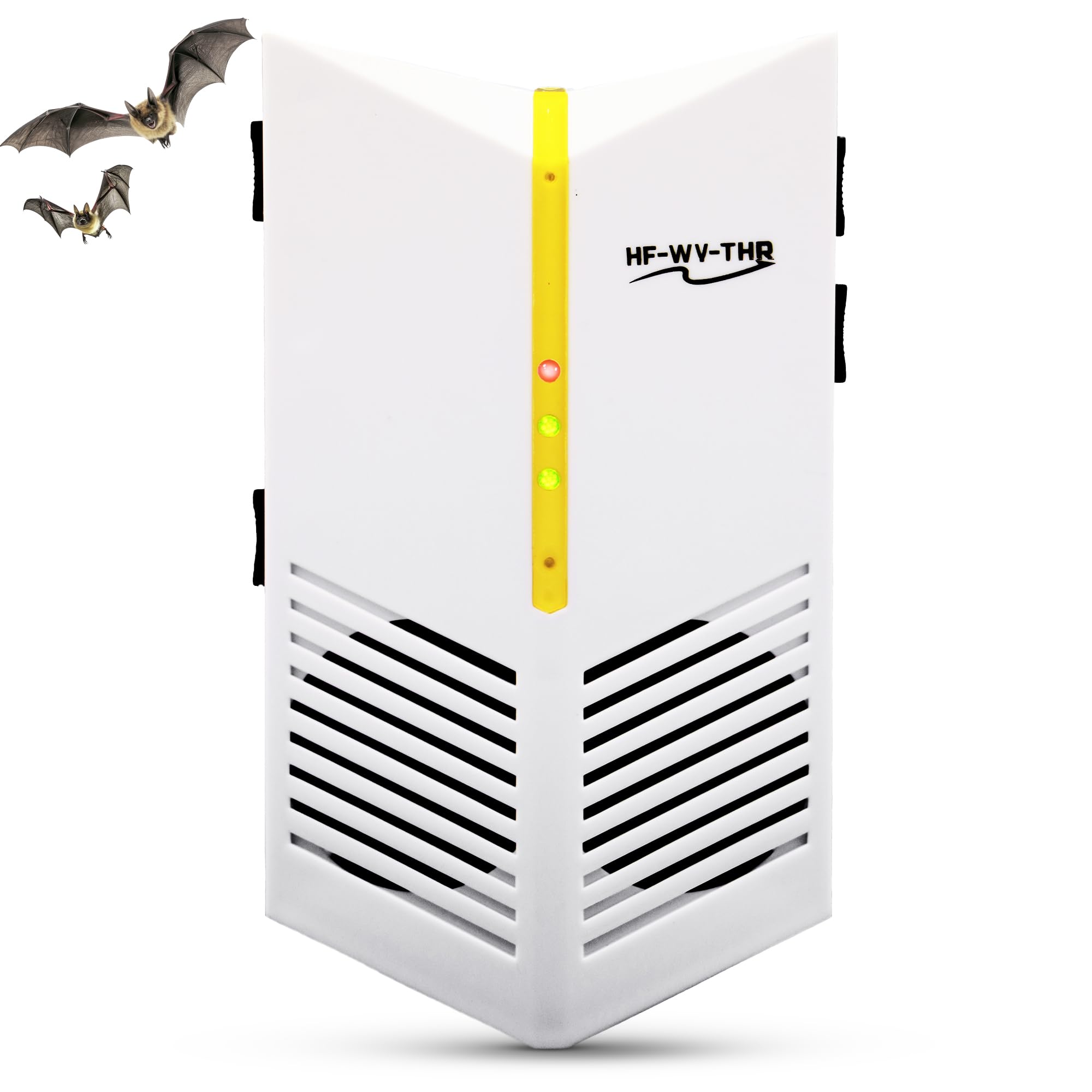
HF-WY-THR’s Bat Exclusion System is engineered for users who need to target a specific single room — typically an attic or garage — with precision. Twin Scanning Technology uses two offset speakers that emit phase-shifted ultrasonic waves, creating interference patterns that bats cannot triangulate around. The proprietary bat-exclusion tones operate between adjustable pitch, range, and output sliders, giving you fine-grained control over the acoustic environment.
A standout detail is the Electromagnetic High Impact Repelling circuit that piggybacks on the outlet’s internal wires. If bats are traveling through the soffit-to-wall pathway, this secondary field stops them from simply shifting deeper into the structure when the ultrasonic waves reach them. Owners consistently report visible reductions in droppings within a few days, with total clearance around the one-week mark when placement is aimed directly at the roost region.
The unit is rated for 5,000 square feet of open area, which is realistic for an attic with minimal interior walls. At six ounces and a compact 2 x 3.5 x 6-inch footprint, it mounts easily on a rafter or hangs from a nail in the ridge beam. One reviewer noted it saved them over in professional exclusion costs — a testament to how effective a well-placed ultrasonic device can be when the entry points are identified and sealed after the bats leave.
Why it’s great
- Twin offset speakers create interference zones that bats cannot easily navigate around or ignore
- Adjustable pitch/range/output sliders let you fine-tune the frequency without needing a separate tool or app
Good to know
- Best results require placing the unit within 10–15 feet of the primary entry point — distance reduces effectiveness in sprawling spaces
- Some owners reported that bats returned after a week if the entry hole was not sealed during the clearance window
3. BORHOOD Ultrasonic Rodent Repellent (2‑Pack)

The BORHOOD 2‑Pack stands alone in this roundup for its vehicle-specific design. While most bat repellent devices are strictly AC-powered plug-in units, the BORHOOD offers three power modes — 4 AA batteries, USB‑C to a 5–12V adapter, or direct DC wiring under the hood. This makes it the only option here that can protect a car engine bay from bats and rodents that chew wiring harnesses during cold months.
The 18–36 kHz sweep range covers the lower end of bat hearing, and the LED strobe lights add a visual deterrent that reinforces the ultrasonic barrier at night. An intelligent vibration sensor pauses the ultrasonic emission when the car starts, then resumes 90 seconds after the engine shuts off, preserving battery life. Owners consistently praise the compact 2.76 x 1.11 x 4.53-inch body that zip-ties easily to existing harnesses without obstructing engine access.
While marketed primarily for rodents, the frequency range overlaps with bat hearing, and multiple owners confirm its effectiveness in attics and garages when placed near entry points. The dual-pack lets you protect both a vehicle and a porch simultaneously, making it a strong mid-range choice for property owners dealing with multiple pest species across different environments.
Why it’s great
- Three power modes (AA battery, USB, or DC hardwire) make it the only truly portable bat repeller for vehicle use
- Vibration sensor auto-pauses during driving, then resumes after 90 seconds — no manual reset needed
Good to know
- Battery life is rated at three months in standby mode — expect shorter runtime if bats are constantly triggering the sensor
- Sound output is lower than AC-powered units, so coverage is best within 10–15 feet of the device
4. Briidea Bat Away System

The Briidea Bat Away System uses dual speakers to project two powerful ultrasonic streams that create an environment bats find disorienting. The frequency shifts unpredictably, which prevents the neural adaptation that plagues single-tone repellers. Briidea recommends continuous use for 16 to 20 days to achieve clear results — a timeline consistent with most ultrasonic devices that need to disrupt three to four roosting cycles.
Installation offers two methods: screw-mounting directly to a rafter or using the included nano-markless hook sticker for surface attachment. The plug-and-play design means no wiring or programming; just hang the unit overhead in the target area and plug it in. The 7,000 square foot open-area rating is the highest in this roundup, making it the best choice for large barns, warehouses, or unfinished basements with high ceilings.
Owner experiences are mixed but instructive: those who placed the unit within 15 feet of the roost and left it running continuously saw complete cessation of bat activity after three weeks. Critics who reported failure often had the unit plugged into an extension cord on a workbench far from the actual bat entry point, underscoring that ultrasonic waves drop off sharply with distance and cannot penetrate even thin plywood.
Why it’s great
- Highest open-area coverage rating in the group — 7,000 sq ft suits barns, warehouses, and large attics
- Dual speakers project overlapping sound streams that minimize dead zones in irregular spaces
Good to know
- Some units shipped with poorly adhered speaker components that required DIY silicone reattachment
- No electromagnetic wall-wiring repellent — bats can simply move into adjoining wall cavities if the attic only is treated
5. RevolMax ZRM-27 4‑Pack
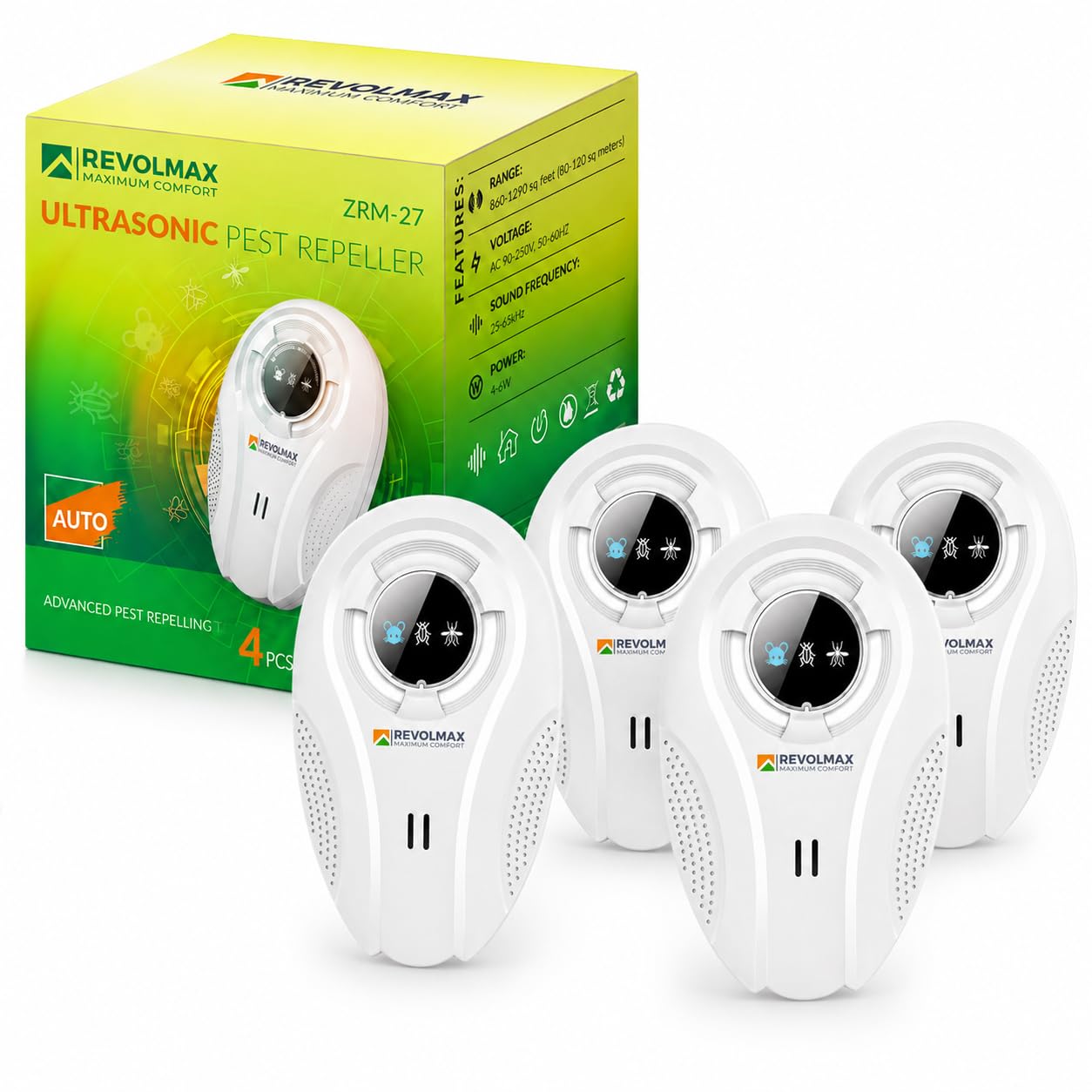
The RevolMax ZRM-27 4‑Pack offers the broadest frequency sweep in this collection — 20 to 65 kHz — which covers the entire bat hearing range and extends into insect repellent territory. The auto-cycling sound waves shift randomly, preventing any single pest species from habituating to a fixed tone. With each unit covering 1,600 square feet in open areas, a four-pack can treat four separate rooms or a single 6,400-square-foot open floor plan.
This is the most practical solution for homeowners who need coverage across multiple rooms simultaneously. Because ultrasonic waves cannot pass through drywall, you need one unit per enclosed space. The ZRM-27’s compact, all-white design blends into standard wall outlets, and the 100% chemical-free operation makes it safe to leave running 24/7 in bedrooms and kitchens. Owners consistently report noticeable reductions in flying insect activity within the first week, followed by bat deterrence after three to four weeks of continuous use.
The trade-off for the multi-pack value is that each individual unit lacks the dual-speaker output or electromagnetic circuits found in the premium single units. For mild bat activity spread across several rooms, this is an efficient strategy. For a heavy attic infestation, you would likely need to supplement with a more powerful directed unit at the roost point.
Why it’s great
- Four units cover multiple rooms simultaneously — essential because ultrasonic waves cannot pass through walls
- Auto-cycling across a wide 20–65 kHz band prevents pest adaptation better than fixed-frequency devices
Good to know
- Each unit’s 1,600 sq ft open-area rating means real-world coverage drops significantly behind obstacles
- No electromagnetic repelling layer — bats inside wall cavities may not be affected
6. Tryfire Ultrasonic Mouse Repellent (4‑Mode)
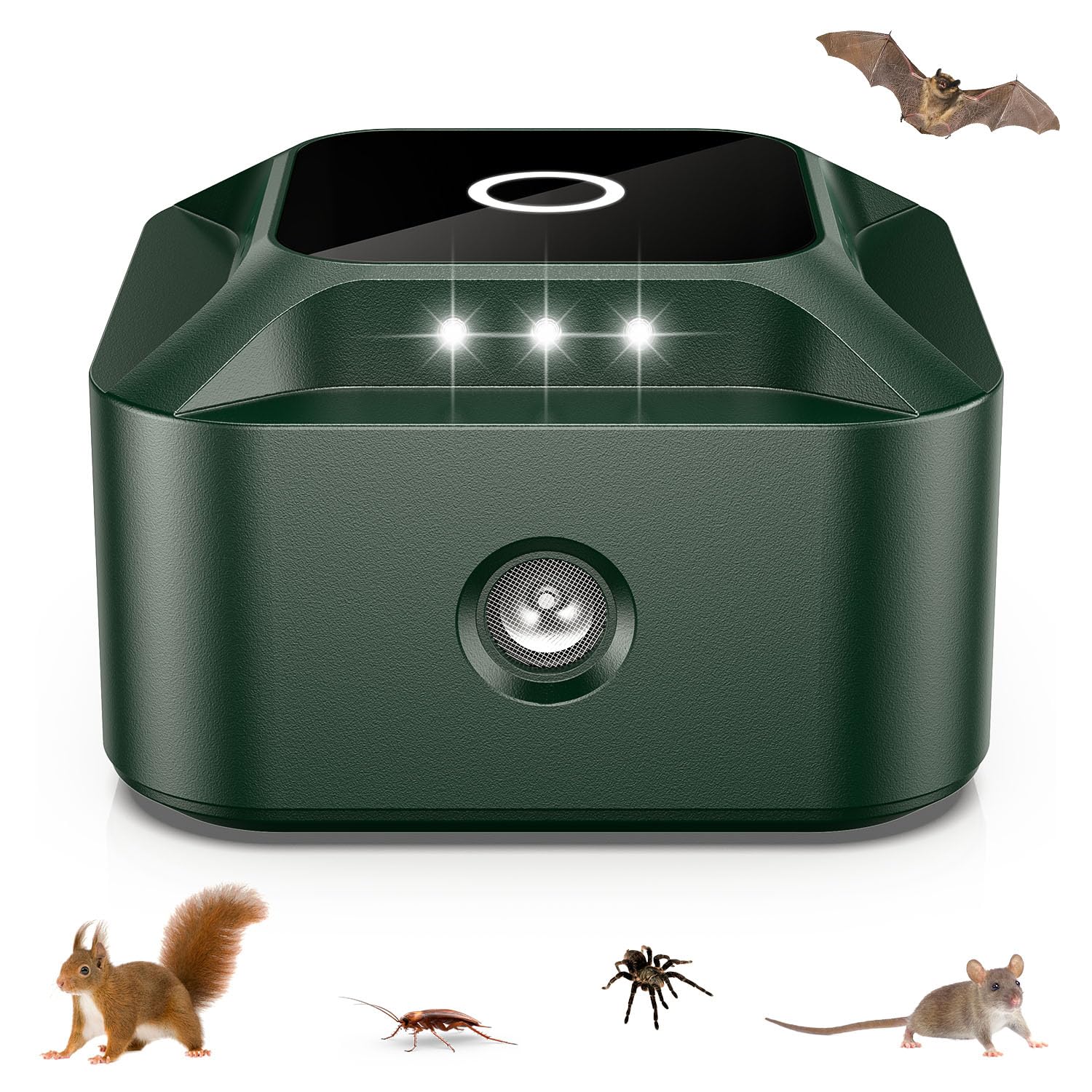
The Tryfire Ultrasonic Mouse Repellent brings a surprising feature set to the budget tier. Four distinct modes — TEST, ULTRA, TRANS, and DUO — let you calibrate the sound intensity to the specific infestation level, and the 12 LED strobe lights provide visual deterrence in dark corners like attic crawlspaces and garage rafters. The 25–35 kHz sweep targets bat hearing at the lower end while also disrupting rodents and insects.
Owners note that the built-in TEST mode makes initial verification easy: you can hear a faint pulsing sound to confirm operation, then switch to silent operating mode. The green housing is low-profile, and multiple reviewers report clear attics after three to four weeks of continuous use when the unit is placed 10–50 inches above the floor as recommended.
The limitation is the narrower frequency band compared to premium units. Bats with acute high-frequency hearing may find a 25–35 kHz sweep less irritating than a broader 20–65 kHz pattern. However, for mild infestations in smaller spaces like porches, garages, or single-car attics, this unit delivers cost-effective deterrent with no ongoing consumable costs.
Why it’s great
- Four operating modes (TEST, ULTRA, TRANS, DUO) let you match the ultrasonic intensity to your specific infestation level
- LED strobe lights add a night-time visual deterrent that increases effectiveness in dark attic spaces
Good to know
- Narrow 25–35 kHz sweep may not cover the full hearing range of all bat species, reducing effectiveness for some colonies
- Not all buyers experienced results — ultrasonic success depends heavily on correct placement and sealing entry points
7. JahyElec 2‑Pack Ultrasonic Bat Repellent
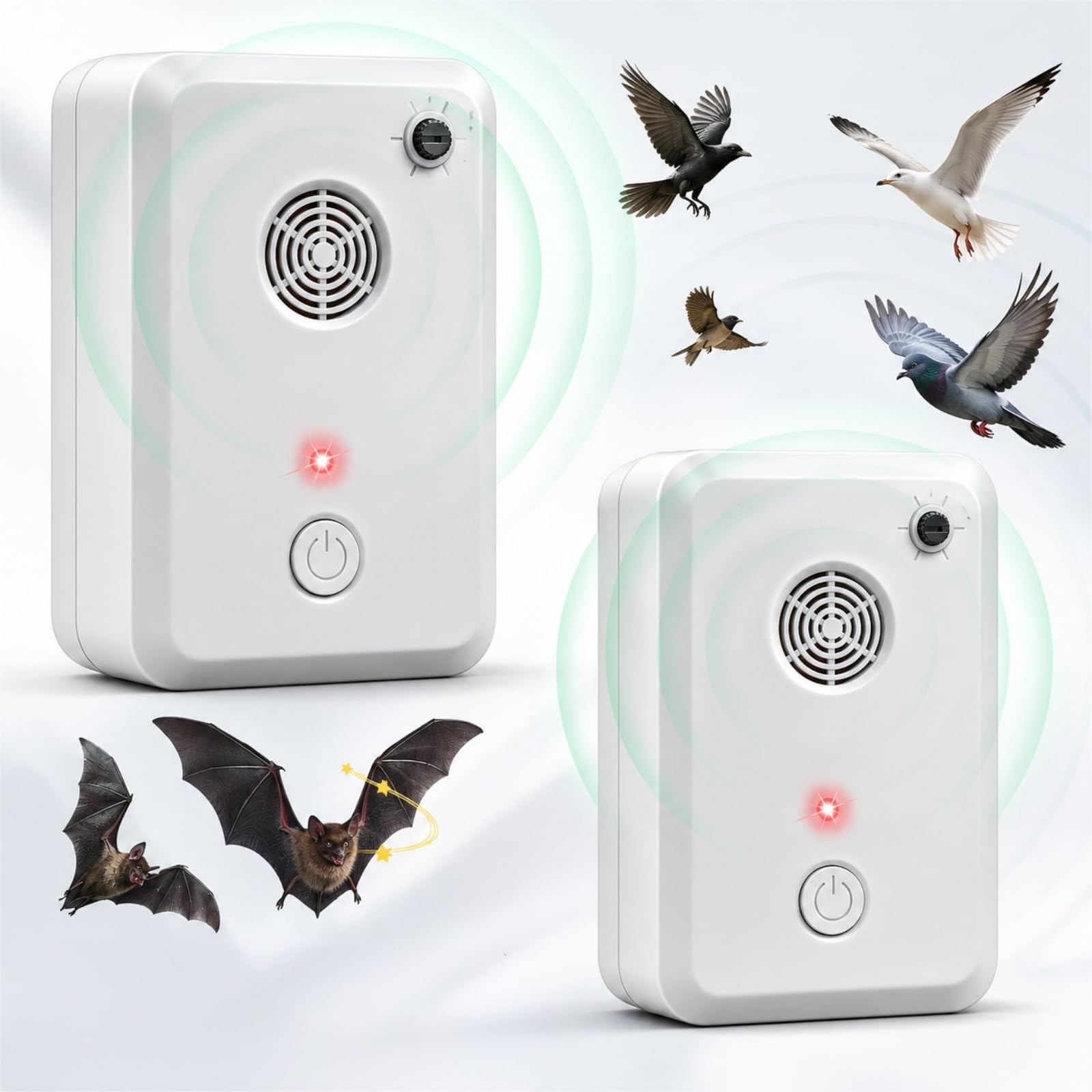
The JahyElec 2‑Pack offers the lowest entry point for dual-zone coverage in this roundup. Each unit covers 5,000 square feet in open areas and includes adjustable high or low frequency settings, giving you some control over the acoustic output. The ultrasonic sound is entirely silent to humans, and owners consistently note zero humming, buzzing, or mechanical noise — something that matters when placing the device in a bedroom or finished attic space.
Real-world reports lean positive, especially for users who needed a set-and-forget solution for porches, garages, and small attics. One reviewer who had bats hiding in a washer drum at night found that the devices cleared the colony within a week. Another owner managing an old house with decades of bat history praised the peace of mind — no traps to check, no chemicals to refresh, just continuous background deterrence with a faint indicator light as the only sign of operation.
The two-pack allows covering two separate entry points — for example, one unit aimed at the gable vent and another at the ridge line. The compact 2.16 x 0.98 x 3.14-inch body plugs directly into a standard outlet with no dangling cords or wall-mounting brackets needed. While the low price means no electromagnetic circuit or multi-mode frequency sweeping, the dual-pack provides a practical start for homeowners dipping their toes into ultrasonic bat control.
Why it’s great
- Two units in one package let you cover separate entry points simultaneously without buying a second order
- Absolutely silent operation — no humming, no vibration, only a faint indicator light confirms it’s running
Good to know
- Fixed high/low frequency selection lacks the random sweeping patterns that prevent long-term bat adaptation
- No electromagnetic wall-cavity protection — bats inside wall spaces may not be affected
FAQ
How long does it take for a bat repellent device to clear an attic?
Can ultrasonic bat repellers harm my pets or children?
Should I seal entry points before or after using an ultrasonic repeller?
Do I need one device per room even though the box says 5,000 square feet?
Final Thoughts: The Verdict
For most users, the bat repellent device winner is the BugWomp BEU-W Stealth White Edition because its combination of dynamic frequency sweeping and electromagnetic wall-cavity protection addresses both the roost space and the travel paths bats use inside walls. If you need a portable solution for vehicle engine bays or want to cover two zones at once, grab the BORHOOD 2‑Pack. And for large barns or warehouses where open-area coverage matters most, nothing beats the Briidea Bat Away System with its 7,000-square-foot reach.