
Our readers keep the lights on and my morning glass full of iced black tea. As an Amazon Associate, I earn from qualifying purchases.
Specs are compiled from manufacturer listings and verified buyer reviews and can change over time — please confirm the key details on the product page before buying.
If you are shopping for a lithium battery, the first thing to know is that the heavy lead-acid unit in your boat, RV, or solar setup is probably the weakest link. Swapping it for a lithium iron phosphate (often called LiFePO4) battery delivers dramatically more usable energy, a fraction of the weight, and a cycle life measured in the thousands rather than the hundreds.
I’m Min — the founder and writer behind Gadgets Feed. This guide is built by comparing the manufacturers’ published specifications and the patterns across verified customer reviews, so you get each pick’s real strengths and trade-offs instead of marketing spin.
The best lithium battery choices here pair real-world owner feedback with hard specs like amp-hour capacity, cycle counts, and protection features. This guide cuts through the specs to help you pick the right batería de litio for your boat, RV, or off-grid power needs.
Our Picks at a Glance


How To Choose The Best Batería De Litio
Choosing a lithium battery depends on three questions: how much power you need, where you’ll mount it, and how much weight you want to lift. Here’s how to think through each one before you spend.
Capacity: Amp-Hours and Watt-Hours
The capacity of a battery is measured in amp-hours (Ah) — think of it as the size of the fuel tank. A 100Ah battery can deliver 100 amps for one hour, or 10 amps for ten hours. For a quick estimate of total energy, multiply the voltage by the capacity to get watt-hours (Wh); for example, a 12.8V 100Ah battery holds roughly 1280Wh. More amp-hours means your trolling motor, fridge, or lights run longer between charges.
Chemistry: Why LiFePO4 Wins
Lithium iron phosphate (LiFePO4) is the chemistry used in nearly every quality deep-cycle battery in this guide. Unlike older lithium-ion chemistries, LiFePO4 handles thousands of deep cycles — often 4000 to 15000 — without significant degradation. That is a huge jump from the 300-500 cycles typical of lead-acid, which makes the higher upfront cost worth it for anyone who uses the battery regularly.
Safety: The BMS and Low-Temperature Protection
Every lithium battery should have a Battery Management System (BMS) — a small computer inside that protects against overcharging, over-discharging, and short circuits. Low-temperature protection matters if you camp or boat in cold weather: the BMS stops charging below freezing to prevent permanent cell damage. These features keep the battery safe, but remember that none of these are starter batteries for engines.
Monitoring: Bluetooth vs. No Display
Some batteries connect to a phone app over Bluetooth, letting you check the charge level, voltage, and health from your couch. Others use a simple LCD screen or rely on an external monitor. The choice is about convenience: if you want to know your battery’s state at a glance without a cable, Bluetooth is worth seeking out.
Weight and Size: The Real Advantage
Lithium batteries weigh a fraction of lead-acid units with the same capacity. A 100Ah lithium battery typically weighs around 22-24 pounds, while a lead-acid equivalent can hit 60 pounds or more. If you carry the battery in and out of a boat or RV, that weight difference is the single biggest quality-of-life upgrade you’ll feel.
Quick Comparison
| Model | Best For | Capacity | Weight | Cycle Life | Amazon |
|---|---|---|---|---|---|
| Litime 12V 100Ah★ Best Overall | Best Overall for trolling motors & RVs | 100 Ah | 22.2 lb | 15,000 max | Amazon |
| Kratax AA 12 PackBudget Champion | Household AA devices | 3500 mWh | 19 g each | 1,600 cycles | Amazon |
| GOLDENMATE 12V 10AhCompact Pick | Fish finders & kids’ ride-on toys | 10 Ah | 3.3 lb | 5000+ cycles | Amazon |
| HWE Energy 12V 25Ah | Alarm systems & small backups | 25 Ah | 4.8 lb | 5000+ cycles | Amazon |
| SEFEPODER 12V 20Ah (2-pack) | Scooters & power wheels | 20 Ah each | 7.9 lb (pair) | 4000+ cycles | Amazon |
| yeagulch 12V 150Ah | Off-grid & overnight camping | 150 Ah | — | 15000+ cycles | Amazon |
| DUMFUME 12V 150Ah | RVs & solar storage | 150 Ah | 41.03 lb | 4000+ cycles | Amazon |
| HumsiENK 12V 100Ah | RVs & home backup | 100 Ah | 19.73 lb | 15,000 cycles | Amazon |
| ECO-WORTHY 12V 280Ah | Whole-RV power & heavy loads | 280 Ah | — | — | Amazon |
In‑Depth Reviews
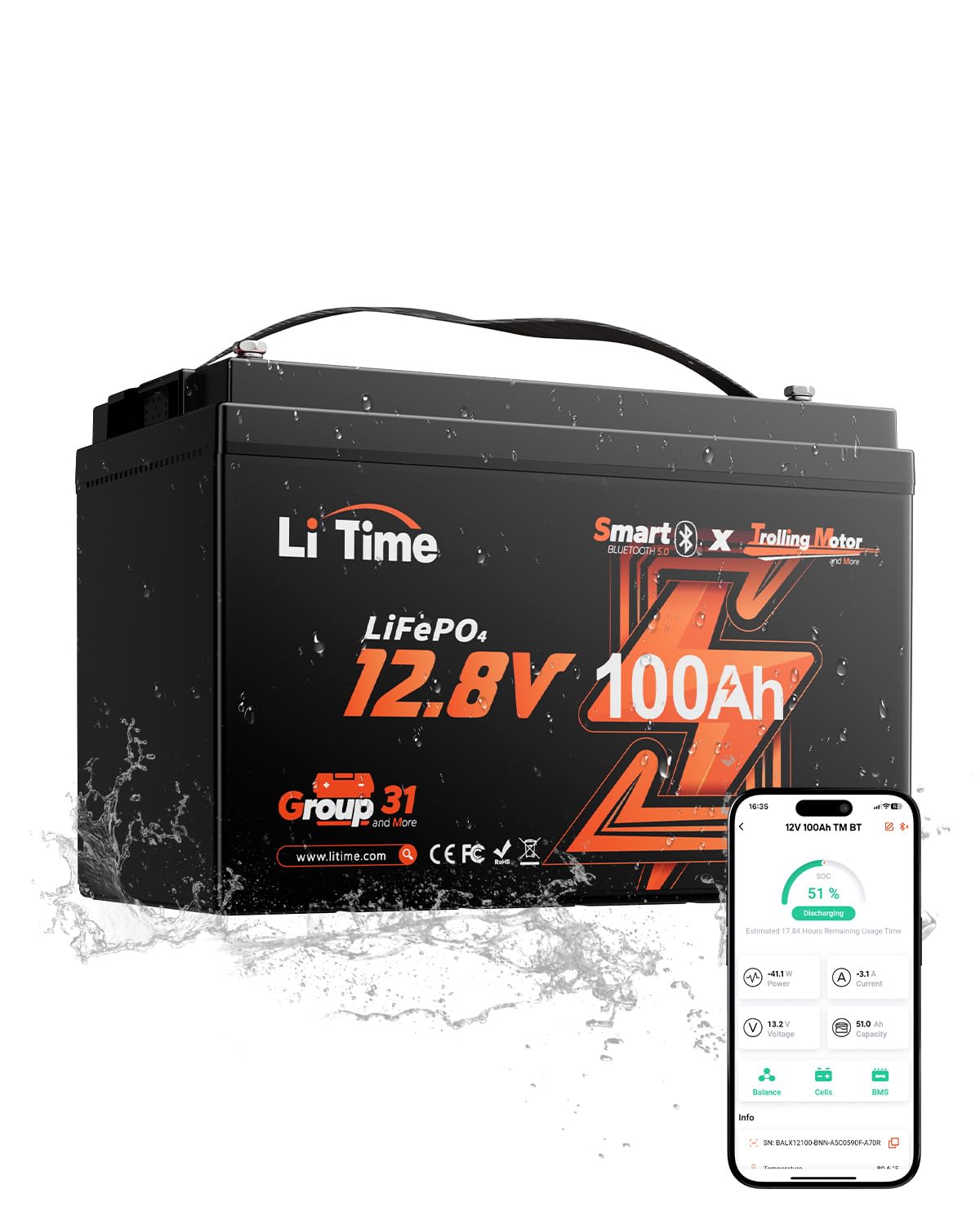
1. Litime 12V 100Ah Trolling Motor LiFePO4 Battery
Our pick — over 4.5★ from 600+ verified ratings; the strongest balance of quality and price.
The lightweight 100Ah powerhouse that redefines what a trolling motor battery can do.
This is the pick that crams a full day of fishing into a box that weighs just 22.2 pounds — light enough that owners describe picking it up with one finger. Its 100 amp-hour capacity is the same as the lead-acid units it replaces, but buyers report it can run a trolling motor all day with SpotLock engaged on a 16.5-foot boat and only need a charge every three or four trips.
The a neat extra is the Bluetooth app, which auto-connects in seconds and shows you state of charge plus per-cell balance right from your phone. It is also built for cold weather: it stops charging below 32°F and stops discharging below -4°F, so winter storage won’t wreck the cells. With an IP65 waterproof rating and salt resistance, it shrugs off the marine environment.
The cycle life is the headline number — up to 15,000 deep cycles at 60% depth of discharge, or 4000 cycles at 100% DOD. Owners mention: “After 4hrs in 25mph wind, still 72% charge, no power loss.” The one catch is that it is not meant as a starter battery for engines — it is strictly for deep-cycle energy storage.
Why Owners Love It
- Bluetooth app shows charge level, cell balance, and BMS status in real time
- Weighs 22.2 lb — a fraction of lead-acid — lightening your boat’s tongue weight by 60 lb in some setups
- Low-temp protection keeps cells safe in freezing weather
What To Know
- Requires a lithium-compatible charger to activate Bluetooth on first use
- The app asks for frequent sign-ins, which some owners find tedious
Reach for this if: you run a trolling motor, RV, or solar setup and want one battery that handles it all with phone monitoring.
Think twice if: you need a starter battery — this one is strictly for deep-cycle energy storage, not cranking engines.
2. Kratax Rechargeable AA Lithium Batteries 12 Pack
The 1.5V AA that holds a steady voltage until the very last drop.
While most of this guide is about big 12V batteries, this is the everyday workhorse for the AA devices scattered around your house. Each cell pushes a stable 1.5 volts to the device until it is fully drained — unlike NiMH cells that sag in voltage as they deplete. That constant output means a game controller or trail camera performs consistently from first use to last.
The charging speed is the standout spec: a full charge in about 2 hours, which is roughly half the time of traditional NiMH rechargeables. The 1600-cycle rating means each cell can replace over a thousand disposable batteries over its life. Weighing just 19 grams each, they are noticeably lighter than NiMH cells — about 20% lighter — which matters in a remote control held for hours.
There is a real fit note here: these batteries are picky about being charged in the supplied charger, and customers note that the charge improves after a few full cycles. The most-discussed experience is battery life, and it is mixed — they work brilliantly for some devices like trail cameras (as owners put it, “I use a set of these in a trail camera and they last a long time”) but can be unreliable in pairs for 3V devices, where one cell can drain faster than the other. For high-drain gear like camera flashes, look elsewhere.
The takeaway: a fast-charging, constant-voltage AA that excels in high-current devices and trail cams, with the caveat that pair-use in 3V gear is hit-or-miss.
Best for: high-drain AA devices like game controllers, outdoor cameras, and motorized toys where stable 1.5V output matters.
skip it if: you rely on pairs of AAs for 3V devices — the uneven drain between two cells is the recurring gripe.
3. GOLDENMATE 12V 10Ah LiFePO4 Lithium Battery
A featherweight 3.3 lb battery that slips into any tackle box and powers gear all day.
This tiny 10 amp-hour wonder weighs just 3.3 pounds — compare that to the 22.2-pound Litime 100Ah, and you see the difference is a 6.7x gap in weight for a much smaller capacity. It is the grab-and-go option for fish finders, kayaks, and kids’ ride-on toys where every ounce counts. Reviewers point out powering a fish finder all day and still seeing a full charge afterward, with one noting it only dropped to 50% after heavy use.
What makes it special is the IP67 waterproof rating, meaning it is fully protected against dust and can handle immersion in water up to a meter — huge confidence for kayak and marine use. It delivers a continuous discharge up to 10 amps, a spec that the built-in BMS protects against overcharging and short circuits. With over 5000 deep cycles and a 10-year lifespan claim, it outlasts the 300-500 cycles of a typical lead-acid battery many times over.
The 10Ah capacity is right for small loads, not for running a fridge all weekend. It supports expansion though: you can connect up to four units in series or parallel to reach a total of 51.2V 40Ah. It only needs a recharge about every year in storage thanks to its low self-discharge, making it the set-and-forget option for seasonal gear.
Why it wins: the 3.3 lb weight and IP67 waterproofing make it the easiest lithium battery to just toss in a bag and forget about, with a 5000+ cycle life that makes it a true lead-acid replacement.
Best for: fish finders, kayaks, emergency lighting, and ride-on toys where compact size and water resistance matter more than raw capacity.
Not for: large loads like RV fridges or trolling motors — 10Ah is meant for small devices, not heavy appliances.
4. HWE Energy 12V 25Ah LiFePO4 Rechargeable Battery
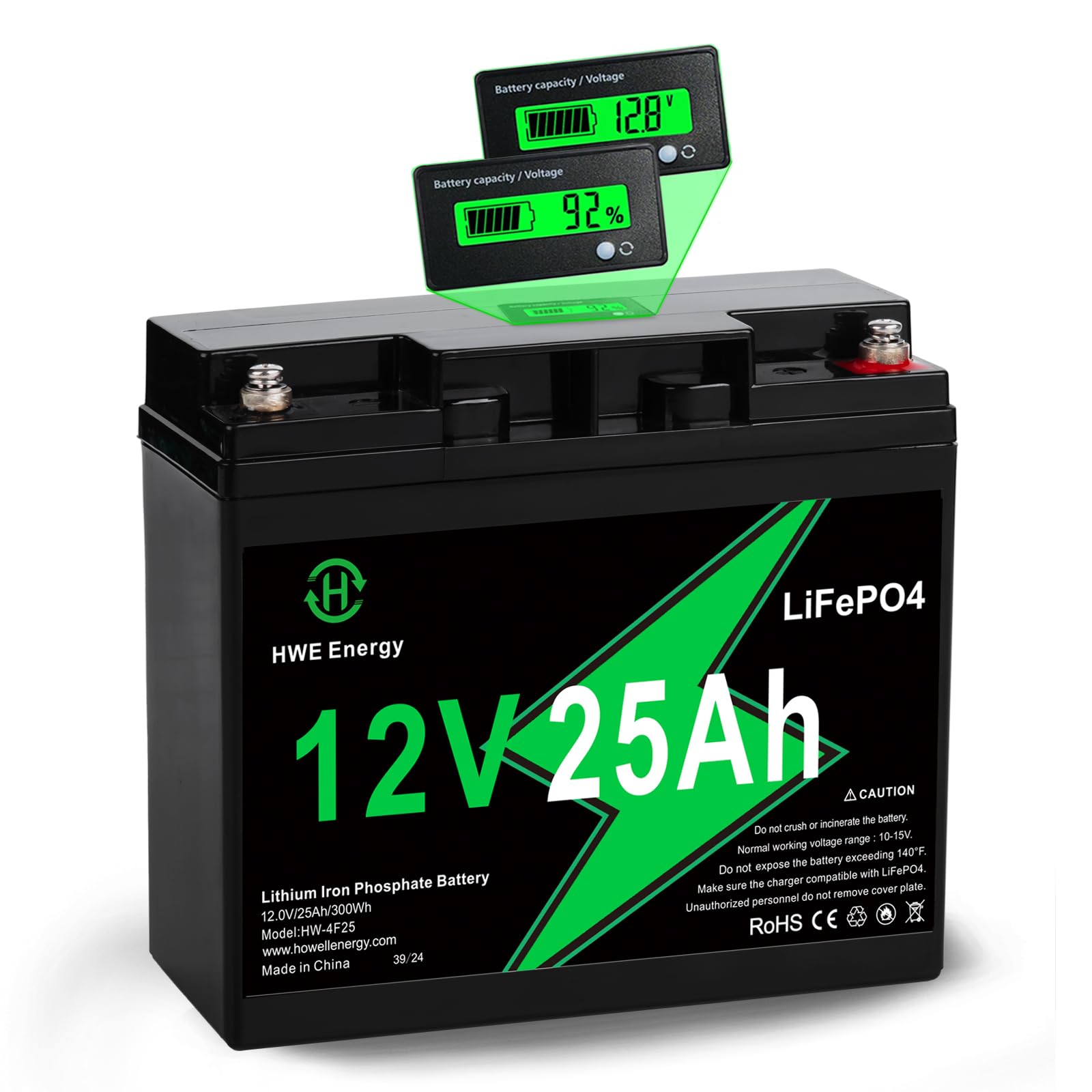
The 4.8 lb battery with a built-in LCD screen so you always know your charge.
Somewhere between the tiny 10Ah and the heavy 100Ah units sits this 25 amp-hour balance at just 4.8 pounds. That is less than half the weight of the 12-pound sealed lead-acid battery it replaces, which makes it a favorite for pump boxes and equipment enclosures where the old SLA was a back-breaking chore to swap. Owners note it fits perfectly in pump equipment boxes and powers RV pressure pumps with no trouble.
The defining feature is the dedicated LCD meter that shows real-time voltage and state of charge with one button press — no app, no Bluetooth, just glance at the screen. For a security alarm system or a deer feeder that sits in the garage for months, that instant readout removes the guesswork. The 20A BMS protects against overcharge, over-discharge, overcurrent, and short circuits, and its ultra-low self-discharge keeps it safe in both hot and cold weather.
It is a direct drop-in for common SLA sizes like 6FM20, FM12200, and ML22-12, with an M5 screw terminal for easy wiring. The 5000+ deep-cycle rating and 10-year lifespan claim dwarf the 300-500 cycles of lead-acid. A word of caution from the data: discharge is capped at 20A, so if you are trying to replace the battery in a large UPS, it will trip over-current protection beyond that — fine for computers and routers, not for full 1500VA loads.
Owners Highlight
- Built-in LCD screen shows voltage and charge level with one button press
- At 4.8 lb it is under half the weight of the 12 lb SLA it replaces
- Drop-in fit for common alarm and backup battery sizes like 6FM20
Watch Out For
- 20A max discharge means it is not suited for high-draw UPS loads
- Recharge with a lithium charger when the level drops below 20%
The right pick if: you want a lightweight, no-app-required battery with a visible charge indicator for alarm systems, pumps, or small backups.
Look elsewhere if: you plan to run full-size UPS loads or heavy appliances that exceed the 20A limit.
5. SEFEPODER 12V 20Ah LiFePO4 Battery 2 Pack

Two 20Ah batteries for the price of one big unit, perfect for wheelchairs and scooters.
If you need two batteries — one spare, or a series pair for higher voltage — this 2-pack delivers 20 amp-hours in each 12.8V unit. The whole pair weighs just 7.9 pounds, which is about a third of what lead-acid units of the same capacity would weigh, and that is the spec owners notice first. A motorized wheelchair user reports the pair is lighter than the old lithium-ion cells and gives increased range on a single charge.
Each battery packs a 40A BMS against overcharge, over-discharge, overcurrent, and short circuits, with output discharge up to 20A continuous. The 4000+ cycle rating means it will outlast several lead-acid replacements. Owners have used them as a direct plug-and-play swap for a Black & Decker 36V mower pack, which is proof of the flexibility of connecting units in series — up to four identical batteries can be linked.
The honest fit note: battery life gets mixed feedback, with some owners finding the charge doesn’t hold well over time, and one reporting a unit failed shortly after the 1-year warranty. Charging is also slow — one ice fisherman jokes it takes forever to charge, though it has survived two seasons of ice fishing. The quality of the cells themselves earns a lot of praise, but treat the longevity claims with some patience.
The smart buy: a pair of compact 20Ah batteries at a weight that beats lead-acid by two-thirds, ideal for wheelchairs, scooters, and ride-on toys — with the caveat that charging is slow and long-term battery-life reports vary.
Reach for it if: you need two batteries for a scooter, power wheels, or a series setup and want the lightest option possible.
Be patient if: you hate slow charging — owners consistently note this one takes a long time to top up.
6. yeagulch Upgrade 12V 150Ah LiFePO4 Battery
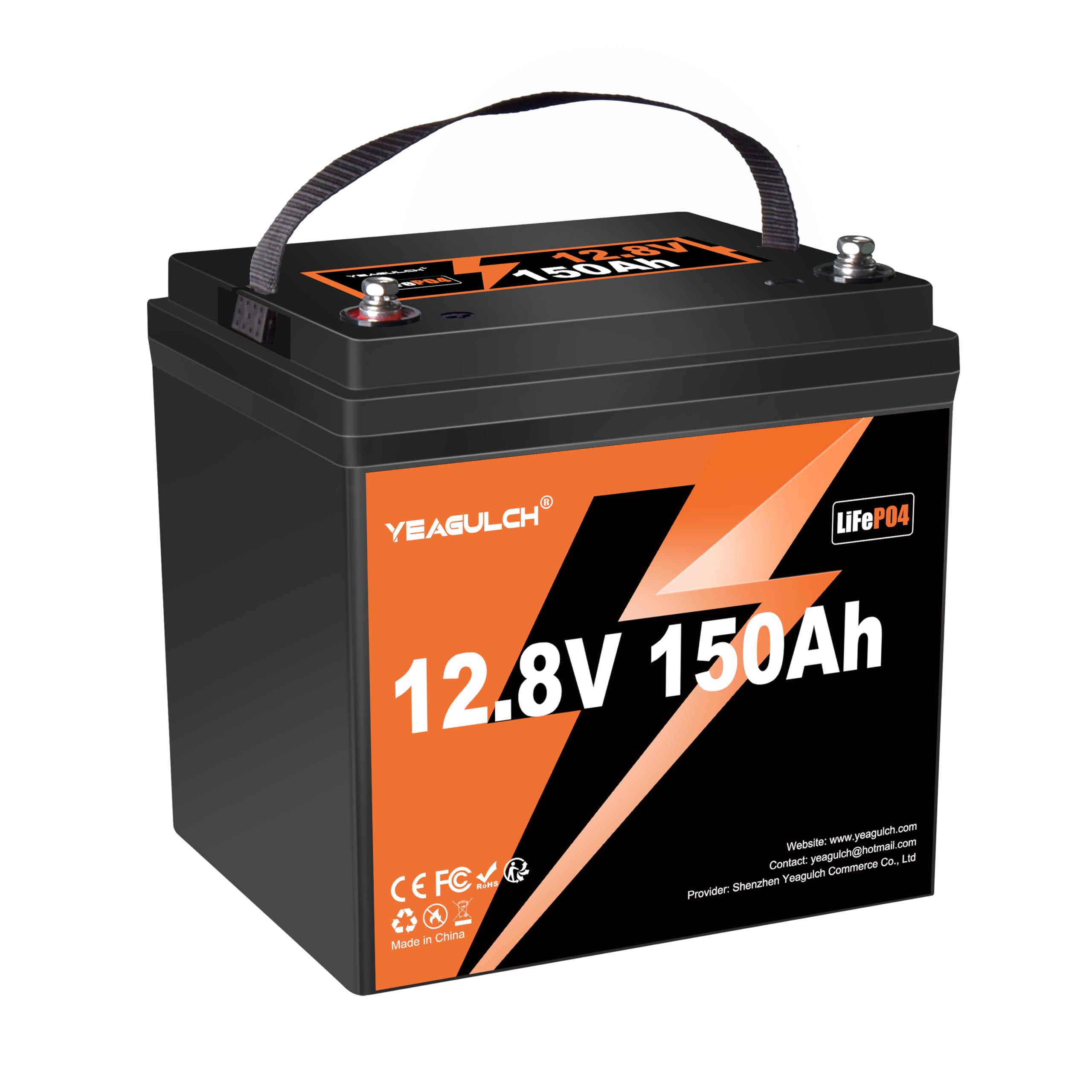
A 1920Wh reserve that runs a CPAP machine for three full nights off-grid.
This 150 amp-hour battery is where the “set it and trust it” crowd lands. It stores a substantial 1920 watt-hours of energy, and the data shows owners leaning on it hard: one CPAP user reports running the machine for three full nights off an inverter and still having about 30% left. That is the kind of margin that makes an off-grid weekend feel easy rather than stressful.
The built-in 100A BMS handles overcharge, over-discharge, short circuits, and overheating, and the low-temperature cutoff stops charging at 32°F to protect the cells in winter. It is configured to allow up to 4S4P connection, so you can scale to a 51.2V system or boost capacity to 600Ah by linking four in parallel. Owners also note an impressive six-month check: charge or discharge it once every six months to prevent damage from disuse.
The 15000+ deep-cycle rating is the biggest number on the spec sheet, and reliability is what owners praise most. The honest trade-off is weight — it is the kind of unit you install once and leave in place, not carry in and out of a boat each trip. There is also no Bluetooth, so you will need a shunt or solar controller to monitor the charge level, which suits owners who are already running a solar setup.
The verdict: a 1920Wh deep-cycle workhorse built for solar stations, trolling motors, and overnight off-grid use, with reliability the most-praised quality and no Bluetooth monitoring as the main compromise.
Best suited for: off-grid solar, RV, and marine applications where you want 1920Wh of reserve and don’t need phone monitoring.
Think twice if: you want to track charge from your phone — this one has no Bluetooth, so you’ll need external monitoring gear.
7. DUMFUME 12V 150Ah Max LiFePO4 Battery
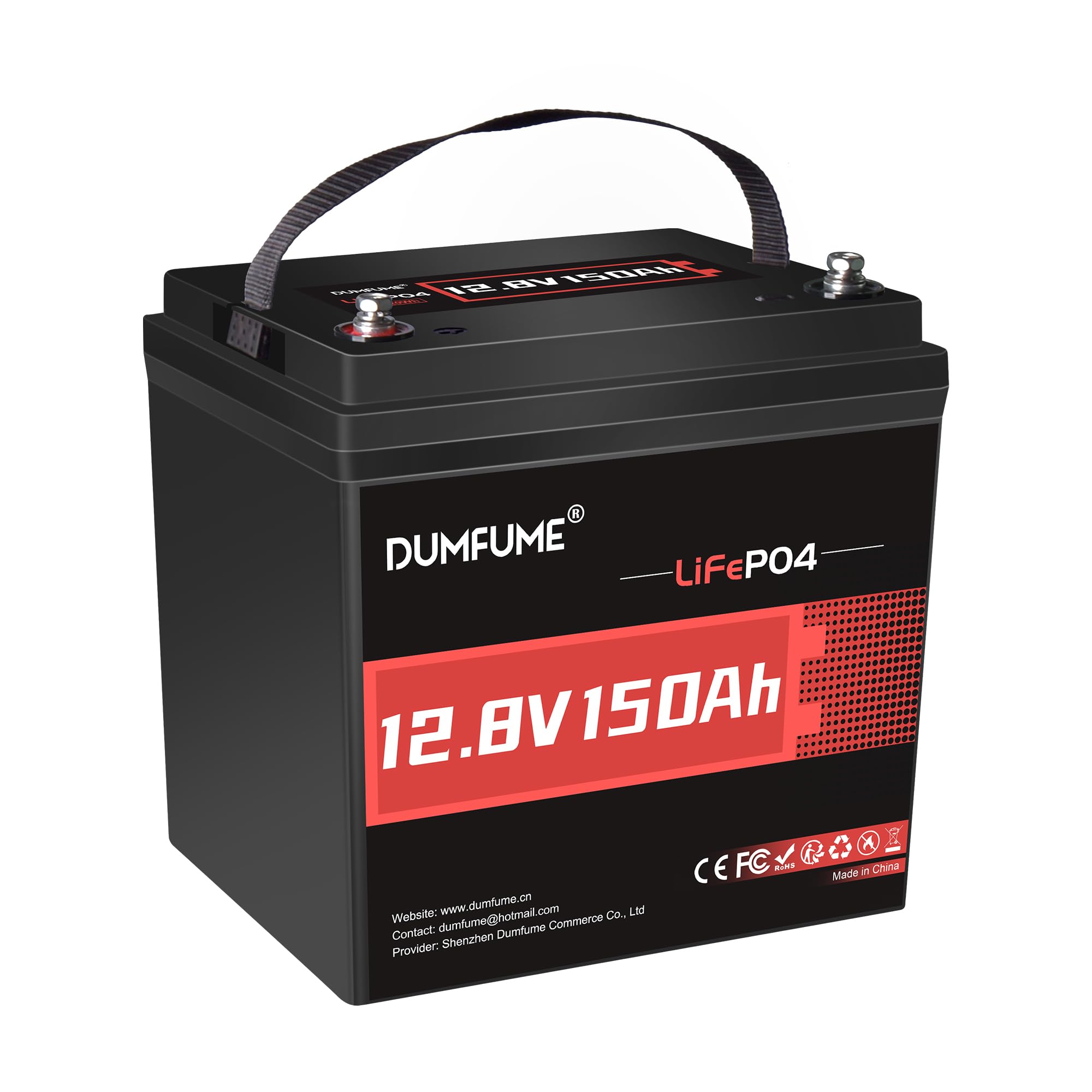
A 41 lb 150Ah unit that powers an entire RV on a single charge.
For RV owners who want serious reserve capacity without a forklift, this 150 amp-hour battery weighs 41.03 pounds and stores 1920Wh of energy. The most compelling owner story involves a full solar setup: two of these linked together powered an entire RV fridge easily, with a 300Ah total configuration. Weighing in at 41.03 lb, it is significantly lighter than comparable lead-acid batteries while delivering over 4,000 cycles to 80% capacity.
The 100A BMS provides the full safety suite — overcharge, over-discharge, short circuit, and overheating protection — and it carries an IP65 waterproof rating for marine or outdoor installation. The compact dimensions of 10.04 x 7.68 x 9.84 inches let it fit in tight cabinet spaces under RV counters. It supports series and parallel connections up to 4S4P, so you can scale a custom off-grid setup as your needs grow.
Owners specifically praise the performance and battery quality, with capacity tests showing it exceeds the rated spec. There is a real caveat buried in the requirements: the battery needs ambient temperatures of 5°C or higher to perform, and return shipping for low-temperature charging issues is not covered — so if you winter in a freezing climate, this might not be the one. Also, the 5-year warranty applies to direct purchases, not Amazon orders, which is worth knowing before you rely on it.
What Stands Out
- 41.03 lb weight with 1920Wh storage — owners call it the best internal build quality they’ve seen
- IP65 waterproof rating and compact dimensions fit tight RV cabinet spaces
- Rated for over 4,000 cycles to 80% capacity
Consider This
- Fails to charge in cold environments — needs 5°C or warmer to operate
- The 5-year warranty does not cover Amazon purchases, only direct orders
Reach for this if: you want a proven, high-quality 150Ah for an RV or solar setup and live in a climate that stays warm.
Hold off if: you camp in freezing temperatures — the low-temp charging limitations are the main drawback.
8. HumsiENK 12V 100Ah LiFePO4 Lithium Battery with Bluetooth
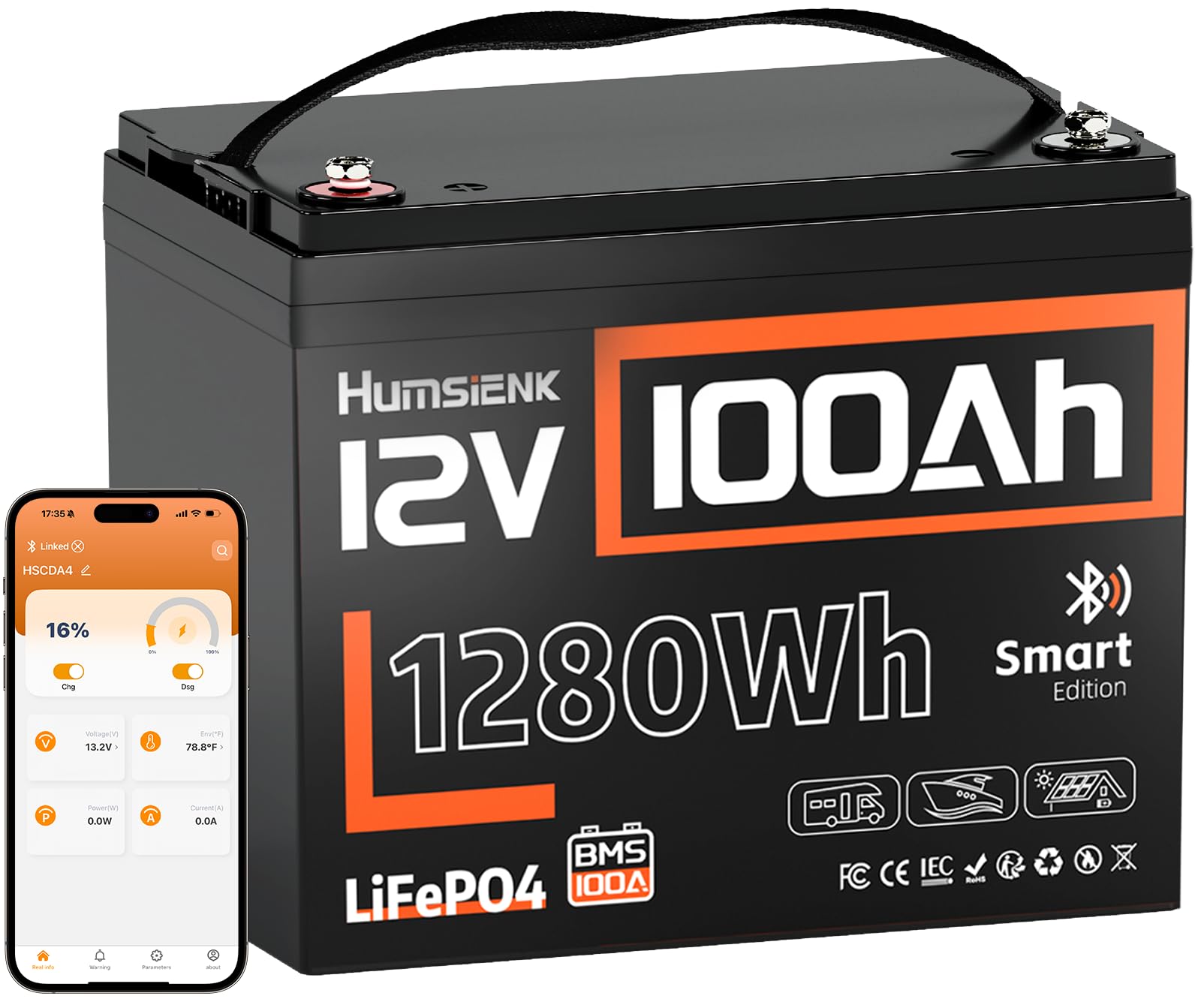
The lightest 100Ah in this list at 19.73 lb, with Bluetooth that updates several times a second.
At 19.73 pounds, this is over 60% lighter than a lead-acid battery of the same capacity — and lighter than the Litime 100Ah by a couple of pounds. That makes it the easiest 100Ah to haul in and out of a boat or RV compartment. The compact Group 24 size means it drops into standard Group 24-31 battery boxes without modification, saving over 30% in space compared to lead-acid.
The Bluetooth app is the star here, showing voltage, state of charge, current, and temperature with updates several times per second. Shoppers say the app connection works flawlessly, with per-cell data and detailed alarms — you can even disable discharge from your phone. The 100A BMS handles overcharge, over-discharge, over-current, and short circuits, and the low-temperature cutoff stops charging below freezing.
The cells are A+ grade LiFePO4 that are UL tested and FCC and CE certified, and the unit supports 15,000 cycles with 4S4P configurations up to 48V and 20.48 kWh. The recurring praise centers on quality and battery life — buyers report it holds voltage well under load and even powers major kitchen appliances. The main mixed note is Bluetooth connectivity for a minority of users, and a rare negative involves a unit failing after about six months of use, so do your installation carefully.
Bottom line: a sub-20 lb 100Ah with the most responsive Bluetooth app in this guide, built to Group 24 size for easy drop-in installation — the quality and battery life are what owners praise most.
Choose this if: you want a light, compact 100Ah with excellent phone monitoring and easy installation in a standard battery box.
Consider the alternative if: you specifically need the lowest weight above all — the Litime is slightly heavier but has a longer track record in the data.
9. ECO-WORTHY 12V 280Ah Metal Case LiFePO4 Battery
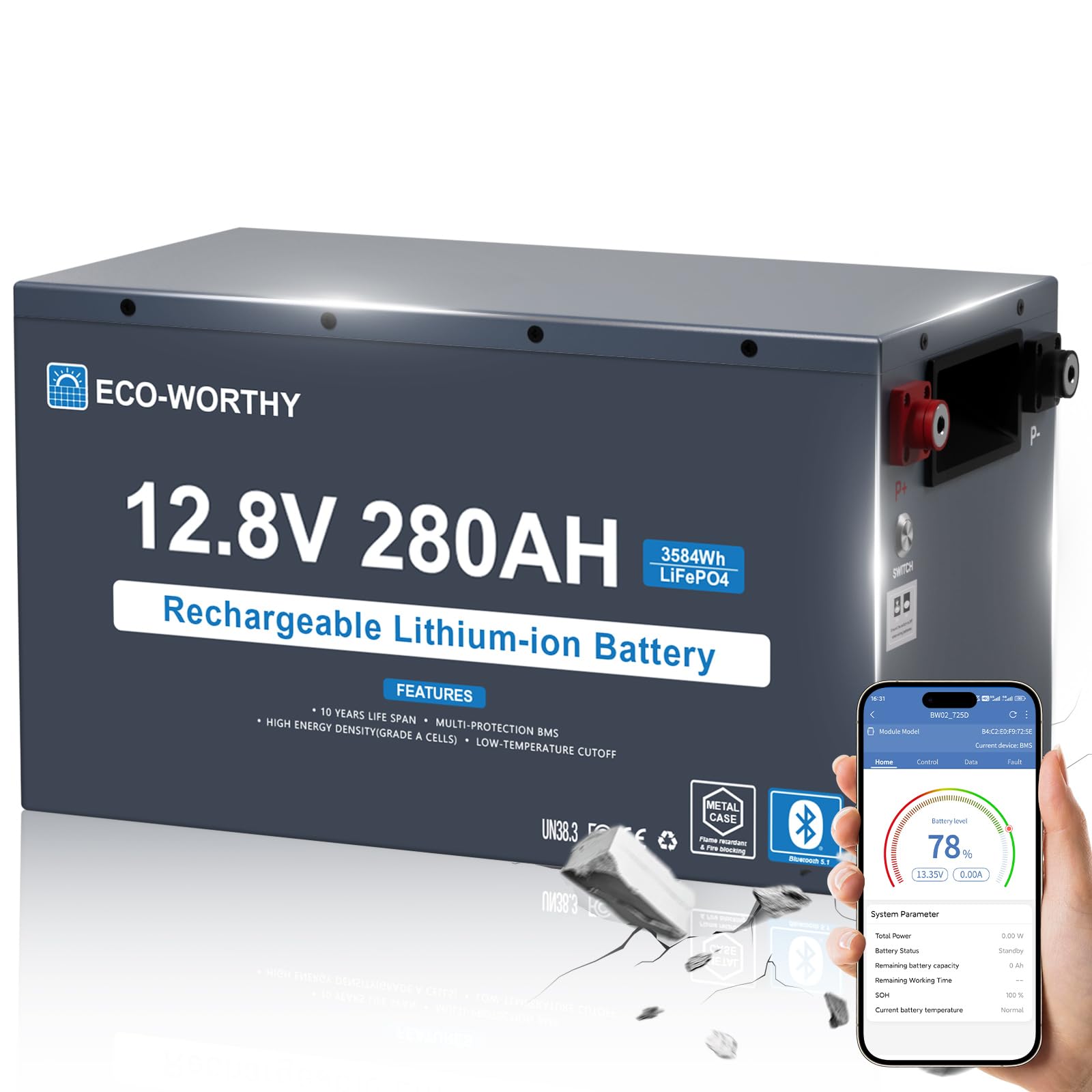
The 280Ah metal-cased giant that keeps an RV fridge running for days straight.
This is the battery for people who measure their power needs in days, not hours. At 280 amp-hours, it stores 3584Wh of energy — enough that owners mention running a 12V 10 cubic foot fridge for two days straight, or powering a 1000-watt amp without breaking a sweat. The defining feature is the heavy-duty metal enclosure, which provides fire protection and heat resistance plus four mounting feet so you can bolt it directly to an RV floor without any extra battery box.
The 200A BMS is the strongest in this guide, protecting against over-charge, over-discharge, over-current, short-circuit, and temperature issues. There is also a weak-current power switch for one-touch cut-off during installation or maintenance, which is a thoughtful safety touch. Bluetooth monitoring through the app shows voltage, capacity, and charge status in real time, and the low-temperature protection cuts charging automatically to keep cells safe in the cold.
Performance reviews are strong across the board: the battery exceeds its rated capacity, and owners praise the build quality — one even notes the JBD BMS is compatible with the Overkill Solar app, a favorite among DIY solar enthusiasts. The recurring theme is value: the most-praised aspect is battery quality, with battery life close behind, and multiple owners call it the best value on the market. The only real note is that with 3584Wh on tap, you want this for systems that actually need the capacity — for a small kayak this is overkill.
The Big Wins
- 3584Wh of energy keeps RV fridges running for two days or more
- Metal case with mounting feet means no extra battery box required
- 200A BMS with Bluetooth and low-temp cutoff
Know Before Buying
- Two label styles are shipped randomly — identical inside, but appearance varies
- Orders may arrive in multiple packages at different times
Grab this if: you are powering an entire RV, camper van, or off-grid home and want the biggest single-battery capacity with a rigid metal shell.
Reconsider if: your needs are modest — a 280Ah unit is heavy to move and oversized for small setups.
Understanding the Specs
Amp-Hours (Ah) vs. Watt-Hours (Wh)
Amp-hours measure how much current a battery can supply over time — a 100Ah battery delivers 100 amps for one hour or 10 amps for ten hours. Watt-hours add voltage into the equation: multiply the voltage (12.8V) by the capacity (100Ah) to get total energy (1280Wh). For a quick comparison, watt-hours is the number that tells you how long your fridge, trolling motor, or lights will actually run.
BMS and Low-Temperature Protection
A Battery Management System (BMS) is the internal computer that keeps the battery safe, cutting off power during overcharge, over-discharge, overcurrent, and short circuits. Low-temperature protection is a specific BMS feature that stops charging when the battery is freezing — usually below 32°F — because charging a frozen lithium cell causes permanent damage. Every battery in this guide has a BMS, but low-temp cutoff is not universal, so check for it if you store or use batteries in winter.
Cycle Life: 4000 vs. 15000
A “cycle” is one full charge and discharge. Lead-acid batteries typically last 300-500 cycles, which is why they need replacing every few years. Lithium iron phosphate cells are rated in the thousands — 4000, 6000, even 15000 cycles depending on how deeply you discharge them each time. The 100% DOD rating (full discharge) is always lower than the 60% DOD rating (discharge to 60% of capacity), so a battery rated 4000 cycles at full depth will last far longer if you avoid draining it completely.
Series vs. Parallel Connections
Connecting batteries in series (positive to negative) adds voltage — two 12V batteries in series make a 24V system. Connecting in parallel (positive to positive) keeps voltage the same but adds capacity — two 100Ah batteries in parallel make a 12V 200Ah system. Most batteries in this guide support up to 4S4P, meaning four in series and four in parallel, giving you flexibility to build anything from a 24V trolling motor setup to a high-voltage RV bank.
FAQ
Can I use a lithium battery to start my car or boat engine?
What charger do I need for a LiFePO4 battery?
How long does a 100Ah lithium battery actually last?
Can I connect batteries of different brands in series or parallel?
What does the IP65 or IP67 waterproof rating mean?
Is it safe to store a lithium battery over the winter?
How much weight will I save switching from lead-acid to lithium?
What is the difference between 12V and 24V battery systems?
Can these batteries power a CPAP machine while camping?
Why is the rechargeable AA battery in this guide?
Final Thoughts: The Verdict
For most people, the batería de litio winner is the Litime 12V 100Ah because it pairs a 100 amp-hour capacity with Bluetooth monitoring and a 15,000-cycle rating in a boat-friendly 22.2-pound package. If you want a smaller, waterproof option for fish finders and kayaks, grab the GOLDENMATE 10Ah. And for whole-RV power that lasts for days, the ECO-WORTHY 280Ah is the one to reach for.
How We Picked
We do not accept paid placement. Every pick is matched to a real buyer and a real use-case; we do not hands-on test units.
Sources & Methodology
Specifications: manufacturer listings and product documentation. Review insights: verified customer reviews, as of August 2026. Pricing: not shown on this page (it changes often); check the current price via the retailer link.
As an Amazon Associate, Gadgets Feed earns from qualifying purchases. This does not affect which products we feature.