
Our readers keep the lights on and my morning glass full of iced black tea. As an Amazon Associate, I earn from qualifying purchases.
Specs are compiled from manufacturer listings and verified buyer reviews and can change over time — please confirm the key details on the product page before buying.
You want the steam gone and the mirror clear without a jet engine running over your head, and that is exactly what a good bath exhaust fan delivers — the right airflow in CFM (cubic feet per minute, the measure of how much air it moves) matched to your room size, at a noise level you can live with. Get those two numbers right and you will never think about your fan again. Get them wrong and you get fogged mirrors, peeling paint, and a fan you switch off because it is too loud to run.
I’m Min — the founder and writer behind Gadgets Feed. This guide is built by comparing the manufacturers’ published specifications and the patterns across verified customer reviews, so you get each pick’s real strengths and trade-offs instead of marketing spin.
Quiet operation and honest airflow ratings are the two things that separate a fan you forget about from one you regret. This guide walks through nine tested-by-owners options so you can pick the right bath exhaust fan for your bathroom on the first try.
Our Picks at a Glance


How To Choose The Best Bath Exhaust Fan
Buying the wrong fan is almost never about brand — it is almost always about three numbers that have to line up with the room you already have. Here is what actually matters before you hand over any money.
Size the airflow to the room, not to the label
CFM is the amount of air the fan pulls out in one minute. A bathroom under 50 square feet generally works with a 50 CFM fan. A room around 100 square feet wants something in the 100 to 110 CFM range. Go too small and the steam lingers longer than the fan runs. Go unnecessarily large and you pull conditioned air out of your home faster than you need to.
Read sones honestly
A sone is a unit of perceived loudness — it is not linear like decibels, so 2 sones sounds noticeably louder than 1 sone, and 4 sones sounds dramatically louder than 2. Below 1.5 sones most people forget the fan is on. Anything advertised as “quiet” but truly running louder than claimed will be the first thing you notice in daily use.
Match the duct and the cutout before you buy
Most bathroom exhaust fans in this range use a 3-inch or 4-inch duct, and some use a 4-inch round connector versus a 4-inch oval. If you are replacing an existing fan, measure the ceiling opening and the duct collar first. A fan that needs a new, larger ceiling cutout turns a simple swap into a drywall patch job.
Quick Comparison
| Model | Best For | Airflow (CFM) | Noise (Sones) | Duct Size | Amazon |
|---|---|---|---|---|---|
| Panasonic FV-0511VFL1 WhisperFit★ Best Overall | Whole-bath coverage with adjustable airflow | 50 / 80 / 110 CFM | Whisper-quiet (per design) | 4″ or 6″ | Amazon |
| Harrier Hardware 70 CFMBest Value | Tight-budget replacement in small bathrooms | 70 CFM | 2.0 Sones | 3″ | Amazon |
| Tech Drive Very Quiet Bathroom FanCompact Pick | Roomside install with no attic access | 70 CFM | 2.0 Sones | 3″ | Amazon |
| JOEAONZ 110 CFM | Larger bathrooms wanting high airflow quietly | 110 CFM | 1.0 Sone | 4″ | Amazon |
| POWERENG 141 CFM Ceiling Mount | Big bathrooms wanting maximum airflow | 141 CFM | 0.7 Sones | 4″ | Amazon |
| Homewerks 7140-50 | Small bathrooms wanting a hidden, quiet swap | 50 CFM | 1.0 Sones | 4″ round | Amazon |
| Broan-NuTone 744 Recessed Light Fan | Replacing a can light with a fan-light combo | 70 CFM | 1.5 Sones | 4″ round | Amazon |
| OREiN 2-in-1 Fan with Light | Daylight-bright fan-light combo, DIY install | 110 CFM | 2.0 Sones | 4″ (3″ reducer included) | Amazon |
| Panasonic FV-0510VSL1 WhisperValue | Slim spaces needing flexible speed and light | 50 / 80 / 100 CFM | Whisper-quiet (per design) | 4″ oval | Amazon |
In‑Depth Reviews
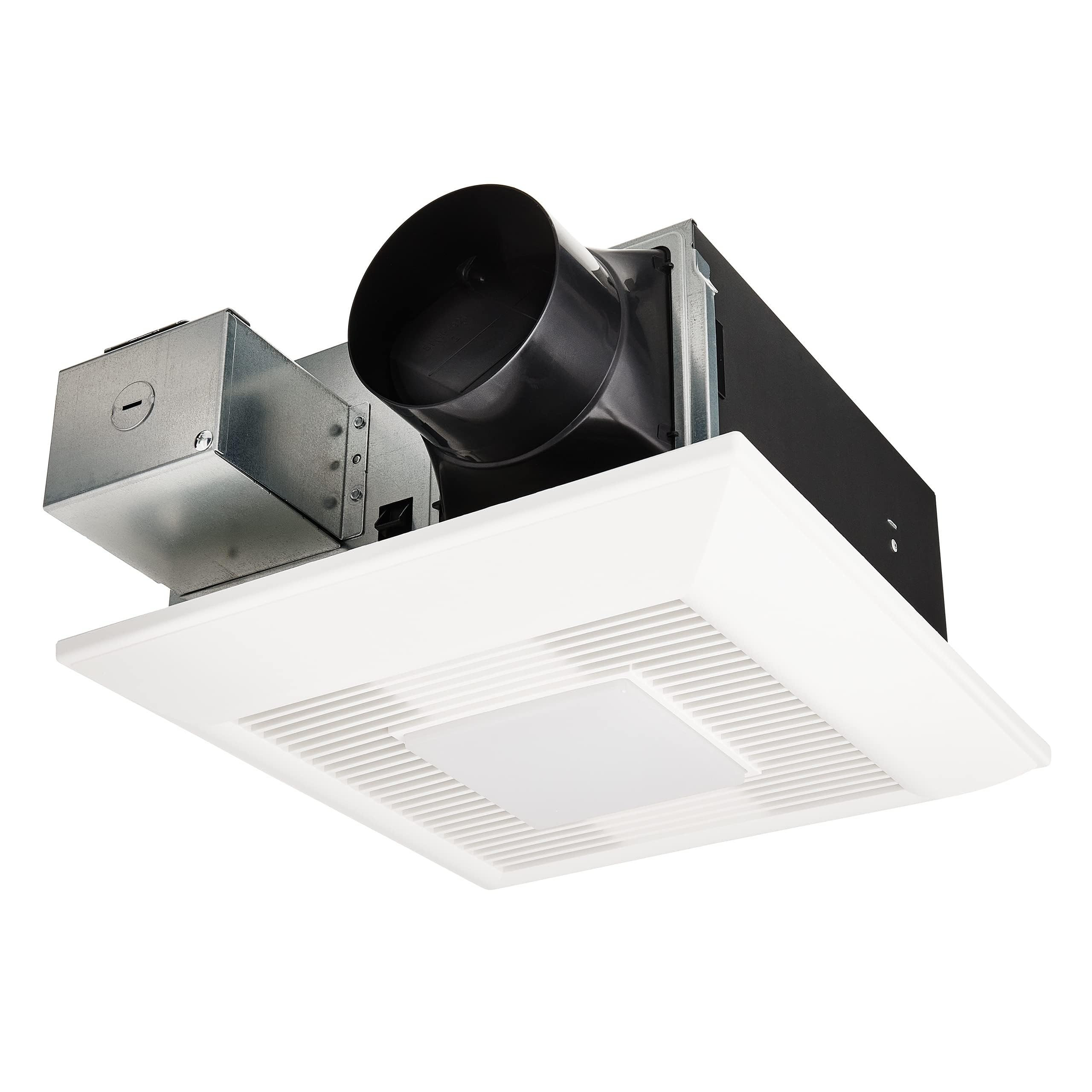
1. Panasonic FV-0511VFL1 WhisperFit Bath Fan + Light, 50-80-110 CFM
Our pick — over 4.5★ from 900+ verified ratings; the strongest balance of quality and price.
A 50/80/110 CFM fan with a dimmable LED and night light, built to run quietly for years.
The thing that wins people over on this one is the sheer build quality — the WhisperFit DC line has a reputation among owners as the benchmark fan, and it shows in how few complaints come up about reliability. The 110 CFM setting handles a full-size bathroom with ease, and it is the only pick here that lets you choose 50, 80, or 110 CFM with a flip of a switch, so you are not locked into one airflow number if you move it later. Owners tend to compare it directly against cheaper quiet fans and report the difference is worth the step up in airflow and quietness.
Installation is where it surprises people in a good way. The Flex-Z Fast bracket uses one hinge that lets a single person position and mount the housing without climbing into the attic, and the removable duct and wiring junction box keeps the electrical side simple. If you are handy enough to hang a ceiling fixture, you can do this. On ducting: the fan supports either a 4-inch or 6-inch duct, and the 110 CFM rating only reaches full airflow on the larger 6-inch run — on a short 4-inch run you are limited, which owners who read the fine print flag clearly.
The good news is the fan itself does not seem to punish a non-expert installer — several buyers who openly call themselves non-handy report getting it installed and working anyway, just slower than expected. The LED light is bright and dimmable, and it functions as a low-power night light too — a feature you notice more once you have it and would miss without it.
Where it genuinely shines
- Three airflow settings (50 / 80 / 110 CFM) from one fan — flexible across bathroom sizes and future moves
- Single-hinge Flex-Z Fast bracket means attic access is not required to mount it
- Dimmable 10W LED plus a low-power night light built into the grille
- Energy Star-certified DC/ECM motor that owners consistently describe as very quiet and efficient
What to know before you buy
- Instructions are thin; budget time to find a video walkthrough instead
- On a short 4-inch duct, the 110 CFM setting cannot reach its full rating — a 6-inch run is the ideal fit
- A retrofit may need minor drywall repair around the cutout
Buy it if: you want a fan designed to be the last one you install in that bathroom, with adjustable airflow and a real light built in.
Know this: unless your ducting supports the 6-inch size, the top 110 CFM setting is not the number you will actually experience.
2. Harrier Hardware Bathroom Exhaust Fan 70 CFM Super Quiet 40dB 2 Sone
A 70 CFM, 2.0-sone drop-in replacement for an old, loud bathroom fan.
If you are upgrading an old fan that sounds like a small aircraft, this is the choice most owners make. The noise level is the single thing they praise most, and it is easy to see why — at 2.0 sones (roughly 40 decibels, about the loudness of a quiet bedroom) it is a massive step down from the ancient units it usually replaces. You want to keep it clean. The 7.5-inch plastic blade is larger than the 6-inch blade in the Tech Drive fan, and the 70 CFM airflow is plenty for a small-to-medium bathroom. The galvanized steel housing resists moisture, and the fan is UL Listed for use over a tub or shower on a GFCI-protected circuit.
Installation is a mixed bag in the sense that owners who already have joist and attic access find it straightforward, while those replacing a differently-oriented fan sometimes discover the motor sits on the opposite side and requires a full unit swap instead of just a motor change. That is worth knowing if you were hoping for a quick motor-only replacement. Once it is in, buyers report it handles steam and mirror fog without issue.
What keeps this from being the top pick is build quality. The housing is solid galvanized steel, but a handful of owners flag the plastic electrical connectors and push-in wiring as the weak spot — thin plastic that you want to handle carefully during install. Steady, gentle wiring gets around it, but treat those clips with respect. Given the price, this is a quiet, serviceable fan that will handle a small bathroom for years.
Quiet for the money: at 2.0 sones and roughly 40 decibels, this is one of the quietest fans at its airflow level and it drops cleanly into a standard small-bathroom footprint.
Wiring gripes exist: the plastic connectors and push-in wiring get flagged as the least-loved part of this fan — plan to handle them slowly and firmly, not force them.
Reach for it if: you are replacing an existing 70 CFM fan and want quieter, cheap, and straightforward.
Look elsewhere if: you want a replaceable motor for future servicing — on this design, a dead motor means swapping the whole unit.
3. Tech Drive Very Quiet Bathroom Fan, 70 CFM, 2.0 Sone, 3-Inch Duct
A 70 CFM, 2.0-sone fan with a 4-inch-tall housing for roomside installs in shallow ceilings.
The pitch here is no-attic installation — the housing is designed so you can do the whole job from the room-ceiling side, and the low-profile 4-inch housing height means it slips into shallower ceiling cavities where other fans will not fit. If your ceiling opening is close to the standard 7.6 x 7.3 inches, this is a direct-fit candidate. It runs at 2.0 sones and 70 CFM, which owners describe as several steps quieter than the 6-sone fans it typically replaces.
Where this fan earns its place is the tall-but-slim housing: 7.5 x 7.25 x 4 inches makes it one of the more compact options in this lineup. It is a smart fit for smaller bathrooms, closets, and laundry rooms where a big-format fan will not squeeze in. The galvanized steel housing resists corrosion and it is Energy Star qualified plus UL and HVI certified — solid third-party validation for the noise and airflow ratings. Owners appreciate that the motor is rated for at least 25,000 hours of operation. It also carries a 3-inch duct outlet, which is the same as the Harrier above, but the shorter 6-inch blade means it moves the same air with less fan-sweep. Keep that in mind if noise at low speed is your priority.
Two honest notes. First, this fan is designed for a 3-inch duct and the airflow is fine for a short run, but owners who tried to push it through a long duct report it struggles — if your duct run is long, look at a fan with a 4-inch or 6-inch connection instead. Second, the keyhole mounting slots make install simple, but a couple of owners flag that they can allow slight rattling, so snug everything down properly. The low-speed operation and mirror-clearing performance are otherwise consistent across buyer feedback.
Roomside-ready: the no-cut housing means install is possible without poking your head into the attic — the trade-off is that the housing is taller than a standard fan, so confirm your ceiling depth before you buy.
Fits best if: you have a small bathroom, a shallow ceiling cavity, and an accessible work area with no room to crawl.
Skip if: your duct run is long — a 3-inch outlet on this airflow rating is not the tool for a long exhaust push.
4. JOEAONZ Bathroom Exhaust Fan 110 CFM 1.0 Sones Ultra-Quiet

110 CFM at 1.0 sone on a standard 4-inch duct, sized for rooms up to 107 square feet.
At 110 CFM and a 1.0-sone noise rating, this is the airflow-to-noise ratio that makes people stop looking at other fans. Owners describe it as effectively silent and note it clears the fog and humidity in larger enclosed rooms without complaint. The 4-inch duct connection is the most common duct size out there, so in most retrofit situations you can reconnect to the existing pipe without chasing adapters. It handles rooms up to 107 square feet.
The design is designed for practical retrofits. It has drywall tabs, quick-connect electrical and duct connections, and a removable motor held by just two screws. The motor being that accessible matters over the long haul — if it ever needs cleaning, you get to it without taking the whole housing out. The grille is white plastic and the housing is metal, which keeps the look clean without feeling flimsy. Owners also report good condensation control in basements and en-suite bathrooms.
Two caveats worth your attention. First, the housing box is noticeably larger than a standard 50-CFM fan, so if you are replacing an older, smaller unit, you may need a slightly bigger ceiling cutout — measure first. Second, the exhaust port sits on the opposite side from many older fans, so you may need to reroute a little of your existing piping. Air movement gets mixed feedback: some owners find it very strong, others find it adequate rather than fierce. It is a 110 CFM fan and moves air accordingly, but a genuinely small bathroom might be overpowered by the airflow at the smallest room size.
What buyers keep complimenting
- 1.0-sone rating at 110 CFM is one of the strongest airflow-to-noise combinations here
- Removable motor via two screws makes future cleaning straightforward
- Standard 4-inch polymeric duct connector lines up with most existing plumbing
- Drywall tabs and quick-connect wiring keep the retrofit job manageable
Before you commit
- Housing is larger than a 50-CFM unit, so check your ceiling cutout
- Exhaust port location sometimes differs from older fans and needs rerouting
- Air movement gets mixed reports — a small-enclosed-space owner may want less airflow, not more
Best match for: a mid-size or larger bathroom that needs serious moisture pull without a loud fan thrumming overhead.
Watch the fit: larger footprint plus occasional port relocation means a slightly bigger install than the number 110 CFM suggests.
5. POWERENG Bathroom Fan Ceiling Mount Exhaust Ventilation, 141 CFM 0.7 Sones

141 CFM at a 0.7-sone rating on a 4-inch duct, for rooms up to 141 square feet.
On paper, 141 CFM at 0.7 sones is the most aggressive combination in this lineup: a very high airflow rating paired with one of the lowest sone numbers. The fan is designed for spaces up to 141 square feet, and it uses a 4-inch duct. Owners who are happy with it report strong odor and moisture removal and a bright, modern look. If your bathroom is on the large side and you want lots of air movement without a loud fan, that is the story this product is telling.
Installation is ceiling-mount with a straightforward 3-wire hookup (brown for live, blue for neutral, yellow for ground), and the unit includes heat-protection circuitry that shuts the motor down if internal temperature climbs too high. That safety feature is worth knowing about — it protects the fan from cooking itself and reduces fire risk from prolonged high-temperature operation. It is certified to regional, national, and international industry standards. The included LED light runs 6000K at 12W, which is daylight — crisp and bright rather than warm.
Then comes the honest part. Quality and durability scores on this unit are weaker than the rest of the field, with mixed customer sentiment on both — some owners love it, but a substantial minority report the plastic body and lack of metal support arms as noticeable, and a few say the fan ran louder than the 0.7-sone claim suggests. The ceiling opening needed is also larger than the standard 8-inch cutout, which can mean cutting additional drywall. If your installation is straightforward and your bathroom is large, this delivers the airflow. If you want a bulletproof build, spend for the Panasonic WhisperFit or the OREiN instead.
The airflow case: 141 CFM is the highest rating in this guide and the right answer for a bathroom that just cannot clear no matter what you throw at it.
The durability trade: quality and long-term durability feedback is the shakiest here — the housing is mostly plastic and the fan has no metal support arms, so install carefully and do not over-torque anything.
Designed for: a large bathroom that stays steamy even after a fan runs for ten minutes — this is the pick that moves the most air.
Only buy if: you are comfortable with a plastic-bodied housing and a larger ceiling cutout — this is a strong airflow pick, not a heavy-duty build pick.
6. Homewerks 7140-50 Bathroom Fan Ceiling Mount Exhaust Ventilation, 1.0 Sones, 50 CFM

50 CFM at 1.0 sone, sized for half baths and guest baths under 50 square feet.
For a pint-sized half bath or a guest bathroom under 50 square feet, 50 CFM at 1.0 sones is a very sane pairing: enough airflow to move humid air without being oversized for the space. Owners describe it as quiet to the point of being barely noticeable and say it blends into a white ceiling. The build quality gets credit from the majority of buyers — the galvanized steel construction is corrosion-resistant and the grille uses a modern low-profile style that hides itself well in tight bathrooms.
Installation is made simple by the no-cut ceiling mount design: the ceiling opening is fixed at roughly 7.75 x 7.5 inches square with a 4-inch round duct connector, which is a standard-size cutout for most small-bathroom retrofits. Buyers who go in prepared for the wiring and duct alignment report it is one of the easier fans in this lineup to get in place. It comes with HVI, ETL, and Energy Star certifications and a 3-year limited warranty.
The two honest catches. First, the exhaust port sits on one side of the housing rather than centered, which can mean rerouting your existing duct or cutting a slightly repositioned ceiling hole depending on your joists. Second, the plastic clip that holds the spring is the recurring complaint here — a handful of owners mention it snapping. It is a small part and it is replaceable, but treat the grille spring gently when you remove or reinstall the cover.
Small-room balance: 50 CFM at 1.0 sones is the right sizing for a half bath or guest bath where a bigger fan would be wasted airflow.
One fragile piece to know: the spring clip on the grille is what occasionally fails — handle the grille almost gently and it will not be a problem.
Perfect for: a small bathroom that needs quiet, low-volume ventilation with a near-invisible grille.
Double-check before ordering: the off-center exhaust port may need your duct rerouted — plan for that on install day.
7. Broan-NuTone 744 Recessed Light Ventilation Fan, 70 CFM, 1.5 Sones

A 70 CFM, 1.5-sone fan that drops into a recessed-can opening and matches the trim.
This one is the fan for anyone whose bathroom has a recessed can light that never gets used — the housing drops into the same style of opening, and the trim is matched to the look of major recessed-light manufacturers. Owners routinely swap out a dull can light for this and get a fan that looks completely at home. The 70 CFM airflow at 1.5 sones sits in the middle of the lineup: not the tallest air mover, but definitely one of the quieter combos you can find with a light built in.
Where this really wins people over is quietness — noise level is the single thing owners bring up the most, and it competes with the Panasonic WhisperFit as the quietest pick on this page. The 6.87-inch housing depth fits inside standard 2×8 ceiling joists for easy installation, and the fan runs on a 75-watt R30 or BR30 bulb, with optional wall controls available. Owners install it in bathrooms and laundry rooms and report it clears steam effectively and looks like a recessed light from the room side. It uses a 4-inch round duct connector.
The catches are real but manageable. The metal casing has sharp edges and burrs that will need deburring before you handle it — glove up on install day. On most joist orientations the exhaust outlet exits on the side that is harder to route, so expect to work around the joist direction. And if the fan hums when it is running, that is usually a vibration issue, not a defective unit — the instructions cover a crimp-and-clip step that stops the metal slides from rattling, and owners who skip it are the ones who complain about noise.
What stands out
- Looks like a recessed light from below — a clean visual upgrade over an old flush grille
- 1.5 sones at 70 CFM delivers quiet operation at usable airflow
- 6.87-inch housing fits inside standard 2×8 ceiling joists
- Can be used over a shower or tub enclosure when installed correctly
Install notes worth knowing
- Metal casing has sharp edges — deburr before handling to avoid cuts
- Exhaust outlet direction is not always convenient relative to joists
- Do the crimp-and-clip step in the instructions or you will hear vibration hum
Strongest fit for: a bathroom with an underused recessed can light on the ceiling that could become a hidden fan-light combo.
Plan ahead for: the outlet angle and the deburring step — bring gloves and a file to the install and you will be done in one session.
8. OREiN 2-in-1 Bathroom Exhaust Fan with Light, 110 CFM, ENERGY STAR

A 110 CFM, 2-sone fan-light with a 1000-lumen 5000K LED for rooms up to 110 square feet.
For anyone whose bathroom fan was always the thing you tolerate rather than like, the OREiN flips that — it is a fan-light combo built around a 1000-lumen 5000K LED that turns the ceiling into usable light. Owners consistently report the light brightens the room and the fan clears steam better than the older units it replaces. At 110 CFM and 2 sones, it moves plenty of air in rooms up to 110 square feet, and the operating noise sits comfortably below most older fans.
Installation is the biggest variance here. Designed for roof-side install with no attic needed, with a 4-inch duct outlet and a 4-to-3-inch reducer in the box so it works with either size duct. When it goes in easily, buyers describe the process as straightforward and simple. When it does not, the complaints are about the mounting frame, the screws, and an awkward bracket when replacing an existing fan in a finished ceiling — a few owners found themselves needing attic access after all. If your ceiling opening matches the 7.36 x 7.68-inch footprint, the install tends to go smoothly. If you are retrofitting from a differently sized fan, plan more time.
The other thing owners notice is a short spin-up period when you first turn the fan on — it ramps up to speed over a moment rather than starting instantly. Most see that as a feature, not a bug: a gentler start likely extends motor life. The fan is ENERGY STAR certified and ETL/HVI listed, and it carries a 5-year warranty, which is longer than most of the field.
Lighting you notice daily: 1000 lumens of 5000K daylight LED is more output than most fan-lights at this level and makes a real difference for morning routines.
Be ready for gray-area installation: the frame and bracket can fight you on a retrofit — measure your existing ceiling cutout and read the instructions twice before you start.
Ideal for: a bathroom that currently feels dim and stuffy — this brightens and ventilates in one ceiling cutout.
Do not choose it if: you want a simple direct swap from an oddly sized old fan — the install can take more planning than expected.
9. Panasonic FV-0510VSL1 WhisperValue Bath Fan + Light, 50-100 CFM
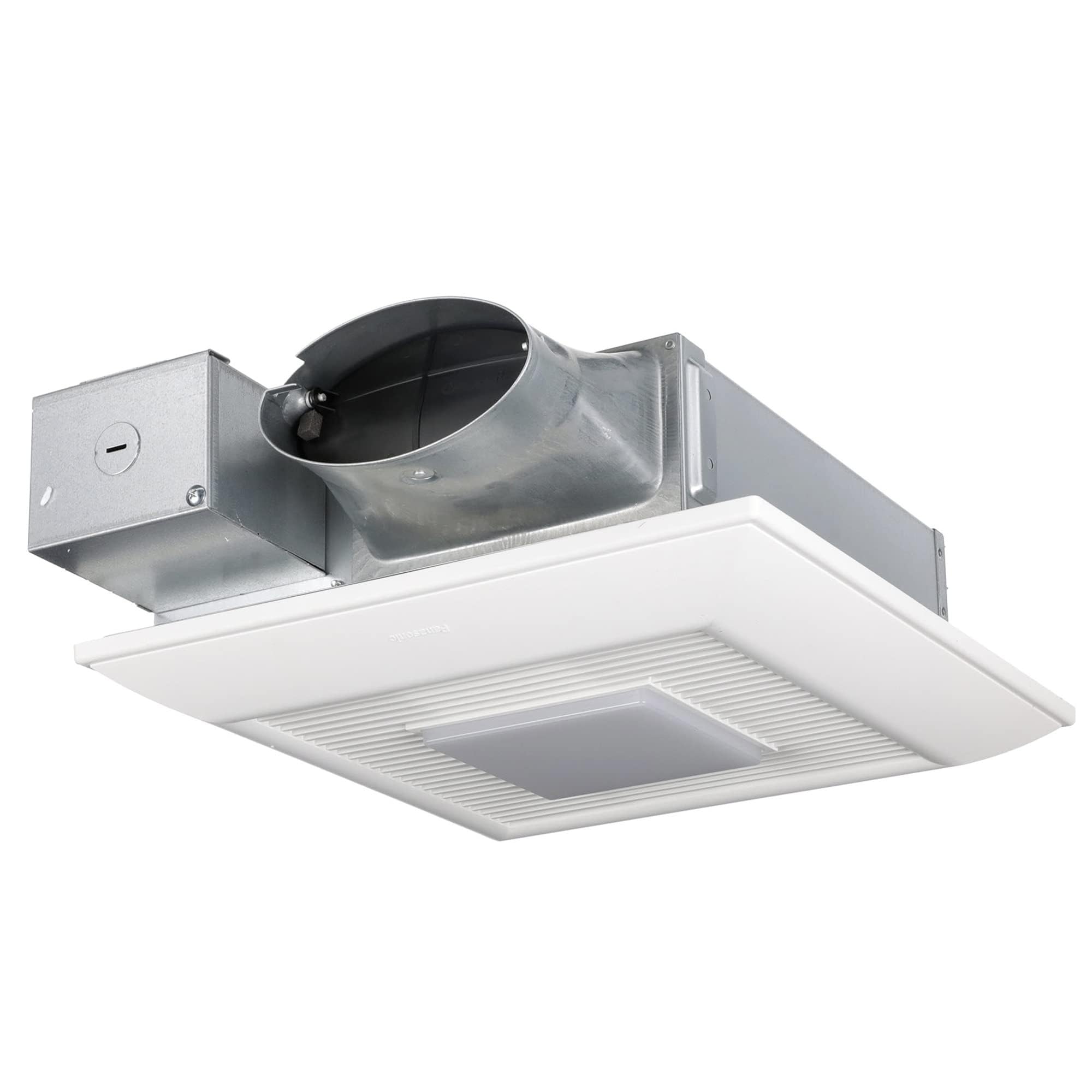
A sliver-thin fan-light that tucks into ceilings where nothing else will fit.
Where the bigger WhisperFit picks 110 CFM at full speed, this WhisperValue version tops out at 100 CFM — a slightly lower ceiling but a substantially slimmer body. The housing is only 3-3/8 inches deep, which is the key number here: it slips into tight ceiling spaces above finished rooms where a standard-depth fan would have nowhere to sit. Like the WhisperFit it runs on Panasonic’s DC/ECM motor with SmartFlow technology and includes a dimmable 3000K LED plus a low-power night light.
The Pick-A-Flow selector on this model gives you 50, 80, or 100 CFM at the flip of a switch, so it scales to a range of bathroom sizes without forcing you to buy a different fan. Owners describe it as ultra-quiet and especially impressive at the lowest 50 CFM setting — often reported as roughly half the noise of the fans it replaces. Bright, useful LED light and a working nightlight round out the daily experience. The slim L-shaped bracket system makes installation more manageable, and it is UL listed for ceiling, wall, and tub/shower enclosure mounts when GFCI protected. It uses a 4-inch oval duct connection.
The one consistent gripe: this is not a straight drop-in replacement for a standard old fan. It is larger overall than many older units, so a replacement job often requires cutting and patching drywall around the new cutout. The oval duct outlet also means you may need an adapter to connect to a standard round run. Plan for those two factors and the result is a very quiet, very slim, very reliable fan. Owners who go in expecting a full replacement rather than a simple swap report being very satisfied.
Where it earns its keep
- 3-3/8-inch slim housing fits tight ceiling spaces where standard-depth fans will not
- Pick-A-Flow 50 / 80 / 100 CFM switching adapts to different bathroom sizes
- Dimmable 3000K LED plus a low-power night light in one unit
- UL listed for ceiling, wall, and shower enclosure mounting when GFCI protected
Where the trade-offs sit
- Not a drop-in replacement — expect drywall cutting and patching on a retrofit
- 4-inch oval duct connection may need an adapter to match a round run
- Lower top airflow (100 CFM) than the WhisperFit’s 110 CFM
Choose this when: ceiling depth is your limiting factor and you still want multiple airflow settings plus a good light.
Not the one if: you want a simple direct swap with no drywall work — this is a real replacement, not a straight grille-to-grille change.
Understanding the Specs
CFM: How much air you actually move
CFM stands for cubic feet per minute — it is the volume of air the fan can push out of the room in sixty seconds. A bathroom under 50 square feet typically wants a 50 CFM fan; a room around 100 square feet wants 100 to 110 CFM. You can spot-check airflow with a tissue held up to the grille — if it sucks the tissue and holds it, you have real movement. On very long duct runs, the rating on the box and the airflow you feel at the grille can differ significantly, so match duct length to airflow.
Sones: The honest noise scale
A sone is a measure of how loud a fan sounds, and unlike decibels it compounds — 2 sones is noticeably louder than 1 sone, and 4 sones is much louder than 2. Under about 1.5 sones, most people genuinely forget the fan is on. Any fan rated at 1.0 sones or less competes with a library-quiet space in the right install. Bear in mind that a fan rated 0.7 sones at the factory can sound louder once it is mounted, because the ceiling cavity and ducting add noise — a manufacturer claim of near-silence is worth reading alongside real install feedback.
FAQ
How many CFM do I need for my bathroom size?
What is a sone and what is actually quiet?
Can I install a bathroom exhaust fan without attic access?
What size duct does a bathroom exhaust fan use?
Can a bathroom fan be installed over a shower or tub?
Do I need a separate light if my fan has a light built in?
How long should I run a bathroom exhaust fan after a shower?
Will a bathroom exhaust fan remove mirror fog and mildew?
How do I stop a bathroom fan from rattling or humming?
Is a 3-inch or 4-inch duct better for a bathroom fan?
Final Thoughts: The Verdict
For most people, the bath exhaust fan that balances airflow, quiet operation, and build quality best is the Panasonic FV-0511VFL1 WhisperFit — the only pick here that lets you choose between 50, 80, and 110 CFM on one unit, with the single-hinge bracket that makes solo install possible and a dimmable LED built in. If your bathroom is small and your budget is tight, the Harrier Hardware 70 CFM at 2.0 sones is the value pick most owners install without fuss. And for a large bathroom that needs maximum airflow and a bright daylight light, the POWERENG 141 CFM has the highest CFM rating on the page — just go in knowing that the plastic housing is not built like the Panasonic.
Before you order, measure three things: your bathroom’s square footage, the ceiling opening of your existing fan, and the size of the duct collar behind it. Those three numbers determine every compatibility question in this guide, and getting them right is the difference between a one-afternoon swap and a drywall project you did not plan for.
How We Picked
We do not accept paid placement. Every pick is matched to a real buyer and a real use-case; we do not hands-on test units.
Sources & Methodology
Specifications: manufacturer listings and product documentation. Review insights: verified customer reviews, as of September 2026. Pricing: not shown on this page (it changes often); check the current price via the retailer link.
As an Amazon Associate, Gadgets Feed earns from qualifying purchases. This does not affect which products we feature.