
Our readers keep the lights on and my morning glass full of iced black tea. As an Amazon Associate, I earn from qualifying purchases.
Specs are compiled from manufacturer listings and verified buyer reviews and can change over time — please confirm the key details on the product page before buying.
A bath fan with a humidity sensor solves this by switching on automatically when steam rises, so you never have to remember to flip the switch. This guide breaks down the best models by airflow, noise, and sensor smarts, so you can clear the air efficiently and quietly.
I’m Min — the founder and writer behind Gadgets Feed. This guide is built by comparing the manufacturers’ published specifications and the patterns across verified customer reviews, so you get each pick’s real strengths and trade-offs instead of marketing spin.
You want a bath fan with humidity sensor that clears steam fast without sounding like a jet engine. The right pick hinges on matching airflow (CFM) to your bathroom’s square footage and choosing a noise level (in sones) you can tolerate.
Our Picks at a Glance

How To Choose The Best Bath Fan With Humidity Sensor
Choosing the right fan isn’t about picking the priciest model. It’s about matching exhaust power to your bathroom’s size and finding a noise level you can accept. Here are the three things that matter most.
Match Airflow (CFM) to Your Square Footage
The airflow rating, measured in cubic feet per minute (CFM), tells you how much air the fan moves. A bigger bathroom needs a higher CFM to clear steam effectively. As a rule of thumb, you want about 1 CFM per square foot of floor space, so a 100-square-foot bathroom typically needs a 100 CFM fan.
Understand Noise in Sones
Noise is measured in sones, and lower numbers mean quieter operation. A fan rated at 1.0 sone is whisper-quiet, while something at 4.0 sones is loud enough to hear clearly over a running shower. If you’re sensitive to sound, prioritize fans that operate around 1.5 sones or below.
Pick the Right Sensor Behavior
Not all humidity sensors act the same. Some turn on at a fixed humidity level, like 60%, and shut off when it drops. Others are adjustable, letting you set the trigger point. A few offer a continuous low-speed trickle that ramps up when steam is detected, which is great for keeping air moving in humid climates.
Quick Comparison
| Model | Best For | Max Airflow | Noise Level | Extra Features | Amazon |
|---|---|---|---|---|---|
| Panasonic FV-0511VFC1★ Best Overall | Quiet Retrofit Power | 110 CFM | Whisper-quiet | Pick-A-Flow selector | Amazon |
| VIVOHOME EC MotorBest Value | Budget Smart Control | 160 CFM | 0.1 Sone (Silent) | 6-Speed Remote | Amazon |
| Delta BreezSlim SLM70HCompact Pick | Compact Retrofits | 70 CFM | 2.0 Sones | 60% Humidity Trigger | Amazon |
| Tech Drive 110 CFM | No-Attic Install | 110 CFM | 1.5 Sones | GFCI Safe | Amazon |
| Delta Breeze 80 CFM | Adjustable Sensing | 80 CFM | <0.8 Sones | Dual-Speed Auto | Amazon |
| breez Delta GBR80HLED | Fan + Bright Light | 80 CFM | 0.8 Sones | Dimmable 850-Lumen LED | Amazon |
| VIVOHOME 4-in-1 | All-in-One Warmth | 160 CFM | 0.1-1.5 Sones | 1600W PTC Heater | Amazon |
| Homewerks Dual Speed | Auto Humidity Levels | 110 CFM | 1.0-1.5 Sones | Dual-Color Night Light | Amazon |
| OREiN 3-in-1 | Big Room, Fast Clear | 160 CFM | 1.0 Sone | 1500-Lumen 3-Color Light | Amazon |
In-Depth Reviews
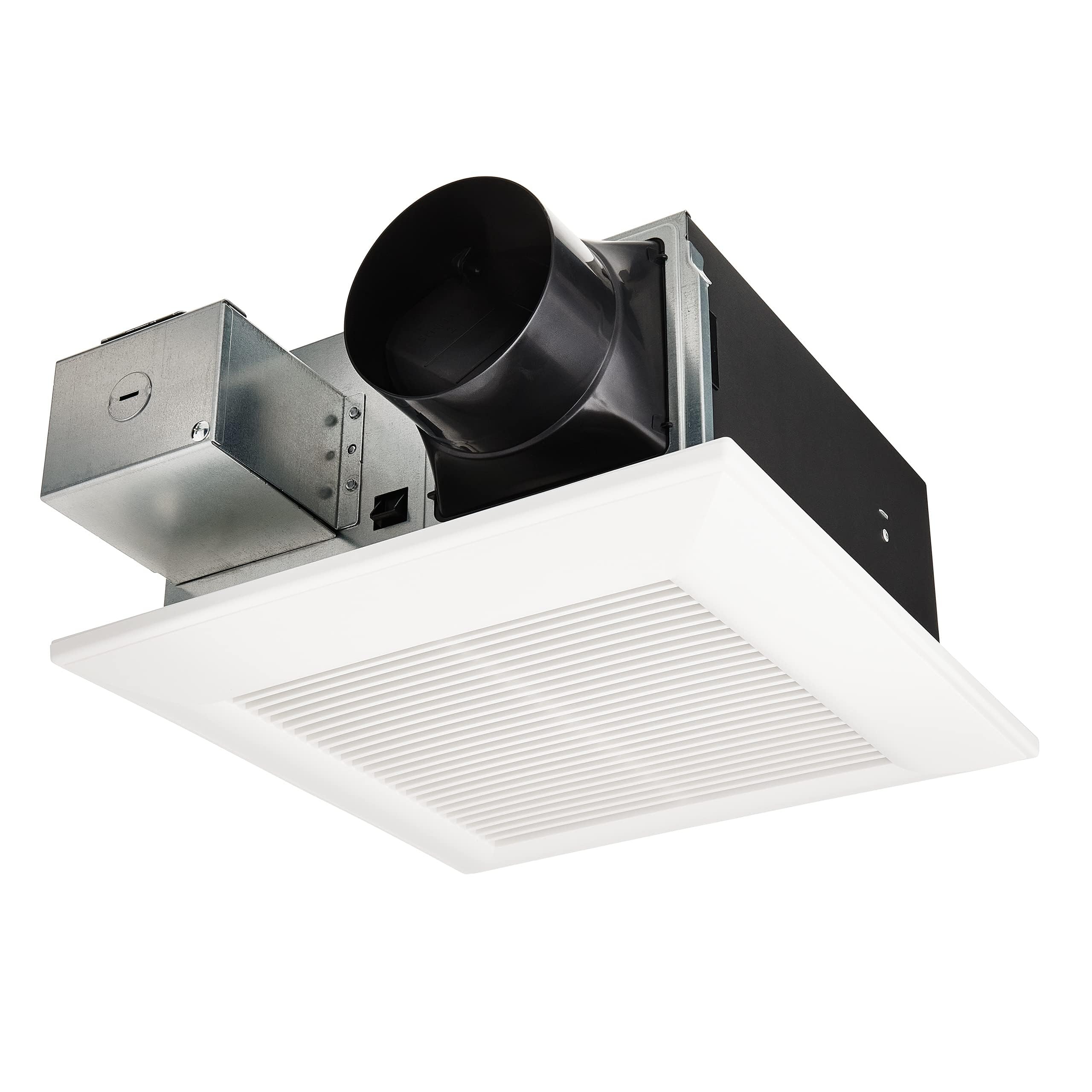
1. Panasonic FV-0511VFC1 WhisperFit
Our pick — 4.5★ from 200+ verified ratings; the strongest balance of quality and price.
The ultra-quiet retrofit king that lets you dial in the airflow after installation.
Buyers who want near-silence without losing airflow choose this Panasonic. Its Pick-A-Flow feature (a switch that lets you set the fan to 50, 80, or 110 CFM) means you can adjust airflow after it’s installed in the ceiling, so you’re not stuck guessing your room size. Reviewers report they sometimes question if it’s running at all—until they see the mirror stays clear, it’s that quiet.
Installation is designed for retrofits. The Flex-Z Fast Bracket uses a single hinge for easy positioning, and the low-profile 5-5/8″ housing depth slides into tight spaces like 2 x 6 joists. The built-in condensation sensor turns the fan on automatically when it detects humidity, and a 20-minute delay timer is included in the box to keep air moving after you leave.
What wins people over is the noise level—it’s the top praise from owners by a wide margin. The trade-off is the sensor, which gets more mixed feedback; some find it responsive, while others report it cycles on without an obvious reason. Buyers also mention the installation manual is unclear, with one noting they rewired three times before getting it right.
What Owners Celebrate
- Extremely quiet operation—owners often double-check it’s running.
- Adjustable airflow via Pick-A-Flow (50/80/110 CFM).
- Slim housing fits challenging existing spaces.
What to Watch For
- Humidity sensor behavior gets mixed reviews.
- Wiring instructions in the manual are hard to follow.
The Verdict: The best pick for anyone who prioritizes a nearly silent fan and wants the flexibility to adjust airflow after install.
Consider This: If you have a large bathroom, the 110 CFM max is solid, but you’ll want to verify your ductwork is clear to avoid sensor confusion.
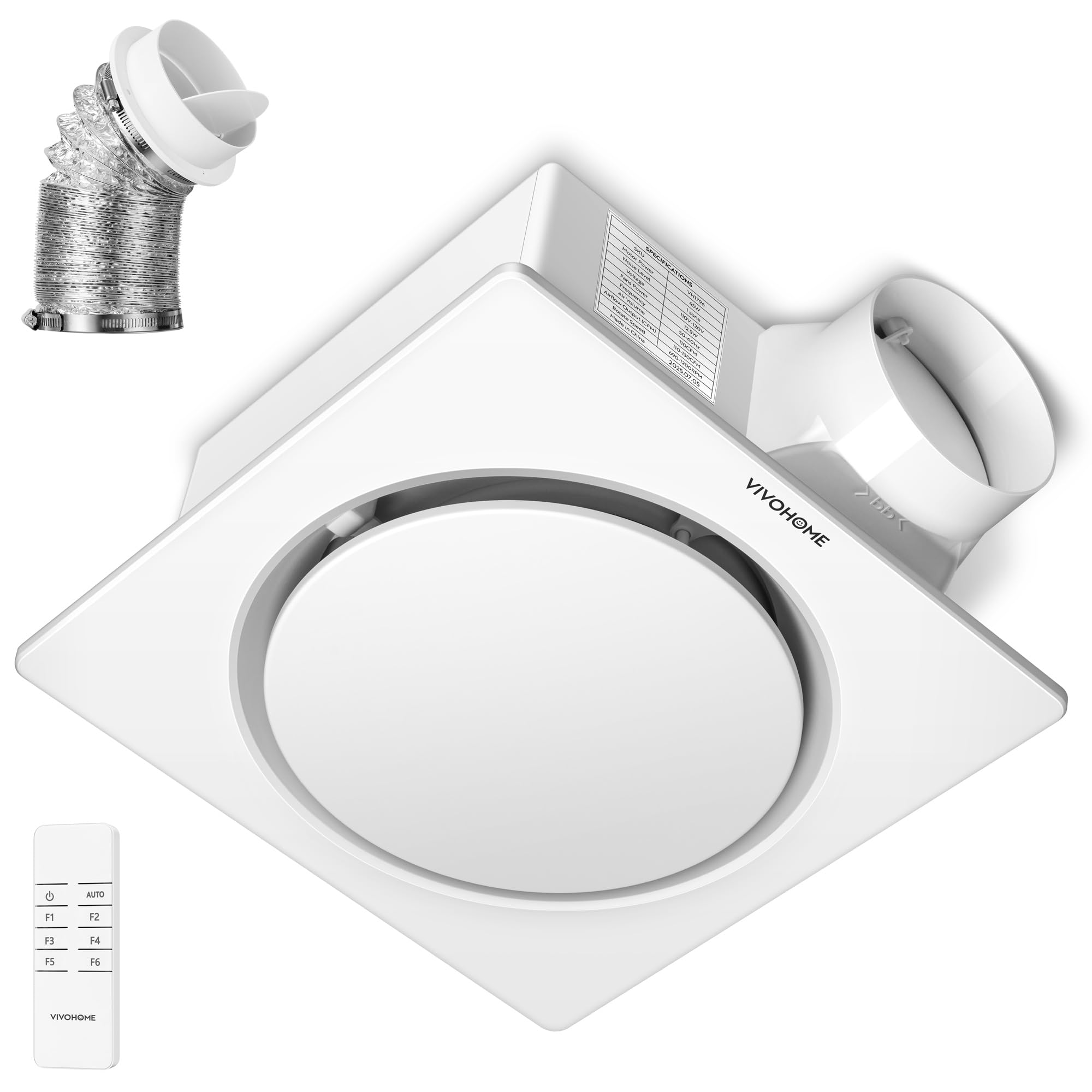
2. VIVOHOME EC Motor Exhaust Fan
A feature-packed budget champion with a remote and three auto speed modes.
VIVOHOME gives you premium-level specs at a budget price. Its brushless EC motor (an energy-efficient motor type) pushes 110 CFM while drawing just 12.5W, and the built-in humidity sensor automatically shifts airflow between 50, 110, and 160 CFM as steam rises. Buyers admit initial doubt about the lesser-known brand—one wrote, “was skeptical not gonna lie not being a big name brand, but this fan does the job and then some.”
Control is handled via a wireless remote with manual 6-speed control, giving you granular command over ventilation; just note it requires 2 AAA batteries that aren’t included. The tool-free installation is a major plus—housing measures 8.9×8.9×5.7 inches and fits standard openings, and the package includes a backdraft damper, aluminum duct, and cut-out template.
The thing everyone raves about is the build quality, with owners praising its sturdy feel and clear instructions. In silent mode, noise drops to just 0.1 Sone with minimal power consumption, making it suitable for 86-129 ft² bathrooms. The recurring gripe is the remote—some buyers report connectivity issues, and a few note that settings can reset if power is cut to the unit.
Our Take: This fan beats the Delta BreezSlim on raw airflow potential—160 CFM versus 70 CFM—making it a much stronger choice for larger or steamier bathrooms. The remote adds convenience, but if you prefer a standard wall switch, its behavior may be quirky.
Reach for This If: You want maximum features per dollar and enjoy fine-tuning fan speed from a remote.
Look Elsewhere If: You demand flawless reliability from the remote every single time, or you prefer a simple hardwired switch setup.
3. Delta BreezSlim SLM70H
The tiny titan designed for tight retrofit spaces where nothing else fits.
If your ceiling joist bay is tight, this Delta fits where others won’t. Its housing measures just 7.5″W x 3.9″H, so it slides into a confined space when you’re replacing an older fan. Despite the slim build, it’s Energy Star qualified (meets federal efficiency standards), runs on a brushless DC motor, and stays quiet at 2.0 sones (a sone is a unit of loudness—2.0 is roughly a quiet library).
The humidity sensor logic is simple and effective: in sensing mode, the fan starts when humidity rises above 60% and stops when it drops below 60%. A blue LED indicator shows sensing mode, while an amber light signals full-speed operation, making it easy to glance up and know what the fan is doing. It’s UL approved for both ceiling and wall mounting, adding versatility.
Performance is a strong point, with owners regularly upgrading from loud, underpowered builder-grade fans and noticing a big difference at the same CFM. The main trade-off involves the sensor’s behavior—some owners mention the fan runs constantly in humidity mode and doesn’t shut off as expected, which can be frustrating if you want cycle control. It’s a small footprint that requires careful expectation-setting.
The High Points
- Extremely compact 7.5″ x 3.9″ housing for tight retrofits.
- Clear blue/amber LED status indicators.
- Dual mounting flexibility (ceiling or wall).
The Limitations
- Reliability and sensor shut-off get mixed reviews.
- At 70 CFM, it’s best for smaller bathrooms only.
Who It’s For: Homeowners with a small bathroom and a very tight ceiling cavity who need a straightforward drop-in replacement.
Who It Isn’t For: Those with larger, steam-heavy bathrooms that need more than 70 CFM of raw exhaust power.
4. Tech Drive Bathroom Fan 110 CFM
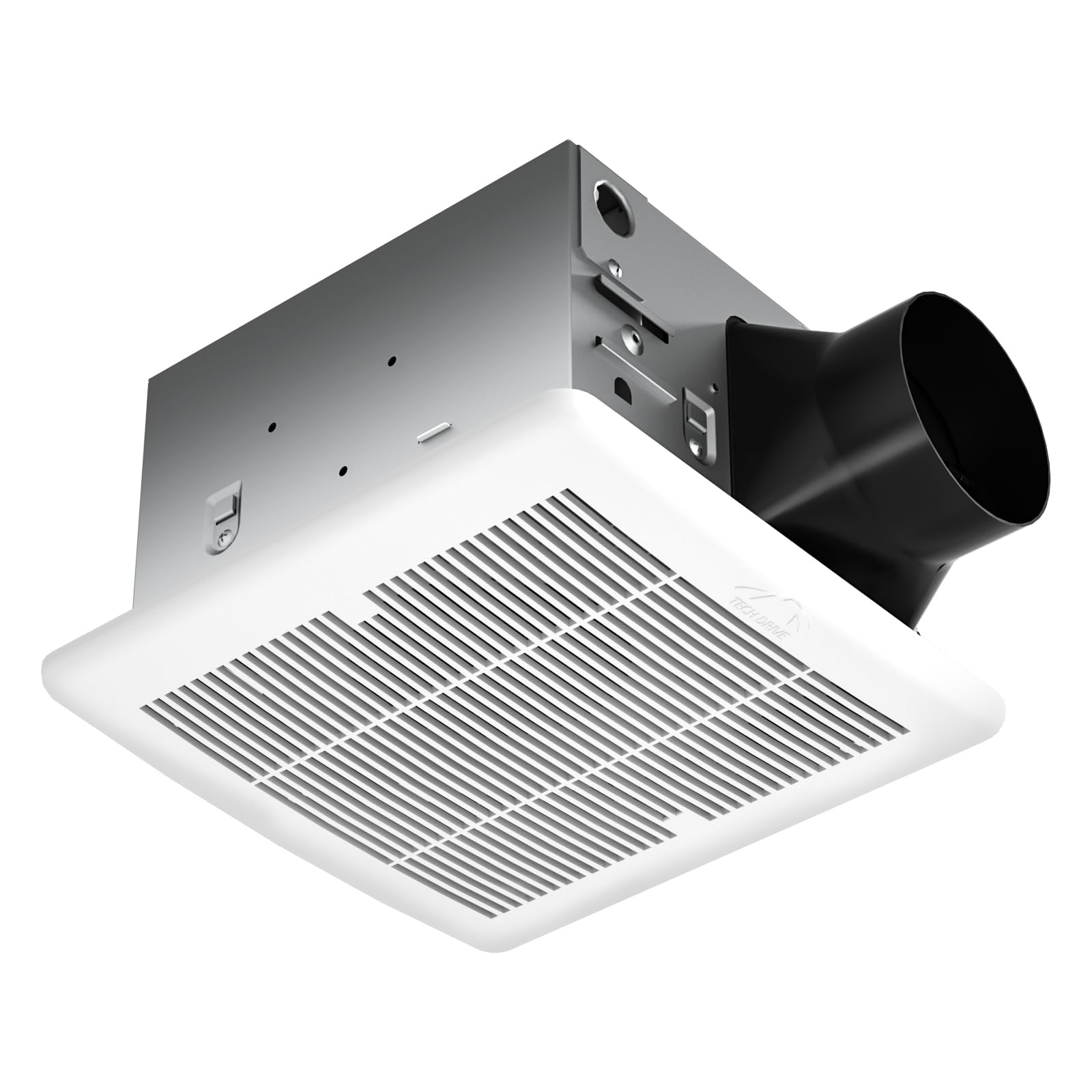
A powerful, no-attic-access retrofit that brings strong 110 CFM airflow to larger rooms.
Tech Drive focuses on making installation as painless as possible for existing homes. This fan is designed for no-attic-access installation, meaning if you don’t have roof space to work in, you can still replace your old unit from the room-ceiling side. With a housing size of 9″x8.5″x6″ and a 4-inch duct, it fits standard openings and suits bathrooms up to 110 square feet.
Operation is clear-cut with two modes. Manual mode uses a red LED indicator and runs the fan continuously. Humidity sensing mode switches the indicator to green, and the fan automatically turns on when the room’s humidity exceeds 60%, giving you a visual cue for which mode is active. The motor is rated for a 25,000-hour service life.
Owners consistently praise its strong performance and value, noting it’s quiet—rated at 1.5 sones—and effective at clearing steam. However, the noise level is the most-discussed aspect, and it’s a mixed bag; some find it surprisingly quiet, while others expected more silence at this spec. Buyers upgrading from a “builder’s special” fan tend to be thrilled, while those expecting library-level silence may want to look at the Panasonic instead.
Our Read: This is a solid mid-range choice that leads on installation flexibility. It’s quieter than an old builder-grade fan and moves serious air, but it’s not the absolute whisper-quiet performer its marketing might suggest.
Pick This If: You have no attic access and need a strong, straightforward retrofit that can handle a larger bathroom.
Think Twice If: Absolute silence is your top priority—the 1.5 sone rating is quiet, not invisible.
5. Delta Breeze 80 CFM Exhaust Fan

The whisper-quiet dual-speed fan with an adjustable sensor for precise moisture control.
Delta’s Breeze line steps up the sensing game with an adjustable humidity sensor, letting you set the exact trigger point rather than being locked to a factory default. It operates at less than 0.8 sones, which is genuinely whisper-quiet, and it offers a continuous low-speed setting of 0 or 50 CFM for keeping air moving between showers. When the sensor detects your set humidity level, it kicks into full-speed operation at 80 CFM to clear the room efficiently.
The design includes intuitive blue and amber LED lights that indicate humidity control and full-speed modes, so you always know what the fan is doing. It’s ideal for wet areas like tub and shower enclosures when wired to a GFCI-protected circuit. Owners who installed it found it dramatically quieter than their old units, with one reporting it clears mirror fog in about 5 minutes..
Reliability gets mixed feedback—some units have stopped working within a year, though others run flawlessly for 18 months or more. The most common operational quirk is the switching; with a single wall switch, the fan auto-switches between low and high based on humidity, but you need a second switch if you want manual high-speed override. Buyers love the auto-clearing capability, but the inability to disable the always-on blue nightlight is a recurring note.
Why It Stands Out
- Adjustable humidity sensor trigger—uncommon at this level.
- Ultra-quiet at less than 0.8 sones.
- Continuous low-speed trickle option (50 CFM).
The Caveats
- Some customers note units failing within the first year.
- The blue nightlight cannot be disabled.
- Manual high-speed control requires a second switch.
The Bottom Line: A fantastic pick for those who want a very quiet fan with tunable sensing, provided you can live with the always-on light or wire a second switch.
6. breez Delta GreenBuilder GBR80HLED

A fan and a bright dimmable light in one, engineered for a cleaner, well-lit bathroom.
This GreenBuilder model tackles two bathroom needs at once: ventilation and lighting. It extracts air at 80 CFM, which is appropriate for bathrooms up to 80 square feet, and it does so at a quiet 0.8 sones. The included LED module is the star here—it’s an energy-efficient 11-watt unit producing 850 lumens at a warm 3000K, giving you plenty of light to get ready by.
The DC brushless motor is precision-engineered for extended reliability, and the galvanized steel construction resists corrosion in humid environments. A safety feature stops the fan impeller if it becomes obstructed, preventing potential damage. Owners frequently deploy this in small spaces like a 6′ x 11′ bathroom and find it clears steam effectively while providing excellent illumination.
What owners rave about is the quiet operation and the effective humidity sensor—many report it dries towels faster and helps prevent musty smells. The trade-off is installation complexity. This unit benefits from multiple switches to separate fan, light, and humidity modes. A few owners note the high-speed airflow can feel weak if duct runs are long, and the warm 3000K LED may clash with daylight bulbs in adjacent fixtures.
Our Assessment: It’s a strong 2-in-1 solution for a small bath, but be honest about your wiring setup. If you can’t dedicate a switch to the humidity mode, you’ll lose access to its best feature.
Go For It If: You’re remodeling a small bathroom and want a coordinated light and quiet fan that you can control via separate switches.
Be Aware: Retrofit installation can be tricky, and a very long duct run will weaken the high-speed airflow.
7. VIVOHOME 4-in-1 Exhaust Fan
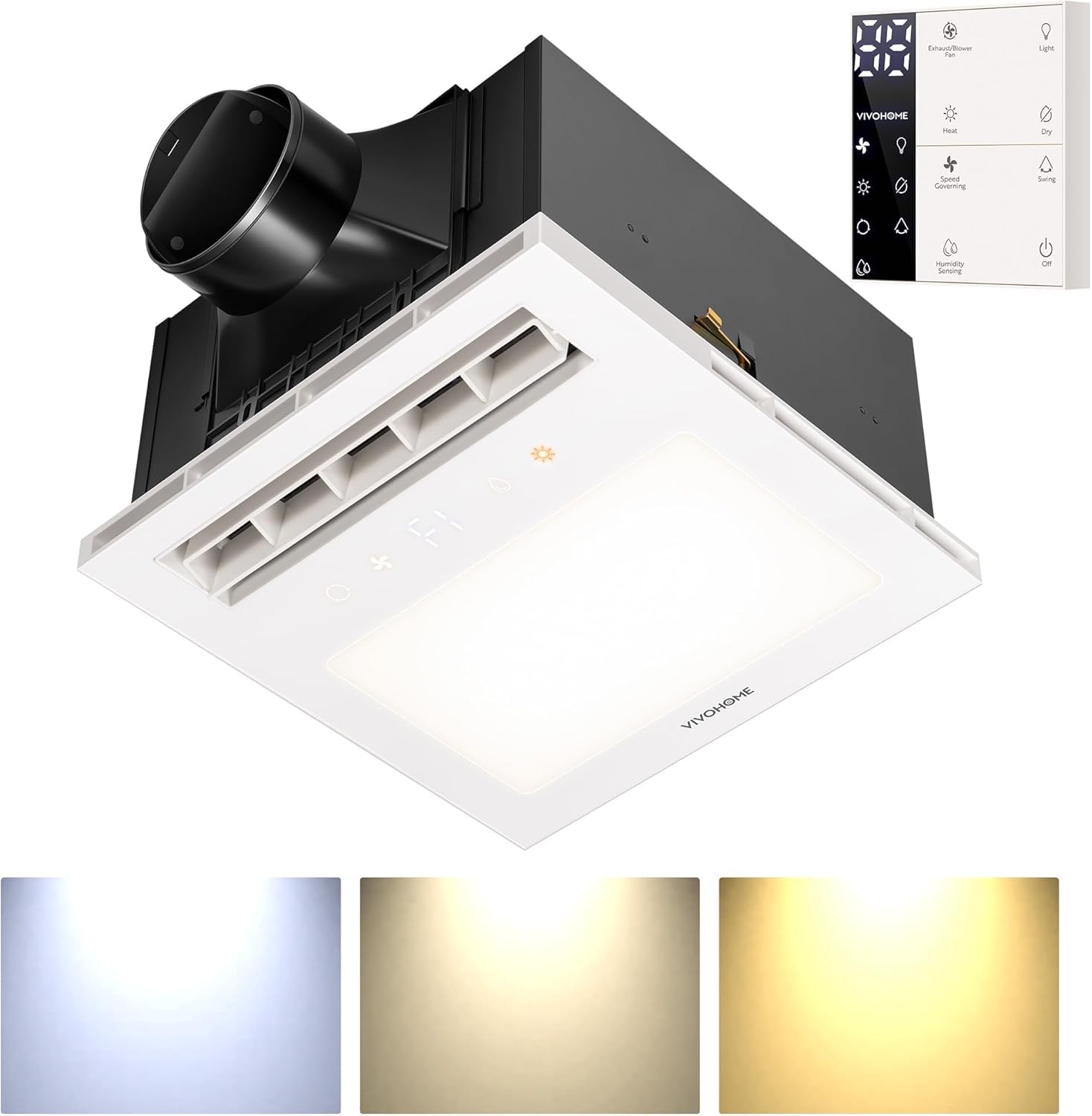
A 4-in-1 powerhouse that vents, lights, heats, and senses humidity with one remote.
This VIVOHOME is a complete bathroom climate system in a single ceiling unit. It combines a 40W brushless DC motor that pushes up to 160 CFM, a 1600W PTC ceramic heater with 5 temperature settings, and a 12W LED panel with 3 color temperatures. The humidity sensor automatically activates the exhaust to remove steam and odors, so you can step out of the shower into a warm, clear, and fresh room.
Smart heating is a key feature: the unit auto-adjusts heat and fan speed to maintain 38±3°C (around 100°F) for optimal comfort. A “smart dry” mode runs 25 minutes of heating followed by 5 minutes of exhaust to prevent overheating and lingering moisture. Control is via a wireless remote, though it requires 2 AAA batteries that aren’t included.
Owners who installed it were impressed by the instant, noticeable warmth—one measured a 10°F temperature rise in 5 minutes in an 80-square-foot bath.. The fan clears humidity effectively and operates quietly between 0.1 and 1.5 sones. The main complaints center on the remote control, which some owners find finicky, and the installation, which can be complex if your existing wiring doesn’t match the new unit’s requirements.
The Standout Features
- Integrated 1600W heater for warm, comfortable showers.
- Powerful 160 CFM airflow with 3-speed control.
- Adjustable louvers to direct airflow where needed.
Points to Ponder
- Remote control reliability gets mixed reviews.
- Installation may require electrical work beyond a simple swap.
Who It’s Perfect For: Anyone who wants a heater and fan combo to make cold morning showers more bearable in a small-to-medium bath.
Who Should Think Twice: DIYers looking for a simple 30-minute swap—this one requires more planning and possibly attic work.
8. Homewerks Dual Speed Exhaust Fan

An automatic dual-speed fan that ratchets up its power as the room gets steamier.
Homewerks takes the guesswork out of ventilation with a truly automatic dual-speed sensor. The fan operates at a quiet 1.0 sone and 80 CFM on its low setting when humidity hits 60%. If the room gets steamier, it automatically ramps up to 1.5 sones and 110 CFM when humidity reaches 80%, then switches off once levels drop below 60%. This staged approach conserves energy while still clearing heavy steam.
It’s built to last with corrosion-resistant galvanized steel, and it includes a dual-color night light for nighttime visibility. The fan and light can be controlled manually via the included LED wall switch, giving you direct override capability. For odor control, the powerful ventilation helps clear harsh chemical smells left over from cleaning products.
The feature set and control panel draw consistent praise, with owners loving the multiple settings, quiet operation, and the sleek touch-screen wall control. However, reliability is a mixed bag—some units have the control switch fail after several months, though customer support often provides replacements. Installation is doable as a retrofit without attic access, but it’s not the simplest task; some reviewers point out needing to skip the mounting rails and self-drill screw holes for a clean fit.
Expert View: The automatic staged response to humidity is genuinely smart, but the control switch is a known weak point. Be prepared for the possibility of a support call if the touchpad acts up.
Choose This For: A feature-rich fan that actively manages moisture levels in stages without constant manual intervention.
Keep In Mind: The included touch switch is the component most likely to need attention, and a true no-attic retrofit takes some extra effort.
9. OREiN 3-in-1 Exhaust Fan

A high-CFM room-side install with a blindingly bright light and true auto-humidity control.
OREiN’s 3-in-1 is built for larger bathrooms that need serious air movement. It delivers a powerful 160 CFM, suitable for rooms up to 160 square feet, while operating at a modest 1.0 sone. The whole package—fan, light, and sensor—is designed to be installed entirely from inside the room with no attic access, fitting standard 11.81″ x 11.02″ ceiling openings and compatible with both 6″ or 4″ duct systems.
The lighting is a major draw. It produces 1500 lumens—enough to light up the entire bathroom—and lets you choose between 3000K, 4000K, or 5000K color temperatures using a built-in switch. A soft 2200K night light provides low-level illumination for nighttime trips, and a green LED indicator confirms when humidity-sensing mode is enabled. The sensor automatically triggers ventilation when humidity rises above 60%.
Owners consistently highlight how quiet it is for the massive 160 CFM airflow, and its ability to keep mirrors fog-free after hot showers draws specific praise. The concern is sensor reliability; performance gets mixed marks, with some units running constantly for days if the ambient humidity is high. The night light is also noted as being quite bright, and the backdraft flapper can audibly click on windy days. It’s backed by a 5-year limited warranty and ENERGY STAR, HVI, ETL, and FCC certifications.
Why It Impresses
- Powerful 160 CFM airflow perfect for larger baths.
- Ultra-bright 1500-lumen light with three color temps.
- No-attic-access installation simplifies retrofits.
Where It Trips Up
- Sensor performance is the most-discussed mixed point.
- Night light may be too bright for some users.
Best For: Homeowners with a large, steam-heavy bathroom who want a bright light and a high-CFM fan in one easy-to-install package.
Consider This: If your bathroom is in a humid climate, the auto-sensor might run more often than you expect; that’s a feature unless it bothers you.
Understanding the Specs
Airflow (CFM) and Room Size
CFM stands for cubic feet per minute, which is a measure of how much air the fan moves. It’s the most critical spec for bathroom ventilation. A general rule is that you need about 1 CFM for every square foot of your bathroom. So, a 60-square-foot bathroom needs a 60 CFM fan at minimum, and a larger 100-square-foot bathroom benefits from a 110 CFM model. If you choose a fan with too low a CFM, the steam will linger and the sensor will struggle to clear the air effectively.
Noise Levels (Sones)
Noise is measured in sones, a linear scale where each whole number represents a doubling of perceived loudness. A rating of 1.0 sone is roughly equivalent to the sound of a quiet refrigerator, while 4.0 sones is as loud as a normal conversation. If quiet operation is key for you—like for a master bathroom—look for a model rated at 1.5 sones or lower. Many premium fans now operate at 0.8 sones or less, which makes it hard to tell they’re running at all.
FAQ
Why would I choose a fan with a humidity sensor over a standard one?
Can I install a humidity-sensing fan myself?
How does the humidity sensor actually work?
What does CFM mean and how much do I need?
Will a quiet fan still be effective at moving air?
Is a higher CFM always better?
What is a “sone” rating?
Do I still need a wall switch if the fan has a humidity sensor?
Are these fans safe to use over a bathtub or shower?
How long do these fans typically last?
Final Thoughts: The Verdict
For most buyers, the bath fan with humidity sensor winner is the Panasonic FV-0511VFC1—it runs near-silent and lets you adjust airflow from 50 to 110 CFM after installation, backed by a brand owners trust for reliability. On a tight budget but still want remote control and 160 CFM of power? Choose the VIVOHOME EC Motor. For a large bathroom needing bright light plus strong ventilation, the OREiN 3-in-1 is your pick.
How We Picked
We do not accept paid placement. Every pick is matched to a real buyer and a real use-case; we do not hands-on test units.
Sources & Methodology
Specifications: manufacturer listings and product documentation. Review insights: verified customer reviews, as of September 2026. Pricing: not shown on this page (it changes often); check the current price via the retailer link.
As an Amazon Associate, Gadgets Feed earns from qualifying purchases. This does not affect which products we feature.