
A fogged mirror after every shower is a minor nuisance, but a bathroom filled with lingering moisture is a genuine threat to your ceiling paint, wallboard, and fixture longevity. The motorized solution sits silently above your head, yet most homeowners tolerate a rattling, underpowered unit that moves air with all the subtlety of a vacuum cleaner. Choosing the right exhaust fan means deciding exactly how much noise your peace of mind can tolerate.
I’m Min — the co-founder and writer behind Gadgets Feed. I’ve spent countless hours analyzing noise curves, airflow metrics, and installation constraints to separate the fans that merely spin from the ones that truly clear a room.
My research into sound levels and cubic-feet-per-minute ratings has helped dozens of readers select the best bathroom extractor fan without climbing into an attic twice.
How To Choose The Best Bathroom Extractor Fan
Selecting an extractor fan for your bathroom is not about picking a white square. The critical variables are airflow capacity measured in CFM, acoustic comfort rated in Sones, installation complexity, and power consumption. Understanding these three numbers will save you from buying a unit that sounds like a jet engine or lacks the muscle to clear a post-shower cloud.
Matching CFM to Room Size
CFM stands for cubic feet per minute — the volume of air the fan moves every sixty seconds. The industry rule of thumb is simple: the fan should exchange the room’s entire air volume eight times per hour. For an average bathroom, that translates to 1 CFM per square foot of floor area. A 50-square-foot room needs a minimum of 50 CFM, while a larger master bath spanning 100 square feet demands 100 CFM. Undersizing this spec leaves you with a fan that runs for an hour but never fully clears the steam.
Understanding the Sone Scale
Sones measure perceived loudness. The scale is not linear: 1.0 Sone is roughly the sound of a quiet refrigerator, 2.0 Sones is the hum of a conversation at three feet, and 4.0 Sones approaches the noise of a busy office. Most contractor-grade builder fans rank at 3.0 to 4.0 Sones — loud enough to notice every time you flip the switch. The premium tier hangs around 1.0 Sone or below. If you plan to run the fan while you shower or while someone sleeps in an adjacent room, a sub-1.0 Sone rating becomes non-negotiable.
Retrofit vs. New Construction Installation
Retrofit fans are designed to slide into an existing ceiling cutout without attic access — a lifesaver for anyone living in a multi-story home, a condo, or an apartment where the crawl space above is inaccessible. New-construction fans assume you have full access to the joists. Check the fan’s housing dimensions against your current opening. Many premium retrofit models specifically advertise “no attic access required” in their feature set.
DC Motor Efficiency
An Energy Star certified fan with a DC motor consumes roughly 7 to 10 watts during operation, compared to 25 to 50 watts for an older AC design. The DC motor also runs cooler and generates less vibration, which directly reduces audible noise. The initial cost premium for a DC motor model is usually recouped through lower electric bills within three to four years if the fan runs daily.
Quick Comparison
On smaller screens, swipe sideways to see the full table.
| Model | Category | Best For | Key Spec | Amazon |
|---|---|---|---|---|
| Kaze Appliance SNP100 | Premium | Ultra-quiet 0.8 Sone operation | 100 CFM / 0.8 Sones | Amazon |
| OREiN 2-in-1 with Light | Premium | Combined ventilation and 1000-lumen LED | 110 CFM / 2.0 Sones | Amazon |
| Broan-NuTone AE80B | Premium | Reliable brand with TrueSeal damper | 80 CFM / 1.5 Sones | Amazon |
| Delta BreezSlim SLM50 | Premium | 70,000-hour DC motor longevity | 50 CFM / 1.0 Sones | Amazon |
| Tech Drive DC Motor Fan | Mid-Range | No attic access needed at 7.2 watts | 50 CFM / 1.0 Sones | Amazon |
| Harrier Hardware Exhaust Fan | Budget | Super quiet at 40 dB / 2.0 Sones | 70 CFM / 2.0 Sones | Amazon |
| Fanspex Ceiling Exhaust Fan | Budget | Lowest power draw at 26 watts | 110 CFM / 1.0 Sones | Amazon |
In‑Depth Reviews
1. Kaze Appliance SNP100

The Kaze SNP100 achieves a rare feat in the bathroom fan category: it delivers 100 CFM of real airflow while humming at just 0.8 Sones. That noise figure places it below the typical “very quiet” threshold of 1.0 Sone, meaning you will have to place your hand under the grille to feel the air movement — your ears will not notice it. Consumer Reports awarded this unit a perfect 5/5 for airflow and noise combined.
Installation does not require attic access, and the detachable 4-inch polymeric duct includes a back-draft prevention damper. Several buyers noted that the noise level measured closer to 51 dB inside the bathroom during operation depending on duct length, but that reading still classifies as conversation-friendly. The Energy Star and HVI certifications back the performance claims.
Some users reported a rattling noise on windy days if the duct rise is very short, and the plastic duct adapter can deform if over-tightened. These are minor quirks in an otherwise top-shelf design. For anyone upgrading from a builder-grade fan, the difference in living comfort is immediate.
Why it’s great
- Sub-1.0 Sone noise at 100 CFM airflow
- No attic access needed for retrofit install
- Energy Star and HVI certified
Good to know
- Duct adapter can warp if screws are overtightened
- Short duct rises may produce backdraft noise in high wind
2. OREiN 2-in-1 Bathroom Exhaust Fan with Light

Combining a 110 CFM exhaust fan with a 1000-lumen 5000K LED light, the OREiN eliminates the need for a separate ceiling fixture. The matte white trim fits a 7.36 by 7.68-inch cutout, and the standard 4-inch duct outlet comes with a reducer for 3-inch ducting. This is a space-saving solution that still moves serious air for rooms up to 110 square feet.
At 2.0 Sones, the noise level is noticeably higher than the premium Kaze, but users consistently describe it as quiet relative to typical contractor fans. The Energy Star certification and included 5-year warranty provide long-term confidence. The bracketless mounting system with spring clips allows full installation from the room side — no attic access needed.
Owners mention that the light temperature can glitch if cycled too quickly, and some found the included mounting hardware a bit lightweight. For the price, you get two products in one ceiling space, which alone makes this an attractive option for small bathrooms where an extra fixture would crowd the ceiling.
Why it’s great
- Integrated 1000-lumen daylight LED
- 110 CFM airflow suitable for larger bathrooms
- Energy Star certified with 5-year warranty
Good to know
- Light mode may glitch if toggled too quickly
- Mounting hardware could be more robust
3. Broan-NuTone AE80B
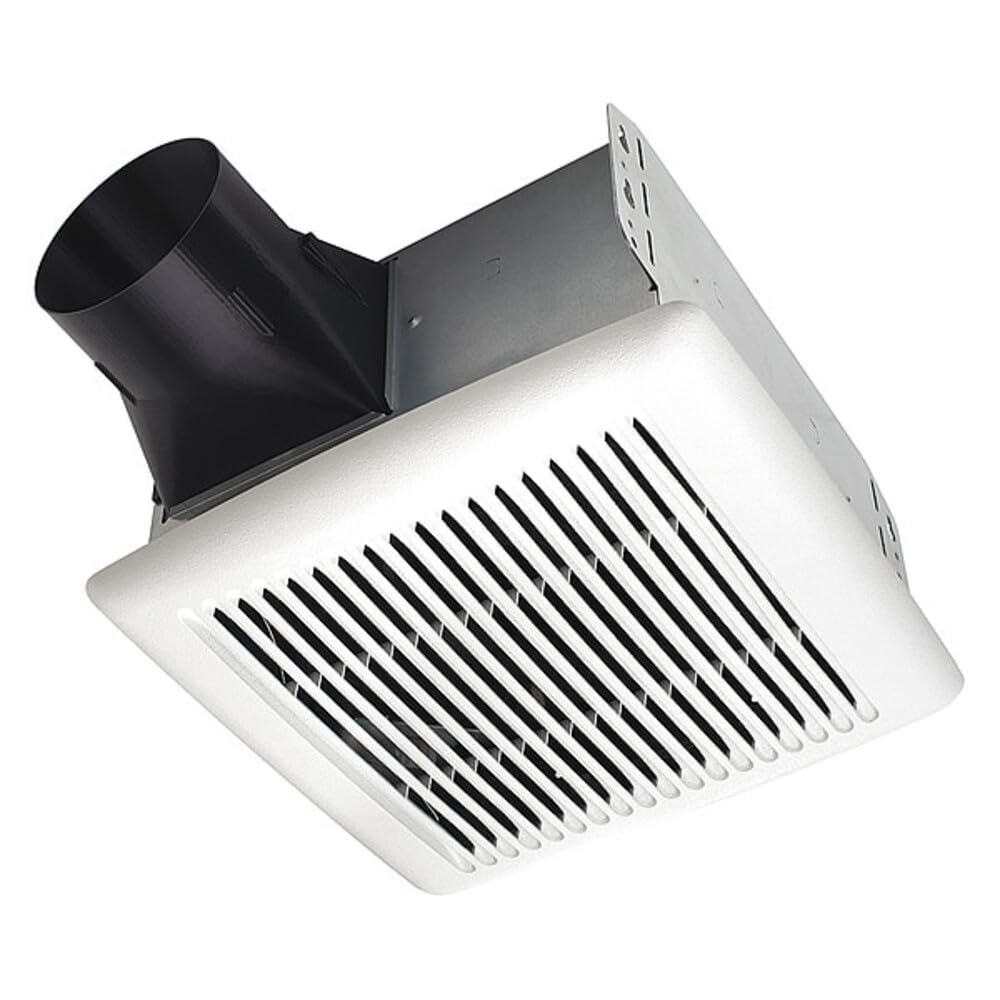
Broan-NuTone is the name most contractors reach for, and the AE80B shows why. Rated at 80 CFM and 1.5 Sones, this fan covers bathrooms up to 75 square feet with a noise level that is present but not intrusive. The TrueSeal damper technology cuts air leakage by up to 50 percent compared to standard models, which helps maintain indoor temperature and prevents cold backdrafts.
The installation is room-side, meaning no attic access is required. The included non-metallic damper and duct connector fit standard 4-inch ductwork. Owners highlight the low-profile grille and the easy-access motor removal system. The fan is UL listed for use over tubs and showers when wired to a GFCI circuit.
Some users noted that the mounting tabs could be more flexible for non-standard joist spacing, and a few had to enlarge their existing drywall opening to accommodate the housing. At 0.3 amps, the power draw is low enough to run alongside a timer switch without tripping a breaker. It is a solid, mid-range performer from a trusted manufacturer.
Why it’s great
- TrueSeal damper reduces air leakage significantly
- Easy room-side installation without attic access
- UL listed for tub and shower use
Good to know
- May require enlarging existing ceiling opening
- Mounting tabs are not adjustable for odd joist spacings
4. Delta BreezSlim SLM50

Delta Electronics has engineered the BreezSlim SLM50 around one specific advantage: a thermally protected DC motor tested to run continuously for 70,000 hours — roughly eight years of non-stop operation. At 50 CFM and 1.0 Sone, this fan is designed for smaller bathrooms up to 50 square feet where silence matters more than raw air volume.
The slim profile fits into shallow ceiling cavities, and the retrofit-ready design works from the room side without attic entry. It operates at just 7 watts, delivering up to 85 percent energy savings compared to older AC exhaust fans. Owners who replaced old Broan 688 and 696N units report that the noise profile is higher-pitched but still far less intrusive than the whine of a contractor-grade fan.
The main trade-off is airflow: at 50 CFM, this unit cannot keep up with steam in a large master bath. Some users noted the grille lacks a flange at the base, requiring foil tape to seal gaps. For small half-baths or powder rooms where whispers matter, the SLM50 is a precision tool.
Why it’s great
- 70,000-hour rated DC motor for longevity
- 7-watt power draw saves 85% over traditional AC fans
- Fits shallow ceiling cavities and no-attic retrofits
Good to know
- 50 CFM max limits use to small bathrooms under 50 sq. ft.
- Grille lacks an integrated flange, gaps require foil tape
5. Tech Drive DC Motor Bathroom Fan

Tech Drive’s 50 CFM fan brings DC motor efficiency to the budget tier without cutting corners on quietness. The 1.0 Sone noise rating puts it in the same acoustic class as fans costing twice as much. Power consumption sits at just 7 watts, and the Energy Star and HVI certifications confirm the performance claims.
The most distinctive feature is the 7-second delay protection circuit built into the motor. When you flip the switch, the fan takes a moment to ramp up before hitting full speed. This soft-start mechanism extends motor life and prevents the sudden torque that can rattle loose duct connections in older homes. The housing measures 7.5 by 7.25 by 4 inches, fitting a standard ceiling cutout without requiring attic access.
Owners consistently note the whisper-quiet operation, though a few wished the plastic grille were slightly larger to better cover the opening. The 3-inch duct requirement is smaller than the standard 4-inch fitting found in many homes, which may require a reducer. For small bathrooms where budget and silence are the top priorities, this DC-powered unit punches well above its price class.
Why it’s great
- 1.0 Sone quiet operation with 7W DC motor efficiency
- 7-second delayed start protects motor longevity
- No attic access needed for installation
Good to know
- Uses 3-inch duct, may need a reducer for standard 4-inch systems
- Plastic grille is slightly smaller than typical ceiling openings
6. Harrier Hardware Bathroom Exhaust Fan

Harrier Hardware packs 70 CFM of airflow into a galvanized steel housing designed to resist corrosion in moisture-heavy environments. The 2.0 Sone noise rating places it at the comfortable end of the conversation-level hum — audible enough to know it is running but not loud enough to interrupt daily routines. The unit is UL listed for over-tub and shower installation when wired to a GFCI circuit.
The quick-connect electrical connections simplify wiring, and the 3-inch duct outlet pairs with the included hardware for fast ceiling mounting. Owners who replaced older builder-grade fans report a 50 percent reduction in noise. The galvanized housing is noticeably heavier and more rigid than budget plastic units, which helps dampen vibration noise during operation.
One limitation is the non-modular design: the motor is mounted so that replacing it requires swapping the entire housing rather than just the motor assembly. A few users also noted that the included screws are too short for some joist configurations. For the price, however, this fan delivers solid airflow and corrosion resistance that plastic fans cannot match.
Why it’s great
- Galvanized steel housing resists bathroom moisture
- 70 CFM airflow for medium-sized rooms
- Quick-connect wiring simplifies installation
Good to know
- Motor cannot be replaced independently of the housing
- Included screws may be too short for some joist setups
7. Fanspex Bathroom Ceiling Exhaust Fan

Fanspex delivers an impressive 110 CFM airflow rating at a 1.0 Sone noise level — a ratio of performance to quietness that typically costs much more. The enclosed copper motor is thermally protected and permanently lubricated, and the fan draws just 26 watts during operation. This combination makes it suitable for bathrooms up to 170 square feet, where larger rooms demand higher air exchange rates.
The housing dimensions are roughly 9.1 inches square, slightly larger than the standard 7.5-inch cutout found in many homes. You will need to check your existing opening before ordering. The included wiring joints and screw kit cover the basics, and the push-button dial control gives you manual speed adjustment without a separate wall switch.
Customer feedback is split on actual noise: some praise it as ultra-quiet while others note a low-frequency rumble from the blade cage. A few reviewers measured power consumption at around 32 watts rather than 26 watts. For the price, you get high CFM numbers and a 1.0 Sone rating that competes with premium fans, though manufacturing tolerances may vary from unit to unit.
Why it’s great
- 110 CFM at 1.0 Sones is an exceptional price-to-performance ratio
- Enclosed copper motor with thermal protection
- 26-32 watt draw keeps operating costs low
Good to know
- Housing is 9.1 inches, may not fit standard 7.5-inch openings
- Some units exhibit blade cage rumble at full speed
FAQ
Can I install a bathroom fan without attic access?
What size duct do I need for a 100 CFM bathroom fan?
How many Sones is too loud for a bathroom exhaust fan?
Final Thoughts: The Verdict
For most users, the best bathroom extractor fan winner is the Kaze Appliance SNP100 because it delivers 100 CFM of airflow at just 0.8 Sones — a combination of silence and performance that is rare at this price. If you want an integrated LED light to save ceiling space, grab the OREiN 2-in-1. And for a compact bathroom under 50 square feet where whisper-grade quietness matters most, nothing beats the Delta BreezSlim SLM50.