
Our readers keep the lights on and my morning glass full of iced black tea. As an Amazon Associate, I earn from qualifying purchases.
Specs are compiled from manufacturer listings and verified buyer reviews and can change over time — please confirm the key details on the product page before buying.
If your bathroom mirror fogs over seconds after the shower and the walls stay damp all day, the real fix isn’t a bigger wall grille — it’s a fan that hides up in the ductwork and pulls moisture out with force. An inline fan mounts inside the pipe itself, so the noisy part sits away from your ears while it pushes far more air than a typical ceiling unit. This guide walks you through how to match one to your duct size and how to tell real airflow numbers from inflated ones.
I’m Min — the founder and writer behind Gadgets Feed. This guide is built by comparing the manufacturers’ published specifications and the patterns across verified customer reviews, so you get each pick’s real strengths and trade-offs instead of marketing spin.
You want the damp gone, the noise down, and a fan that survives years of humid air — that is exactly what separates the picks below, and every one here is a ducted unit built for the job. The list ahead covers real airflow, duct sizing, and honest noise expectations for bathroom inline ventilation fans.
Our Picks at a Glance

How To Choose The Best Bathroom Inline Ventilation Fans
An inline fan is judged on three things: how much air it moves (measured in CFM, or cubic feet per minute), how loud it is while moving it (measured in dBA, a sound-level scale), and whether its duct size matches the pipe already running through your wall or attic. Get those three right and the rest is detail.
Match the duct size before anything else
A 6-inch fan pushes air through a 6-inch duct; forcing a bigger fan onto a smaller pipe chokes the airflow and raises the noise. Measure your existing duct’s inner diameter first. If your run is short and straight, a smaller fan can do the job, but long or filtered runs need the larger diameter to keep air moving.
Understand what CFM really does
CFM tells you the volume of air the fan shifts per minute, and for a bathroom you want enough of it to swap the room’s air several times over while you shower. A higher CFM rating matters most on long duct runs or when you are also pulling through a filter. Two fans can share the same pipe diameter and still move very different volumes, so compare the airflow number, not just the size label.
Read dBA honestly
A dBA number is the fan’s sound pressure level — roughly how loud it is standing nearby. Lower is quieter, and anything in the low 30s is about as soft as a fridge hum. Just know that airflow almost always costs some noise, so a fan rated at a very low figure at its quiet setting will get louder as you dial the speed up.
Decide how much control you want
A basic wall switch just turns it on and off. A wired multi-speed controller lets you run slow for background ventilation and crank it for a steam-heavy shower. Some controllers remember your last speed after a power cut, and a few add app or remote control for scheduling. Match this to how hands-off you want the routine to be.
Quick Comparison
| Model | Best For | Duct Size | Airflow | Noise | Amazon |
|---|---|---|---|---|---|
| AC Infinity CLOUDLINE A6★ Best Overall | Quiet all-round ventilation | 6″ | 352 CFM | 34 dBA | Amazon |
| VIVOSUN G6 AeroZeshTop Performer | Grow rooms and fume venting | 6″ | 388 CFM | 32 dB | Amazon |
| Toolazy 6 Inch Inline Duct FanBest Value | Maximum airflow on a budget | 6″ | 405 CFM | 31 dB | Amazon |
| Hon&Guan PRO 4 Inch | Small rooms and tight ducts | 4″ | 212 CFM | 28 dB | Amazon |
| DNYSYSJ 6″ Inline Duct Fan | Basic budget exhaust | 6″ | 318 CFM | 31 dB | Amazon |
| Nalle 8 Inch Radon Fan | High-volume ducted exhaust | 8″ | 742 CFM | Under 50 dB | Amazon |
| Voltset 8 Inch Duct Fan | Big ducts with remote control | 8″ | 740 CFM | 50 dB | Amazon |
| ALORAIR 4 Inch Inline Fan | Attic-mounted bathroom exhaust | 4″ | 170 CFM | — | Amazon |
In‑Depth Reviews
1. AC Infinity CLOUDLINE A6, Quiet 6” Inline Duct Fan with Speed Controller
Our pick — over 4.5★ from 700+ verified ratings; the strongest balance of quality and price.
The 6-inch ducted fan that made this category quiet — 352 CFM at 34 dBA, and the safest first buy for a steamy bathroom.
The number that sells this one is 34 dBA — that’s a background hum, closer to a fridge than a fan. Owners consistently describe it as quiet to the point of being hard to hear at all, and it runs hard when you ask it to.
What wins people over is how little noise it makes for the air it shifts. The dual ball bearings (a metal bearing type built for long continuous running) let it run all day without complaint, and that matches how owners actually use it — pulling cool air from a central AC trunk to an upstairs room, boosting a return vent, or clearing smoke from a laser cutter in a workshop. It has a memory that holds your speed setting even after the power is pulled, so a power cut doesn’t reset your setup.
The included controller gives you 10 speeds and a straightforward click-wheel, and buyers report it slots into the wider CLOUDLINE controller family if you later want app control. On the power draw, the review pages sum it up: “Draws ~0.5amp full speed, ~0.2amp at speed 4.” At a mid setting it produces the same airflow as cheaper boosters while staying far quieter, and it’s rated to handle 1amp when wired into a furnace output.
What It Gets Right
- 352 CFM through a 6-inch duct — real capacity for a long duct run or a filtered setup
- 34 dBA operation that owners describe as near-inaudible at low and mid speeds
- 10-speed wired controller with memory that survives a power cut
- Dual ball bearings built for continuous, all-day running
- Upgradeable to the wider CLOUDLINE smart controller family
Where It Asks For Patience
- At the highest speeds the noise becomes plain — a fan this strong always does
- Some installations leave a gap that needs extra duct tape to seal cleanly
- It’s a ducted inline unit, so it needs access to your ductwork to mount
Reach for this if: you want one fan that handles a bathroom, a workshop, or an upstairs room at near-silent low speeds, with headroom to crank it when needed.
Look elsewhere if: you only have a short, simple duct run and don’t need this much capacity — a smaller unit will do and cost less.
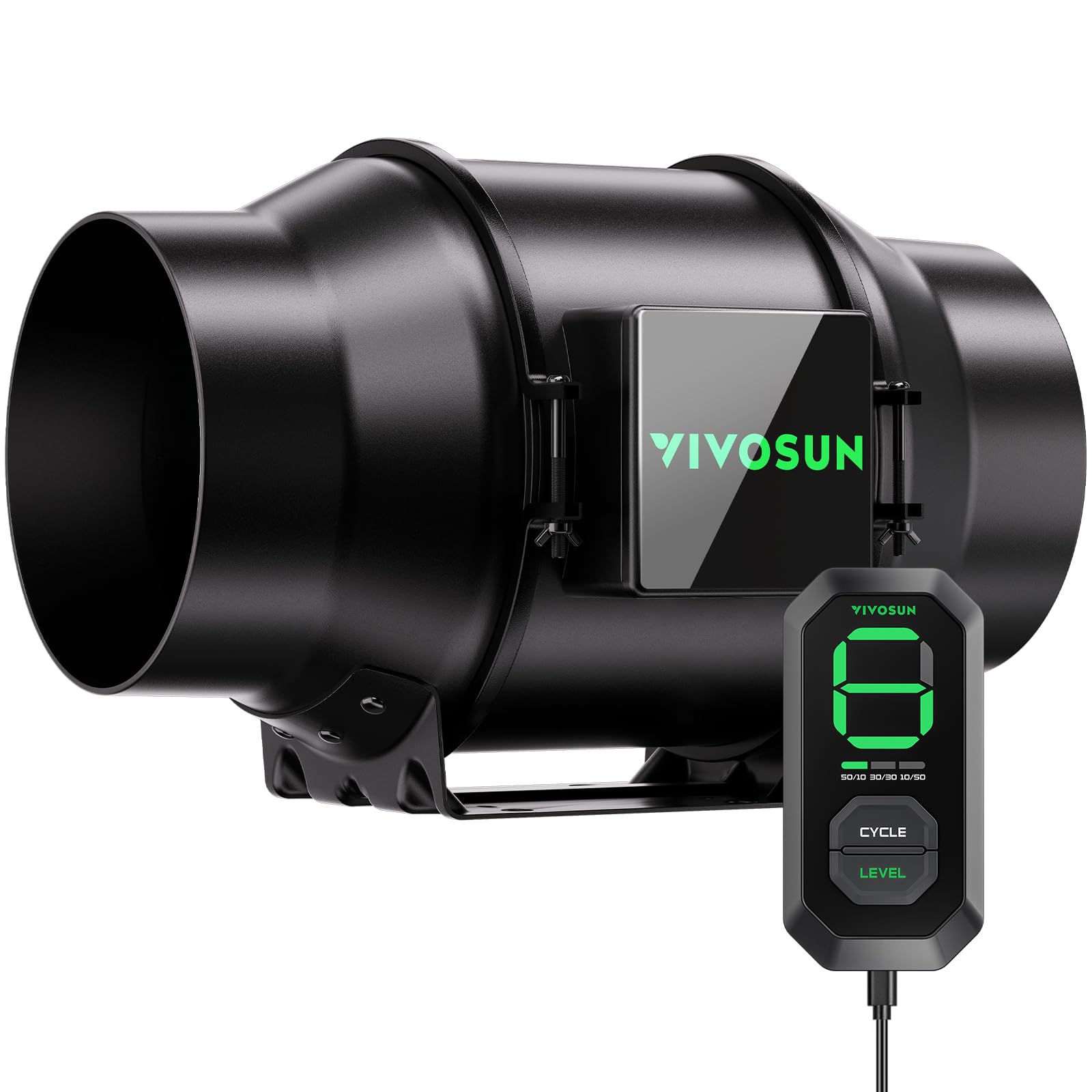
2. VIVOSUN G6 6″ Inline Fan & Cycle Mode Speed Controller, 388 CFM AeroZesh Fan
More airflow than the CLOUDLINE, a touch quieter on paper — the grow-room workhorse that doubles as serious exhaust.
This one undercuts the CLOUDLINE A6 on noise while pushing slightly more air: 388 CFM to the A6’s 352, at a rated 32 dB to the A6’s 34 dBA. Both run through a 6-inch duct, so if you’re comparing them side by side, the VIVOSUN gives you a bit more volume and a half-notch less sound on the spec sheet. What sells it beyond the numbers is the build — owners consistently flag the construction quality first when they talk about it.
The E12 controller offers ten fan speeds and a cycle mode (it automatically cycles the fan on and off on a timer to save power), plus a backup memory that remembers your last speed through a shutdown. VIVOSUN also lets you step up to the E42A multi-device controller or the GrowHub app system later if you want remote automation. An environmental probe is included, so the fan can react to temperature changes on its own.
Owners use it for grow tents, but plenty also run it to vent laser cutters and 3D printer enclosures, where variable speed keeps the room from losing its air conditioning while it clears fumes. The one thing to keep an eye on is longevity — one buyer’s note sums it up: “Works great easy to inline move air… we’ll see had an 8″ it only lasted a year.” Treat it well, keep it clear of dust, and it should hold up.
The case for it: more airflow than the top pick at a lower noise rating, with the app upgrade path if you want to automate later. For a grow tent or a fume-venting setup where raw air volume matters, it’s the better fit of the two 6-inch options.
What to weigh: the noise only stays low at the quiet end of the dial — crank it up and it becomes apparent, and the occasional unit has called it a day within a year, so it rewards a bit of care.
Best suited to: growers and workshop tinkerers who want maximum airflow at a low noise rating and don’t mind dialing in speed by hand.
Consider the CLOUDLINE A6 instead if: you want the more established controller family and the wider track record on long-term reliability.
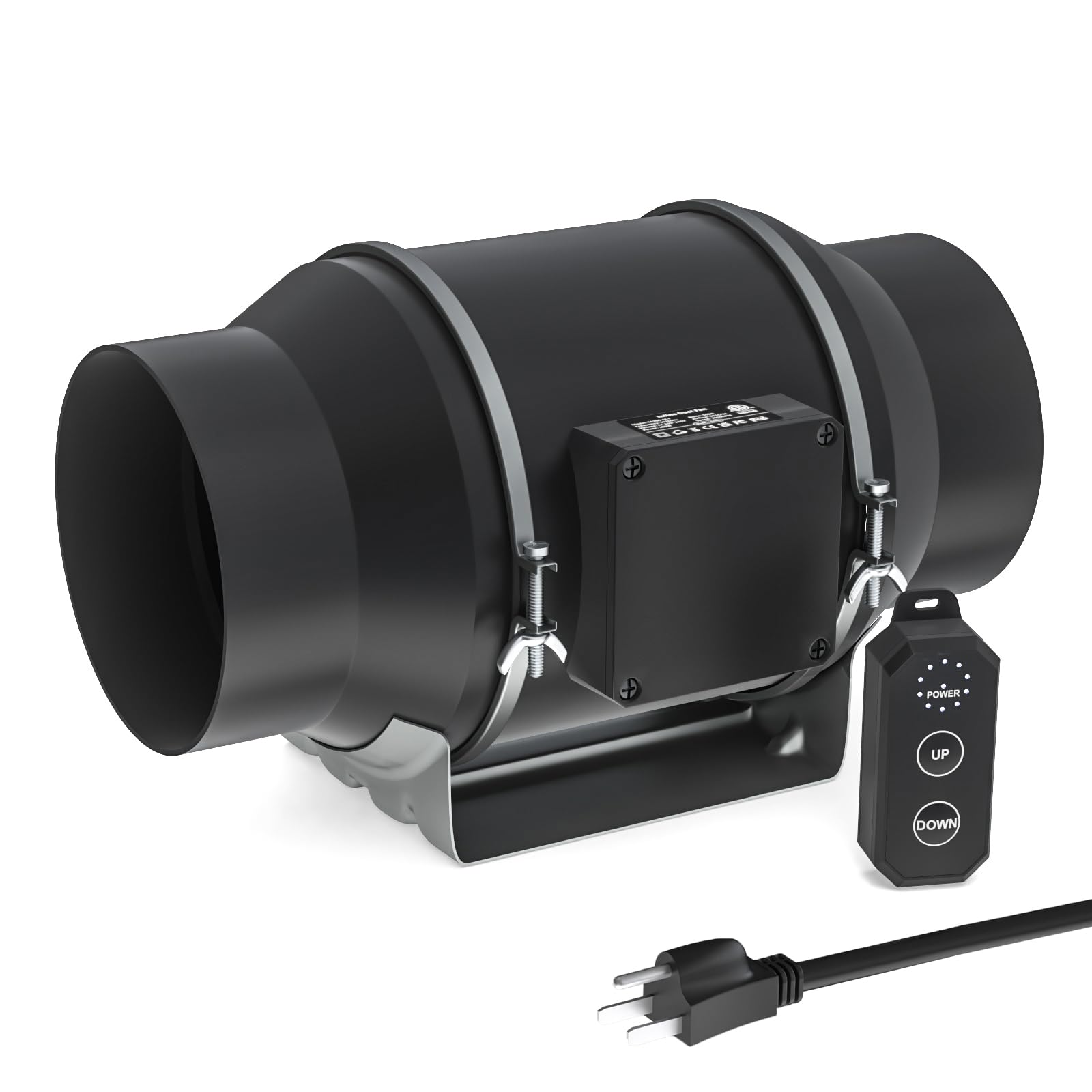
3. Toolazy 6 Inch Inline Duct Fan, 405 CFM Quiet EC Motor Ventilation Fan with 10-Speed PWM Controller
The airflow champion of the 6-inch picks — 405 CFM on a brushless three-phase EC motor.
405 CFM is the most air any 6-inch fan here claims, topping the VIVOSUN G6’s 388 and the CLOUDLINE A6’s 352. It does it with a brushless three-phase EC motor (an electronically controlled motor that runs cooler and more efficiently than a standard AC type), and the maker rates the motor for a 40,000+ hour lifespan. At its quietest it’s rated 31 dB — the lowest noise figure among the three 6-inch fans in this guide.
Where it earns its place is static pressure — its ability to keep pushing air through resistance. Owners venting a laser cutter through an 8-inch duct, a MERV 14 filter, a HEPA filter, and carbon filters report it still pulls hard enough to clear the enclosure. Another owner measured bedroom airflow jumping from 70 to 270 ft/min at 60% power. It also retains its last speed after an external power cut.
The included controller gives you a 10-step dial, and the whole kit ships with a 5 ft power cord, an 8 ft control cable, and mounting hardware. The honest catch is noise at the top end — bring it to full power and it’s loud enough that more than one owner describes it that way. Run it at 60%, though, and it’s quiet enough that owners call it surprisingly quiet for the job.
The Strong Points
- 405 CFM — the highest airflow among the 6-inch fans in this list
- 31 dB quiet rating, the lowest of the trio of 6-inch picks
- Mixed-flow design holds its airflow through long or heavily filtered ducts
- 10-speed PWM controller with memory through a power cut
- Complete kit: fan, controller, cord, control cable, mounting hardware
Where It Costs You
- At full power it’s loud — several owners say so plainly
- The wider 6-inch body needs the right clearance to mount
- Remote control needs the separately sold smart controller, not included
Buy it if: you want the most airflow per dollar on a 6-inch duct and are happy setting a speed and leaving it there.
Think twice if: your duct is short and simple — this is a lot of fan for a small, straight run.
4. Hon&Guan PRO 4 Inch Inline Duct Fan – 212 CFM with Quiet EC Motor & Speed Controller
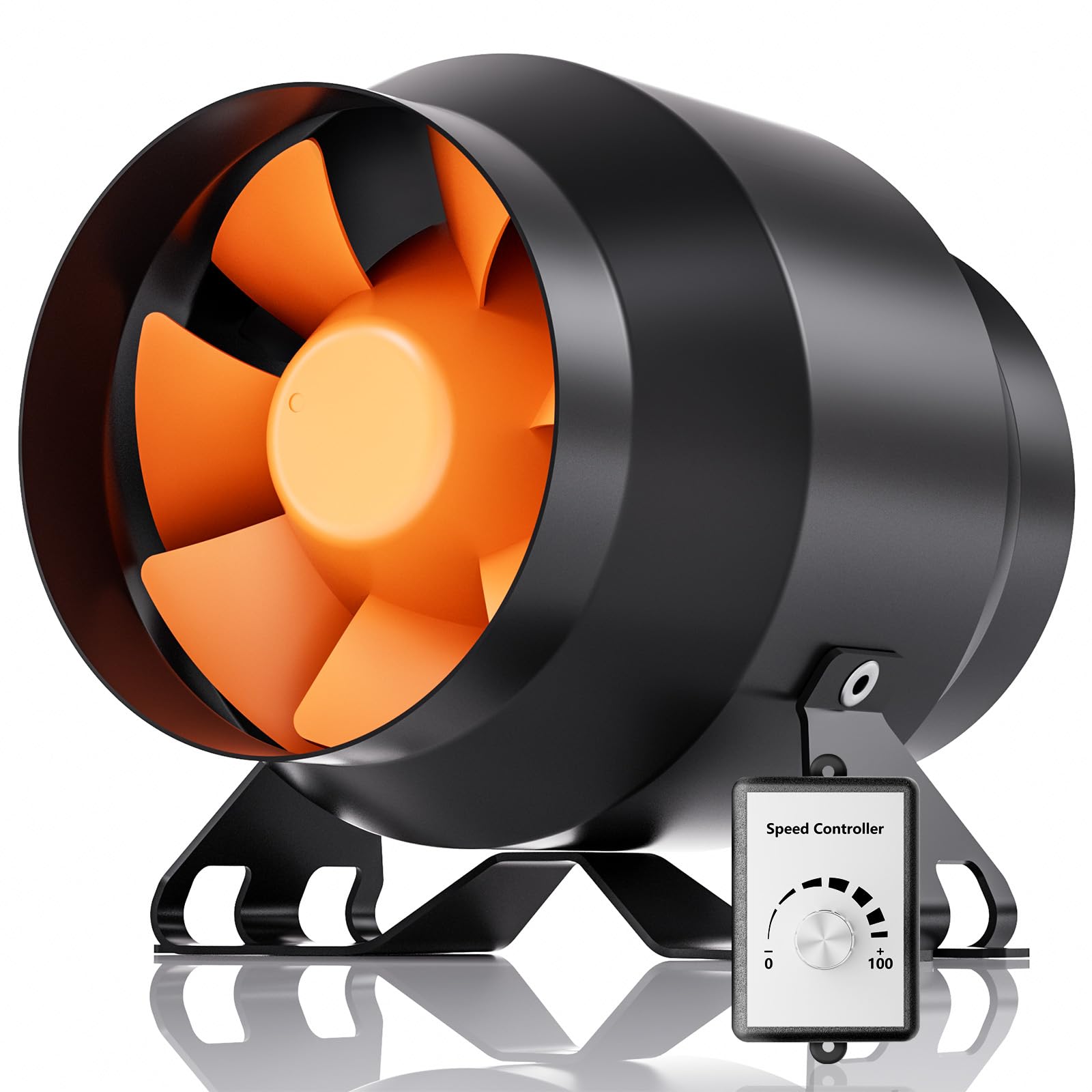
The 4-inch specialist — 212 CFM through a 4-inch pipe at a rated 28 dB, the quietest fan on this list.
If your duct is the smaller 4-inch size, this is the one built for it. It moves 212 CFM through a 4-inch run — less total air than the 6-inch picks, but the right amount for a small bathroom that doesn’t need a big pipe. Its 28 dB rating is the lowest noise figure here, and the EC motor is rated to save half the energy of a comparable AC motor.
The stepless speed controller is the standout feature — instead of clicking through fixed speeds, you dial from 0% to 100% freely and set it exactly where you want it. That makes it easy to find the quiet edge you’re comfortable with. Owners mention it’s very quiet once ducted, and the metal housing felt solid.
A couple of honest notes: it’s marketed with “smart” in the listing but buyers found no system integration to speak of, and vibration carried through the wall for one installation. It also gets loud if pushed to full power, which is normal for any fan this size. The IP42 rating means it shrugs off dust and light splashing, so a bathroom install isn’t a worry.
Why it fits: 4-inch ducts don’t get fans this quiet or this controllable. The 0–100% stepless dial is a nicer feel than a fixed-speed knob, and the metal housing plus IP42 rating make it a solid long-term pick for a small bathroom.
The caveat: it’s a small-duct fan, so don’t expect 6-inch volumes — and the “smart” wording on the listing overpromises; there’s no real home-system integration.
The pick for: small bathrooms, tight closets, or anywhere you’re stuck with a 4-inch duct and want it quiet.
Skip if: you’ve got a 6-inch duct and want the extra airflow — moving up a size gets you noticeably more capacity for a similar spend.
5. DNYSYSJ 6″ Inline Duct Fan, 318 CFM Ventilation Extractor Fan with Quiet Copper Motor

A straightforward 6-inch exhaust fan for basic ventilation, with a copper motor and a low-noise claim.
This is a simple, low-cost 6-inch inline exhaust that moves 318 CFM through a copper-wound motor (a pure-copper motor coil built for energy efficiency), and it’s rated at 31 dB with a durable plastic housing. It’s the kind of fan that gets basic jobs done — venting a closet, a storage room, or a small kitchen run.
The standout use-case from owners is cooking ventilation: one ran it with a Y-duct to both a deep fryer and a stove, and reported that while the fan collects grease quickly, it cleans up easily once disassembled — and no replacement ductwork is needed if you pick the right duct for the heat. It runs quietly if it’s mounted out of the way, like in an insulated attic.
Be careful on the numbers before you buy: the maker’s own spec sheet lists 318 CFM, but more than one owner found the fan’s printed label showed a lower figure. For a bathroom you may prefer a fan with a tighter, more consistent airflow claim — but if you want a low-cost inline exhaust and can mount it quietly, it does the job.
The short version: a no-frills 6-inch exhaust that handles basic jobs and cleans up easily, at the lowest bar of this list.
What to watch: the airflow claim isn’t the most consistent — the spec sheet and the fan’s printed label don’t agree, so treat the number loosely and pick a higher-tier model if exact airflow matters to you.
Reach for this if: you just need to shift air out of a closet, storage room, or a grease-heavy cooking space and want a low-cost inline unit you can mount out of earshot.
Look further if: your bathroom needs a verifiable, dependable airflow figure — a step or two up gets you steadier performance.
6. Nalle 8 Inch Inline Duct Fan Radon Fan 168W 740 CFM Ventilation Exhaust Blower

The 8-inch blower — 740 CFM at 168W, for spaces that need serious air moved, not a gentle pull.
When a small fan just can’t clear the air, this is what you step up to: an 8-inch duct fan pushing 740 CFM from a 2300 RPM motor, rated for under 50 dB. That’s roughly double the airflow of the 6-inch picks here — the Voltset 8-inch moves 740 too, while the Nalle trades on being the version billed for radon and heavy ventilation duty. It hangs anywhere in the duct run with the included cord.
Owners use it for exactly what its airflow suggests — clearing smoke, cooling equipment, and pulling heavy air out of tight spaces. One ran it with 3 feet of 8-inch flex duct and an 8-to-4-inch adapter to cool a generator and stop carbon monoxide buildup, which a smaller blower couldn’t handle. Where the smaller fan failed, this one kept the airflow strong.
Be realistic on the noise, though. This fan is powerful and it sounds like it — owners describe it as extremely loud during normal operation, loud enough that it’s audible over a TV, and while the speed controller brings it down to tolerable, it’s still noticeable. If you can mount it in an attic or a distant part of the run, that fixes the problem. In a bathroom right next to your head, it won’t be quiet.
Who it serves: someone with an 8-inch duct or a job that needs serious volume — a grow room, a workshop, or an equipment-cooling setup where the fan lives far from where you sit.
The trade-off: airflow this high costs noise, and this one is loud at speed. Mount it away from your living space, or accept the trade for the air it moves.
Best for: high-volume exhaust in an attic or workshop where the fan is out of earshot and air movement beats silence.
Not for: a small bathroom you want to sleep near — for that, step down to a 6-inch or 4-inch model.
7. Voltset 8 Inch Duct Fan 740 CFM Inline Ventilation Exhaust Fan

An 8-inch duct fan with the remote control no other pick in this category includes.
This one matches the Nalle on airflow — 740 CFM, 8-inch duct — but adds the feature the others skip: a remote control. On a fan mounted up in a duct in the basement or attic, that remote is a genuine convenience, letting you switch it on and pick low or high speed from the floor below without walking to a switch. It’s rated 50 dB from a 2300 RPM copper-core motor.
The 740 CFM is the headline, though the reviews hint at a wrinkle: some owners describe it as a strong fan while noting it doesn’t quite hit the CFM number printed in some listings. That’s directionally honest and worth knowing — treat the airflow figure as an upper bound rather than a promise, and the two speeds give you flexibility on noise versus volume either way.
For 3D printing and laser exhaust, this fan is a common pick — one ran it in-line for two years on a laser cutter’s exhaust port with no clogging, and later moved it to a different laser to vent fumes. The blades and body are plastic, and it works as either an intake or exhaust fan depending on which way you orient the run.
what separates it
- 740 CFM airflow with an 8-inch duct and a 2300 RPM copper-core motor
- Remote control — rare on an 8-inch ducted fan, handy for hard-to-reach installs
- Two speeds (low and high) with an on/off remote
- Works as either intake or exhaust depending on orientation
- Rated 50 dB, with owners calling it reasonably quiet for the volume it moves
What To Know First
- Customers note it doesn’t fully reach the claimed CFM in some listings
- Only two fixed speeds — no stepless dial like the smaller Hon&Guan
- A small air leak at the outer cone has been mentioned by at least one owner
Choose this if: you’ve got an 8-inch duct, want high airflow with a remote in hand, and value convenience over a dial you have to walk to.
Choose the Nalle instead if: you’d rather not pay for the remote and are fine controlling the fan at the switch.
8. ALORAIR 4 Inch Quiet Inline Bathroom Exhaust Fan, 170 CFM
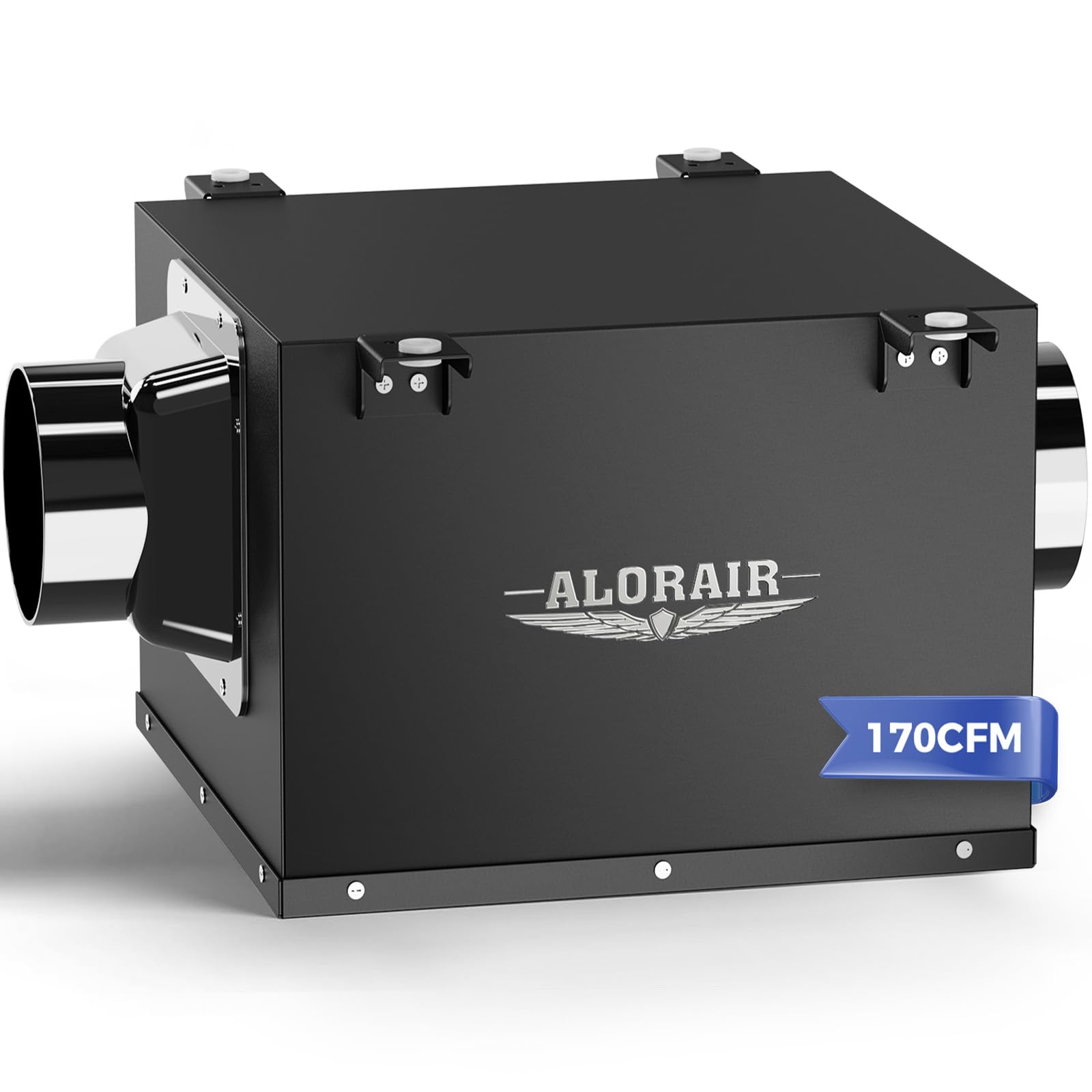
A 14.7 lb attic-mounted 4-inch unit built to hang far from the bathroom and pull humidity out through the duct.
This is the pickup where the installation method is the whole story. It’s an attic-mounted 4-inch inline fan that pushes 170 CFM from a 1590 RPM motor, and at 14.7 lbs it’s the heaviest fan in this guide. That weight is partly why it’s so vibration-resistant — it comes with a hanging kit and a sturdy suspension system designed to keep it from rattling against the joists.
Owners describe it as surprisingly quiet for what it does, and quiet enough that a running unit in the attic won’t disturb the room below. At 170 CFM it clears a bathroom’s shower steam, and owners say one attic-mounted unit can serve two to three bathrooms on a single run. It also carries a 3-year limited warranty and a temperature range down to -13°F, so a cold attic in winter won’t stop it.
Two caveats worth stating. First, at 170 CFM it moves less air than the 6-inch and 8-inch picks here — fine for a bathroom run, but not a high-volume job. Second, while most owners find the noise manageable, some disagree loud enough to name it as a negative. And there’s a rare case of a unit that needed a push to start — an occasional defective arrival, not a pattern, but worth knowing to check your unit promptly on arrival.
The Good
- Vibration-resistant suspension system — no rattle against the joists
- Quiet enough to run in the attic without disturbing the room below
- 170 CFM at 1590 RPM, enough to vent a bathroom or two to three on one run
- 3-year limited warranty and a -13°F to 113°F temperature range for cold attics
- Includes hanging kit and mounting hardware for ceiling or suspended installs
The Caveats
- At 14.7 lbs it’s heavy — you’ll want a helper or solid joists to hang it
- 170 CFM is modest compared to the 6-inch and 8-inch fans here
- Some owners find the noise higher than the “whisper-quiet” billing suggests
Fits best when: you’re venting a bathroom from the attic, want quiet and vibration-free operation, and have a 4-inch duct run to work with.
skip it if: you need high airflow or a fan you can drop easily into a tight wall cavity — this one is built to be hung.
Understanding the Specs
CFM — Airflow Capacity
CFM stands for cubic feet per minute, the volume of air the fan shifts every minute. More CFM means faster clearing of steam, moisture, and odors. For a bathroom, match CFM to your duct size and run length — a long or heavily filtered duct eats into that airflow, so a higher CFM helps on tough runs. Two fans can share a 6-inch duct and still move different volumes, so compare the airflow number and not just the duct size.
dBA — Noise Level
dBA is a sound-pressure scale that roughly tracks how loud a fan sounds to your ear. Lower is quieter, and figures around the low 30s sit around the level of a quiet fridge. The key thing to remember: airflow and noise move together. A fan rated at a low dBA figure at its slowest speed will get noticeably louder as you increase speed. If a manufacturer quotes a single low number, that’s usually the quiet-setting figure, not the full-power one.
Duct Size
Duct size is the inner diameter of the round pipe the fan mounts into. A 6-inch fan needs a 6-inch duct, and matching the two keeps airflow efficient. Forcing a wide fan onto a narrow duct chokes the airflow and amplifies noise. Measure your existing pipe before ordering, and remember that a room’s required airflow depends on its size and the length of the run.
Motor Type & Bearings
Most modern inline fans use either a standard AC motor or an EC motor (an electronically controlled motor that runs cooler and draws less power for the same airflow). EC motors also tend to hold up better under the back-pressure of a long or filtered duct. Bearings matter too — ball bearings are built for long continuous running, which suits a bathroom fan that needs to run through long steamy showers.
FAQ
Will a 6-inch inline fan fit my existing 4-inch bathroom duct?
How many CFM does my bathroom actually need?
How do I keep a ducted fan quiet in a bathroom?
Is an inline fan louder than a standard ceiling exhaust fan?
Can I wire an inline fan to a wall switch or a timer?
Can one inline fan vent more than one bathroom?
What does an EC motor give me over a standard AC motor?
Does an inline fan come with everything I need to install it?
Can I use the same inline fan for a kitchen or a grow tent instead of a bathroom?
Final Thoughts: The Verdict
For most people venting a bathroom from the ductwork, the bathroom inline ventilation fans winner is the AC Infinity CLOUDLINE A6 — 352 CFM through a 6-inch duct at 34 dBA, with the widest track record and the most established controller family in this category. If you want the most airflow on a 6-inch duct, the Toolazy 6 Inch Inline Duct Fan pushes 405 CFM at a 31 dB rating. And if you’re stuck with a 4-inch duct or an attic install, the Hon&Guan PRO 4 Inch and the ALORAIR 4 Inch are built for exactly that. Any one of them beats a ceiling grille fan that leaves your mirror fogged — match the duct size to your run and buy with confidence.
How We Picked
We do not accept paid placement. Every pick is matched to a real buyer and a real use-case; we do not hands-on test units.
Sources & Methodology
Specifications: manufacturer listings and product documentation. Review insights: verified customer reviews, as of September 2026. Pricing: not shown on this page (it changes often); check the current price via the retailer link.
As an Amazon Associate, Gadgets Feed earns from qualifying purchases. This does not affect which products we feature.