
Our readers keep the lights on and my morning glass full of iced black tea. As an Amazon Associate, I earn from qualifying purchases.
Specs are compiled from manufacturer listings and verified buyer reviews and can change over time — please confirm the key details on the product page before buying.
If you are standing in front of a dripping shutoff valve under a bathroom sink, the answer you need is simple: the best pick here is the PROCURU two-pack push-fit angle stop, because it locks onto copper, PEX, or CPVC with no torch, no glue, and no soldering. Every valve on this list uses the same two connection sizes — a 1/2-inch inlet and a 3/8-inch outlet — so the real question is how the valve attaches to your pipe and how it feels when you turn it.
I’m Min — the founder and writer behind Gadgets Feed. This guide is built by comparing the manufacturers’ published specifications and the patterns across verified customer reviews, so you get each pick’s real strengths and trade-offs instead of marketing spin.
Getting that connection right the first time is what keeps your cabinet dry and your repair short. This breakdown of the bathroom sink cut off valve covers push-fit versus compression fittings, pack sizes, and which valve suits a first-time fix.
Our Picks at a Glance


How To Choose The Best Bathroom Sink Cut Off Valve
A shutoff valve under a bathroom sink is a small part with a big job: it lets you stop water to one faucet without draining the whole house. Choose wrong and you get a slow drip, a rounded-off nut, or a valve that sticks the day you actually need it.
Push-Fit Or Compression Inlet?
This is the first decision you make, because it changes what tools you need. A push-fit inlet (sometimes called push-to-connect) grips the pipe when you shove it on, so there is no wrench work at the wall. A compression inlet threads a nut and ring onto the pipe and tightens down — it needs one or two adjustable wrenches but costs less and matches the valve you are probably removing.
If the stub-out coming out of your wall is short or tucked behind a pedestal, push-fit is the easier route because the valve body itself is small. If you have a normal run of copper and you are comfortable with a wrench, compression gives you the same reliable seal for less money.
Match The Two Sizes To What Is Already There
Nearly every valve here runs a 1/2-inch inlet feeding a 3/8-inch outlet, which is the standard pairing for a bathroom sink. The 1/2-inch side meets the pipe from your wall; the 3/8-inch side meets the braided hose that screws onto your faucet. Measure both before you buy, and check whether your wall pipe is copper, PEX, or CPVC — that material tells you which valve will actually grab.
Quarter-Turn Versus Multi-Turn
A quarter-turn valve opens and closes with a 90-degree twist of a lever, and it needs only a quarter turn to go from full flow to fully shut. Older multi-turn valves spin several full rotations, which is slower and can seize over time. If you have ever fought an old valve that would not budge, that is the exact problem quarter-turn operation sidesteps.
How Many Do You Actually Need?
One bathroom sink needs one valve, but most people find a two-pack or larger makes sense. Shutoff valves age at the same rate, so if one is corroded, its neighbors usually are too — and a spare on the shelf costs far less than a second trip to the store mid-repair.
Quick Comparison
| Model | Best For | Inlet | Outlet | Pack Size | Amazon |
|---|---|---|---|---|---|
| PROCURU 2-Pack PushFit Angle Stop Valve★ Best Overall | Tool-free first fix | 1/2″ Pushfit | 3/8″ OD Compression | 2 | Amazon |
| SharkBite Max UR23036Fastest Install | Wet-line swaps in tight spots | 1/2″ Push-to-Connect | 3/8″ Compression | 1 | Amazon |
| PXZBLG 2 Pack Stop ValveBest Value | Budget two-valve replacement | 1/2″ Compression | 3/8″ OD Compression | 2 | Amazon |
| EFIELD 2Pcs Angle Stop Valve | Frequent faucet changers | 1/2″ Nominal Compression | 3/8″ OD Compression | 2 | Amazon |
| VINTEX 5 Pack Pex Angle Valve | PEX remodelers with a crimp tool | 1/2″ PEX | 3/8″ OD Compression | 5 | Amazon |
| BrassCraft G2CR19L1X 4-Pack | Whole-house valve refresh | 1/2″ Nominal Compression | 3/8″ OD Compression | 4 | Amazon |
| GUOFIS 10 Pack Angle Compression Stop Valve | Contractor-scale supply | 5/8″ Compression (fits 1/2″) | 3/8″ Compression | 10 | Amazon |
| Miiflex Heavy Duty Squared Body 5-Pack | Grip-and-turn maintenance | 1/2″ NOM Compression | 3/8″ OD Compression | 5 | Amazon |
| SharkBite 23036LFA4 4-Pack | Repairing every fixture at once | 1/2″ Push-to-Connect | 3/8″ Compression | 4 | Amazon |
In‑Depth Reviews
1. PROCURU 2-Pack PushFit Angle Stop Valve, 1/2″ Nom x 3/8″ OD Comp
Our pick — over 4.5★ from 550+ verified ratings; the strongest balance of quality and price.
Two valves that push onto the pipe and seal — no torch, no flux, no guesswork.
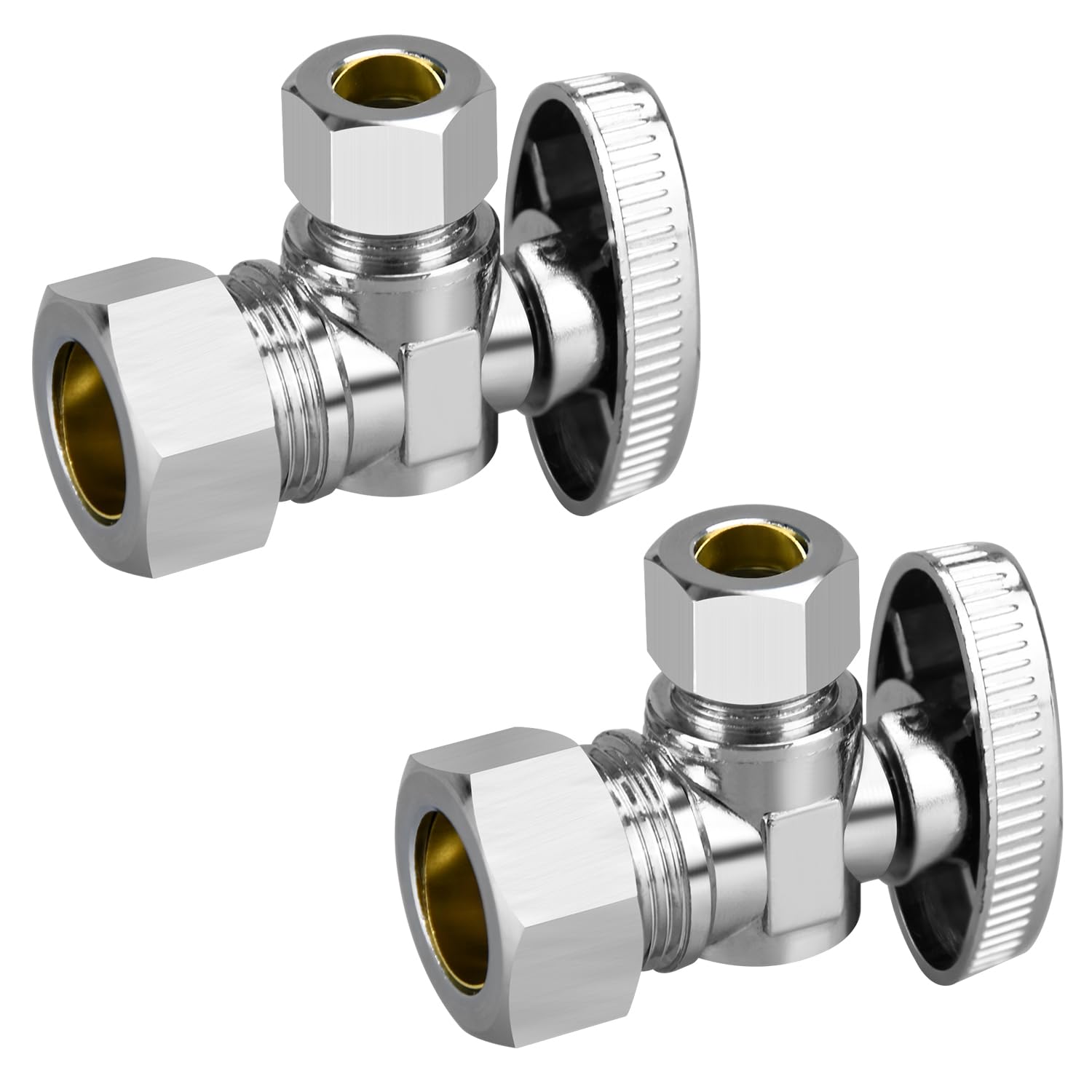
Start with the number that decides the whole job: the inlet is a 1/2-inch push-to-connect fitting, which means you slide it onto copper, PEX, CPVC, or PE-RT and it locks in place with hand pressure alone. No installation tools, no glue, and no soldering are listed as required. The outlet is a standard 3/8-inch compression connection, so the same braided supply line already feeding your faucet threads straight on.
The body is heavy-duty solid lead-free brass, rated to a maximum of 200°F and 200 PSI. That 200 PSI ceiling matters because household water pressure usually sits far below it, so you have real headroom rather than a valve running at its limit. It also carries UPC, ANSI/NSF-61, and ASSE certifications and is approved for potable drinking water — worth knowing if this valve ever feeds a drinking-water line rather than a bathroom faucet.
Two packs are included, so a single purchase covers both the hot and cold sides of one sink. That is also where the honest catch sits. Buyers consistently describe turning this valve off as a two-handed job — one hand to brace the body, one to work the handle — because the push-fit grip and the shutoff are on the same small fitting. It opens and closes fine every time; it just is not a one-finger flick. For a valve you touch twice a decade, that is a fair trade for tool-free installation.
Where It Earns Its Keep
- Push-fit inlet locks onto copper, PEX, CPVC, or PE-RT with no tools, glue, or soldering
- Solid lead-free brass body rated to 200°F and 200 PSI
- UPC, ANSI/NSF-61, and ASSE listed and approved for potable water
- Two valves per pack covers both hot and cold lines under one sink
What To Know Before You Buy
- Shutting off the valve takes two hands — brace the body while you turn the handle
- The push-to-connect depth marker sits shallower than some depth gauges, which can confuse a first-timer
Made for the no-torch crowd: pick this if your wall pipe is copper, PEX, or CPVC and you would rather push than solder — the two-pack covers both lines in one go.
Look at a compression valve instead: if you already own a wrench set and want the lowest-cost two-valve fix, the compression-style options further down cost less for the same 1/2-by-3/8 pairing.
2. SharkBite Max 1/2 x 3/8 Inch Compression Angle Stop Valve, Quarter Turn
The single valve to grab when the water is already dripping and you have no room to swing a wrench.
What separates this one is a push-to-connect inlet that the maker lists as installable on wet lines — meaning you do not have to get the pipe bone dry before you push the fitting on. That single detail is why it shows up in tight under-sink cabinets where you cannot fully drain the line. It fits PEX, copper, CPVC, PE-RT, and SDR-9 HDPE, so the material of your stub-out rarely rules it out. A quarter-turn full-port brass ball valve handles the on/off, and the reinforced stainless steel collar is listed as cutting insertion force, which is the push effort you feel at the wall.
It is also the most compact valve in this lineup. Its item dimensions read 1.69 x 1.14 x 0.1 inches against the PROCURU two-pack’s 3.4 x 1.2 x 1.8 inches — a smaller body that disappears behind a pedestal sink or a cabinet divider. What earns the most praise is the quality of the build itself, with installation ranking a close second; buyers routinely report it slips over PEX and copper without the fuss of a compression nut. It is a single valve, though, and SharkBite lists it at 160°F and 125 PSI, a lower ceiling than the PROCURU’s 200 PSI. For a bathroom sink line running ordinary household pressure, that rating is still well clear of daily demand.
Weigh it against the PROCURU above and the trade is clear: you give up the second valve in the box and some pressure headroom, and you gain a smaller body you can set in a wet line. If your sink is a single faucet and the cabinet is cramped, that is the right swap to make.
The wet-line advantage: no other valve here is listed as installable on a line that is still wet, and the quarter-turn ball valve closes with a single 90-degree twist — handy when you are reaching past a trap arm to cut supply to one fixture.
The honest limit: at 4.16 ounces it is marginally heavier than the PROCURU at 4 ounces, and at 160°F and 125 PSI it carries a lower temperature and pressure rating. Neither matters for a standard bathroom sink, but check your rating if the line runs unusually hot.
Reach for this if: you are replacing one dripping valve under a cramped single-sink vanity and want it done in one pass without draining the line completely.
Better served elsewhere: if you need valves for two fixtures, a two-pack or larger delivers more coverage per purchase.
3. PXZBLG 2 Pack Stop Valve, 1/2″ Nominal (5/8″ OD Comp.) Angle × 3/8″ OD Compression
A straightforward compression valve that swaps straight into an old fitting’s place.
This is the classic approach, done correctly. The inlet is a 1/2-inch nominal compression fitting that threads onto copper, and the outlet is a 3/8-inch OD compression connection for the braided supply line to your faucet. You tighten a nut and ring onto the pipe with two adjustable wrenches — one to hold the valve body steady, one to turn the nut — and that is the whole job. No soldering, crimping, or glue is needed, and it can be installed on a wet line.
The body is chrome-plated brass with an ABS handle, and the sales copy calls out corrosion resistance and heat resistance. Where owners land hardest is on the overall build — quality leads the praise, with functionality right behind it — and the recurring theme is that a quarter-turn valve simply outperforms the old multi-turn style it replaces. One buyer’s advice is worth repeating for anyone new to this: hand-tighten the nut first, then give it a quarter turn with a wrench, and stop there. Over-tightening is the usual reason a compression fitting ends up weeping.
One detail is genuinely important to check: this valve uses the 1/2-inch nominal (5/8-inch OD) inlet. If the device already glued to your CPVC pipe has differently sized male threads, the two will not mate, and you will need a valve matched to that connector instead. The number of packs is 2 and the listing shows 8 ports total across the pair, so you are getting two complete valves. That is the whole package — no surprises, no extras.
The Case For It
- Compression inlet and 3/8″ OD outlet install with two wrenches and no torch
- Chrome-plated brass with an ABS handle built for corrosion and heat resistance
- Quarter-turn operation is quicker and less prone to seizing than old multi-turn valves
- Two valves per pack with all connecting hardware
Check This First
- Verify your existing connector’s thread size — a mismatched male thread will not seat
- Feels lighter in the hand than premium-brand equivalents, though buyers still call it solid for the money
Ideal for a standard swap: matching compression valve to compression valve, on a copper stub-out you can reach with a wrench.
skip it if: the fitting already glued to your CPVC has threads of a different size — check before you order, because that mismatch is the one thing this valve cannot work around.
4. EFIELD 2Pcs Angle Stop Valve 1/2″ Nominal (5/8″ OD) Comp x 3/8″ OD

A two-pack built for homes where faucets get changed more often than the plumbing does.
EFIELD supplies this pair with a compression inlet at 1/2-inch nominal (5/8-inch OD) and a 3/8-inch OD compression outlet, the same pairing every other valve here uses. What makes it a sensible repeat buy is the material claim and the certification together: lead-free brass with a chrome-plated finish, marked for both hot and cold water, and carrying Uniform Plumbing Code certification.
The finish is chrome-plated brass, and the quarter-turn water shutoff is the operation you want in a valve you may not touch for years. Owners lean on the quality of the build more than anything else, and the phrase that keeps surfacing is the price relative to the big-box stores. Fit earns its own mention — the 1/2-inch side seats cleanly on standard copper, which is what makes a two-pack worth keeping on the shelf. One buyer described these as well built from the start, which is the least dramatic and most useful thing you can say about a shutoff valve.
The honest trade-off here is consistency. Most buyers report clean, leak-free installs, but a minority run into leakage and a small number find parts missing from the box. That is not a defect pattern so much as a variable one — worth a quick parts count before you shut off the main, so a missing ferrule does not strand you mid-repair. If the box is complete and the compression nut seats right, this is one of the best-value pairs on the list.
What buyers keep coming back to: the build quality and the fit at the wall, both of which matter more than any finish detail on a part you see twice a decade. The chrome-plated lead-free brass body and UPC certification round out a valve that reads as more expensive than it is.
The honest caveat: leakage feedback is genuinely mixed, and a few units have arrived short on parts. Count the nuts, rings, and ferrules against the listing before you start the install — that five-minute check is the whole defense.
Your pick if: you want a certified, chrome-finished pair that can cover a sink now and a toilet later without a second order.
Think twice if: you need absolute certainty from the start — count the included parts on arrival, since a rare unit ships incomplete.
5. VINTEX 5 Pack 1/2 Inch Pex x 3/8 Inch Od Angle Pex Valve
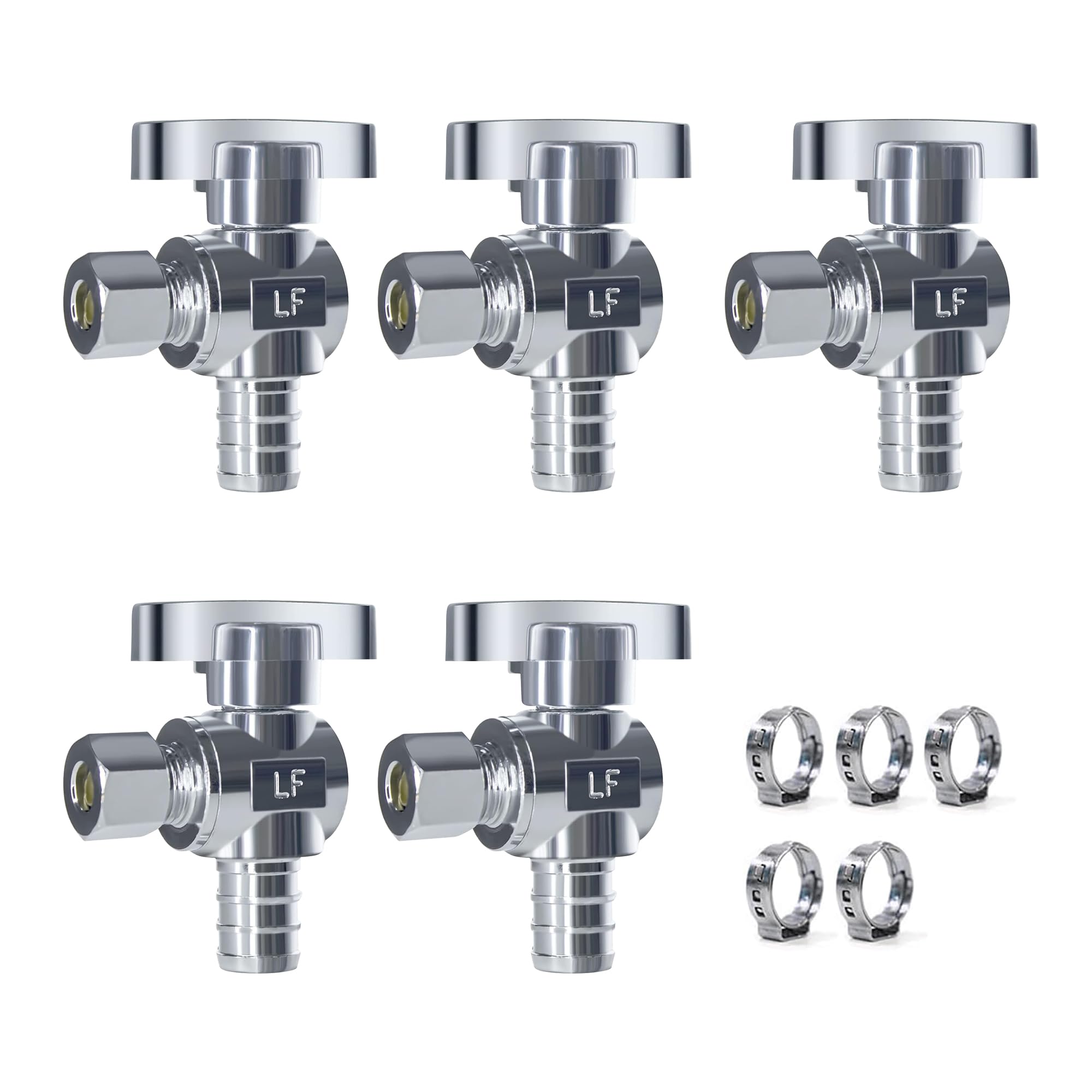
Five PEX valves with the crimp rings already in the box — enough for a whole bathroom remodel.
If your house runs PEX rather than copper, this is the pack built for it. The inlet is a 1/2-inch PEX connection that crimps on with a copper ring or a stainless PEX clip and a clip tool, while the outlet is the familiar 3/8-inch OD compression for your supply line. Five valves and five 1/2-inch PEX stainless steel clamp rings come together, and the outer box measures 4.5 x 4.5 x 1.8 inches — small enough to tuck on a shelf until the next repair. The material is thickened brass listed as corrosion resistant, rust resistant, and high hardness.
Buyers like the per-valve price when replacing several valves at once. Buyers describe it as much cheaper than the big box stores and note the included clamps save a separate trip. The quarter-turn handle turns smoothly, and the 3/8-inch threads and 1/2-inch PEX clamp rings are reported as well formed with no burrs. One buyer fit four of the five with no leaks, keeping the fifth for the toilet — that is the normal story. A small number of owners have flagged slightly rough chrome at the handle base, cosmetic only, with no effect on the seal.
You do need one thing to use these: a PEX crimp tool and rings, since this is a crimp fitting rather than a push-fit or compression valve. If you do not own that tool, the math flips — that single requirement is what separates the PEX crowd from everyone else on this list.
Why PEX Owners Like It
- Five valves and five 1/2″ PEX stainless clamp rings in one box
- Compatible with copper, PEX, or CPVC when used with the matching connector
- Smooth quarter-turn handles with well-formed threads and no burrs reported
- Thickened brass body listed as corrosion and rust resistant
Before You Order
- Requires a PEX crimp tool or clip tool and rings — not included
- Chrome at the handle base can arrive slightly rough, a cosmetic quibble only
Built for the PEX remodel: if your plumbing is PEX and you already own a crimp or clamp tool, five valves for the price of two elsewhere is the sensible buy.
Wrong tool for a copper house: if your stub-outs are copper or you do not own a PEX tool, a push-fit or compression valve will serve you better with less setup.
6. BrassCraft G2CR19L1X 1/2-in Nominal Comp x 3/8-in OD Outlet, 1/4-Turn Angle Stop Valve, 4-Pack

A four-pack with the brand recognition — and a plastic ball valve inside the brass body.
The construction detail that counts is the one-piece body with a quarter-turn on/off, built from lead-free material compliant with the low-lead requirements S3874 and AB1953. The inlet is 1/2-inch nominal compression for copper pipe, and the outlet is 3/8-inch OD compression. Note the “less outlet sleeve/nut” line in the name — that means the 3/8-inch outlet ships without its own nut and sleeve, so you either reuse the ones on your existing supply line or pick up a set. It is a four-pack, which makes it the natural choice when several valves in the house are the same vintage.
What buyers reward here most is the value the four-pack delivers, closely followed by how quickly each valve goes in — the recurring note is a job that takes only minutes per valve. The one-piece brass body plus quarter-turn handle gets described as solid, and buyers who have lived with both prefer this style to the old washer-seal valves they replaced. That is real: a quarter-turn ball valve does not have the same internal rubber seat that ages out on older multi-turn designs.
The honest note is inside the body. While the exterior is brass and the handles are metal, some owners mention the internal ball is made of plastic rather than metal, which is the trade-off behind the price. It seals and operates smoothly — the valve works — but if your standard is all-metal internals, the Miiflex and SharkBite picks further down build differently. Reusing your existing outlet nut also means no new part to seat, which cuts one failure point and one item off the shopping list.
Where the value sits: the four-pack pricing, the one-piece lead-free body, and an install most owners finish in minutes per valve. Compliance with the low-lead requirements plus the familiar quarter-turn handle makes it an easy recommendation for replacing several aging valves at once.
The internal detail to know: the ball inside is reported as plastic by some owners even though the exterior is brass. If you want a fully metal ball valve, look at the all-metal picks in this list — this one trades a little internal material for a lower multi-pack price.
Right choice for a valve sweep: when four old valves in the house are failing together and you want a named brand at a four-pack price.
Look at the all-metal picks if: the internal ball material matters to you — the brass exterior here does not extend all the way through.
7. GUOFIS 10 Pack Angle Compression Stop Valve, 1/4 Turn Water Shut Off Valve

Ten quarter-turn valves in one box — the refit-everything-in-the-house move.
Count the packs and the purpose becomes obvious: ten valves with a 5/8-inch compression inlet that fits 1/2-inch pipes and a 3/8-inch compression outlet that meets standard toilet and faucet hoses. That is a contractor-scale supply, and it is why this sits well above the smaller packs here on per-purchase cost while running low per valve. The body is lead-free brass with a chrome-plated finish listed as resisting corrosion and rust, and it carries Uniform Plumbing Code certification for the drinking-water standard. Hot and cold water both work, and the listing covers residential and commercial use.
The practical payoff is the shutoff itself. Buyers point to the ability to isolate one appliance — turn off the single valve feeding a faucet or toilet and repair it without cutting water to the whole house, so everything else keeps running. That is the whole reason a shutoff valve exists, and a ten-pack lets you put one on every fixture. Owners describe the valves as well made and working well, with the per-unit price drawing the same comment the smaller packs do: far below the big box stores.
The honest caveat is leakage, and it comes back mixed. Some users report a clean seal with no issues, and a minority hit a weep at the connection. Nothing about the design predicts that — a compression fitting that weeps usually points to an over-tightened or under-tightened nut, and the room you get on the tenth valve does not change the first one. If you are replacing a single under-sink valve and do not want nine spares on the shelf, the smaller packs above are the better fit.
Why Ten Makes Sense
- 10 valves with a 5/8″ compression inlet fitting 1/2″ pipe and 3/8″ compression outlet
- Lead-free brass, chrome-plated, and Uniform Plumbing Code certified
- Isolates a single fixture for repair without shutting off the whole house
- Works with copper or PEX supply lines on hot or cold water
The Trade To Weigh
- Ten valves is overkill for a single-sink repair — most of the box sits unused
- Leakage experience is genuinely mixed, so proper nut torque matters
The bulk refit pick: if every fixture in the house has a valve of the same age, buying ten at once replaces them all for the cost of a couple of branded pairs.
Fall back to a smaller pack if: you are fixing one sink and do not want the rest of the box in the garage for years.
8. Miiflex Heavy Duty 1/4 Turn Angle Shut Off Valve, Squared Body, 1/2 in. NOM Comp x 3/8 in. OD Comp (5 Pack)

A squared-off body that a wrench can actually bite — the detail that makes an old valve budge.
The squared body design is not cosmetic. A flat-sided valve gives a wrench a tight grip when you are tightening the compression nut against the wall, which is exactly where a rounded valve slips and strips. That is the single most practical thing about this five-pack, and it pairs with an all-metal ball valve and a metal handle. The inlet is 1/2-inch nominal compression and the outlet is 3/8-inch OD compression, with the compression rings included. The working range is listed at 40 to 165 degrees Fahrenheit, and the listing covers faucet, toilet, drinking fountain, and dishwasher supply hookups.
Build quality is what buyers talk about most here, with the heavy, all-metal feel running right behind it. The metal handle earns a specific mention because it does not crack or break the way plastic handles can after years of use — a small detail that only matters once you have snapped a plastic one. Removal is worth planning for: some owners needed a ferrule puller to free the old compression ring from the pipe, and one recommended adding a few drops of penetrating oil inside the valve and cycling it before install to head off corrosion or sticking later.
Leak-proof performance is a mixed bag, with a majority reporting clean seals and a minority hitting a weep. The design is not the culprit — a compression joint that weeps is nearly always a torque issue — but it is worth sealing the threads carefully and testing before the cabinet goes back. The 40 to 165°F window covers every residential bathroom and kitchen line, so temperature is not the constraint here.
Why The Squared Shape Matters
- Flat-sided body gives a wrench a tight grip instead of a slip
- All-metal construction with a metal handle that resists cracking
- Compression rings included, and rated for 40 to 165 degrees Fahrenheit
- Five valves cover a full bathroom and kitchen refresh
Plan For This
- A ferrule puller may be needed to remove the old compression ring from the pipe
- Leak-proof reports are mixed, so sealing the threads carefully is worth the extra minute
Choose this if: you want the all-metal, squared-body feel and you are ready to deal with an old ferrule on the pipe.
Look elsewhere if: your valves come off clean and you would rather not invest in a ferrule puller for the job.
9. SharkBite 1/2 x 3/8 Inch Compression Angle Stop Valve, Pack of 4, Quarter Turn

Four push-on valves that remove the guesswork from every fixture in the house.
This is the four-pack version of the SharkBite push-to-connect valve, and the combination is the point: a 1/2-inch push-to-connect inlet and a quarter-turn full-port brass ball valve, sold four at a time. It fits PEX, CPVC, PE-RT, SDR-9 HDPE, and copper, so the pack works no matter which piping your fixtures use. No special tools, crimping, glue, or soldering are needed, and the valve can be installed on a wet line. The 4-pack ships as 15.52 ounces in total for the box, and the finish is listed as sleek chrome.
The advantage a four-pack of push-fit valves has is total coverage: one order handles every fixture in a house, from the bathroom sink to the kitchen to the toilet. Buyers describe the installation as easy enough for a beginner and still fast for a professional, with the push-to-connect method saving the time and guesswork of compression fittings. The most-praised aspect is how quickly they go on, and functionality — a clean, simple shutoff — is right behind it. Users who have run SharkBite fittings for years describe the same result every time, which is the quiet endorsement that matters for a plumbing part.
Two real limits are worth naming. SharkBite fittings cost more than compression ones, so you are paying for the convenience of the push-fit method — a fair trade if you are doing several fixtures at once. And the pressure range is the same 160°F and 125 PSI ceiling as the single valve, below some other options here. For a bathroom sink, neither matters, but on an unusually hot or high-pressure line, check the rating first.
What Four At Once Buys You
- Push-to-connect inlet fits PEX, CPVC, PE-RT, SDR-9 HDPE, and copper
- No special tools, crimping, glue, or soldering — and installable on wet lines
- Four valves cover every fixture in the house from one order
- Made and tested in the USA, with a chrome finish and a removing clip or tongs
What You Give Up
- Costlier than compression valves of the same size
- Rated to 160 degrees F and 125 PSI — check before use on a hot or high-pressure line
The whole-house fixer: if every fixture you own uses a different pipe material, this four-pack of push-to-connect valves covers any combination without a tool.
Keep it to the sink if: you only have one bathroom and would rather not pay the push-fit premium on four valves at once.
Understanding the Specs
Connection Sizing: What 1/2 x 3/8 Really Means
The first number is the size that meets the pipe coming out of your wall, and the second is the size that meets the supply line to your faucet. You will see this written as 1/2-inch nominal (or 5/8-inch OD) on the inlet and 3/8-inch OD compression on the outlet. Measure both ends of your existing setup before you buy — matching these two sizes to what is already in the wall is the single most important check you can make.
Quarter-Turn Versus The Old Multi-Turn Style
A quarter-turn valve opens or closes with a 90-degree twist of the handle, while a multi-turn valve spins several full rotations. The quarter-turn version is the modern standard because it shuts off faster and is less likely to seize with age. If your old valve is stiff or rounds off when you turn it, a quarter-turn replacement solves exactly that problem.
Push-Fit Versus Compression Inlets
A push-fit inlet locks onto the pipe as you push the valve on, needing no tool, glue, or soldering. A compression inlet threads a nut and ring onto the pipe and tightens with a wrench. Push-fit shines in tight spaces or on a wet line; compression costs less and matches the valve you are likely removing. Both give the same reliable seal when installed correctly.
Pressure, Temperature, And Material Ratings
Look at the pressure, temperature, and material on the label. Valve ratings in this category commonly run to 200 PSI or to 160 degrees F and 125 PSI, depending on the model, and lead-free brass is the standard material for drinking-water lines. If your line runs unusually hot or high-pressure, confirm the valve’s rating covers it before install.
FAQ
Will a 1/2 x 3/8 inch valve fit my bathroom sink faucet?
What is the difference between a push-fit and a compression inlet?
Can I install a shutoff valve on a wet line?
How long does a quarter-turn shutoff valve last?
Do I need a torch or soldering to replace an old shutoff valve?
How tight should I turn the compression nut?
Can I replace a valve without shutting off the entire house?
How do I remove an old compression ring from the pipe?
Which is better for a bathroom sink, a PEX valve or a compression valve?
Can I use a bathroom sink valve for a toilet or dishwasher too?
Is lead-free brass really necessary for a shutoff valve?
Final Thoughts: The Verdict
For most people replacing a shutoff under a bathroom sink, the bathroom sink cut off valve winner is the PROCURU 2-Pack PushFit Angle Stop Valve because its 1/2-inch push-to-connect inlet locks onto copper, PEX, or CPVC with no torch and no soldering, and the two-pack covers both the hot and cold lines in one purchase.
If you only need one valve and your cabinet is tight, grab the SharkBite Max UR23036 — it is the most compact body here and the only one listed as installable on a wet line. And if your plumbing is PEX and you already own a crimp tool, the VINTEX 5 Pack Pex Angle Valve is the one to reach for, with five valves and five clamp rings in the box.
The PROCURU pair is the highest-rated pick here at 4.8 stars across 500+ ratings — start there unless your wall pipe or your tool drawer points to a different pick.
How We Picked
We do not accept paid placement. Every pick is matched to a real buyer and a real use-case; we do not hands-on test units.
Sources & Methodology
Specifications: manufacturer listings and product documentation. Review insights: verified customer reviews, as of September 2026. Pricing: not shown on this page (it changes often); check the current price via the retailer link.
As an Amazon Associate, Gadgets Feed earns from qualifying purchases. This does not affect which products we feature.