
Our readers keep the lights on and my morning glass full of iced black tea. As an Amazon Associate, I earn from qualifying purchases.
Specs are compiled from manufacturer listings and verified buyer reviews and can change over time — please confirm the key details on the product page before buying.
If your bathroom fan dumps damp air right back under your soffit, it isn’t really venting — it is just recycling the problem. You need a soffit vent that pushes that humid exhaust clear of the eave, keeps pests out, and actually moves air instead of just covering a hole. This guide breaks down the 7 best options by what they do best, from simple snap-in covers to engineered designs that redirect moisture with a baffle.
I’m Min — the founder and writer behind Gadgets Feed. This guide is built by comparing the manufacturers’ published specifications and the patterns across verified customer reviews, so you get each pick’s real strengths and trade-offs instead of marketing spin.
The right choice depends on material, airflow design, and how much you care about keeping that damp air away from your siding. This is your clear-eyed look at the bathroom soffit vent market, focused on what actually works under a real eave.
Our Picks at a Glance


How To Choose The Best Bathroom Soffit Vent
A bathroom soffit vent does a simple job — let humid air out and keep everything else out. But the difference between a good one and a bad one shows up in the first winter freeze or the first time a bird decides that flap looks like a perch. Here is what separates the keepers from the headaches.
Material: The Rust and UV Reality
Stainless steel is obviously tougher than plastic, but plastic can be surprisingly durable if it is UV-resistant resin (plastic treated to not break down in sunlight) rather than thin ABS (acrylonitrile butadiene styrene, a common rigid plastic). Steel handles the sun better long-term and resists impact, but razor-sharp edges are a real installation hazard. Plastic is lighter and easier to cut, but can become brittle and crack after several seasons of direct sun and freeze-thaw cycles.
Airflow Design: Flaps, Baffles, and Louvers
The cheapest vents use a simple gravity flap (a hinged door that opens by its own weight when air pushes it). The better ones add a louvered face (angled slats) that deflects rain, a screen that blocks insects, or an engineered baffle (a wall that redirects airflow) that actually turns the exhaust 90 degrees so it exits away from the soffit rather than pooling under it. For bathroom vents specifically, that baffle feature matters because humid air trapped under the eave can lead to rot and mold over time.
Size and Duct Compatibility
Nearly every residential bathroom fan uses 4-inch ductwork (the flexible tube that carries air), so a 4-inch soffit vent collar (the ring where the duct connects) is the standard. But the devil is in the connection: some vents have a short collar designed for a quick-connect fitting (a snap-on adapter), which won’t grip a standard flex duct (the ribbed hose most fans use). Others accept a clamp and hose directly. The depth of the mounting body also matters in a tight soffit (the underside of your roof overhang).
Quick Comparison
| Model | Best For | Material | Airflow Design | Pest Protection | Amazon |
|---|---|---|---|---|---|
| Zonon 12-Pack★ Best Overall | Whole-home projects | 304 Stainless Steel | Louvered 45° | Mesh screen | Amazon |
| PreVent-ItAlso Great | Moisture redirection | Resin plastic | Baffled, directs 95%+ away | Built-in damper | Amazon |
| No-Pest Vent | Bird and pest prevention | UV-resistant plastic | Dual-door, backdraft prevention | Patented dual-door | Amazon |
| Panasonic EZSV14 | New construction installs | Plastic, powder-coated | Trap door, low backpressure | Auto-close flap | Amazon |
| Lambro 143WP (2-Pack) | Budget twin-pack | Plastic | Gravity flap with damper | Damper only | Amazon |
| VIHOSE 8-Pack | Multi-room coverage | ABS Plastic | Louvered with fly screen | Built-in fly screen | Amazon |
| Lambro 143W (2-Pack) | Entry-level replacement | Plastic | Gravity flap with damper | Damper only | Amazon |
In‑Depth Reviews
1. Zonon 12 Pcs Stainless Steel Soffit Vents 4 Inch
Our pick — over 4.5★ from 350+ verified ratings; the strongest balance of quality and price.
An industrial-grade stainless steel vent that handles multiple rooms without showing rust
If you are outfitting an entire floor or a metal building, the twelve-vent count here is the headline. But the real story is the material: 304 stainless steel (a rust-proof grade of steel), which means no rust, no flaking paint, and a lifespan that should outlast the house. The 45-degree louver design (slanted slats) sheds rain while the built-in mesh screen stops insects and larger pests. Unlike the ABS plastic packs that follow, these are heavy-duty covers that feel substantial in hand.
The installation catch is well documented: the edges are razor-sharp. One buyer who said “304 stainless steel vents, 4″ size fits well with holesaw” also noted that the sharp edges “caused cuts” during installation. Wear heavy gloves and handle with care. A second honest note is that the mesh screen has larger openings — buyers report that small insects and mosquitoes can still get through, so if you need no-gap pest protection, you will need to add a finer secondary screen. No mounting hardware is included, so have screws ready.
These do not come with a damper or flap, so cold air backdraft (air blowing back into the house) is possible in windy conditions. They are best suited for applications where you want a simple, durable louver that just lets air out and keeps rain out — think soffit ventilation for an attic or shed, or as an exhaust cover for a dryer in a metal structure.
The Steel Advantage
- 304 stainless steel — will not rust or corrode
- Heavy-duty construction feels quality
- 12-pack is ideal for whole-home or building projects
- Mesh screen keeps larger bugs and debris out
The Installation Hurdles
- Razor-sharp edges require gloves and careful handling
- Screen holes are large enough for small insects
- No damper, so cold drafts can blow back in
- No mounting hardware included
Best for: multi-room renovation projects and metal buildings where rust resistance and volume matter more than pest-proofing or backdraft prevention.
Not ideal for: a single bathroom vent that needs a sealed damper — grab a single unit with a flap instead.
2. PreVent-It Soffit Vents 4 Inch
The only vent that directs moist air away from the house instead of under it
This is not just a hole cover with a flap. The PreVent-It uses an engineered baffle that redirects the exhaust through a front opening, forcing 95% of moist bathroom air away from the soffit entirely. That single design choice solves the biggest hidden problem with standard vents — humid air that pools under the eave and slowly rots the wood. It is rated for bathroom fans up to 110 CFM (cubic feet per minute, a measure of how much air the fan moves), which covers most residential units.
Installation is straightforward: the durable resin (UV-resistant plastic) body fits a standard 4-inch hose and comes with four screws. A removable screen makes cleaning simple without removing the whole unit. The damper (a flap that shuts when the fan is off) prevents pests and cold drafts from entering. The one honest trade-off is that it is larger than a basic vent, so you need enough room in the soffit channel (the space under the eave) to accommodate the 11.25-inch depth. It is noticeably more expensive than a basic plastic vent, but owners consistently say the build quality and performance justify the cost.
The crowd favorite — 4.7 stars across 300+ ratings — is driven by people who actually saw the difference. As review pages sum it up: “a well made and sturdy vent” that “works great to push the air away from the soffit.” The only caveat that comes up is that the plastic flap pins may not be the strongest long-term, and the vent should be mounted flat to avoid any binding on the door.
The Baffle Advantage
- Patented baffle directs 95% of moist air away from the soffit
- Durable resin plastic that stands up to weather
- Removable screen for easy cleaning
- Simple install with included screws
The Soffit Space Trade-off
- Bulky body (11.25″ deep) may not fit tight soffits
- Plastic flap hinge pins could wear over time
Reach for this if: you are installing a bathroom vent in a standard soffit and want to prevent moisture damage — the baffle design is a genuine upgrade over every simple flap vent.
Look elsewhere if: your soffit channel is shallow or you are on a strict budget for a high-quantity project.
3. No-Pest Vent, 4 Inch Soffit Vent Cover (Brown)

A dual-door design that birds, wasps, and backdrafts cannot beat
Standard gravity flaps (hinged doors that open by weight) are an open invitation for pests — birds learn to push them open, wasps build nests inside, and a strong gust of wind lifts the flap and lets cold air pour in. The No-Pest Vent solves all three problems with a patented dual-door design. Both doors stay firmly closed by gravity when the fan is off, and they only open when the exhaust fan pushes air through. When the fan stops, they snap shut immediately, stopping bugs, birds, and backdrafts completely. This makes it a stronger pest barrier than the simple mesh on the Zonon.
This is UV-resistant plastic (treated to not degrade in sunlight), not metal, so it will not rust. The quality is what impressed buyers most — one called it “a quality built vent, not cheap plastic” and noted it works perfectly in a 100-year-old house remodel where the soffit was the only venting option. The removable bottom panel is a real convenience: you can clean lint and debris without tools. The biggest fit issue is the collar (the ring where the duct connects): it is designed for a quick-connect fitting (a snap-on adapter), not a standard 4-inch flex duct (ribbed hose). One buyer had to modify their old vent collar because the connection did not work with standard hose clamp installation. Check your duct termination before ordering.
At 4.4 stars from 138 ratings, the consensus is clear: this is the best option for anyone who has dealt with birds nesting in a vent or cold drafts from a flapping damper. It excels in high-wind areas and looks clean on the outside.
The Pest Barrier
- Dual-door design keeps birds, bugs, and backdrafts out
- Removable bottom panel for tool-free cleaning
- UV-resistant plastic — won’t rust or fade quickly
- Made in the USA
The Connection Catch
- Collar is designed for quick-connect, not standard 4″ flex duct
- May require modification to fit your existing duct
Perfect for: homeowners who have had pest invasions through their vents or live in windy areas where backdrafts are a problem.
Avoid if: your duct terminates in a standard flex hose with a clamp — you will need to adapt the connection.
4. Panasonic EZSV14 EZ Soffit Ventilation

Panasonic’s pre-soffit design that pros reach for on new construction
This is not a retro-fit part for an existing hole. The Panasonic EZSV14 is designed for pre-soffit installation — meaning it goes in before the soffit panel is installed, creating a clean, integrated look. The trap door design creates a reliable, low-backpressure (low resistance to airflow) seal that prevents insects and outdoor air from entering while allowing the exhaust fan to push air out with minimal resistance. It is rated for fans up to 110 CFM using 4-inch ductwork, matching the PreVent-It in capacity.
Build quality here is exceptional, which is what you expect from Panasonic. The plastic body feels dense and well-molded, and the snap-fit installation makes it fast once you have access. The baffle snaps off for easy duct taping and snaps back into place. The honest downside is that this is the most expensive option on the list, and it really only makes sense if you are doing new construction or a major soffit replacement where you can install it before the panel goes up. Retrofitting into an existing soffit requires cutting a section out, installing the unit, and replacing the panel — doable but more work than a simple hole-cut vent.
The 4.7-star rating from 209 reviews comes largely from contractors and experienced DIYers who value the clean look and reliable performance. The central trade-off: this is not a quick weekend swap. It is for the project where you want the best possible seal and are willing to do the install right.
The Installer’s Choice
- Low backpressure trap door design — fan works efficiently
- Snap-fit baffle for easy duct connection
- Rated for fans up to 110 CFM
- Top-tier build quality from a trusted brand
The Pre-Install Requirement
- Designed for pre-soffit installation — harder to retrofit
- Most expensive vent on this list
- Must be perfectly level for the trap door to function
Grab this for: a new construction or full soffit replacement where you can install it before the panels go up.
Skip it for: a quick fix in an existing soffit — a simpler through-hole vent will save time and money.
5. Lambro Industries 143WP Plastic Under Eave Vent, 2-Pack

The budget two-pack that gets the job done when you need simplicity and quantity
The 143WP is Lambro’s most popular soffit vent, and with 923 ratings making it the most-reviewed option here, it is the default choice for a huge number of homeowners. It is a simple gravity-flap design (a hinged door that opens by weight) in a white plastic body that directs moist bathroom air away from the house through a 90-degree turn. The built-in damper (a flap that shuts when the fan is off) prevents cold outside air from blowing back in when the fan is off. For two vents at a budget-friendly price, it is tough to top the value.
The durability and quality ratings are mixed for a reason — several owners mention that the plastic distorts easily and the hinge tabs are a weak point. The flap can also bang in the wind, and in very cold climates the damper may freeze shut due to condensation, requiring a few minutes of fan run time to thaw. There is no screen, so insects can enter unless you add your own stainless steel mesh.
The install requires a 4.5-inch hole saw for the duct and clamp — slightly larger than the 4-inch duct itself. For a bathroom fan in a mild climate where budget matters, this is a perfectly functional option. Just know that it is not built for decades of harsh weather.
The Budget Case
- Very affordable for a 2-pack — lowest cost per vent
- Damper prevents backdrafts
- Simple install with a 4.5″ hole saw
- Most-reviewed vent on this list, trusted by thousands
The Thin Plastic Reality
- Plastic feels thin and can distort over time
- No built-in bug screen
- Damper can freeze shut in cold weather
- Flap can bang audibly in wind
Reach for this if: you need two vents for a simple bathroom and dryer setup and you are working within a tight budget.
Think twice if: you live in an area with harsh winters or heavy insect pressure — you will want a sturdier, screened option.
6. VIHOSE 8 Pack Soffit Vents 4 Inch
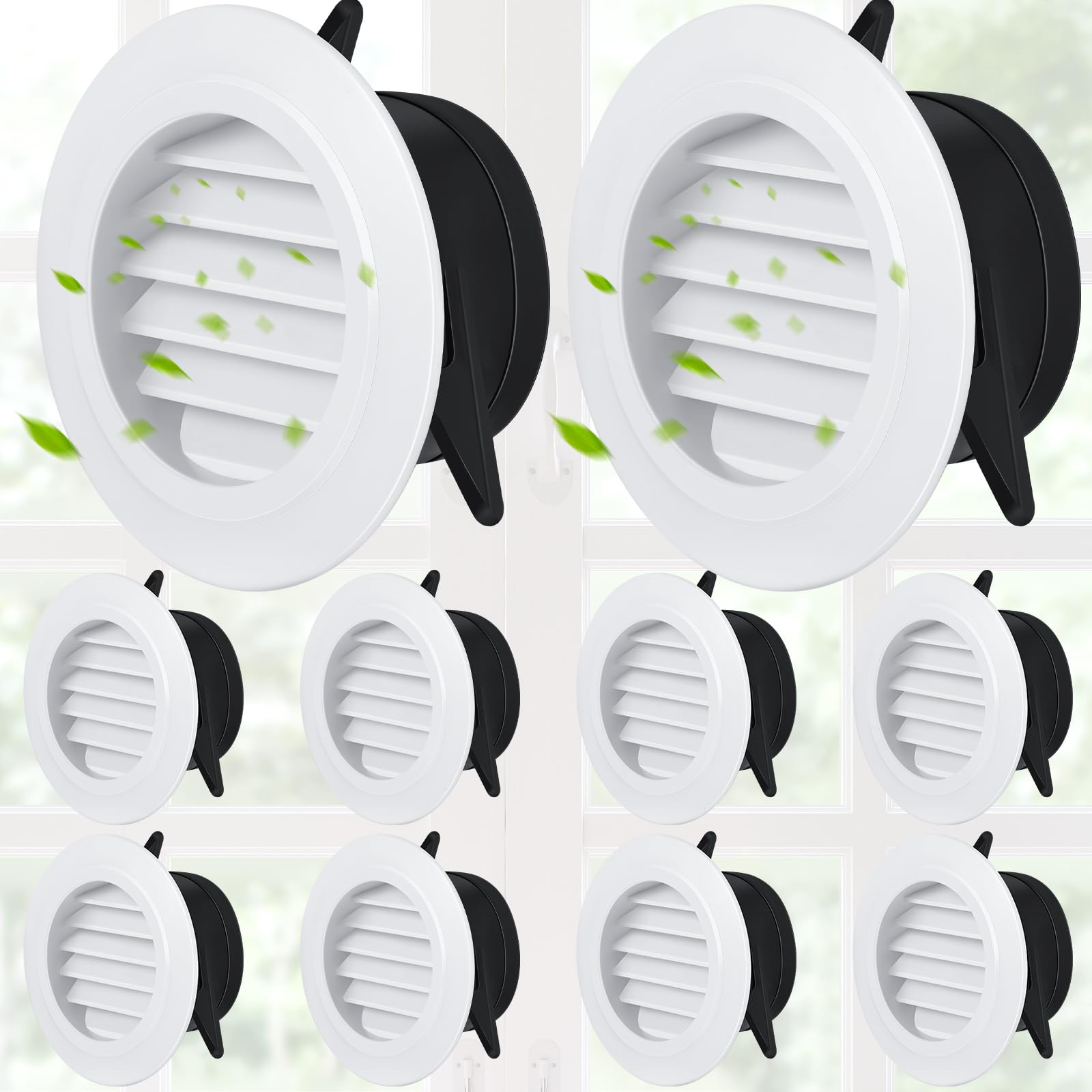
An eight-pack of simple snap-in vents that covers an entire house project in one order
If you are adding soffit vents to a shed, camper, workshop, or multiple rooms, the VIHOSE 8-pack delivers the highest unit count at a low per-vent cost. Each vent is a white ABS plastic (a rigid plastic) louver (slatted cover) with a built-in fly screen. The louvers deflect rain while the screen keeps insects out. The design is purely a cover — there is no damper, no flap, and no duct collar, so these are for passive soffit ventilation (air moving without a fan), not for terminating an exhaust fan duct.
Customers note that the quality is good for the price, with one noting the vents “fit fine in a 3-inch hole and looks great” — an honest rangefinding since the listed spec says it fits holes from 3.54 to 4.33 inches. The plastic is thin but functional, and the installation is simply drilling a hole and pushing the vent in. The most common use case is adding more passive airflow to an attic or shed soffit. Unlike the Lambro 143WP, there is no backdraft prevention at all.
This is not the right choice if you need a sealed vent for a bathroom exhaust fan. Without a backdraft damper, cold air and pests can enter freely. And while the fly screen stops larger bugs, it will not block fine dust or tiny insects. For its intended purpose — passive venting of an unconditioned space at high volume — it is a solid value.
The Coverage King
- 8-pack covers a whole project in one order
- Built-in fly screen keeps bugs out
- Simple snap-in installation
- Good value for passive soffit ventilation
Not for Active Ducts
- No damper or backdraft prevention
- Thin ABS plastic may crack over time in direct sun
- Not designed for terminating a bathroom fan duct
Best for: adding passive ventilation to a shed, attic, or camper where you just need air to move and bugs to stay out.
Not for: connecting a bathroom exhaust fan — you need a dampened vent with a duct collar for that.
7. Lambro 143W White Plastic Under Eave Vent, 2-Pack

A basic backdraft-preventing vent at a price that makes the two-pack feel like a spare
The 143W is the slightly older version of the 143WP above, and it shares the same DNA: a white plastic body with a gravity flap damper (a hinged door that prevents outside air from entering). It is designed for bathroom fan and dryer venting in under-eave applications. For someone replacing a single broken vent on a tight budget, this is the cheapest dampened option on the list.
The durability concerns are louder here than on the 143WP. The plastic is delicate and can distort easily if over-tightened, and the hinge tabs that hold the flap are the weak point. Reviewers point out the flap banging in the wind, and no screen, gasket (a rubber seal), or screws are included. The recommended hole saw size is 4.5 inches. As one experienced DIYer put it: “low price, delicate plastic frame distorts easily.” The damper can also freeze shut in cold weather, requiring the fan to run for a few minutes to thaw the condensation.
For a temporary fix, a shed, or a very mild climate, this works. For a long-term install in a primary bathroom where you want durability and pest protection, the extra few dollars for the 143WP (which is essentially the same design) or a premium option is money well spent.
The Dollar Stretcher
- Lowest price point for a dampened under-eave vent
- Damper prevents backdrafts when the fan is off
- Designed for standard 4″ ductwork
- Made in the USA
The Fragility Factor
- Thin plastic frame distorts easily
- No bug screen — add your own
- No mounting hardware or gasket included
- Flap can freeze shut in winter
Reach for this if: you need a single vent for a low-use bathroom or workshop on a very tight budget — it works, but treat it gently during installation.
skip it if: you want something that will last through harsh winters or if you cannot add your own bug screen.
Understanding the Specs
CFM Ratings and Fan Compatibility
CFM stands for cubic feet per minute — how much air your bathroom fan can move. A soffit vent rated for up to 110 CFM will handle nearly all standard residential bathroom fans. If your fan is more powerful, you need a vent designed for higher flow, or you risk restricted air movement and louder fan noise. The PreVent-It explicitly notes it is meant for fans up to 110 CFM; pairing it with a higher-CFM fan can cause performance issues.
Dampers, Flaps, and Backdraft Prevention
A damper (a flap that opens when the fan pushes air and closes by gravity when the fan stops) is your main defense against backdrafts. Gravity flaps are the most common and work well enough, but they can freeze shut in winter if condensation builds up. The No-Pest Vent’s dual-door design solves this by using lighter doors that seal more positively. Any vent without a damper — like the VIHOSE and Zonon — will let cold air and pests back in freely whenever the wind blows.
Material: Plastic vs. Stainless Steel vs. Resin
Basic ABS plastic (acrylonitrile butadiene styrene, a rigid plastic) is the cheapest and lightest, but it can become brittle and crack after UV exposure over a few years. Stainless steel, like the Zonon’s 304 grade (a specific rust-proof alloy), will never rust and is physically tougher, but the edges are hazardously sharp. UV-resistant resin (plastic treated to resist sunlight), used in the PreVent-It, is a middle ground: it is durable and weather-resistant without the installation risk of sharp metal edges. For a bathroom soffit vent, resin or steel is the better long-term play.
Pest Screens and Mesh Density
A built-in screen keeps bugs out, but not all screens are equal. The Zonon’s stainless steel mesh stops large insects and debris, but mosquitoes can still get through. The No-Pest Vent seals completely with its dual doors. A simple fly screen, like on the VIHOSE, stops flies and wasps but will not block dust or tiny insects. If you need total pest exclusion, look for a vent with a damper or very fine mesh — or plan to add your own screen.