
Our readers keep the lights on and my morning glass full of iced black tea. As an Amazon Associate, I earn from qualifying purchases.
Specs are compiled from manufacturer listings and verified buyer reviews and can change over time — please confirm the key details on the product page before buying.
You just want a stall door that actually latches and a stranger who can see from three steps away whether it is free. That is the whole job. The catch is that most partition hardware is sold as a bare latch with no screws in the box and no indicator plate, so you find out at the door whether you bought the right thing. This guide sorts the slide latches, the vacant/engaged indicator bolts, and the reinforcement locks by what they actually mount to and what comes in the package.
I’m Min — the founder and writer behind Gadgets Feed. This guide is built by comparing the manufacturers’ published specifications and the patterns across verified customer reviews, so you get each pick’s real strengths and trade-offs instead of marketing spin.
The category splits cleanly: a plain slide latch for replacing worn-out hardware, or an indicator bolt with a red-and-green face so nobody rattles the handle while you are inside. Both work, but they solve different problems, and the details below show which one your partition needs. Our breakdown of the bathroom stall lock covers mounting hole spacing, door thickness, and what ships in the box.
Our Picks at a Glance


How To Choose The Best Bathroom Stall Lock
Two numbers decide almost everything before you order. The first is the distance between the mounting holes on your existing latch. The second is how thick the partition door is. Get either wrong and a perfectly good latch will not sit flush, or the screws will not bite.
Measure your hole centers before anything else
A slide latch mounts through two screw holes drilled in the door. The span between those holes is called the hole centers, and 2-3/4 in. is a common commercial spacing. If your old latch used that spacing, a replacement with the same figure lines up with the existing holes. If it does not, you are drilling fresh holes in a partition panel, which is a job most people would rather skip.
Know your door thickness
Indicator bolts clamp onto the door panel, so they are built for a thickness band. Some are specified for panels between 0.5 and 1.4 inches. Others are built for boards between 12 and 18 mm. Measure the panel edge with a ruler before ordering, because a clamp that is too loose slides around and one that is too tight will not seat.
Decide if you need the red and green face
A plain slide latch only does the latching. An indicator bolt also shows vacant in green and engaged in red from a distance, so people stop knocking and stop pushing on a door that is already locked. In a busy shared restroom that face plate does most of the daily work.
Check what is in the box
Some latches ship as the latch body only, with the strike and keeper sold separately. Others include the keep and the fixing hardware. Read the included components line carefully, because buying a latch and then discovering you need a separate strike plate adds a second order and a second wait.
Quick Comparison
| Model | Best For | Type | Material | Mounting Notes | Amazon |
|---|---|---|---|---|---|
| Harris Hardware TP5020-B★ Best Overall | Replacing a worn slide latch | Slide latch | Die cast zamac, chrome | 2-3/4″ center to center, inswing | Amazon |
| Prime-Line Slide LatchTop Performer | Commercial restroom retrofit | Slide latch | Diecast, chrome | 2-3/4 in. hole centers, screws not included | Amazon |
| CALIDAKA Indicator LatchClever Indicator Pick | Cutting down knocking | Latch indicating lock | Zinc alloy, satin nickel | Surface mounted | Amazon |
| LVOERTUIG Indicator Bolt | Emergency outside release | Deadbolt with indicator | Zinc, satin nickel | Bolt-through fixing, keep included | Amazon |
| ULWSKY Black Indicator Lock | Dark partition panels | Latch indicating lock | Zinc alloy, matte black | Fits 0.5-1.4 inch door panels | Amazon |
| ULWSKY Silver Indicator Latch | Screw-in install from the start | Deadbolt with indicator | Zinc, polished silver | Fits 0.5-1.4 inch panels, screws included | Amazon |
| Flylin Vacant Occupied Lock | Thinner partition boards | Deadbolt with indicator | Zinc alloy, silver | For 12-18 mm door boards, emergency hole | Amazon |
| ANTEISI Reinforcement Lock | Extra hold on a wooden door | Slide reinforcement latch | Zinc alloy, silvery | Screw mount, 180-degree rotation | Amazon |
In‑Depth Reviews
1. Harris Hardware TP5020-B Slide Latch
Our pick — 4.5+★ from 350+ verified ratings; the strongest balance of quality and price.
A die cast zamac slide latch that stops a worn stall door rattling loose.
If your stall door still hangs straight but the latch rattles loose every few weeks, this is the replacement that ends that cycle. The body is die cast zamac — a zinc alloy that holds its shape under repeated slamming better than stamped steel — finished in chrome plate. It measures 2.75 inches on each side, and those 2-3/4″ center-to-center holes are the figure that decides whether it drops into your existing screw holes.
The crowd favorite here, and 4.5+ stars across 350+ ratings backs that up. What wins people over is the build itself — the casting feels solid in the hand, the slide action is smooth, and it fits where the old one came out. This is the least fussy path to a door that latches again.
Here is the one thing to plan for. The strike and keeper are sold separately, and so are the screws. For an inswing door you pair it with the Harris TP5110-I strike; for an outswing door, the TP5210-O. If your existing strike plate is still sound, you may not need either. Screws for a 1-inch door and for a 7/8-inch door come as separate hardware packs. Order the matching one or you will be making a second trip.
What holds up over time
- Die cast zamac body resists the deformation that bends cheaper latches
- Chrome plated finish wipes clean and shrugs off damp restroom air
- 2-3/4″ center-to-center holes match a common commercial layout
- 4 ounces of metal — it feels like hardware, not a toy
Order the extras with it
- Strike and keeper are not in the box
- Screws need a separate hardware pack matched to door thickness
- Built for inswing mounting only
Reach for this if: you are replacing a tired slide latch on a standard partition panel and want the door to feel solid again.
Look elsewhere if: you want a single box with every part inside — you will need to add the strike and the right screw pack.
2. Prime-Line Slide Latch, 2-3/4 in. Hole Centers
At 3.2 ounces, a chrome-plated diecast slide latch light enough to hold overhead while you drive the screws.
Holding a latch overhead with a screwdriver in your teeth is easier when it weighs less, and at 3.2 ounces this is the lighter of the two slide latches here — the ULWSKY indicator lock weighs 8 ounces. The body is diecast metal with a chrome-plated finish that resists corrosion, so damp restroom air sitting on the hardware all day is less of a problem.
Function is where it lands its punches. It is described as a surface-mounted slide latch built for high-traffic commercial restrooms, and the smooth operation is the point — a slide that catches halfway is what makes people shove doors. The 2-3/4 in. mounting hole spacing is the spec to check against your old holes. Prime-Line calls the design universal for doors of virtually any thickness.
The recurring gripe is the screws. They are not in the box, so you supply your own two. For anyone with a jar of spare wood screws that is a non-event; for anyone without one, it is a stop at the hardware store. Everything else about the part — the fit, the finish, the smooth catch — is what keeps this on shortlists.
Where it wins: industrial restrooms and busy partition banks where latches get used hard all day and smooth action keeps people from forcing doors open.
The honest catch: no mounting screws included, and the fit depends on your existing holes landing at 2-3/4 in. — measure before you order.
Suits the fix-it crowd: if you already own a box of screws, this is the cleanest straight swap on the list.
Hold off if: your latch holes sit at any spacing other than 2-3/4 in. — this one is drilled for that layout.
3. Calidaka Bathroom Stall Door Latch with Vacant/Engaged Indicator
A surface-mounted zinc alloy latch with a red/green vacant-engaged face plate.
Not every stall problem is a broken latch — sometimes it is the person outside jiggling the handle while you are mid-sentence. This one puts a red and green display on the door face so anyone approaching reads occupied or free at a glance. It cuts out the guesswork and the wait time in a single move.
Underneath that face plate it is a zinc alloy latch with a satin nickel finish, built for everyday commercial use across toilet cubicles, restroom partitions, and privacy doors. It is surface-mounted, so it fixes directly to the cubicle panel or a flush door without any recessed cutting. The satin nickel tone is forgiving — it blends with brushed partition hardware rather than glaring against it.
This is a smaller player in review volume and sits at 3.5+ stars across a modest handful of ratings. Treat it as the value route to an indicator face rather than a heavy-duty workhorse. If you are outfitting a partition that sees light traffic — a small office bathroom or a single shower cubicle — it does the job without fanfare.
What it solves: the knocking and the awkward handle-rattle, thanks to the red/green vacant and engaged plate on the front.
Size it to the job: with fewer ratings than the slide latches here, this is the pick for light-traffic doors rather than a hard-used commercial bank.
Ideal for: a small office restroom or a single shower cubicle where an indicator face matters more than heavy-duty build.
Think twice if: you need a proven-in-traffic commercial latch — the metal slide latches are the safer bet there.
4. LVOERTUIG Door Lock Indicator Toilet Lock, Satin Nickel

A surface-mounted indicator bolt with an outside emergency release for jammed stall doors.
A stall that jams shut with no way in from the outside is the nightmare scenario for anyone running a restroom. This one answers it with an emergency release on the outside face, so a locked door can be opened from the corridor without breaking the panel. For a school, gym, or public facility, that single feature is worth more than any finish.
You get everything needed to fit it in one box. It is a surface-mounted indicator bolt with a vacant/occupied display on the face plate, so people outside can see if the stall is free. It mounts with bolt-through fixing directly to a cubicle or flush panel door, and the matching keep and fixing hardware come in the package — lock, keep, and hardware together. Satin nickel over polished zinc keeps it looking tidy. It is also a big piece of hardware at 12.6 x 3.94 x 3.15 inches, against the 1.4 x 2.5 x 3.1 inch footprint of the ULWSKY silver latch. That makes it the larger chunk by a wide margin, so check clearances before you assume it will sit where a slim latch did.
Owners describe it as well-made and functional, with the look matching the product photos. At 4.0+ stars across 120+ ratings it is a mid-pack scorer, not a runaway. The reasoning is fair: the indicator is the star, and the release is the safety net. If neither matters to you, a plain slide latch does the same latch job.
Why facilities pick it
- Emergency release outside lets a jammed door open without damage
- Keep and fixing hardware included in the package
- Vacant/occupied indicator on the face plate
- Bolt-through fixing grips a flush panel firmly
Check before you buy
- Larger footprint than slim slide latches — verify clearance
- 4.0+ star going, not a top scorer
- The emergency release only helps if it fits your door layout
Made for: schools, gyms, and public facilities where a locked-in customer is a real risk.
Skip the upgrade if: you just want a simple latch and never worry about emergency access — a slide latch covers that for less bulk.
5. ULWSKY Black Latch Indicating Lock

A matte black zinc alloy indicator lock sized for 0.5-1.4 inch door panels.
Most stall hardware is chrome or satin nickel, which looks wrong on a black or charcoal partition. This one is matte black zinc alloy, so it sits quietly on dark panels instead of standing out like a badge. It weighs 8 ounces, which is the heavier of the two weight figures in this category — the Prime-Line slide latch comes in at 3.2 ounces — so expect a substantial feel rather than something flimsy.
The latch is 2.5 inches long and 1.4 inches wide, with a latch arm reaching 3.1 inches. The indicator plate on the face is 2.3 inches by 1.5 inches and shows free in green and engaged in red. It fits door panels between 0.5 and 1.4 inches thick, so measure the edge before ordering — a partition outside that band will not seat right. Push-button control and a matte finish round out the spec.
Honest note: this is a newer listing with fewer ratings behind it, sitting at 3.0+ stars. The build and the dark finish are the draw, not a long track record. If your partition is black and you want the hardware to vanish, it does that better than chrome will. If proven reliability is your priority, the heavier-rated slide latches above are the safer call.
The reason to pick it: matte black zinc alloy on a dark partition looks intentional, not like a spare part bolted on.
Weigh the record: fewer ratings and a lower score than the metal slide latches here, so this is a fit-and-look pick more than a durability proof.
Choose it when: your partition is black or dark grey and you want the latch to blend instead of contrast.
Pass if: you want a long review history behind the part — the slide latches have more of that.
6. ULWSKY Silver Latch Indicator with Screws
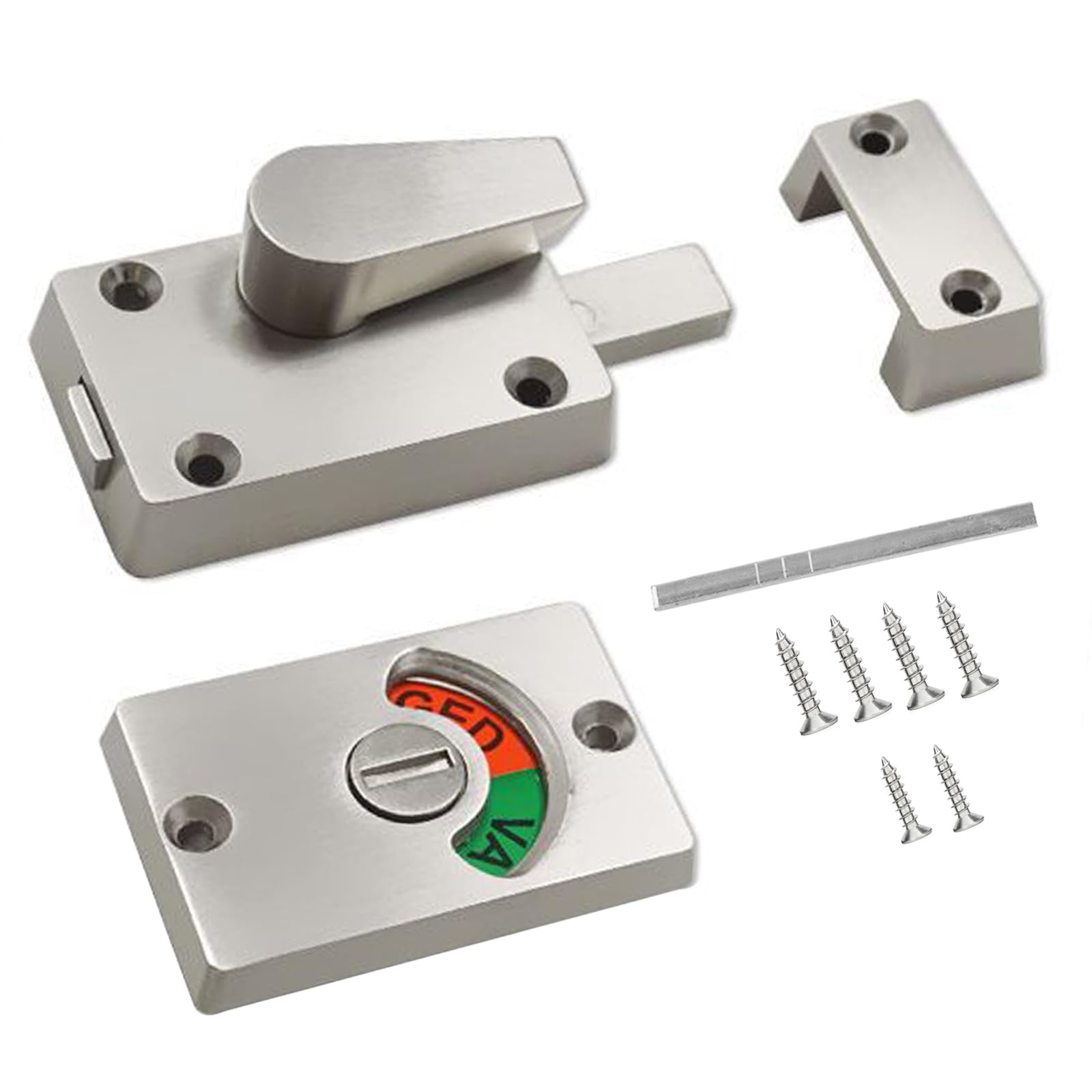
A compact silver indicator deadbolt that ships with its mounting screws in the box.
Mounting hardware in the box sounds like a small thing until you are holding an uninstalled latch at 9 p.m. This one includes the latch and the mounting screws together. In a category where several latches leave screws out, that alone changes the install from a project into a ten-minute job.
It is polished silver zinc alloy, 2.5 inches long by 1.4 inches wide, with a 3.1-inch latch arm and a 2.3 by 1.5 inch indicator plate that reads free in green and engaged in red. The door thickness band is 0.5 to 1.4 inches, the same range as its matte black sibling. It is a deadbolt-type latch, so the throw engages a keeper rather than a simple slide catch.
The footprint is the contrast worth knowing. This is a compact 1.4 x 2.5 x 3.1 inch body, while the LVOERTUIG indicator bolt comes in at 12.6 x 3.94 x 3.15 inches — a big size difference on the door face. If your partition has limited clear space around the latch, the compact shape here fits where the larger bolt would not. The listing is newer with a shorter review history, so treat it as a workable everyday latch rather than a battle-tested commercial one.
Standout detail: screws ship in the box, so the install is complete straight out of the package.
Set expectations: a newer listing with modest ratings behind it, best suited to normal-traffic doors.
Good fit for: someone with no spare screws and a standard panel who wants an indicator face fitted the same day.
Not the one for: a hard-used public bank where you want years of proven service on record.
7. Flylin Vacant Occupied Bathroom Lock

A deadbolt indicator lock specified for 12-18 mm door boards, with an emergency outside hole.
Thin boards are where indicator bolts go wrong. This one is specified for door boards between 12 and 18 mm thick — roughly 15/32 to 23/32 inch — so it seats on slimmer panels that a general-fit bolt would leave wobbling. Measure the board edge first; that thickness band is the whole compatibility story.
On that board it does two jobs at once. The vacant green and engaged red indicator tells everyone at a distance whether the restroom is free, which is what stops the knocking and the door-rattling. And there is an emergency hole on the outside face, so a door that jams shut can be opened from the corridor. That pairing — indicator plus outside release — is the useful combination for a shared facility. The zinc alloy body is described as anti-rusty with a smooth, wear-resisting surface.
At 4.0+ stars this is the best-scoring indicator lock in the group, though on a smaller set of ratings than the slide latches. It is a deadbolt type, so the throw locks into a keeper rather than sliding across a catch. Flylin pitches it at gyms, airports, railway stations, hospitals, restaurants, malls and offices, which tells you the target: doors that get used by people who have never touched them before.
Where it earns its place
- Specified for 12-18 mm boards — fits slim panels properly
- Emergency outside hole opens a jammed door
- Vacant/engaged indicator visible from a distance
- Top rating in this group of indicator locks
Know your panel
- Only works on 12-18 mm boards — check thickness before ordering
- Fewer ratings than the slide latches here
Built for: a thin partition panel that needs both a visible indicator and an emergency release.
Move on if: your door is thicker than 18 mm — this one is sized to the slim band.
8. ANTEISI Bathroom Stall Door Reinforcement Lock
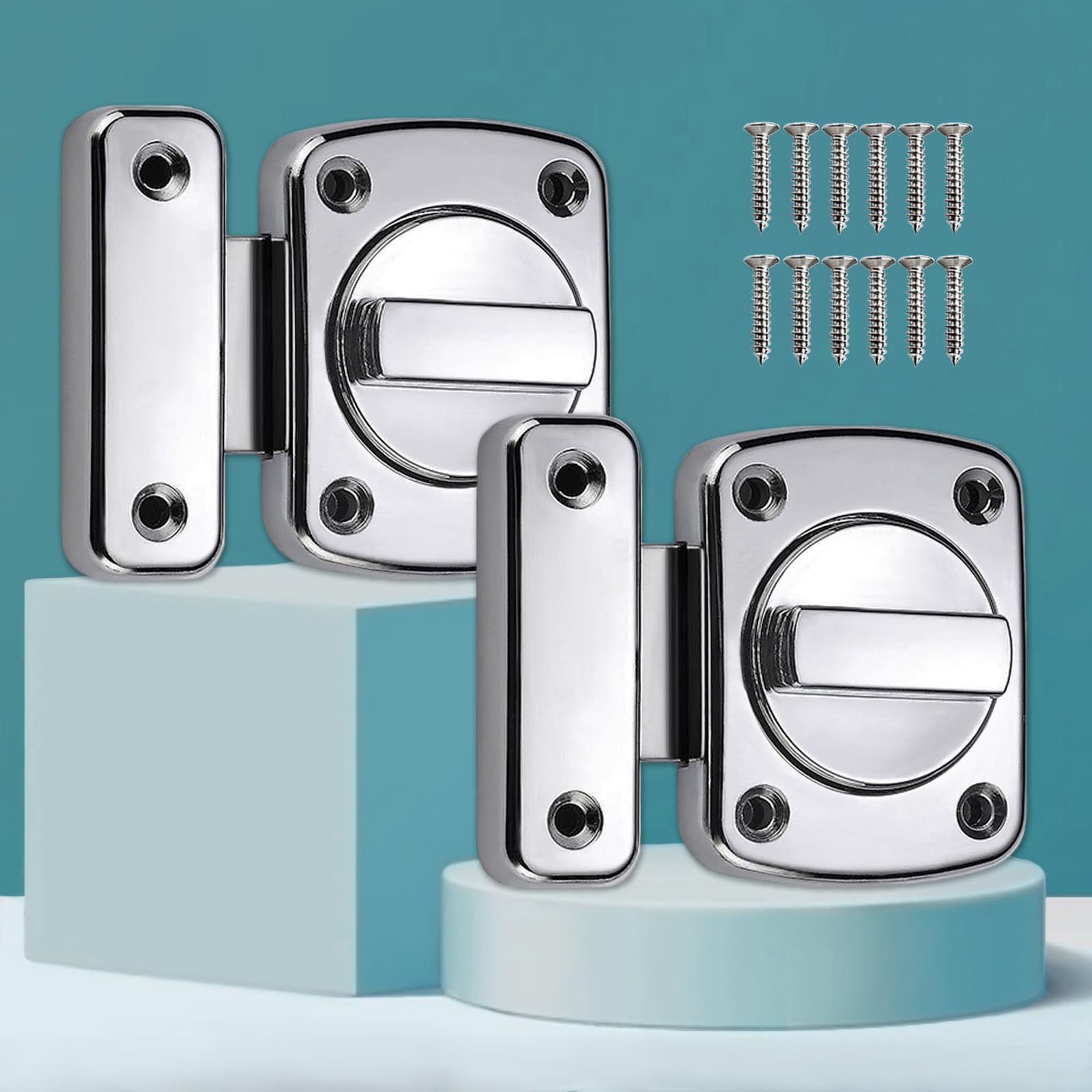
A zinc alloy sliding bolt that adds a second, pry-resistant point of hold on a wooden door.
Read the label carefully. This is an inner door reinforcement lock, a sliding bolt meant to add holding power rather than replace partition hardware. The zinc alloy body is built to resist deformation, and the thickened construction is described with anti-prying features for extra security. On a wooden door — a bedroom, a garage-side entry, a garden room — that extra bolt is the difference between a lock that gives and one that does not.
The clever bit is the two-way design. The slide supports a smooth 180-degree rotation, so it works on doors that open left or right without you working out which version to order. Screw installation mounts it flat to a single door. It comes as two pieces with the screw, so you have a spare or a second door to cover. At 7.36 ounces it has real weight behind the throw.
Sized at 2.3 x 2.16 x 0.39 inches, it is a slim bolt, not a face-plate indicator. It has no vacant/engaged display, so do not expect it to stop people knocking. What it does is add a second point of hold — and for a door where children, pets, or a determined shoulder are the concern, that extra hold is the whole point. It scores well at 4.0+ stars, though on a smaller set of ratings than the flagship slide latches.
What it actually does: a second sliding bolt that adds pry resistance and keeps kids and pets from working a door open.
Don’t confuse it: no indicator face, no visible vacant sign — this is hold, not signaling.
Right pick for: a wooden interior door that needs a second lock, especially where children or pets are the concern.
Wrong pick if: you need a partition latch with a vacant/engaged indicator — this one is a reinforcement bolt.
Understanding the Specs
Hole Centers and Mounting Spacing
Hole centers are the distance between the two screw holes a surface-mounted latch uses. Commercial slide latches often use 2-3/4 in. or 2-3/4″ center-to-center spacing. Match that figure to your existing holes and the swap is straightforward — you reuse the same drill points. Mismatch it and you are drilling fresh holes in a laminate panel, which risks cracking the core.
Door Thickness Range
Indicator bolts clamp over the panel edge, so they are built for a specific thickness band. You will see ranges like 0.5 to 1.4 inches and 12-18 mm on the listings. Measure the board edge with a ruler. A clamp on the loose end of its band can slide around, and one at the tight end may not seat at all. This figure decides fit more than any finish or color.
Slide Latch vs. Deadbolt Throw
A slide latch moves a flat bar across into a strike or catch, which is the classic partition setup. A deadbolt type throws a bolt into a separate keeper for a firmer hold. Neither is better in every case — slide latches suit a standard partition layout, and deadbolts give a more positive lock. Check which one your door already has holes for before you buy.
Zinc Alloy, Die Cast, and Chrome
Most stall hardware is zinc alloy or die cast zamac — a zinc mixture cast into shape so it holds form under repeated use. Chrome plating and satin nickel finishes sit on top to resist damp air and wiping. In a restroom the finish does real work: bare metal pits and discolors. Matte and satin finishes hide fingerprints and scuffs better than polished chrome.
FAQ
How do I know which slide latch fits my existing stall door holes?
Will a vacant and engaged indicator lock work on a thin partition panel?
Why do some stall latches not include screws?
What is the difference between a slide latch and a deadbolt stall lock?
Can a stall lock be opened from the outside in an emergency?
Should I buy a strike and keeper with a slide latch?
Is zinc alloy good for bathroom stall hardware?
Can a reinforcement lock replace a bathroom stall latch?
How thick should the door be for a surface-mounted stall latch?
Does a vacant indicator reduce knocking on the stall door?
Final Thoughts: The Verdict
For most people replacing worn partition hardware, the bathroom stall lock winner is the Harris Hardware TP5020-B because its die cast zamac body and 2-3/4″ hole centers make for a straight, sturdy swap that stops the rattle. If you want the whole package together, grab the ULWSKY Silver Latch Indicator — it ships with the screws. And for a thin partition board that needs both an indicator and an emergency release, the Flylin Vacant Occupied Lock is the one to reach for.
How We Picked
We do not accept paid placement. Every pick is matched to a real buyer and a real use-case; we do not hands-on test units.
Sources & Methodology
Specifications: manufacturer listings and product documentation. Review insights: verified customer reviews, as of November 2026. Pricing: not shown on this page (it changes often); check the current price via the retailer link.
As an Amazon Associate, Gadgets Feed earns from qualifying purchases. This does not affect which products we feature.