
Our readers keep the lights on and my morning glass full of iced black tea. As an Amazon Associate, I earn from qualifying purchases.
Specs are compiled from manufacturer listings and verified buyer reviews and can change over time — please confirm the key details on the product page before buying.
If you’re shopping for a home solar battery, the single most important decision isn’t the brand — it’s the voltage and capacity that matches your inverter and your daily energy use. Every pick below stores at least 5 kWh (that’s roughly a day’s worth of basics like lights, your fridge, and small appliances), and most go far beyond that. This guide breaks down nine real, buyable battery banks, explaining in plain English what each one does for you, what it costs in weight and complexity, and who it’s actually right for.
I’m Min — the founder and writer behind Gadgets Feed. This guide is built by comparing the manufacturers’ published specifications and the patterns across verified customer reviews, so you get each pick’s real strengths and trade-offs instead of marketing spin.
Here’s a heads-up: some picks come as multi-packs, so you’ll see combined capacities that add up over 5 kWh. The batteries for home solar decisions hinge on chemistry, cycle life, and how easily each unit expands — all covered below.
Our Picks at a Glance
How To Choose The Best Batteries For Home Solar
Before you compare amp-hours, you need to know your home’s daily draw and your inverter’s voltage. These two numbers determine everything else.
Match the Voltage to Your Inverter First
Your solar inverter — the box that turns DC from the panels into AC for your home — expects a specific battery voltage. If it’s a 48V system, you need 48V batteries; a 24V inverter needs 24V banks, and so on. Mixing voltages won’t just fail to work; it can damage equipment, so treat this as the non-negotiable first filter. The good news is that many modern batteries support both parallel (adding capacity at the same voltage) and series (combining to reach higher voltage) connections, but always confirm before you buy.
Capacity: Amp-Hours vs. Watt-Hours
You’ll see two numbers: amp-hours (Ah) and watt-hours (Wh). Amp-hours measure the charge, but watt-hours are the real-world energy — multiply volts by amp-hours to get watt-hours (e.g., a 51.2V × 100Ah battery = 5120Wh). A 5 kWh battery can run a 500-watt fridge for about 10 hours, or a 1000-watt microwave for about 5. Always compare watt-hours when judging how long your home stays powered.
Chemistry and Cycle Life
All the picks here use LiFePO4 (lithium iron phosphate), the safe, long-lived chemistry that’s become the standard for home storage. It’s prized for two reasons: it’s chemically stable (won’t catch fire easily), and it lasts for thousands of charge/discharge cycles. While lead-acid batteries might give you 200-500 cycles, LiFePO4 batteries typically offer 4000+ cycles at full depth of discharge — meaning over a decade of daily use before they degrade. That’s the single biggest reason lithium is worth the higher upfront cost for solar.
Quick Comparison
| Model | Best For | Voltage | Capacity | Weight | Amazon |
|---|---|---|---|---|---|
| ECO-WORTHY Cubix100★ Best Overall | Certified whole-home backup | 51.2V | 100Ah / 5120Wh | 100 lbs | Amazon |
| 2 Packs 12V 200AhBest Value | RVs and trolling motors | 12.8V | 400Ah / 2560Wh | 89.1 lbs | Amazon |
| VEVOR 24V 200AhTop Performer | Flexible high-energy builds | 24V | 200Ah / 5120Wh | 76.5 lbs | Amazon |
| DUMFUME 12V 600Ah | Bulk budget capacity | 12.8V | 600Ah / 7200Wh | ~108 lbs | Amazon |
| DUMFUME 12V 600Ah IP65 | Weather-tolerant solar banks | 12.8V | 600Ah / 7680Wh | ~108 lbs | Amazon |
| HumsiENK 48V 100Ah | Smart active-balancing racks | 48V | 100Ah / 5120Wh | 96.45 lbs | Amazon |
| Litime 12V 460Ah 2Pack | High-drain off-grid living | 12.8V | 920Ah / 11600Wh | 172 lbs (2×86) | Amazon |
| HumsiENK 48V 300Ah | Whole-house, one-unit power | 48V | 300Ah / 15360Wh | 260 lbs | Amazon |
| LiTime 4 Pack 24V 230Ah | Massive scalable solar arrays | 24V | 920Ah / 23552Wh | 331.6 lbs (4×82.9) | Amazon |
In‑Depth Reviews
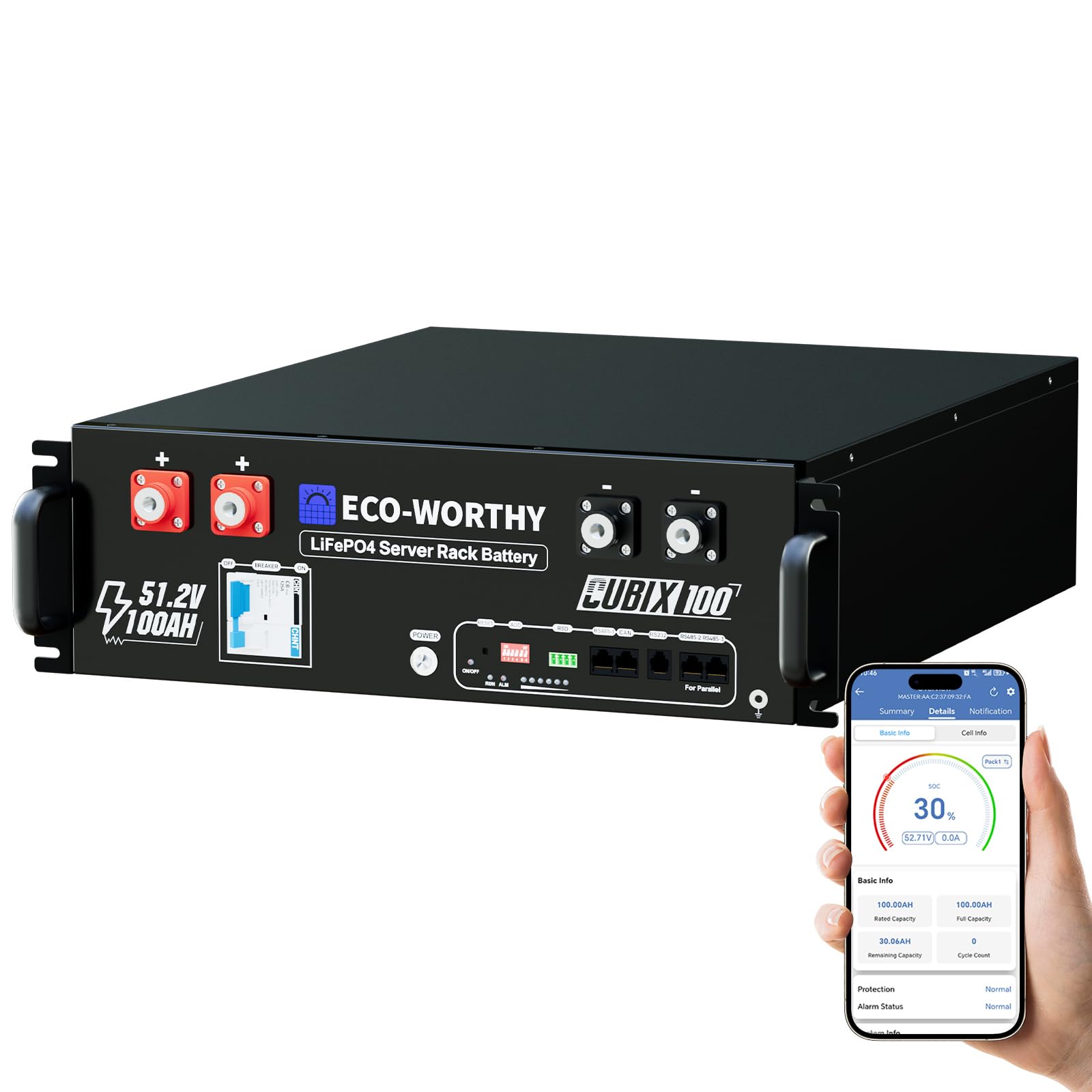
1. ECO-WORTHY Cubix100 48V 100Ah LiFePO4
Our pick — over 4.5★ from 300+ verified ratings; the strongest balance of quality and price.
The certified-capable rack unit that gives a 48V system serious, expandable muscle.
Safety certifications are the first thing to verify on a home battery that lives inside your living space, and this ECO-WORTHY ticks all the big boxes: it’s UL9540, UL1973, and CEC listed. Those aren’t just sticker badges — they mean Intertek tested it for electrical safety and thermal runaway management, so it meets the standards the California Energy Commission expects. It’s the peace-of-mind pick for a permanent home installation.
It stores 5120Wh of energy in a 51.2V, 100Ah package, and the closed-loop communication (via CAN/RS485 ports plus Bluetooth and WiFi) lets it talk to leading integrated solar inverters for smarter operation. Buyers report it pairs cleanly with EG4 6000XP and Sungold 10kW inverters, with one buyer powering a 3-bedroom home off-grid with zero issues after a month. One buyer even used it as an add-on to a Bluetti Apex 300 with a modified cable, noting “capacity nearly tripled” and good SOC (state of charge) tracking.
Physically, it’s a server-rack design that weighs 100 pounds — heavy, but it’s meant for vertical mounting where space is tight. The plug-and-play kit includes parallel cables, communication cables, grounding wires, and terminal covers, so you’re not hunting for parts. If you want to grow later, you can parallel up to 32 units for a massive 163.8kWh system. A 10-year limited warranty backs the Grade A LiFePO4 cells.
High voltage capacity
- Battery quality and performance dominate the feedback — over 100 owners single these out as the top strengths
- Value for money is praised by 40 owners for what a 5kWh battery delivers
- Bluetooth monitoring via the app, though basic, gives you live state-of-charge data
Heavy unit weight
- No on-unit screen — you get LEDs only, so remote monitoring is via app or communication ports
- Communication features get mixed feedback; the app lacks time-left and charge-time estimates
big solar setups: you want a certified, rack-mountable 48V battery with room to scale to a massive system, and you value safety certifications over a built-in screen.
tight spaces: you need a quick glance at the battery’s status without pulling out your phone — there’s no display here.
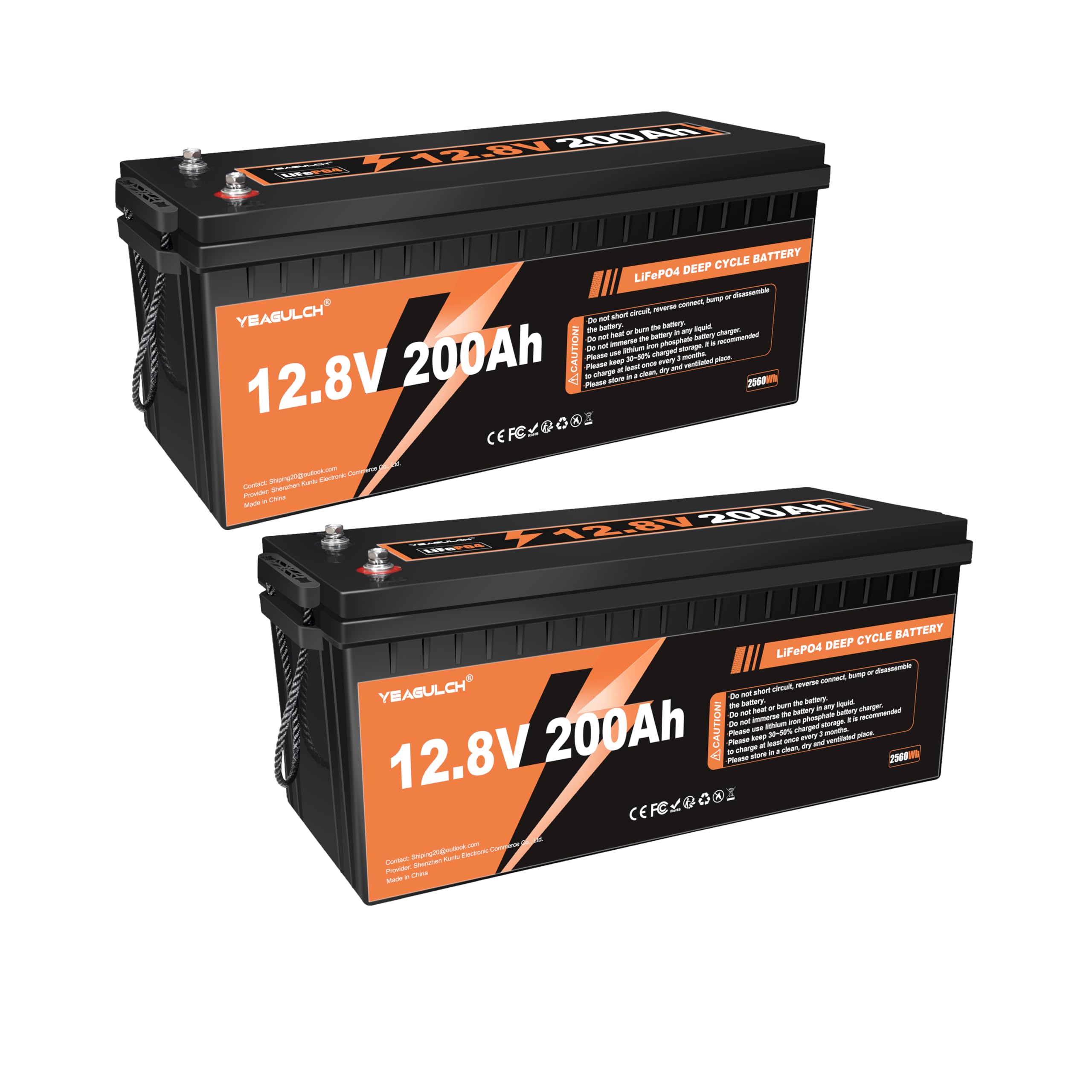
2. 2 Packs 12V 200Ah LiFePO4
A lightweight 12V workhorse pair that’s a gentle giant for boating and RV life.
If your setup is a 12V system, this two-pack gives you 2560Wh of total energy — but the real star is the weight. Each 200Ah module weighs 58.86 lbs, which the maker says is about 1/3 lighter than the same capacity lead-acid battery. Owners feel that difference immediately: one buyer on a 10′ pontoon noted the lithium delivers a 10% speed boost and has lasted “at least 4 outings without recharge,” while another ran an 80lb trolling motor for a 3-day trip without needing a charge. The whole pair combines to 89.1 pounds.
The built-in 200A BMS (Battery Management System) protects against overcharging, overdischarging, overcurrent, overheating, and short circuits — the standard safety net you want. The ABS shell carries an IP67 waterproof rating, so it shrugs off damp marine environments and outdoor installs. Maxing out the cycles, the maker rates this for 4000 cycles at 100% depth of discharge, 6000 at 80%, and up to 15000 at 60% — a decade-plus of daily cycling versus lead-acid’s 200-500.
What wins people over is the blend of quality and price. That said, reliability is the most-discussed topic here, with a few owners reporting units that stopped working after about a week — so buy from a seller with a responsive support line and test your units right away. The 12.8V voltage means it’s not the right pick for a 48V home inverter without series wiring.
dual battery banks: you run a 12V trolling motor, boat, or RV and want serious runtime at a light weight — the 70-80lb thrust motor crowd is clearly thrilled.
single battery needs: reliability is your top fear; a small number of owners had early failures, so verify your warranty path before relying on it for critical home backup.
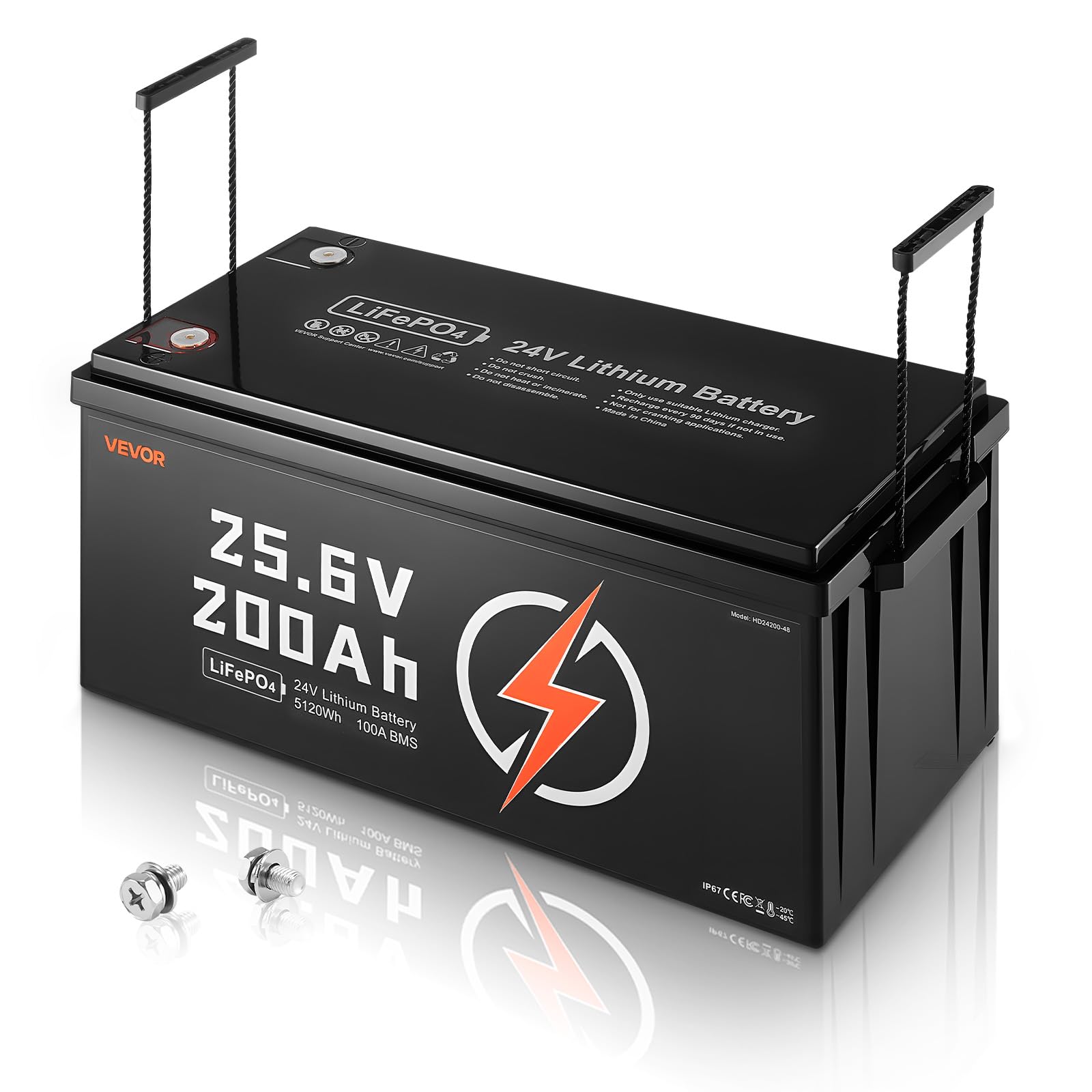
3. VEVOR 24V 200Ah LiFePO4
A 5120Wh 24V bank that charges in 5 hours flat — built for travelers who hate downtime.
This VEVOR stores a full 5120Wh of energy (200Ah at 24V) — exactly double the 2560Wh you’d get from the 12V two-pack above — yet it weighs 76.5 pounds, which is lighter than that pair. That energy-to-weight ratio makes it a smart choice for an RV, camper, or compact off-grid cabin where every pound of payload matters. The 24V setup also means thinner, cheaper wiring for the same power delivery.
The headline feature is fast charging: it fully charges in 5 hours, so a solid day of solar can top it off well before you need the power at night. The built-in 100A BMS (Battery Management System) guards against overcharge, over-discharge, overcurrent, high heat, and short circuits, and there’s low-temperature protection for cold-weather charging — a key detail if you’re storing it in an unheated garage or RV in winter. With 4000+ cycles rated, it’s built for years of daily use.
Expansion is where this shines for home solar: you can scale it up to 20.48 kWh of storage to make your backup system genuinely dependable. Buyers who’ve owned it for over 8 months report zero problems and are buying more to stack. It’s a 24V system though, so if your inverter is 48V, you’d need two in series to match.
off-grid cabins: you want a middle-voltage 24V bank with rapid 5-hour charging and the option to expand past 20 kWh for a serious home backup setup.
portable builds: your inverter runs on 48V natively — you’d need to pair two of these in series, which adds cost and wiring.
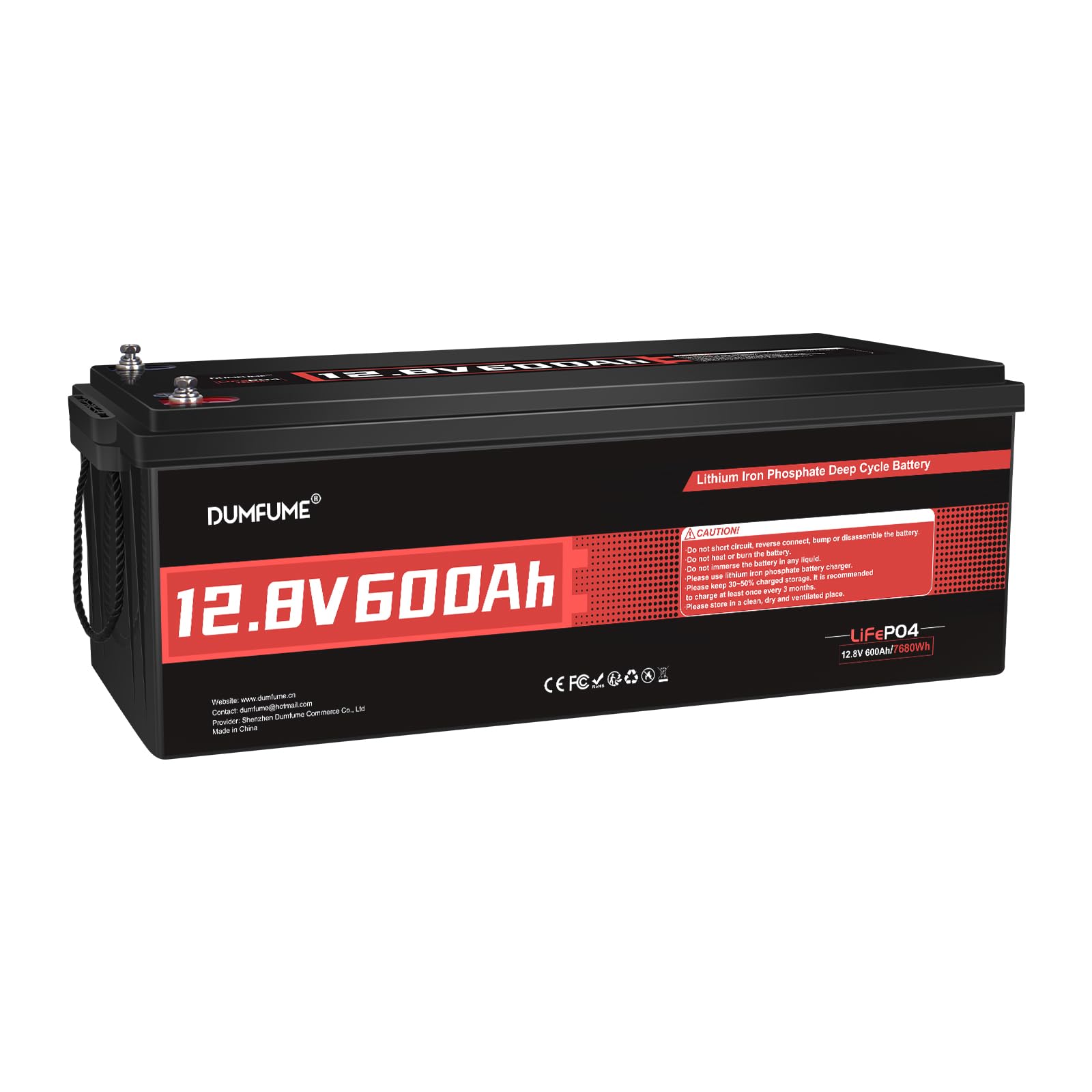
4. DUMFUME 12V 600Ah LiFePO4
A single 7200Wh cell that replaces a whole rack of smaller batteries for basic home needs.
This DUMFUME is a 12V 600Ah monster storing 7200Wh — roughly a full day’s basic household power (think lighting, a fridge, and small appliances) in one unit. It weighs 49 kg (about 108 lbs), and the maker notes it’s lighter than paralleling multiple lead-acid batteries to hit the same capacity. For a small home solar project that just needs to keep the essentials alive through the night, this is one uncomplicated box to wire up — owners say the terminals are easy to connect.
The built-in 200A BMS (Battery Management System) covers the usual protections — overcharge, over-discharge, over-current, overheating, short circuits — and adds low-temperature cutoff that disconnects charging below 0°C and discharging below -20°C, so winter cold won’t damage the cells. It’s rated for 4000+ cycles at 100% depth of discharge, 6000 at 80%, and 15000 at 60%, with a 10-year lifespan claim versus lead-acid’s 3 years. The 12V platform also means you can wire multiple in parallel for more capacity, or in series to build a 24V or 48V bank.
Performance and build quality are the two things owners praise most — over 130 buyers collectively. But charging capacity and battery life both get mixed reviews, so it’s fair to say consistency varies; some owners mention it not lasting as long as hoped, and one noted a dead battery after a year. It’s a great value for the raw watt-hours per dollar, but buy it knowing the long-term track record is less proven than premium brands.
long off-grid trips: budget-minded 12V solar setups that need one massive bank to run lights and a fridge, and owners comfortable with a no-frills, non-smart battery.
frequent moving: given the mixed long-term battery-life reports, treat the 5-year warranty as essential — and confirm it applies to your purchase channel.
5. DUMFUME 12V 600Ah LiFePO4 IP65
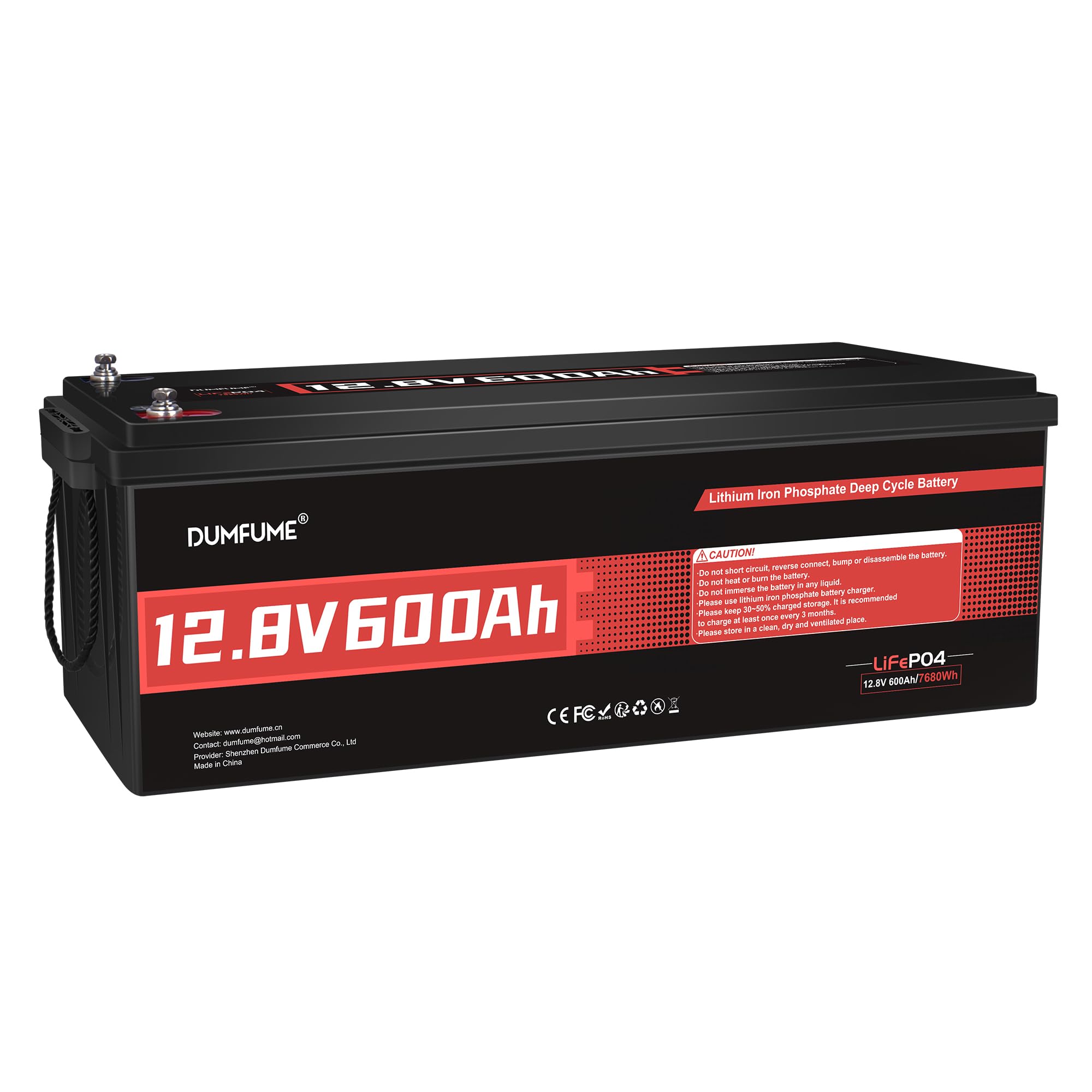
The 7680Wh sibling with an IP65 shield — built to sit in damp, dusty, or outdoor spots.
This is the weatherproof version of the 600Ah DUMFUME, and the key upgrade is the IP65 rating — meaning it’s protected against dust and low-pressure water jets. If your battery lives in a boat, an unsealed shed, or a semi-open camper bay, that sealing matters. It stores even more than its sibling at 7680Wh, and one owner described it as “lot of energy in a small package” — exactly the right frame for how much punch fits in this box.
The smart 200A BMS (Battery Management System) adds a dual low-temp cutoff — it disables charging below 0°C and discharging below -20°F, protecting the cells in extreme weather. The maker rates this for 4000+ cycles at 100% depth of discharge (6000+ at 80%), and it weighs 48.9 kg (about 108 lbs) — roughly half the weight of lead-acid equivalents. Owners confirm it holds a charge well and runs appliances like fridges and slides for days.
Battery quality and performance are the clear highlights, with over 80 positive mentions between them. Battery life, though, is the most-discussed mixed topic — several customers note it “doesn’t last very long” in use, which is a real flag for a high-ticket purchase. One unhappy owner hit a wall with a defective BMS and found the third-party seller unresponsive, so verify the seller’s support reputation before committing. One owner happily runs three of these in a 48V setup to power mini-split air conditioners.
outdoor installations: you need a big 12V bank that can handle damp and dusty conditions, and you’re powering loads like fridges or mini-splits.
budget builds: you can’t tolerate any risk of an early failure — the mixed battery-life reports mean a responsive seller and solid warranty are must-haves, not nice-to-haves.
6. HumsiENK 48V 100Ah LiFePO4
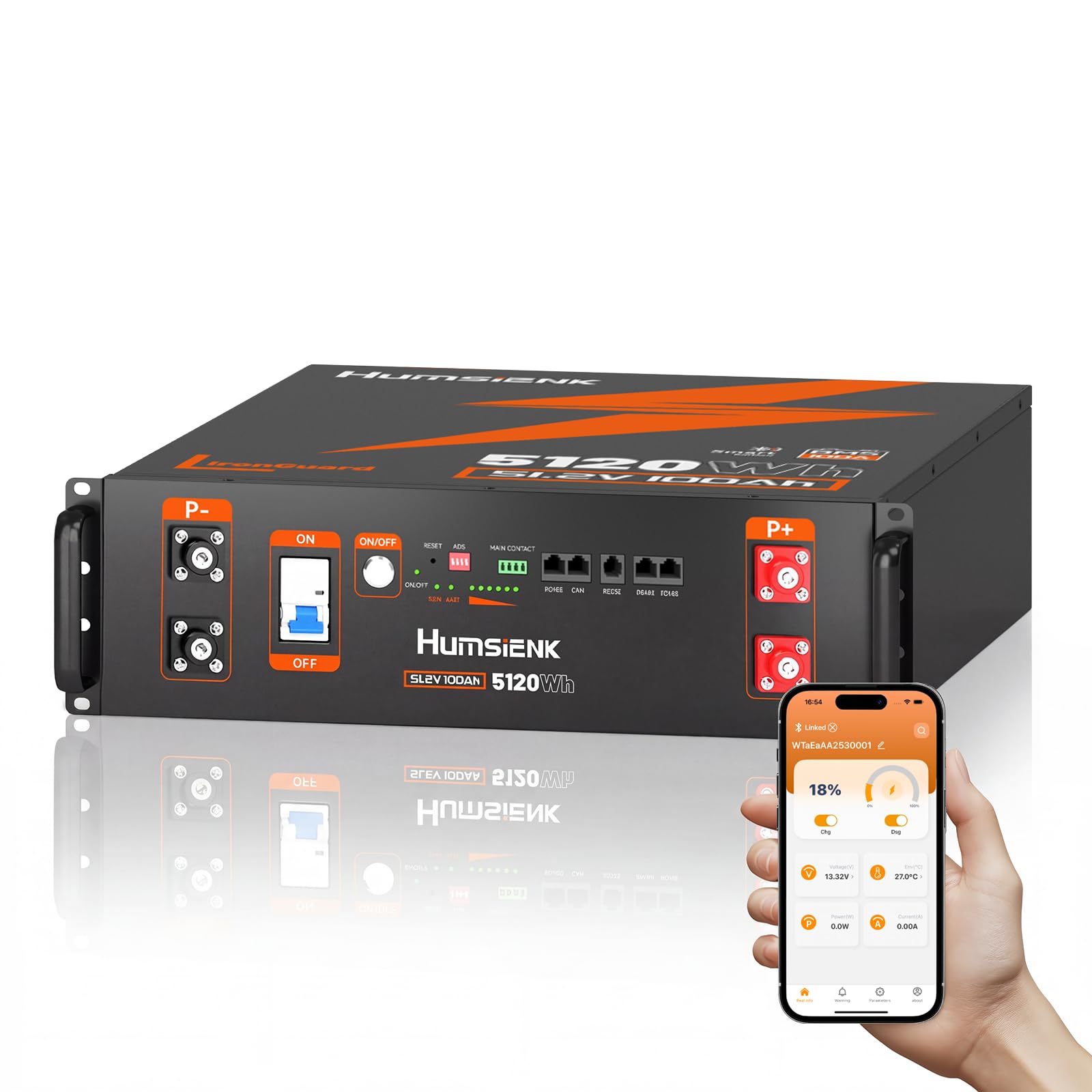
A 48V rack unit with premium BYD cells and 3A active balancing for maximum longevity.
What sets this 48V 100Ah server-rack battery apart is what’s inside: BYD LiFePO4 cells. BYD is one of the world’s largest EV battery makers, and the brand choice signals quality before you even check the specs. It’s UL 1973 tested for safety, and the 100A BMS (Battery Management System) protects against overcharging, over-discharging, overload, and short circuits, with low-temp cutoff and overheat protection for extreme climates.
The active balancing is the tech to understand: at up to 3A of balancing current, it continuously equalizes the voltage across all cells, which reduces energy loss and extends the whole pack’s life. It stores 5120Wh and can output 5120W continuously — enough to run high-power appliances for extended periods. That’s why owners use it for serious loads: one paired it with a Pecron FP3000LFP and runs a gas furnace and an on-demand water heater, ready for any outage. Another calls it “the best batteries on the market at the time.”
It’s a compact 3U rack design (17.32″ x 19.69″ x 5.24″) at 96.45 lbs — the maker says it’s 60% lighter and 33% smaller than four 12V 100Ah lead-acid batteries. You can stack up to 20 units in parallel for a full 102.4kWh system, with automatic addressing that identifies the host and slave units. The mobile app gives you live voltage, current, and capacity, and it supports CAN, RS232, and RS485 protocols for inverter compatibility. It comes with a 10-year limited warranty.
Owners love the build and the value — one bought two and installed them in parallel to a bus bar for a 10kWh shop setup. The one recurring note is that if you mix this battery with a different brand in parallel, the indicator lights may not work (the batteries themselves still function fine). It’s a small quirk for a 48V system owner mixing brands.
small solar homes: 48V solar builds where cell quality and long-term balancing matter more than the lowest price, and you want app-based monitoring.
high-draw loads: stick to HumsiENK units when paralleling to keep the indicator lights and communications working as intended.
7. Litime 12V 460Ah Group 8D (2Pack)

A 250A BMS and 100% usable capacity make this the go-to for heavy off-grid draw.
When you need to push serious current — think a 3000-watt inverter, running an air conditioner, or a full off-grid cabin — the BMS (Battery Management System) rating becomes the limiting factor. This Litime two-pack carries a 250A BMS, which is the highest continuous rating on this list, so it can feed high-demand devices without tripping. That’s the engineering reason owners confidently run big loads: one runs a 3000-watt inverter off it, and another let the 460Ah bank run AC all night on 560W of solar.
Each battery holds 460Ah and delivers 5.8kWh of energy, so the pair gives you 11.6kWh total. The maker emphasizes 100% DOD (depth of discharge) — you can use the full capacity while staying above 12.8V, which is nearly twice the usable energy of lead-acid. EV-grade cells and the 250A BMS deliver “safer, more stable power,” and owners confirm the build quality and lighter-than-AGM weight (86 lbs each). The convenient lugs make connections easy.
Quality is the #1 praise (45 owners), with value for money right behind (34). The battery-life score is the most-discussed item, though — and it’s marked mixed, so it’s honest to note some reviewers point out shorter-lived performance than expected. One owner swapped 2×80Ah lead-acid for a 320Ah LiTime setup and came back from a 4-day off-grid trip with 55% remaining — no generator needed. If you want expandability, this supports up to 4P4S, and it’s covered by AIG Product Liability Insurance effective May 22, 2026.
marine replacements: you plan to power a high-wattage inverter or run your home essentials overnight off 12V — the 250A BMS is the enabler.
compact layouts: the mixed battery-life signals mean you should buy with a clear warranty path, even though build quality earns strong praise.
8. HumsiENK 48V 300Ah LiFePO4
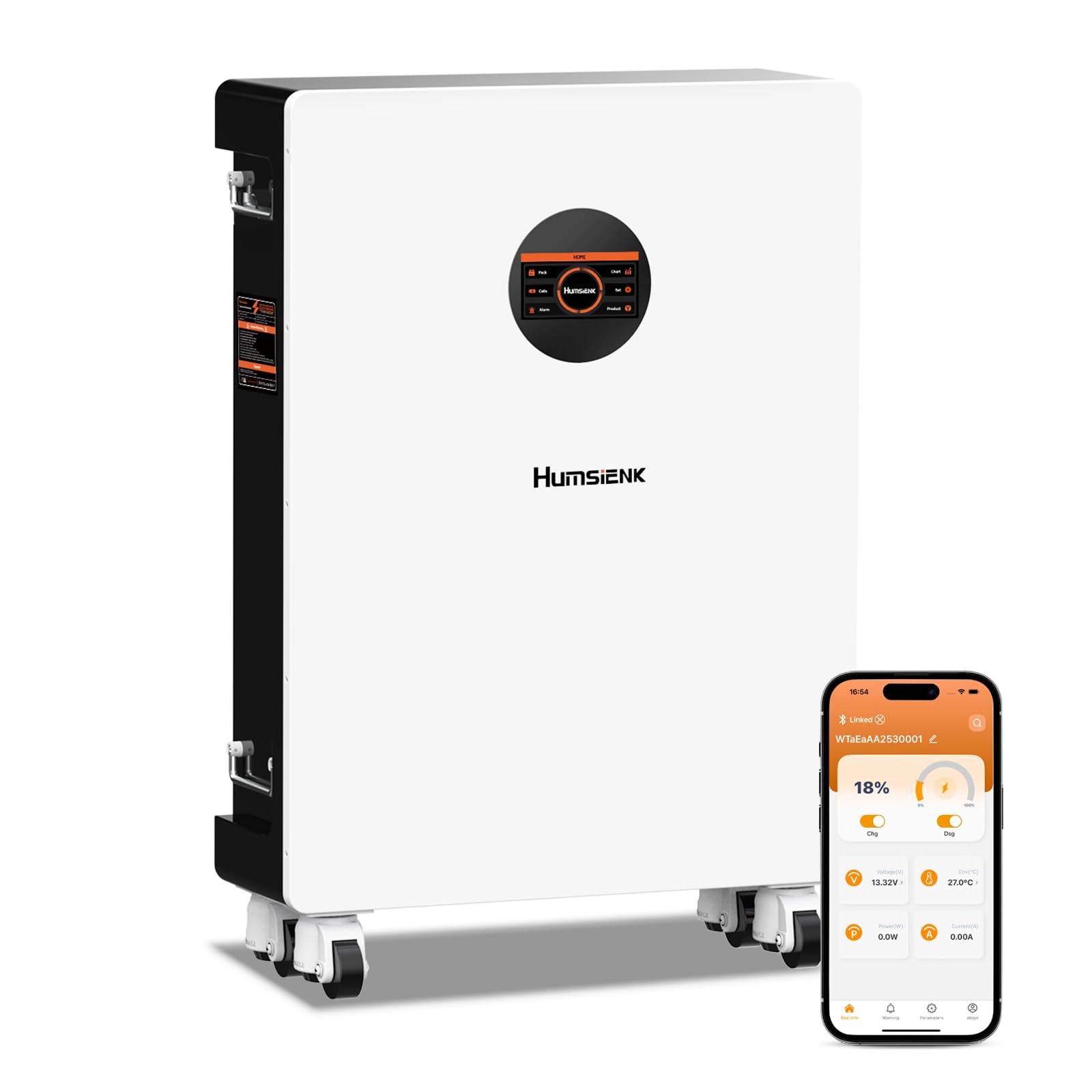
One 15.36kWh unit with built-in wheels — the whole-house backup without stacking six racks.
If your goal is whole-house backup and you want to avoid the complexity of wiring multiple 100Ah units in parallel, this HumsiENK is the shortcut. A single 48V 300Ah battery stores 15.36kWh — equivalent to three traditional 48V 100Ah batteries in parallel. It ships on a pallet via freight (so confirm your driveway fits a truck) and weighs 260 pounds, but it comes with built-in heavy-duty casters so you can roll it into place. The maker says it’s 30% thinner than traditional storage batteries.
Inside are automotive-grade A cells rated for 6000+ deep cycles at 80% DOD — that’s decades of daily service. The 200A BMS (Battery Management System) supports high-power inverters in the 7-10kW range and handles sudden surge currents like motor starts without dropping out. One buyer runs it with a 7000-watt inverter and liked it so much they planned a second unit. You get Bluetooth and an LCD screen for real-time status, plus CAN, RS485, and RS232 ports for integration with Victron, Growatt, and SRNE inverters — and you can parallel up to 15 units for a 230.4kWh system.
The active balancing triggers at a 15mV cell difference, keeping cells consistent to boost longevity. Charging works from 32°F to 131°F and discharging from -4°F to 140°F, so it handles most climates. Owners praise the quality and speed of delivery — one was impressed enough to call it “lo mejor que he visto en el mercado.” The honest catch: customer service gets dinged as slow to respond, with one owner hitting a frustrating dead end on a charging issue. It’s a 260-pound commitment, so delivery logistics and support responsiveness are real considerations.
whole-home backup: you want massive 15.36kWh storage in a single mobile unit, with Bluetooth and LCD monitoring, and you have the floor space and truck access to accommodate it.
small setups: you need a responsive, hands-on support team or you’re tight on space and can’t handle a 260-pound freight delivery.
9. LiTime 4 Pack 24V 230Ah LiFePO4
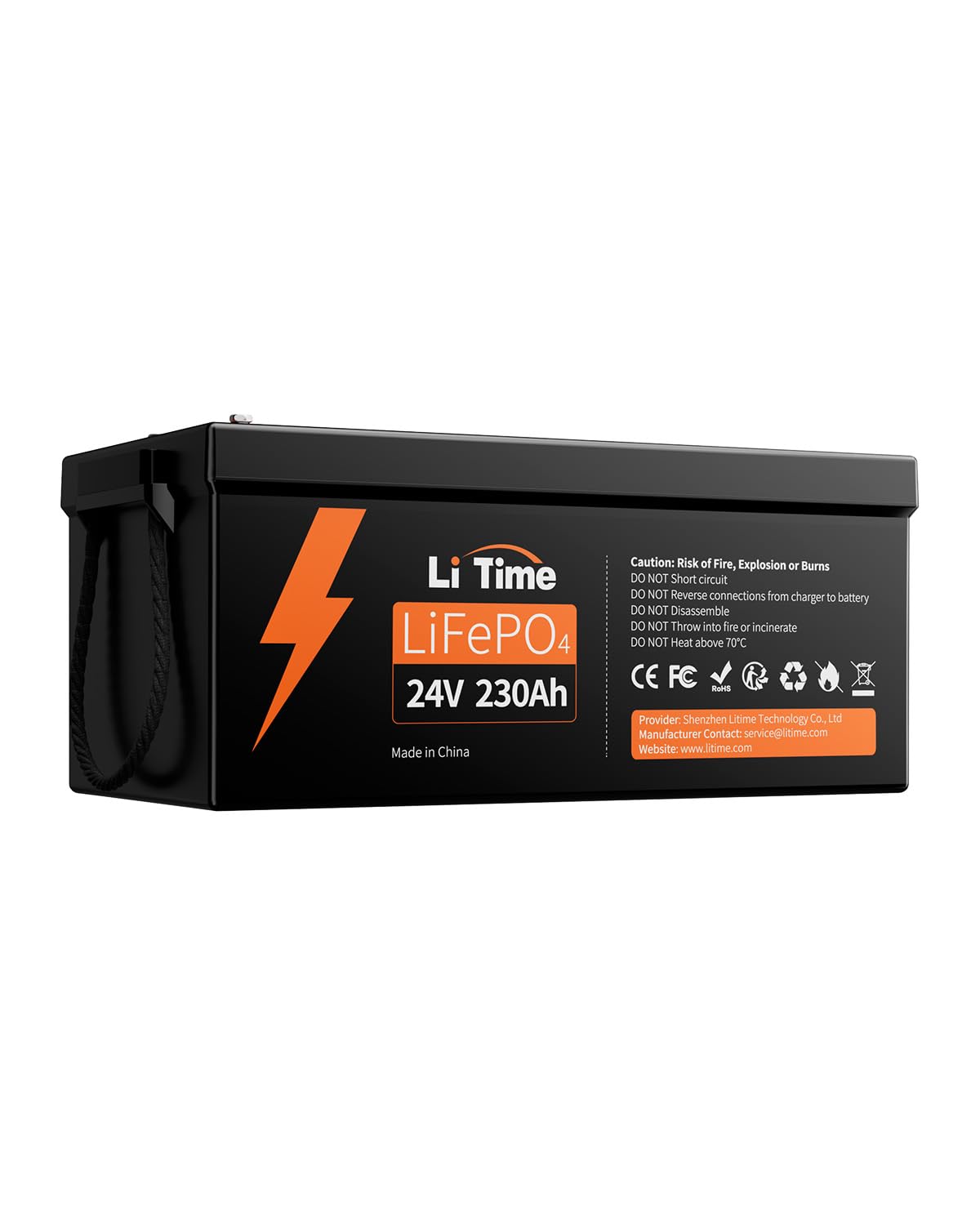
Four 24V 230Ah batteries combine into a 23.5kWh fortress — the serious solar array starter.
This is the “go big or go home” option for solar. Each of the four LiTime batteries holds 230Ah at 24V (5888Wh each), so the pack totals a massive 23.5kWh — enough to run a large home through multiple grid-down days. One owner bought six of these for a full solar array and called them “perfect and low-maintenance,” noting the non-smart, non-Bluetooth design means “less to go wrong.” That’s the philosophy here: simple, reliable, enormous capacity.
Each battery integrates a 200A BMS (Battery Management System) with over 20 protection functions, and the chemistry is rated for 4000+ cycles at 100% DOD, 6000 at 80%, and 15000 at 60% — a solid decade of service. The IP65 rating and flame-retardant ABS case allow for indoor or outdoor placement in varied conditions. At 82.9 lbs each, they’re 33% lighter and 20% smaller than equivalent 24V lead-acid batteries, which makes the huge total weight (331.6 lbs for all four) more manageable and the wiring easier in tight RV or cabinet spots.
Owners are effusive: one converted their RV to lithium house batteries and called them “incredible,” citing review videos they’d watched before choosing. Another uses them for a floor scrubber and is hoping for long-term performance. The one recurring note is that they’re big and heavy compared to 12V versions — obvious, but worth stating for physical handling. You can wire them up to 4P2S for flexibility, and the product is covered by AIG Product Liability Insurance effective May 22, 2026.
multi-bank systems: you’re building a large home solar or off-grid system and want maximum capacity with minimal electronics to fail — the no-Bluetooth simplicity is a feature, not a flaw.
minimalist builds: you need per-battery app monitoring or you’re short on physical strength and space — these are heavy, bulky units best placed once and left alone.
Understanding the Specs
Voltage (V) — The Inverter’s Language
Your inverter demands a specific battery voltage: 12V, 24V, or 48V. This is the first compatibility gate. A 48V system runs thinner, safer wiring and is the standard for whole-home setups, while 12V is common in RVs and small cabins. You can sometimes change voltage by wiring batteries in series (adding voltages) or parallel (adding capacity), but always confirm your inverter and BMS support the configuration before buying.
Capacity (Ah & Wh) — How Long You’re Powered
Amp-hours (Ah) alone don’t tell you the energy; multiply by voltage to get watt-hours (Wh), the real measure of stored energy. A 51.2V × 100Ah battery stores 5120Wh, enough to run a 500-watt fridge for about 10 hours. When comparing batteries, always compare watt-hours side by side. For a whole home, you’ll typically need 10-20 kWh; for essentials-only backup, 5-10 kWh often suffices.
FAQ
What does BMS mean and why is it critical in a solar battery?
How do I know if a battery is compatible with my existing solar inverter?
How many cycles will a LiFePO4 battery last for home solar use?
Can I add more batteries later to expand my solar storage?
What is IP65 or IP67 waterproofing and do I need it?
How much does a home solar battery weigh and how do I move it?
Is a 12V battery stack better than a single 48V battery for home use?
What is depth of discharge (DOD) and why does it matter for battery life?
Does my solar battery need Bluetooth or an app?
What happens if I mix different brands of solar batteries in one bank?
Final Thoughts: The Verdict
Across the board, the batteries for home solar winner is the ECO-WORTHY Cubix100 because it combines critical UL and CEC safety certifications with a 5120Wh capacity and a 10-year warranty — the full package for a permanent home install. If you want a single massive unit to power your whole house without stacking racks, the HumsiENK 48V 300Ah delivers 15.36kWh on wheels. And for the budget-conscious 12V setup that just needs to keep the fridge running, the DUMFUME 12V 600Ah offers the most watt-hours per dollar — the crowd favorite across nearly a thousand owners at 4.4 stars.
How We Picked
We do not accept paid placement. Every pick is matched to a real buyer and a real use-case; we do not hands-on test units.
Sources & Methodology
Specifications: manufacturer listings and product documentation. Review insights: verified customer reviews, as of August 2026. Pricing: not shown on this page (it changes often); check the current price via the retailer link.
As an Amazon Associate, Gadgets Feed earns from qualifying purchases. This does not affect which products we feature.