
The promise of a battery-powered air conditioner sounds like the ultimate summer hack: cold air anywhere, no window required. But the reality is that the term “battery-ready” spans a shocking range of designs — from evaporative fans that simply blow room-temperature air over a wet pad, to 12V DC rooftop units that pull your van’s lithium bank down by the amp-hour. The wrong choice leaves you sweating through a power failure or hauling a 40-pound brick that barely cools a tent.
I’m Min — the co-founder and writer behind Gadgets Feed. For this guide, I spent hours cross-referencing cooling capacity measured in BTUs, power draw in watts per hour, battery compatibility in amp-hours, decibel ratings for sleep, and real-world user data from van lifers, campers, and homeowners facing grid outages to find the true best battery air conditioner for every scenario.
Whether you need frosty air in a rooftop RV unit or a portable solution that runs off a solar generator, the right model depends on understanding compressor type, required battery size, and the difference between evaporative and true compressor-based cooling.
How To Choose The Best Battery Air Conditioner
The market is split into two distinct worlds: evaporative coolers that rely on water and ambient humidity, and true compressor-based AC units that use refrigerant and require serious battery power. Your first decision is knowing which world fits your use case.
Compressor Type: Evaporative vs. Refrigerant-Based
Evaporative coolers use a fan to pull air through water-saturated pads. They are cheap and sip power (often 50W–100W), but they only work in low-humidity environments. In muggy climates, they just move air. True compressor units use refrigerant and a sealed system to actually remove heat from the air. These are the only real “air conditioners” and produce genuine cold air regardless of outdoor humidity, but they draw 250W–700W depending on size.
Power Consumption and Battery Sizing
For true battery-powered operation, you need to know your system’s voltage. A 12V DC unit can be wired directly to a house battery bank without an inverter, avoiding conversion losses. A 120V AC unit requires a pure sine wave inverter and a larger battery — a 400W load on a 12V system pulls about 33 amps. To run all night, you need a battery bank sized at roughly 3 times the hourly draw times the number of hours. A 400Ah LiFePO4 battery at 12V provides about 4800 watt-hours, enough for roughly 10 hours on a 400W unit or 6 hours on a 600W unit.
Cooling Capacity vs. Covered Area
Cooling capacity is measured in BTUs (British Thermal Units). An evaporative cooler moving 2500 CFM of air may feel cool in dry air but will never match a true 3500 BTU AC that actually removes heat. A true 3500 BTU unit handles a tent or small RV cabin up to about 65 square feet. A 6100 BTU unit covers 120 to 180 square feet. A 10,000 BTU roof unit is designed for the full interior of a small van or RV. Over-spec your unit for the space — running a big unit at low power is quieter and more efficient than running a small unit at max.
Quick Comparison
On smaller screens, swipe sideways to see the full table.
| Model | Category | Best For | Key Spec | Amazon |
|---|---|---|---|---|
| BougeRV PC35 | Compressor AC | Small tents & RVs | 3500 BTU / 480W draw | Amazon |
| BODEGACOOLER 6000 | Compressor AC | Tents & small cabins | 6000 BTU / 440W draw | Amazon |
| Gidrox 12V 10000 BTU | 12V Roof AC | RVs & camper vans | 10000 BTU / 350W ECO | Amazon |
| Contrymod 12V 10000 BTU | 12V Roof AC | RVs & vans | 10000 BTU / 300W ECO | Amazon |
| Outequip 12V 10000 BTU | 12V Roof AC + Heat | RVs, vans, tractors | 10000 BTU / 200W ECO | Amazon |
| EcoFlow WAVE 3 | Portable Compressor AC | Tents, vans, camps | 6100 BTU / 400W draw | Amazon |
| Lifecreek Evaporative | Evaporative Cooler | Dry-climate rooms | 3.2 gal tank / 65 dB | Amazon |
| YIJU Evaporative | Evaporative Cooler | Bedrooms, garages | 2.5 gal tank / 2500 CFM | Amazon |
| TOSOT Aoraki Mini-Split | Mini-Split | Permanent home/garage | 12000 BTU / 20 dB in/52 dB out | Amazon |
In‑Depth Reviews
1. EF ECOFLOW WAVE 3

The EcoFlow WAVE 3 is the most versatile battery-powered AC on the market. It produces genuine compressor-based cooling at 6100 BTU — enough to drop the temperature in a tent or small camper by 15°F in about 15 minutes. Unlike evaporative units, it works in any humidity, making it reliable for muggy summer camps and vanlife in coastal regions. The integrated 1024Wh LiFePO4 battery delivers up to eight hours of cordless runtime on eco mode, and its 1000W fast charging can refill that battery from empty to full in roughly 75 minutes.
It also doubles as a heater with 2000W heating capacity, raising the vent temperature by 17°F within 15 minutes. The app controls are comprehensive — you can set timers, monitor battery, toggle between cooling, fan, dehumidifier, heating, and sleep modes, and even activate PetCare mode to remotely cool the cabin for a pet left behind. Noise is rated at 44 dB in sleep mode, quiet enough for undisturbed rest inside a tent or van.
Owners report it pairs seamlessly with EcoFlow Delta power stations via the Extra Battery Cable, extending runtime to roughly 11 hours on a Delta 2 Max setup. It’s expensive compared to basic evaporative coolers, but for true cordless, humidity-independent cold air in a compact 40-pound package, nothing else in this form factor delivers as much real-world utility.
Why it’s great
- Genuine compressor cooling and heating in one portable unit.
- Built-in 1024Wh battery for 8-hour cordless operation.
- Fast 75-minute recharge and full app control with PetCare mode.
Good to know
- Premium price point requires serious budget.
- Replacement battery (Wave 3 EB) sold separately if you want hot-swap capability.
- No window installation kit included — only a template for DIY fitting.
2. Gidrox 12V DC 10000 BTU
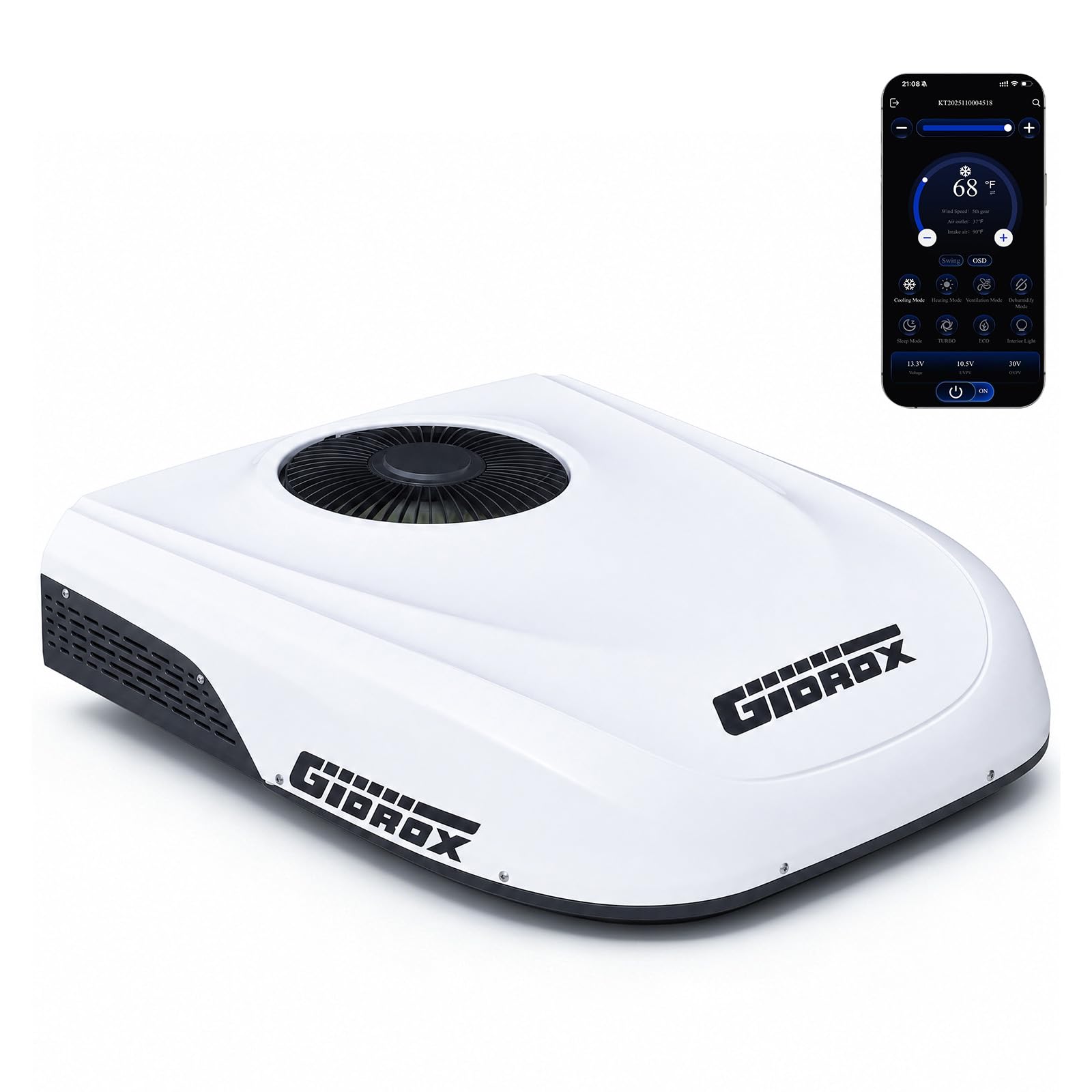
The Gidrox 12V DC roof unit is a purpose-built solution for RVs and camper vans that runs directly off a house battery without an inverter. Its 10,000 BTU inverter compressor delivers rapid cooling in about three minutes, and real-world user data shows it draws as low as 250W in dehumidifier mode, 350W on ECO, and peaks at 650W-700W on turbo. For a van with a 400Ah LiFePO4 battery at 12V (roughly 4800Wh), that translates to all-night operation on ECO mode without draining the bank.
Noise is a major differentiator here: this unit operates at 40 dB in sleep mode — quieter than most modern refrigerators. The brushless fan design and sound insulation make a noticeable difference compared to older Dometic or Coleman roof units that can reach 65 dB. It fits the standard 14″x14″ roof opening, and at 59 pounds total, it’s manageable for a two-person install.
User feedback highlights the need for a solid battery bank and careful wiring — at 12V, a 700W turbo draw pulls roughly 58 amps, which requires 4 AWG or larger gauge wire and proper fusing. But once installed, owners report it maintains a steady 72°F to 76°F even during heat waves. The app, remote, and panel controls give three ways to adjust settings, and the included 20-foot power cable simplifies routing.
Why it’s great
- True 12V DC direct battery connection eliminates inverter loss.
- Ultra-quiet 40 dB sleep mode won’t disturb rest.
- Draws as low as 250W on dehumidifier mode for extended runtime.
Good to know
- Requires a large battery bank (400Ah+) for all-night use on turbo.
- Installation requires careful electrical planning — high amp draw at 12V needs thick wire.
- Manual is vague on wiring specs; experienced DIYers will manage but beginners need research.
3. Contrymod 12V DC 10000 BTU
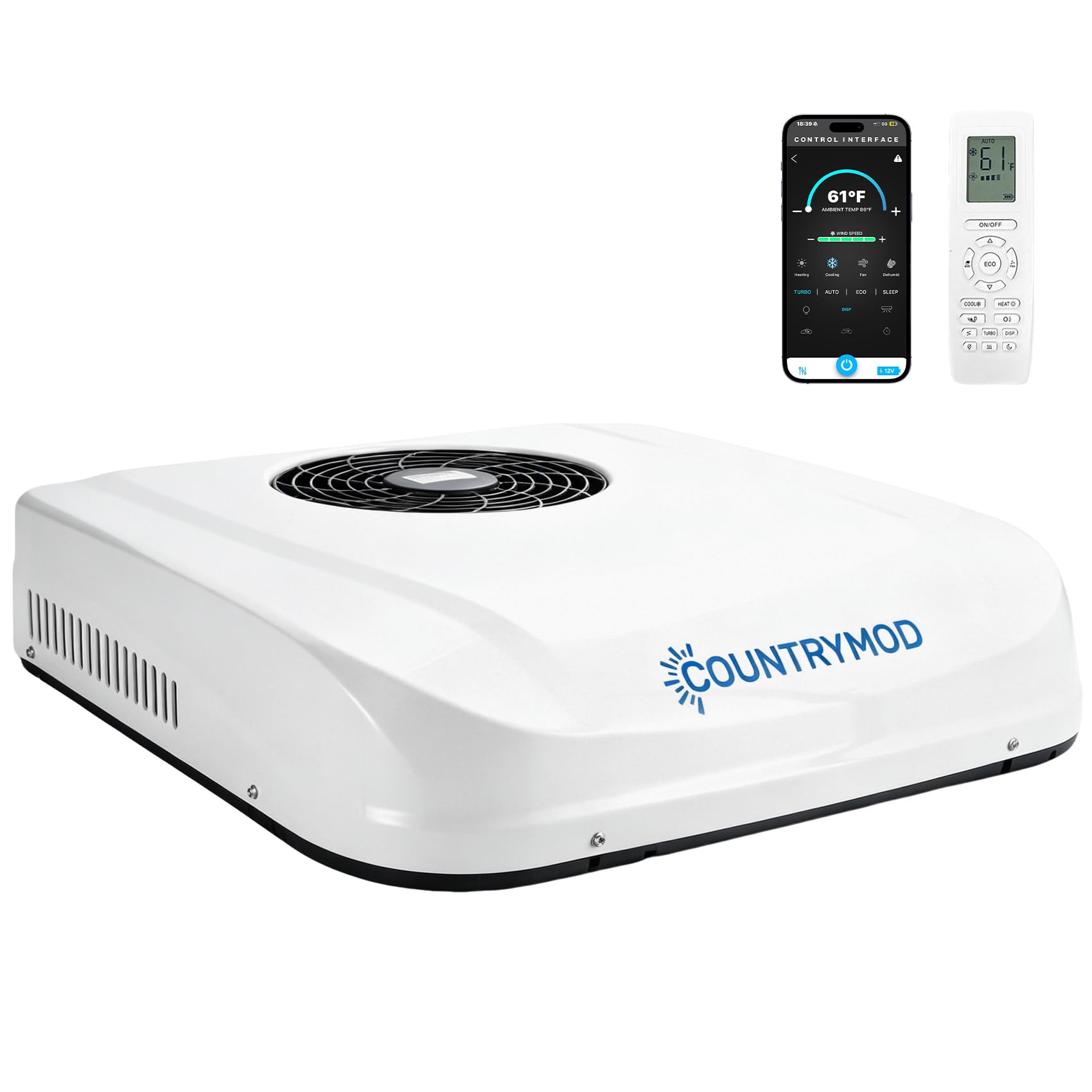
The Contrymod 12V DC roof AC is engineered for efficiency over brute force. Its variable frequency inverter compressor draws only 300W on ECO mode while still delivering 10,000 BTU of cooling capacity. That translates to roughly 0.3 kWh per hour of operation — five times more efficient than a standard 120V RV AC that draws 1.5 kWh per hour. With a 480Ah battery bank, owners report running the unit all night without needing a generator.
Noise levels are rated at 45 to 55 dB depending on fan speed — slightly louder than the Gidrox in sleep mode but still far quieter than traditional roof units. The horizontal compressor design provides a lower center of gravity, reducing vibration and road shock for better long-term durability. It fits the standard 14″x14″ roof opening and includes articulating vents that swing 360 degrees for even air distribution.
Users who replaced older Dometic and Coleman units consistently report that the Contrymod cools better, runs quieter, and costs less to operate. One owner in the Arizona desert reported maintaining 80°F during the day and 72°F at night with outdoor temps hitting 113°F. The app and remote control simplify adjustments without leaving your seat, and customer service from the brand’s support team has been praised for prompt part replacements.
Why it’s great
- Extremely low 300W ECO draw enables all-night off-grid use.
- Horizontal compressor reduces vibration and prolongs lifespan.
- Fully articulating vents distribute cool air evenly without direct blast.
Good to know
- Instructions are sparse — installation relies on YouTube tutorials and prior experience.
- Thicker roofs (arched or insulated) may need longer than the included bolts.
- Not compatible with ducted RV systems — this is a non-ducted design only.
4. Outequip 12V 10000 BTU (w/ Heater)
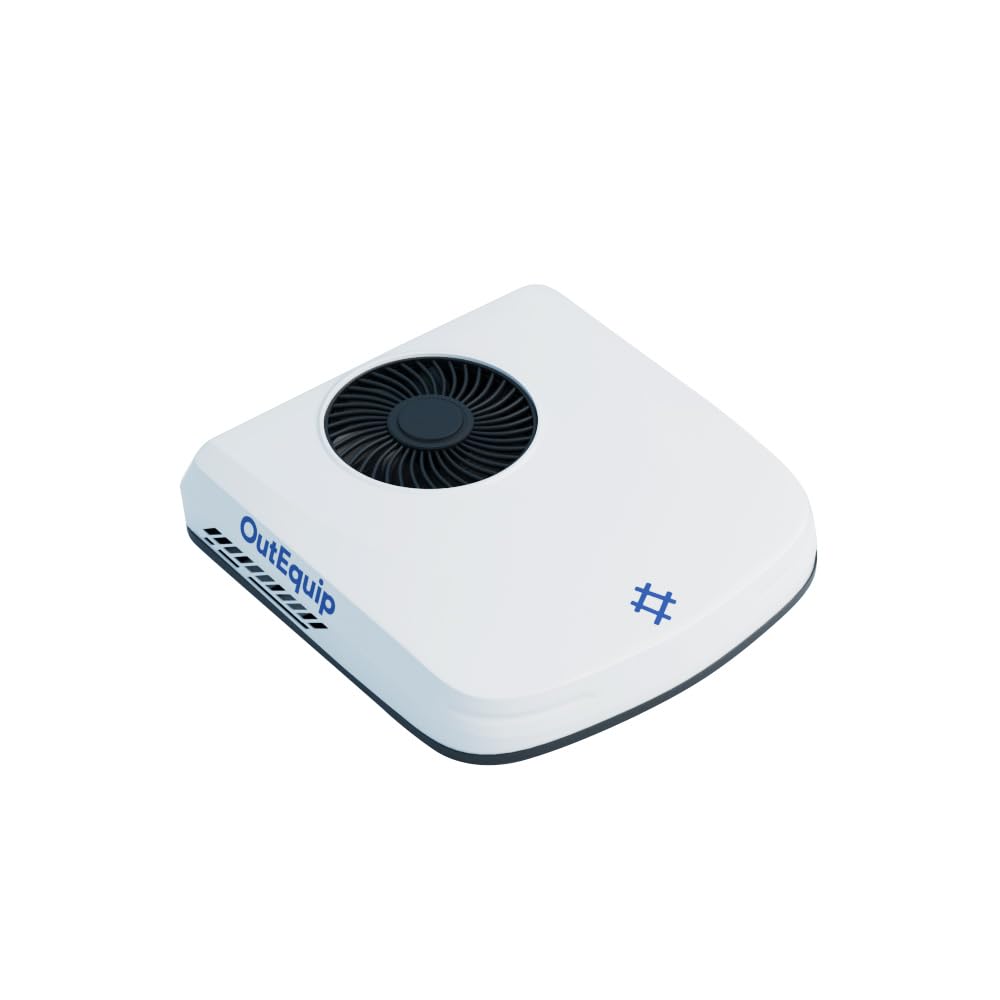
The Outequip 12V rooftop unit stands out because it includes a built-in 4,500 BTU PTC heater alongside its 10,000 BTU inverter compressor cooling. For vanlifers and truck campers who need year-round climate control from a single rooftop box, this is the most cost-effective way to get it.
Its efficiency is remarkable: on ECO mode, the compressor pulls as low as 200W to 300W, and the 43-pound total weight makes it the lightest 10,000 BTU roof unit in this comparison. The low-profile design is only six inches tall, reducing wind drag and making it a better fit for smaller vans with minimal roof clearance. Owners report the noise level around 40 dB on sleep mode — barely audible over ambient van sounds.
Installation is more versatile than competing units: it fits both 14″x14″ and 14″x9″ roof openings, and the power cable routes through the return duct without drilling into the roof. Customer support has been praised for swapping voltages (12V to 24V) free of charge when buyers mis-specified. One van owner with 560Ah of LiFePO4 reported running it on ECO continuously through a hot weekend without the battery dropping below 50%.
Why it’s great
- Integrated 4,500 BTU heater provides year-round climate control in one unit.
- Lowest ECO draw in its class at 200W-300W.
- Ultra-light at 43 lbs; fits two common roof opening sizes.
Good to know
- Heater is supplemental — not suitable as primary heat for extreme cold or large spaces.
- Lid screws can be difficult to remove during install; plan for some patience.
- Plastic connectors are fragile — handle gently to avoid breakage.
5. TOSOT Aoraki 12,000 BTU Mini-Split
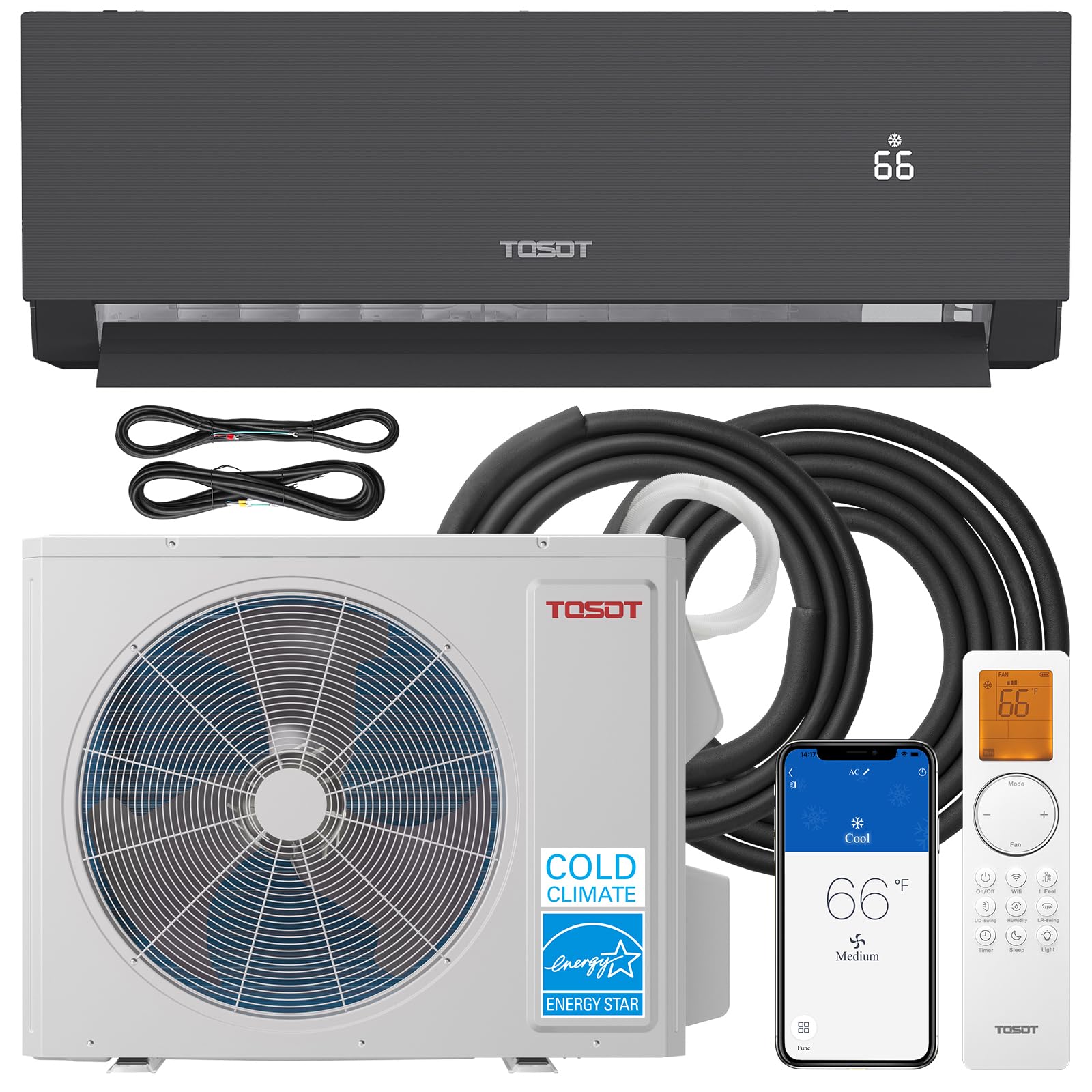
The TOSOT Aoraki is a ductless mini-split, not a portable or rooftop unit, but it earns its spot here because it is the most energy-efficient way to run a real 12,000 BTU air conditioner on a battery system. When paired with a large inverter and battery bank, it can cool an entire RV, tiny home, or garage workshop for hours off-grid.
It also handles extreme temperatures: cooling works in outdoor ambient as low as -20°F for server rooms, and heating functions down to -22°F. The indoor unit operates at just 20 dB — virtually silent. The optional Energy Recovery Ventilator (ERV) add-on recycles energy from exhaust air to pre-condition incoming fresh air, making it ideal for van builds with high insulation standards. It holds ENERGY STAR, Cold Climate, and ETL certifications, and qualifies for federal tax credits in the US.
Users praise its performance in both single-digit winter temps and 100°F+ summers. One plumbing contractor reported it heated a drafty 1940s building effortlessly. The catch is professional installation — this is not a plug-and-play unit. The line set needs to be vacuumed and charged, and the outdoor condensers need to be mounted securely. However, for permanent setups where battery power is part of a whole-home or whole-van solar system, the TOSOT is unmatched in efficiency per BTU.
Why it’s great
- Industry-leading 24.5 SEER2 efficiency minimizes battery drain.
- Optional ERV module improves air quality and energy recovery.
- Operates down to -22°F heating and -20°F cooling.
Good to know
- Requires professional HVAC installation — not a DIY, portable or drop-in solution.
- WiFi module can be glitchy; some users needed a replacement.
- Outdoor unit is large; not suitable for small vehicles.
6. BougeRV PC35 3500 BTU
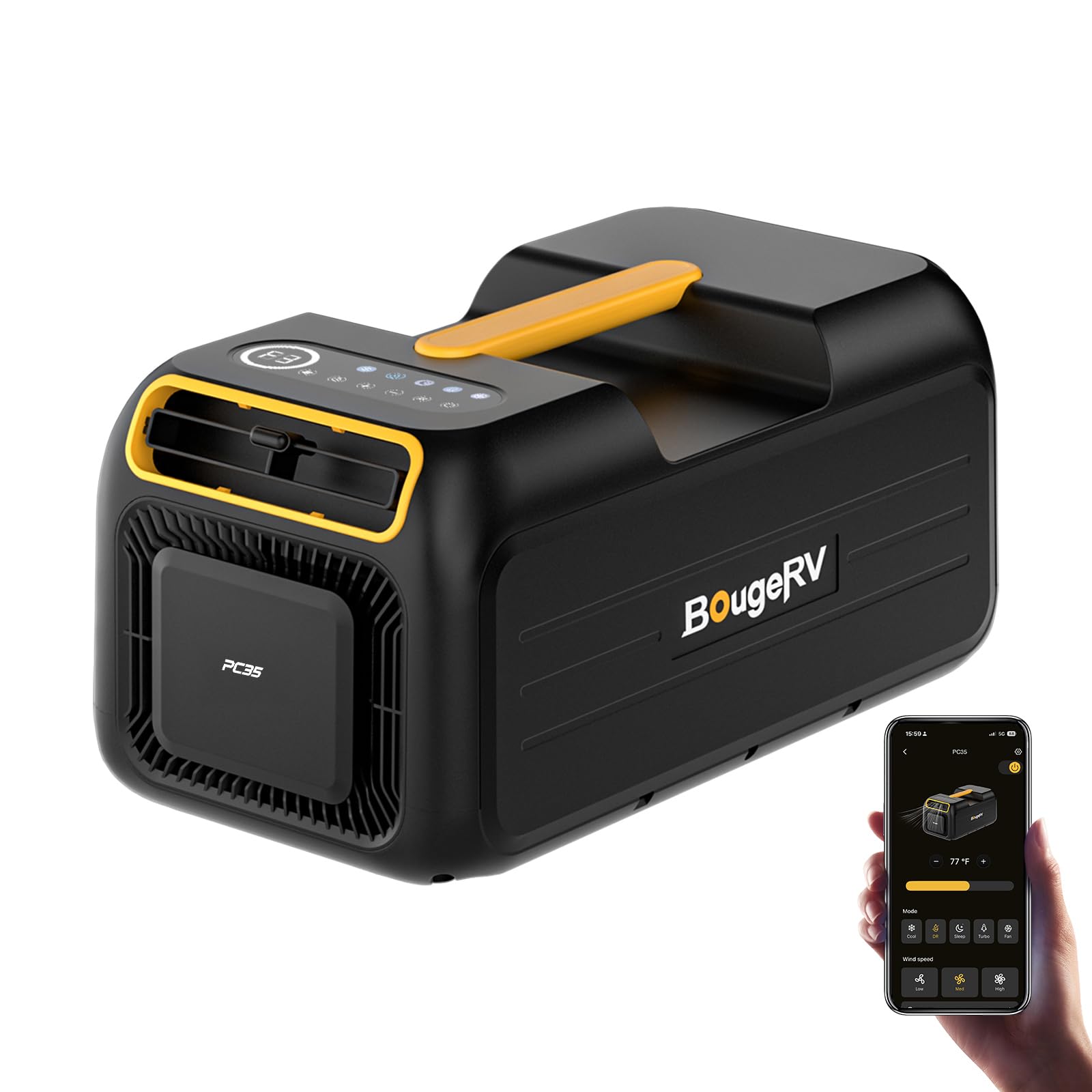
The BougeRV PC35 is the most affordable true compressor-based AC unit in this lineup, making it the go-to option for budget-conscious campers who need real cold air in a small tent or truck cab. Its 3500 BTU rating drops temperature by 18°F in 15 minutes on strong mode within a space roughly 65 square feet. This is not evaporative cooling — a sealed compressor system moves refrigerant to remove heat, and it works regardless of humidity, which is critical for campers in the southeast or pacific northwest.
Power draw peaks around 480W, which means you need a portable power station of at least 500Wh to run it for an hour on max, or about 1000Wh for a full night on medium. The included app lets you adjust temperature, modes, and timer without leaving your sleeping bag, and the five-in-one functions include cooling, dehumidifying, fan, high power, and sleep modes. It weighs 34 pounds and has an ergonomic handle, though it is not truly portable like the EcoFlow since it needs an AC power source.
Owners report it works well with mid-range power stations like the EcoFlow Delta 2 or Jackery 2000 Pro. Some users noted the compressor shuts off after a few minutes in extreme ambient heat above 105°F, which could be a thermal protection feature or a design limitation. It is also loud enough at max speed to disturb light sleepers. But for the price, it is the cheapest entry point into real battery-compatible compressor cooling for car camping.
Why it’s great
- Genuine compressor cooling at the lowest price point in the review.
- App control from 33 feet away for convenient adjustments.
- Rapid 18°F temperature drop in 15 minutes on strong mode.
Good to know
- Requires an external battery and inverter — no built-in power source.
- Some units experience compressor shutoff in extreme heat above 105°F.
- Heavy at 34 lbs and bulky for small tent setups.
7. BODEGACOOLER 6000 BTU

The BODEGACOOLER 6000 BTU targets a narrow but important niche: larger tents, small cabins, and pop-up campers where a 3500 BTU unit is too weak but a roof AC is overkill. This is a 120V AC compressor unit — it needs an external power station or generator, but at 440W peak draw, it pairs well with a 1000Wh power station for about two hours of cooling or a larger 2000Wh station for a full night. The noise rating of ≤50 dB makes it acceptable for sleep, though not library-quiet.
Its five modes include dedicated Cooling, Fan, Sleep, Dehumidifier, and Max Cool options. The forced-cooling mode pushes the compressor hard for rapid temperature drops, and the dehumidifier mode is genuinely useful in muggy tent environments where condensation builds up overnight. The remote control works from a sleeping bag or chair. Dimensions are 11.1 x 22.2 x 12.3 inches — roughly the size of a small suitcase, making it possible to position near a tent vestibule or window.
User feedback is mixed on the 6000 BTU claim — some owners report it cools a living room from 83°F to 76°F effectively, while others say it does not blow as cold as expected. One reviewer noted the 6000 BTU unit uses only 450W, whereas a comparable 5200 BTU unit from another brand used 900W, suggesting the BTU rating may be optimistic. The compressor noise can include a crunching sound on some units, indicative of possible quality control variance. Buyers should ensure they have the option to return if the unit arrives with defects.
Why it’s great
- 6000 BTU capacity fills the gap between tiny tent ACs and full RV units.
- Dedicated dehumidifier mode reduces tent condensation.
- Low 440W peak draw compatible with mid-range portable power stations.
Good to know
- BTU rating may be inflated relative to power draw — cooling output is modest.
- Quality control variance: some units have noisy or failing compressors.
- Requires 110V AC power — not 12V DC compatible without an inverter.
8. Lifecreek Evaporative Air Cooler
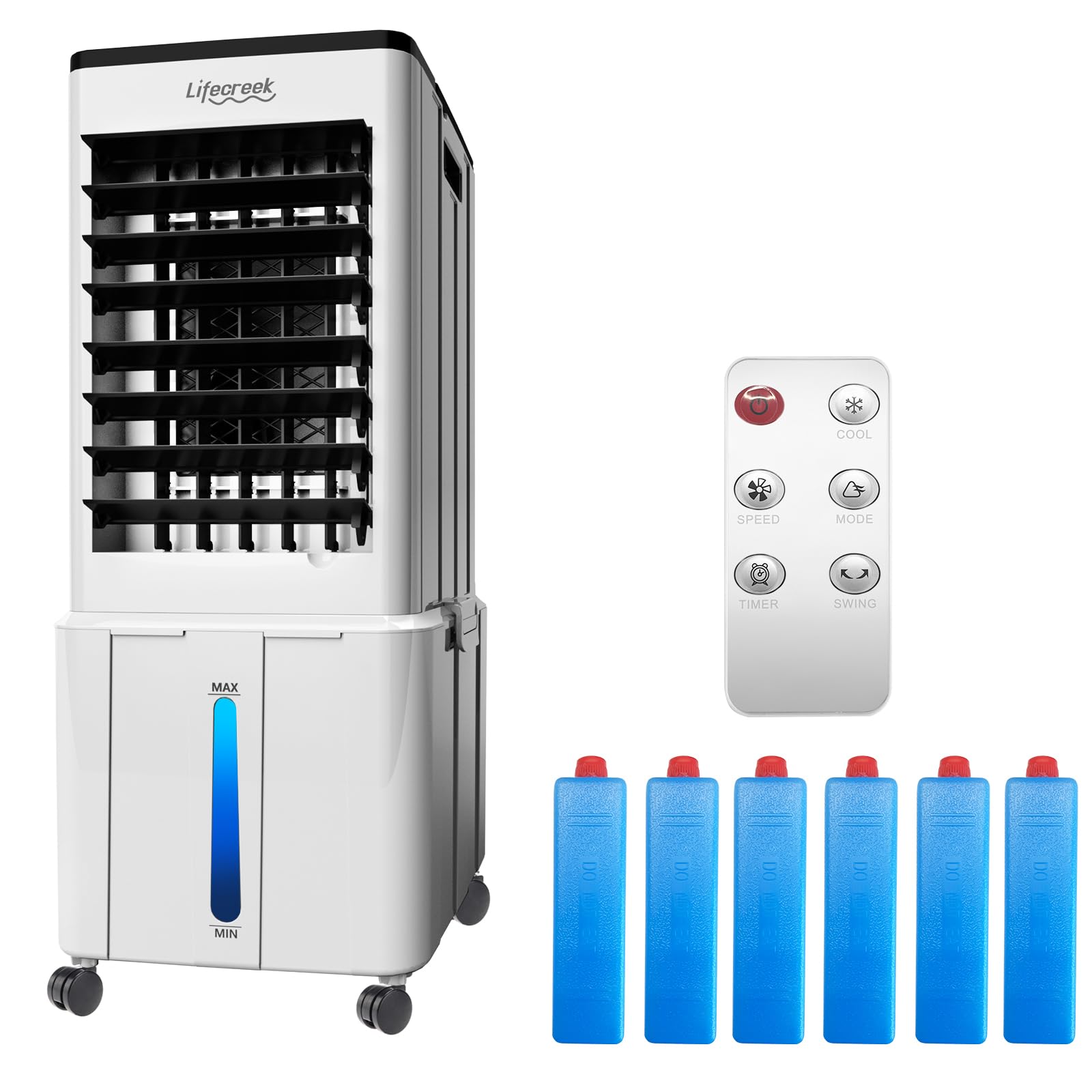
The Lifecreek evaporative cooler is the best option for dry-climate homes, workshops, and garages where humidity stays low. It works by pulling air through water-saturated pads and six included ice packs, producing a cooling effect of about 10°F to 15°F in the immediate airflow path. At roughly 100W of power draw, it can run all day on a small Jackery or Renogy battery without straining your system — which is impossible for a true compressor unit.
The 3.2-gallon water tank provides extended runtime before needing a refill, and the top-fill design plus visible water level window make maintenance simple. It includes four modes (Normal, Natural, Sleep, Cooling) and three fan speeds, plus a 12-hour timer. The 65 dB noise level is moderate — about as loud as a box fan on high — so it works for bedroom use if you don’t need silent sleep. The bottom casters make it easy to roll from room to room.
Owners are generally satisfied with its ability to cool a 12×10 foot space. One reviewer called it perfect for a garage or camping setup, and another noted the humidifier function prevents dry air in desert climates. The limit is humidity: in coastal areas or during rainy weather, the cooling effect drops toward zero, and it becomes just a noisy fan. Buyers in humid regions should skip evaporative coolers entirely and invest in a compressor-based unit.
Why it’s great
- Extremely low power consumption — runs all day on a small battery.
- Large 3.2-gallon tank and six ice packs for extended cooling sessions.
- Portable with casters; easy top-fill water tank design.
Good to know
- Ineffective in high-humidity environments — only suitable for dry climates.
- Noise at 65 dB may be too loud for deep sleepers.
- Ice packs provide only a modest temporary boost; water-only mode is weak.
9. YIJU Evaporative Air Cooler
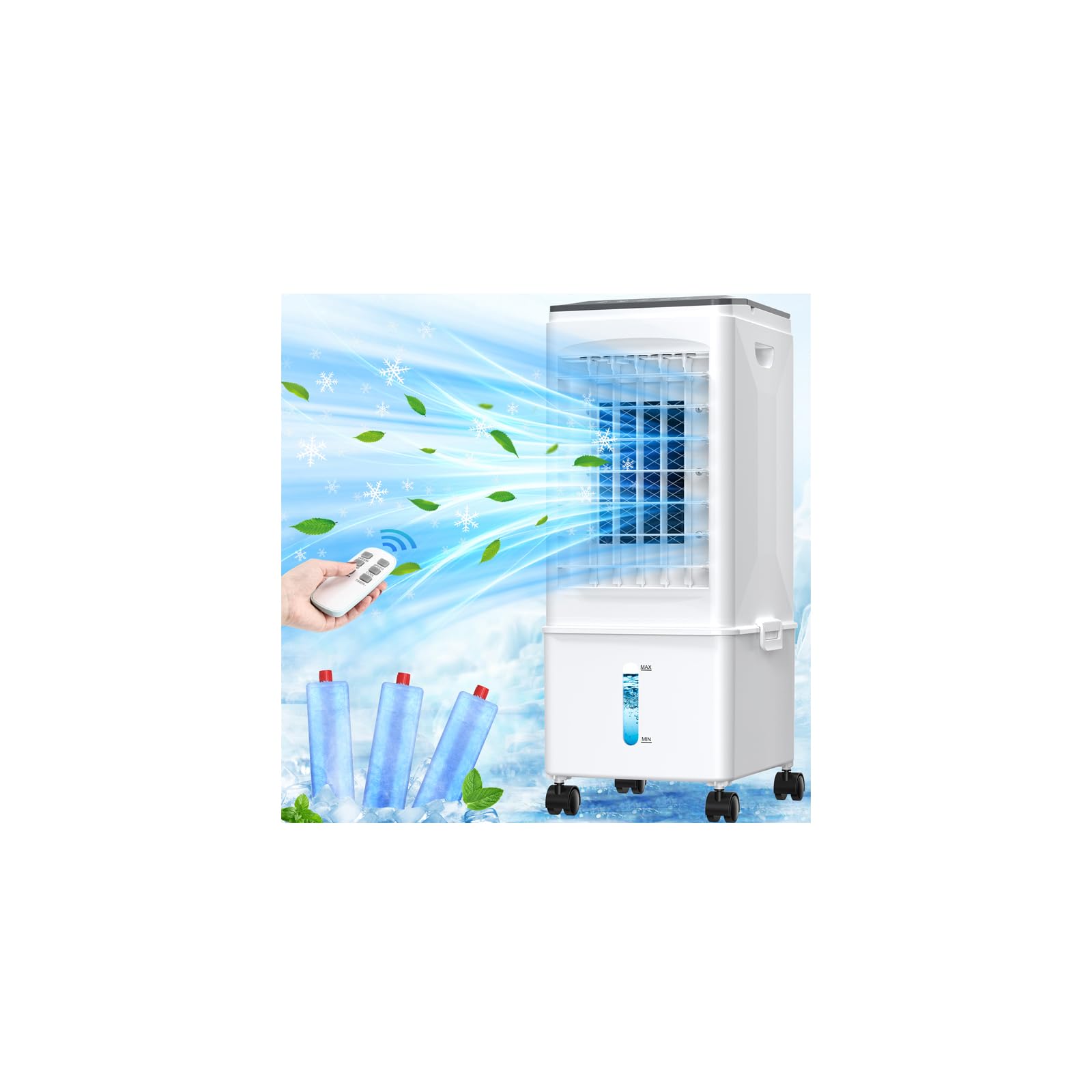
The YIJU evaporative cooler is the most affordable option in this guide, designed for small rooms, garages, or screened-in porches in dry climates. It moves an impressive 2500 CFM of air through its dual-tank design (2.5 gallons total), and the manufacturer claims a temperature drop of 5°F to 9°F when the included ice packs are added to the water. At just 60W of power consumption, it can run for over 40 hours on a typical 200Wh power station — meaning you can practically ignore battery management.
It includes 60-degree automatic and 120-degree manual oscillation to distribute air across up to 300 square feet. The noise rating of 40 dB is genuinely quiet — quiet enough for a bedroom where you want a gentle breeze without fan whine. The 7-hour timer and remote control with a 26-foot range add convenience. The LED display auto-dims after a period of no operation, which is thoughtful for nighttime use.
User reviews are polarized. Positive owners call it a “fantastic solution for smaller spaces” that cools a Florida lanai effectively. Negative owners say it “doesn’t cool as advertised” and “performs like a weak personal fan.” The discrepancy comes down to humidity: in dry air, evaporative cooling works well; in humid air, it does not. The unit also lacks a compressor, so it cannot produce the kind of cold air a person expects from an actual air conditioner. If you live in a dry region and want a whisper-quiet breeze with a small cooling effect, this is an excellent budget option.
Why it’s great
- Ultra-low 60W consumption — runs days on a small battery.
- Very quiet at 40 dB suitable for sleep.
- Large 2.5-gallon tank provides 24 hours of continuous use.
Good to know
- Evaporative cooling only works in low-humidity conditions.
- Does not produce cold air — just a breeze that feels cooler due to evaporation.
- Replacement aroma pads are difficult to find; alternative fragrance solutions needed.
FAQ
What is the difference between an evaporative cooler and a true battery air conditioner?
How big of a battery do I need to run a 10,000 BTU RV AC all night?
Can I run a 120V AC battery air conditioner off a portable power station?
Why do some battery air conditioners claim 10000 BTU but only draw 300W?
Are 12V DC air conditioners worth the premium over 120V AC models?
Final Thoughts: The Verdict
For most users, the best battery air conditioner winner is the EF ECOFLOW WAVE 3 because it combines genuine compressor cooling and heating into a truly portable, self-powered package with an eight-hour battery, app control, and the most versatile use case of any unit here. If you need a permanent rooftop solution for your RV, grab the Outequip 12V 10000 BTU for its unmatched efficiency and built-in heater. And for budget-conscious tent campers in dry climates, nothing beats the YIJU Evaporative Cooler for its ultra-low power draw and whisper-quiet operation.