
Our readers keep the lights on and my morning glass full of iced black tea. As an Amazon Associate, I earn from qualifying purchases.
Specs are compiled from manufacturer listings and verified buyer reviews and can change over time — please confirm the key details on the product page before buying.
A dead battery can ruin your morning, whether it’s a car that won’t start or a flashlight that fails during a blackout. Tossing a battery at the first sign of weakness wastes money and can leave you stranded. A battery analyzer gives you concrete numbers to determine if a battery is truly dead or just needs a recharge.
I’m Min — the founder and writer behind Gadgets Feed. This guide is built by comparing the manufacturers’ published specifications and the patterns across verified customer reviews, so you get each pick’s real strengths and trade-offs instead of marketing spin.
From simple handheld load testers to lab-grade chargers that report internal resistance, this guide covers the best battery analyzer options for home mechanics, hobbyists, and pro shops who need dependable data before making a swap.
Our Picks at a Glance


How To Choose The Best Battery Analyzer
Choose an analyzer based on the battery types you handle most. An AA cell tester won’t work on a 12V car battery, and a shop-grade load tester can damage small NiMH cells.
Car Batteries: Load Testers vs. Digital Conductance Testers
For starter and deep-cycle batteries, you have two paths. An analog load tester (like the Battery Tender or OTC) applies a heavy resistive load and measures voltage drop — it tells you if the battery can deliver real current. A digital conductance tester (like the Clore SOLAR BA9) sends a small AC signal through the battery and calculates health from the internal resistance. Digital units are gentle on the battery and faster, but load testers are famously simple and hard to fool.
Small Rechargeables: Standalone Charger-Analyzers
If your world is AA, AAA, 18650, or NiMH packs, you want a charger that also runs analysis cycles. The key features are independent channels (each slot works on its own), adjustable charge and discharge current, and the ability to show you the actual capacity in mAh after a test. A model that can also measure internal resistance gives you a reliable way to spot cells that are near death even when voltage looks fine.
Compatibility and Battery Types
Check the spec sheet for the range of battery chemistries and sizes the unit supports. Some analyzers handle only lead-acid (Flooded, AGM, Gel). Others are made strictly for NiMH/NiCd. A few premium units (like the TOPDON BT600) cover both 12V and 24V lead-acid systems and accept multiple chemistries. Matching the analyzer to your batteries saves money and frustration.
Quick Comparison
| Model | Best For | Test Type | Battery Types | Item Weight | Amazon |
|---|---|---|---|---|---|
| Clore SOLAR BA9★ Best Overall | Quick car battery health | Digital conductance | 12V Flooded, AGM, Spiral, Gel | 9.6 ounces | Amazon |
| TOPDON BT600Also Great | Pro-grade shop use | Digital conductance | 12V / 24V Lead-Acid | 1.29 kg | Amazon |
| Opus BT-C3400 | Lab-style reconditioning | Charge / Discharge / IR | Li-ion, NiMH, NiCd | — | Amazon |
| OTC 3181 | Heavy load testing | Analog load (130A) | 6V / 12V Lead-Acid | — | Amazon |
| Battery Tender 026-0020 | Budget load testing | Analog load (100A/50A) | 6V / 12V Lead-Acid | 2.1 Pounds | Amazon |
| Opus BT-C2400 | AA/AAA capacity testing | Charge / Discharge / Test | NiMH, NiCd (AA, AAA) | 0.5 Pounds | Amazon |
| ZTS Mini-MBT | Household battery check | Pulse Load | Alkaline, Li-ion, NiMH | 3.68 ounces | Amazon |
In‑Depth Reviews
1. Clore Automotive SOLAR Digital BA9 Battery and System Tester
Our pick — over 4.5★ from 800+ verified ratings; the strongest balance of quality and price.
The featherweight digital tester that catches hidden battery decay.
At just 9.6 ounces, the Clore SOLAR BA9 is easy to throw in a glovebox — it weighs 9.6 ounces while the ZTS Mini-MBT weighs 3.68 ounces, but still light enough to hold with one hand while you clamp. It tests 12V batteries using conductance technology, which means it learns health without draining the battery during the test. The unit handles a CCA range of 40 to 1200, so it works on small motorcycles all the way up to full-size trucks. It is compatible with Flooded, AGM, Spiral, and Gel Cell batteries.
One buyer mentioned it let them know the battery in their 2020 Subaru was bad before the battery actually failed to start the car — exactly the kind of early warning you want. Another reviewer noted the tester showed a new 750 CCA battery was actually delivering 695 CCA, which is useful for verifying what you paid for. The LCD display is designed to stay readable in all lighting, and the unit checks cranking and charging systems too. The operating range is 7 to 15 volts, with a minimum operating voltage of 4.5 Volts.
A note of caution: the included manual is very small, with tiny type, and flipping through pages while holding the tester on a dirty battery is a hassle. Some buyers recommend watching a YouTube walkthrough first. The tool requires the battery to power itself, so a completely dead battery may not register at all.
Why it wins
- Very light at 9.6 oz; easy to keep in the car
- Conductance testing gives high accuracy without draining the battery
- Covers 40-1200 CCA for cars, motorcycles, boats
- User reports that it caught a bad Subaru battery well before failure
Minor gripes
- Tiny manual with small type makes setup harder than it needs to be
- Needs the battery to self-power; won’t work on a fully dead cell
- Some mention the display could be better for a 4.5/5 overall rating
Home mechanic essential: Pick this if you maintain a few vehicles and want a simple, accurate digital tester that fits practically anywhere.
Skip it when: You need to test 6V batteries or you want a built-in printer for shop use.
2. TOPDON BT600 12V/24V Car Battery Tester
Print a professional battery report without leaving your driveway.
The TOPDON BT600 is the only unit in this roundup that gives you a dedicated 3.5-inch color screen and a built-in thermal printer. Its 3.5-inch screen is larger than 90% of car battery testers, ensuring clear results even in low-light conditions. It uses conductance testing technology to handle 12V and 24V lead-acid batteries rated from 100 to 2000 CCA — that covers everything from a sedan to a heavy-duty truck. The unit also runs cranking and charging alternator tests, which lets you pinpoint whether the battery itself or the charging system is the problem.
Buyers report that this analyzer gets daily use in a pro shop and still keeps working after being dropped several times. One reviewer noted they chose the BT600 over their shop’s Interstate tester because the printed receipt gives customers tangible proof. The built-in printer uses thermal paper and prints immediately, so you hand over a record every time. The data playback function saves the last test, which helps when you are comparing results after a recharge.
A single real limitation: this tester does not work on 6V batteries. If you maintain classic cars or vintage equipment on a 6V system, you need a different tool. The unit requires power from the battery it tests, so a completely dead battery (below about 4.5V) may not power up the analyzer. One reviewer also found that a battery reading 13.29V caused the unit to display “voltage too high” and refused to test, so keep that edge case in mind.
What stands out
- 3.5-inch color screen; built-in thermal printer for instant reports
- Covers 12V and 24V, 100-2000 CCA, multiple chemistries (Flooded, AGM, GEL, EFB)
- Runs cranking and charging system tests, not just battery health
- Mini-USB port for free lifetime firmware updates via Windows, per the maker
Watch for
- Does not support 6V batteries
- Needs the battery itself to power up; a dead battery may not read
- One report of a “voltage too high” error on a 13.29V battery
Shop-ready pick: Best for mechanics, fleet managers, and used-car dealers who need professional printed proof of battery health at the push of a button.
Not for you if: You work on 6V classic cars or need a tool that tests on a completely stone-dead battery with no residual voltage.
3. Opus BT-C3400 Battery Charger Analyzer Tester

The charger that acts like a battery lab on your desk.
If you obsess over rechargeable cells, the Opus BT-C3400 is the most versatile unit here. It handles Li-ion, NiMH, and NiCd cylindrical cells across a huge size range — from AAAA up to 26650. Each of its four channels is fully independent, so you can charge one 18650 while discharging two NiMH AA cells and running a capacity test on a fourth slot. The adjustable charging rate goes from 200 to 2000 mA, though it drops to 1000 mA maximum when all four channels are active. It can measure internal resistance, which is the gold standard for identifying a cell that appears charged but is actually worn out.
One reviewer ran the discharge-refresh cycle on three bad Enercell NiMH batteries and found internal resistance readings of 2.5-4.0 ohms — far above the ≤0.2 ohm healthy range. The unit correctly identified them as unrecoverable. Another buyer noted that they left batteries on the charger for weeks with zero damage, unlike older chargers that would overheat and ruin cells. The backlit LCD shows capacity in mAh, voltage, elapsed time, and current for each channel, so you can match cells before building a pack.
The only real catch is the cooling fan. Several owners mention that after extended use the fan can develop a whining noise, though the unit still functions. The maximum discharge current is limited to 1000 mA (700 mA for NiMH/NiCd), which is fine for most consumer cells but slow for high-capacity 26650s.
Strengths
- Four independent channels with adjustable current (200-2000mA)
- Supports Li-ion, NiMH, NiCd; handles sizes from 10440 to 26650
- Measures internal resistance; runs 5 modes (Charge, Discharge, Refresh, Test, Quick Test)
- Customers note weeks on charger with no damage to cells
Trade-offs
- Fan can get noisy after heavy use, per multiple reviews
- Discharge limited to 1000mA (700mA NiMH)
- Full power only if you use 3 slots or fewer
Hobbyist’s best friend: Get this if you use 18650s for flashlights or vapes, or if you need to match exact pairs of NiMH cells for sensitive devices.
Not ideal for: Strictly checking car batteries — this unit is for small rechargeables only.
4. OTC 3181 130 Amp Heavy-Duty Battery Load Tester

The 130-amp brute that gives you real load data in ten seconds.
While the TOPDON uses digital conductance, the OTC 3181 is a classic analog load tester that puts a real 130-amp draw on the battery. It is built for 6V and 12V batteries, and the heavy-duty clamps are designed with extra grip for both top-post and side-post terminals — a detail that matters when you work in tight engine bays. The display is a large analog meter with a 0-16 volt range and a zero-adjust screw, so you can calibrate it before each test. It gives results in about 10 seconds, which is fast enough for production-line work.
One buyer tested a known good car battery, a small tractor battery, and a dry-cell battery; the OTC 3181 correctly delivered the full 130-amp load to each and flagged the dry-cell as bad. That reviewer also cross-checked with a Fluke multimeter and confirmed accuracy. The tester has side tabs for storage of the clamps and a back bracket so you can mount it on a wall or toolbox. The clamps are described as “first class” by multiple owners, with heavy-duty cables and a comfortable handle.
The catch: this is a “short duty” tool. The manufacturer says you must let it cool between tests to avoid burning out the internal coil. One reviewer explicitly mentions following the run/cool times to protect the unit. The cords are a bit short, which can limit reach on large trucks.
Key assets
- Delivers a true 130-amp load for 6V and 12V lead-acid batteries
- Extra-grip clamps work on top-post and side-post batteries
- Large analog meter with zero adjust for accurate reads
- Built-in clamp storage and wall-mount brackets
What limits it
- Must cool between tests or risk coil burnout
- Short cables can be inconvenient on large vehicles
- Analog gauge not as instantly readable as a digital screen
For the old-school pro: Ideal for a garage or shop that needs a rugged, no-nonsense load test on a wide range of vehicle batteries.
Look elsewhere if: You want fast digital results or you need to test small household batteries.
5. Battery Tender 026-0020 100-Amp Load Tester
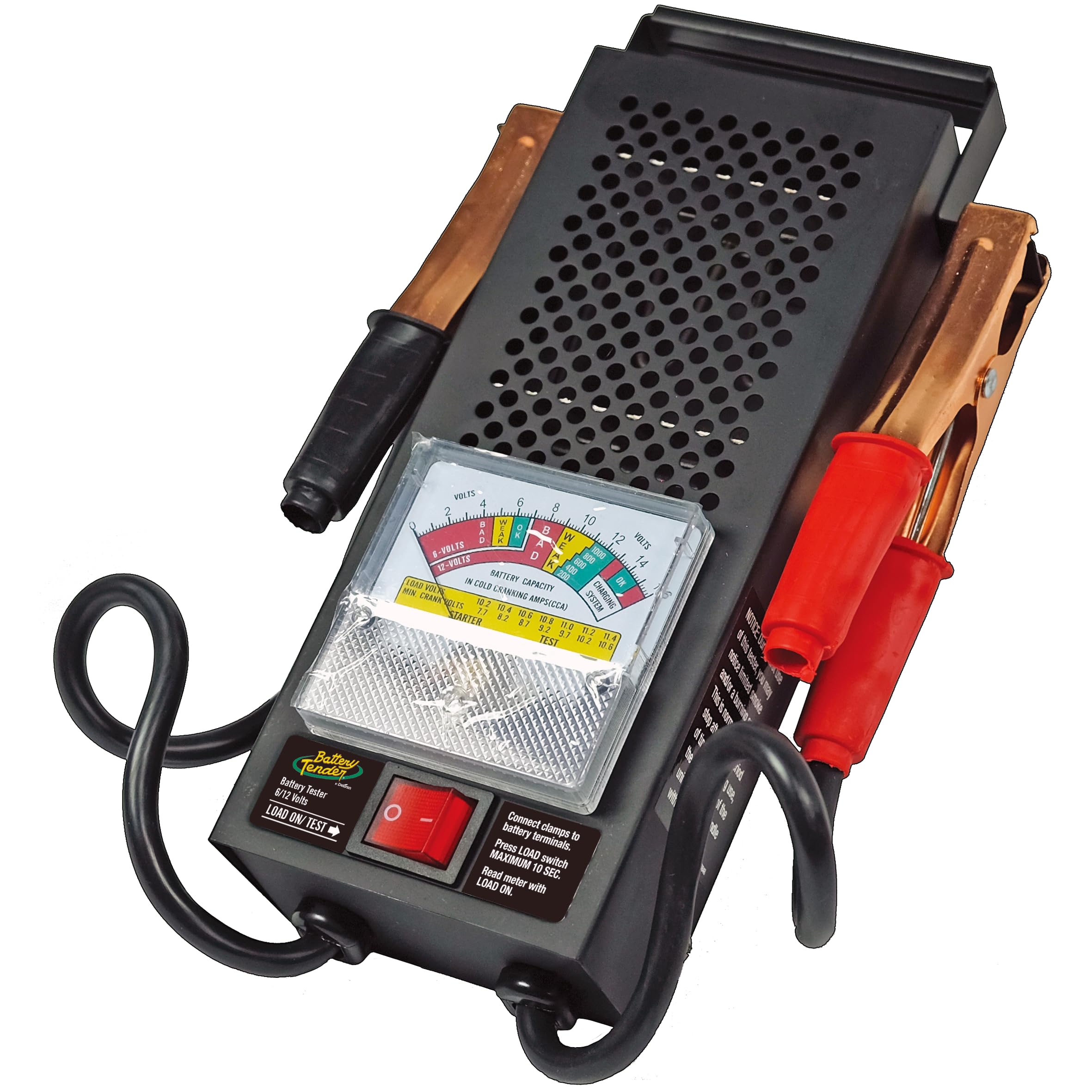
The old-school analog load tester that costs less than a trip to the auto parts store.
The Battery Tender 026-0020 is a simple, affordable way to put a real load on a battery instead of just reading voltage. It performs a 100-amp load test for 12V batteries and a 50-amp load test for 6V batteries. At 2.1 pounds, it is the heaviest unit in this roundup — weighing 2.1 pounds versus the Opus BT-C2400 at 0.5 pounds — but that weight comes from the heavy-duty internal coil and thick-gauge cables needed to handle the current. It works on cars, pickup trucks, SUVs, motorcycles, RVs, boats, and ATVs with up to 1,000 cranking amps. The color-coded display makes it easy to see good/bad at a glance.
Reviewers point out that this tester is “cheaper than Harbor Freight,” which speaks directly to the value proposition. One owner said it helped neighbors discover they needed a battery upgrade, and another noted that testing static voltage tells you nothing: this unit reads battery strength under load. The rubber-insulated carrying handle and heavy-duty color-coded alligator clamps add safety and confidence. It shows health and voltmeter readings through a single toggle switch.
The catch: like the OTC 3181, this analog tester generates heat and has duty-cycle limits. Multiple reviews mention a slight smell during operation, and you must follow the run/cool time to avoid coil burnout. It is also the biggest and heaviest unit for travel, so it is more of a shop tool than a glovebox companion.
What works
- 100-amp load for 12V, 50-amp for 6V batteries
- Simple color-coded display makes results obvious
- Strong clamps and thick wire; safe rubber handle
- Shoppers say it is cheaper than Harbor Freight — solid value
Things to know
- Heavy at 2.1 pounds — not a portable tool
- Must rest between uses to avoid coil damage
- Analog gauge less precise than a digital readout
Budget-conscious buyer: Grab this if you want a real load test for your car or boat battery without spending over.
Pass on this if: You need a lightweight tester for travel or digital accuracy for deeper diagnostics.
6. Opus BT-C2400 Battery Charger Analyzer Tester

The dedicated NiMH/NiCd analyzer that brings dead cells back to life.
The Opus BT-C2400 is a specialized charger-analyzer built specifically for AA and AAA NiMH and NiCd rechargeable batteries. It weighs just 0.5 pounds — while the Battery Tender load tester weighs 2.1 pounds — making it easy to leave plugged in on your desk. Each of its four independent channels can be set individually to charge, discharge, refresh, or test. The highest capacity limit is 20,000 mAh, which means it can handle high-capacity NiMH cells without cutting off early. The backlit LCD digitally displays capacity in mAh, voltage, time elapsed, and current for each channel.
One buyer used this to restore old cordless phone batteries that were 8 years old: the charger accurately charged those nearly dead AAA cells, and the batteries “lasted about as long as the charger indicated they would.” That is the kind of real-world validation you want from a recovery tool. The unit also tests internal resistance, letting you compare cells before pairing them for multi-battery devices. The current rating is 1400 milliamps, and it uses a DC power jack with an input voltage of 240 Volts.
The interface is the main friction point. Several reviews mention that the button layout is not intuitive and the interface could be improved. Some buyers also note that in very windy conditions or when hands are dirty, the small buttons and display are harder to operate. For strictly AA/AAA NiMH work, however, this unit is a proven performer.
Highlights
- Four independent channels for simultaneous different cycles
- Supports up to 20,000 mAh capacity — great for large NiMH cells
- Measures internal resistance to identify bad cells
- Reviewers report successfully reviving 8-year-old batteries
Minor flaws
- Interface is a bit confusing; buttons are small
- Only works on NiMH/NiCd — no Li-ion support
- Hard to operate with dirty hands or in wind, per users
AA/AAA specialist: Get this if you power photography gear, toys, or remote controls with rechargeable NiMH cells and want to extend their useful life.
Not the right fit: You need to test car batteries or lithium-ion cells — this is a narrow-purpose tool.
7. ZTS Mini Multi-Battery Load Tester Mini-MBT

The pocket-sized pulse loader that tests six battery types in two seconds.
At just 3.68 ounces, the ZTS Mini-MBT is the lightest battery analyzer here — it weighs 3.68 ounces, while the Clore SOLAR BA9 weighs 9.6 ounces. Its patented Pulse Load Technology measures each battery under a simulated load instead of just checking open-circuit voltage, which is far more revealing. The device is fully automatic: you touch the probe to the battery’s terminals and it shows the remaining capacity in 20% increments via five LEDs. It covers 1.5V AAA, AA, C, D, N cells, 1.2V NiMH/NiCd, 3.6V Li-ion, 3V photo lithium, and 9V alkaline batteries.
Buyers report that this tester is “the most reliable” they have found after testing multiple devices on dozens of AA NiMH cells. One owner reported it works accurately with 4 NiMH cells under load. Another said they should have bought it years ago and that it is better than using a multimeter without a load. The device is made in the United States and comes with a one-year warranty. The probe and lead wire store away in the seam of the case, which keeps everything tidy.
The main limitation: it does not test button cells or coin batteries. For that, ZTS makes the MBT-1 separately. Some users note that the first reading can read slightly higher (80% then 60%) as the load settles, so you may want to test twice. The device requires 4 AAA batteries (not included) to power its own internal electronics.
What we like
- Extremely light at 3.68 oz; fits in a drawer or backpack
- Pulse load test gives real remaining capacity, not just voltage
- Covers six common chemistries; automatic 2-second read
- Made in the USA; one-year warranty
Shortfalls
- Cannot test button/coin cells
- Needs 4 AAA batteries to run (not included)
- First reading can be optimistic; a second test is often needed
Household organizer: Perfect for anyone with a big drawer of mixed batteries who wants to know which ones are still worth keeping before recycling.
Skip this if: You test car batteries or coin cells — this tool is strictly for small household formats.
Understanding the Specs
Cold Cranking Amps (CCA)
This is the number that tells you if a car battery can start the engine on a cold morning. CCA measures how many amps the battery can deliver for 30 seconds at 0°F before dropping below a set voltage. A higher CCA rating means stronger starting power, especially in cold weather. The BATTERY ANALYZER you choose needs to match your battery’s CCA range — some testers only go up to 1200 CCA, while others handle up to 2000.
Load Testing vs. Conductance Testing
Load testers physically draw a big current (like 100 or 130 amps) from the battery and watch the voltage drop. It is a direct, old-school test that is hard to fool. Conductance testers send a small AC signal through the battery and measure internal resistance. They are faster, gentler on the battery, and often more portable, but they are estimating health rather than proving it under a full load. Both are reliable when used correctly.
Independent Channels
On a charger-analyzer for smaller batteries, independent channels let you run different cycles on each slot simultaneously. You might charge one NiMH cell while discharging another and measuring a third’s capacity. Without independent channels, all slots must do the same thing at the same time, which is much less flexible when you are testing a batch of mixed cells.
Internal Resistance (IR)
This is a key measurement for rechargeable cells. As a battery ages, its internal resistance rises. A cell that shows fine voltage but high IR is near the end of its useful life and will drop voltage quickly under load. Many advanced analyzer-chargers (like the Opus BT-C3400) report IR in ohms, letting you sort healthy cells from tired ones before you build a pack or rely on them in a device.
FAQ
Can I use a car battery tester on a AAA NiMH battery?
What is the difference between CCA and CA on a battery?
How often should I test my car battery with an analyzer?
Will a battery analyzer work on a completely dead battery?
Does the ZTS Mini-MBT test coin cell batteries?
Can I leave batteries in the Opus BT-C3400 after charging?
How long does a load test take?
What does it mean when a battery tester shows “voltage too high”?
Is the Battery Tender 026-0020 better than a digital tester?
Can the Opus BT-C2400 charge and test at the same time?
Final Thoughts: The Verdict
For the majority of shoppers, the best battery analyzer winner is the Clore Automotive SOLAR Digital BA9 Battery and System Tester because it offers accurate conductance testing, a wide 40-1200 CCA range, and a lightweight 9.6-ounce design — all at a very competitive price for what you get. If you want a simple digital tool to check your car battery in seconds, the Clore BA9 is the ideal choice.