
Our readers keep the lights on and my morning glass full of iced black tea. As an Amazon Associate, I earn from qualifying purchases.
Specs are compiled from manufacturer listings and verified buyer reviews and can change over time — please confirm the key details on the product page before buying.
When the power drops, your fridge, router, and lights are the first things you miss. A battery backup keeps those essentials running silently and fume-free during an outage. This guide ranks the best portable power stations and a UPS by real capacity, output, and owner experiences.
I’m Min — the founder and writer behind Gadgets Feed. This guide is built by comparing the manufacturers’ published specifications and the patterns across verified customer reviews, so you get each pick’s real strengths and trade-offs instead of marketing spin.
Find the right battery backup for home appliances by matching capacity, wattage, and recharge speed to what you actually need to keep running.
Our Picks at a Glance


How To Choose The Best Battery Backup For Home Appliances
Before buying, know your appliances’ wattage draw and how long you need them powered. Bigger watt-hours (the total energy stored) mean longer runtime, while higher wattage (the peak power output) lets you start heavy-draw devices like refrigerators and microwaves.
Start With Watt-Hours, Not Just Watts
Watt-hours (Wh) tell you the total energy stored, which decides runtime. A 768Wh station can run a small fridge for hours, while a 3,000Wh-plus unit can keep a household running for a day or more. Match watt-hours to the number of appliances you need through a typical outage.
Check Continuous and Surge Output
Continuous output is what a station sustains, while surge output handles the brief spike when a motor starts. A fridge might run on 150W but needs a surge to kick on. Ensure continuous output exceeds the combined watts of everything you plug in at once.
Prioritize LiFePO4 for Lifespan
LiFePO4 (lithium iron phosphate) batteries last far longer than older lead-acid types, often rated for thousands of charge cycles. That longevity makes LiFePO4 the standard for home backup, ready for years between outages.
Consider Recharge Speed and Solar
Fast AC recharge times, from 1 to several hours, get you ready for the next outage. AC charging times range from about 1 hour to several hours depending on the model. For off-grid recharging, look for a high solar input wattage to refill during extended outages.
Quick Comparison
| Model | Best For | Capacity | AC Output | Weight | Amazon |
|---|---|---|---|---|---|
| BLUETTI AC70★ Best Overall | Portable essentials and camping | 768Wh | 1000W | 22.5 lb | Amazon |
| GOLDENMATE UPSInstant Protection | Instant protection for electronics | 600W | 600W | 4.8 kg | Amazon |
| DABBSSON 2000LBest 2kWh Value | Whole-home essentials | 2048Wh | 2200W | 41 lb | Amazon |
| AFERIY P210 | Quiet, high-output home backup | 2048Wh | 2400W | 54 lb | Amazon |
| Anker SOLIX S2000 | Fridge backup in a compact frame | 2,010Wh | 1,500W | 35.7 lb | Amazon |
| BLUETTI Elite 200 V2 | High-draw appliances and longevity | 2073.6Wh | 2600W | 53.4 lb | Amazon |
| EF ECOFLOW DELTA 3 Max | Fast recharge and premium build | 2048Wh | 2400W | — | Amazon |
| AFERIY 3840Wh | Long-duration, expandable backup | 3840Wh | 3600W | 80.46 lb | Amazon |
| Jackery HomePower 3000 | Multi-day household essentials | 3072Wh | 3600W | 59.5 lb | Amazon |
| Anker SOLIX F3000 | Massive capacity with wheels | 3,072Wh | 3,600W | 91.5 lb | Amazon |
| EF ECOFLOW DELTA Pro | Expandable, heavy-duty home backup | 3600Wh | 3600W | 99 lb | Amazon |
In‑Depth Reviews
1. BLUETTI AC70 Portable Power Station
Our pick — over 4.5★ from 850+ verified ratings; the strongest balance of quality and price.
The crowd favorite that balances power, portability, and a sub-20ms UPS transfer for real home coverage.
The AC70 earns its spot for light-duty backup because it runs a fridge, lights, or a fan on a 768Wh capacity and a 1000W inverter (the device that converts stored power to usable electricity). Its power lifting feature pushes up to 2000W for a brief surge when a motor starts, so a refrigerator compressor kicks on without tripping. Buyers report it ran a 100W guitar amp for 8 hours with 59% left, showing how efficiently it sips power on lighter loads. At 22.5 pounds, you can move it from the kitchen to the campsite without a workout.
Charging is where this thing flexes: a single cable pushes up to 950W, hitting 80% in 45 minutes and full in 1.5 hours from AC. There is no bulky adapter to store, just one cord. If you have panels, it accepts up to 500W of solar for a full charge in about 1.9–2.4 hours — a solid pairing for an off-grid cabin or a long outage.
The thing everyone raves about is the build quality; the standout praise is for how well it is made and how fast it refills. A few owners mention the 3000+ cycle LiFePO4 battery as the reason they trust it for years of occasional use. It is also quiet, and the ≤20ms UPS switchover means a desktop PC won’t blink when the grid drops. The catch: at 22.5 pounds it is not a pocket unit, so this is for home backup and car camping, not backpacking.
portable solar ready: the LiFePO4 chemistry is rated for 3000+ cycles, so a decade of occasional outages is well within reach.
heavy for camping: the BLUETTI app controls charging and discharge modes from your phone, even offline.
solar camping: you want one reliable station for home essentials, camping, and emergency power without paying for capacity you will not use.
tiny loads: you need to power a window AC or a microwave regularly — the 1000W continuous output will not cover those.
2. GOLDENMATE 1000VA/600W Lithium UPS
A plug-and-play UPS that shields your modem, router, and TV the instant the grid hiccups.
This is a different beast from the portable stations above: a true uninterruptible power supply that sits between your wall and your gear. It delivers a pure sine wave at 600W — the same clean power your outlets provide — so sensitive electronics like computers and network devices stay safe. Owners mention it has powered a 185W A/V system through multiple outages over six months, kicking in every time without a stumble.
The lithium iron phosphate battery is rated for 5000+ charge cycles and a 10-year lifespan, which makes the higher upfront cost easier to swallow versus a lead-acid UPS you would replace every few years. It is a tower design with eight NEMA 5-15P outlets, so you can protect a whole desk or an entertainment center. The low-noise cooling fan runs only under heavy battery use, so it stays quiet for daily duty.
What wins people over is performance, with the most owners citing how dependably it protects their gear during outages. The recurring trade-off is battery life at peak load — run it near the 600W cap and it shuts down after seconds, which is normal for a UPS. This is the right tool for keeping a computer or router alive during brief flickers, not for running a fridge for hours.
quiet UPS backup
- True UPS with instant switchover to battery, verified in real outages
- 10-year battery life with 5000+ cycles cuts long-term cost
- Eight surge-protected outlets cover a full workstation
limited runtime
- 600W cap means no fridge or microwave here
- Battery is non-replaceable when it eventually wears out
home office: protecting a computer, router, and TV from constant mini-outages and surges with zero setup.
long outages: your goal is multi-hour appliance runtime — that needs a portable power station, not a UPS.
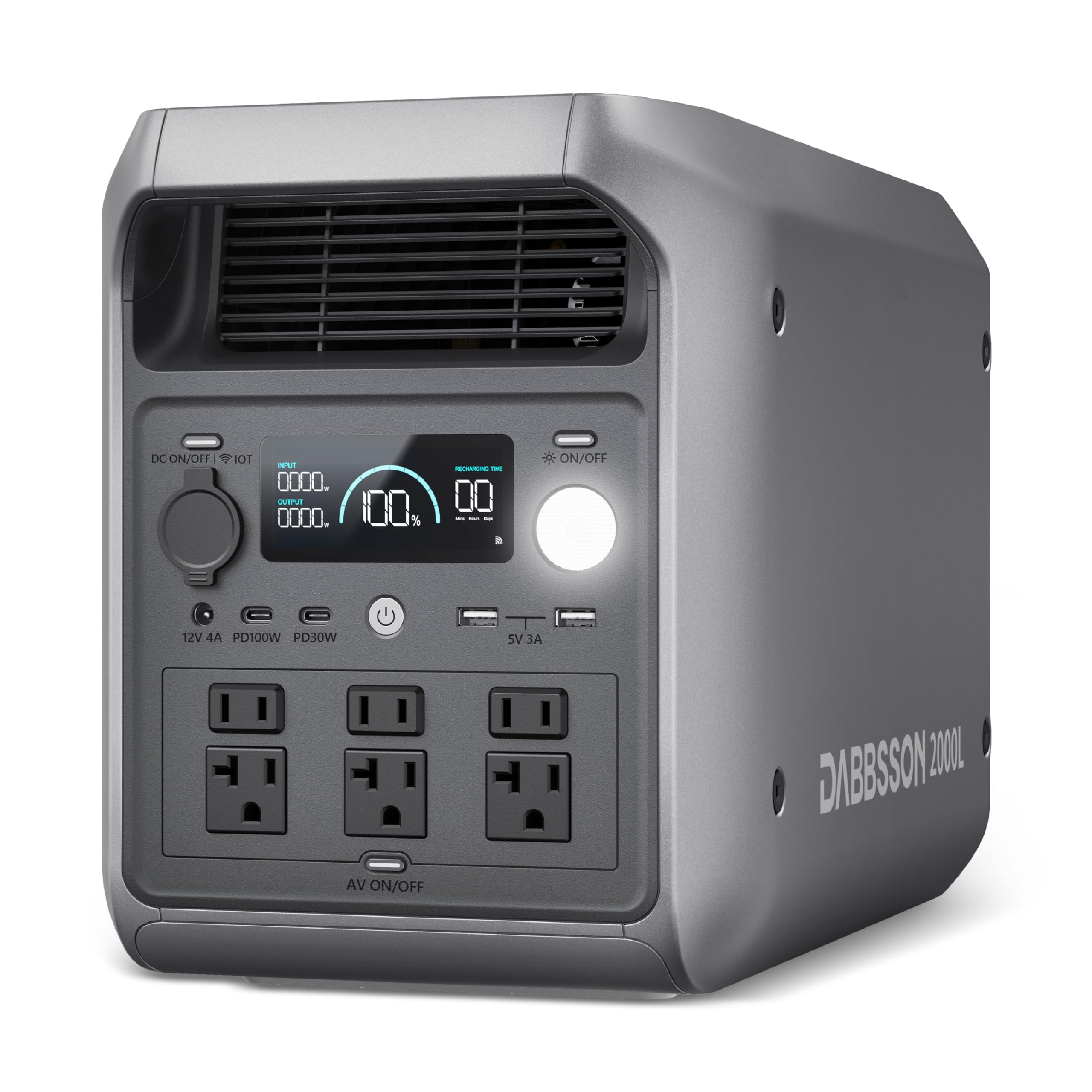
3. DABBSSON Portable Power Station 2000L
A 2048Wh station that refills in one hour and powers the heavy hitters like fridges and power tools.
The 2000L packs 2048Wh of capacity with a 2200W continuous output and a 3300W surge boost, which is enough to run a refrigerator, a heater, or even a grill in a pinch. Owners have demonstrated it running a 1600W air fryer multiple times and powering lights and tools without issue. It is also 1.3x longer-running than comparable 2048Wh stations, per the maker, thanks to efficient conversion.
Its single most impressive trick is the recharge: a full 2048Wh top-up in just 1 hour from AC input. For a unit this size, that is unusually fast, and it means you can drain it overnight and refill it before the next outage hits. Solar input goes up to 800W MPPT, so off-grid recharging is genuinely workable, with one owner getting a full charge in about 6 hours of sun.
Reliability is the top praise from owners, and at 41 pounds it is noticeably easier to move than most stations in this capacity class. The six AC outlets mean you can spread power across a room, and the <10ms EPS switch keeps a computer or NAS from dropping. The honest caveat is the solar input — one owner found 800W lower than expected — so budget for that if solar is your main path.
off-grid power: you want 2kWh-class backup with the fastest wall recharge around and enough surge to start a fridge.
daily carry: you planned heavy daily solar input — the MPPT cap may underdeliver vs. the spec sheet.
4. AFERIY P210 Solar Generator

Silent enough for a bedroom, strong enough for a 12,000 BTU air conditioner — a rare combo.
The P210 handles bigger loads than the AC70, pairing a 2048Wh LiFePO4 battery (a long-lasting lithium-iron-phosphate type) with a 2400W inverter and a 4800W surge. Owners have pushed it hard: a 12,000 BTU air conditioner runs with relative ease, and an LG portable AC ran 3.5 hours on a charge. Its quiet operation stands out — under 30 dB at full load and only 16 dB under normal load, per the maker — so it will not disturb sleep while powering equipment at night.
All 16 ports are pure sine wave on both input and output, which protects sensitive electronics. The <10ms UPS response makes it a capable home-lab backup, with one owner noting it maintained 117VAC under load. It is a 54-pound unit, so you will want the handles, but the cord compartment, dust cover, and storage bag make it easy to live with.
Quality is what owners praise most, and the value lands well below a comparable gas generator when you factor in fuel and maintenance. The catch is solar: the MPPT input is capped at 350W regardless of how many panels you connect, so solar recharging is slower than the headline spec suggests. For AC wall charging, expect a full top-up in about 2 hours.
sunny trips: anyone who needs quiet home backup with enough muscle for a window AC and sensitive electronics.
cloudy days: solar recharging is capped low, so this leans on wall charging for daily refills.
5. Anker SOLIX S2000
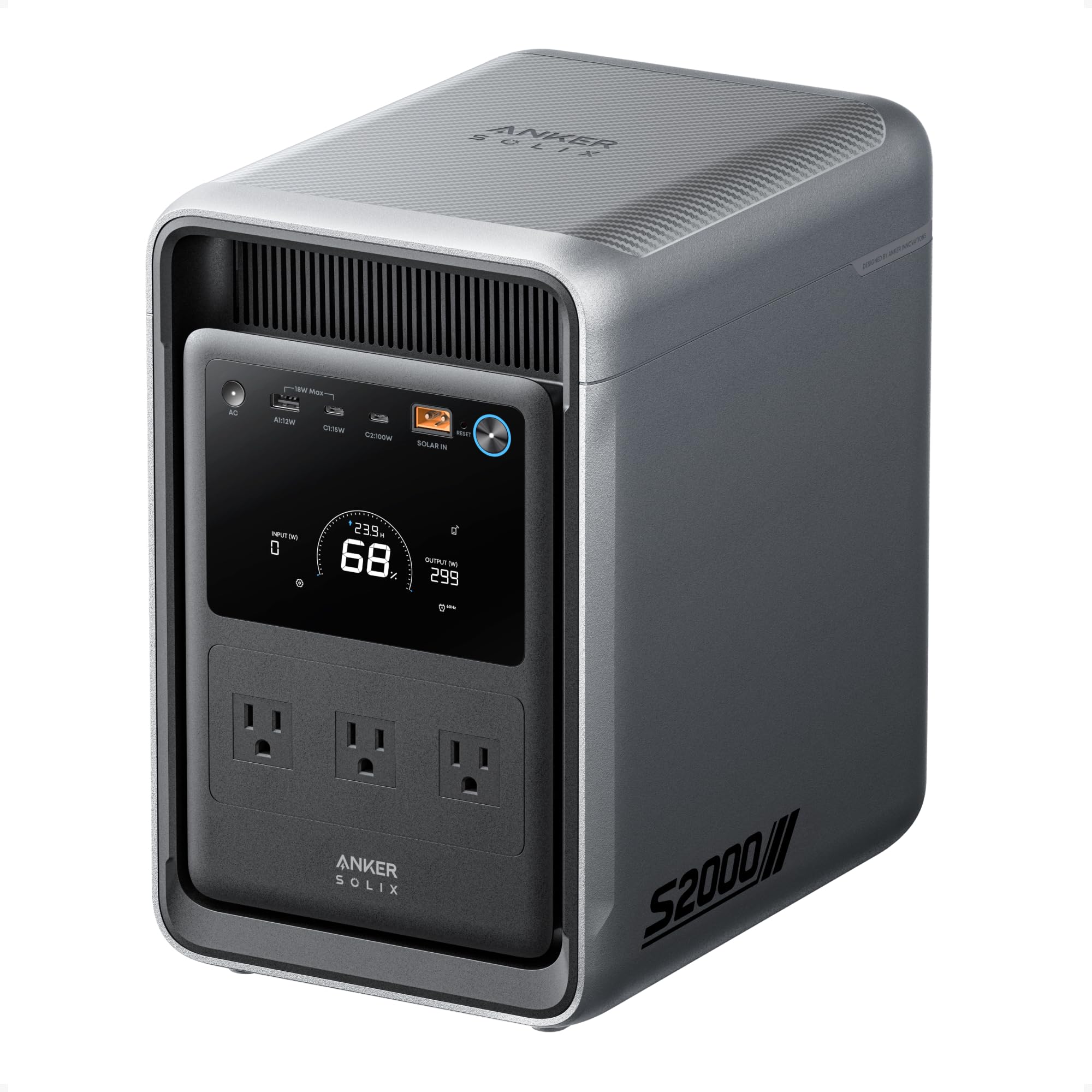
The lightest 2kWh station around, built to keep a full-size fridge cold for a day and a half.
Anker engineered the S2000 to be the most efficient fridge backup in its class: a 6W idle draw and 10% higher efficiency let it run a fridge for 35 hours, per the maker. Owners confirm the real-world math, with one reporting a full-size 220L fridge ran an hour using just 3% battery — projecting roughly 33 hours of runtime. At 35.7 pounds, it is 30% smaller and 25% lighter than the industry average for a 2kWh station, per Anker.
Output is 1,500W continuous with a 3,000W peak, which covers 99% of home essentials. There is no 12V DC port, but the eight AC outlets split into front and rear — plug everyday devices up front and always-on appliances in the rear. It handled a coffee maker pushing over 1600W without complaint, and the dual USB-C ports deliver up to 100W for a laptop.
Performance and reliability are the twin pillars owners praise most. The <10ms UPS switchover replaces the need for a separate UPS for a home office, and the app adds charge limits, time-of-use scheduling, and remote monitoring. The noise gets mixed feedback: quiet under load, but the fan is noticeable during a fast 1200W charge. An occasional unit also arrives with a burn-off smell that clears after the first charge.
quick refills: keeping food cold through a long outage is your top priority and you want the lightest unit that does it.
budget builds: the fan gets loud mid-charge, so you may want to refill it during the day.
6. BLUETTI Elite 200 V2

A 2600W output in a compact cube that runs a microwave, air fryer, and fridge at once.
The Elite 200 V2 squeezes 2073.6Wh and a 2600W continuous output into a footprint that owners call a compact 53.4-pound cube. That output clears the hurdle most stations miss: it runs a 1300W microwave and a 1600W air fryer, which owners have tested, plus a fridge and TV during outages. The 3900W power lifting mode adds headroom for startup surges on motors and compressors.
The battery is the headline — a CNAS-certified automotive-grade LiFePO4 pack rated for over 6000 cycles and a 17-year lifespan of everyday use. Owners also report the Turbo charge mode hits 80% in about 1 hour and full in around 85 minutes, which is fast for a 2kWh class. A 95%+ AC efficiency rating means less energy is lost converting to household power.
Power capacity and value are what owners praise most, noting it handles all their needs while running a fridge for 24 hours. The standby draw drops to just 10W, 3 times lower than similar stations, which stretches runtime between loads. The trade-offs: it is heavy at 53.4 pounds, and the app has a learning curve. An occasional overload shutdown happens if you push past the output cap, but the power button resets it.
apartment backup: running high-draw appliances like a microwave or air fryer during outages without tripping the inverter.
off-grid use: it is not expandable, so what you buy is the capacity you get.
7. EF ECOFLOW DELTA 3 Max
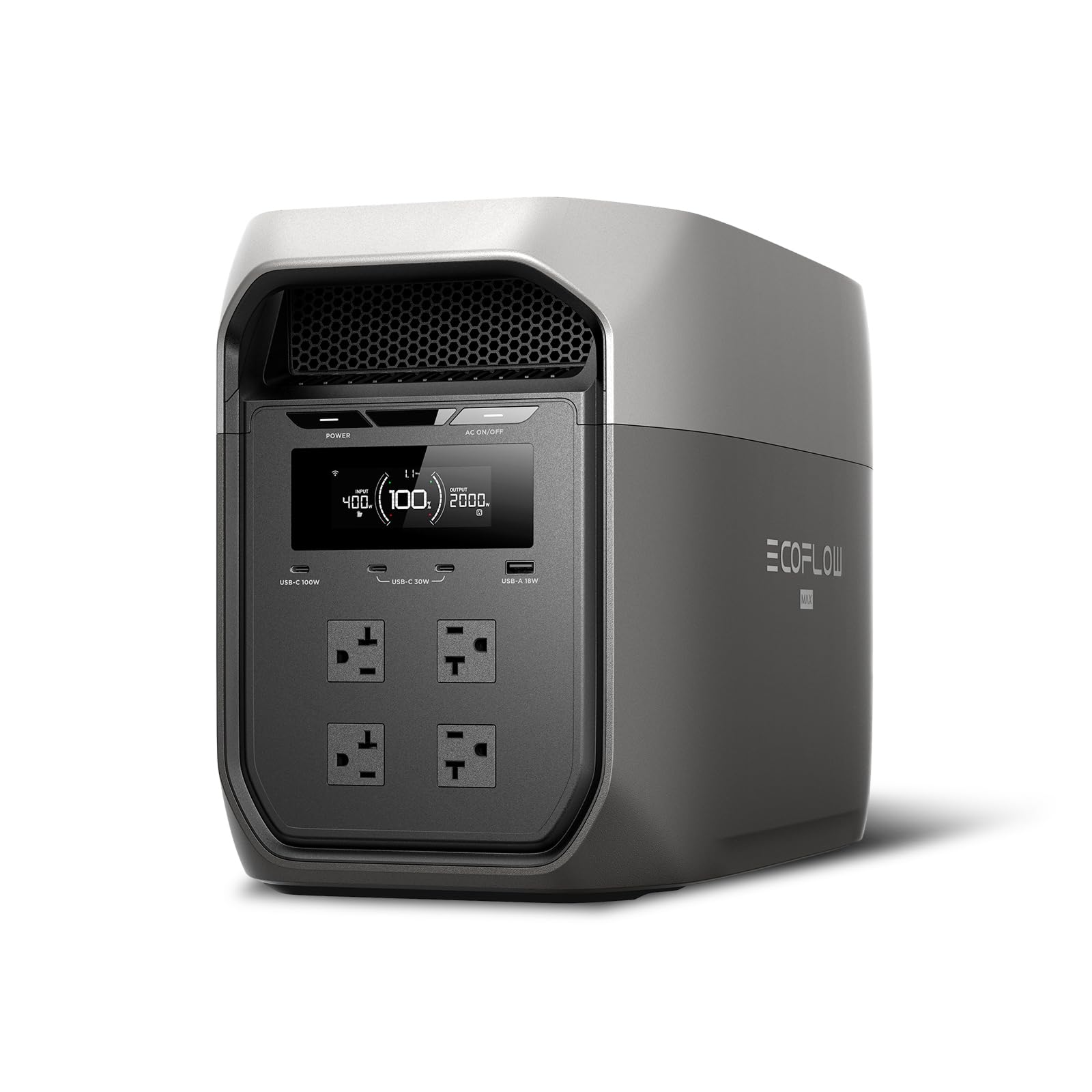
Recharges to 80% in just over an hour and runs 99% of appliances with X-Boost headroom.
The DELTA 3 Max pairs a 2048Wh LiFePO4 battery with a 2400W continuous output that stretches to 3400W in X-Boost mode — enough for fridges, microwaves, and power tools, per the maker. That X-Boost headroom is the difference between a station that just covers a fridge and one that lets you cook and work during an outage. The transfer time is under 10ms, so computers and sensitive electronics ride through an outage without a blip.
Charging is the P210’s defining strength: X-Stream technology (a fast-charging protocol) refills from 0–80% in about 1.13 hours, which owners consistently call fast and efficient. The 5-year service plan adds confidence for a unit built for 10 years of daily use, per the maker. Aluminum and plastic construction keeps it lighter than its capacity suggests, so moving it from the garage to the campsite is easier than you’d expect.
Performance is what owners praise most, with many calling it a top-quality system that charges to full incredibly fast. Battery life gets high marks too, with reports of it running most appliances in a home. The catch is that it is still a heavy unit, and the solar recharge path is planned rather than tested by most owners in this batch. For a balanced, premium home backup, this is the one that checks the most boxes.
home backup: you want fast recharge, a sub-10ms UPS, and enough surge power to run most appliances.
small spaces: it is a solid, heavy build — fine for home placement, less ideal for constant lugging.
8. AFERIY 3840Wh Portable Power Station

A 3.8kWh frame that scales to 11.5kWh and wheels around like a suitcase to back up the whole house.
The AFERIY anchors a serious home backup setup with 3840Wh capacity and 3600W continuous output. Its standout feature is expansion: add battery packs to scale from 3.8kWh up to 11.5kWh, turning a single-day station into a multi-day solution for a refrigerator, phones, a WiFi router, and lights. The maker quotes around 17 hours for common household essentials and 1–2 days for a refrigerator on the base unit.
Despite its 80.46-pound weight, the built-in wheels and pull handle make it manageable, which owners specifically call out as a plus. The <10ms UPS (uninterruptible power supply, a switch that kicks in faster than a blink) keeps critical devices like computers, security cameras, and even pet feeders running smoothly through outages. Recharging takes as fast as 1.5 hours under supported conditions, with AC, solar, car, or AC + solar as the four paths.
Owners call it a powerhouse that is easy to use and great for emergencies, with quiet low-load operation getting specific praise. Charging speed gets mixed feedback — some report full charges in under 90 minutes while a few had units that would not charge at all, though the company replaced those promptly. With 15 ports and app control, it covers everything from a fridge to a mobile workstation.
whole house: whole-home backup where you want the option to grow capacity over time instead of buying it all upfront.
standard outlets: the base unit is heavy, and expansion batteries are the planned next purchase for true multi-day coverage.
9. Jackery HomePower 3000
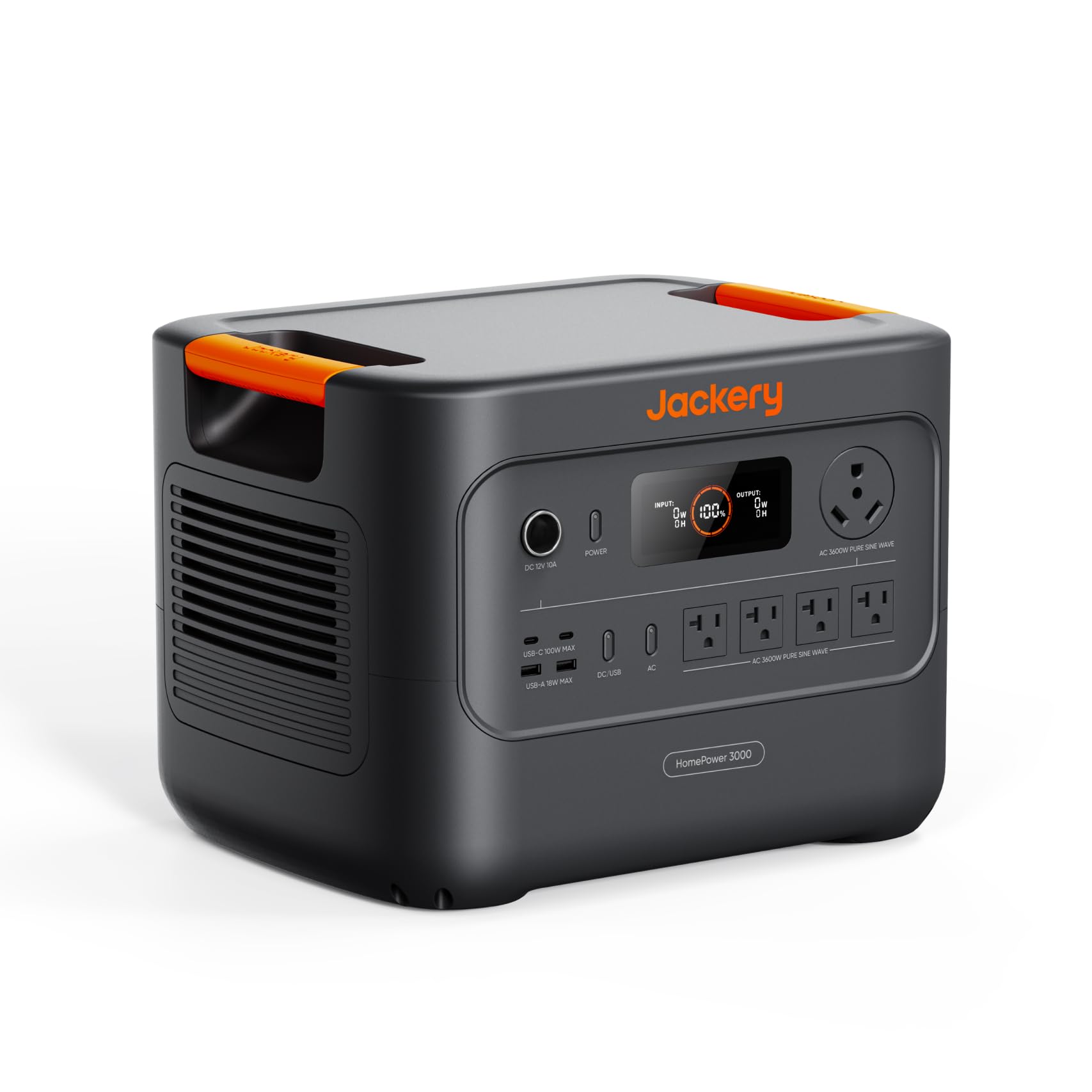
Runs a household for up to 15 hours with a fridge lasting 1–2 days — the serious outage answer.
The HomePower 3000 brings 3072Wh and a 3600W output with a 7200W surge, enough to power a fridge, fan, WiFi router, and lights simultaneously. Customers note a Whirlpool side-by-side refrigerator running for 30+ hours, and the maker quotes a household running for up to 15 hours on a charge. The built-in TT-30 RV port also makes it a natural fit for a camper.
It recharges fully in 1.7 hours via hybrid AC and DC, or 2.2 hours via AC alone. With two 200W SolarSaga panels, it reaches 80% in about 9 hours. The UL-certified UPS switches within ≤20ms, keeping security cameras, Zoom calls, and medical refrigerators running without interruption. ChargeShield 2.0 tech stretches the LiFePO4 battery to 4000 cycles while retaining 70% capacity.
Performance and battery life are the top praises, with owners calling it the best thing for when the power goes out — one powered a large TV, router, lights, and an electric blanket for hours. It is also the lightest in its class per the maker, 47% smaller and 43% lighter than comparable 3kWh models. The honest downsides: it is still heavy at 59.5 pounds, the fan is noisy around 60 dB under heavy load, and one owner hit cold-weather limits trying to run an engine block heater below 15°F.
permanent install: multi-day household backup with RV compatibility and the lightest footprint in the 3kWh class.
rental use: daily UPS duty in a quiet office — the fan noise under load rules that out.
10. Anker SOLIX F3000
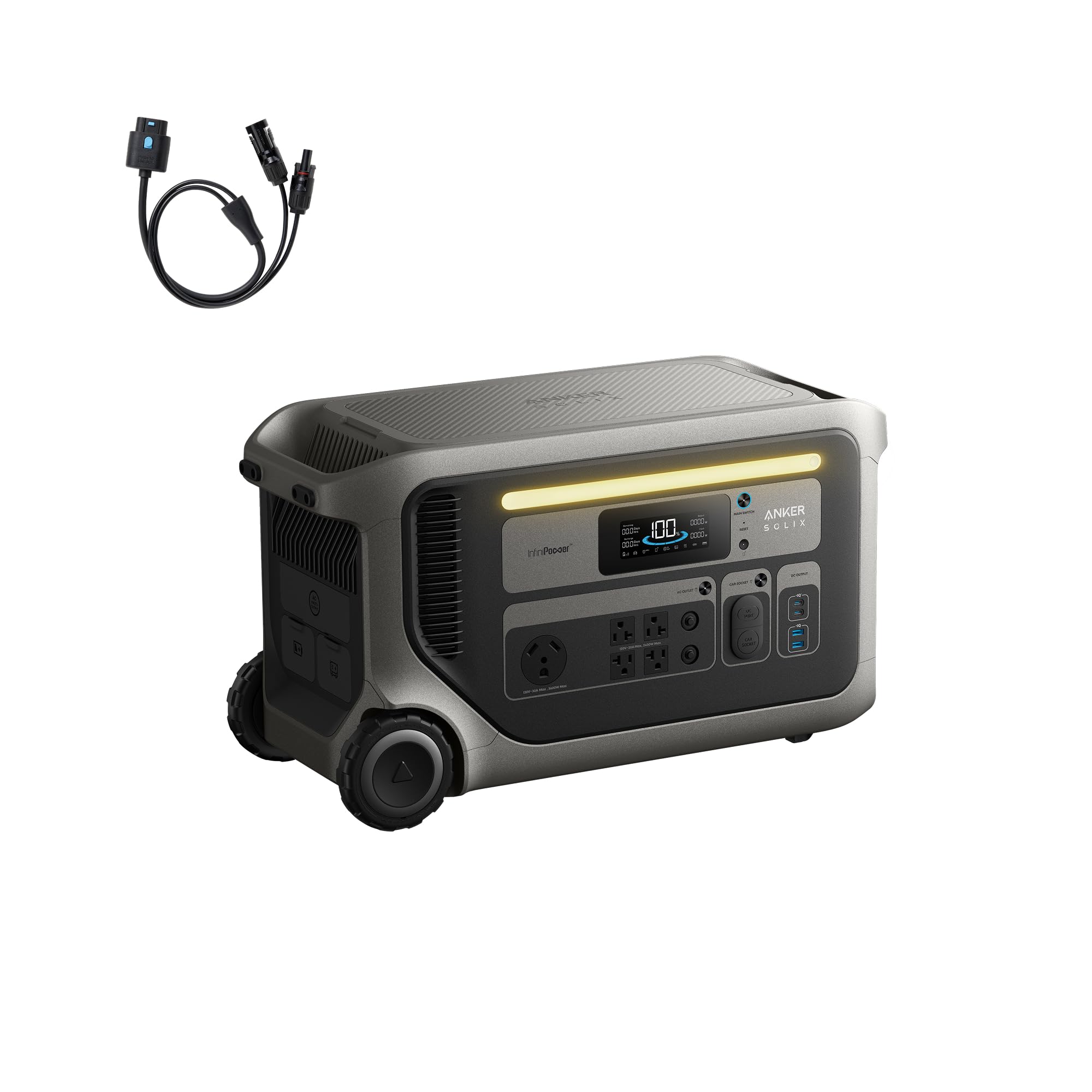
A wheeled 3kWh station with a 42-hour fridge runtime and 6,000W hyper-fast recharging.
The F3000 pairs a 3,072Wh starting capacity with a 3,600W output, and the efficiency story is strong: ultra-low idle power lets it run a 190W fridge for 42 hours, per the maker. Owners confirm the battery holds a charge for up to five days in standby, and the built-in wheels make the 91.5-pound weight genuinely easy to maneuver — a point owners specifically love. It powered an RV AC for 4+ hours quietly.
Recharging is the flex: 6,000W input when you combine a fuel generator and solar, or 2,400W from solar alone through the 165V or 60V ports. That means a big station can refill fast even in a pinch. Pass-through charging at 3,600W lets you run appliances while refilling from a 120V generator. Expandability goes from 3kWh to 24kWh for 80 hours of outage-proof energy, per Anker.
Owners say it handles everything like a pro, and mobility is the standout praise. The app-only controls — port memory, charge limits, power saving — work well but require the app for full function. The trade-offs: no 240V split-phase output for high-voltage appliances, USB ports have a minimum 1W draw you cannot control, and it lacks a dedicated 12V DC port. For sheer capacity with mobility, this is a top-tier choice.
heavy appliances: you want 3kWh of capacity that actually rolls around and refills at record speed.
quiet rooms: no 240V split-phase output means it will not run a whole-house electric system.
11. EF ECOFLOW DELTA Pro
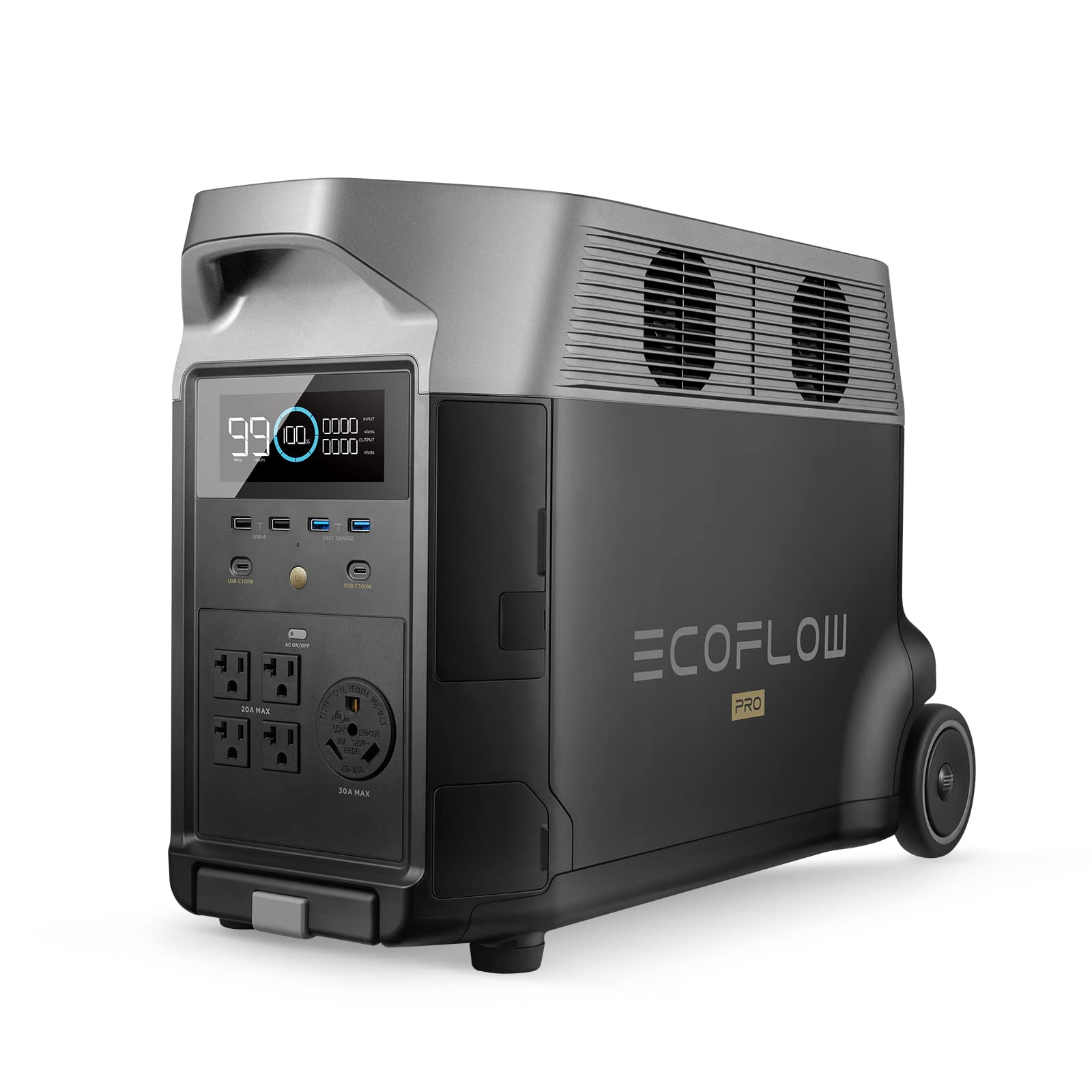
The expandable 3.6kWh workhorse that powers a home and grows to 25kWh with extra batteries.
The DELTA Pro starts at 3600Wh and 3600W of AC output, expandable to 4500W with X-Boost and to 7200W by pairing two units. Add Extra Batteries or a Smart Generator and the capacity scales from 3.6kWh up to 25kWh, per the maker — making this the most future-proof option on the list. Owners have run a heat press flawlessly at markets and kept a neighbor’s fridge and lights running overnight with 30% left.
Charging is flexible and fast: 1.8 hours from a 240V outlet at 3000W, 2.7 hours from a standard 1800W wall outlet, or 2.8 hours from 4x400W solar panels. The 23% solar conversion efficiency is industry-leading per EcoFlow. With five ways to charge — EV station, solar, wall, smart generator, or car — you are never stuck. Fifteen output methods include dual USB-C at 100W, five AC outlets, and an Anderson port.
Performance and reliability are the twin pillars owners praise most, with many citing the fast 2.7-hour recharge and portability for traveling without hookups. It is quieter than a gas generator and holds a full charge for up to 15 days, per the maker. The catch: at 99 pounds, it is the heaviest unit here, so plan where it lives. Durability gets mixed notes, and the weight earns the most negative feedback.
serious off-grid: you want a flagship unit that can grow to whole-home capacity over time instead of maxing out today.
occasional use: at 99 pounds, this is a place-it-and-leave-it station, not a carry-along.
Understanding the Specs
Watt-Hours (Wh)
This is the total energy your station stores — the size of the fuel tank. A 768Wh unit runs a small fridge for several hours, while a 3,072Wh unit can go a full day or more. Match the Wh to how many appliances you want kept alive and for how long.
Continuous vs. Surge Watts
Continuous watts are what a station sustains hour after hour. Surge watts cover the brief spike when a motor or compressor starts — a fridge might run on 150W but needs a jolt to kick on. Always keep your total appliance wattage under the continuous rating, with surge for the starts.
FAQ
What size battery backup do I need for a refrigerator?
How long will a power station run my fridge and lights?
Can a portable power station replace a gas generator?
What is the difference between a UPS and a portable power station?
How many charge cycles does a LiFePO4 battery last?
Can I recharge a power station with solar panels?
How fast do these stations recharge from a wall outlet?
Is it safe to run a power station indoors?
Can I expand the capacity of my power station later?
Will a power station run a microwave or air fryer?
Final Thoughts: The Verdict
For most people, the battery backup for home appliances winner is the BLUETTI AC70 because it balances real fridge-saving capacity, fast 1.5-hour recharge, and a manageable 22.5-pound frame at a mid-range value. If you want instant outage protection for a computer or router, the GOLDENMATE UPS is the plug-and-play answer. And for whole-home, multi-day backup that grows with you, the DABBSSON 2000L or a 3kWh-class station like the Jackery HomePower 3000 delivers the capacity that actually keeps the lights on.
How We Picked
We do not accept paid placement. Every pick is matched to a real buyer and a real use-case; we do not hands-on test units.
Sources & Methodology
Specifications: manufacturer listings and product documentation. Review insights: verified customer reviews, as of August 2026. Pricing: not shown on this page (it changes often); check the current price via the retailer link.
As an Amazon Associate, Gadgets Feed earns from qualifying purchases. This does not affect which products we feature.