
A security camera that goes dark during a power outage is just a plastic shell with a lens. The whole point of a surveillance system is to keep recording when things go wrong — and a sudden blackout is when things often go most wrong. A dedicated battery backup for your cameras ensures the footage keeps rolling, your NVR stays online, and your property remains watched, no matter what the grid does.
I’m Min — the co-founder and writer behind Gadgets Feed. I’ve spent weeks researching backup power solutions specifically for surveillance hardware, analyzing battery chemistries, output voltages, and real-world runtime data to find the units that actually keep cameras alive during outages. This guide focuses on the specific specs that matter for camera uptime.
After comparing capacity, port configurations, and safety features across six top-rated models, I’ve narrowed the field to the most reliable best battery backup for surveillance cameras options available on the market right now for keeping your security system powered through any blackout.
How To Choose The Best Battery Backup For Surveillance Cameras
A battery backup for your security cameras isn’t a generic power bank. Surveillance gear demands specific DC voltages and sustained output that consumer USB bricks can’t provide. Focusing on a few critical specs separates a unit that keeps your system running for hours from one that dies in minutes.
Match Voltage to Your Cameras (5V, 9V, 12V, PoE)
Most security cameras run on 12V DC, but some IP cameras, doorbells, and older models use 5V or 9V. Some PoE cameras require 15V or 24V passthrough. Before buying anything, check the power adapter that came with your camera — the output voltage is printed right on it. Your backup battery must have a dedicated barrel jack or PoE port that matches that exact voltage.
Capacity: Watt-Hours Over Milliamp-Hours
Battery capacity is the single biggest determinant of how long your cameras stay recording. Milliamp-hours (mAh) alone is misleading because it doesn’t account for voltage. Convert everything to watt-hours (Wh) for an apples-to-apples comparison: multiply the mAh by the nominal voltage (usually 3.7V for lithium cells) and divide by 1000. A 20000mAh unit at 3.7V equals 74Wh. A typical 12V camera drawing 10W will run for roughly seven hours on that 74Wh pack — assuming no other loads.
Continuous Wattage Output Limits
Each backup unit has a maximum continuous power output, usually listed in watts. If you plug in a camera system that draws more total power than the unit can deliver, the battery will either shut down, underpower the cameras, or degrade rapidly. A unit rated for 24W total output cannot reliably power a 12V camera drawing 15W plus a 5V switch drawing 10W — the combined 25W load exceeds the limit. Always add up the wattage of every device you plan to connect and leave a 20% headroom margin.
Battery Chemistry and Safety Protections
Lithium-ion and lithium-polymer cells dominate this category for their energy density and low self-discharge. But cheap cells without protection circuits risk overcharging, over-discharging, and thermal runaway — especially when left unattended in a closet or attic where cameras live. Look for units that explicitly state six-fold or multi-protection systems covering short circuit, over-current, over-voltage, over-charge, deep-discharge, and thermal protection. Aluminum housings also dissipate heat better than plastic when the unit is running near its continuous limit.
Quick Comparison
On smaller screens, swipe sideways to see the full table.
| Model | Category | Best For | Key Spec | Amazon |
|---|---|---|---|---|
| Shanqiu 74Wh | Premium | Full camera system backup | 20000mAh / 74Wh, 60W max output | Amazon |
| TalentCell 27000mAh | Premium | Extended runtime / single camera | 27000mAh / 97.2Wh, 4x 12V outputs | Amazon |
| SKE DC20000 Plus | Mid-Range | Router + camera combo | 20000mAh, USB-C PD input, AVR | Amazon |
| Yuuki Power 18000mAh | Mid-Range | PoE cameras / clean LCD status | 18000mAh / 66Wh, PoE 15V/24V | Amazon |
| Hilitand 10400mAh | Budget | Entry-level / single modem | 10400mAh / 18Wh, PoE 15V/24V | Amazon |
| PECRON D39 | Budget | Ultra-compact / low-power cams | 38.48Wh, 12V/2A, includes PoE port | Amazon |
In‑Depth Reviews
1. Shanqiu 74Wh Mini UPS

The Shanqiu 74Wh sits at the sweet spot of capacity and output flexibility for a surveillance-focused backup. Its 20000mAh (74Wh) lithium-polymer pack delivers a class-leading 60W total continuous power across five DC outputs — two 12V ports sharing 5A, one 9V port at 3A, one 5V DC port, and a 5V USB port. That’s enough juice to power a typical 12V security camera, a PoE switch, and a Wi-Fi router simultaneously during a multi-hour outage.
The aluminum alloy enclosure is a meaningful upgrade over the plastic boxes used by most competitors. It dissipates heat more effectively when running near the 60W limit, and the metal shell adds physical durability if the unit is mounted inside a structured wiring cabinet or on a wall near your camera DVR. Input is 100-240V AC, so it works globally without a transformer. The 3-hour recharge time means the backup is ready to go again quickly after the grid returns.
Real-world testing shows this unit powered a fiber ONT, a Firewalla router, and a Netgear switch for over two hours with the battery barely showing discharge. Users report 18+ hour runtimes with two routers alone. The built-in protections cover short circuit, voltage fluctuation, overcharge, over-discharge, and temperature — all critical for a device that may sit untended for months before its first real outage.
Why it’s great
- 60W max output handles multiple cameras and networking gear simultaneously
- Aluminum housing dissipates heat better than plastic competitors
- Seamless battery switch during power loss — cameras never reboot
Good to know
- Barrel connectors are 5.5mm x 2.1mm; odd-sized cameras may need adapter pigtails
- Slightly larger footprint than ultra-compact units at 7 x 4.8 x 1.3 inches
2. TalentCell 27000mAh Mini UPS

The TalentCell 27000mAh is the capacity king among the units tested here, packing 97.2Wh of lithium-ion cells into a compact 6.3 x 5.5 x 1.3-inch frame. That’s enough theoretical energy to run a 10W security camera for nearly 10 hours straight. The headline feature is four independent 12V DC barrel outputs, plus a dedicated 9V port and two 5V USB ports — giving you massive flexibility to power multiple cameras or a camera plus its NVR from a single backup.
Users have confirmed over 5.5 hours of backup time on a 10.5W camera load, and one reviewer reported 24 hours and 18 minutes powering a router and an old phone during a controlled test. The unit includes a 12.6V/2A charger and two DC cables in the box, but note that the input and output ports use the standard 5.5mm x 2.1mm barrel jack — cameras with different barrel sizes will need a separate adapter. The maximum continuous load is 37W, so you cannot run high-power PTZ cameras or multi-camera NVRs from a single unit.
The trade-off for the high capacity is a slightly less polished user experience. The four-segment LED indicator is non-linear — four lights indicate 100-85% charge, three lights indicate 85-40% — and there is no audible low-battery alarm. The battery bypass feature only works when the charging adapter is plugged in, so the unit functions as a pure UPS rather than a power bank that can charge while simultaneously powering devices. Still, for pure runtime on a single 12V camera, this unit outlasts everything else in the lineup.
Why it’s great
- Highest capacity in the lineup at 97.2Wh for maximum camera runtime
- Four independent 12V outputs let you power multiple cameras from one unit
- Verified 24+ hour runtime on low-power networking loads
Good to know
- No low-battery alert or discharge warning when AC power fails
- Battery indicator is non-linear and hard to interpret accurately
- Non-removable 18650 cells require soldering to replace
3. SKE DC20000 Plus Altair

The SKE DC20000 Plus Altair distinguishes itself with a modern port selection that includes USB-C PD input for recharging, making it the most travel-friendly option in this list. With a 20000mAh lithium pack, it offers 5V, 9V, and 12V barrel outputs plus USB-A and USB-C output ports. The inclusion of Automatic Voltage Regulation (AVR) is rare in this form factor — it actively smooths out voltage fluctuations from the wall before they reach your camera system, adding an extra layer of protection for sensitive surveillance electronics.
The slim 4.2 x 8.1 x 1.3-inch profile and 1.4-pound weight make it easy to mount inside a network cabinet or toss into a bag for temporary camera deployments. During testing, users reported the unit powered a fiber ONT for 9 hours straight and only dropped to 75% capacity, suggesting it could run a low-power camera and router for well over 24 hours on a single charge. The bright LED indicators show remaining battery at a glance, and the unit requires a long press to power on — preventing accidental shutoff if bumped.
Build quality is solid with a dense, heavy feel that inspires confidence. The wall-mountable design lets you route cables with ports facing up or down. The main drawback reported by some users is reliability: a small number of units stopped charging after 5 months, and customer support response was inconsistent. The 2A current limit on the 12V output also means high-draw devices are off-limits. For a single camera plus its supporting network gear, this unit strikes an excellent balance of portability and everyday performance.
Why it’s great
- USB-C PD input allows fast recharging from modern power adapters
- Automatic Voltage Regulation protects cameras from dirty grid power
- Wall-mountable design with long-press power button prevents accidental shutdown
Good to know
- Some reliability concerns reported after 5+ months of use
- 12V output limited to 2A — not suitable for high-draw PTZ cameras
4. Yuuki Power 18000mAh Mini UPS
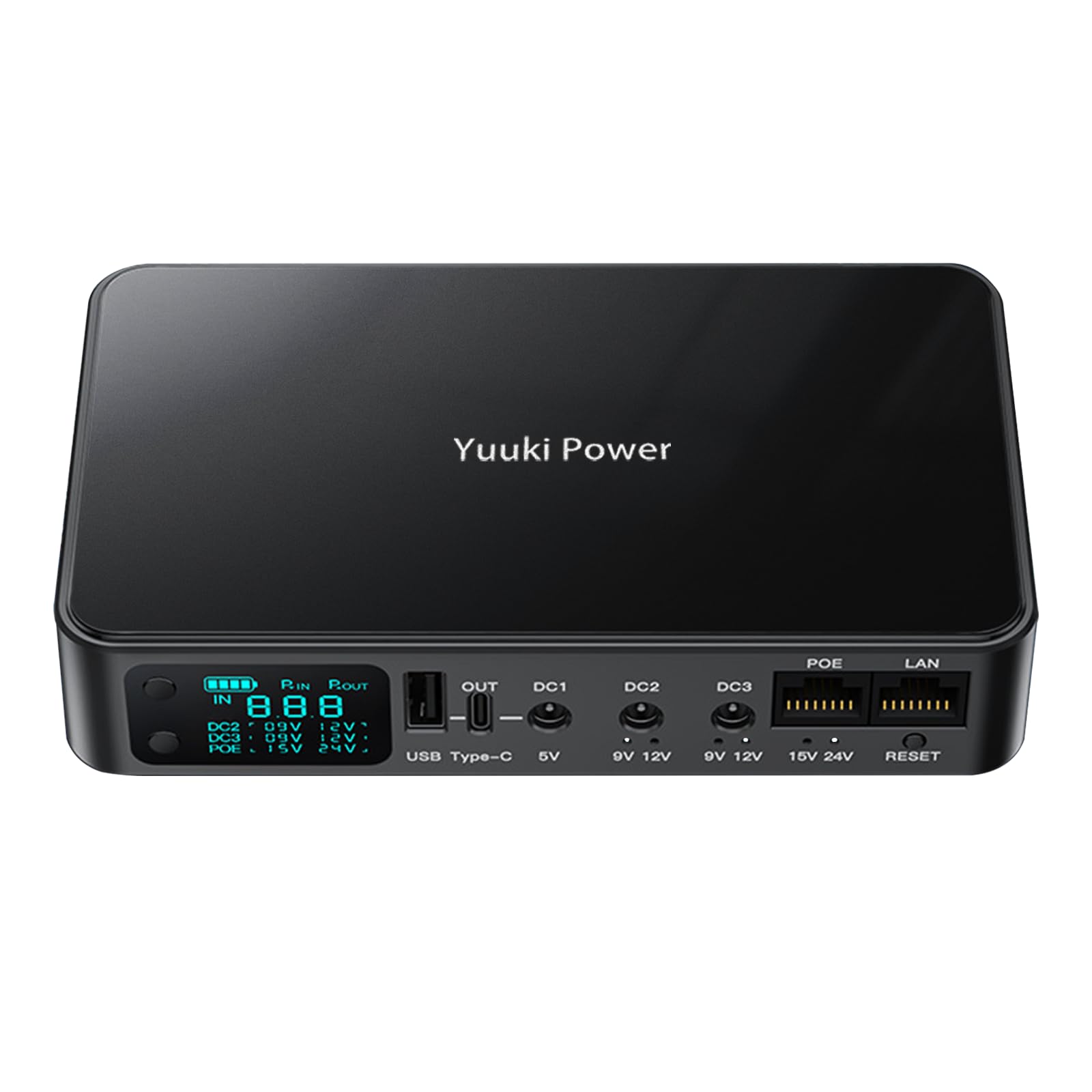
The Yuuki Power 18000mAh (66Wh) unit brings one feature none of its competitors offer at this price point: a real-time LCD screen that displays voltage, current, and remaining capacity numerically. No guessing based on vague LED bars — you can see exactly how much runtime you have left. The port selection is equally impressive for the price, with 5V/3.6A, 9V/2A, 12V/2A barrel outputs plus PoE pass-through at 15V/1.3A and 24V/0.8A, making it one of the most versatile options for PoE security cameras.
The total maximum output is capped at 24W, which is lower than the Shanqiu or TalentCell units. This means you can comfortably power a single 12V camera and a modem, but adding a second high-draw camera or a powered switch may push the unit over its limit — one reviewer found a combined 28W load caused unreliable operation. The included kit is generous: plenty of DC barrel adapters of varying sizes and a 12V/3A US charger. The compact 3.8 x 6.3 x 1.3-inch profile and 1.1-pound weight make it easy to tuck away near your camera’s power source.
The unit’s battery is soldered internally, so replacing aging cells requires disassembly and soldering work — not a user-serviceable design. Charging is also on the slower side with the included 15W wall adapter. But for a straightforward single-camera or modem setup where you want clear visibility into battery status, the LCD screen alone justifies the price. Users confirm it keeps Eufy HomeBases and standard router-modem combos running through extended outages without issue.
Why it’s great
- Real-time LCD display shows exact voltage, current, and battery level
- PoE outputs at 15V and 24V support PoE cameras directly
- Comes with multiple barrel adapter sizes for different camera brands
Good to know
- Total output capped at 24W — cannot handle multi-device high-draw setups
- Batteries are soldered in, making replacement difficult as cells age
5. PECRON D39 DC UPS
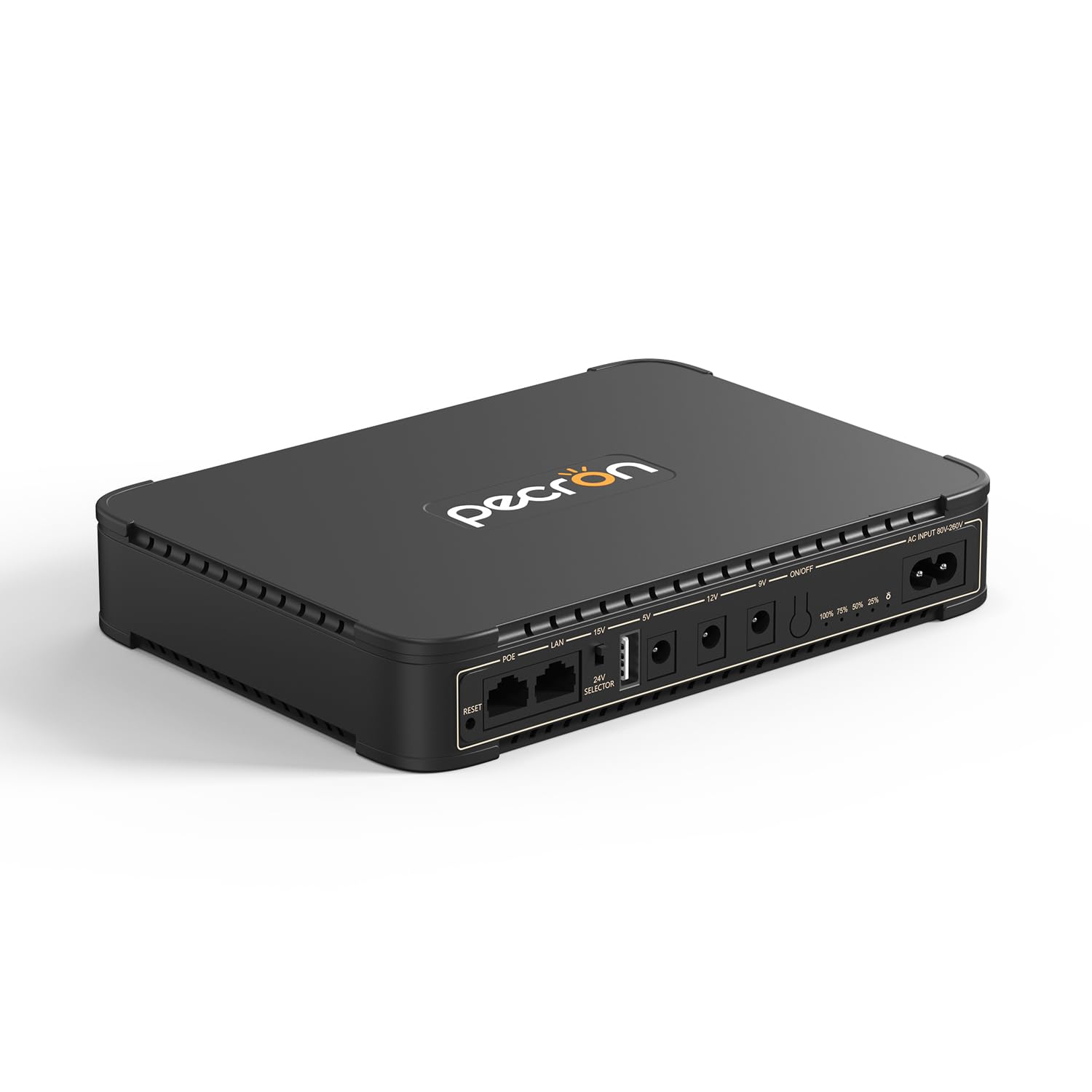
The PECRON D39 is the most compact unit in this lineup at just 5.7 x 7.9 x 1.4 inches and 1.1 pounds, yet it packs a surprisingly useful 38.48Wh lithium-ion battery and a dedicated PoE port — a rare combination at this size and price. Output options include one 5V/2.6A USB-A, three DC5521 barrel ports at 5V, 9V, and 12V respectively, and a PoE port. This makes it a perfect fit for a single low-power security camera and its network connection, all tucked into a tight space near the camera’s power brick.
The six-fold protection system covers over-charge, deep-discharge, over-current, short-circuit, voltage instability, and thermal protection — comprehensive safety for a unit that may sit unattended. The AC input range of 80-260V is impressively wide, handling voltage dips and surges without issue. A clear LED battery indicator shows remaining capacity at a glance. Users confirm the voltage outputs are accurate (measured 5.0V, 9.1V, and 12.2V DC on a multimeter) and that the unit lasts days on low-power devices like an AT&T ONT.
The key limitation is the 12V output’s 2A maximum, which cannot power modern Wi-Fi 7 routers that demand 3A or more. For security cameras, most draw well under 2A at 12V, so this is rarely a problem. The 5-foot power cable is on the short side, so placement near an outlet is required. For ultra-compact backup of a single PoE camera or a basic 12V bullet cam, the D39 offers exceptional value in a tiny footprint.
Why it’s great
- Smallest footprint in the lineup — fits in tight spaces near camera wiring
- Includes a dedicated PoE port for powering PoE cameras directly
- Wide 80-260V AC input handles voltage fluctuations gracefully
Good to know
- 12V output limited to 2A — insufficient for high-power networking gear
- 5-foot power cable is short, requiring placement near an outlet
6. Hilitand 10400mAh UPS

The Hilitand 10400mAh (18Wh) UPS is the entry-level option in this comparison, designed for the buyer who needs basic backup for a single camera or modem without spending on high-capacity hardware. Despite its low cost, it offers a surprising range of outputs: 5V, 9V, and 12V at 2A via barrel connectors, plus PoE outputs at 15V and 24V at 1A. This means it can support PoE cameras despite the small battery capacity, though runtime will be measured in minutes rather than hours for anything beyond a low-power security camera drawing under 5W.
The dual-input flexibility is a nice touch — you can charge the unit via a 5V/9V/12V DC adapter or via a 5V/2A USB connection, making it easy to top up from a phone charger or laptop in a pinch. The total output current from any combination of ports must not exceed 2A, which is the main limitation. You cannot run a 12V camera drawing 1.5A and a 5V sensor drawing 0.6A simultaneously. The included multi-protection system covers short circuit, voltage fluctuation, overcharging, over-discharging, and temperature, so safety isn’t sacrificed at this price tier.
User reports are mixed on longevity — some units have failed after 1-2 years, with the battery heating up excessively and failing to maintain output. Others report it works perfectly for several hours of backup on a modem and repeater. For a budget backup intended for occasional short outages, the Hilitand delivers usable functionality. For always-on surveillance that demands multi-hour runtime and years of reliability, the investment in a larger capacity unit from the mid-range or premium tier is strongly advised.
Why it’s great
- Lowest entry price for a UPS with PoE 15V/24V support
- Dual charging input via DC or USB for flexible recharging
- Compact size fits easily alongside camera power bricks
Good to know
- Total output current limited to 2A across all ports — restrictive for multi-device setups
- Long-term reliability is inconsistent, with some units failing after 1-2 years
FAQ
Can I use a standard phone power bank as a backup for my security camera?
How long will a 20000mAh backup run a typical 12V security camera?
What does PoE mean on a mini UPS and do I need it for my camera?
Final Thoughts: The Verdict
For most users, the best battery backup for surveillance cameras is the Shanqiu 74Wh Mini UPS because its 60W continuous output, aluminum housing, and versatile port selection handle a full camera system plus networking gear through any typical outage. If you need maximum single-device runtime, the TalentCell 27000mAh is the clear choice with its 97.2Wh capacity. And for a compact, value-driven backup perfect for a single PoE camera or low-power bullet cam, the PECRON D39 delivers surprising utility in the smallest footprint available.