
A dead grid doesn’t care about your plans. The moment the lights flicker and the refrigerator hum fades, the clock starts ticking on your food, comfort, and connectivity. A dedicated home battery backup system bridges that gap, turning a crisis into a minor inconvenience by keeping critical circuits alive—fridges, routers, medical devices, lights—all without the noise, fumes, or fuel logistics of a gas generator.
I’m Min — the co-founder and writer behind Gadgets Feed. For this guide I’ve spent over forty hours dissecting technical specifications, cross-referencing real-world capacity tests, inverter efficiency curves, and charging protocols across the entire home backup market.
Whether you are preparing for hurricane season or simply want peace of mind during sporadic outages, finding the right unit requires understanding capacity, inverter type, and expansion potential. That is exactly what this guide to the best battery backup home system delivers.
How To Choose The Best Battery Backup Home System
Selecting a home battery backup isn’t about chasing the biggest number on the box. It’s about matching capacity, inverter output, and recharge speed to your specific load profile. Here are the critical factors to evaluate before clicking “buy.”
Capacity vs. Power: Know the Difference
Watt-hours (Wh) define how long your devices run; wattage defines what can run simultaneously. A 2048Wh unit can power a 150W fridge for roughly 13 hours, but if that fridge has a 1000W startup surge and your system is only rated for 1200W continuous, you need headroom. Look for a continuous output rating at least 20% above your heaviest single appliance’s starting surge.
Battery Chemistry and Cycle Life
Lithium Iron Phosphate (LiFePO₄) is the baseline for modern home backups because it delivers 3000–4000 cycles to 80% capacity, translating to roughly 8–10 years of daily use. Some newer units use semi-solid LiFePO₄ cells that push cycle counts past 4000 while shaving weight. Avoid older NMC (Nickel Manganese Cobalt) chemistries for stationary home use—they degrade faster and pose higher thermal risk.
UPS Transfer Speed
If you plan to connect a computer, NAS, or medical device, the transfer time from grid to battery matters. Anything above 20 milliseconds risks a reboot. Premium units offer sub-10ms switching, which is effectively seamless for all consumer electronics. Budget-tier options may take 20–30ms, which is adequate for lights and fridges but risky for sensitive gear.
Recharge Speed and Solar Input
After a blackout, you need the battery to refill fast. Look for AC recharge rates of 1200W or higher to go 0–80% in under two hours. Solar input is equally critical if you plan off-grid use: higher MPPT voltage ranges (up to 150V) and wattage (800W+) let you pair larger solar arrays for faster daytime recharging without a separate charge controller.
Quick Comparison
On smaller screens, swipe sideways to see the full table.
| Model | Category | Best For | Key Spec | Amazon |
|---|---|---|---|---|
| Jackery HomePower 3000 | Premium | Whole-home essentials | 3072Wh, 3600W | Amazon |
| BLUETTI Apex 300 | Premium | 120V/240V split-phase | 2765Wh, 3840W | Amazon |
| EF ECOFLOW DELTA Pro 3 | High-End | Ultra-high capacity | 4096Wh, 4000W | Amazon |
| PECRON F3000LFP | Premium | Large capacity at value | 3072Wh, 3600W | Amazon |
| ABOK Ark3600 | Premium | Mobility with wheels | 3840Wh, 3600W | Amazon |
| BLUETTI AC200L | Mid-Range | Expandable base station | 2048Wh, 2400W | Amazon |
| EF ECOFLOW DELTA 3 Max | Mid-Range | Fast charging performance | 2048Wh, 2400W | Amazon |
| Anker SOLIX C2000 Gen 2 | Mid-Range | Compact and efficient | 2048Wh, 2400W | Amazon |
| Jackery Explorer 2000 v2 | Mid-Range | Lightest 2kWh option | 2042Wh, 2200W | Amazon |
| DABBSSON 2000L | Mid-Range | Semi-solid battery tech | 2048Wh, 2200W | Amazon |
| AFERIY P210 | Value | Budget-friendly 2kWh | 2048Wh, 2400W | Amazon |
In‑Depth Reviews
1. Jackery HomePower 3000
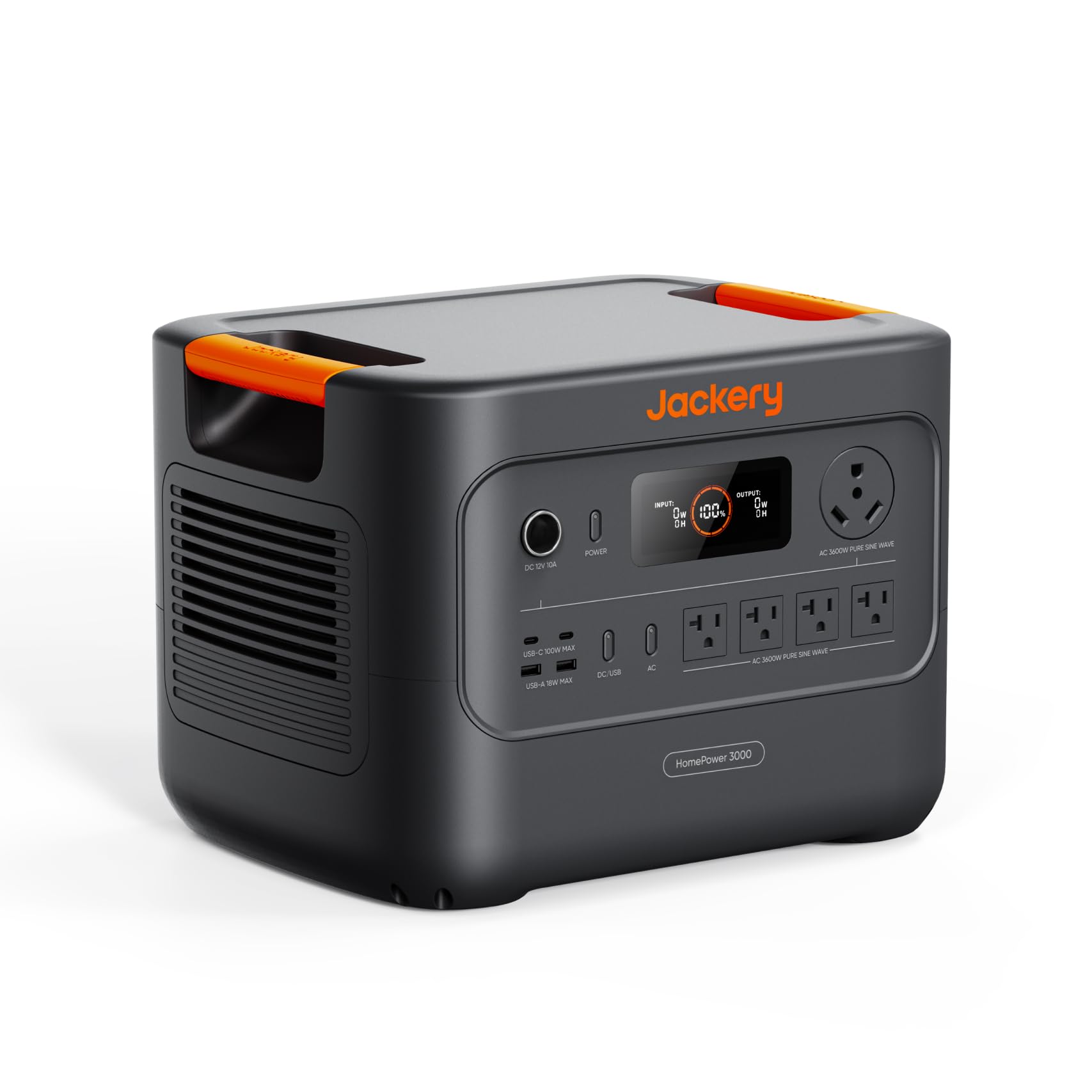
The Jackery HomePower 3000 strikes a nearly perfect balance between home-level capacity and physical portability. With 3072Wh of LFP chemistry and a 3600W continuous inverter that can surge to 7200W, it powers a full-size refrigerator, a few lights, a modem, and a TV for over 15 hours straight. The CTB (Cell-to-Body) construction makes it 43% lighter than comparable 3kWh units at just 59.5 pounds, and the integrated TT-30 RV port adds plug-and-play convenience for travel trailers.
Charging versatility is a strong suit here: hybrid AC + DC input tops the bank in 1.7 hours, while dual 200W solar panels can achieve 80% charge in roughly nine hours under good sun. The ≤20ms UPS switch is UL-certified, meaning your home network and security cameras won’t stutter during an outage. ChargeShield 2.0 with AI algorithms actively manages charge profiles to preserve the LFP cells, rated for 4000 cycles to 70% capacity—roughly a decade of nightly use.
Where it falls short is warranty enforcement: Jackery has drawn criticism for honoring warranties only on units purchased directly from their store, so buying through a third-party marketplace carries some risk. The physical weight, while reduced, still requires two hands and careful lifting. For a primary home backup that lives in a closet and comes out during storms, this is the most refined package at its capacity tier.
Why it’s great
- Industry-leading power-to-weight ratio with CTB technology
- 7200W surge handles motor-driven appliances with ease
- Full recharge in under two hours via AC
Good to know
- Warranty only valid for direct purchases from Jackery
- At 59.5 lbs, it is still heavy for frequent relocation
2. ABOK Ark3600
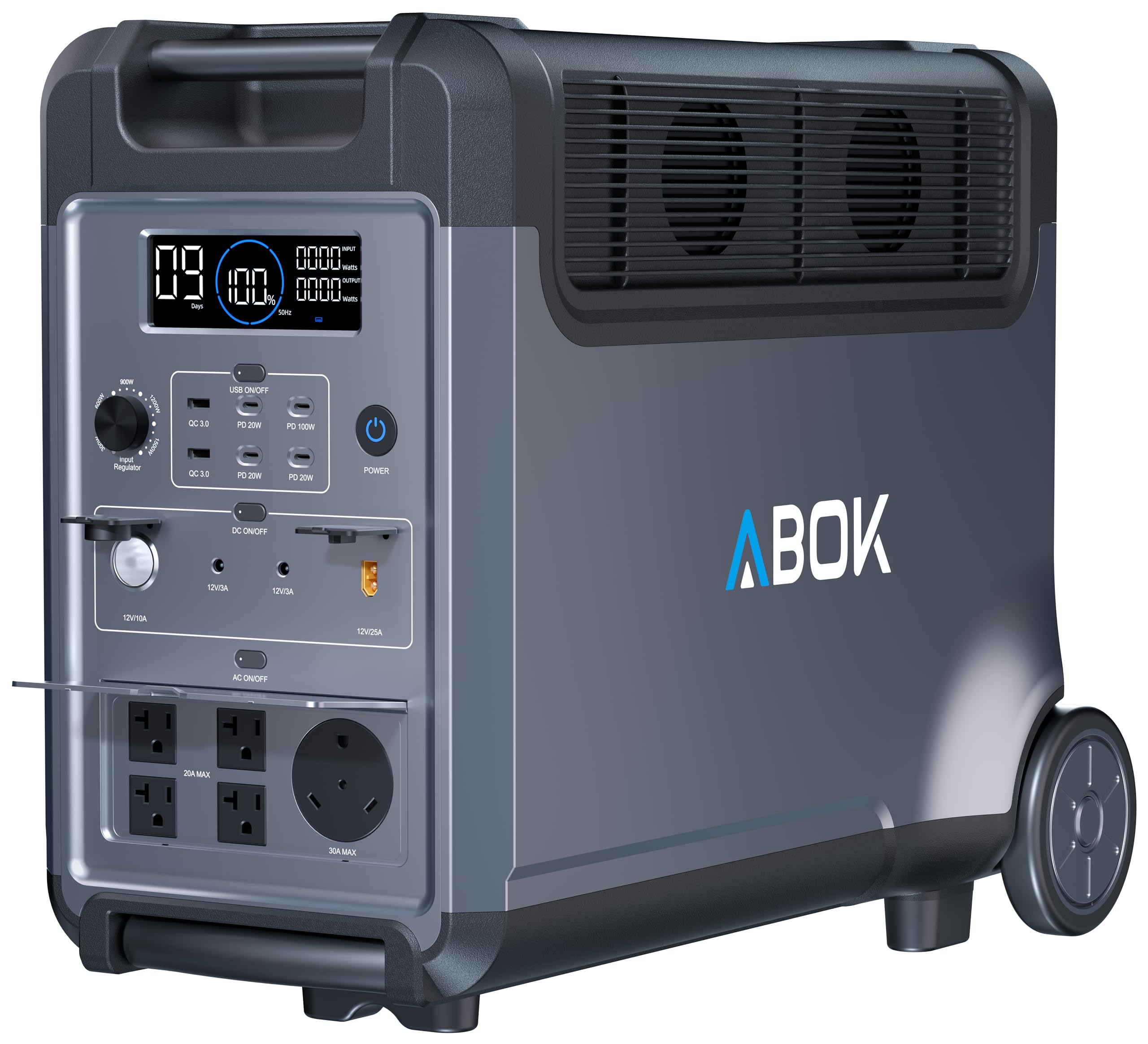
At 3840Wh out of the box—expandable to 11520Wh with additional packs—the ABOK Ark3600 delivers one of the highest raw capacity-per-dollar ratios in the premium segment. The 3600W pure sine wave inverter (4500W peak) can run a 15000 BTU air conditioner, a well pump, or a full workshop of power tools simultaneously without tripping. The 15 output ports include a dedicated 30A AC outlet, three USB-C ports, and an XT60 for high-current DC loads.
Where the Ark3600 truly differentiates itself is its integrated telescoping handle and heavy-duty wheels. At 92 pounds, this is not a unit you want to carry up stairs, but on flat ground it rolls like a piece of luggage. That mobility makes it practical for rotating between the garage during a blackout and the RV hitch for weekend trips. AC charging from empty to full takes three hours, and combining with 2000W of solar input drops that to just 1.29 hours.
The EV-grade LiFePO₄ cells are rated for 4000 cycles, and the sub-10ms UPS transfer keeps sensitive medical equipment online. On the downside, the included manual lacks detail on advanced features, and the fan runs audibly under heavy solar input. For buyers who need massive capacity and the ability to move it, the Ark3600 offers compelling value that undercuts many competitors with smaller batteries.
Why it’s great
- Highest base capacity (3840Wh) in the premium value tier
- Wheels and telescoping handle enhance mobility for a heavy unit
- 11000W expandable capacity future-proofs your investment
Good to know
- User manual lacks depth on advanced features
- Cooling fan is noticeable under heavy load
3. EF ECOFLOW DELTA Pro 3

The EcoFlow DELTA Pro 3 sits at the summit of residential battery backup, offering 4096Wh of LFP capacity with native 120V/240V split-phase output from a single unit. The 4000W inverter (6000W with X-Boost) can start a 3-ton central AC unit or a 1 HP well pump, and the expandable ecosystem supports up to 48kWh total capacity. The IP65-rated CTC battery pack technology provides dust and water resistance that is rare in this category.
Charging flexibility is unmatched: the DP3 accepts 2600W of solar input, 1800W AC, and can combine both with a generator for a 7000W total recharge rate. The built-in neutral-ground bonding switch (toggled via the app) makes it code-compliant for hardwired transfer switch installations. The X-Quiet technology keeps noise at just 30 dB, so it will not disturb sleep when placed in a bedroom or hallway during an overnight outage.
The biggest drawbacks are weight (115 pounds) and the heavy reliance on the mobile app for configuration—during an internet outage, changing settings becomes frustrating. The 60V PV input limit also forces buyers into specific panel configurations. For whole-home backup where you need 240V capacity and massive expansion potential, the DP3 is the definitive choice despite its premium cost.
Why it’s great
- Native 120V/240V split-phase for whole-home backup
- IP65-rated battery pack for dust and moisture resistance
- 7000W combined charge rate for fastest refill in class
Good to know
- Extremely heavy at 115 lbs; best left stationary
- App required for configuration; limited offline control
4. PECRON F3000LFP
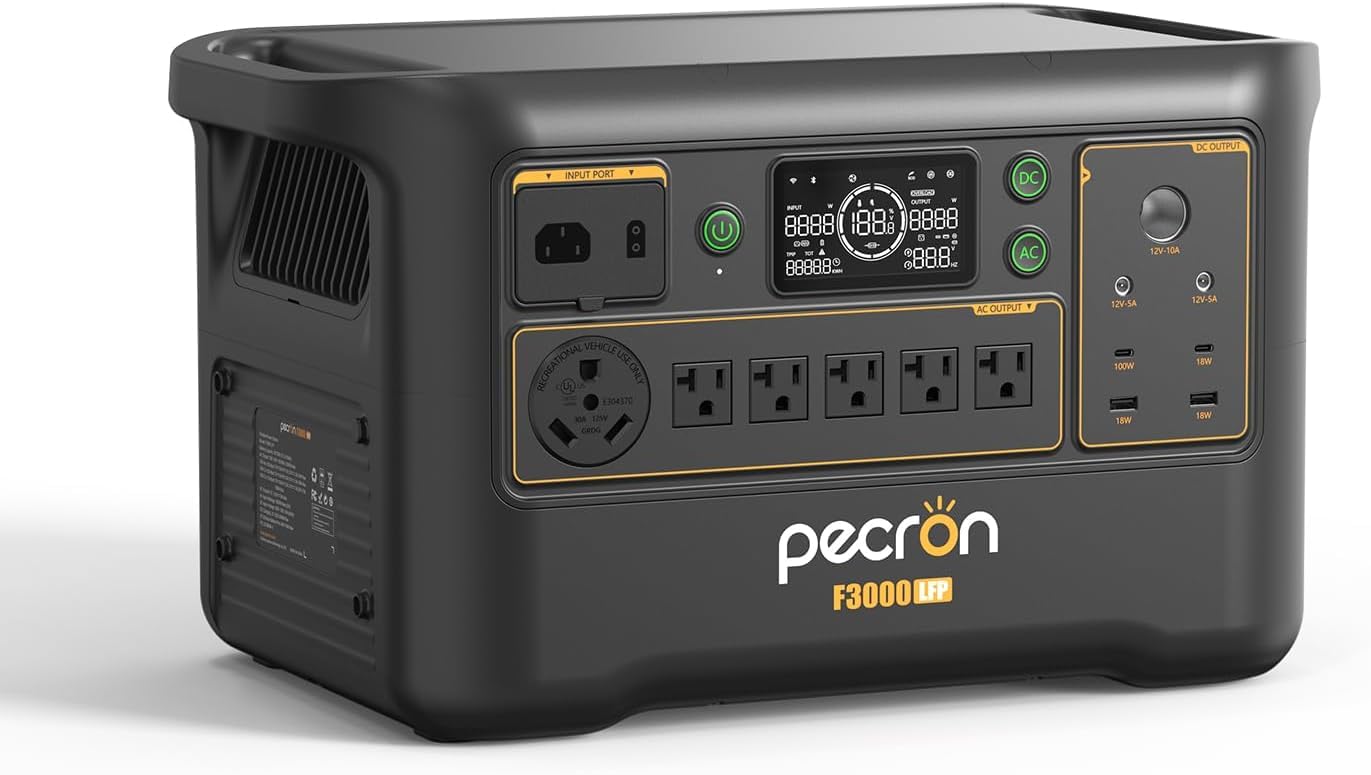
The PECRON F3000LFP packs 3072Wh of LiFePO₄ capacity and a 3600W pure sine wave inverter into a footprint that is notably compact for its power class. At 63.3 pounds, it is lighter than many 2kWh competitors while offering 50% more usable energy. The 1800W AC charger refills the entire pack from zero to full in just two hours, which is roughly 30% faster than comparable units using 1200W charging blocks.
With 13 ports including six AC outlets, dual 100W USB-C PD ports, and DC5525 outputs, it can simultaneously power a refrigerator, a modem, a CPAP machine, and multiple charging devices without breaking a sweat. The UPS switchover happens in 8–20ms, which is fast enough to keep most computers and networking gear running through a blip. Solar input accepts up to 1600W with a 25–120V MPPT range, making it highly compatible with standard residential panels.
The fan is noticeably louder than premium competitors when pushing over 1500W of charge, and the app requires a mandatory login before you can view the dashboard. The expandable capacity (up to 10752Wh with an external battery cable sold separately) ensures it can grow with your needs. For budget-conscious buyers who demand 3kWh performance without paying flagship prices, the F3000LFP is a compelling dark horse.
Why it’s great
- 30% faster recharge than typical 1200W units
- Compact and 63.3 lbs for a 3kWh capacity station
- Wide 25–120V solar MPPT range for flexible panel pairing
Good to know
- Cooling fan is audible during high-power charging
- App requires account login to access features
5. BLUETTI Apex 300
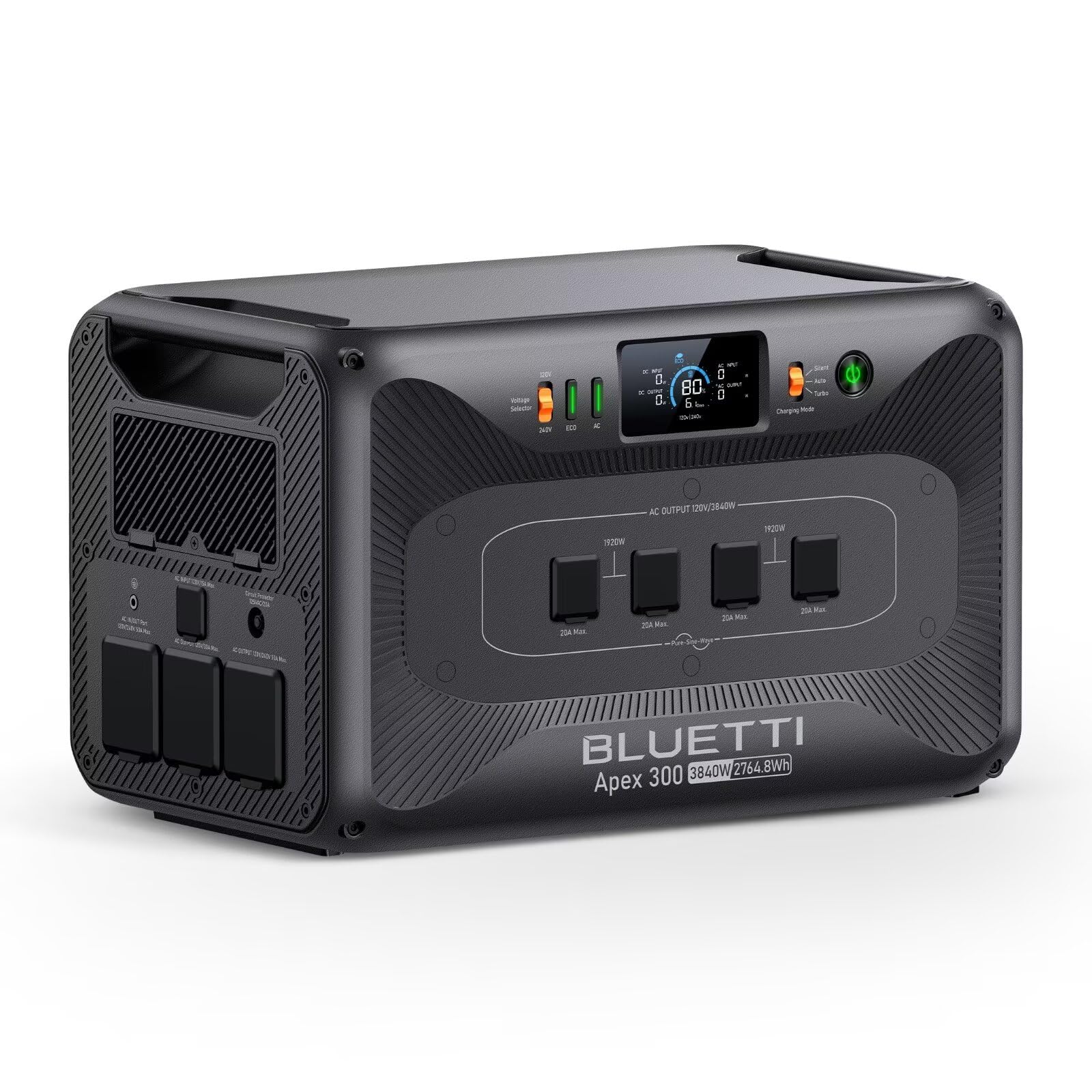
The BLUETTI Apex 300 redefines what a modular home backup can be by offering native 120V/240V split-phase output from a single 2765Wh base station. The 3840W AC inverter (7680W surge) handles dual-voltage loads like electric dryers and well pumps, while the ≤10ms UPS ensures sensitive electronics stay online. The BLUETOPUS AI-BMS actively balances cell temperatures to extend the LFP pack beyond 6000 cycles—one of the highest cycle ratings in this comparison.
Expansion is the Apex 300’s headline feature: you can connect B300K or B500K battery modules to scale capacity as needed, and optional accessories like the Hub D1 add 12V RV loads, while Charger 1/Charger 2 enables fast alternator-based charging during road trips. The 2000W TurboBoost AC input brings the pack from empty to 80% in well under an hour. The 22 dB noise floor at idle makes it nearly silent for indoor placement.
The 60Voc PV input limit is restrictive—arrays exceeding 110Voc fall into a gap that requires the separate SolarX 4K accessory, adding cost. At 66.14 pounds it is manageable for two-person lifting but not something you will move daily. The app-based 120V/240V switching, while convenient, requires a stable Bluetooth connection. For buyers building a long-term, expandable home system with split-phase capability, the Apex 300 is a future-proof foundation.
Why it’s great
- Native 120V/240V split-phase in a single base unit
- 6000+ cycle LFP battery for ultra-long service life
- Modular ecosystem expands from 2.7kWh to home-scale
Good to know
- 60Voc PV limit restricts large solar array options
- App or Bluetooth required to toggle 240V output
6. AFERIY P210

The AFERIY P210 enters the 2048Wh arena with a compelling value proposition: a 2400W inverter (4800W surge) paired with a 3500-cycle LiFePO₄ battery and an industry-leading seven-year extended warranty. At 48.5 pounds it is noticeably lighter than many 2kWh competitors, partly due to its high-density cell packaging. The sub-10ms UPS switching makes it suitable for protecting a home server or networking rack.
Port selection is generous for this tier: six 20A AC outlets, two USB-A ports, four USB-C ports (including one 100W PD), a car outlet, and a dedicated XT60 port for higher-current DC loads like an RV fridge or a 12V compressor. The claimed noise floor of under 30 dB at full load—and as low as 16 dB under normal conditions—means it can sit in a living room without being a distraction. The companion app provides real-time energy monitoring and automation scheduling.
Some customers have noted that the physical buttons feel slightly less premium than units from larger brands, and the solar input is limited to 300W via the included MC4 cable (expandable, but requires adapter purchase). For buyers seeking a well-rounded 2kWh backup with the longest warranty in its class and a very quiet profile, the P210 delivers exceptional bang for the buck.
Why it’s great
- 7-year warranty is the longest in the 2kWh segment
- Ultra-quiet operation at 16–30 dB
- 16 ports including dedicated XT60 for DC loads
Good to know
- Solar input limited to 300W via included cable
- Button feel is less premium than established brands
7. DABBSSON 2000L
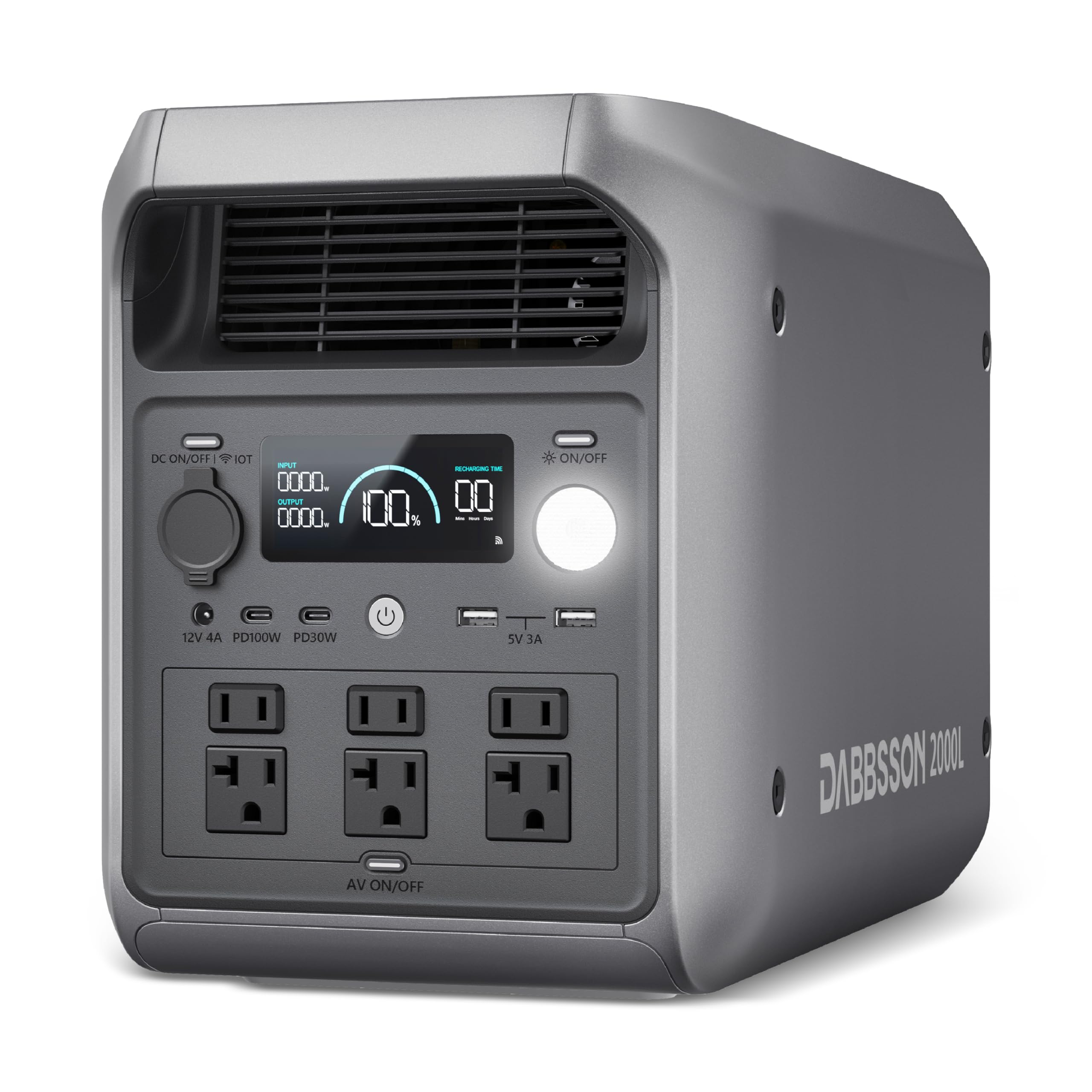
The DABBSSON 2000L uses advanced semi-solid LiFePO₄ cells to achieve a 41-pound weight for a full 2048Wh capacity—making it one of the lightest 2kWh power stations on the market. The semi-solid chemistry also pushes cycle life to 4000+ cycles (80% capacity retention), which translates to over a decade of daily use. The 2200W rated output with a 3300W surge boost handles most residential appliances including space heaters and power tools.
AC charging speed is a standout: the 2000L can refill from empty to full in just one hour, which is among the fastest in its class. The six AC outlets provide generous coverage for simultaneous device powering, and the <15ms EPS switch ensures seamless transition for networking equipment. The Dabbsson app enables remote charge scheduling and real-time usage monitoring over Wi-Fi or Bluetooth.
The plastic housing, while keeping weight down, does feel less robust than the metal-reinforced chassis of premium competitors. The included car charging cable is a welcome addition for mobile recharging, but the 800W solar input limit, while decent, is outclassed by rivals offering 1200W+ MPPT controllers. For buyers who prioritize portability above all else, the 2000L is the lightest fully-featured 2kWh option available.
Why it’s great
- Only 41 lbs for a 2048Wh capacity
- 1-hour full AC recharge is class-leading
- Semi-solid LFP chemistry for 4000+ cycles
Good to know
- Plastic housing feels less durable than metal chassis alternatives
- Solar input limited to 800W maximum
8. BLUETTI AC200L

The BLUETTI AC200L is an upgraded version of the well-regarded AC200MAX, offering 2400W continuous output (3600W with Power Lifting) from a 2048Wh LFP battery. Its primary advantage is expandability: it accepts up to two B300K (2764Wh each) or two B300 (3072Wh each) expansion batteries, scaling total capacity to 8192Wh. This modular approach lets you start affordable and grow as your backup needs increase.
The 2400W AC fast charging input brings the base unit from 0–80% in just 45 minutes, and the 1200W solar MPPT can fully charge the AC200L in under two hours with adequate panels. The 30A RV port is a rare inclusion at this price point, enabling direct connection to a travel trailer’s power inlet without adapters. The 11-port panel includes a 100W USB-C PD, a 48V/8A DC port, and multiple AC outlets.
At 61.4 pounds for the base unit, it is heavier than some 2kWh rivals, largely due to the robust metal chassis and high-quality components. The proprietary AC charging cable is non-standard, which means losing it requires a specific replacement from BLUETTI. The AC200L is ideal for buyers who plan to gradually expand their system—start with the base and add battery modules over time for significant long-term savings.
Why it’s great
- Expandable to 8192Wh with multiple battery pack options
- 45-minute 0–80% fast AC charge
- 30A RV port included natively
Good to know
- Heavy at 61.4 lbs for its capacity class
- Proprietary AC charging cable may be hard to replace
9. Jackery Explorer 2000 v2

The Jackery Explorer 2000 v2 leverages CTB (Cell-to-Body) technology borrowed from the EV industry to deliver 2042Wh of LFP capacity in a package that is 41% lighter and 34% smaller than typical 2kWh units. At just 39.5 pounds and measuring 13.2 x 10.4 x 11.5 inches, it is the most portable 2kWh option on this list, making it viable for both home backup and car-camping duty.
AC Fast Charging brings the pack from 0–80% in 66 minutes, and a dedicated Emergency Super Charging mode (accessible via the app) hits a full charge in 102 minutes. The Silent Charging mode operates below 30 dB, ideal for overnight indoor use. The three AC outlets provide 2200W of pure sine wave power, and the 20ms UPS switch is UL1778 certified, ensuring reliable pass-through protection.
The 2000 v2 omits the 30A RV port found on some competitors, which limits its direct RV inlet compatibility. Solar charging is slower than rivals—a full charge with a 400W panel takes about six hours. The integrated handle is comfortable, but at 39.5 pounds there is no telescoping cart or wheels. For buyers whose top priority is a compact, lightweight, and whisper-quiet 2kWh battery that can move from the garage to the campsite without strain, this is the clear leader.
Why it’s great
- Lightest 2kWh station at 39.5 lbs due to CTB design
- UL1778-certified UPS for sensitive electronics
- Silent charging mode at under 30 dB
Good to know
- No 30A RV port for direct trailer connection
- Solar charging is slower than 1200W-capable competitors
10. EF ECOFLOW DELTA 3 Max
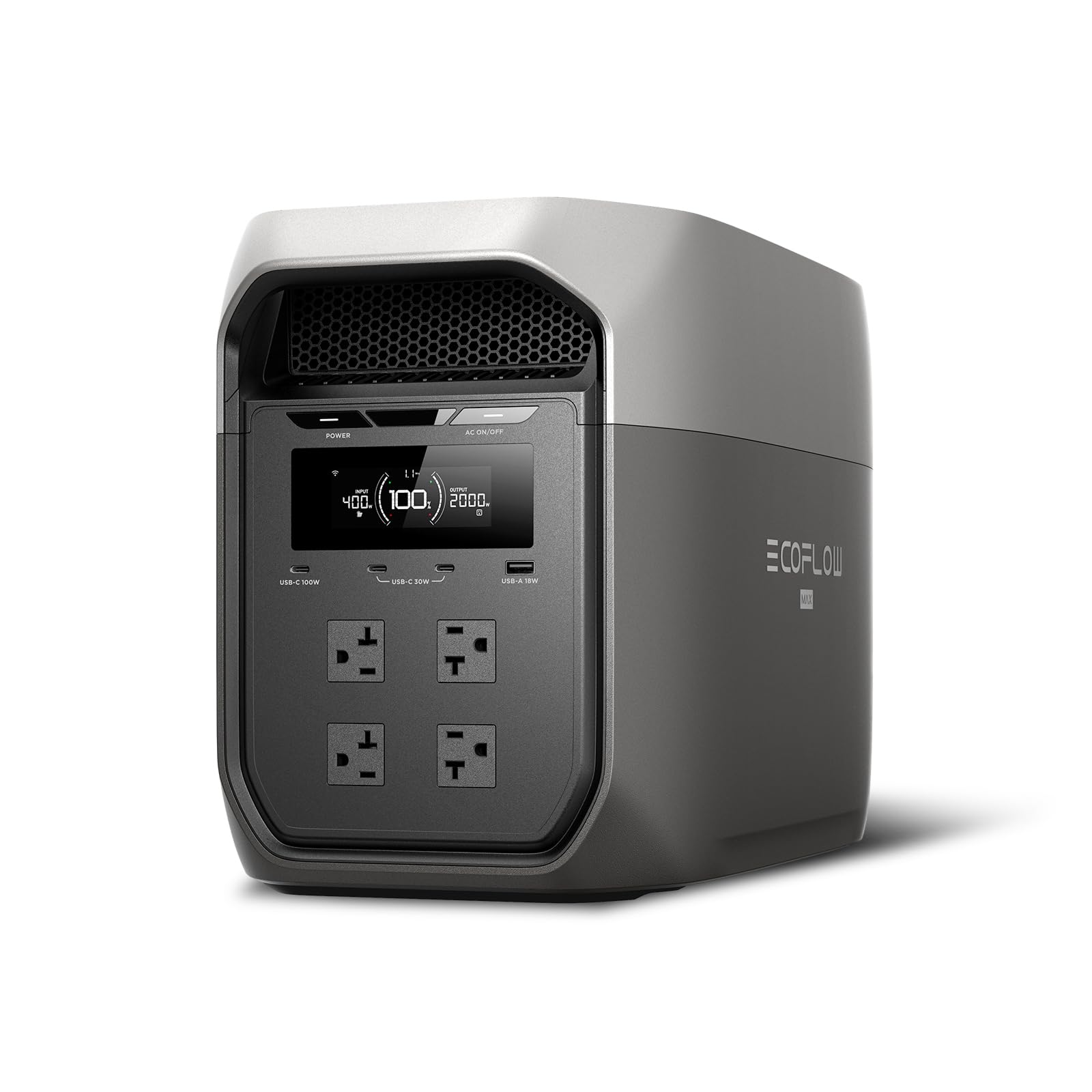
The EcoFlow DELTA 3 Max delivers 2048Wh of LFP capacity with a 3400W X-Boost output, enabling it to power 99% of household appliances including induction cooktops and circular saws. The X-Stream technology recharges from 0–80% in just 1.13 hours, and the 10ms UPS transfer is among the fastest available, making it ideal for protecting sensitive electronics like gaming PCs and medical monitors.
The aluminum-reinforced chassis keeps weight manageable at a competitive level while providing excellent structural rigidity. The dual-handle design makes two-person lifting ergonomic, and the integrated fan is tuned for ultra-quiet operation even under load. The EcoFlow app provides Storm Guard mode, which pre-charges the battery to 100% when bad weather is forecast, ensuring maximum readiness before an outage.
The solar input, while efficient, is limited to a single XT60i connector, which may require adapters for some third-party panel arrays. The display, while clear, has been noted by some users as less visible in direct sunlight compared to competitors. For buyers who want the fastest recharge, the most seamless UPS, and the highest surge output in the 2kWh class, the DELTA 3 Max is the performance benchmark.
Why it’s great
- 3400W X-Boost handles 99% of appliances
- Ultra-fast 1.13-hour 0–80% recharge
- 10ms UPS for seamless electronics protection
Good to know
- Single XT60i solar connector may need adapters
- Display visibility in direct sunlight is average
11. Anker SOLIX C2000 Gen 2
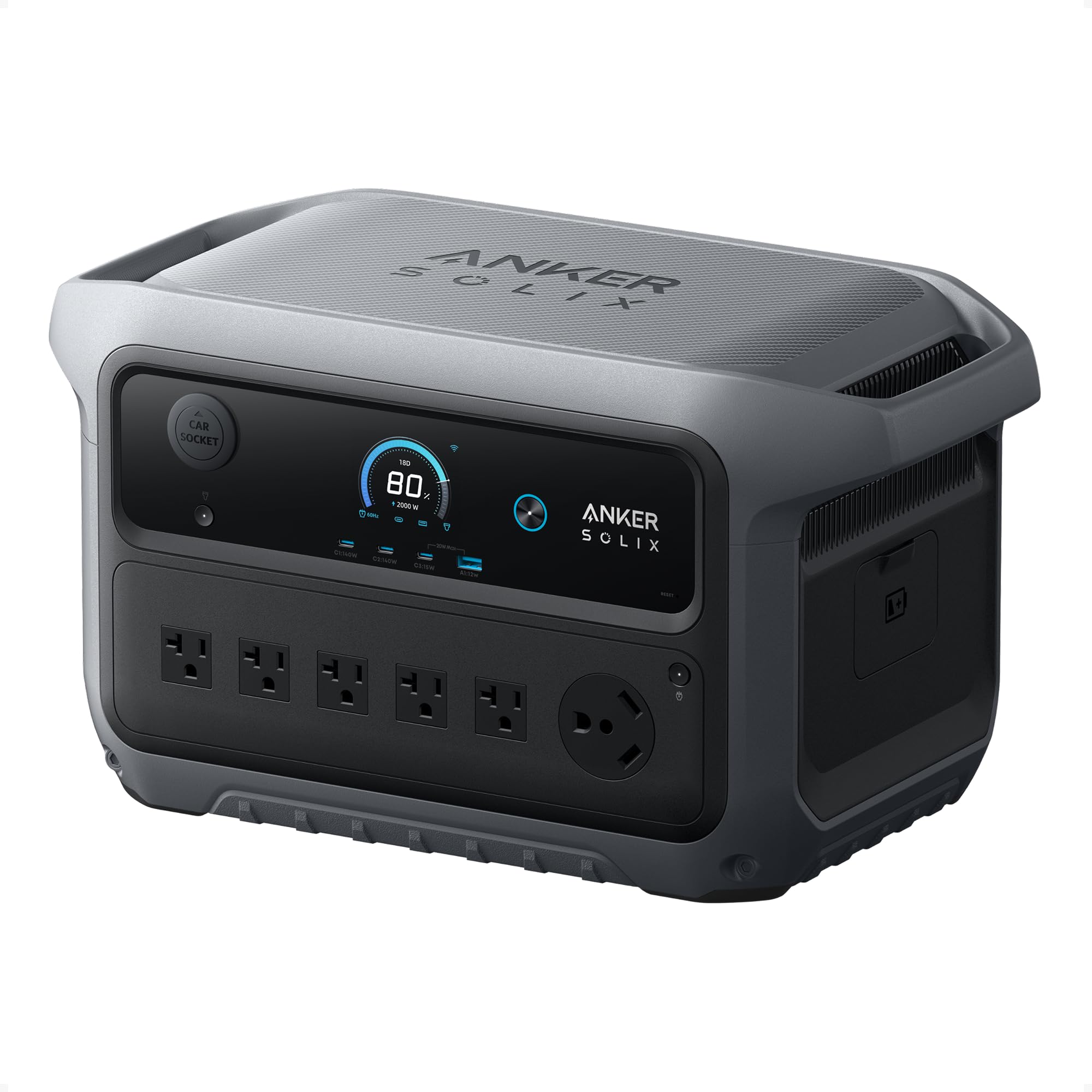
The Anker SOLIX C2000 Gen 2 is engineered for efficiency: it draws just 9W on standby, enabling it to power a dual-door refrigerator for up to 32 hours on a single charge. The 2400W rated output (4000W peak) handles window AC units and RV appliances, and the expandable design allows adding a second battery to reach 4kWh for up to 64 hours of fridge runtime. At 41.7 pounds and a compact 18.1 x 9.8 x 10.1 inches, it is 25% lighter and 29% smaller than typical 2kWh competitors.
Recharge speed is a highlight: the C2000 Gen 2 reaches 100% in just 58 minutes via AC input. The 800W UltraFast alternator charging capability refills the pack in three hours while driving—8x faster than a standard 12V car socket. The six AC outlets are spread across two separate circuits, reducing the risk of tripping when multiple high-draw devices are connected simultaneously.
The metal-reinforced chassis provides a premium feel, but the included manual is digital-only, which some users find inconvenient. The solar input is capped at 600W, which is lower than the 800W+ offered by competitors in this class. For buyers who prioritize exceptional standby efficiency, compact dimensions, and Anker’s proven customer support, the C2000 Gen 2 is a smart, energy-conscious choice.
Why it’s great
- Only 9W standby means minimal self-discharge
- 58-minute full AC recharge is best in class
- 800W alternator charging for on-the-road refills
Good to know
- 600W solar input is lower than some rivals
- Paper manual not included in the box
FAQ
Can a battery backup home system run a central AC unit?
How long does a 2048Wh station power a refrigerator?
Is it safe to use a battery backup indoors?
What is the difference between UPS and EPS modes?
Can I connect solar panels directly to any backup battery?
Final Thoughts: The Verdict
For most users, the battery backup home system winner is the Jackery HomePower 3000 because it offers the best power-to-weight ratio, fastest recharge in its capacity class, and a versatile port selection that covers both home and RV use. If you want native 120V/240V split-phase output for whole-home backup, grab the EF ECOFLOW DELTA Pro 3. And for a budget-friendly entry point with the longest warranty on the market, nothing beats the AFERIY P210.