
Our readers keep the lights on and my morning glass full of iced black tea. As an Amazon Associate, I earn from qualifying purchases.
Specs are compiled from manufacturer listings and verified buyer reviews and can change over time — please confirm the key details on the product page before buying.
When the power dies, a surge protector only stops the spike—it doesn’t keep your devices on. A battery backup power supply (UPS) keeps your computer, router, and modem running on battery for minutes after an outage, so you can save your work, shut down safely, or keep the Wi‑Fi alive until the lights return.
I’m Min — the founder and writer behind Gadgets Feed. This guide is built by comparing the manufacturers’ published specifications and the patterns across verified customer reviews, so you get each pick’s real strengths and trade-offs instead of marketing spin.
Below you’ll find the nine smartest routes to a battery backup power supply, judged on runtime, outlet count, and the real-world reliability buyers report over years of use.
Our Picks at a Glance


How To Choose The Best Battery Backup Power Supply
Shopping for a UPS is really about matching its capacity to the gear you actually need to keep running. The single most useful number is the wattage rating—that tells you which devices will stay powered—and the second is the battery runtime, which tells you for how long.
Match the wattage to your load
A desktop PC plus a monitor can pull a couple of hundred watts. If you add a router and modem, the total load rises fast. A unit rated 600VA/360W covers a basic computer setup, while a 1500VA/810W model gives you headroom for a gaming rig and its peripherals. Overloading a UPS makes it shut down immediately—that defeats the purpose.
Do not confuse battery outlets with surge-only outlets
Most UPS units split their outlets. The battery backup ones keep devices on during an outage; the surge-only ones just protect against spikes. Plug your router and computer into the battery side. Peripherals like printers belong on the surge-only side—they draw power heavily and would drain the battery fast.
Consider AVR for unstable power
Automatic Voltage Regulation (AVR) corrects small dips and spikes in voltage without switching to the battery. If your home sees frequent brownouts, AVR keeps your gear running smoothly off wall power and saves the battery for real outages.
Quick Comparison
| Model | Best For | Capacity | Battery Outlets | Waveform | Amazon |
|---|---|---|---|---|---|
| CyberPower AVRG900LCD★ Best Overall | Whole desktop setup | 900VA / 480W | 6 | Simulated Sine | Amazon |
| SKE SK600Best Value | Budget PC protection | 600VA / 360W | 6 | Simulated Sine | Amazon |
| CyberPower EC750GSmart Energy Pick | Energy-saving setups | 750VA / 450W | 6 | Simulated Sine | Amazon |
| APC BE700G3 | Wi-Fi & routers | 700VA / 420W | 4 | Simulated Sine | Amazon |
| Eaton Tripp Lite AVR750U | Wall-mount installs | 750VA / 450W | 6 | PWM Sine (battery) | Amazon |
| GOLDENMATE 600W Lithium | Long-term durability | 1000VA / 600W | 8 | Pure Sine | Amazon |
| APC BX1350M | High-end PCs | 1350VA / 810W | 5 | Simulated Sine | Amazon |
| Eaton Tripp Lite OMNI1500LCDT | Whole office electronics | 1500VA / 810W | 10 | Simulated Sine | Amazon |
| GOLDENMATE 1600W Lithium | Gaming rigs & 3D printers | 2000VA / 1600W | 8 | Pure Sine | Amazon |
In‑Depth Reviews
1. CyberPower AVRG900LCD Intelligent LCD UPS Battery Backup
Our pick — over 4.5★ from 650+ verified ratings; the strongest balance of quality and price.
The desktop backbone that keeps a full rig running through island-style outages.
This is the pick for anyone running a desktop PC alongside a NAS, router, and modem. Its 900VA/480W capacity easily powers two machines and their monitors—owners mention an 18–20 minute runtime at a 175–200W load, which is plenty of time to bridge to a generator or shut things down cleanly. A single modern PC can stretch that well past 30 minutes.
The layout does more than most. You get 12 outlets total—six on battery backup and six surge-only—with staggered ports so bulky wall warts don’t block each other. The automatic voltage regulation (AVR) corrects minor power fluctuations without ever tapping the battery, which keeps your gear stable during brownouts. It’s UL safety certified, backed by a 3-year warranty that includes the battery., and ships with PowerPanel software for graceful auto-shutdown.
Buyers also call out its quiet operation, a rare compliment for a UPS. The main friction points are the bright LCD and a beep that fires during battery use, though both are manageable. It’s rated 4.6 stars from over 600 owners., and the thing everyone raves about is its power capacity.
Why owners stick with it
- Power capacity is the most-praised aspect—83 owners single it out
- Silent operation in normal use
- AVR keeps voltage stable without draining the battery
Honest trade-offs
- Bright LCD that some find distracting in dark rooms
- Frequent beeping while on battery power
- Won’t power on if unplugged from the wall
Reach for this if: you want one box that covers a full desktop, network gear, and storage with room to spare.
Look elsewhere if: you need it silent at night in a bedroom—the beep and bright screen will get noticed.
2. 600VA/360W Ups Battery Backup and Surge Protector, SKE Smart Key Energy
The budget-friendly sentinel that bridges the gap between a generator kicking in.
If your computer just needs to survive the 15 seconds it takes for a backup generator to start, this 600VA/360W tower is the honest workhorse. Its 6 outlets provide battery backup and surge protection, with 2 more offering surge protection only, so you can keep the router alive on battery while the printer stays on the surge side.
The intelligent LCD shows input voltage, output voltage, battery capacity, and load capacity in real time—and it auto-extinguishes after 30 seconds to save power. A touch of the switch wakes the backlight. The beeping alarm in battery mode can be silenced with a quick tap, and the cooling fan keeps high-power demands from overheating the unit.
Customers note 18+ months of reliable surge and outage protection for a PC and router, noting the runtime declines over time but the battery is cheap and easy to swap yourself. It’s rated 4.2 stars from over 600 owners. The most-discussed aspect is build quality, which draws mixed feedback—so treat it as a solid entry-level unit rather than a decade-long investment. Unlike the pricier CyberPower AVRG900LCD above, this one’s smaller 600VA/360W rating means you’ll want to keep the load light.
Best for: a single desktop or a PC-plus-router combo where you just need a few minutes to shut down gracefully.
Remember: it’s compact and affordable, but expect the battery to lose runtime faster than a premium model.
3. CyberPower EC750G Ecologic UPS Battery Backup and Surge Protector
The energy-saving pick that cuts power to peripherals when your PC sleeps.
This 750VA/450W UPS saves you money automatically. Its ECO mode detects when your computer is off or asleep and cuts power to the peripherals in its three ECO-controlled outlets, reducing wasted electricity—a small “low-maintenance” saving on your monthly bill.
You still get 12 outlets total: six battery-backup and surge-protected, plus six surge-only. It’s UL safety certified, carries a 3-year warranty including the battery., and covers connected gear up to. The free PowerPanel software tracks power events so you can see exactly what happened during an outage.
Buyers use it to replace aging units and find it reliably handles outages once set up. It’s rated 4.4 stars from over 500 owners. The recurring gripe is the ECO function itself—if your PC doesn’t fully power off its USB ports, the feature can misbehave, though support swaps units when that happens. Its 750VA/450W capacity lands neatly between the entry-level SKE SK600 above and the higher-capacity AVRG900LCD.
Grab it if: you want battery backup plus automatic energy savings on your home office gear.
skip it if: your PC keeps USB ports powered during sleep—the ECO feature may not behave as expected.
4. APC 700VA/420W Backup Battery Power Supply for Home Office, Wi-Fi | BE700G3

The compact bread-loaf-sized box built to keep your Wi‑Fi and calls online.
This is the one that keeps the internet alive. At 700VA/420W it delivers up to 29 minutes of runtime at a 100W load, which covers a router, modem, and VOIP phone through most outages. Once your high-power computer shuts down safely, the unit keeps running low-power gear like networking equipment for hours, so your connection never blinks.
Its 6 well-spaced outlets split into 4 battery-backup and surge-protected, plus 2 surge-only. Two built-in USB ports—one USB-C and one USB-A at 5V/3A shared—charge phones and tablets right from the front, a handy touch when the lights are out. The upright tower is compact enough to tuck under a desk or mount on a wall for apartments and dorms.
Reviewers point out it handles power pops smoothly, protecting a GPU from corruption during outages and keeping a CCTV system recording. It’s rated 4.1 stars from over 300 owners, with power quality the most-discussed aspect—so it suits light electronics. The trade-off: the battery isn’t officially user-replaceable, though a DIY swap with four screws is possible.
Perfect for: remote workers and streamers who need the Wi‑Fi to survive the outage.
Note: it’s a lighter-duty unit, so a high-wattage gaming rig will find it outmatched by the APC BX1350M later in this list.
5. Eaton Tripp Lite AVR750U 750VA UPS 450W Battery Backup Surge Protector AVR

A quiet, wall-friendly UPS that filters out line noise and powers remote work setups.
This 750VA/450W unit fixes a common problem: where to put the UPS. Its bottom mounting tabs let you mount it on a wall, keeping it out of the way in small workspaces, while the 5-foot power cord reaches standard outlets. It’s also one of the quieter models, emitting just a single beep on outage with no buzzing.
You get 12 outlets total—six battery-backup and six surge-only. Automatic voltage regulation corrects input voltages between 89V and 145V back to safe levels without switching to battery, which extends the UPS’s own lifespan. The USB port connects to PowerAlert software for unattended file saving and safe shutdown. The internal battery is easy to replace with Tripp Lite’s RBC51 cartridge.
Buyers rely on it to keep video calls running through a 2-second surge, powering a laptop, display, and camera simultaneously. It’s rated 4.2 stars from over 600 owners, with ease of use being the most-praised aspect. The most-discussed note is reliability, which runs mixed—some units last 4 years, others fail sooner, so treat the battery as a wear item. At 12.01 x 7.01 x 4.02 inches, it’s a sizable footprint but earns its place with the wall-mount flexibility.
Best for: home offices where floor space is tight and you want the flexibility to hang the unit.
Think twice if: you need a compact footprint—this one is hefty and wide compared to the APC BE700G3 above.
6. GOLDENMATE 1000VA/600W Lithium UPS Battery Backup & Surge Protector, White

The lithium-powered box that promises a decade of service and pure sine output.
This is the anti-routine-replacement UPS. Instead of the lead-acid battery found in most units, it uses a Lithium Iron Phosphate (LiFePO4) cell rated for over 10 years of life and 5000+ charge cycles. The maker claims this cuts total cost of ownership by over 40% versus lead-acid, since you won’t need to swap the battery.
At 1000VA/600W with pure sine wave output, it supplies clean power that’s safe for sensitive electronics like computers, workstations, and telecom gear. Eight outlets provide battery backup and surge protection, all under a low-noise cooling fan that stays under 50 dB. The intelligent LCD shows real-time battery and power status, and a buzzer mute function silences the alarm with a single touch.
Buyers run it at a 185W load for about 3 hours of runtime and find it light and compact for a 1000VA unit. It’s rated 4.3 stars from over 900 owners, and performance is the clear standout—188 owners praise it. The trade-offs: there’s no AVR or USB data port, the battery is non-replaceable, and some note the outlet spacing is tight for bulky plugs. For a full-featured desktop setup, the CyberPower AVRG900LCD remains the more conventional choice.
What wins people over
- Performance is the top praise—188 owners call it out
- Pure sine wave is safe for sensitive electronics
- Light and compact for a 1000VA rating
Fair caveats
- Non-replaceable battery means a full unit swap at end of life
- No AVR or USB data connection
- Outlet spacing is tight for large adapters
Choose this if: you’d rather pay once and not think about battery swaps for a decade.
Pass on it if: you need AVR for unstable power or want software-controlled shutdown.
7. APC 1350VA/810W Pro UPS Battery Backup for Office Electronics, AVR, BX1350M

The heavyweight that eats a 100W load for over 54 minutes and powers a serious PC.
If your rig draws serious wattage—think an RTX-class GPU plus a high-end CPU—this 1350VA/810W UPS is the muscle you want. It delivers over 54 minutes of backup runtime at a 100W load, and shoppers say 5–15 minutes of safe-shutdown time under a power-hungry gaming PC pulling real wattage. That’s enough to save your game or work and power down properly.
Ten outlets split into 5 battery-backup and 5 surge-only, plus built-in coaxial and Ethernet surge protection so a lightning strike on your cable line doesn’t fry your motherboard. Automatic voltage regulation corrects low-voltage brownouts from 88V up and trims surges of +/-13% back to a stable 120V without draining the battery. It’s Active PFC compatible, so it plays nice with modern power supplies.
The user-replaceable battery (APCRBC123, sold separately) means zero-downtime swaps, and ENERGY STAR certification brings 92%+ efficiency.. It’s rated 4.6 stars from nearly 600 owners, with performance and protection the top praise. The honest cost: it’s big, heavy, and buyers report the PowerChute software can’t monitor two units simultaneously. Its 810W beats the Eaton Tripp Lite AVR750U’s 450W by a wide margin for anyone running high-end hardware.
The verdict: the best all-around pick for a demanding gaming or workstation PC that needs real headroom.
The catch: it’s a heavy floor or desk unit—plan the placement before it arrives.
8. Eaton Tripp Lite OMNI1500LCDT 1500VA UPS 810W 10 Outlets 650 Joules AVR LCD

A five-year veteran that keeps a modem, NAS, and switch humming for hours.
Longevity is this unit’s superpower. Owners mention running a modem, NAS, and switch for several hours during an outage on the original battery after five years of ownership—a level of endurance that’s rare in the UPS world. At 1500VA/810W, it has the headroom to cover a desktop, gaming console, and all your network gear at once.
Its 10 outlets all provide battery backup and surge protection, backed by 650 joules of surge protection to absorb spikes. Automatic voltage regulation corrects brownouts and overvoltages between 92V and 150V back to a safe 120V without touching the battery. The front LCD displays battery runtime, wattage load, overload status, and input voltage. Ethernet RJ45 and telephone/DSL RJ11 dataline protection round out the package.
It’s rated 4.4 stars from over 900 owners, with value for money the most-praised aspect. The display earns mixed feedback—it’s bright and readable, but the always-on backlight may bug you in a dark room. The internal battery is user-replaceable with the RBC51 cartridge, extending the unit’s life even further. At 19.29 x 9 x 11 inches, it’s a large tower that demands shelf space, but it’s the closest thing to a “buy once, forget it” office UPS here.
Why it earns its keep
- Value for money is the top praise among owners
- All 10 outlets give battery backup
- Battery lasted 5 years in real-world use
Honest limitations
- Always-on LCD backlight bothers some in dark rooms
- Companion software has a spotty reputation
- Large footprint needs a dedicated spot
Buy it for: a full home office where you want every device protected and a battery that truly lasts.
pass on it if: you need something discreet—the bright screen and big body are hard to hide.
9. GOLDENMATE 2000VA/1600W Lithium UPS Battery Backup & Surge Protector, Gray
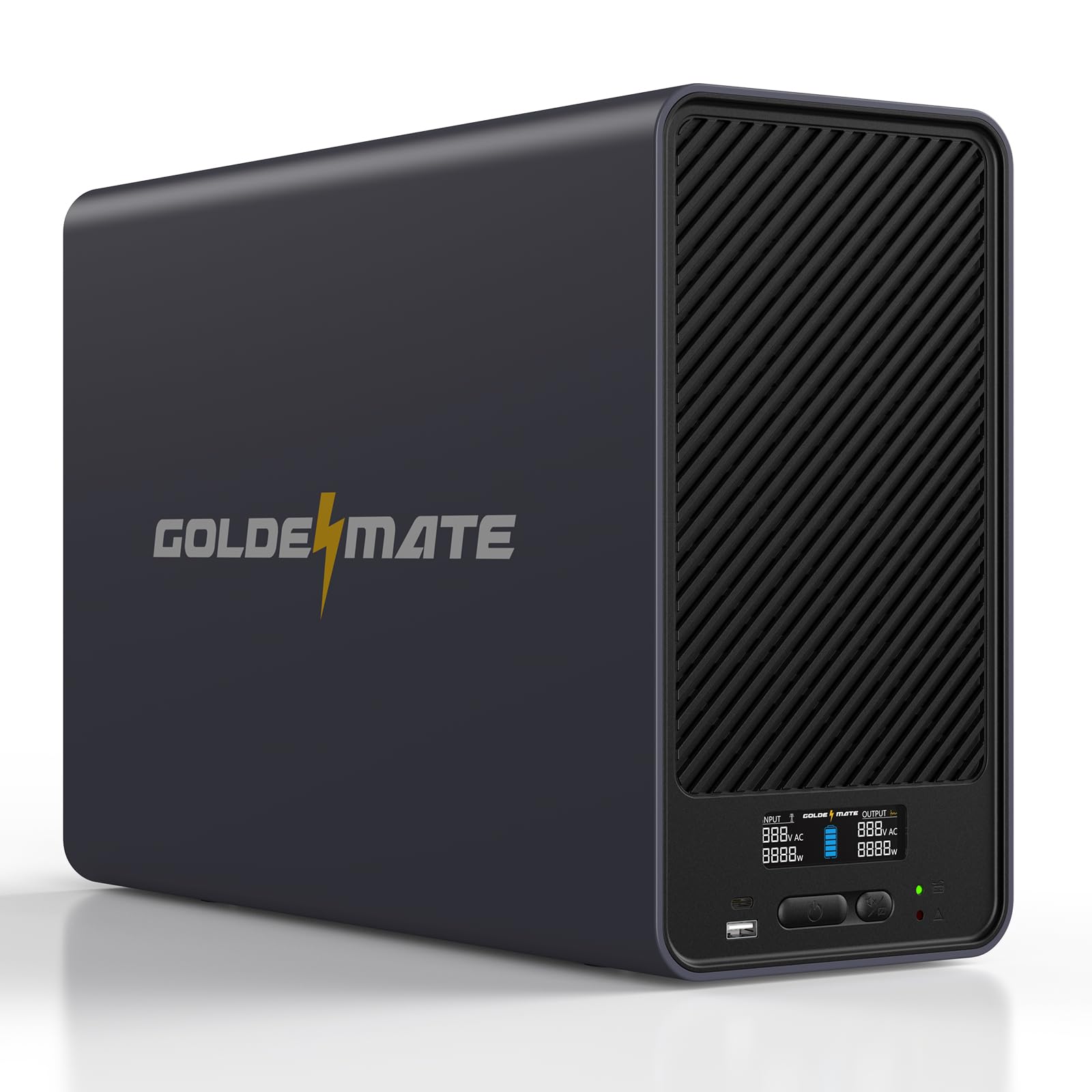
The flagship lithium UPS that keeps a 1500W gaming rig and 3D printers running.
For the top end of home power, this 2000VA/1600W unit is in a class of its own. It runs a high-end gaming PC with an RTX 5090-class GPU and a 1500W power supply without breaking a sweat, and owners double up as 3D printer operators using it to keep two FDM printers with AMS units alive through interruptions. Pure sine wave output (a smooth, steady power flow) means even sensitive electronics get clean, stable power.
Its Lithium Iron Phosphate (LiFePO4) battery pack—51.2V, 9Ah—is rated for over 10 years and more than 3,000 charge cycles., and The maker claims it cuts total cost of ownership by over 40% versus lead-acid. Automatic voltage regulation corrects power fluctuations, surges, and drops. Eight outlets all provide battery backup and surge protection, with wider spacing to fit bulky adapters side by side.
New for this model: a communication port with USB cable for automatic Windows shutdown, plus two front USB charging ports (one Type-C, one Type-A, 10W total) to keep phones and tablets topped up. It’s rated 4.4 stars from 80+ owners, with performance and power output the top praise. The honest caveats: battery life runs mixed, hitting about 80% of the calculated max runtime in one test, and it’s a serious 17.5 kg commitment that will not fit on a small shelf.
The standout: 1600W of pure sine power with a lithium battery that outlives every lead-acid unit on this list.
The reality: it’s the priciest and heaviest pick—buy it only if your hardware genuinely pulls that much power.
Understanding the Specs
VA vs. Watts
VA (volt-amperes) is the rough sizing number, but watts are what actually matters for your gear. A 600VA/360W unit handles about 360 watts of continuous draw. To figure out what you need, add up the wattage of everything you’ll plug into the battery outlets—a desktop PC might pull 200–300W, a monitor another 50W. Pick a UPS with watts comfortably above that total.
Runtime at load
Runtime is the length of time the battery holds up your gear once the power dies. It’s always quoted at a specific wattage—for example, 29 minutes at a 100W load. A heavier load drains the battery much faster, so a gaming PC might get only 5–15 minutes while a router and modem could run for hours. Think about what you’re protecting: minutes to save work, or hours to stay online.
FAQ
Will a battery backup power supply keep my PC running during a long blackout?
How do I know if my PC will fit on a 600VA or a 1500VA unit?
What is the difference between a battery backup outlet and a surge-only outlet?
How long does a UPS battery last before it needs replacing?
Is a pure sine wave UPS worth the extra cost?
Can I replace the battery in my UPS when it dies?
What does AVR do and why does it matter?
How much surge protection do I need in a UPS?
Final Thoughts: The Verdict
Across the board, the battery backup power supply winner is the CyberPower AVRG900LCD because it pairs a 900VA/480W capacity with six battery outlets and AVR in a quiet, well-reviewed package. If you want lithium longevity and pure sine output, grab the GOLDENMATE 1000VA. And for a demanding gaming PC that needs real headroom, the APC BX1350M is the one to reach for.
How We Picked
We do not accept paid placement. Every pick is matched to a real buyer and a real use-case; we do not hands-on test units.
Sources & Methodology
Specifications: manufacturer listings and product documentation. Review insights: verified customer reviews, as of August 2026. Pricing: not shown on this page (it changes often); check the current price via the retailer link.
As an Amazon Associate, Gadgets Feed earns from qualifying purchases. This does not affect which products we feature.