
Our readers keep the lights on and my morning glass full of iced black tea. As an Amazon Associate, I earn from qualifying purchases.
Specs are compiled from manufacturer listings and verified buyer reviews and can change over time — please confirm the key details on the product page before buying.
When the lights flicker, your router, PC, and work should keep running. A battery backup surge protector bridges a dead grid and your still-on screen, giving you minutes to save, shut down, or ride out a blip. This guide cuts through capacity jargon and wattage math to help you pick a unit that fits your desk, devices, and outage reality.
I’m Min — the founder and writer behind Gadgets Feed. This guide is built by comparing the manufacturers’ published specifications and the patterns across verified customer reviews, so you get each pick’s real strengths and trade-offs instead of marketing spin.
The goal is to help you find the best battery backup surge protector for your power needs, gadget count, and budget without overpaying for unused capacity.
Our Picks at a Glance


How To Choose The Best Battery Backup Surge Protector
To keep your gear running during an outage, first add up the wattage of everything you want to power. The watt rating (the maximum load a backup unit can support) is what gives you real headroom for a gaming PC or a big TV; the VA rating (volt-amperes, a measure of how the unit handles that load) matters less for most buyers.
Match Your Load, Not Your Entire Desk
Only plug in the essentials — your computer, monitor, router, and modem. Printers, speakers, and lamps can go into the surge-only outlets or a cheap power strip, because they do not need battery power to keep your work safe.
Sine Wave Shapes Matter for Sensitive Gear
If you own a high-end audio setup, a premium TV, or a PFC-equipped gaming power supply, look for “pure sine wave” output. Cheaper units use a simulated sine wave, which is fine for most PCs and networking gear but can cause hum or glitches in sensitive electronics.
Plan for the Battery’s Life and Replacement
Every UPS has a battery that will eventually wear out. Look for a model with a user-replaceable battery and a warranty that covers it, because a battery swap is far better than replacing a unit.
Quick Comparison
| Model | Best For | Capacity | Power | Outlets | Amazon |
|---|---|---|---|---|---|
| CyberPower ST900U★ Best Overall | Whole entertainment setup | 900VA | 500W | 12 total | Amazon |
| Eaton Tripp Lite INTERNET550UCompact Pick | Compact wall-mount spots | 550VA | 300W | 10 total | Amazon |
| SKE VL425Best Value | Low-power network gear | 425VA | 240W | 7 total | Amazon |
| SKE SK600 | Budget PC protection | 600VA | 360W | 8 total | Amazon |
| Eaton Tripp Lite AVR750U | Voltage fluctuation fixes | 750VA | 450W | 12 total | Amazon |
| CyberPower AVRG900LCD | LCD-monitored setups | 900VA | 480W | 12 total | Amazon |
| APC BE850G3 | AVR-corrected brownouts | 850VA | 510W | 8 total | Amazon |
| APC BE1050G3 | Mid-size home offices | 1050VA | 600W | 8 total | Amazon |
| GOLDENMATE 1000VA | Light, long-life lithium | 1000VA | 600W | 8 total | Amazon |
In-Depth Reviews
1. CyberPower ST900U Standby UPS
Our pick — over 4.5★ from 900+ verified ratings; the strongest balance of quality and price.
The roomy power strip that keeps your whole entertainment stack alive through a flicker.
This standby unit runs a gaming PC, a home theater, and a broadband router at once, thanks to its 900VA capacity pushing 500W. Buyers report the software shows real-time usage between 80W and 180W on that exact setup, so you have plenty of margin left over. It offers eight battery-backed outlets plus four surge-only ones, giving you 12 NEMA 5-15R ports (standard US wall plugs) in total; four are widely spaced so chunky wall adapters do not block their neighbors.
The slim 7 x 12.2 x 3.1-inch profile is what wins people over — it slides into tight spots where a tower UPS will not fit, and the 45-degree right-angle plug keeps it close to the wall. It also carries a 3-year warranty that includes the battery, plus a connected equipment guarantee, so a single surge does not mean a total loss.
The honest trade-off is runtime under a heavy load: owners mention roughly 10-20 minutes when the PC is really working, which is perfect for a safe shutdown rather than an all-night run. A few also mention the alarm beep is annoying, though it can be disabled in the free PowerPanel software.
What Owners Love
- Huge 12-outlet count with 6 on battery backup and 6 surge-only
- Widely spaced outlets accept big power bricks
- 3-year warranty covering the battery itself
What To Weigh
- Battery runtime drops to 10-20 minutes under a heavy gaming load
- The alarm beep is persistent unless you disable it
Reach for this if: you need one box to protect an entire desk or media cabinet with room to grow.
Look elsewhere if: you want pure sine wave output for high-end audio gear — this uses simulated sine wave.
2. Eaton Tripp Lite INTERNET550U
Tiny footprint, wall-mount tabs, and a 316-joule shield for storm-prone setups.
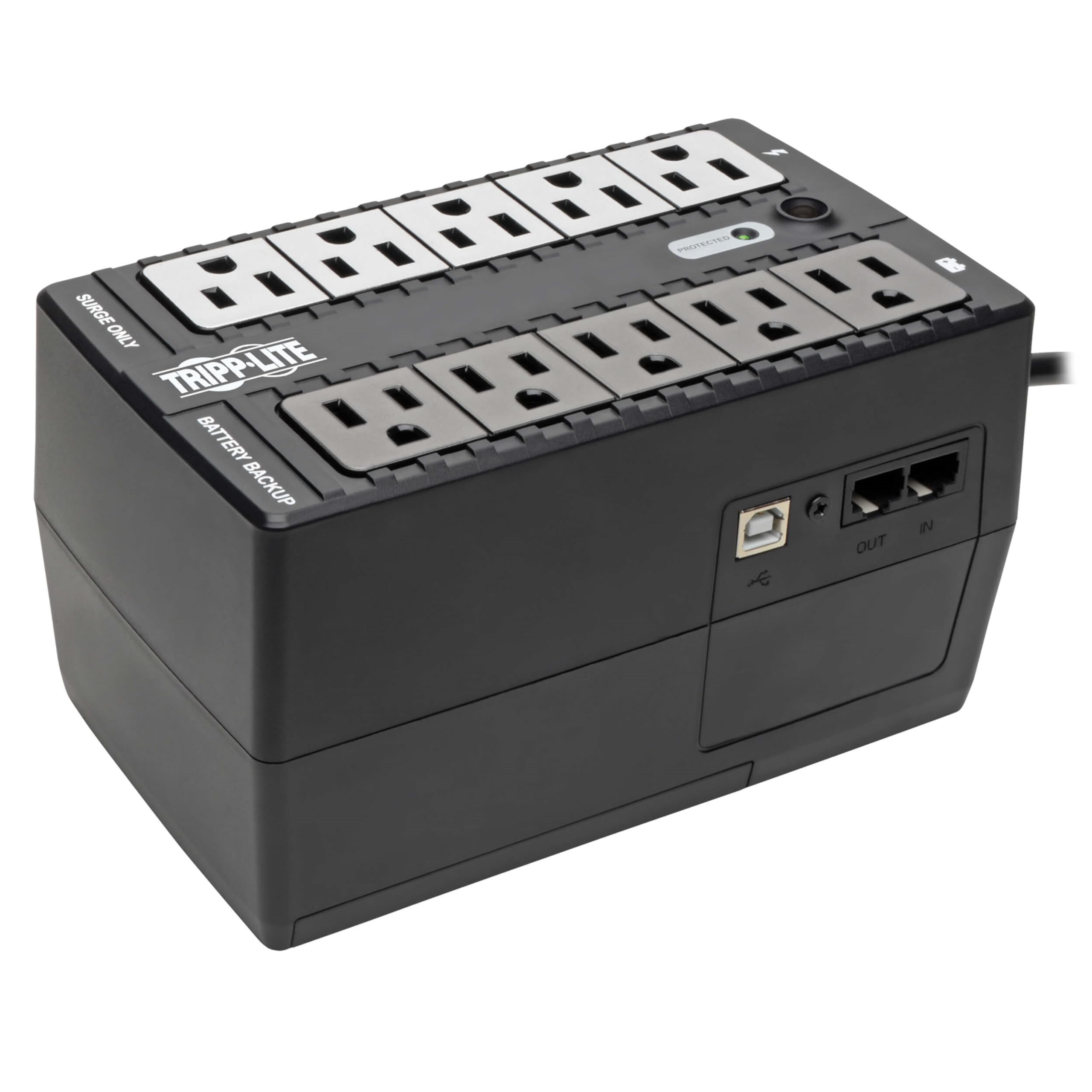
This 550VA / 300W unit is a third smaller than the CyberPower above — 5.75 x 10.87 x 3.07 inches — so it fits in a cramped electrical cabinet. Its bottom keyhole tabs let you mount it under a desk or flat on a wall. You get 10 outlets total (five on battery backup, five surge-only) and 316 joules of surge protection (a measure of how much energy it can absorb) for the whole lot.
Runtime figures are stated plainly: a 20W wifi router runs for 67 minutes, a 100W TV for 9.2 minutes, or a 200W PC for 2.9 minutes — enough to save your work and shut down cleanly. Buyers in storm-prone Michigan report it works flawlessly for momentary outages under five seconds, powering a 65-inch TV, a Sony receiver, and an Xbox through the brief drops.
Owners consistently praise the build quality here. The recurring gripe is the sealed lead-acid battery: it can die after about two years, and replacement costs are not covered by the 3-year warranty. That said, the battery is user-replaceable internally, so you can fix it rather than throw the unit away.
Who It Fits: anyone short on desk space who wants a quiet, mountable UPS for a router, modem, and a modest TV. The 7-hour charge time (6.5 hours to full) and the 316-joule rating mean it is built for blips, not for long blackouts.
Grab it for: a wall-mounted network closet or under-desk install where inches matter.
Think twice if: you have a high-wattage gaming rig — the 300W ceiling will trip before your PC finishes booting.
3. SKE VL425 UPS with AVR
The budget box that keeps a router, modem, and a small PC breathing through blips.
If your whole backup need is a modem, a router, and maybe a small desktop, this 425VA / 240W tower is the entry-level balance. It has five battery-backed outlets and two surge-only ones, plus USB and Type-C charging ports so your phone can top up without using a backup outlet. The built-in AVR (Automatic Voltage Regulation, which smooths out minor voltage swings) keeps your gear from constantly bouncing onto battery power.
Owners find it is enough capacity for a computer, two monitors, and external storage, and the 8-pound unit tucks neatly under a desk. Its compact tower design and quiet operation make it a distraction-free addition to a home office.
The catch here is the 240W ceiling — it is a 2.1x gap versus the CyberPower ST900U’s 500W, so do not plug a power-hungry gaming PC or a big TV into it. Also note the outlets sit close together, so larger block plugs and 90-degree adapters can block a neighbor; keep that in mind when planning what goes where.
Plain-English Take: for pure network gear and light desktops, this is a genuinely good-value pick with handy USB-C charging. It is not built for heavy loads or long runtime — treat it as a blip-bridge, not a blackout-runner.
Choose it for: a low-power home office where you just need to keep the internet and a small PC alive.
Pass it by if: you regularly run a gaming PC or large display in an outage — you need a bigger VA/watt rating.
4. SKE SK600 600VA UPS

An LCD-equipped tower that shows you real-time watts and voltage without the premium price.
The standout here is the multi-functional intelligent LCD, which displays input voltage, output voltage, battery capacity, and load capacity live, so you always know exactly how much headroom you have left. That transparency separates it from blind budget boxes, and it automatically dims the screen after 30 seconds to avoid being a night-light.
With 600VA / 360W and six battery-backed outlets plus two surge-only ones, it comfortably handles a desktop PC, a router, and a monitor. Customers note it kicks in smoothly when the generator takes 15 seconds to spin up, keeping the computer running through that awkward gap — exactly the bridging job a UPS (uninterruptible power supply) is for.
Reliability is the mixed note here: some units have died after roughly 12 months of use, and battery runtime does start to fade over time. The battery is user-replaceable and cheap to swap, which softens that blow, but it means this is a value play rather than a set-and-forget decade box.
Nice To Have
- Real-time LCD monitoring of watts and battery level
- Silent-mode button for the beeping alarm
- Free management software for unattended shutdown
Budget Reality
- Some owners saw units fail around the 1-year mark
- Battery runtime fades noticeably over 18 months
Pick this if: you want live power stats on a budget and a UPS that bridges a generator gap.
Look elsewhere if: you need proven multi-year reliability — the mixed longevity reports make this a gamble for critical gear.
5. Eaton Tripp Lite AVR750U

The voltage-correcting workhorse that fixes brownouts silently, without draining its battery.
The defining trick of this 750VA / 450W unit is its AVR: it corrects input voltages between 89V and 145V without ever switching to battery power. That means your gear stays fed through brownouts — those sagging-voltage moments that kill electronics slowly — while the battery stays charged and ready for a true blackout.
It also switches to Pure Sine Wave output in AC mode and PWM Sine Wave in battery mode, a step up from many competitors, and its 12 outlets split evenly: six on battery backup and six surge-only. Owners running a video call report it keeps the connection alive through a two-second surge, and the quiet single beep is a welcome change from other units that alarm constantly.
The battery history is the honest caveat — some units fail after about 8 months, while others ran flawlessly for 4 years before the battery needed a swap. The user-replaceable RBC51 cartridge makes that swap straightforward, and the 3-year warranty plus connected equipment insurance softens the risk.
Why It Stands Out: no other pick here corrects low voltage as aggressively (down to 89V) while preserving battery life. If your area has frequent dimming or browning of lights, this is the unit built for it.
Reach for it if: brownouts and voltage sags are a weekly occurrence in your home.
Be aware: battery longevity is a mixed bag across owners — budget for a replacement cartridge after a couple of years.
6. CyberPower AVRG900LCD

A 14.2-pound fortress with a live LCD readout and of connected equipment protection.
This 900VA / 480W unit is the premium sibling to our top pick, trading the slim profile for a beefier 14.2-pound build and a bright LCD that shows load, battery, and voltage at a glance. Its 12 outlets split six battery-backed and six surge-only, and the staggered ports are spaced to fit large power bricks without crowding — an easy win for desks full of adapters.
The power capacity is what wins people over, with buyers noting a 175-200W load yields a solid 18-20 minutes of runtime — more than enough to bridge a generator gap or shut a NAS down safely. On an island with frequent outages, reviewers point out it powers a NAS, a modem, a computer, and all peripherals with way more time than needed to shut down 100TB of storage without data loss.
It also adds data line protection for telephone connections, a 3-year warranty including the battery, and a connected equipment guarantee — the highest coverage in this lineup. The legitimate gripes are the bright LCD (it can be distracting in a dark room) and some owners finding it beeps frequently when on battery.
Top Shelf Stuff
- sturdy power capacity with 18-20 minute real-world runtime
- connected equipment guarantee
- Staggered outlets accept bulky adapters
Minor Annoyances
- Bright LCD can glow in a dark bedroom
- Frequent beeping on battery trips some owners up
Best for: the person who wants a heavier-duty unit with the highest insurance payout and live monitoring.
Skip if: you are sensitive to noise or light in a shared space — the LCD and alarm both demand attention.
7. APC 850VA/510W Pro UPS

The lightning-tested sentinel that saved a PC when a strike hit three houses away.
This 850VA / 510W tower is the one owners trust with their most expensive gear. One buyer’s home took a lightning strike three houses away that fried a modem and router — but the APC protected the PC, switching to battery instantly. That kind of real-world proof is why the 795 ratings on this unit sit so high.
It delivers over 29 minutes of backup runtime at a 100W load., and the AVR trims or boosts voltage to hold a stable 120V without draining the battery on minor fluctuations. The 8 outlets split 4 battery-backed and 4 surge-only, with built-in coaxial and Ethernet surge protection — meaning it guards your cable and network lines too, not just the wall sockets.
The battery is user-replaceable (RBC17, sold separately) and the unit is ENERGY STAR certified for 92%+ efficiency, so it does not waste electricity idling on your desk. The main complaint is the warranty process if a unit fails early — some shoppers say slow, multi-week turnarounds from APC — though a 3.5-year flawless run is the more common story.
Why It Impresses: the combination of AVR, coaxial/Ethernet protection (which shields your cable and network lines from surges), and a replaceable battery in one ENERGY STAR box is tough to top. It is the pick for people who want one unit to outlast several storms.
Reach for this if: lightning and dirty power are real threats — this unit has the scars to prove it works.
Bear in mind: the warranty claim process can be slow; treat it as insurance, not a speedy concierge.
8. APC 1050VA/600W UPS

The flexible tower that stands upright or lies flat to fit whatever nook you have.
This 1050VA / 600W unit is the largest APC in this list, and the space-saving design lets you stand it vertically or lay it horizontally — a genuine convenience for cramped home offices and media cabinets. It delivers up to 36 minutes of runtime at a 100W load, the best stated figure in this lineup..
It gives you 8 well-spaced outlets (6 battery-backed, 2 surge-only) plus USB-C and USB-A ports at 5V/3A shared, so you can charge a phone or tablet without burning a backup outlet. Owners running NVRs and network gear praise the instant battery switchover and plug-and-play setup, and one buyer credits it with saving a TV from a lightning strike.
The battery is user-replaceable with the APC APCRBC164 (sold separately), and the 3-year warranty plus equipment protection add a solid safety net. The mixed reports center on battery longevity — some owners saw the battery fade or the unit quit within months, though the replaceable design makes that a repair, not a loss.
Versatile Build
- Vertical or horizontal placement options
- Longest stated runtime here: 36 minutes at 100W
- USB-C and USB-A charging built in
Real World Notes
- Some batteries fade or fail within months
- 6 battery outlets plus 2 surge-only may limit big setups
Best for: a mid-size home office that wants max runtime and flexible placement in one box.
Consider the risk: the mixed battery reports mean you should test it early — and know the RBC164 replacement part number.
9. GOLDENMATE 1000VA Lithium UPS

The featherweight lithium box that outlives lead-acid rivals by a decade or more.
This 1000VA / 600W unit is the only lithium-based pick here, using a Lithium Iron Phosphate (LiFePO4) battery instead of the standard lead-acid cells. The maker claims a 10-year lifespan and 5000+ charge cycles, far outlasting any lead-acid unit here. — and at 4.8 kg (about 10.5 lbs), it is also the lightest 1000VA tower you will find.
It runs on pure sine wave output, which is the cleanest power for sensitive electronics, and the intelligent LCD shows real-time battery and power conditions. Owners running a 185W audio/video load report roughly 3 hours of backup, and the low-noise cooling fan stays under 50 dB during heavy use — so it is quiet enough for a living room.
The serious caveat: this unit has no AVR (Automatic Voltage Regulation), so it does not correct brownouts — it only kicks in when the power actually drops. The battery is non-replaceable, so the unit is retired after its 10-year lifespan., and the switchover time of 20ms could be risky for the most sensitive gear.
The Long Game: if you want to buy a UPS once and forget about battery swaps for a decade, this is the only one built for that. The lack of AVR is the trade-off — it is a blackout warrior, not a brownout corrector.
Choose it for: light-duty loads under 500W with a decade-long ownership horizon and zero battery maintenance.
Pass it by if: your power sags before it cuts — you need AVR, which this lacks.
Understanding the Specs
VA vs Watts — The Real Headroom
VA (volt-ampere) is the unit’s rated capacity, while watts tell you how much real power it can push to your devices. A 900VA unit that delivers 500W can run a typical gaming PC and monitor, but not a gaming PC plus a large TV at once. Add up the watts of everything you want to keep on battery, then pick a unit with at least 20% headroom above that number.
AVR and Sine Wave — Clean vs Corrected
AVR (Automatic Voltage Regulation) smooths out low or spiky voltage without switching to battery, saving battery life and protecting gear from brownouts. Sine wave shapes matter too: pure sine wave is the cleanest, safest power for audio equipment and premium TVs, while simulated sine wave is fine for most PCs, routers, and monitors and costs less.
FAQ
How long will a battery backup surge protector keep my computer running?
What is the difference between a UPS and a surge protector?
Will my gaming PC work with a simulated sine wave UPS?
How often do I need to replace the battery in a UPS?
How many watts do I need to power my router and modem?
Is a higher VA rating always better?
Why does my UPS beep when the power goes out?
Can a UPS protect my TV and home theater from surges?
What is AVR and why does it matter?
How long does a UPS take to recharge after an outage?
Final Thoughts: The Verdict
Our top pick is the CyberPower ST900U, because it pairs 900VA of capacity with 12 outlets and a battery-inclusive 3-year warranty — the best balance of headroom, price, and protection for a typical household. If you want the cleanest long-term ownership, the GOLDENMATE Lithium is the one to grab for a decade of zero battery swaps. And for storm-prone areas with dirty power, the Eaton AVR750U corrects brownouts without draining its battery, making it the right reach for voltage-sag zones.
How We Picked
We do not accept paid placement. Every pick is matched to a real buyer and a real use-case; we do not hands-on test units.
Sources & Methodology
Specifications: manufacturer listings and product documentation. Review insights: verified customer reviews, as of August 2026. Pricing: not shown on this page (it changes often); check the current price via the retailer link.
As an Amazon Associate, Gadgets Feed earns from qualifying purchases. This does not affect which products we feature.