
Our readers keep the lights on and my morning glass full of iced black tea. As an Amazon Associate, I earn from qualifying purchases.
Specs are compiled from manufacturer listings and verified buyer reviews and can change over time — please confirm the key details on the product page before buying.
You open the camper door after a rainy afternoon of hiking, flip a switch, and nothing happens — the old lead-acid battery dropped below half capacity after one evening of lights and the fridge. That sinking feeling is the exact reason a modern lithium battery bank belongs in your camper before your next trip. This guide looks at four options that keep your gear running, your fridge cold, and your phone charged without hunting for a hookup.
I’m Min — the founder and writer behind Gadgets Feed. This guide is built by comparing the manufacturers’ published specifications and the patterns across verified customer reviews, so you get each pick’s real strengths and trade-offs instead of marketing spin.
You will see a mix of standalone deep-cycle batteries and an all-in-one portable power station, each chosen for the kind of power a camper actually uses. The goal is to help you pick the right battery bank for camper based on capacity, chemistry, and real-world longevity — not just the sticker specs.
Quick Picks
- ECO-WORTHY 3584Wh 12V 280Ah LiFePO4 RV Battery w/Bluetooth & Low Temp Cutoff — Best Value
- Litime 12V 230Ah LiFePO4 Battery, 12 Volt Lithium Battery with 200A BMS — Light & Long
- Dumfume 12V 400Ah LiFePO4 Lithium Battery, 5120Wh Energy Built-in 200A BMS — Massive Reserve
- ABOK Ark3600 Portable Power Station, 3840Wh LiFePO4 Battery, Expandable to 11520Wh — All-In-One Power
How To Choose The Best Battery Bank For Camper
Your camper’s electrical system is a small off-grid home, and the battery bank is the foundation. Pick the wrong chemistry or capacity, and you either run out of power halfway through the weekend or carry way more weight than you need. Here are the three specs that matter most.
Chemistry: Why LiFePO4 is the standard
Lithium Iron Phosphate (LiFePO4 — a type of lithium battery that is safer and lasts far longer) batteries have replaced lead-acid for good reasons. They deliver over 4000 deep cycles (a full drain and recharge) compared to the 200-500 cycles of a lead-acid battery. You also get the full rated capacity — a 100Ah LiFePO4 battery gives you 100 amp-hours (Ah), while a lead-acid battery of the same rating only gives you about 50Ah before you risk damage. They charge faster, weigh less, and hold voltage steady under load, so your fridge keeps running instead of dropping out early.
Capacity: Amp-hours and watt-hours explained
The capacity tells you how long your gear runs before the battery needs charging. Amp-hours (Ah) at 12V is the standard unit for camper batteries — a 280Ah battery stores 280 amp-hours of energy. Watt-hours (Wh) is the total energy: multiply amp-hours by voltage (12.8V for most LiFePO4). A 280Ah battery at 12.8V gives you about 3584Wh. To estimate what you need, add up the watts of everything you plan to run (fridge, lights, water pump, inverter) and multiply by the hours you plan to run them each day.
BMS and low-temperature protection
A Battery Management System (BMS — a small electronic board inside the battery that monitors and protects every cell) handles overcharge, over-discharge, overcurrent, and short circuits automatically. For campers that stay out in freezing weather, low-temperature protection is critical: a quality BMS stops charging below about 19°F (-7°C) and resumes above 32°F (0°C), preventing permanent internal damage to the cells.
Quick Comparison
| Model | Best For | Energy Capacity | Weight | Cycle Life | Amazon |
|---|---|---|---|---|---|
| ECO-WORTHY 280Ah | Real-time monitoring & value | 3584Wh | 61.7 lbs | 6000 cycles | $439.99Amazon |
| Litime 230Ah Plus | Lightweight & long-lasting | 2944Wh | 45.3 lbs | 4000 cycles | Amazon |
| Dumfume 400Ah | Massive capacity in one unit | 5120Wh | 82.7 lbs | 4000-15000 cycles | $589.91Amazon |
| ABOK Ark3600 | All-in-one portable power | 3840Wh | 92 lbs | 4000 cycles | Amazon |
In‑Depth Reviews
1. ECO-WORTHY 3584Wh 12V 280Ah LiFePO4 RV Battery w/Bluetooth & Low Temp Cutoff
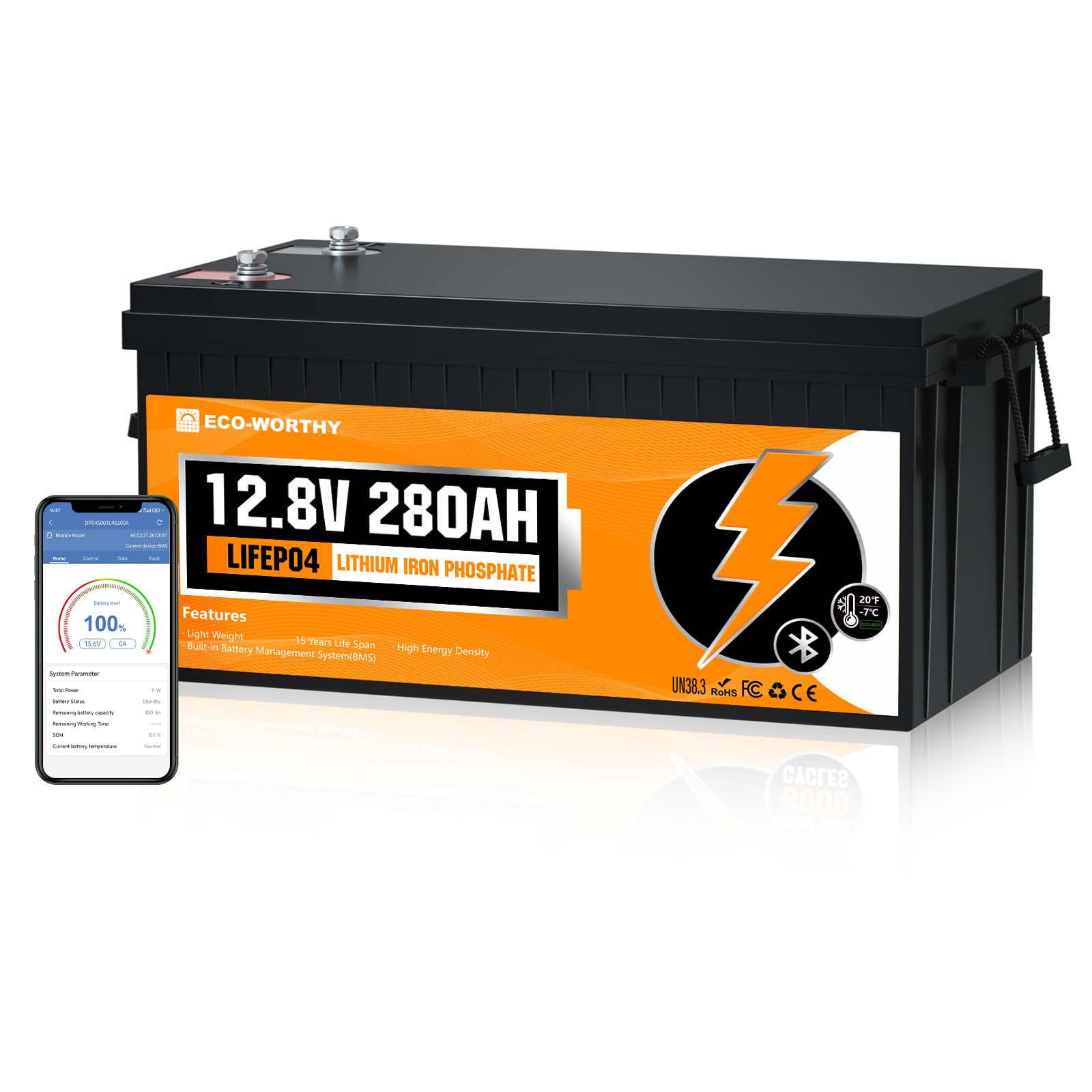
The battery that talks to your phone while keeping your camper running through a snowy weekend.
This ECO-WORTHY battery holds 3584Wh of energy from a 280Ah LiFePO4 (lithium iron phosphate) cell pack, wrapped in a high-strength metal case that prevents internal expansion. Unlike many competitors that hide cell data behind a basic percentage, its Bluetooth app gives you real-time voltage, current, and capacity — and if you want even deeper cell-level monitoring, it works with the Overkill Solar app for individual cell voltage. One buyer upgraded his RV from a 110Ah AGM to two of these for a 560Ah total setup, calling it an excellent upgrade for cold-weather camping down to 20°F.
The built-in 200A BMS (the battery’s safety board) stops charging when the temperature drops below 19.4°F (-7°C) and cuts discharge below -4°F (-20°C), so the cells stay safe even in a winter camper. At 61.7 pounds it is heavier than the Litime 230Ah battery (45.3 pounds), but you get 22% more amp-hours (280Ah vs 230Ah) for the extra weight — meaning a fridge or lights run that much longer.
The catch is the cost: the manufacturer claims 6000 cycles (one full drain and recharge) and offers a 3-year warranty, but you need a lithium-capable converter (a special charger that matches LiFePO4 voltage settings) or a compatible solar panel setup (a 600W panel takes about 6 hours for a full charge). Make sure your existing camper charger is rated for LiFePO4 chemistry, or the battery may not charge to full capacity.
Best for the builder: This battery suits campers who want to monitor power from a phone, run heavy appliances like a 2000W inverter for an induction stove, and keep the battery safe in freezing temps.
Mind the weight gain: At 61.7 pounds it is noticeably heavier than the 45.3-pound Litime, so account for mounting hardware in your camper’s battery compartment before ordering.
Our pick if you: value Bluetooth visibility, a long cycle life, and the ability to run high-wattage gear through a 200A BMS — and have the extra weight budget and a LiFePO4-ready charger.
2. Litime 12V 230Ah LiFePO4 Battery, 12 Volt Lithium Battery with 200A BMS
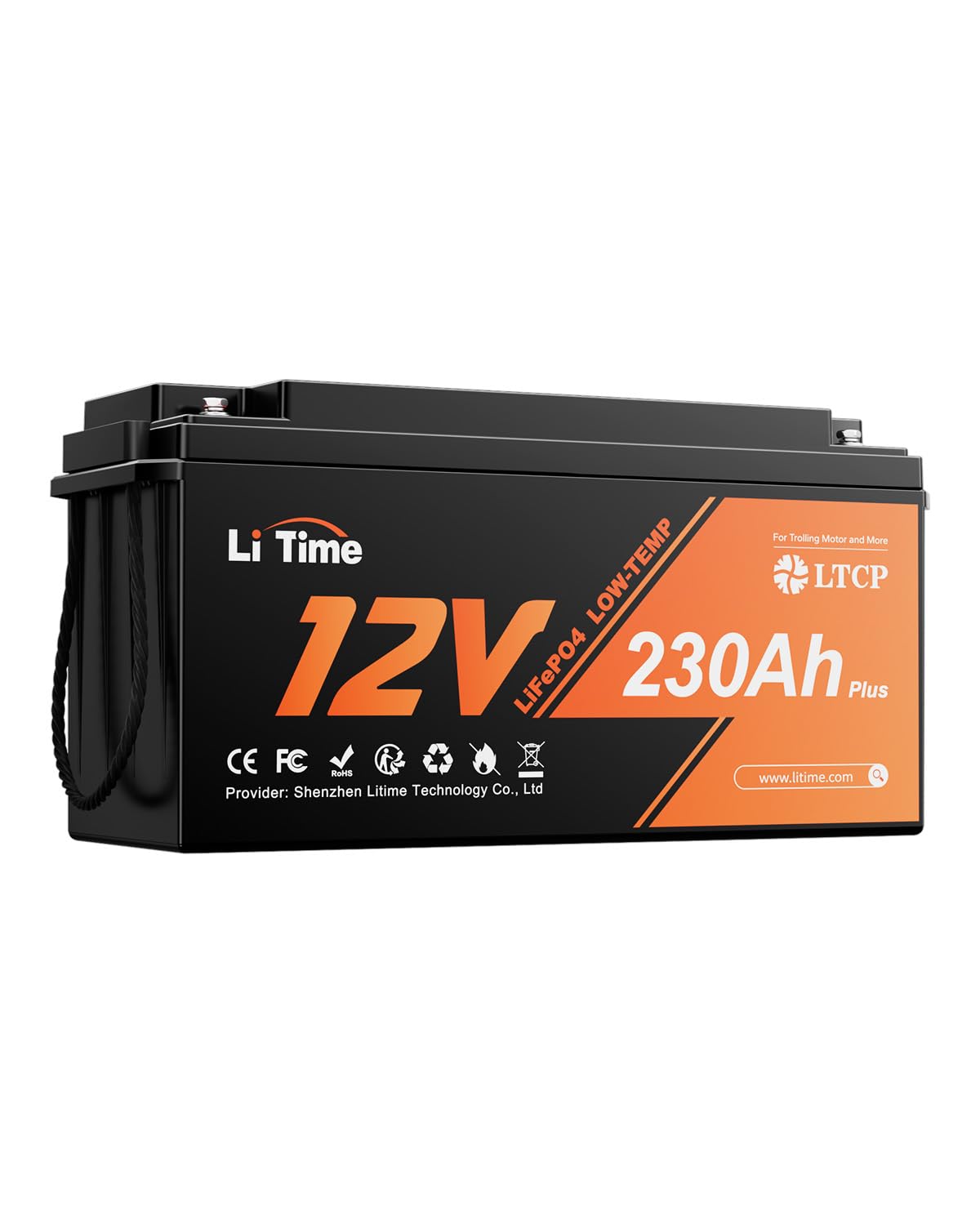
A feathery 45-pound battery that has proven itself in a truck bed for two years straight.
At 45.3 pounds and 2944Wh of energy (230Ah at 12V), the Litime 12V 230Ah Plus is the lightest battery on this list for its capacity class. One reviewer noted it survived two years in an open truck bed powering a fridge and compressor, handling a steady 30A draw without issue — a solid endurance test for any camper battery. The Bluetooth app lets you check charge and discharge rates, though some owners note the app can require a reconnect during charging cycles.
The 230Ah rating gives you 36% less capacity than the ECO-WORTHY 280Ah (230Ah vs 280Ah), but the weight savings of 16.4 pounds can make a real difference if you are mounting the battery in a tongue box or a small slide-in camper. Litime claims 4000 cycles, and its 200A BMS handles trolling motors up to 70 lbs thrust. The battery is compatible with marine, RV, and solar off-grid setups, and the 19 x 6.7 x 9.5-inch footprint fits many standard battery trays.
One common complaint is that the battery cannot control charge current from an RV converter; some owners found their trailer charger overwhelmed it at 50A, requiring a lithium-capable converter upgrade. Check your existing charger’s output before installing, or budget for a replacement if your camper is older.
Perfect for portable setups: This battery is ideal for campers where every pound matters — truck-bed campers, pop-ups, and small trailers where 45.3 pounds is manageable and 2944Wh covers a weekend of fridge, lights, and phone charging.
Watch your charger: If your camper has a stock lead-acid converter that pushes 50A, you will need to upgrade it to a lithium-profile charger to avoid an overcurrent shutdown.
Reach for this if… weight is your number-one constraint and you need a proven, durable battery that fits a standard mount — plus you are willing to verify your RV converter is LiFePO4-compatible.
3. Dumfume 12V 400Ah LiFePO4 Lithium Battery, 5120Wh Energy Built-in 200A BMS
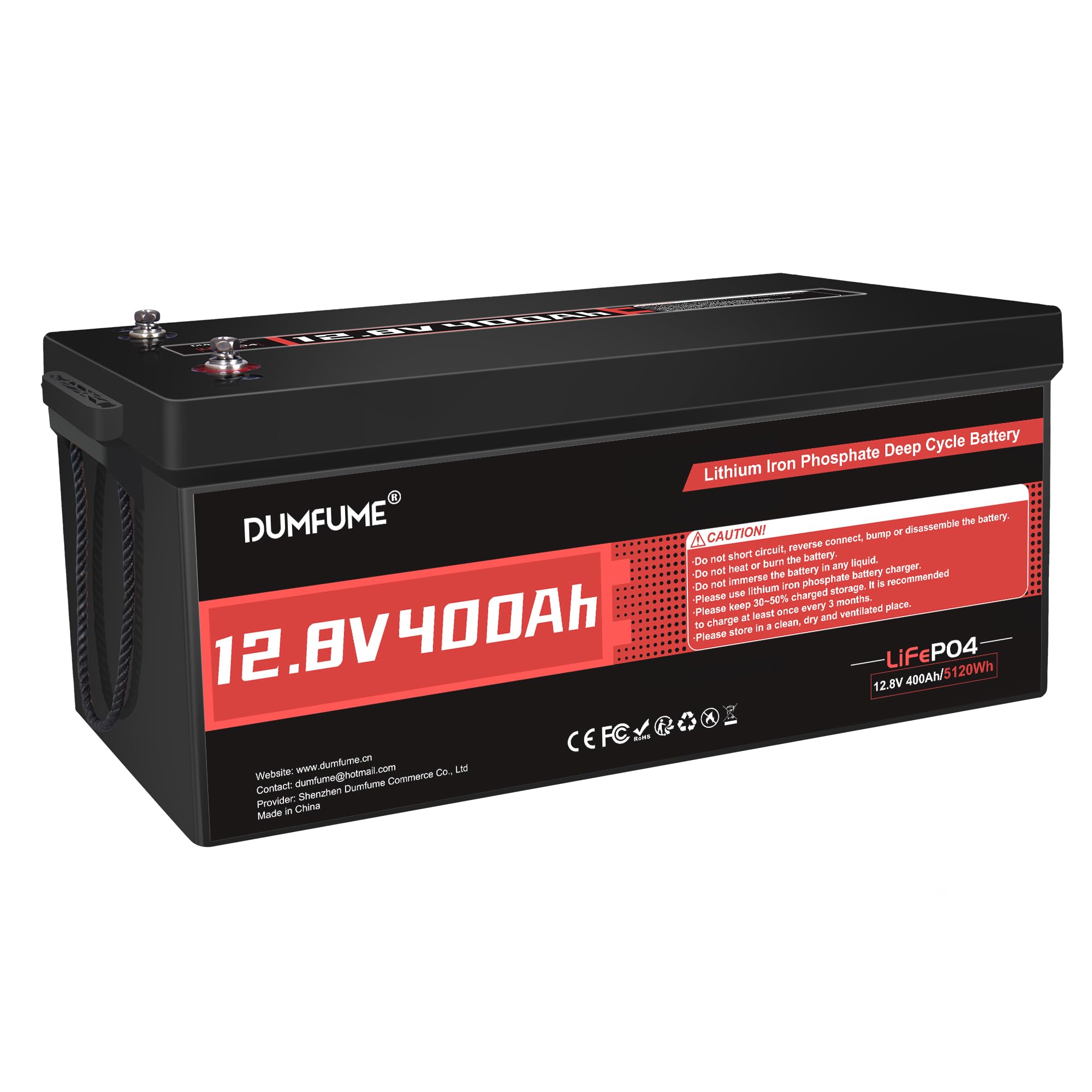
A single 5120Wh block that holds 74% more energy than the Litime 230Ah.
The Dumfume 12V 400Ah battery packs 5120Wh of energy into a single 20.5 x 10.6 x 8.7-inch case, making it the highest raw capacity on this list — 74% more watt-hours than the Litime 230Ah’s 2944Wh. That means you can run a 4000W load (like a microwave plus a small air conditioner) without voltage sag, thanks to the 200A BMS (internal safety board) that handles overcharge, over-discharge, and temperature extremes. The manufacturer claims 4000 to 15000 deep cycles, matching the ABOK Ark3600 at the low end.
One buyer mentioned the battery died after one year in a campervan, unable to hold a charge overnight with a 3.5A fridge draw; the 5-year warranty excludes Amazon orders, so verify coverage before buying. On the positive side, other owners found their 400Ah units delivered over 150Ah per battery and weighed 24.5 lbs each, praising the value. The ABS (a tough plastic) casing resists heat and flame, though the battery is not waterproof, so keep it in a dry compartment.
Because this is a non-smart battery (no Bluetooth, no app), you need an external battery monitor (a separate display device) or shunt to track state of charge. At 82.7 pounds, it is also the heaviest standalone battery here — 36% heavier than the ECO-WORTHY 280Ah — so plan your mounting hardware accordingly.
Ideal for long off-grid stays: If you need the absolute highest single-unit capacity for extended boondocking or heavy inverter loads, this 5120Wh pack gives you the most energy in one box.
Check warranty terms: The 5-year warranty excludes Amazon purchases; confirm direct purchase coverage if confidence is critical.
Choose this for one-box power: The Dumfume fits campers that need massive reserve without parallel wiring — but only if you are comfortable with no Bluetooth monitoring and can verify warranty coverage.
4. ABOK Ark3600 Portable Power Station, 3840Wh LiFePO4 Battery, Expandable to 11520Wh
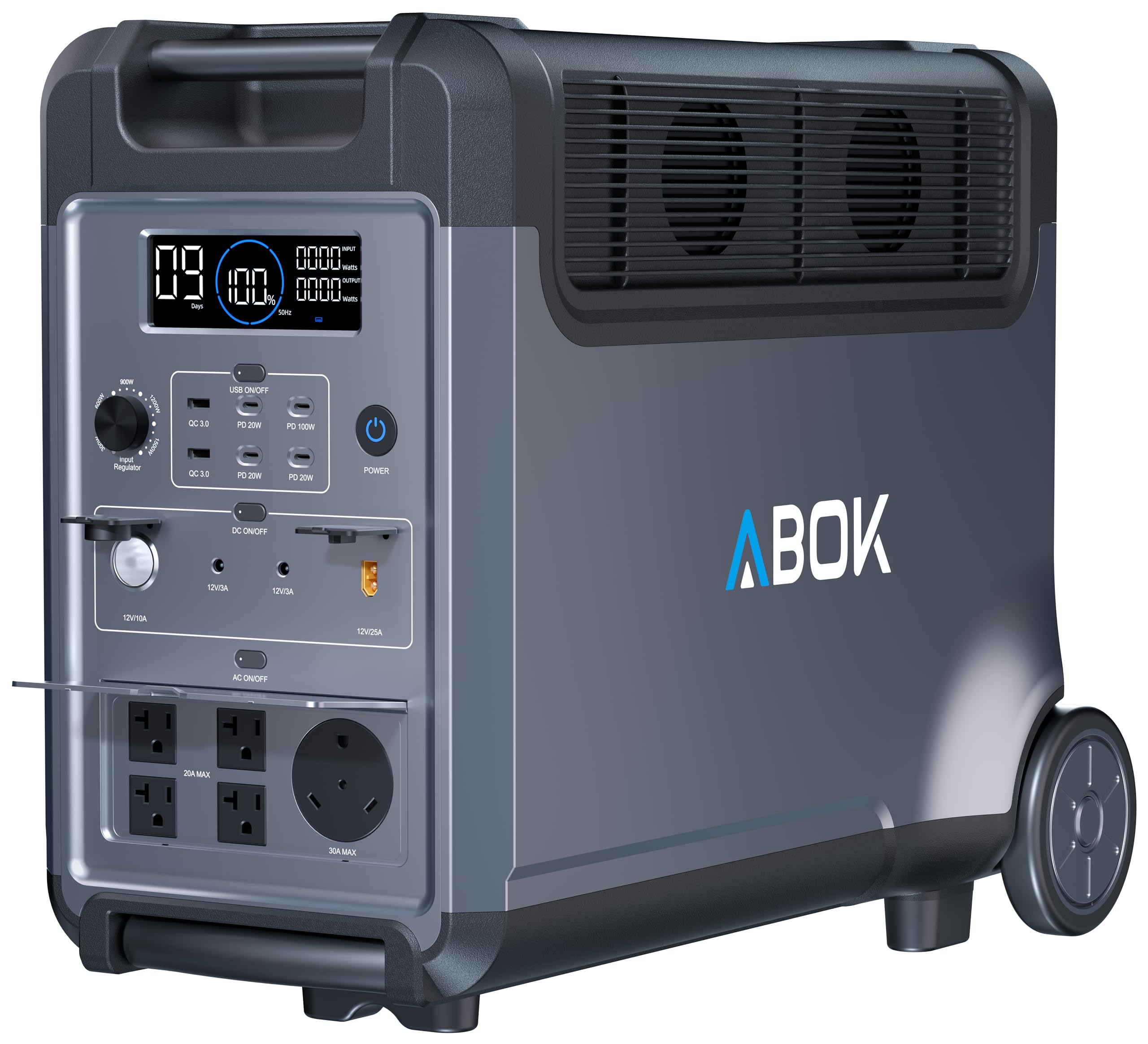
A wheeled powerhouse that runs your camper like a silent gas generator.
The ABOK Ark3600 is the only all-in-one unit here — it combines a 3840Wh LiFePO4 (lithium iron phosphate) battery pack with five AC outlets, multiple USB ports, a 12V cigarette lighter port, and an XT60 (a round high-current connector) output, all in a rolling case with a telescoping handle. At 3600W rated output (4500W peak), it ran a wet vac, heat gun, and hammer drill simultaneously for a full workday, according to one buyer. The battery is expandable to 11520Wh by connecting additional Ark3600 units, making this a modular system for serious off-grid setups.
Charging is fast: AC alone fills the battery in 3 hours, while pairing AC with 2000W solar drops that to just 1.29 hours. The UPS mode (uninterruptible power supply) switches in 10 milliseconds, so your camper’s electronics never blink during a power transfer. One reviewer used it to power a boiler during a -20°F cold snap, preventing frozen pipes — showing it can handle emergency camper heating when connected to a space heater or boiler pump. At 92 pounds, this is the heaviest unit on the list, but the built-in wheels and handle make it easy to roll from truck to campsite.
The main trade-off is that you cannot install this as a permanent battery bank hardwired to your camper’s 12V system — it is a portable power station with limited 12V-only ports (two DC5521 at 12V/3A and one XT60 at 12V/25A). If your camper runs mostly on 12V lights and a water pump, a standalone battery like the ECO-WORTHY or Litime may be more practical. The app documentation was also noted as lacking by some buyers.
What stands out
- 15 total output ports including 5 AC outlets, 4 USB-C (one at 100W PD), and a 30A AC port
- Expandable to 11520Wh by stacking multiple units
- 3-hour full charge from wall power
- Bluetooth app for remote monitoring
The limitations
- Heaviest pick at 92 pounds — wheels help, but it still takes space
- Limited 12V output (no permanent hardwiring to camper system)
- App documentation needs improvement per user feedback
Best for portable power versatility: The Ark3600 suits campers who want silent, fume-free power with AC outlets ready to go, and who value expandability and fast charging over a permanent 12V installation.
Understanding the Specs
Watt-Hours (Wh) vs Amp-Hours (Ah)
Watt-hours tell you the total energy stored — a 3584Wh battery can run a 100W fridge for roughly 35 hours (3584 ÷ 100). Amp-hours at 12V is the same energy in different units: multiply Ah by 12.8V to get Wh. A 280Ah battery gives 3584Wh; a 230Ah battery gives 2944Wh. Always compare watt-hours across batteries regardless of voltage to get the true energy comparison.
BMS and Low-Temperature Protection
The Battery Management System (BMS) is a circuit board inside the battery that handles safety: it stops charging when the battery is full, stops discharging when it is empty, and cuts power if the current is too high. Low-temperature protection is a specific BMS feature that prevents charging below a certain temperature — around 19°F (-7°C) — because charging a cold lithium cell causes permanent damage. If you camp in freezing weather, this is a must-have feature.
FAQ
How long will a 280Ah battery run my camper fridge?
Can I connect multiple batteries together for more capacity?
What is the difference between 4000 cycles and 6000 cycles?
Will a standard RV converter charge my LiFePO4 battery properly?
Does the Dumfume 400Ah battery have Bluetooth?
Can I use the ABOK Ark3600 as a permanent battery bank in my camper?
How do I know if my solar panels will work with these batteries?
What size inverter do I need to run AC appliances?
Is it safe to leave a LiFePO4 battery in my camper during winter?
Which battery is best for a small pop-up camper that only needs lights and a fridge?
Final Thoughts: The Verdict
For most campers, the best battery bank for camper is the ECO-WORTHY 280Ah because it balances Bluetooth monitoring, a 3584Wh capacity, low-temperature protection, and a competitive price into a single 61.7-pound package. If you want the lightest option with proven long-term durability, grab the Litime 230Ah — at 45 pounds it is the clear choice for small campers and weight-conscious setups. And if you need an all-in-one portable power station with AC outlets and expandable capacity, the ABOK Ark3600 wins for versatility and fast charging.
How We Picked
We do not accept paid placement. Every pick is matched to a real buyer and a real use-case; we do not hands-on test units.
Sources & Methodology
Specifications: manufacturer listings and product documentation. Review insights: verified customer reviews, as of July 2026. Pricing: not shown on this page (it changes often); check the current price via the retailer link.
As an Amazon Associate, Gadgets Feed earns from qualifying purchases. This does not affect which products we feature.
Product prices and availability are accurate as of the date/time indicated and are subject to change. Any price and availability information displayed on Amazon at the time of purchase will apply to the purchase of this product. As an Amazon Associate I earn from qualifying purchases.
CERTAIN CONTENT THAT APPEARS ON THIS SITE COMES FROM AMAZON. THIS CONTENT IS PROVIDED "AS IS" AND IS SUBJECT TO CHANGE OR REMOVAL AT ANY TIME.
Amazon and the Amazon logo are trademarks of Amazon.com, Inc. or its affiliates.