
When you are miles from the nearest outlet, the difference between a successful off-grid trip and a gear failure is entirely determined by your power station’s usable watt-hours, inverter quality, and recharge speed. The right unit keeps your CPAP running, your phone charged for navigation, and your cooler powered without hauling a noisy gas generator through the woods.
I’m Min — the co-founder and writer behind Gadgets Feed. I’ve spent hundreds of hours analyzing capacity ratings, cycle life figures, charging inputs, and port configurations across dozens of models to separate real-world performance from marketing specs in this category.
After evaluating seven of the most compelling options on the market, this guide delivers the definitive look at what matters when choosing the best battery bank for camping for your specific adventure style and power demands.
How To Choose The Best Battery Bank For Camping
Camping batteries are not just about milliamp-hours. You need to match inverter wattage, port selection, and recharge methods to your specific gear. The right choice balances capacity against weight for the distances you carry it.
Capacity and Watt-Hour Reality Check
Ignore marketing labels like “300Wh” alone — instead, calculate your load. A CPAP machine draws roughly 30–60W per hour, so a 300Wh station gives you 5–10 hours. A mini fridge pulls around 45W average, cutting that runtime significantly. Always overshoot your estimated needs by at least 30 percent for unexpected situations.
Inverter Type: Pure Sine Wave vs. Modified Sine Wave
Pure sine wave inverters deliver clean AC power identical to household outlets. Sensitive electronics like CPAP machines, laptops, and camera battery chargers can overheat or malfunction on modified sine wave power. Every unit in this guide uses pure sine wave technology for safe device operation.
Recharge Methods and Solar Compatibility
A camping battery should recharge from at least two sources — wall AC and solar. Look for integrated MPPT charge controllers that maximize solar panel efficiency even in partial shade. The faster the AC recharge (under two hours to 80 percent is excellent), the less downtime you face during travel days between campsites.
Quick Comparison
On smaller screens, swipe sideways to see the full table.
| Model | Category | Best For | Key Spec | Amazon |
|---|---|---|---|---|
| Jackery Explorer 1000 v2 | Premium | High-capacity camping and RV trips | 1070Wh, 1500W AC, 4000 cycles | Amazon |
| EF ECOFLOW Delta 3 Classic | Premium | Fast charging and heavy load support | 1024Wh, 1800W AC, <10ms UPS | Amazon |
| BLUETTI AC70 | Premium | Solar recharging with robust build | 768Wh, 1000W AC, 500W solar input | Amazon |
| Jackery Explorer 300 | Mid-Range | Lightweight short camping trips | 293Wh, 300W AC, 7.1 lbs | Amazon |
| VTOMAN Jump 600X | Mid-Range | Car jump start and camping combo | 299Wh, 600W AC, car jump start | Amazon |
| LIBRIDS C600 | Budget-Friendly | Home backup and CPAP camping | 640Wh, 600W AC, 4000+ cycles | Amazon |
| Anker SOLIX C200 | Budget-Friendly | Ultra-portable solar kit for backpacking | 192Wh, 200W AC, 60W solar panel included | Amazon |
In‑Depth Reviews
1. Jackery Explorer 1000 v2

The Jackery Explorer 1000 v2 delivers 1070Wh from a LiFePO4 battery rated for 4000 cycles before dropping to 70 percent capacity, translating to over a decade of weekend trips. Its 1500W pure sine wave inverter handles a microwave or an electric pot without tripping, and the 3000W surge peak covers startup loads for compressor fridges.
Fast AC recharging hits full capacity in one hour when you enable emergency mode through the Jackery App, while the default 1.7-hour charge optimizes long-term battery health. Two USB-C ports include a 100W PD output for quickly topping off a MacBook Pro or camera battery without carrying separate chargers.
At 23.8 pounds with a foldable handle, this unit is heavy enough to feel solid but light enough for a single person to load into an RV or truck bed. The companion app gives you remote monitoring and charge mode switching, though the bright LCD display on the unit itself already shows real-time draw and remaining runtime clearly.
Why it’s great
- 4000-cycle LiFePO4 battery lasts well over a decade
- 1-hour full recharge via emergency mode
- 1500W inverter handles microwaves and electric pots
Good to know
- Heavier than smaller capacity units at 23.8 lbs
- Emergency mode must be activated each time via app
2. EF ECOFLOW Delta 3 Classic
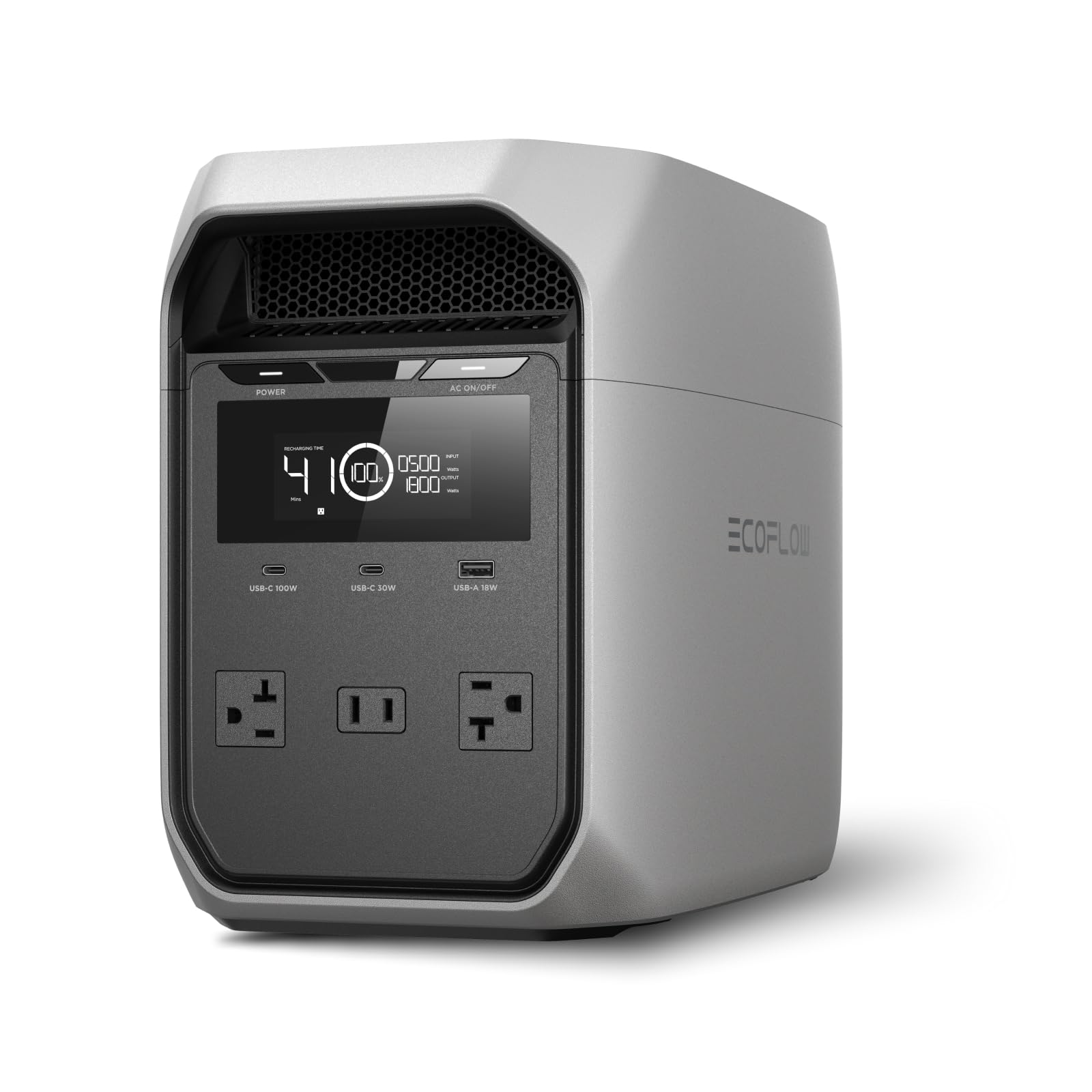
The EcoFlow Delta 3 Classic packs 1024Wh and a 1800W pure sine wave inverter that peaks at 3600W surge, letting you run a leaf blower, electric grill with a fan, or a mini fridge without hesitation. X-Boost technology extends usability up to 2600W loads by intelligently managing the inverter, providing a safety margin most competitors lack.
X-Stream AC charging brings the battery from 0 to 80 percent in just 45 minutes, and solar recharging reaches full in 2.5 hours with a 500W panel. The sub-10ms UPS switchover protects your PC or CPAP machine from power drops with seamless continuity, making this unit viable for both campsite and home backup roles.
At 15 pounds, the Delta 3 Classic is remarkably light for its capacity class, and the dual handles make lifting into a vehicle easier than the boxy designs of rival brands. The EcoFlow app provides full scheduling control, including storm alert modes that automatically maintain a high state of charge when severe weather approaches.
Why it’s great
- 45-minute 0-80% AC charging is class-leading
- 1800W inverter with 3600W surge handles heavy loads
- Weighs only 15 lbs for 1024Wh capacity
Good to know
- Not compatible with Delta 2 or Delta 3 Series extra batteries
- App setup required for full scheduling features
3. BLUETTI AC70

The BLUETTI AC70 provides 768Wh of LiFePO4 storage paired with a 1000W pure sine wave inverter capable of 2000W power lifting for short bursts. This combination comfortably runs a 100W guitar amp with five pedals for eight hours while only draining 41 percent, or powers a laptop and monitor setup through a full workday off-grid.
AC charging reaches 80 percent in 45 minutes, and a single cable eliminates the need for a bulky power brick. Solar input maxes out at 500W, enabling a full recharge from solar panels in under two hours under good sun — the fastest solar recharge rate in its capacity bracket. The XT-60 DC input connector is significantly more robust and reliable than older 7909 connectors found on previous generation units.
At 22.5 pounds, this is a denser unit that prioritizes durability and heat dissipation over absolute portability. The BLUETTI app offers remote monitoring and charge/discharge scheduling, making it easy to manage power settings from inside your tent without walking to the battery station.
Why it’s great
- 500W solar input enables sub-2-hour solar recharge
- 45-minute 80% AC recharge from a single cable
- 2000W power lifting handles startup surges easily
Good to know
- Heavier than competitors at 22.5 lbs
- Plastic housing less rugged than metal chassis options
4. Jackery Explorer 300 (Renewed)

The Jackery Explorer 300 brings 293Wh of capacity in a 7.1-pound package, making it the lightest AC-output power station in this lineup for short overnight trips where every ounce counts. Two pure sine wave AC outlets provide 300W continuous power, which is enough for LED lanterns, camera battery chargers, and a laptop simultaneously.
Recharging takes around two hours to reach 80 percent when using the wall outlet and 60W PD USB-C port simultaneously. The refurbished version tested by users arrived in like-new condition at roughly half the cost of retail, with no functional difference reported for camping applications. It reliably powered lamps, cameras, and phones through 8–9 hours of evening use while consuming 65 percent of its capacity.
This is not designed for high-draw appliances like electric grills or mini fridges. The Explorer 300 is best for solo campers or minimalist backpackers who need a reliable source for personal electronics and small lighting, valuing portability over raw power capacity.
Why it’s great
- Only 7.1 lbs — easy to carry to any campsite
- Refurbished option provides significant savings
- Dual charging cuts recharge time dramatically
Good to know
- Limited to 300W max output
- Li-ion battery, not as long-lived as LiFePO4
5. VTOMAN Jump 600X

The VTOMAN Jump 600X combines a 299Wh LiFePO4 power station with a dedicated car jump start port, eliminating the need to pack a separate jumper pack. Users confirmed it jump-started a Dodge Ram instantly, making this a smart dual-purpose unit for overlanders and fishing trips where vehicle reliability is paramount.
Its 600W pure sine wave inverter can surge to 1200W, and VTOMAN’s constant-power technology keeps output stable even when appliances momentarily exceed 600W rather than shutting down. Regulated 12V DC ports maintain consistent 12V/10A output, ideal for running CPAP machines and car refrigerators without voltage drop issues that damage sensitive 12V devices.
The capacity expands to 939Wh with an optional extra battery module, bridging the gap between portable and semi-permanent campsite power. At 14.6 pounds, it lands mid-pack in weight, but the integrated LED light with five modes adds practical utility for nighttime camp setup and emergency signaling.
Why it’s great
- Integrated car jump start port saves space and weight
- Regulated 12V DC output protects CPAP and fridge electronics
- Expandable to 939Wh with additional battery
Good to know
- 299Wh base capacity is lower than similarly priced options
- Jumper cables sold separately
6. LIBRIDS Portable Power Station C600
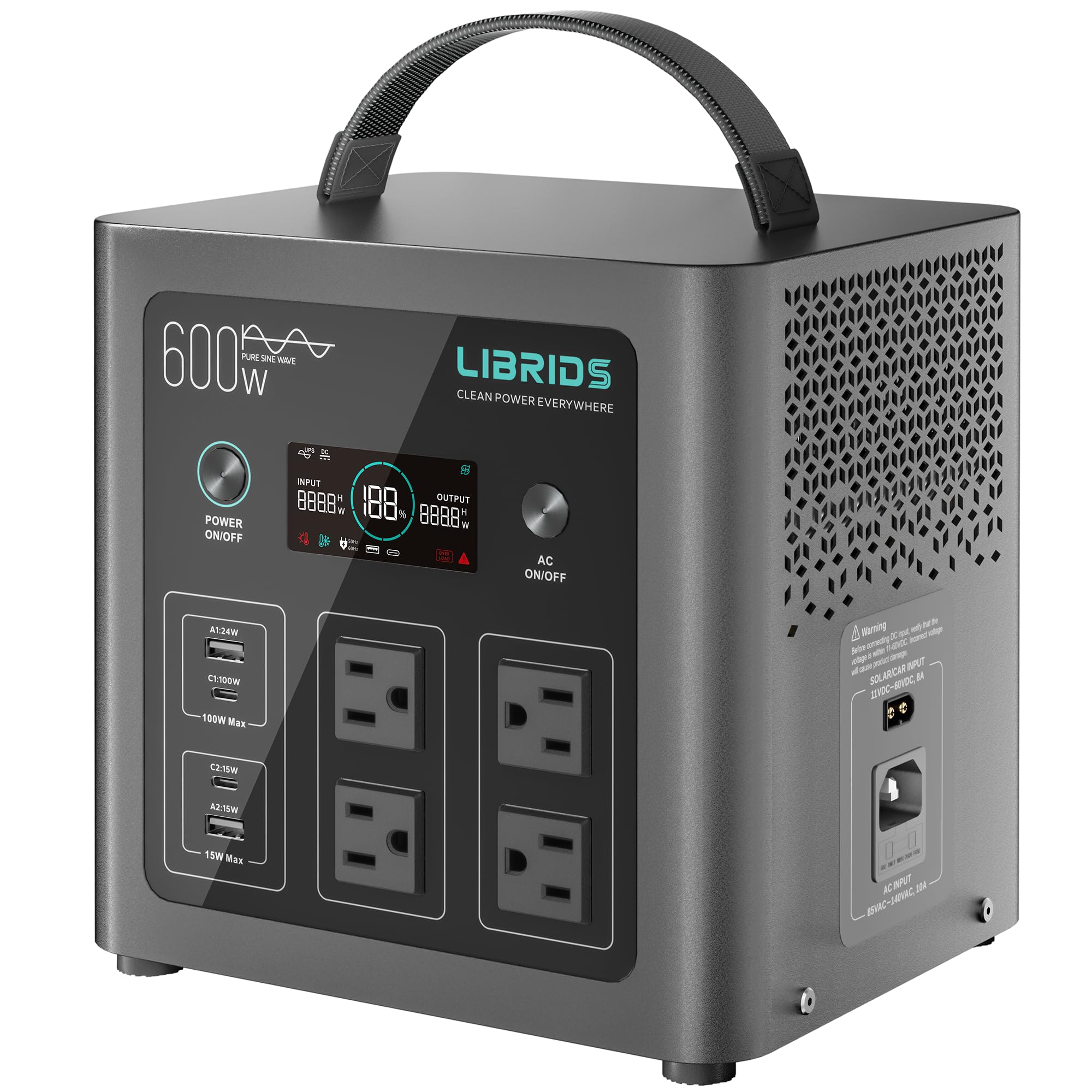
The LIBRIDS C600 delivers 640Wh of LiFePO4 storage with a 600W pure sine wave inverter that peaks at 1200W surge, all in a metal chassis package that improves heat dissipation compared to plastic alternatives. Users reported running a Resmed Airsense 11 CPAP for seven hours while only draining 24 percent of the battery, confirming excellent inverter efficiency for medical devices.
Built-in 10ms UPS automatically switches to battery during a power drop, keeping WiFi routers and CPAP machines active without interruption — a feature rarely found at this price point. AC recharge reaches full in just 1.5 hours, and the 4000-plus cycle rating ensures the battery outlasts most camping gear by years.
The eight output ports include four AC outlets plus multiple USB-A and USB-C ports, allowing simultaneous charging for phones, tablets, a laptop, and a fan. The large smart LCD screen clearly displays remaining battery percentage and real-time input/output wattage, so you always know exactly how much runtime remains for your gear.
Why it’s great
- 4000+ cycle LiFePO4 battery with metal enclosure
- 10ms UPS switchover protects CPAP and router equipment
- 640Wh capacity at an accessible price point
Good to know
- Rated for indoor or dry outdoor use only
- 600W inverter limits high-draw appliance support
7. Anker SOLIX C200 DC + 60W Solar Panel

The Anker SOLIX C200 DC bundles a 192Wh LiFePO4 power station with a 60W solar panel that folds into a case for easy transport, creating a complete solar kit that fits into a small backpack. Despite its compact size, the unit features a 140W two-way USB-C port for fast laptop charging and a 100W USB-C port, covering most personal electronics without needing AC outlets.
Users confirmed the C200 ran Starlink Mini for five hours using the OEM DC-to-USB-C cable, and the 60W solar panel fully recharges the station in a few hours under direct sun. The LiFePO4 battery chemistry, backed by a 3-year warranty, provides reliable performance for multiple seasons of use without significant capacity degradation.
At just 2.6 pounds, this is the lightest option in the comparison, and it charges a phone roughly five times before needing a recharge itself. The solar panel’s foldable design includes a carrying case, making this bundle ideal for backpackers, thru-hikers, and minimalist campers who want to stay topped off without carrying heavy lead-acid or larger lithium units.
Why it’s great
- Fits in a small backpack at 2.6 lbs total
- 60W solar panel included, folds into carrying case
- 140W USB-C charges laptops at full speed
Good to know
- 192Wh capacity limits usage to personal electronics only
- No AC outlet — relies entirely on USB-C and USB-A ports
FAQ
Can I run a CPAP machine all night on a camping battery bank?
How do I calculate how many watt-hours I need for a weekend camping trip?
What does pure sine wave inverter mean and does my CPAP need it?
Final Thoughts: The Verdict
For most users, the best battery bank for camping winner is the Jackery Explorer 1000 v2 because it balances a massive 1070Wh capacity, 1500W AC output, and a 4000-cycle LiFePO4 battery in a portable 23.8-pound package that charges fully in one hour. If you want the fastest recharge speeds and heaviest load support, grab the EF ECOFLOW Delta 3 Classic. And for backpackers or entry-level campers who need an ultra-portable solar kit, nothing beats the Anker SOLIX C200 DC bundle.