
The single biggest lie about portable solar generators is that you can just toss one in your trunk and be ready for a blackout or a week off-grid. The reality hits when a laptop refuses to charge past 20%, the panel barely trickles in after 4 PM, or the capacity listed in milliamp-hours doesn’t match the real watt-hours your devices actually draw. A truly capable off-grid power solution requires matching the battery chemistry, inverter quality, solar input specs, and port selection to your actual gear — not just grabbing the highest mAh number.
I’m Min — the co-founder and writer behind Gadgets Feed. I spend my days digging into the technical specifications of portable power stations, cross-referencing battery cell types, charge controller efficiency, and real-world discharge rates to separate marketing claims from usable capacity.
Tired of unreliable power during outages or wondering if your solar panel can actually keep your gear alive through a rainy weekend, I did the hard research to find the best battery bank with solar panel for every scenario.
How To Choose The Best Battery Bank With Solar Panel
Selecting a solar generator isn’t about picking the highest mAh number. The real factors are battery chemistry, inverter type (pure sine wave vs. modified), solar input capacity, and the physical ports you need. Start by totaling the watt-hours your critical devices consume in a day, then match that to a power station with at least 1.5x that capacity.
Battery Chemistry: LiFePO4 vs. NCM/Lithium-Ion
LiFePO4 (Lithium Iron Phosphate) batteries offer 3,000+ charge cycles versus roughly 500-800 for standard NCM lithium-ion. They also tolerate higher temperatures and are inherently safer against thermal runaway. The trade-off is slightly lower energy density, meaning a LiFePO4 unit may be a bit bulkier for the same Wh capacity. For a solar generator intended for regular use or emergency backup, LiFePO4 is the clear winner for longevity.
Solar Input: Watts, Voltage, and Connectors
The solar panel’s wattage and the power station’s maximum solar input rating determine how fast you recharge. A 60W panel paired with a station that accepts up to 60W will fully recharge a 288Wh unit in about 5-6 hours of direct sun. Pay attention to the connector type — most affordable units use a standard 5.5×2.5mm DC barrel jack, while higher-end models like Anker use XT60 connectors for higher current capacity. Also check the voltage range of the solar input to ensure compatibility with third-party panels.
AC Output: Pure Sine Wave vs. Modified Sine Wave
If you plan to power sensitive electronics — laptops, medical devices, certain camera chargers — you need a pure sine wave inverter. Pure sine wave produces clean, grid-quality power that won’t cause humming, overheating, or data corruption. Modified sine wave inverters are cheaper but can damage sensitive gear over time. All products in this guide use pure sine wave inverters.
Quick Comparison
On smaller screens, swipe sideways to see the full table.
| Model | Category | Best For | Key Spec | Amazon |
|---|---|---|---|---|
| Anker SOLIX C300 + 60W | Premium | Long-term reliability & fast recharge | 288Wh LiFePO4, 300W AC, 140W USB-C PD | Amazon |
| SinKeu E300 + 40W Panel | Premium | Family camping & emergency backup | 256Wh LiFePO4, 300W AC, 3500+ cycles | Amazon |
| ZeroKor R200 + 40W Panel | Premium | Dual-unit kit for extended trips | 280Wh + 100Wh, 2 power stations | Amazon |
| Apowking HP200L + 40W Panel | Mid-Range | Quiet operation & large LED light | 220Wh, 300W AC, pure sine wave | Amazon |
| Powkey HP500S + 30W Panel | Mid-Range | Panel-included value & compact size | 88.8Wh, 65W AC, 24000mAh | Amazon |
| HOWEASY H120 Max | Mid-Range | Ultra-portable & 7-device charging | 98Wh, 135W AC, 65W PD, 2.3 lbs | Amazon |
| DARAN Power Station 89.6Wh | Budget | Flight-friendly LiFePO4 on a budget | 89.6Wh LiFePO4, 100W AC, 7 ports | Amazon |
In‑Depth Reviews
1. Anker SOLIX C300 with 60W Solar Panel

The Anker SOLIX C300 is the benchmark for a complete solar generator kit in this class. Its 288Wh LiFePO4 battery is rated for 3,000 cycles — meaning it will still hold a usable charge after a decade of weekly use. The 300W inverter (600W surge) delivers pure sine wave AC power, and the two 140W USB-C ports enable two-way charging, so you can top up the internal battery from a USB-C power brick at up to 140W, reaching 80% in just 50 minutes via wall power.
The included 60W folding solar panel is a step above the 40W panels found in most kits, offering a real-world charging rate around 50W in direct sunlight. The panel uses an XT60 connector and packs down to a compact size for stowing. Anker claims the unit operates at a whisper-quiet 25dB, which is genuinely silent for a fan-cooled inverter. The integrated app shows real-time wattage, battery temperature, and estimated runtime from up to 100 feet away via Bluetooth.
On the port side, you get 3 AC outlets, a 120W car socket, and two 140W USB-C ports. This is enough to run a 240W laptop for about 5 hours, recharge a phone 20+ times, or keep an air mattress pump running for 10 minutes with only 5% battery drain. The 60W solar panel recharges the unit fully in about 1.5 hours in full sun, making it the fastest solar recharge in this lineup.
Why it’s great
- LiFePO4 chemistry with 3,000-cycle lifespan
- 140W two-way USB-C for ultra-fast wall recharge
- Included 60W panel recharges in 1.5 hours sun
- App-based monitoring with real-time data
- Near-silent 25dB operation
Good to know
- No carry strap included (sold separately)
- Only one USB-A port at 12W
- Higher price point than other kits
2. SinKeu E300 with 40W Solar Panel
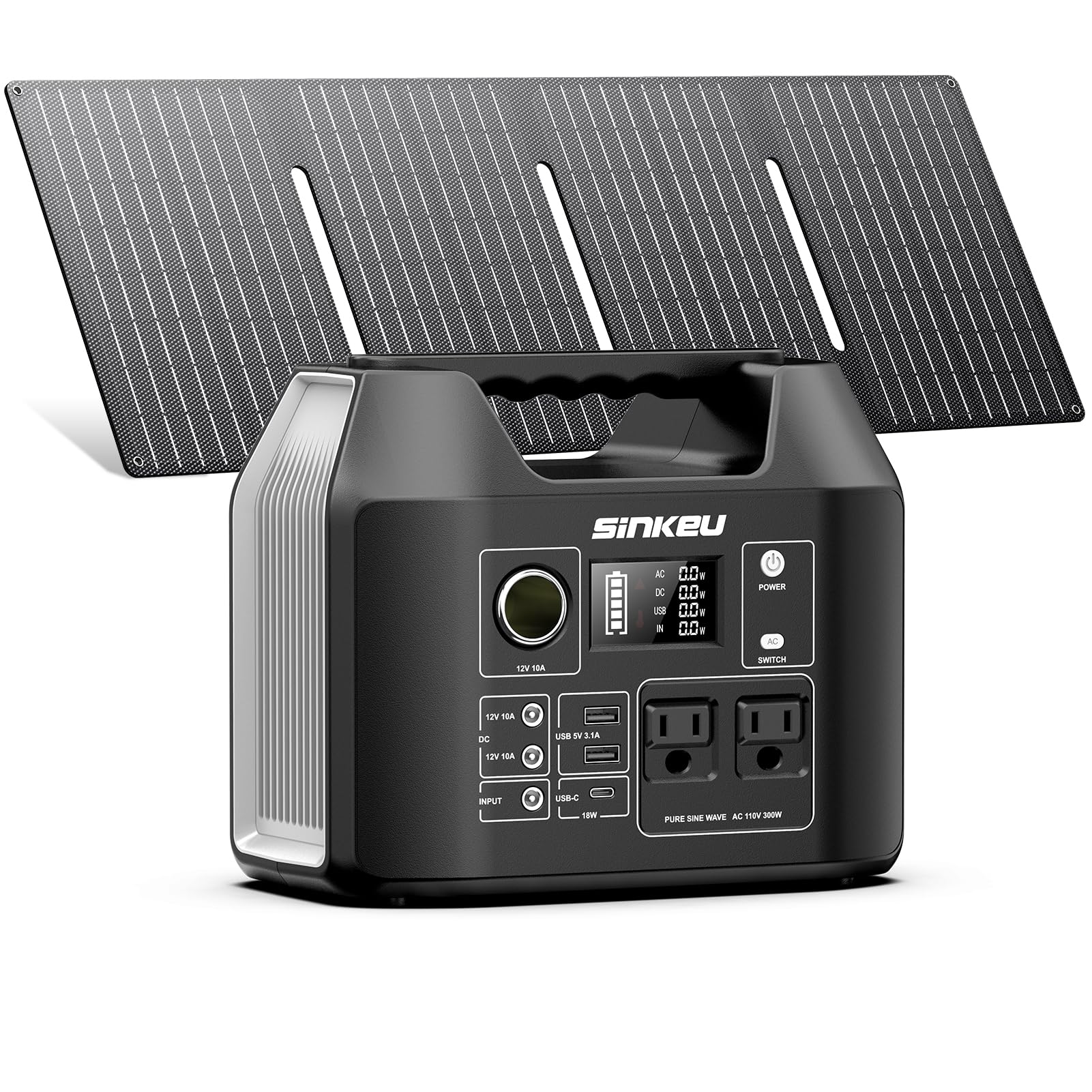
The SinKeu E300 brings LiFePO4 durability to a more accessible price point. Its 256Wh (80000mAh equivalent) capacity paired with a 300W pure sine wave inverter can handle laptops, mini-fridges, CPAP machines, and camera batteries simultaneously. The LiFePO4 battery is rated for over 3,500 charge cycles, making it one of the most long-lasting options in this comparison. The included 40W monocrystalline solar panel is foldable, weighing just 1.9 lbs, and uses a standard DC connector for compatibility with most third-party power stations.
The port selection includes 2 AC outlets, 2 USB-A ports (5V/3.1A), 1 USB-C PD port (12V/1.5A), and 2 DC outputs (12V/10A). This covers the essentials for a camping or emergency setup. The built-in LED light has multiple brightness levels and an SOS strobe for signaling. At 6.5 lbs, it’s light enough to carry from a tent to a picnic table but still substantial enough to power a 60W projector for about 4 hours.
User reports indicate the unit handles an 800W heater (peak power draw exceeding the rated 300W continuous) by temporarily shutting down rather than failing — a sign of robust BMS protection. One reviewer successfully ran an electric blanket and a heating pad on low settings without issues, though continuous draws over 300W will trigger overload protection. The solar recharge time is roughly 6-8 hours in full sun with the included 40W panel, which aligns with expectations for this class of generator.
Why it’s great
- 3,500+ cycle LiFePO4 battery for long lifespan
- Compact 6.5 lb form factor with carrying handle
- Bright multi-mode LED light with SOS
- Pure sine wave AC output for sensitive electronics
Good to know
- USB-C PD limited to 12V/1.5A (18W)
- 40W solar panel charges slowly in overcast conditions
- Battery capacity drops noticeably after a few charge cycles per some users
3. ZeroKor Dual Kit (280Wh + 100Wh + 40W Panel)
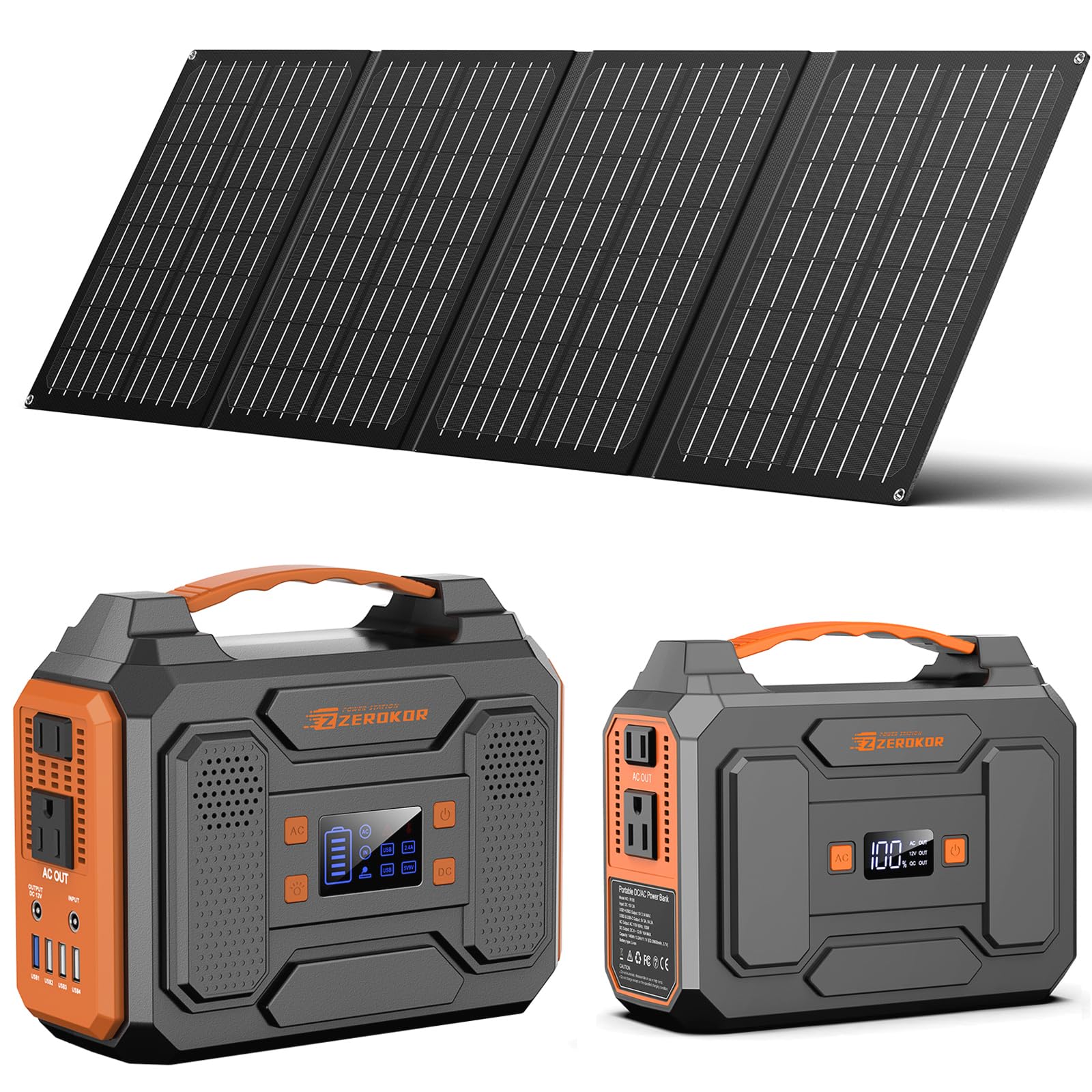
The ZeroKor kit is unique in this comparison — it includes two separate power stations: a 280Wh unit with a 300W inverter and a compact 100Wh unit with a 100W inverter. This dual-unit approach gives you flexibility: leave the larger unit at the base camp powering a cooler or CPAP, and carry the smaller 100Wh unit on day hikes for phone and camera charging. The combined 380Wh capacity (280Wh + 100Wh) beats any single-unit competitor in total energy storage.
The larger 280Wh station offers 2 AC outlets (pure sine wave), 3 USB-A ports (5V/3A), 1 QC3.0 USB port, and 1 DC vehicle output (9-12.6V/10A). The smaller 100Wh unit adds 2 AC outlets, 1 USB-C PD port (5V/3A, 9V/2A), and its own LED flashlight with SOS mode. Both units include built-in BMS protection for over-voltage, over-current, short circuit, and overload. The included 40W solar panel can charge either unit, but you’ll need to charge them one at a time unless you buy a second panel.
Real-world tests show the 280Wh unit runs a house fan on high for 8 hours while using only 5% of the battery, indicating excellent voltage regulation at low loads. Another reviewer used the smaller unit during a hurricane in Jamaica to keep phones and a portable fan running continuously. The main downside is the separate charging requirement — you cannot daisy-chain the two units for faster recharge or use them in parallel for higher AC output.
Why it’s great
- Two units for maximum flexibility (280Wh + 100Wh)
- Combined 380Wh capacity is class-leading for the price
- Both units have pure sine wave AC outlets
- Quiet operation with no disruptive fan noise
Good to know
- Must charge each unit separately with the single panel
- No USB-C PD on the larger unit (only QC3.0)
- Cannot power high-draw appliances (coffee makers, hair dryers)
4. Apowking HP200L with 40W Solar Panel

The Apowking HP200L stands out for its quiet operation and the large, bright LED panel on the back — a full backlit surface rather than a small flashlight. With a 220Wh lithium-ion battery and a 300W pure sine wave inverter (600W peak), it can charge up to 7 devices simultaneously. The 40W monocrystalline solar panel included in the kit achieves 24% conversion efficiency, which is excellent for this price bracket, performing well even in overcast conditions.
Port selection includes 2 AC outlets, 3 USB-A ports (5V/3.1A), 1 USB port (5V/3A, 9V/2A), and 1 DC vehicle output (9-12.6V/10A). Notably absent is a USB-C PD port, which means no fast-charging modern laptops directly from the unit without using the AC inverter. The unit also lacks WiFi or Bluetooth connectivity, so all monitoring is through the basic LCD screen showing remaining charge and output wattage.
Reviewers report the unit holds about 3.5 hours of runtime under moderate load and takes roughly 40 minutes to fully charge from a wall outlet. Solar charging with the included 40W panel is slow — one user noted it took 8 hours to gain just 2 bars of charge from 60W of solar input. The unit’s quiet cooling vents and pure sine wave inverter make it suitable for indoor emergency use without the drone of a fan. The 12-month warranty and responsive customer service are a plus for budget-conscious buyers.
Why it’s great
- Large back-lit LED panel (not just a flashlight)
- Quiet fanless cooling design for indoor use
- 7 simultaneous device charging capability
- 24% efficient monocrystalline solar panel included
Good to know
- No USB-C PD port for modern laptop charging
- Solar charging is very slow (8 hours for partial charge)
- No app or Bluetooth connectivity for monitoring
5. Powkey HP500S with 30W Solar Panel
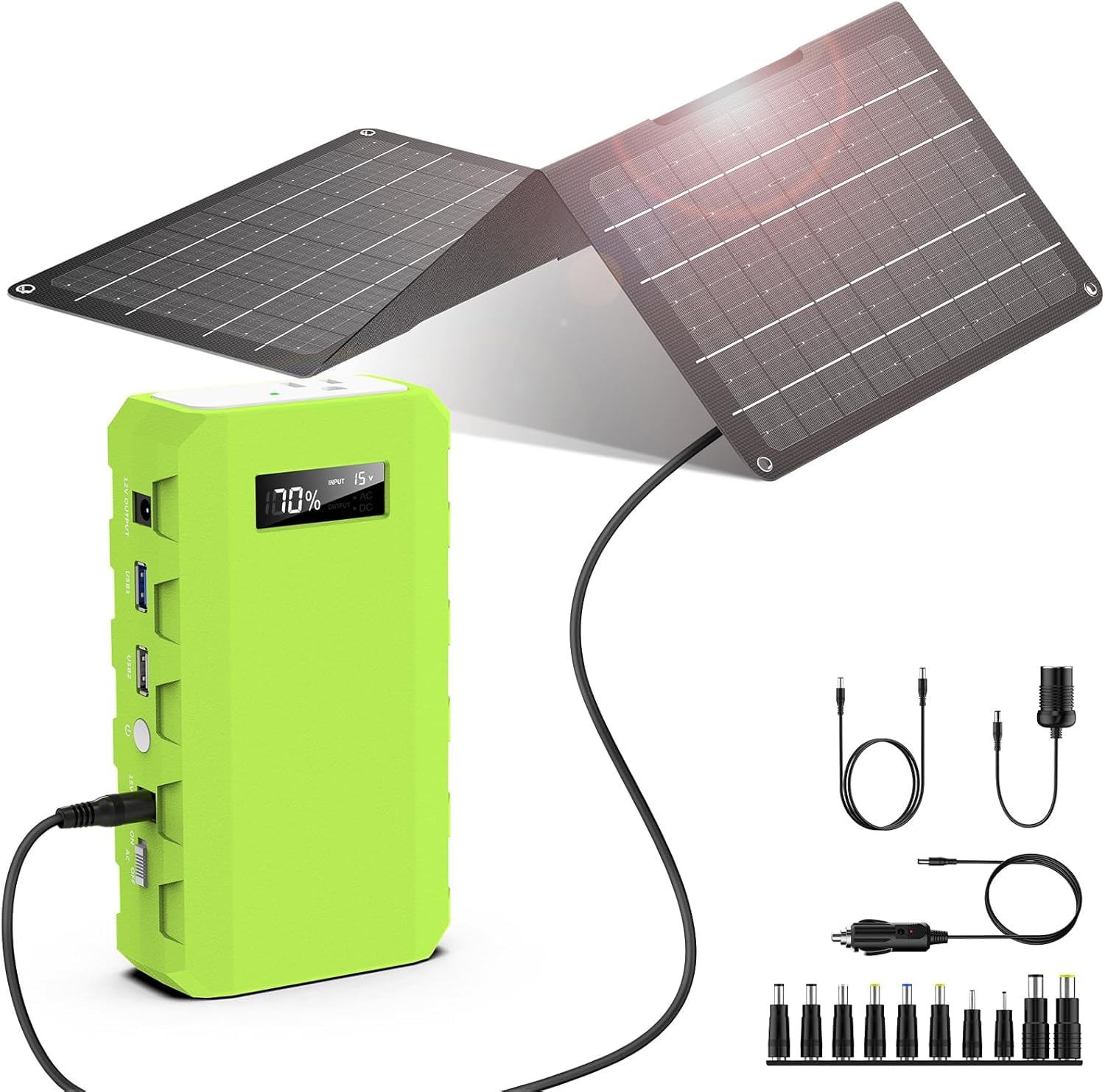
The Powkey HP500S is the most compact solar generator-with-panel kit on this list. Its 88.8Wh (24000mAh) capacity and 65W AC inverter are best suited for small electronics: phones, tablets, Bluetooth speakers, a small fan, or a smartwatch. The included 30W foldable solar panel is water-resistant and uses polyester fabric, making it rugged enough for backpacking. The panel’s smart chip identifies connected devices for optimal charging speed and overload protection.
The unit offers 3 output ports: 1 DC output (15V/2A), 1 USB-C (12V/1.5A max), and 1 USB QC3.0. It also includes 10 DC adapters for compatibility with almost 98% of solar generators on the market — a nice touch for backwards compatibility. The LED screen displays remaining charge percentage and input/output wattage. The AC outlet is limited to 65W, so it can charge a Surface tablet in about an hour (using 80% of the battery) but won’t run a laptop with a high-wattage charger or any appliance.
Car charging from 10% to full takes about 3.5 hours. Solar charging is slower but usable: leaving the panel on the car dashboard during a weekend camping trip kept the unit topped off enough for multiple phone charges. One reviewer noted the unit powered a cat cam for 12 hours using 40% of the battery. The neon green color is polarizing but makes it easy to find in a dark tent. A small number of users reported the unit stopped charging after a few uses, suggesting quality control inconsistency.
Why it’s great
- Smallest and lightest kit for true portability
- Water-resistant 30W solar panel included
- 10 DC adapters for broad compatibility
- Good for phones, tablets, and small electronics
Good to know
- 65W AC outlet cannot power laptops over 65W
- Some reported unit failure after a few uses
- Slow solar charging in overcast conditions
6. HOWEASY H120 Max (98Wh)
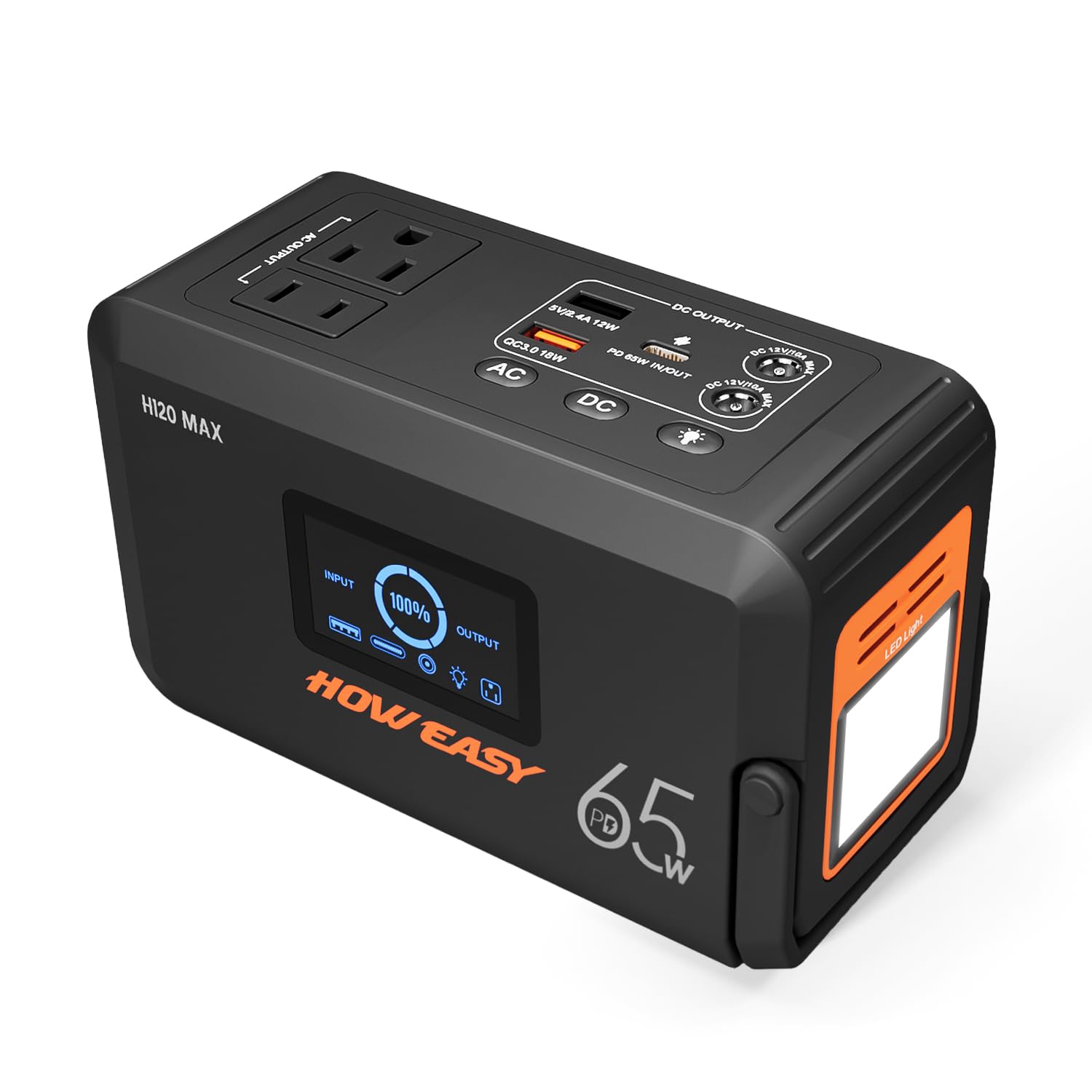
The HOWEASY H120 Max weighs just 2.3 lbs and measures 6.6 x 3 x 4 inches, making it one of the lightest units in this guide that still includes an AC outlet. Its 98Wh capacity is just under the FAA 100Wh limit, allowing it on flights. The 135W (270W peak) inverter can charge most laptops, drones, and small appliances. The 65W PD USB-C port charges a laptop to 80% in about 1 hour, which is competitive for a unit this small.
The port lineup is generous for its size: 2 AC outlets (110V/135W), 1 65W PD port (input/output), 1 QC3.0 port, 1 5V/2.4A port, and 2 DC ports. This allows charging 7 devices simultaneously — phones, tablets, e-readers, cameras, and a laptop all at once. The built-in 4-mode LED light (low/medium/high/SOS) provides versatile lighting for camping or emergencies. The BMS system offers 6-layer protection: over-voltage, overload, overcurrent, overheating, short circuit, and overcharge.
Customer feedback is strong, with users praising its reliability for deer season, emergency kits, and remote work. One reviewer noted the unit charged their laptop and two phones simultaneously without issue. However, a few users complained about the 65W AC limit — using it with an outdoor projector reduced runtime to just 30 minutes. Another minor complaint is the lack of a true on/off switch; the DC button serves as a standby toggle, and the cooling fan can be fairly loud during AC charging.
Why it’s great
- Ultra-light at 2.3 lbs and flight-safe 98Wh
- 65W PD port fast-charges most laptops
- 7 simultaneous device charging from compact form
- Multi-mode flashlight with SOS
Good to know
- No solar panel included in this kit
- 135W AC limit — cannot run high-wattage devices
- Cooling fan is loud during AC charging
- No physical on/off switch; relies on DC button
7. DARAN 89.6Wh LiFePO4 Power Station
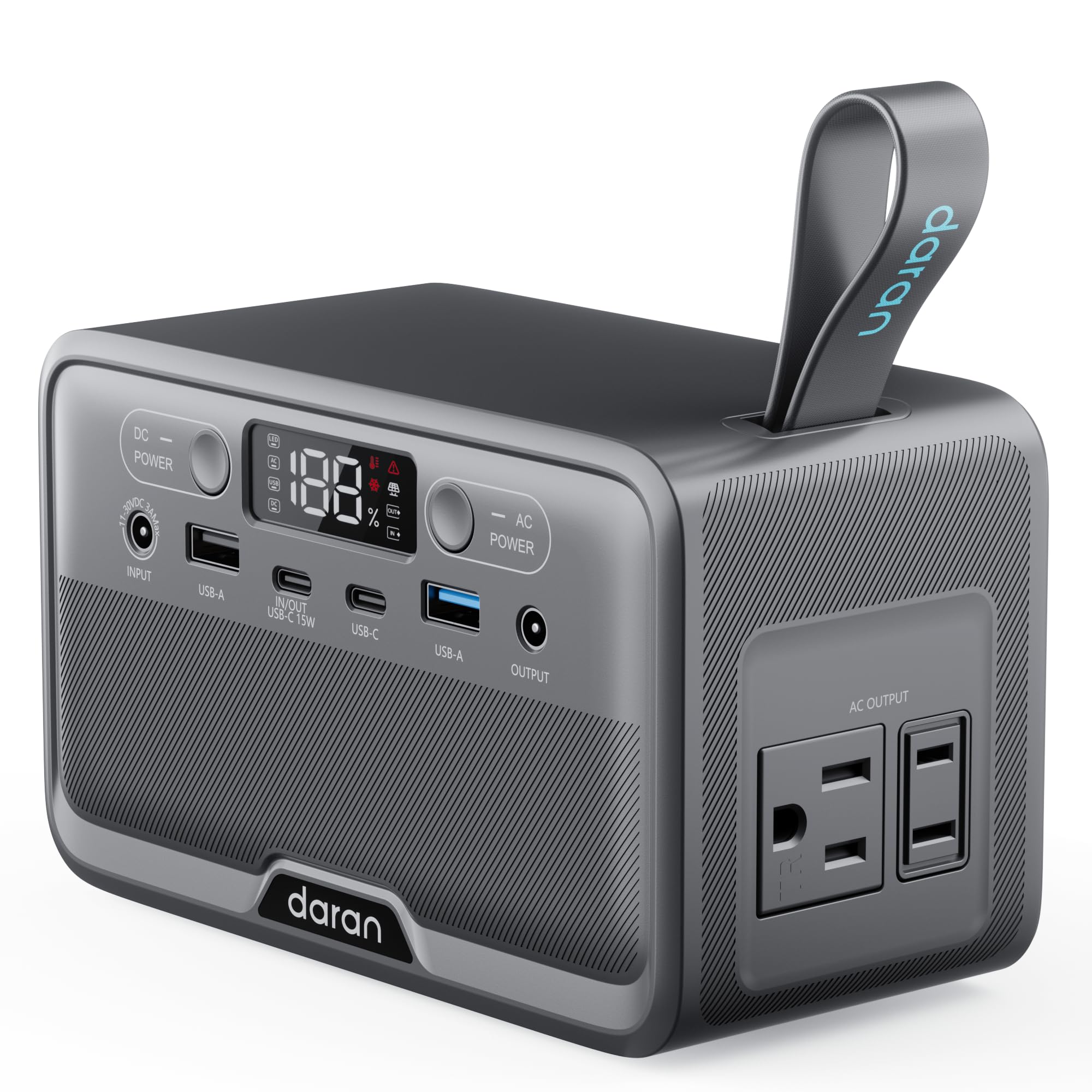
The DARAN 89.6Wh power station is the most affordable entry point into LiFePO4 battery technology on this list. Its lithium-iron-phosphate battery is rated for 3,500+ cycles — far exceeding the standard 500-cycle NCM batteries found in similarly priced units. At 2.5 lbs and roughly the size of a smartphone (6.5 x 3.3 x 4 inches), it’s flight-safe and backpack-compatible. The 100W (200W peak) pure sine wave inverter provides clean power for small electronics.
Port selection includes 2 AC outlets (100W total), 2 USB-C ports (45W/15W), 2 USB-A ports (18W/15W), and 1 DC5521 port (60W). The 45W USB-C PD port can charge many laptops, though slower than the 65W found on the HOWEASY. The LED display shows remaining charge and working status. One thoughtful touch: the unit requires a long-press to activate, preventing accidental power drain in a bag. The fanless operation makes it genuinely silent — no hum during charging or discharging.
Users report charging 6 half-drained phones from a single charge, or running an aquarium pump for 24 hours. For ham radio enthusiasts, it provides about 12 hours of moderate use. The 0-80% charge time via wall outlet is just 1.5 hours. Solar charging is possible but slow; the unit accepts solar input via DC barrel, and users recommend a 40W panel for reasonable recharge times. The main downsides are the 100W max AC limit (cannot run a projector or mini-fridge) and the small LCD icons can be hard to read in bright light.
Why it’s great
- LiFePO4 battery with 3,500+ cycle life
- Flight-safe 89.6Wh at 2.5 lbs
- 7 ports including 45W USB-C PD
- Silent fanless operation
Good to know
- No solar panel included in this kit
- 100W AC limit — not for high-draw devices
- Small LCD icons can be hard to read
FAQ
How do I calculate the real runtime for my laptop?
Can I use a third-party solar panel with my power station?
Why does my LiFePO4 power station lose capacity in cold weather?
Final Thoughts: The Verdict
For most users, the best battery bank with solar panel winner is the Anker SOLIX C300 with 60W Solar Panel because it combines LiFePO4 longevity, fast 140W USB-C charging, a near-silent inverter, and the most capable included solar panel in this comparison. If you want a dual-unit setup for flexibility during extended camping trips, grab the ZeroKor dual kit. And for a budget-friendly LiFePO4 option that’s flight-safe, nothing beats the DARAN 89.6Wh power station.