
A loose battery bouncing around a camper compartment isn’t just annoying — it’s a safety hazard. Hydrogen gas from charging batteries needs proper ventilation, and exposed terminals risk short circuits that can ruin your trip. The right box keeps your battery secure, vents dangerous fumes outside, and turns a raw power source into a usable 12V hub for lights, fridges, and devices.
I’m Rikta — the co-founder and writer behind Gadgets Feed. I’ve spent years analyzing battery enclosure designs, ventilation standards, and wiring configurations to help campers choose boxes that meet real-world safety and usability demands. (And Homer 🐱 supervised the unboxing, giving each box a firm paw-bat of approval).
Whether you need a replacement for a worn-out factory tray or a full power center you can carry from camp to camp, this guide breaks down the seven best options for the battery box for camper, comparing ventilation, terminal access, and built-in features that matter most on the road.
How To Choose The Best Battery Box For Camper
Selecting the right enclosure is about more than just size. Camper owners need to balance physical fit with safety features like gas venting and electrical protection, while also deciding how much built-in convenience they want for powering accessories on the go.
Battery Group Size and Internal Clearance
The physical dimensions of your battery — typically Group 24, 27, or 31 — dictate which box will fit. Group 24 boxes are the most compact, while Group 31 boxes offer the largest internal volume for high-capacity lithium or dual-purpose AGM batteries. Always measure your battery’s length, width, and terminal height, and check the box’s internal dimensions before purchasing.
Ventilation and Gas Management
Flooded lead-acid and AGM batteries release hydrogen gas during charging. A proper battery box for camper use must include a vent port, hose, and grille to route these gases outside the living compartment. Look for boxes that meet U.S. Coast Guard CFR 183.420 or ABYC E-10.7 standards — this indicates the box has been tested for safe gas expulsion.
Integrated Power Management vs. Passive Storage
Passive boxes simply hold the battery and vent gases. Smart boxes add a 12V cigarette socket, USB charging ports, a digital voltmeter, and circuit breakers. If you plan to power a fridge, charge phones, or run lights directly from the box, a smart unit saves you from buying separate distribution hardware. For pure storage under a bench or in a tongue-mount, a passive vented box is sufficient.
Quick Comparison
On smaller screens, swipe sideways to see the full table.
| Model | Category | Best For | Key Spec | Amazon |
|---|---|---|---|---|
| ALL-TOP Smart Battery Box | Smart Power Center | High-amp appliances (fridge, oven) | 50A Anderson connectors + 60A fuses each | Amazon |
| Litime Portable Battery Box | Smart Power Center | Group 31 batteries, dual 15A outlets | Built-in voltmeter + QC3.0 + Type-C | Amazon |
| SUNAPEX Smart Battery Box | Smart Power Center | DIY portable power, solar generator | Built-in 16A overload switch + light | Amazon |
| POWO Carlife Smart Battery Box | Compact Smart Box | Small LiFePO4 batteries, hunting, photography | Dual QC3.0 + PD + waterproof seal | Amazon |
| Peastorm Steel Battery Box | Metal Enclosure | Outdoor tongue-mount, waterproof need | Stainless steel, lockable, waterproof grommets | Amazon |
| Camco 55371 Vented Battery Box | Vented Passive Box | Replacement box, simple storage | USCG approved, complete vent kit included | Amazon |
In‑Depth Reviews
1. ALL-TOP Smart Battery Box

The ALL-TOP is the closest you can get to a DIY power station without wiring a panel yourself. It ships with two 50-amp quick connectors (Anderson SB50 compatible), each protected by its own 60-amp fuse, allowing you to run a refrigerator or an inverter directly from the box. The main switch isolates a 16-amp resettable circuit breaker for the USB and cigarette ports, keeping your sensitive gear safe while the heavy terminals stay unfused for high-current loads.
Internally, the box is spacious enough to accept Group 24, 27, and 31 batteries, including 100Ah LiFePO4 cells with room to spare for wiring. The digital voltmeter reads accurately to within 0.1V, giving you real-time state-of-charge at a glance. Some users noted that the plastic 12V socket can feel flimsy under heavy plugs, and there is no integrated carry handle — this is best suited for a fixed mount in a camper compartment rather than daily carrying.
If you need high-amp output for a fridge and solar charging without buying a separate distribution box, the ALL-TOP delivers two fused Anderson ports that handle the job cleanly. It has been widely adopted in overland and vanlife circles as an affordable, clean-looking power hub for 12V systems up to 36V.
Why it’s great
- Two 50A fused Anderson connectors for high-current appliances
- Spacious interior fits 100Ah lithium batteries comfortably
- Digital voltmeter provides real-time voltage monitoring
Good to know
- No carry handle — best for fixed installation
- 12V socket quality is basic and may loosen over time
2. Litime Portable Battery Box

Litime’s offering combines wide Group 24-31 compatibility with a built-in power center that includes two 15-amp cigarette sockets, one Qualcomm Quick Charge 3.0 port, and a Type-C port. The internal 6AWG silicone cables with M8 ring terminals make connecting a Group 31 battery straightforward and secure, while the external terminals let you charge the battery without lifting the lid — a nice convenience for campers who want to keep the box closed and protected.
The box uses a PC/PBT plastic blend rated to hold batteries up to 66 pounds, though real-world testing showed the integrated handle can fail under the weight of a 52-pound lead-acid battery. For lighter lithium batteries (22 pounds typical for a 100Ah LiFePO4), the handle works fine and the box is genuinely portable. The 16-amp automatic reset circuit breaker protects all accessory ports from overload, and the voltmeter is always visible on the front panel.
Owners consistently praise the value — you get a full power distribution system in one box for the price of a basic enclosure. If you plan to use a lithium battery and want multiple 12V outputs plus USB-C for modern devices, the Litime is a strong mid-range contender.
Why it’s great
- Dual 15A cigarette sockets plus QC3.0 and Type-C ports
- External terminals for charging without opening the box
- Fits all three common group sizes (24, 27, 31)
Good to know
- Handle may break under heavy lead-acid batteries over 50 lbs
- Plastic build is adequate but not as rugged as metal boxes
3. SUNAPEX Smart Battery Box
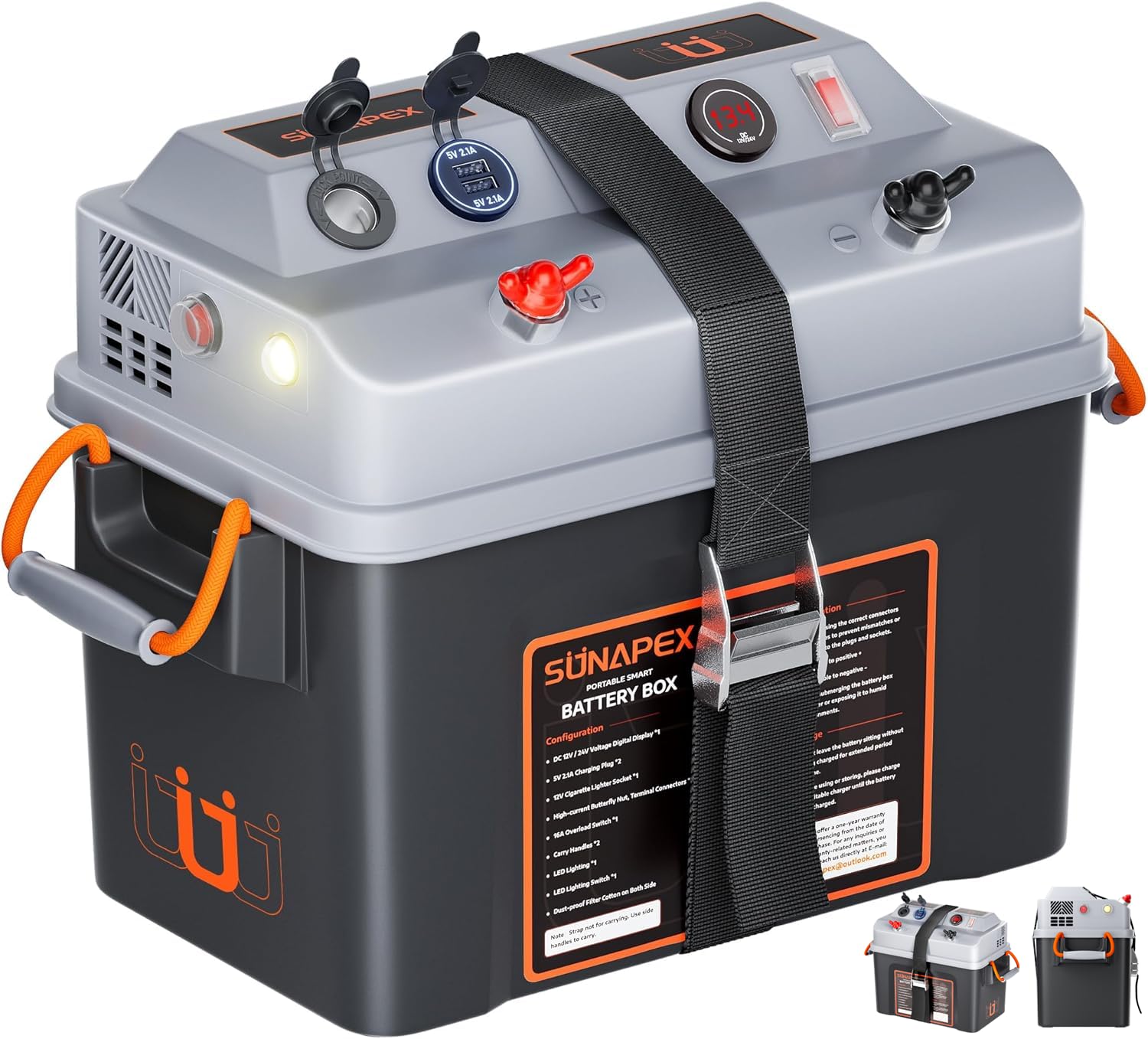
SUNAPEX packs more convenience features into a single box than most competitors. The stand-out addition is a left-side integrated LED light that illuminates the battery compartment area — a genuine help when you are wiring or checking connections in a dark camper. The front panel includes a 16-amp overload switch, a 12V cigarette lighter socket, two USB 5V 2.1A ports, a digital voltmeter, and external high-current terminals.
The internal dimensions measure 13.1 x 8.2 x 7.8 inches, making it compatible with Group 24, 27, and 31 batteries. Owner feedback confirms that a standard 100Ah LiFePO4 fits perfectly with room for cables. The base plastic is described as sturdy and slightly flexible, resisting cracks from minor impacts, though the rubberized coating has been noted to peel if the box is slid across rough surfaces. The handles are ergonomic and the non-slip rubber pads on the base help keep it steady on a camper floor.
If you are building a DIY solar generator in a camper and want a box that gives you a voltmeter, overload protection, a light, and USB ports without extra components, the SUNAPEX is the most complete package at this tier. Users rate it above pricier brands for overall features per dollar.
Why it’s great
- Integrated LED light for low-light setup and inspections
- 16A resettable overload switch protects all ports
- Ergonomic handles and non-slip base pads
Good to know
- Rubberized exterior coating can wear with rough handling
- Plastic construction feels durable but not premium-grade
4. POWO Carlife Smart Battery Box

The POWO Carlife box is designed for smaller batteries — 10Ah up to 30Ah — making it ideal for compact LiFePO4 cells used in hunting, photography, and portable camping setups. The waterproof seal and gasket construction allow it to withstand rain and splashes in exposed environments. It comes with a pre-installed 30-amp Anderson plug for solar panel input, plus dual QC3.0 USB and a separate QC3.0+PD port for fast charging of phones and laptops.
Internally, the box uses 10AWG wiring to screw terminals and 14AWG to the Anderson connectors, which is adequate for 30-amp continuous loads. The 30-amp overload protection fuse adds a safety layer for the battery. Owners note that a 30Ah battery is the absolute height limit — a taller cell may not close. For 20Ah and smaller batteries, the fit is perfect with room for a charger inside. One user added a foam block to secure a smaller battery and prevent movement during travel.
This is not a box for large Group 31 setups, but if you want a grab-and-go portable power box for a small LiFePO4 battery that can handle a trolling motor, a camping fridge, or emergency phone charging, the POWO Carlife delivers a waterproof, compact solution with fast USB charging built in.
Why it’s great
- Waterproof gasket seal for harsh outdoor conditions
- 30A Anderson plug for solar charging compatibility
- Dual QC3.0 plus PD port for fast device charging
Good to know
- Limited to batteries 30Ah and smaller
- No internal 12V cigarette socket — requires adapter for older accessories
5. Peastorm Steel Battery Box
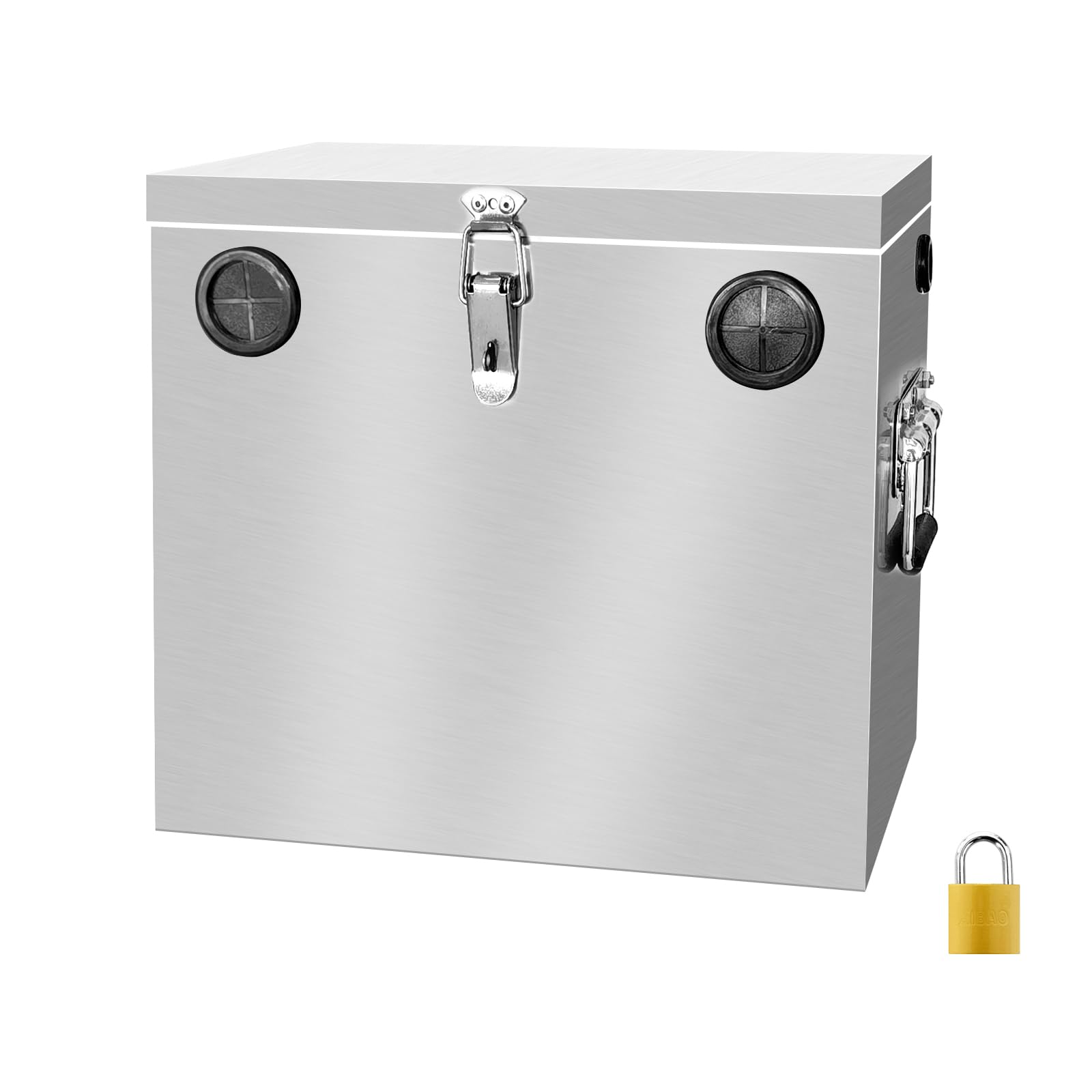
The Peastorm box breaks away from the plastic norm with a full stainless steel construction. It is designed specifically for Group 24 batteries, with internal dimensions of 11 x 7.8 x 11 inches. The metal build offers superior fire resistance, UV protection, and physical puncture protection compared to any polymer box. It includes a lockable lid (padlock included), spring-loaded handles on both sides, and pre-drilled mounting holes with rubber grommets for waterproofing.
Customer reports show it can comfortably hold two 6-volt golf-cart batteries wired in series for a 12V system, or a single large 320Ah lithium battery with foam cushions for a snug fit. The lid opens fully for easy access, and the latch is described as precise and secure. Some owners cautioned that the stainless steel is thin (400 series) and has sharp edges on the lid and top rim — handling requires care. The rubber grommets on the wiring holes are not completely watertight without additional caulking in heavy rain conditions.
If your camper setup demands a battery box that can survive harsh tongue-mount conditions, temperature extremes, and potential impacts from road debris, the Peastorm metal box is the most durable option available. It is best suited for fixed outdoor mounting where plastic boxes would crack or degrade.
Why it’s great
- Full stainless steel construction for maximum durability
- Lockable lid with included padlock for security
- Spring-loaded handles for easy carrying when mounted
Good to know
- Sharp edges on lid and rim require careful handling
- Rubber grommets may need additional caulking for full waterproofing
6. Camco 55371 Vented Battery Box

The Camco 55371 is the simplest, most straightforward battery box for camper use — and it does exactly what a basic enclosure needs to do. It holds a single Group 24 battery and includes a complete venting system: a hose, a hose mount plate, a louvered vent grille, and foam tape. It meets U.S. Coast Guard CFR 183.420 and ABYC E-10.7 specifications, meaning it has been tested to safely expel hydrogen gas in enclosed compartments.
The box measures 14⅞ x 9⅝ x 11¾ inches including the vent ports, and the plastic construction is solid for its weight (just one pound). Owners consistently report that it fits perfectly into standard RV battery trays and that the included hardware is complete and easy to install. The foam tape helps seal the lid, preventing gas from leaking into the living space. One detail that stands out: customers who replaced factory boxes with this unit noted the Camco plastic is noticeably thicker and more rigid than the OEM parts.
If your goal is a reliable, compliant replacement box for a Group 24 deep-cycle battery in a camper compartment, the Camco 55371 delivers the highest value. It lacks USB ports, voltmeters, or fancy features, but for ventilation safety and fit, it checks every box.
Why it’s great
- USCG and ABYC certified for safe gas ventilation
- Complete kit includes all venting hardware and foam tape
- Thicker, more rigid plastic than many OEM factory boxes
Good to know
- No built-in power ports or voltmeter — passive box only
- Limited to single Group 24 battery size
FAQ
Can I put a lithium battery in a standard vented battery box?
What is the difference between Group 24, 27, and 31 battery box sizes?
Do I need a smart box or can I just use a basic vented enclosure?
Final Thoughts: The Verdict
For most users, the battery box for camper winner is the ALL-TOP Smart Battery Box because it combines dual 50-amp fused Anderson connectors with a spacious interior that fits Group 31 and 100Ah lithium batteries — giving you high-current capacity for a fridge or inverter without needing a separate distribution panel. If you want an all-in-one portable power center with USB-C and dual 15A outlets, grab the Litime Portable Battery Box. And for a rugged outdoor tongue-mount setup where plastic won’t survive, nothing beats the Peastorm Steel Battery Box.