
Our readers keep the lights on and my morning glass full of iced black tea. As an Amazon Associate, I earn from qualifying purchases.
Specs are compiled from manufacturer listings and verified buyer reviews and can change over time — please confirm the key details on the product page before buying.
You want a battery cable and lug that delivers your amps reliably without overheating or corroding. The key difference between a connection that lasts years and one that fails is copper purity, lug quality, and how they are joined.
I’m Min — the founder and writer behind Gadgets Feed. This guide is built by comparing the manufacturers’ published specifications and the patterns across verified customer reviews, so you get each pick’s real strengths and trade-offs instead of marketing spin.
You need a cable that actually fits your posts and carries your load, so here is the honest breakdown of the best battery cable and lug sets across every budget tier.
Our Picks at a Glance


How To Choose The Best Battery Cable And Lug
Before you buy, you need to match three things: the wire gauge to your current draw, the lug hole size to your battery post, and the copper type to your environment. Get these right and the cable disappears into your setup; get them wrong and you will be chasing voltage drops and heat.
Match the gauge to the load
The lower the AWG number, the thicker the wire and the more current it can carry safely. A 6 AWG cable suits lighter loads, while a 2 AWG or 1/0 AWG handles high-amp inverters, winches, and starter motors. Thicker wire means less resistance, so your power actually arrives where it needs to go.
Check the lug hole diameter
Lugs come with mounting holes of different sizes, most commonly 5/16″ or 3/8″. That hole must match the bolt or stud on your battery terminal, inverter, or fuse block. A 3/8″ hole on a 5/16″ stud will feel sloppy and can loosen over time.
Know your copper
Pure copper conducts better than copper-clad aluminum (CCA), which is a copper coating over an aluminum core. CCA is lighter, cheaper, and fine for modest loads, but pure or tinned copper handles sustained high current with less heat and resists corrosion far better in marine or RV environments.
Quick Comparison
| Model | Best For | Wire Gauge | Lug Hole Size | Cable Type | Amazon |
|---|---|---|---|---|---|
| TUELETFU 2 AWG★ Best Overall | Inverter & solar hookups | 2 AWG | 3/8 in | Pure copper | Amazon |
| ECO-WORTHY 2 AWGBest Value | RV battery banks | 2 AWG | 5/16 in | Tinned copper | Amazon |
| End Game 4 AWGTop Performer | Starter & alternator runs | 4 AWG | 5/16 in | 99.9% pure copper | Amazon |
| A ABIGAIL 6 AWG | Light inverter & accessory wiring | 6 AWG | 5/16 in | Pure copper | Amazon |
| Linkstyle 6-piece 2 AWG | Parallel solar battery banks | 2 AWG | 3/8 in | 99.9% pure copper | Amazon |
| WindyNation 1/0 AWG | High-amp inverters & trunk batteries | 1/0 AWG | 3/8 in | Fine-strand pure copper | Amazon |
| KEDAKEJI 2 AWG | Heavy-duty vehicle & solar | 2 AWG | 5/16 in | Oxygen-free copper | Amazon |
| Battery Cable Kit 4 Gauge | Car audio & plow installs | 4 AWG | Bare wire + lugs | CCA | Amazon |
| Ruikarhop 1/0 Gauge | RV battery relocation & winches | 1/0 AWG | Bare wire + lugs | CCA | Amazon |
In-Depth Reviews
1. TUELETFU 2 AWG Battery Cable
Our pick — over 4.5★ from 800+ verified ratings; the strongest balance of quality and price.
The crowd-pleasing 2 AWG set that earns trust through a multimeter.
Buyers verify quality and power with a multimeter, confirming reliable current flow for serious loads. The 2 AWG/35MM2 wire with 3/8″ lugs is built for the heavy lifting between coach batteries and an inverter.
Quality is what wins people over here, with good reason: the terminals fit correctly on the ends, and the pair arrives at 2 feet per cable (one red, one black). It is a favorite for second battery installs on boats and for solar collection rigs, where dependable throughput matters more than fancy extras.
Flexibility is the one honest trade-off — some owners find the cables easy to route, while others call them extremely stiff. That stiffness comes with the thick gauge, so plan your bends before you commit. It is a value play that checks every box for coach, solar, and marine duty.
pure copper value
- Verified quality and power — owners test it and it passes
- Pre-attached 3/8 in lugs for quick, secure installation
- Perfect length for inverter and solar battery hooks
stiffness trade-off
- Stiffness varies — routing tight corners takes some muscle
- Fixed 2 ft length limits where you can place it
grab it for: solar banks, boat second batteries, and motorhome inverter runs where a proven 2 AWG connection is the whole job.
think twice if: you need to snake cable through a sharp, tight engine bay — flexibility is not this one’s superpower.
2. ECO-WORTHY 2AWG Battery Cable
A stubby 12-inch tinned-copper jumper that shrugs off corrosion.
Buyers call these well-built short cables for RV battery banks, with tinned copper construction ensuring durability. The nickel-plated 5/16″ lugs resist corrosion, while the cable itself is rated for a maximum operating current of 150 A across a temperature range of -76°F to 392°F.
At 0.27 kg it is the featherweight of the 2 AWG group — over 40% lighter than the TUELETFU pair above — yet it still delivers beefy, thick build quality that owners describe as good value. The 12-inch length is the catch to plan around; it suits tight jumpers between batteries, not long runs.
Flexibility gets a mixed reception because 2 AWG is simply stiff, but that is physics, not a flaw. If your connection point is close and you want corrosion resistance in a damp environment, this is a smart, budget-friendly buy.
reach for it if: you are tying together an RV battery bank or adding a short ground link where corrosion is the enemy.
look elsewhere if: you need length — at 12 inches, it bridges only tight gaps.
3. End Game 4 AWG Battery Cable
The USA-made 4 AWG with hydraulic-press crimps that never fail.
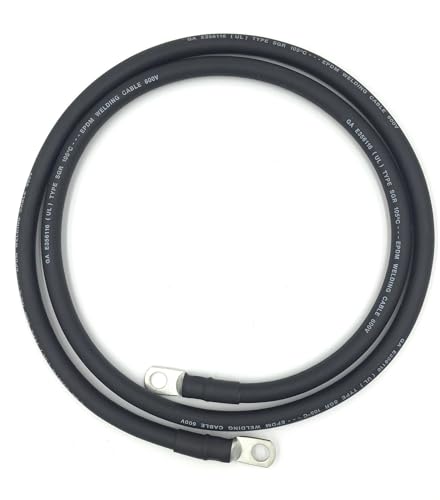
This is the cable for people who hate loose, unreliable connections. The 4 AWG Ultra Flex EPDM cable is made from 99.9% pure copper, and the heavy-duty tinned sealed lugs are crimped with a 10-ton hydraulic crimper plus adhesive-lined heat shrink for a fully sealed, corrosion-proof joint. It is built in the USA on a hydraulic press for a 100% secure crimp.
Buyers confirm it connects alternator to starter on a Chevy Astro, and racecar owners praise the factory-grade crimps at the exact ordered length. The EPDM rubber jacket resists oil and fuel, which is why it outlasts cheap PVC-insulated cables in engine bays.
At 2ft it is the shortest of the pair, but lengths run custom on request, and the 60-volt rating covers most 12V and 24V systems with headroom. If you want a made-in-USA cable with factory-grade terminations, this is the one.
choose it for: starter, alternator, and battery-cutoff wiring where a flawless crimp means you never revisit the connection.
skip it if: you want a pre-made set with both red and black wires — this sells as a single cable.
4. A ABIGAIL 6 AWG Battery Cable

A flexible 3-foot 6 AWG pair that routes like a dream.
At 6 AWG this is the lighter-duty option, but owners say the copper wiring is thick, the insulation is durable without being stiff, and the pre-installed 5/16″ lugs are solidly crimped. The 36-inch red and black pair slips into automotive, solar, marine, and golf cart duty — including hooking up power inverters where space is tight.
Buyers confirm pure copper construction—”no copper clad aluminum”—delivering better conductivity than CCA. The flexible PVC jacket resists abrasion and moisture, and the heat-shrink sealed ends add a layer of protection against the elements.
While 6 AWG handles moderate amps, it is not meant for winch or inverter heavy-load runs. But for accessory wiring, lawn equipment, and small inverter hookups, this is a clean, easy-to-route cable at a fair price.
fit it if: you want an easy-bending 6 AWG pair for inverters, lawn gear, or boat accessories.
pass on it if: you need thick 2 AWG or larger for high-amperage starting or winching — this is a lighter-load cable.
5. Linkstyle 6-Piece 2 AWG Cable Set
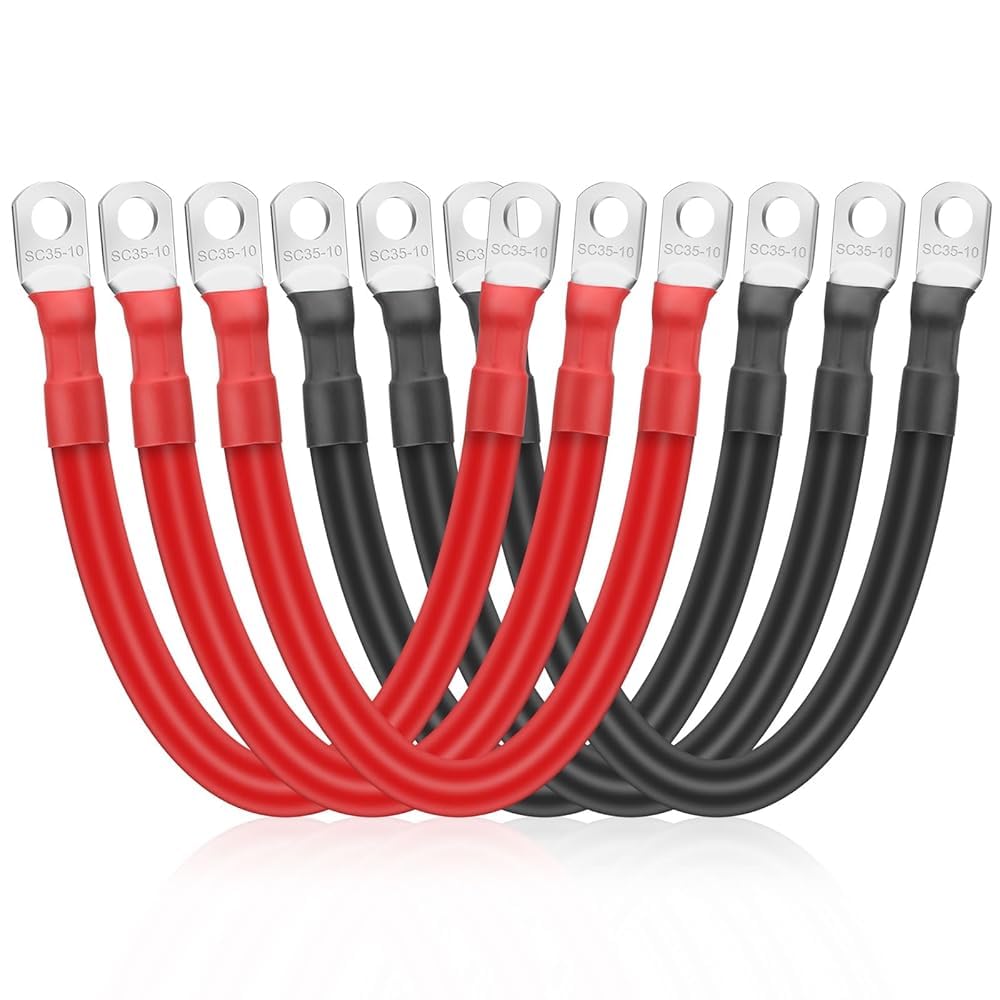
Six pre-terminated 2 AWG jumpers built for parallel battery banks.
This set gives you six 6-inch (15cm) 2 AWG cables in red and black, each with 3/8″ tin-plated copper crimped lugs. Owners parallel three marine deep-cycle batteries for solar and camper hookups, reporting snug ring terminals with no slack.
Made from 99.9% pure copper with nickel-plated terminals and a flexible PVC shell, the set handles 12V-48V setups for solar, RV, marine, and truck applications. The tinned lugs provide corrosion protection while the PVC insulation resists water, wear, and flame.
The honest caveat is length: at 6 inches, these are strictly for linking batteries side by side, not for reaching distant components. But if your project is a battery bank or parallel connection, this multi-pack saves you from buying six separate cables and connectors.
buy it for: linking multiple batteries in parallel or series where you need several identical short, heavy-duty jumpers.
not for: long runs — 6 inches only bridges adjacent terminals.
6. WindyNation 1/0 AWG Battery Cable

Ultra-flexible 1/0 AWG pure copper built for serious amp draw.
The thing everyone raves about is the flexibility — WindyNation’s 1/0 AWG cable is 100% fine-stranded pure copper, so it bends around corners and routes between tight connection points where stiff cables fight you. Owners pair it with 2000-watt inverters and use it to install trunk batteries, praising how easily it flexes into place.
The tinned, closed-end copper lugs resist corrosion, and polyolefin heat shrink forms a protective seal over each crimp. Buyers report the ends are crimped and sealed perfectly, and many say it is cheaper than buying raw wire and lugs to make the same cable yourself.
True to the 1/0 gauge, this handles high amperage with less voltage drop, and the fine stranding keeps it manageable despite the size. Durability draws mild mixed feedback, but the consensus is a premium, flexible connection for demanding inverter and starter jobs.
splurge on it if: you run a large inverter, relocated trunk battery, or high-amp system where flexibility and pure copper matter.
reconsider if: you need only a short, cheap jumper — this premium pair is overkill for simple links.
7. KEDAKEJI 2 AWG Battery Cable

Oxygen-free copper with a 105°C flame-retardant jacket.
Pure oxygen-free copper boosts conductivity, tin-plated terminals fight corrosion, and the 105°C flame-retardant jacket adds heat protection. At 4 feet, the red and black pair reaches a bit farther than the 2-foot competition, and owners say the cable “will last the life of the system.”
Owners mention it is great for solar charging setups and say it holds amps well, though one noted the lug hole may need filing to fit a larger bolt — so check your terminal stud size first. The PVC sheath is flexible, wear-resistant, and waterproof, built for heavy-duty vehicles, RVs, and lawn equipment.
Flexibility draws mixed reviews, which is standard for 2 AWG, but the build quality and fit earn consistent praise. It is a solid mid-premium choice for anyone who wants a slightly longer, corrosion-resistant 2 AWG connection.
pick it for: solar panel hookups, heavy-duty vehicles, and RVs where a 4-foot reach and heat resistance help.
double-check: your bolt diameter — the 5/16″ hole may need a file on some larger studs.
8. 4 Gauge Battery Cable Kit 50ft

A 50-foot CCA kit that bundles wire, lugs, and shrink in one box.
This kit gives you enough material for multiple installations: 25 feet each of red and black 4 AWG copper-clad aluminum (CCA) power/ground wire, 10 pieces each of SC25-10″ and SC25-8″ battery lugs, and 20 pieces of 3:1 dual-wall adhesive heat shrink tubing. The CCA wire is lighter and more flexible than pure copper, so it is easier to route in tight spaces while still carrying power effectively for the price.
Owners use it for off-grid batteries and a western plow, valuing the all-in-one wire-and-connector bundle. The low-memory, soft-touch PVC jacket resists oil, gas, and abrasion, making it easy to route in hard-to-reach places.
The honest caveat: some customers note the wire is not true 4 gauge, measuring closer to a thinner diameter. That matters for high-current draws, so keep it to moderate loads. For car audio, lighting, and ground wire installs, this bundle is a practical, budget-friendly grab.
grab it for: car amplifier wiring, off-grid battery hookups, or lighting projects where you need bulk wire plus connectors.
be aware: the CCA wire is lighter-duty than pure copper and may not be a true 4 gauge — keep high-amp loads in mind.
9. Ruikarhop 40FT 1/0 Battery Cable

Rated 250A and shipped long — 20 feet red, 20 feet black.
For battery relocation projects, this delivers: 40 feet total — 20 feet red and 20 feet black of genuine 0 AWG copper-clad aluminum wire, rated for a maximum current of 250 A. It comes with 20 piece terminal connectors and 3:1 heat shrink tubes, so a full install needs no extra purchases.
Owners use it for camper lithium banks and RV battery relocation, with one reporting faster car starts. The flexible PVC jacket has clear red/black polarity identification and resists impact, making it suitable for tough environments like winch wiring and trolling motors.
The honest trade-off is the material: several owners note it is not solid copper, and one measured the gauge as closer to 2 AWG rather than true 1/0. At higher sustained current, CCA runs hotter than pure copper, so treat this as a cost-effective solution for moderate loads rather than a max-amp pure-copper replacement.
choose it for: RV battery relocation, camper lithium banks, or long winch runs where length and budget matter more than pure copper.
know before you buy: CCA conducts less efficiently than pure copper, and the gauge may run thinner than labeled.
Understanding the Specs
Wire Gauge (AWG)
AWG stands for American Wire Gauge, and the number is counterintuitive: lower numbers mean thicker wire. A 6 AWG cable suits light accessory loads, while 2 AWG and 1/0 AWG carry heavy inverter and starter current. Thicker wire drops less voltage over distance, so your power actually arrives where it needs to.
Lug Hole Size
The lug’s mounting hole must match your terminal bolt or stud — common sizes are 5/16″ and 3/8″. A mismatched hole either leaves the connection loose or forces you to file it out. Check both your battery post and the device terminal before ordering, because a sloppy fit creates heat and resistance.
FAQ
What gauge battery cable do I need for my inverter?
What is the difference between 5/16 and 3/8 lug holes?
Is pure copper really better than copper-clad aluminum?
How do I know if the crimp on the lug is good?
Can I use a battery cable kit to wire my car amplifier?
How long should my battery cables be?
Why are my battery cables stiff and hard to bend?
What does tinned copper do for a battery cable?
Final Thoughts: The Verdict
For most people, the winner is the TUELETFU 2 AWG because it pairs verified build quality with pre-attached 3/8″ lugs at a friendly price. If you want a corrosion-proof tinned-copper jumper for an RV bank, grab the ECO-WORTHY 2 AWG. And for flexible high-amp routing into a large inverter, the WindyNation 1/0 AWG is the premium pick to reach for.
How We Picked
We do not accept paid placement. Every pick is matched to a real buyer and a real use-case; we do not hands-on test units.
Sources & Methodology
Specifications: manufacturer listings and product documentation. Review insights: verified customer reviews, as of August 2026. Pricing: not shown on this page (it changes often); check the current price via the retailer link.
As an Amazon Associate, Gadgets Feed earns from qualifying purchases. This does not affect which products we feature.