
Our readers keep the lights on and my morning glass full of iced black tea. As an Amazon Associate, I earn from qualifying purchases.
Specs are compiled from manufacturer listings and verified buyer reviews and can change over time — please confirm the key details on the product page before buying.
You want a battery connection that stays tight — no hot terminal, no flickering amp, no mystery voltage drop six months down the road. The lug is the weakest link in that chain: an undersized barrel crushes flat under the crimper, and an untinned one corrodes into green mush. The short answer: match the lug to your wire gauge and stud size first, then worry about pack size. Pack count, case, and included shrink tubing only matter after those two numbers line up.
I’m Min — the founder and writer behind Gadgets Feed. This guide is built by comparing the manufacturers’ published specifications and the patterns across verified customer reviews, so you get each pick’s real strengths and trade-offs instead of marketing spin.
Below you’ll find nine lugs sorted by real-world job, from a two-pack-and-done ring terminal set to a full workshop assortment. Every pick is judged on copper grade, barrel thickness, stud fit, and whether the heat shrink actually seals. If you’re wiring a trolling motor, a solar bank, or a winch, this covers the ones worth your bench time, and this breakdown of the best Battery Cable Lugs keeps the focus on fit and copper quality.
Our Picks at a Glance


How To Choose The Best Battery Cable Lugs
Two numbers decide whether a lug works: the wire gauge it swallows and the stud hole it bolts onto. Get either wrong and you’re either forcing strands out the back of the barrel or drilling out a ring that was never meant to fit. Pack count, case, and shrink tubing only matter after those two numbers line up.
Match the gauge, then match the stud
A 2/0 AWG lug will not accept 4 AWG cable, no matter how hard you crimp. Check the barrel size against the wire you’re actually running, then check the ring opening against the battery post or bus bar bolt. A 3/8″ ring on a 5/16″ stud leaves slop; a 5/16″ ring on a 3/8″ stud simply won’t go on.
Bare copper versus tinned copper
Bare copper has the highest conductivity and the lowest price per lug. Tinned copper adds a thin tin coating that fights corrosion — the kind that matters on a boat, a trailer, or anything that sees salt air. In a dry engine bay, bare copper is the right call. On a boat, a trailer, or any salt-air run, the tin coating is what keeps the joint alive.
Barrel thickness is the real durability test
Thin-wall lugs crush rather than compress, and they crack at the shoulder after a few heat cycles. Thick barrels hold their shape under a proper crimp. If the listing doesn’t call out heavy-duty construction, assume it’s a light-duty lug and size your expectations accordingly.
Crimp or solder — pick your method first
Most lugs here accept both. A hydraulic crimper gives a mechanical joint that survives vibration; solder gives an electrical joint that resists corrosion but needs heat control. Closed-end lugs help on the solder side by stopping the solder from running out the back.
Quick Comparison
| Model | Best For | Wire Gauge | Stud Size | Pack Count | Amazon |
|---|---|---|---|---|---|
| TKDMR 10 PCS 2/0 AWG★ Best Overall | All-round heavy cable work | 2/0 AWG | 3/8″ | 10 lugs + 10 shrink | Amazon |
| HOUSUN 132PCS 4-10 GaugeBest Assortment | Mixed small-gauge jobs | 4–10 AWG | Multiple (SC series) | 132 pcs | Amazon |
| SQQHXX 260Pcs Copper LugsMost Sizes | Biggest size spread | 2–12 AWG | Multiple | 260 pcs | Amazon |
| Glarks 105Pcs 12 Type | Organized shop assortment | SC series (multiple) | 5/16″ | 105 pcs | Amazon |
| SVAAR 20pcs 1/0 & 2/0 AWG | Solar and inverter leads | 1/0 & 2/0 AWG | 3/8″ & 5/16″ | 20 pcs | Amazon |
| haisstronica 60PCS AWG 8/6/4 | Clean mid-gauge kit | 8/6/4 AWG | Common stud holes | 60 pcs | Amazon |
| SELTERM 10pcs 4/0 AWG | Marine-grade corrosion fight | 4/0 AWG | 5/16″ | 10 lugs + 12 shrink | Amazon |
| haisstronica 220PCS Kit | Full high-current wiring kit | 8/6/4/2/1 AWG | Multiple | 220 pcs | Amazon |
| Twidec 260PCS Battery Ends | Everything-in-one-case buyers | 8–2/0 AWG | Multiple | 260 pcs | Amazon |
In‑Depth Reviews
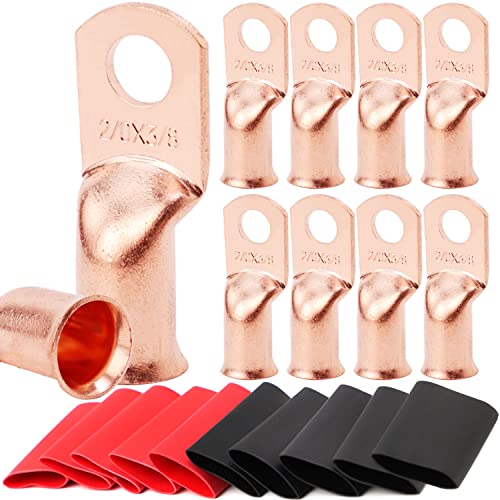
1. TKDMR 10 PCS 2/0 AWG – 3/8 Battery Cable Lugs Copper Wire Ring Terminals
Our pick — 4.5+★ from 12,500+ verified ratings; the strongest balance of quality and price.
The big-bore lug set that treats a 2/0 cable like it deserves to be there.
If you’re running 2/0 cable into a winch, a trolling motor, or a battery bank bus bar, this is the set that covers it without a second order. You get 10 lugs with a 3/8″ ring, and each one has a closed-end pad — so solder stays put during the joint instead of running out the back. The 4:1 dual-wall heat shrink included in the box is the standout extra: that ratio means it shrinks down to a quarter of its starting diameter, gripping a fat barrel and a thin one with the same seal.
What wins people over on this set is the material. The lugs are 100% annealed copper, which is copper that’s been softened so the barrel compresses under a crimper instead of splitting at the shoulder. Owners describe the fit as snug and the crimp as clean, and the stories that keep coming back are welding leads and car audio runs — heavy current, vibration, and no room for a loose joint. The shrink tube carries a UL and CSA rating for up to 600V and 257°F, which is more headroom than a 12V system will ever ask for.
Here’s the honest catch: the lugs are 12″ long overall and 0.75″ tall in the case, so you’re buying a box that takes up real drawer space. Size also draws a mixed word — a few buyers found their particular gauge/stud combination tighter or looser than expected. Check your wire and your mounting hole before ordering, not after. The crowd clearly approves overall, with the set holding 4.5+ stars from a deep well of buyers.
What holds up under the crimper
- 100% annealed copper barrels that compress instead of cracking at the shoulder
- 4:1 adhesive-lined shrink grips thin and thick barrels alike
- Closed-end pad stops solder leaking during a soldered joint
- Rated to 600V and 257°F, plenty for any 12V battery run
Where it asks you to check first
- Only one gauge in the pack — 2/0 AWG, nothing smaller
- Size fit lands as a mixed experience across buyers
- Audio wire may not be a direct fit, per the maker’s own note
Best match: anyone running 2/0 cable who wants the shrink and the lug in one box.
Look elsewhere: if you need several gauges in the same kit.
2. 132PCS 4 6 8 10 Gauge Copper Lugs, Battery Cable Lugs, Wire Connectors
Nine connector types, one box, and a gauge range that covers most small-battery jobs.
Count the two kits side by side and the gap is wide: this HOUSUN set carries 132 pieces against the TKDMR set’s 10 lugs plus 10 shrink pieces — roughly two and a half times the pieces. That head start matters if you’re building harnesses across 4, 6, 8, and 10 AWG wire and don’t want to reorder every time you hit a new size. The nine labeled types (SC4-6 through SC25-8) mean you can reach for a specific barrel instead of hunting.
The copper is tinned, which gives you a light corrosion-fighting surface — worth it if the wiring lives near a trailer hitch or a boat. The 66 heat-shrink tubes come pre-cut in the common sizes, so there’s no trimming during the job. Buyers do appreciate the spread of sizes and the way the connectors simply work.
Now the part you need to know going in. This is a light-gauge, light-duty assortment — 4 through 10 AWG — so it has no place on a 2/0 starter cable. Several owners describe the lugs as on the thin side, and the value read splits down the middle: some call it solid for the cost, others say it feels extremely cheap. Go in expecting a hobby-level assortment, not marine-grade hardware, and it delivers fine for distribution boxes, small solar runs, and motorcycle wiring.
The straight read: a broad small-gauge palette for the price of a couple of individual lugs, best used where light-duty is genuinely acceptable.
Set your expectations: thin-wall lugs want a gentle crimp and a supporting shrink tube, and it won’t handle higher-amperage battery feeds.
Good fit for: DIY job boxes covering 4–10 AWG in one purchase.
Not for: main battery cables or high-amperage starter runs.
3. 260Pcs Copper Wire Lugs, AWG 2 4 6 8 10 12 Gauge Wire Connectors with Heat Shrink Set
Thirteen lug types and a full shrink kit — the widest spread of anything here.
Nothing else in this list spans 2 AWG down to 12 AWG in one box. You get 13 labeled ring terminal types (SC35-10 through SC6-6) plus a 3:1 heat-shrink kit, packed in a terminal box. For someone wiring a golf cart one week and a solar panel array the next, that range is the whole value proposition. The lugs are 100% annealed electrolytic-grade copper, and the maker says they’re heat and corrosion resistant and accept either a crimp or a solder joint.
Where buyers land is on how much you get — the variety is the praised part, and the functional side holds up. But there is a real trade-off in the thickness. The recurring gripe is that these lugs are thin and can break under a hard crimp, and some buyers flag that they’re not right for higher-amperage jobs. Treat them as a size-matching assortment for light-to-moderate current, not as the lug you trust on a 2/0 starter feed.
One number worth knowing before you buy: the set is rated to 600V, so the voltage ceiling isn’t the limiter — the wall thickness is. If your project is low-current control wiring or accessory feeds across many gauges, this is a very practical one-box answer. If it’s a main battery cable, step up.
Why the range sells itself
- 13 lug types spanning 2 through 12 AWG in one purchase
- 3:1 heat shrink kit included, so the seal travels with the lugs
- 100% annealed electrolytic copper on every ring terminal
- Rated to 600V for low-current and control wiring
What to weigh before ordering
- Thin barrels and reported breakage under a hard crimp
- Buyers report it isn’t suited to higher-amperage applications
- Quality read splits — some find the finish inconsistent
Pick it when: you need many gauges once and you’re working at low-to-moderate current.
Think twice if: the job is a main battery feed that wants thick-wall copper.
4. Glarks 105Pcs 12 Type Heavy Duty Wire Lugs Battery Cable Tinned Copper Eyelets

A sorted plastic box of tinned copper that keeps your bench from turning into a scavenger hunt.
Twelve lug types, 105 pieces, sorted by size in a plastic box — that organization is the point. The lugs are 100% annealed electrolytic-grade copper with a tinned surface for corrosion protection, and the closed design seals out moisture. The high-standard flared opening makes it easy to push stripped wire in, and the marine-grade SC terminals carry a UL approval that complies with relevant European standards.
Bare copper vs. this: the Glarks set’s tinned finish is the difference that matters in damp or salt-air conditions. It’s rated to 257°F and takes either a crimp or a solder joint. The stud size is 5/16″, so check your bus bar bolt or battery post before you commit.
The honest limit is that this is a specialized kit — SC-series terminals in a fixed 5/16″ stud, not a big-bore 2/0 solution. Within that lane it’s a solid, well-made buy, and buyers consistently call it well-made and good value with a useful variety of lug and stud sizes. If your wiring lives in the 5/16″ world, it’s a clean pick; if you need a 3/8″ ring or a heavy cable, look up the list.
What it solves: a bench full of loose lugs becomes twelve labeled compartments, and the tinned copper resists corrosion where bare would not.
The limit: 5/16″ stud only — no 3/8″ ring in the box.
Fits best: the tinkerer who wants matched tinned terminals at a 5/16″ stud.
Step up if: you need a bigger ring or a heavier gauge than SC-series covers.
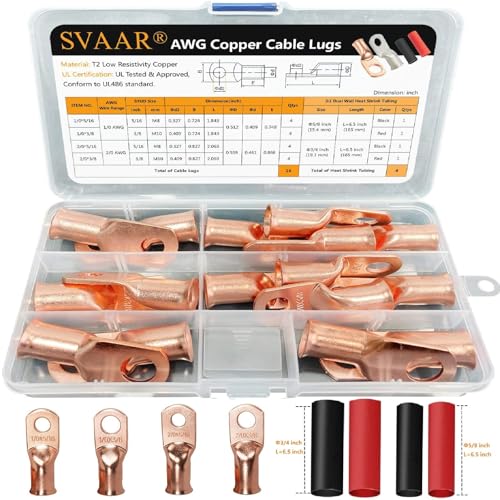
5. SVAAR 20pcs Battery Cable Ends Kit 1/0 AWG 2/0 AWG Copper Lugs with 3/8″ and 5/16″ Stud
Two gauges, two stud sizes, and a copper grade that’s borderline obsessive.
The count is the story here: 20 pieces from SVAAR against 10 from the SELTERM set further down — double the lugs for the same job category. Each of those lugs is T2 low-resistivity purple copper rated at 99.9% purity, which is a spec you rarely see stated on a lug listing. Lower resistivity means less wasted heat at the joint when you’re pulling serious amps through an inverter feed.
You get four size combinations: 1/0 AWG in both 3/8″ and 5/16″, and 2/0 AWG in both sizes. The closed-end design meets the UL486 standard, and the flared opening guides wire in easily. Each pad is stamped with its size so you can tell them apart at a glance in a low-light engine bay. The 3:1 dual-wall adhesive shrink tubing comes uncut in a long tube, which means you cut the length you want instead of accepting a pre-cut piece.
The one thing buyers flag is fit — sizes land differently for different buyers, so measure your stud and your cable before ordering. Otherwise the pattern is clear: these are made for solar installs, inverters, and golf cart battery leads, and the connectivity holds up. If you’re building a battery bank that feeds an inverter, the two-gauge, two-stud coverage is what you want.
Where it earns the bench time
- 99.9% purple copper with T2 low resistivity for cooler high-current joints
- 4 size combinations across 1/0 and 2/0 AWG in both 3/8″ and 5/16″
- UL486 closed-end design keeps moisture out of the barrel
- Uncut 3:1 shrink lets you cut to the length the job needs
What to double-check
- The 12V DC rating is modest, so confirm it fits your system’s voltage expectation
- Fit varies buyer to buyer — measure before ordering
Reach for it if: you’re wiring 1/0 or 2/0 cable into an inverter, solar bank, or cart and want both stud sizes covered.
Skip if: your project is small-gauge accessory wiring.
6. haisstronica 60PCS Battery Cable Lug Kit AWG 8/6/4 4 Sizes

Bare copper for the 8/6/4 gauge corridor, sorted so you don’t dig for it.
Sixty bare copper lugs across 8, 6, and 4 AWG, with flared openings that guide stripped cable into the barrel. The sizes sit separated in an organized case with clear labels — a small thing that saves real time when you’re mid-install and need the 6 AWG right now.
Here’s the honest gap in the box: insulation is not included. The maker expects you to add correctly sized heat shrink or another covering separately. That’s fine if you already keep shrink on the shelf, less convenient if this is your first wiring job. The lugs are UL specification met and accept either a crimp or a solder joint; you’ll want crimp pliers sized for the gauge, and owners mention these working well with large crimp pliers.
Quality is the thing that carries this kit — the barrels are built for heavy-gauge wire, and the tooling compatibility holds up. A few buyers find the value read mixed and the thickness debatable, so if you’re chasing the heaviest wall you can get, weigh the twidec or SELTERM options. For a compact 8/6/4 kit that lives in a labeled case, this one is tidy and predictable.
Best use case: a small, labeled, bare-copper kit that keeps 8/6/4 gauge jobs moving without a scramble.
Know before buying: no heat shrink in the box — add your own.
Made for: the bench that already stocks shrink and wants matched 8/6/4 copper.
Less ideal for: a first-timer expecting a complete sealed kit out of the case.
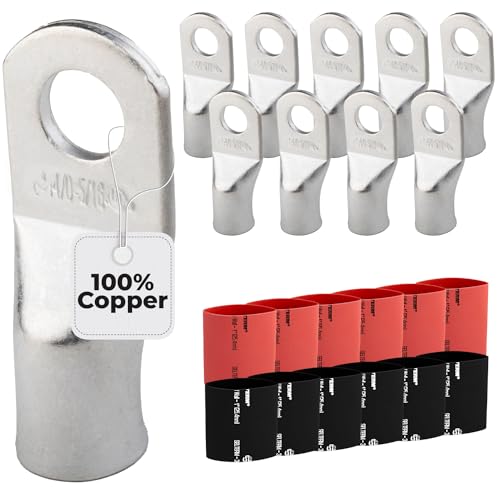
7. SELTERM 10pcs 4/0 AWG 5/16″ Stud Marine Grade Tinned Copper Battery Lugs
The 4/0 lug built for salt air, with a matte tin coating that solders as easily as it crimps.
When the boat’s in saltwater, corrosion is the enemy. This SELTERM set attacks it directly: the lugs are tinned copper with a matte tin plating, and the maker states they’re salt spray tested to the ASTMB117 standard. They’re approved by OEMs and designed to fit 5/16″ ring terminal studs. Ten lugs, plus 12 pieces of 3:1 black and red adhesive-lined heat shrink to seal the joint.
Compare it to the SVAAR set above and the trade is clear: SVAAR gives you 20 pieces across four size combinations, SELTERM gives you 10 pieces in one 4/0 gauge — but with a marine-grade tin coating and a documented salt spray test. If you’re on freshwater or dry land, the extra protection is nice-to-have. If you’re on saltwater, it’s the reason to choose this one.
The lugs crimp cleanly and the shrink is described as top of the line, with buyers calling the finished job professional. Size is the mixed note — some find the fit right, others say it’s off — so measure your stud and cable. It’s rated to 600V DC, which gives plenty of headroom for a 12V marine bank.
Why the marine spec matters
- Tinned copper with matte tin plating resists salt-air corrosion
- Salt spray tested to ASTMB117 — a real, stated standard
- 12 pieces of 3:1 adhesive-lined shrink in black and red
- Crimps and solders equally well for a professional finish
The trade-offs
- One gauge only: 4/0 AWG, 5/16″ stud
- Half the piece count of the SVAAR set for a similar job
- Size fit lands mixed — confirm before ordering
Choose it for: saltwater marine wiring where corrosion protection is the deciding spec.
Pass if: you need multiple gauges or the highest piece count.
8. haisstronica 220PCS Battery Cable Lug & Heat Shrink Kit AWG 8/6/4/2/1

One box that covers 8 down to 1 AWG and hands you the shrink to finish every joint.
An even split — 110 bare copper lugs and 110 matched 3:1 heat shrink tubes for 8, 6, 4, 2, and 1 AWG cable. That balance is the design decision that matters: you’re never hunting for a shrink piece that fits the lug you just crimped, because they’re paired by size from the factory. The barrels are thick with flared openings, and the maker expects you to match both the cable gauge and the mounting-hole diameter before crimping.
The case keeps everything separated by size and is portable enough to carry to the vehicle instead of hauling the vehicle to the bench. It’s rated to 600V and meets UL specification. Buyers describe the kit as good quality with a functional spread of sizes — several different gauges included, all usable.
The one honest caveat: durability reads mixed. Some find the ends solid; others say the set isn’t quite heavy duty. That’s a kit-wide impression across 220 pieces, so treat the lugs as solid mid-tier for automotive, marine, and inverter projects — not the last set you’ll ever buy, but the one that gets the job done with shrink in hand.
The value: 110 lugs paired with 110 shrink tubes across five gauges means a complete, sealed connection every time, with no reordering.
The caveat: durability impressions split — the walls are good, not the heaviest here.
Great for: someone building a full high-current harness who wants lugs and shrink paired for every gauge.
Consider another if: you’re after a single heavy-bore lug rather than a wide kit.
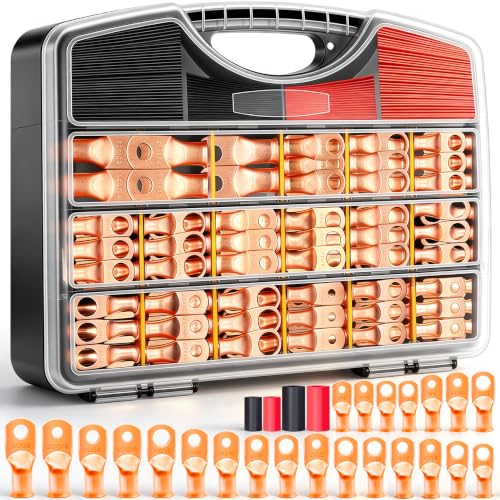
9. Twidec 260PCS Battery Cable Ends AWG 8 6 4 2 1 1/0 2/0 & Heat Shrink Tube
Seven gauge sizes in a handheld box, from 8 AWG all the way up to 2/0.
This is the widest gauge range on the list — 8, 6, 4, 2, 1, 1/0, and 2/0 AWG all packed in one case. That means one purchase can handle a car audio run, a winch lead, and a solar feed without a second order. The lugs are heavy-duty pure copper, with a closed-end pad design and a flared opening for easy insertion. Sizes are printed right on the terminals so you can identify them without squinting.
The heat shrink is a two-size kit with flame retardancy and good electrical insulation, enough to seal the joints. The portable tool box keeps everything separated and is easy to carry. Buyers use these for car audio installs and report the assortment covers what they need — the complete size range is exactly the selling point.
The catch is thin material on some of the smaller gauge lugs, which shows up as a recurring gripe and makes the build feel less substantial than the price implies. The size options also draw mixed reactions, with some finding them on the small side. For a full-range kit that stays organized, it’s a sensible buy; for a job that needs the heaviest wall in the box, look at the SELTERM or TKDMR picks.
Why it covers so much ground
- Seven gauge sizes from 8 AWG to 2/0 AWG in one case
- Sizes stamped on each pad for instant identification
- Closed-end design with flared opening for easy insertion
- Portable, separated storage means no lost pieces
What to watch
- Thin material on some smaller-gauge lugs
- Size options read mixed — some find them too small
- Build quality draws a mixed note from some buyers
Worth it for: the one-box shopper who wants every gauge from 8 to 2/0 covered.
Look higher if: you need thick-wall copper on every lug in the set.
Understanding the Specs
AWG gauge and barrel fit
AWG stands for American Wire Gauge — the standard sizing system for wire thickness. A lower number means thicker wire: 2/0 AWG is far fatter than 8 AWG. The lug’s barrel must match the gauge you’re running, or the wire won’t seat and the crimp won’t hold. Match the barrel first, then worry about how many lugs come in the pack.
Bare vs tinned copper
Bare copper is just that — untreated copper, with the best conductivity. Tinned copper adds a thin tin layer that fights corrosion at the cost of a tiny bit of conductivity. In a dry engine bay, bare copper is the right call. On marine, trailer, or outdoor runs, tinned copper is the safer choice.
Heat-shrink ratios: 2:1, 3:1, 4:1
The ratio tells you how far the tubing shrinks. A 2:1 tube halves in diameter, a 3:1 cuts it to a third, and a 4:1 grips down to a quarter. Higher ratios handle a wider range of barrel sizes, so a 4:1 tube can seal a thin wire and a fat lug with the same piece. Adhesive-lined shrink adds a glue layer that seals moisture out.
Closed-end vs open-end lugs
A closed-end lug caps the back of the barrel, keeping moisture out and stopping solder from leaking during a soldered joint. An open-end lug lets you inspect the wire seating and is easier to clean after crimping. Most heavy-current battery work favors the closed end for moisture protection.
FAQ
Will a 2/0 AWG lug fit 4 AWG wire?
Should I crimp or solder battery cable lugs?
What is the difference between bare and tinned copper lugs?
How do I know what stud size my lug needs?
What does a 4:1 heat shrink ratio mean?
Can these lugs handle high amperage battery current?
Why do some lugs come with heat shrink already included?
What does UL approved mean on a battery lug?
How many lugs do I need for a single battery install?
Can I use these lugs on aluminum wire?
Final Thoughts: The Verdict
For most people wiring a heavy 12V cable, the battery cable lugs winner is the TKDMR 10 PCS 2/0 AWG — 100% annealed copper, a closed-end pad that stops solder leaks, and 4:1 adhesive shrink in the box, all at 4.5+ stars from a deep pool of buyers. If you need a wide range of small gauges in one purchase, the HOUSUN 132PCS set gives you nine connector types from 4 to 10 AWG. And for saltwater marine work, the SELTERM 4/0 AWG earns its place with tinned copper and a stated salt spray test. Wh
How We Picked
We do not accept paid placement. Every pick is matched to a real buyer and a real use-case; we do not hands-on test units.
Sources & Methodology
Specifications: manufacturer listings and product documentation. Review insights: verified customer reviews, as of November 2026. Pricing: not shown on this page (it changes often); check the current price via the retailer link.
As an Amazon Associate, Gadgets Feed earns from qualifying purchases. This does not affect which products we feature.