
Our readers keep the lights on and my morning glass full of iced black tea. As an Amazon Associate, I earn from qualifying purchases.
Specs are compiled from manufacturer listings and verified buyer reviews and can change over time — please confirm the key details on the product page before buying.
An 18650 battery charger is a small but critical piece of gear — it is the difference between a flashlight, vape, or power bank that fires up every time and one that leaves you hunting for a wall outlet with a dead cell in hand. The best options treat each battery individually, show you the exact voltage and charge level, and adjust the current to match the chemistry, all while keeping safety protections like overcharge and reverse-polarity detection in place.
I’m Min — the founder and writer behind Gadgets Feed. This guide is built by comparing the manufacturers’ published specifications and the patterns across verified customer reviews, so you get each pick’s real strengths and trade-offs instead of marketing spin.
if you need a simple dual-bay unit for a few spare cells or a four-slot analyzer that can test and refresh your entire stash, the right battery charger for 18650 rechargeable batteries keeps your gear running without the guesswork.
Our Picks at a Glance


How To Choose The Best Battery Charger For 18650 Rechargeable Batteries
Not all 18650 chargers are the same. Some charge one battery at a time in a shared slot, while others let you mix sizes and chemistries independently. The differences matter when you rely on batteries for flashlights, e-bikes, power tools, or vapes.
Number of Bays vs Independent Slots
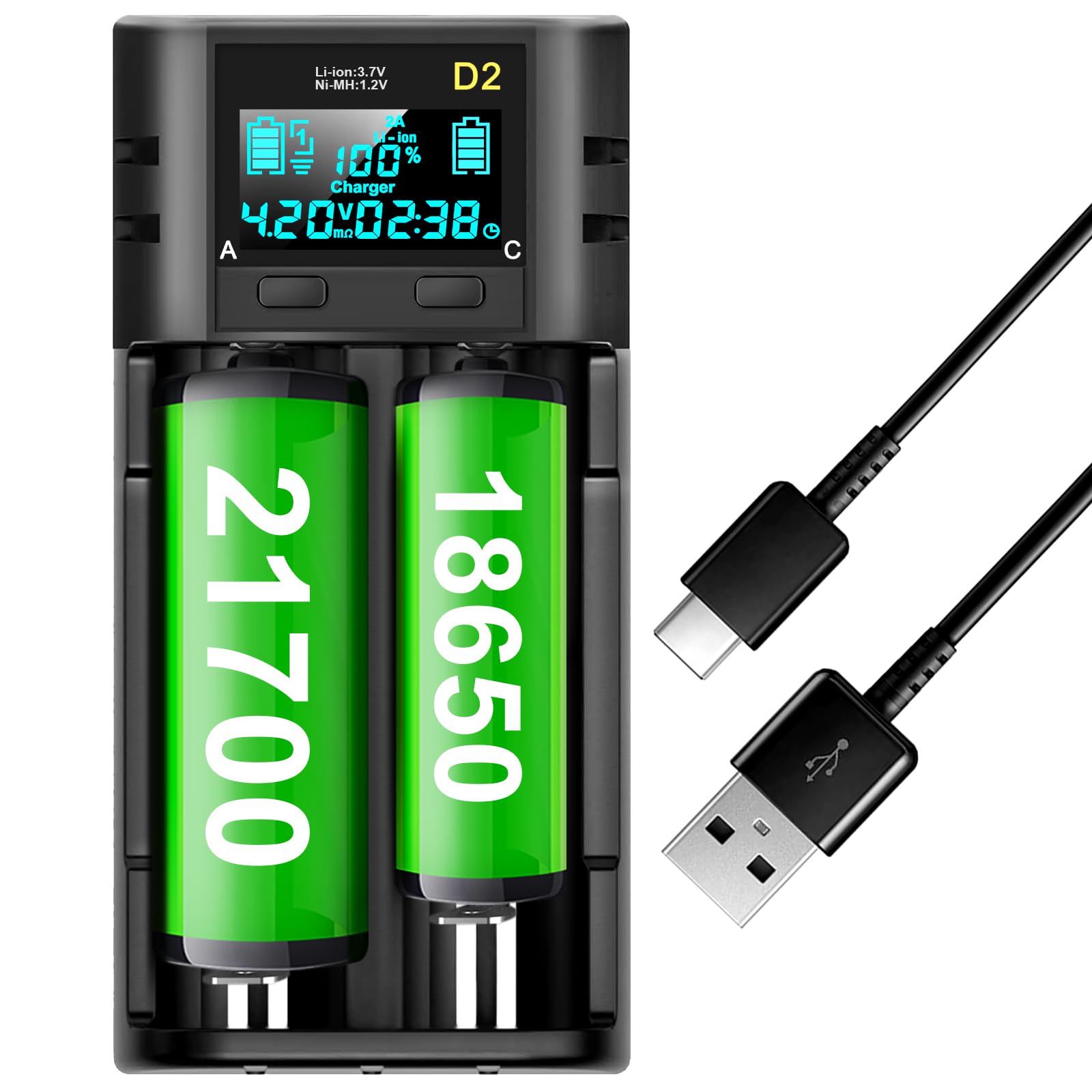
A 4-bay charger does not necessarily charge four batteries independently. Look for independent slots that treat each cell separately. That means you can charge a 21700 and an 18650 side by side, each with its own charge rate and termination.
Charging Current
Charging current — measured in amps (0.5A, 1A, 2A) — determines how fast a battery fills up. A higher current like 2A charges a 3000mAh 18650 in roughly 1.5 hours. A lower current like 0.5A takes longer but causes less heat buildup, which can extend the battery’s overall lifespan.
Safety and Certifications
Lithium-ion batteries demand careful charging. Look for UL, CE, or FCC certification as a sign that the charger has passed testing for overcharge protection, short-circuit protection, reverse polarity detection, and temperature management. A charger built from flame-retardant materials adds another layer of safety.
Quick Comparison
| Model | Best For | Number of Bays | Max Charge Current | Safety Certifications | Amazon |
|---|---|---|---|---|---|
| SUNLYTOUR D4★ Best Overall | Wide battery size support | 4 | 2A | UL | Amazon |
| Swanlake 2-SlotBest Value | Adjustable charging speed | 2 | 2A | UL | Amazon |
| Dlyfull DL2Compact Pick | Compact travel charger | 2 | 2A | UL, CE, FCC | Amazon |
| Tenergy TN471U | Budget-friendly smart charger | 2 | 1A | FCC, RoHS | Amazon |
| XTAR VC4 | Reviving old/dead batteries | 4 | 1A | — | Amazon |
| WANGDAJIEDIAN EL-4 | Fast 2A 4-bay charging | 4 | 2A | — | Amazon |
| Nitecore UMS2 | Premium dual-slot speed | 2 | 3A per slot | — | Amazon |
| Fenix ARE-A4 | Premium build with AC/DC input | 4 | 0.6A | UL | Amazon |
| Opus BT-C3100 | Advanced testing and analysis | 4 | 2A | — | Amazon |
In‑Depth Reviews
1. SUNLYTOUR 4-Slot 18650 Battery Charger (D4)
Our pick — over 4.5★ from 900+ verified ratings; the strongest balance of quality and price.
The four-bay workhorse that handles batteries other chargers can’t fit.
This is the charger to grab when your collection spans 18650, 21700, 26650, and even 26700 cells — the 75mm slot length lets them all slide in without squeezing. Each of the four bays is independent, so you can charge a nearly dead 16340 next to a fresh 21700 at different rates, and the LCD screen gives you voltage, current, and time per slot.
Buyers report it delivers “fast, full charges for 18650/20700/21700 batteries after months of use.” The metal battery tabs feel solid, and the UL certification adds real confidence for lithium-ion charging. The single quirk: the display stays lit even when no batteries are inserted, which is minor but worth knowing if you keep it on a nightstand.
Fast 4-slot charging
- Four independent slots charge mixed sizes simultaneously
- Handles batteries up to 75mm long, including protected 21700s
- Solid metal battery tabs and informative LCD per slot
No LCD display
- Screen stays lit 24/7, even when idle
- Charging speed depends heavily on your USB power brick
Reach for this if: You have a mix of battery sizes and want one charger that handles all of them in independent bays at a crowd-friendly price.
Look elsewhere if: A permanently lit screen in a bedroom or office would bother you — or if you only ever charge one battery at a time.
2. Swanlake 2-Slot LCD Charger
A tiny dual-bay unit that revives low-voltage batteries other chargers reject.
The Swanlake charger lets you pick between 0.5A, 1A, and 2A charging current — while the adjustable charging speed is only for lithium batteries (NiMH charges at a fixed 0.5A), it gives you real control. Set 0.5A to nurse a deeply discharged cell back to life, or crank 2A for speed. The large LCD shows charging voltage, current, time, and battery type, all in a footprint that is about 2.3 inches wide.
One buyer puts it plainly: it “charged a yard sale dog trimmer battery to 100% in 3-4 hours.” The charger automatically detects whether a 1.2V NiMH or a 3.6V/3.7V lithium battery is inserted and adjusts accordingly. The body is PC+ABS (flame-retardant) material, and UL certification covers the safety circuit.
Best for: Anyone who wants a compact travel charger with adjustable current and the ability to resurrect low-voltage cells.
skip it if: You need more than two bays, or you prefer a unit with a built-in wall plug (this requires a separate USB power adapter).
3. Dlyfull DL2 2-Bay USB-C Charger
A slim two-bay charger with USB-C that slips into a backpack pocket.
At 1.39 inches deep and 5.5 inches tall, the Dlyfull DL2 is remarkably compact — it is about 3.5 times shallower than the Swanlake charger. The USB-C input is a modern convenience, and the independent dual slots each support 0V battery activation (it can wake up a cell that has dropped to near-zero voltage). The LCD screen shows battery level at a glance.
Buyers describe the “digital display is nice and easy to read and charges fast.” Reliability is the standout trait among owners, though charging speed feedback is mixed: some find it quick while others note it only charges up to 4.1 volts rather than a full 4.2V. The charger carries UL, CE, and FCC certifications, adding a level of safety verification.
Reach for this if: Travel is your priority — the USB-C cable and tiny footprint make it easy to toss in a bag with spare cells.
Look elsewhere if: You need 4.2V full-charge termination or expect blazing speed from a 2A-rated unit.
4. Tenergy TN471U 2-Bay Universal Charger

A veteran charger that auto-detects battery chemistry for no-fuss charging.
The Tenergy TN471U automatically identifies whether you have inserted a Li-ion, LiFePO4, IMR, NiMH, or NiCD cell and sets the appropriate charge voltage. The LCD screen cycles through charge time, voltage, and progress. With a 1A charge speed, it won’t win any races against a 2A competitor, but the trade-off is easier on battery health.
Owners consistently praise the value. The micro USB input is the most common point of complaint — one buyer’s first unit failed from cable strain. Using the included cable and handling the port gently seems to eliminate the issue. The charger is FCC and RoHS certified, backed by a one-year warranty and lifetime support from Tenergy’s California team.
Best for: First-time 18650 users who want automatic chemistry detection and a clear LCD readout without spending much.
pass on it if: You prefer a more durable USB connection (USB-C) or need faster than 1A charging.
5. XTAR VC4 4-Slot Universal Charger

A battery-revival specialist that breathes life into cells others give up on.
The VC4 is famous for resurrecting batteries that other chargers mark as defective. It displays each cell’s voltage, type, charging current, and charged capacity independently across four slots. You can choose between 500mA (slow) and 1000mA (fast) charging, and it intelligently picks between 0.1A and 1A per slot depending on battery count.
Owners mention that the XTAR VC4 “charged a 18650 battery Nitecore D4 rejected” — and that it consistently revives old overused cells to near-new performance. The single catch: it cannot accept protected 20700 or 21700 batteries (the protective PCB makes them too long). It uses a proprietary barrel connector rather than USB-C, which owners note is hard to replace if lost.
Reach for this if: You have a box of old 18650s you want to test, sort, and possibly revive before buying new ones.
Look elsewhere if: You primarily use protected 20700 or 21700 cells, or you want a USB-C connection.
6. WANGDAJIEDIAN EL-4 4-Bay USB-C Charger
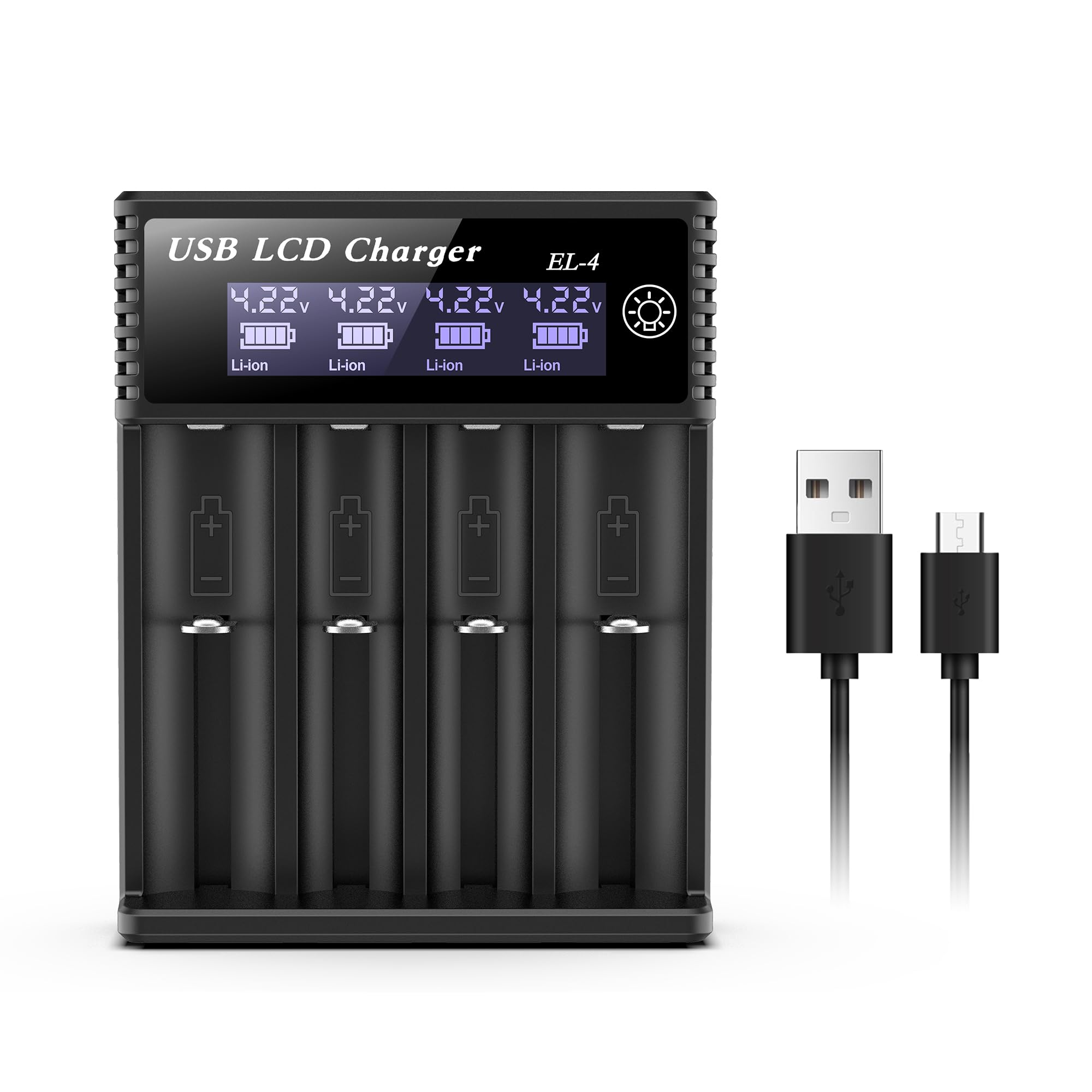
A modern four-bay charger with USB-C and a dimmable display.
This charger delivers up to 2A for lithium-ion batteries (AA/AAA NiMH cells get up to 300mA), making it one of the faster 4-bay options here. The LCD screen has a touch switch that adjusts brightness — after 30 seconds of inactivity it dims automatically, a thoughtful detail for bedside or desk use. The body is made from flame-retardant PC material.
The four bays charge independently and accept batteries from 29mm to 70mm long, covering 18650, 21700, 26650, 18350, 14500, and standard AA/AAA cells. Build quality gets consistent praise from owners. The catch: C-to-C charging with some smart USB-C chargers doesn’t work — an A-to-C cable is the reliable route.
Best for: Anyone who wants a 4-bay fast charger with a modern USB-C input and a display that doesn’t glare in a dark room.
it’s not for you if: You plan to charge exclusively via USB-C to USB-C (use an A-to-C cable instead).
7. Nitecore UMS2 Dual-Slot Quick Charger

A speed-focused dual-bay charger that uses Qualcomm Quick Charge to hit 3A per slot.
When paired with a 9V QC 2.0+ power source, the Nitecore UMS2 delivers a maximum 3000mA per slot for a single battery With a standard 5V/2A adapter, it still delivers 1000mA per slot. The LCD reports real-time battery health, charging status, and mode.
It automatically selects the right current and voltage for Li-ion, IMR, LiFePO4, NiMH, and NiCD chemistries. The bundle includes a battery organizer for travel. Build quality is a standout among owners, and the charger handles a wide range of sizes including protected 21700 cells. The USB-C connectivity receives mixed feedback — some users find it finicky about which cable and adapter combination works.
Reach for this if: You routinely charge high-capacity cells and want the fastest possible dual-bay speed with a trusted brand.
Look elsewhere if: You prefer a four-bay charger, or you want a smooth USB-C experience with any cable.
8. Fenix ARE-A4 Smart Charger

A premium four-bay unit that runs on wall power or a car DC jack.
The Fenix ARE-A4 is built for reliability over raw speed — it charges at a conservative 0.6A, which keeps batteries cool and boost long-term cycle life. It works with both AC (wall outlet) and DC (car) power, making it genuinely portable for road trips or field use. The LCD displays charging status and battery level, and the charger adjusts current automatically based on battery type and size.
Owners consistently highlight the high-quality hard plastic construction and the fact that a previous Fenix charger lasted more than 10 years. The ARE-A4 handles 18650, 21700, 26650, AA, AAA, and C cells, and comes with a LumenTac battery organizer. UL certification covers short-circuit, over-current, over-voltage, and reverse polarity protection.
Best for: Fenix flashlight users and anyone who wants a rugged, long-lived charger with dual power input and genuine UL safety certification.
look elsewhere if: Fast 2A charging is more important to you than gentle long-term battery care.
9. Opus BT-C3100 V2.2 4-Slot Analyzer

The laboratory-grade charger that tests, discharges, and refreshes your entire battery fleet.
It offers five modes: Charge, Discharge, Test (charge/discharge/charge), Quick Test, and Refresh (recondition). You can set charging current from 200mA to 2000mA per slot (1500mA and 2000mA only work on slots 1 or 4). The V2.2 revision fixes the pulse-current issue from earlier versions and adds a temperature-monitored thermal shutdown.
Customers note it “revived NiMH batteries falsely labeled defective by Duracell charger” and tested them at or above rated capacity. The internal fan keeps batteries cool (owners note it can be loud), and the included US power plug means no separate adapter is needed. The biggest limitation: it won’t accept protected 21700 batteries without a spacer adapter. The display is informative but takes some getting used to.
Reach for this if: You maintain a large battery collection and want to test true capacity, revive underperforming cells, or match batteries for multi-cell devices.
Look elsewhere if: You only need to charge batteries and have no interest in testing or analyzing them — simpler units cost much less.
Understanding the Specs
Charging Current (Amps)
Measured in amps (A), this is how fast the charger pushes electricity into a battery. A higher number like 2A fills a typical 18650 in about an hour, while 0.5A takes two to three hours but generates less heat. Many chargers let you adjust the current — use high for speed, low for battery longevity.
Independent Bays
An independent bay treats each slot as its own charger. That means you can insert an 18650 in slot 1 and a 21700 in slot 2, each charging at its own rate, without sharing power. Non-independent bays split the total charge current across all inserted batteries, slowing everything down.
Safety Certifications (UL, CE, FCC)
Third-party certification means the charger has passed testing for specific hazards. UL covers overcharge, overcurrent, short-circuit, and reverse-polarity protection. CE and FCC address electrical safety and radio-frequency interference. A charger with any of these marks has seen a testing lab, not just a product page.
Battery Size Compatibility
18650 cells are 18mm wide and 65mm long, but protected cells (with a PCB at the top) are 67-70mm long. Some chargers accept 21700 (21x70mm), 26650 (26x65mm), or shorter cells like 18350 (18x35mm). Check the maximum slot length — typically 70mm to 75mm — to ensure it fits your batteries.
FAQ
Can I charge different battery sizes at the same time?
What does 0V activation mean in an 18650 charger?
How long does it take to charge an 18650 battery?
Can I leave batteries in the charger after they are full?
What is the difference between protected and unprotected 18650 batteries for charging?
Can I charge NiMH and Li-ion batteries in the same charger?
What does “CC-CV” charging mean for 18650 batteries?
Is a higher amp (A) rating always better for my 18650 charger?
Can I use a phone charger as the power source for my 18650 charger?
How do I know if my 18650 battery needs to be replaced?
Final Thoughts: The Verdict
If you want one dependable pick, the battery charger for 18650 rechargeable batteries winner is the SUNLYTOUR D4 because it combines four independent bays, wide battery size support (75mm slots), and a clear LCD per slot at a price that undercuts competitors. If you want adjustable charging current and a tiny footprint for travel, grab the Swanlake 2-Slot. And if you need to analyze and test battery capacity rather than just charge, the Opus BT-C3100 is the one to reach for.
How We Picked
We do not accept paid placement. Every pick is matched to a real buyer and a real use-case; we do not hands-on test units.
Sources & Methodology
Specifications: manufacturer listings and product documentation. Review insights: verified customer reviews, as of July 2026. Pricing: not shown on this page (it changes often); check the current price via the retailer link.
As an Amazon Associate, Gadgets Feed earns from qualifying purchases. This does not affect which products we feature.