
Our readers keep the lights on and my morning glass full of iced black tea. As an Amazon Associate, I earn from qualifying purchases.
Specs are compiled from manufacturer listings and verified buyer reviews and can change over time — please confirm the key details on the product page before buying.
Want the short answer? The charger that actually tells you what is happening inside each cell is the one worth buying. Fancy labels mean nothing if a bay cannot tell a dead battery from a full one, and four independent channels do more for your battery stash than any single feature you will read about in the marketing copy.
I’m Min — the founder and writer behind Gadgets Feed. This guide is built by comparing the manufacturers’ published specifications and the patterns across verified customer reviews, so you get each pick’s real strengths and trade-offs instead of marketing spin.
You will see exactly how many bays each unit runs, how it stops a charge before things get warm, and which models treat every cell as an individual. If you want a charger that earns its keep in a drawer full of mixed AA and AAA cells, this guide to the battery charger for aa and aaa batteries walks you straight to the one that fits.
Our Picks at a Glance


How To Choose The Best Battery Charger For AA And AAA Batteries
You will likely use the same AA and AAA charger for years, so picking the wrong one turns into a small daily annoyance. The good news: you can settle most of the decision from a few things on the spec sheet before you buy.
Independent channels versus a shared circuit
A channel is one charging circuit, and a bay is one slot for a battery. When every bay has its own channel, each cell gets charged to its own level and a weak or mismatched battery does not drag the others down. A shared circuit charges pairs together, which means one tired cell can hold back a good one. If you routinely mix old and new cells, look for independent channels across every slot.
Cut-off method and overheating protection
A good charger knows when to stop. The negative delta-V method watches for a small voltage dip that signals a cell is full, then switches to a gentle trickle charge. Alongside it, overheat and over-current protection handle the cases where a battery is defective or simply not rechargeable. Those two safeguards are what keep a charger safe to leave running while you get on with your day.
What refresh and discharge modes add
Cells that sit in a drawer for months or live in a rarely used remote can build up a memory effect and lose usable capacity. A discharge or refresh mode drains the cell and charges it back up, which restores some of that lost performance. Refresh modes add cost, but they pay back by reviving part-used cells instead of sending them to the bin.
Input type: wall plug versus USB
A fixed AC plug (a plug built into the charger) is the simplest option, because you just push it into a wall socket. A USB input is more flexible: it can run from a laptop, a power bank (a portable battery pack), or a car charger. But many USB chargers leave the wall adapter from the start, so check what comes with it. Match this to where you will actually charge: a kitchen drawer points to a wall plug, a travel bag points to USB.
Quick Comparison
| Model | Best For | Bays | Charge Time | Input | Amazon |
|---|---|---|---|---|---|
| BT-C2400 Analyzer Tester★ Best Overall | Testing and reviving cells | 4 | — | DC power jack | Amazon |
| EBL 8-Bay Individual ChargerBest Value | Charging a big batch cheaply | 8 | 4 hours | AC power plug | Amazon |
| BEVIGOR 8 Bay with BatteriesReady to Run | First-time setup with cells included | 8 | — | Type-C cable | Amazon |
| POWEROWL 12 Bay USB | Travel and off-grid charging | 12 | — | USB | Amazon |
| Amazon Basics 8 Count Bundle | Toys and pre-charged cells | 4 | 7 hours | Type A plug | Amazon |
| Energizer Recharge Pro | Fast fills with battery included | 4 | 3 hours | US two-prong AC plug | Amazon |
| EBL 12-Bay LCD | Big drawer of mixed cells | 12 | — | Type-C | Amazon |
| Panasonic eneloop 8-Position | Keeping cells cool during charging | 8 | 5 hours | AC power plug | Amazon |
| Panasonic eneloop pro 4-Position | Reading every cell in detail | 4 | 1.5 hours | USB | Amazon |
In‑Depth Reviews
1. BT-C2400 Battery Charger Analyzer Tester
Our pick — 4.5+★ from 700+ verified ratings; the strongest balance of quality and price.
Four separate chargers living in one box, with a screen that tells you what each cell is really doing.
If you have ever wondered whether a battery is genuinely dead or just tired, this is the box that answers the question. It packs four independent channels — four bays, each running its own charging circuit — and treats every cell on its own terms, so a weak battery does not drag a healthy one down. The input voltage reads 240 volts and the current rating sits at 1400 milliamps, which is a big step above the 100 milliamps the EBL 8-Bay lists for its own output.
The backlit LCD is the headline. It digitally displays capacity, voltage, time elapsed and current for every single channel, so you can watch a cell climb from flat to full instead of guessing from a coloured light. Beyond plain charging, it runs Charge, Discharge, Refresh and Test modes, and it can even test internal resistance — the measure of how much a cell has aged internally. It accepts NiMH and NiCd chemistry up to a 20,000 mAh capacity limit, which covers far more than standard consumer cells.
What buyers rave about most is battery capacity handling, and the point of that whole feature set is a charger that actually extends the working life of your NiMH cells instead of just topping them up. It weighs 8 ounces and lives on a DC power jack rather than a built-in wall plug, so it wants a spot near an outlet. This unit takes a 240-volt input while the POWEROWL draws 5 volts from USB, so these two sit at completely different ends of the power chain. The one honest note: charging speed draws a mixed verdict, so treat it as a careful charger rather than a fast one.
What earns the top spot
- Four independent channels read and charge each cell separately
- Backlit LCD shows capacity, voltage, elapsed time and current per bay
- Charge, Discharge, Refresh and Test modes in a single unit
- Handles NiMH and NiCd cells up to 20,000 mAh
Where it asks for patience
- Charging speed is the mixed point in owner feedback
- Runs on a DC power jack, so it needs its own cable and outlet
- Four bays means a large drawer gets charged in batches
Made for: anyone who wants to know the real health of every cell they own, not just fill them up.
Not the one for: speed-first buyers who want a flat battery back in the device fast.
2. EBL AA AAA Battery Charger, 8-Bay
Eight bays that charge one to eight cells independently, powered straight from the wall.
This is the charger you hand to the family and stop thinking about. It takes 1 to 8 NiMH or NiCd cells (the two common rechargeable types) in AA and AAA, in any mix. Each bay runs independently, so one battery gets treated as fairly as a full load. The AC power plug goes straight into a socket with no adapter to lose. A full fill is listed at 4 hours, against the 7 hours the Amazon Basics bundle quotes for four AA cells, so this one leads on speed.
The smart LED does the translation for you. Red means charging, green means fully charged, and a flashing red light flags a bad battery or a non-rechargeable cell dropped in by mistake. Inside, an MCU — a small control chip — cuts the charge when it detects improper input voltage, a short circuit, or a battery that should not be there. Negative delta-V cut-off then switches to trickle charge so the cells avoid over-voltage, over-current and over-heat.
Value is what wins people over here. The fire-proof shell and constant-current charging (a steady flow of current) protect 1.2-volt cells against current fluctuation, and an eight-bay load clears the whole drawer in one session. The honest caveat: charging speed and long-term reliability both land as mixed feedback, with some buyers reporting sluggish fills and a unit that quits after several months. At this price that is a fair trade for the bay count, but buy it as a workhorse, not a lifetime heirloom.
The eight-bay math: one session clears every remote, toy and controller in the house, which is a lot of reclaimed batteries for an entry-level outlay.
The trade to accept: reliability lands mixed in owner feedback, so lean on the two-year-warranty-style brands if you want a single charger to outlast several cells.
Reach for this if: your priority is charging eight cells at once without spending much.
Look elsewhere if: you want a unit with proven long-term reliability above all else.
3. BEVIGOR Rechargeable AA and AAA Battery Charger Kit
A charger that arrives with its own batteries, so you are charging the same day it lands.
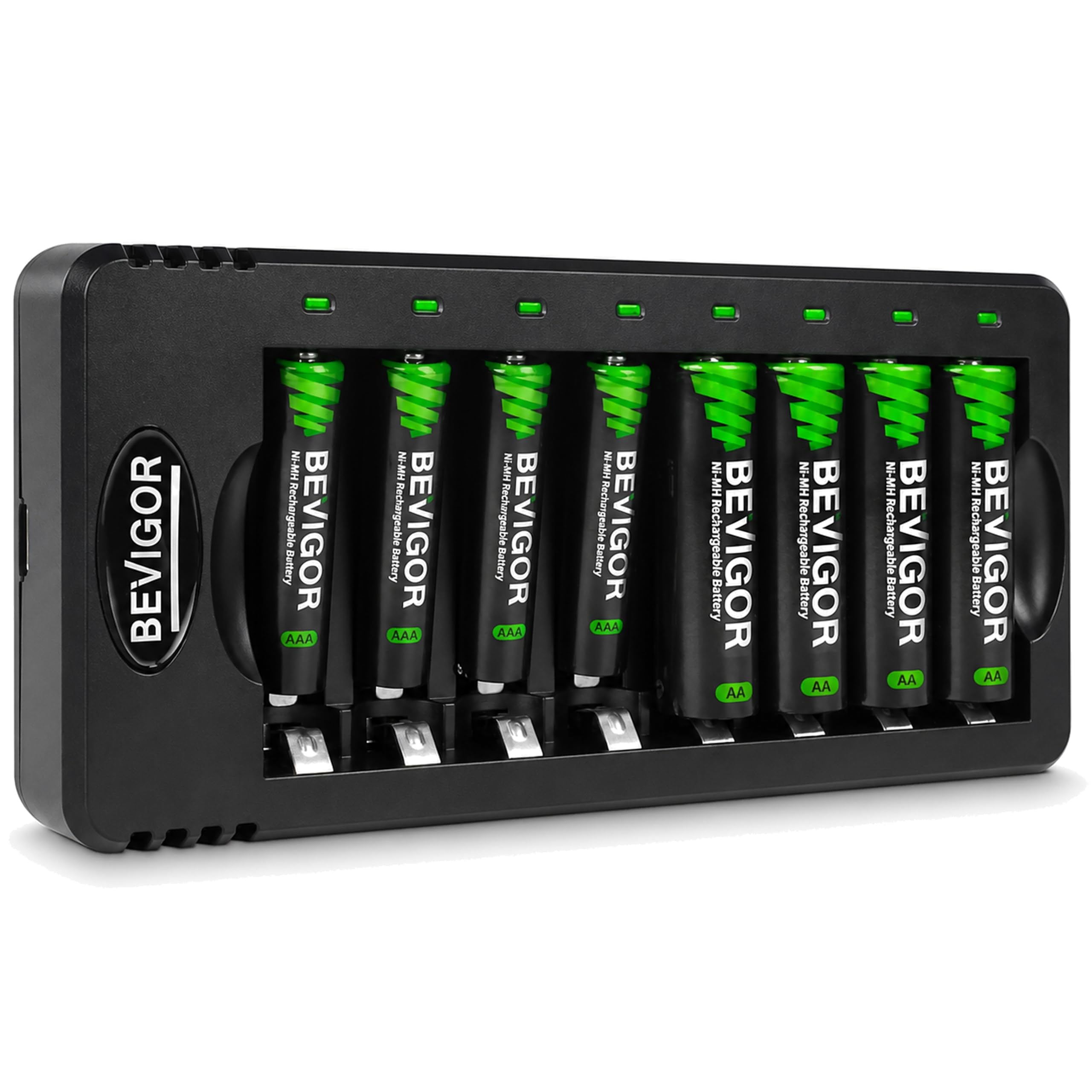
Buying a charger and buying cells are usually two separate errands. This kit folds them into one box: an 8-bay NiMH/NiCd charger, a 4-pack of AA and a 4-pack of AAA rechargeable batteries, plus a Type-C charging cable. The 8 isolated circuits mean you can fill 1 to 8 cells of mixed AA and AAA sizes at the same time, and a trickle charge mode keeps capacity topped up without overdoing it.
Safety is handled quietly in the background. Automatic power-off and thermal protection guard against overheating, and red/green LED indicators monitor the status of each bay so you can see where things stand at a glance. The kit is backed by a stated 2-year warranty. Battery quality is the part that wins buyers over — the cells themselves are the draw here, not just the box they sit in.
Two notes worth knowing before you commit. Battery life draws mixed feedback, with some owners finding the cells do not hold up as long as standard branded ones, and several note the batteries run small in size. Neither is a reason to skip the kit if you want a complete starter set, but if you already own a good stash of cells, the charger-only route makes more sense.
Ideal for: a household starting from zero that needs charger and cells in one order.
Pass on it if: you already own plenty of batteries and only need the charging hardware.
4. POWEROWL 12 Bay AA AAA Battery Charger

Twelve bays fed by USB, so a power bank becomes your charging station.
The bay count is what jumps out: 12 independent charging circuits, each with its own slot, that clear a whole household’s worth of AA and AAA NiMH or NiCd cells in a single pass. Unlike the BT-C2400’s four bays, you are not running batches — you load everything and walk away. At 7.2 inches long and 1.08 inches tall, the body stays flat enough to slide into a drawer or a bag.
The five-volt USB input is the real flexibility story. Plug it into a laptop, a power bank, or a wall adapter and it charges, which makes it the pick for travel and off-grid use. Note that the adapter is not included, so you will need your own USB power source. It meets the UL safety specification and outputs 1.2 volts, the standard figure for NiMH and NiCd cells.
Build quality and charging performance are what earn it the spot, and fast charging draws strong feedback. Buyers repeatedly name the ability to run AA and AAA at the same time as a reason they like it. One thing to watch: battery life is a mixed point, with reports of dead cells showing as charged. Test a suspect cell in a device before you trust the light.
The travel angle: a five-volt USB input means the charger runs off a power bank, a laptop or a car adapter — the adapter you need to supply yourself.
The light caveat: treat the green indicator as a guide, not a guarantee, and give a questionable cell a real test.
Suits you if: you want the highest bay count in this list and charge away from a wall socket.
Think twice if: you need a wall adapter in the box or want a display that shows exact charge levels.
5. Amazon Basics 8 Count Rechargeable NiMH Batteries with 4-Bay Charger

A no-fuss starter kit: four AA, four AAA and a four-bay charger, pre-charged on arrival.
For a first rechargeable setup, this is the least intimidating option in the list. The bundle pairs a 4-bay rapid charger with four AA 2000mAh batteries and four AAA 800mAh batteries, all pre-charged and ready to use. The charger is for NiMH cells only. The batteries are rated for up to 1000 recharges and hold 80% of their capacity for up to 12 months unused, so they suit toys that sit on a shelf between play sessions.
Charging is simple to plan around: two AA cells fill in 3.5 hours, four AA in 7 hours, two AAA in 2 hours, and four AAA in 4 hours. The LED tells you the state with a slow blink for charging, a solid white for full, and a fast blink for a defective or alkaline battery. That last signal is genuinely useful when a child drops a disposable cell into the charger by accident.
Versatility is what the bundle is liked for, and toys are the natural home for it. The honest caveat is that battery quality, charging speed and function all land as mixed feedback — some cells drain quickly and some do not fit certain devices. As a low-cost entry into rechargeables it does the job, and the 12-month low self-discharge means the cells will still be useful when you pick them up next.
Best first step for: a household moving off disposables and wanting a complete kit out of one box.
Skip if: you need to charge more than four cells at once or want faster than 7 hours for a four-AA load.
6. Energizer Recharge Pro Charger with 4 NiMH AA Batteries
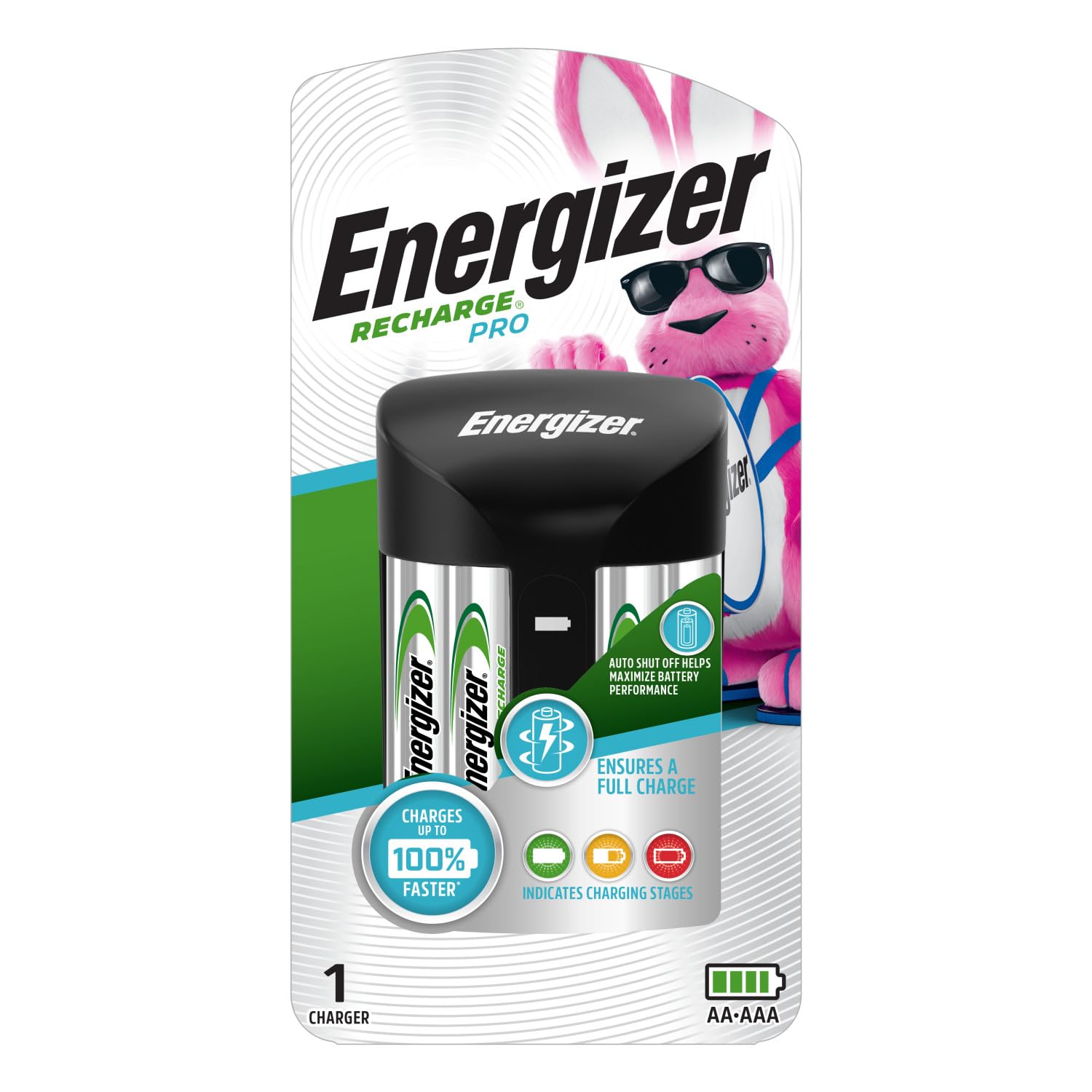
Three hours from flat to full, with an audible beep so you know it is done.
When speed matters, this is the pick. It charges two or four AA or AAA NiMH cells in just 3 hours, and the maker claims it is up to 100% faster than the Energizer Recharge Basic charger. The kit ships with four NiMH AA batteries, so it works from the start. For a household where batteries cycle rapidly, a three-hour fill is a genuine difference against the Amazon Basics 7 hours for four AA cells.
The feedback layer is what makes it pleasant to live with. Red, yellow and green indicator lights track progress along the way, and audible beeps mark the start and end of a charge so you know without watching. If it detects a bad battery, a red X lights up with repeated beeps. Auto shutoff and overcharge protection guard every fill, and the current rating sits at 500 milliamps on a 240-volt input.
The trade is bay count: four slots means a large drawer takes several rounds, and the beeping will not suit everyone in a quiet room. It sits squarely in the mid-range and earns its keep on speed and the included batteries. For anyone tired of watching a charger all afternoon, the beep-and-done routine is the whole appeal.
Why speed hunters pick it
- 3-hour charge for two or four AA or AAA cells
- Four NiMH AA batteries included in the box
- Bad battery detector with a red X and audible alert
- Auto shutoff and overcharge protection
What you give up
- Only four bays, so a big load takes multiple rounds
- Audible beeps with no mute option are intrusive in a quiet room
- No display beyond the three-colour light system
Your pick if: a fast turnaround and an audio cue matter more than bay count.
Consider the alternative if: you charge more than four cells at a time or need silence.
7. EBL 12-Bay Independent LCD Charger
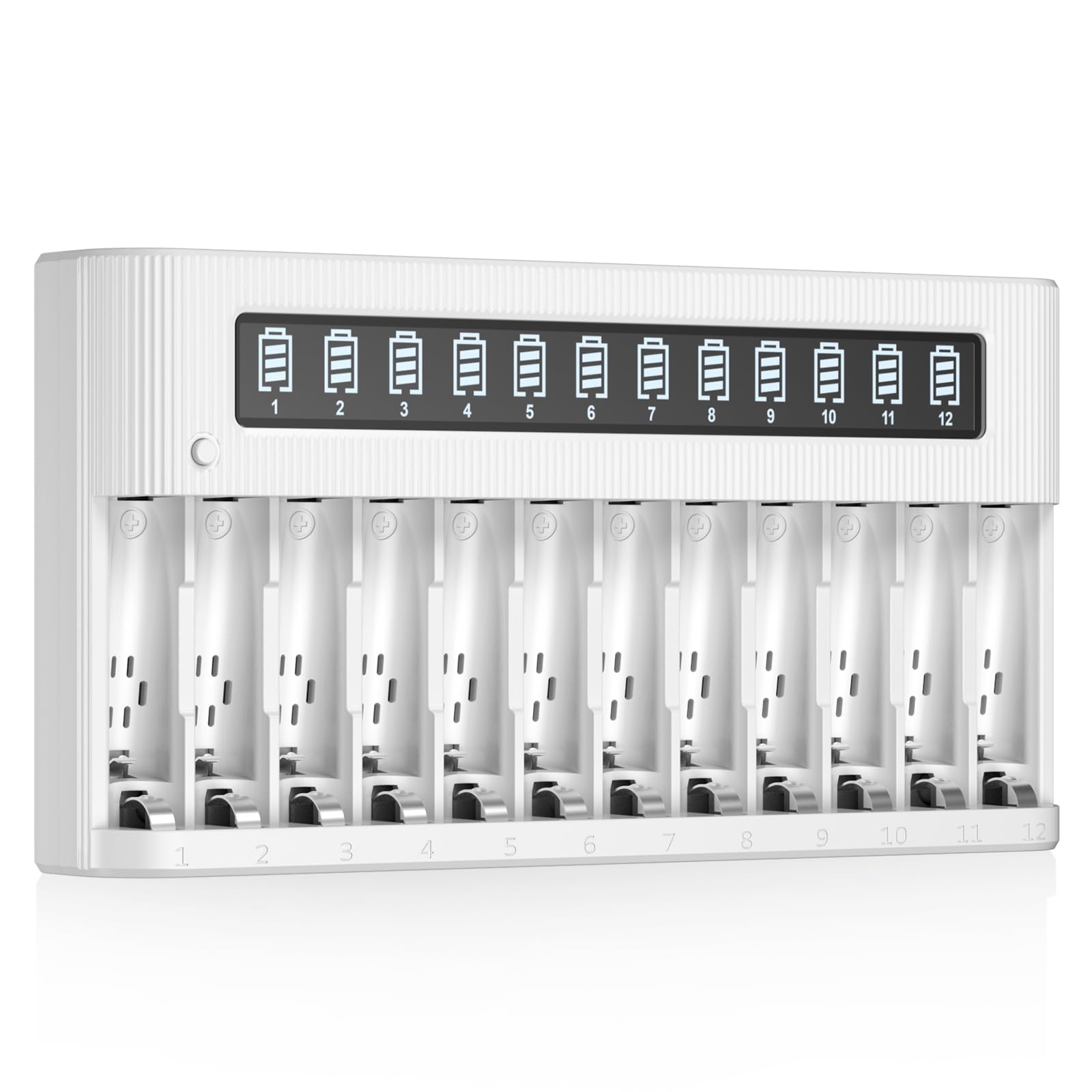
A twelve-bay bench with a screen — built for a drawer full of mixed cells.
Twelve independent slots handle 1 to 12 AA or AAA NiMH/NiCd batteries at once, which is the most generous capacity in this list at a mid-range price. The Type-C input keeps it flexible: it runs from an adapter, a laptop, a car charger or a power bank. A big, clear LCD shows real-time status during charge or discharge, so you can read where every cell stands. There is a protective film on the screen that you peel off before first use.
The discharge function is the one feature worth understanding. Press the button and the charger drains a cell to wipe out the memory effect, then charges it back up to restore usable capacity. That is the part that matters if your batteries have spent months in a seldom-used device. MCU control and negative delta-V cut-off add over-heat, over-current, short-circuit and defective-battery protection, and the unit meets the UL safety specification.
Quality and value are what earn this pick its place — 12 bays with a display and a refresh mode is a lot of capability at this level. The honest notes are real: the discharge cycle is slow by nature, some buyers report a low charging rate and a few note the unit stopping after several uses. Loading and removing cells from twelve tight bays also takes a bit of care. Buy it for the capacity, not for speed.
The capacity play: twelve independent bays with an LCD readout and a memory-clearing discharge mode, all running off a Type-C port.
The real trade: charging speed and reliability both draw mixed feedback, so treat this as a patient workbench rather than a fast one.
Built for: households with a deep drawer of cells that want one session to clear everything.
skip it if: you charge only a few cells a week or want a proven-fast fill.
8. Panasonic eneloop 8-Position Quick Charger
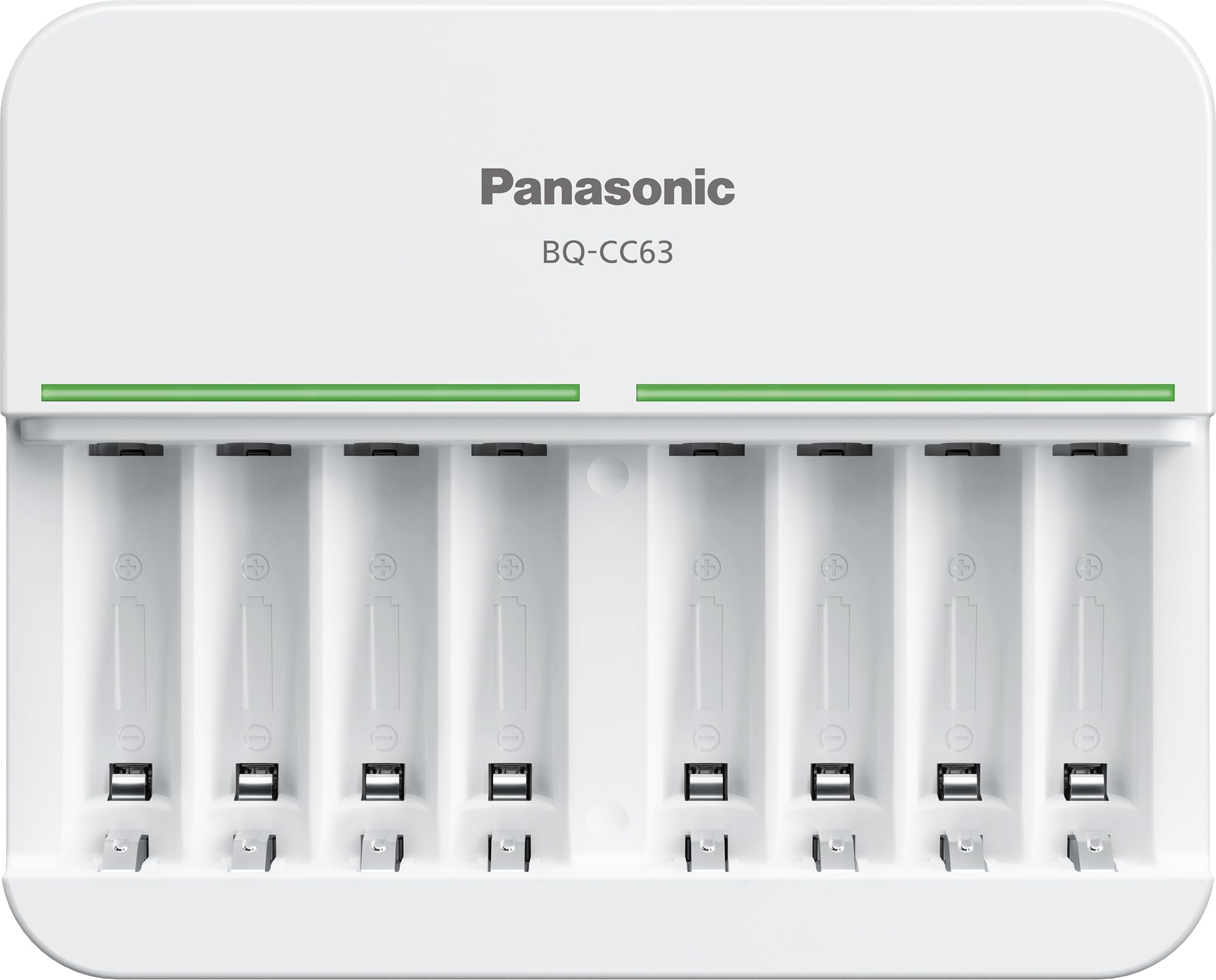
Eight slots that treat each cell to its own charge and keep the heat down while they do it.
This charger is built for people who care about how their cells are treated, not just how fast they fill. It individually charges each of up to 8 AA or AAA eneloop batteries, with a listed 5 hours for a full AA charge and 3 hours for AAA. The Smart Charge technology detects each battery’s voltage and stops at peak capacity, which is the design choice that protects long-term battery health rather than pushing a fast fill at the expense of the cell.
Eight separate LED lights, one per battery, show the status of each cell so you are never guessing which slot is done. Temperature control is the quiet strength — the charger keeps cells cool during use, and that is the part owners notice over months of use. It works with eneloop and eneloop pro cells, and the review pages confirm it plays nicely with Amazon Basics rechargeables too. A 6-foot AC power cord is included, which gives you room to place it on a shelf or bench. Batteries are not included.
The honest catch is the display: the LEDs show charging or full, but there is no percentage readout, so you cannot tell a cell that is 30% full from one that is 80% along. Value also lands as a mixed point given the premium build. If you want exact figures on a screen, the BT-C2400 or the CC65 gives you that instead.
Best fit for: eneloop owners who want individual charging and cool running above a detailed screen.
Look elsewhere if: you need to see exact charge percentages or a refresh mode.
9. Panasonic eneloop pro 4-Position Charger with LCD

Four bays, four LCD panels, and a USB port that charges your phone on the side.
At the top of the range, this charger goes further than any other in this list — its four individual LCD panels highlight charge and discharge time, cell voltage and mAh discharge levels for each battery. That is a full readout per cell, not a colour light, so you know exactly what every battery is doing. The battery detection technology analyses each cell when installed and ends that station’s charge when it is full, which is the smart way to protect eneloop pro cells.
Speed is genuinely quick for a four-bay charger. Four fully discharged eneloop pro AA or AAA cells fill in up to 4 hours, or 2 cells in 2 hours. Four standard eneloop AA or AAA cells take up to 3 hours, or 2 in 1.5 hours. There is also an extra USB port, a 5V 1A output (5 volts at 1 amp) that doubles the charger as a phone or accessory charger. The display is clear enough to read at a glance, and it weighs 225 grams with a USB connector for input power.
The refresh function is the draw for long-term owners. It runs several full charge-and-drain cycles to bring tired cells back toward usable capacity. It suits anyone who wants per-cell data on every battery, not just a full/empty light.
Why it earns the premium tag
- Four LCD panels read charge time, voltage and mAh per cell
- Fast fills: 2 AA or AAA in 1.5 hours for standard eneloop
- Extra 5V 1A USB port doubles as a device charger
- Refresh cycles restore tired cells
The limits to know
- Only four bays, so a big stash takes multiple rounds
- Value draws mixed feedback at the premium end
- Batteries are not included in the box
The one to grab if: you want per-cell data from an LCD panel and a bonus USB port on the same box.
Not worth it if: four bays is too few for your battery collection or you only need a full/empty light.
Understanding the Specs
Milliamps (mA) and Amps (A)
Milliamps measure current — how much charge flows into a cell per hour. A higher amperage figure means the charger pushes harder, which can fill a battery faster but runs the risk of heat. A lower figure is slower but gentler on the cell. The BT-C2400 lists 1400 milliamps against the EBL 8-Bay’s 100 milliamps, so it is worth knowing which pace you actually want from a charger.
Negative delta-V cut-off
This is the method a smart charger uses to detect a full cell. As a NiMH battery reaches full charge, its voltage dips very slightly. The charger watches for that dip, then switches to a small trickle charge to keep the cell topped without cooking it. Chargers without this can overcharge a cell and shorten its usable life.
Trickle charge versus full charge
A full charge is the main event — the fast flow that fills a flat battery. A trickle charge is the gentle top-up that follows, keeping the battery at capacity without pushing more energy than it needs. Both the EBL 8-Bay and the BEVIGOR use trickle charge to protect cells after the main fill is done.
mAh (milliamp-hours) explained
mAh is the capacity measure — the size of the tank. A 2000mAh AA holds more than an 800mAh AAA, which is why a charger needs to handle a range of capacities. The BT-C2400 is rated up to a 20,000 mAh limit, while the Amazon Basics pack lists 2000mAh for its AA cells and 800mAh for its AAA cells.
Voltage: input and output
Input voltage is what the charger draws from the socket or USB source — the POWEROWL takes 5 volts from USB, while the BT-C2400 and Energizer take 240 volts. Output voltage is what reaches the cell, and 1.2 volts is the standard figure for NiMH and NiCd cells. A charger that matches these figures to your batteries protects them, which is why checking both matters.
Bays, channels and slots
These three words get used loosely. A bay or slot is a physical place for a battery. A channel is the charging circuit for that slot. When a product lists independent channels, every slot can be charged at its own pace. When pairs share a circuit, a mismatched cell can hold back its partner — the reason the EBL 12-bay and BEVIGOR kits make a point of their isolated circuits.
FAQ
Can these chargers recharge standard alkaline AA batteries?
Will an 8-bay charger charge just one battery at a time?
Can I mix AA and AAA batteries in the same charger?
How long does it take to charge four AA batteries?
Is a USB-powered charger slower than a wall-plug charger?
What does the refresh or discharge mode do on a smart charger?
Can I leave batteries in the charger once they are full?
Does the Panasonic eneloop charger work with non-eneloop batteries?
Why do some chargers have LCD screens and some only coloured lights?
Final Thoughts: The Verdict
For most readers, the battery charger for aa and aaa batteries worth owning is the BT-C2400 Analyzer Tester. Its four independent channels and per-cell LCD (a screen that shows each battery’s status) let you see and manage every cell, with discharge, refresh and resistance testing on top. If you want a huge batch cleared in one cheap pass, grab the EBL 8-Bay. For charging on the move where a wall socket is not an option, reach for the POWEROWL 12-Bay: its 12 independent USB-fed bays are the most flexible large-capacity option here.
How We Picked
We do not accept paid placement. Every pick is matched to a real buyer and a real use-case; we do not hands-on test units.
Sources & Methodology
Specifications: manufacturer listings and product documentation. Review insights: verified customer reviews, as of November 2026. Pricing: not shown on this page (it changes often); check the current price via the retailer link.
As an Amazon Associate, Gadgets Feed earns from qualifying purchases. This does not affect which products we feature.