
Our readers keep the lights on and my morning glass full of iced black tea. As an Amazon Associate, I earn from qualifying purchases.
Specs are compiled from manufacturer listings and verified buyer reviews and can change over time — please confirm the key details on the product page before buying.
Before you spend a cent on a car battery charger, get one thing straight: most of these units are maintainers, not chargers. They keep a healthy battery topped up all winter, but a 0.75-amp trickle unit will not revive a dead brick in a hurry. If your car just clicked and won’t start, only the higher-amp models here will get you going without a jump. If your car sits for weeks, an inexpensive maintainer is all you need. The roundups below break down which is which so you grab the right one first time.
I’m Min — the founder and writer behind Gadgets Feed. This guide is built by comparing the manufacturers’ published specifications and the patterns across verified customer reviews, so you get each pick’s real strengths and trade-offs instead of marketing spin.
You’ll see real amperage numbers, cord lengths, and honest quirks so you can match the charger to your battery, not the other way around. What follows is a practical look at the battery charger for car battery that earns a permanent spot on the garage shelf.
Our Picks at a Glance



How To Choose The Best Battery Charger For Car Battery
The single biggest mistake buyers make here is buying a maintainer when they needed a charger. The two jobs sound identical and are not. Read the sections below before you pick one, because the wrong choice means a car that still won’t start after a full night on the plug.
Amperage decides whether it charges or just maintains
Amperage is the rate at which power flows into your battery. Low-amp units (roughly 0.75A to 2A) are maintainers: they hold a healthy battery at full charge over months of storage. High-amp units (5A to 15A) push enough flow to actually refill a discharged battery, so a car with a drained battery can be brought back without a jump. Match the amp rating to your real problem, not to the shelf price.
Battery chemistry and voltage
Modern cars and trucks usually run 12V batteries, but classic vehicles and some small equipment use 6V, and a selectable 6V/12V unit covers both. Under that, chemistry matters just as much: flooded lead-acid, AGM (absorbed glass mat, a sealed battery type), gel, deep-cycle, and lithium (LiFePO4) all want different charging voltages. A charger that lists your battery’s exact chemistry in its compatibility list is the safe pick.
Safety features that protect your vehicle’s electronics
Reverse polarity protection stops damage if you clip the leads to the wrong terminals, and spark-proof circuitry means no arc when you make the connection. Both matter on modern cars packed with sensitive electronics. If a unit also claims it won’t damage onboard computers when left connected, that’s the feature that lets you keep it hooked up all winter without disconnecting the battery.
Practical details: cord reach, mounting, and storage
A charger you can’t reach the battery with is useless, so look at total cord length and whether it includes both alligator clamps and ring terminals. Ring terminals bolt to the battery posts permanently, letting you leave a short pigtail attached and just plug in when needed — far easier than lifting the hood and clipping on every time. If the charger mounts to a wall or workbench, even better.
Quick Comparison
| Model | Best For | Amperage | Voltage | Key Feature | Amazon |
|---|---|---|---|---|---|
| Battery Tender Junior 12V★ Best Overall | Powersport & stored car batteries | 0.75 A | 12V | 12-ft cord, 5-step float | Amazon |
| CRAFTSMAN CMXCESM259Best Value | 6V/12V multi-vehicle maintainer | 1.5 A | 6V/12V | 3-in-1 with wall mount | Amazon |
| NOCO GENIUS2Most Versatile | Compact trickle & lithium support | 2 A | 6V/12V | Force Mode from zero volts | Amazon |
| CTEK US 0.8 | Small batteries & winter storage | 0.8 A | 12V | 6-step desulfation | Amazon |
| Battery Tender 2 AMP | 6V & 12V selectable charging | 2 A | 6V/12V | 7-year warranty | Amazon |
| ECO-WORTHY 5A | Faster charging with LCD readout | 5 A | 12V | LCD display, SAE connector | Amazon |
| Schumacher SC1280 | Reviving deeply discharged batteries | 15 A | 6V/12V | 4-in-1 with 3A trickle | Amazon |
| CRAFTSMAN CMXCESM258 | Fast multi-chemistry garage charging | 12 A | 6V/12V | LiFePO4 support, 12-ft reach | Amazon |
| NOCO GENIUS5 | Dead-battery recovery & long-term upkeep | 5 A | 6V/12V | Force Mode, repair mode | Amazon |
In‑Depth Reviews
1. Battery Tender Junior 12V, 750mA Charger and Maintainer
Our pick — over 4.5★ from 49,500+ verified ratings; the strongest balance of quality and price.
The 0.75A set-and-forget maintainer that keeps stored 12V batteries topped up for months
If your car, motorcycle, or lawn tractor sits longer than it runs, this is the one to buy. It pumps out 0.75 amps — the lowest output here, which is exactly the point for a health-keeper rather than a rescue tool. That gentle flow floats your battery at a steady voltage for months without cooking it, which is why owners talk about doubling battery life and avoiding a spring replacement.
Unlike the CRAFTSMAN CMXCESM259’s 1.5 A output, this runs at half the amperage, yet its 12-foot output cord reaches across an engine bay that its bigger sibling’s clamps often can’t. The complete four-step program (initialization, bulk charge, absorption, float) does the thinking so you don’t. Two-color LED tells you charging versus full in a glance, and spark-proof circuitry means no accidental arc when you snap the alligator clips on. The fused-ring harness lets you bolt a permanent pigtail to a hard-to-reach battery and just plug in when you park.
The honest catch is that 0.75 amps is genuinely slow — this maintains a battery, it doesn’t resurrect a dead one. One owner discovered the alligator clamp loop holes are too small for fat battery terminals and had to buy larger quick-connect rings separately. That’s a fit quirk, not a defect, and the rest of the picture is what earns this the top slot — the crowd favorite at 4.8 stars across 49,000+ owners with a 5-year warranty behind it.
What it does well
- 0.75 A output that won’t cook a battery over months of storage
- 12-ft cord and ring terminal harness reach tucked-away batteries
- Spark-proof and reverse hook-up detection for safe clipping
- Won’t overcharge even when left on all winter
Set expectations here
- Low 0.75 A won’t revive a fully dead battery — it maintains only
- Original alligator clamp loop holes can be too small for large terminals
- Gets warm during long-term use (normal, but worth knowing)
Reach for this if: your vehicle sits for weeks and you want a permanent, hands-off battery babysitter that lasts years.
Look elsewhere if: you need to start a car right now — get a 5A or 15A unit instead.
2. CRAFTSMAN 1.5A Car Battery Charger & Maintainer, 6V/12V – CMXCESM259
1.5A auto-sensing 6V/12V charging with a desulfation mode, for a few dollars more than the top pick
This is the amperage upgrade for anyone who wants to actually refill a low battery, not just tread water. At 1.5 A it pumps twice the current of the Battery Tender Junior’s 0.75 A, and it auto-detects whether you’ve hooked up a 6V or 12V battery with no buttons or switches to flip. That auto-sensing is the headline feature: owners who tested it on both a 6V and a 12V battery reported both reaching full charge in about three hours.
The 3-in-1 framing is real — it charges, maintains, and reconditions via a desulfation mode that works at breaking down the sulfate buildup that slowly kills a neglected battery. Reverse polarity protection guards against a mis-clipped hookup, and it’s wall-mountable so it can live permanently on a garage bench instead of eating shelf space. The package includes both quick-connect clamps and ring connectors, so you get the permanent-pigtail option without buying the harness separately.
The one caveat worth flagging: it’s not a jump starter. It’s a 1.5A slow charger, so a completely dead car battery may still need a jump or a bigger unit first. The 6-foot power cord and 5-foot booster cables mean you’re tethered to an outlet during use, which limits where you can park. For maintenance and topping off healthy batteries, though, it’s a genuine value play.
The value angle: 1.5 A at this tier covers both 6V and 12V batteries from one auto-sensing box, with clamps and ring connectors both included — the harness alone usually costs extra elsewhere.
Where it stops: a deeply discharged car battery is beyond its reach; it reconditions and maintains, it doesn’t rescue.
Best suited to: the garage keeper who wants a single small unit to maintain several 6V and 12V batteries with zero switch-fiddling.
Think twice if: you need portable operation — it must be plugged in throughout use.
3. NOCO GENIUS2 2A 6V/12V Smart Battery Charger
The 2A smart charger with Force Mode that charges batteries other units won’t detect
If your battery has sat dead so long you’ve assumed it’s finished, this charger is built for you. It runs at 2 amps, which is more current than the CRAFTSMAN CMXCESM259, so it can push a bit more power into a stubborn battery. Its standout trick is Force Mode — a feature that bypasses the internal sensing and manually charges a battery that’s dropped below the voltage threshold most chargers can detect. That means even a battery reading near zero volts can get a charge. Pair that with temperature compensation, which adjusts each charge cycle based on ambient temperature, and you have a unit that behaves sensibly in a freezing garage or a hot one.
It handles lead-acid, flooded, gel, AGM, marine, deep-cycle, and lithium (LiFePO4) batteries in 6V and 12V — one box that covers essentially any chemistry a home garage sees. It reconditions automatically every 24 hours without overcharging, which is the behavior that makes it safe to leave connected full-time. Compact at just 1.2 pounds, it disappears on a shelf.
The genuine limitation is speed: 2 amps is a trickle rate, so a completely dead battery will charge slowly. Owners who’ve tried to revive very flat batteries note the process can crawl. For maintaining a seldom-driven car or a motorcycle in winter storage, though, the slow-and-steady approach is exactly right. The temperature compensation and Force Mode together make this tough to top for battery types most trickle chargers ignore.
The trick that earns its spot: Force Mode charges from as low as zero volts, so neglected batteries that other units refuse to acknowledge can be brought back.
Speed reality check: at 2 amps, a dead battery recharges gradually — this is a maintenance tool with recovery capabilities, not a fast charger.
Pick this if: you own one battery or several, want lithium (LiFePO4) compatibility, and need to occasionally revive something you forgot about.
Skip if: you need a car started in the next hour — go to the higher-amp picks below.
4. CTEK (56-865) US 0.8 12 Volt Fully Automatic 6 Step Battery Charger

Six charging stages and a desulphation mode for 12V batteries up to 32Ah
Owners of a classic car, a jet ski, or a garage of small equipment get the most from this one. The CTEK handles 12V lead-acid batteries with a full six-step sequence — desulphation, bulk, absorption, analyze, float, and pulse — that’s a stage deeper than the simpler maintainers here. Its patented desulphation function analyzes the battery’s state and, when possible, recovers a sulfated one that’s lost power and lifespan to disuse.
What separates it in daily use is the “connect and forget” design: you clip it on, plug it in, and leave it. It protects sensitive vehicle electronics when left connected, so there’s no need to disconnect the battery first — a real convenience for cars with computer-managed systems. It’s splash and dustproof, non-sparking, reverse polarity protected, and short-circuit proof. The package includes clamps, an eyelet connector, and a storage bag.
The honest catch is its job description. The 0.8 A output is built for charging 1.2–32Ah batteries and maintaining up to 100Ah ones — meaning a large boat or RV battery is a stretch, and the manufacturer’s own guidance flags the 32Ah bulk limit as less than ideal for those big applications. For the small battery it targets, though, the extra charging stages and desulphation put it ahead of the bare-bones trickle units.
Why owners keep it
- Six charging stages including desulphation for reviving neglected batteries
- Splash and dustproof with a 5-year warranty
- Protects onboard electronics — no need to disconnect the battery
- Includes clamps, eyelet connector, and storage bag
Know before you buy
- 0.8 A output is aimed at small batteries — a weak match for large boat or RV banks
- Alligator clip plastic can crack with rough handling
- Runs warm during use, so mount it with the included spacers
Ideal owner: the classic-car, motorcycle, or jet-ski keeper with small 12V batteries who wants deep charging stages and leave-it-connected convenience.
Not your tool if: your daily driver is a large truck or boat with a big battery bank.
5. Battery Tender 6V/12V, 2 AMP Lead Acid & Lithium Selectable Battery Charger
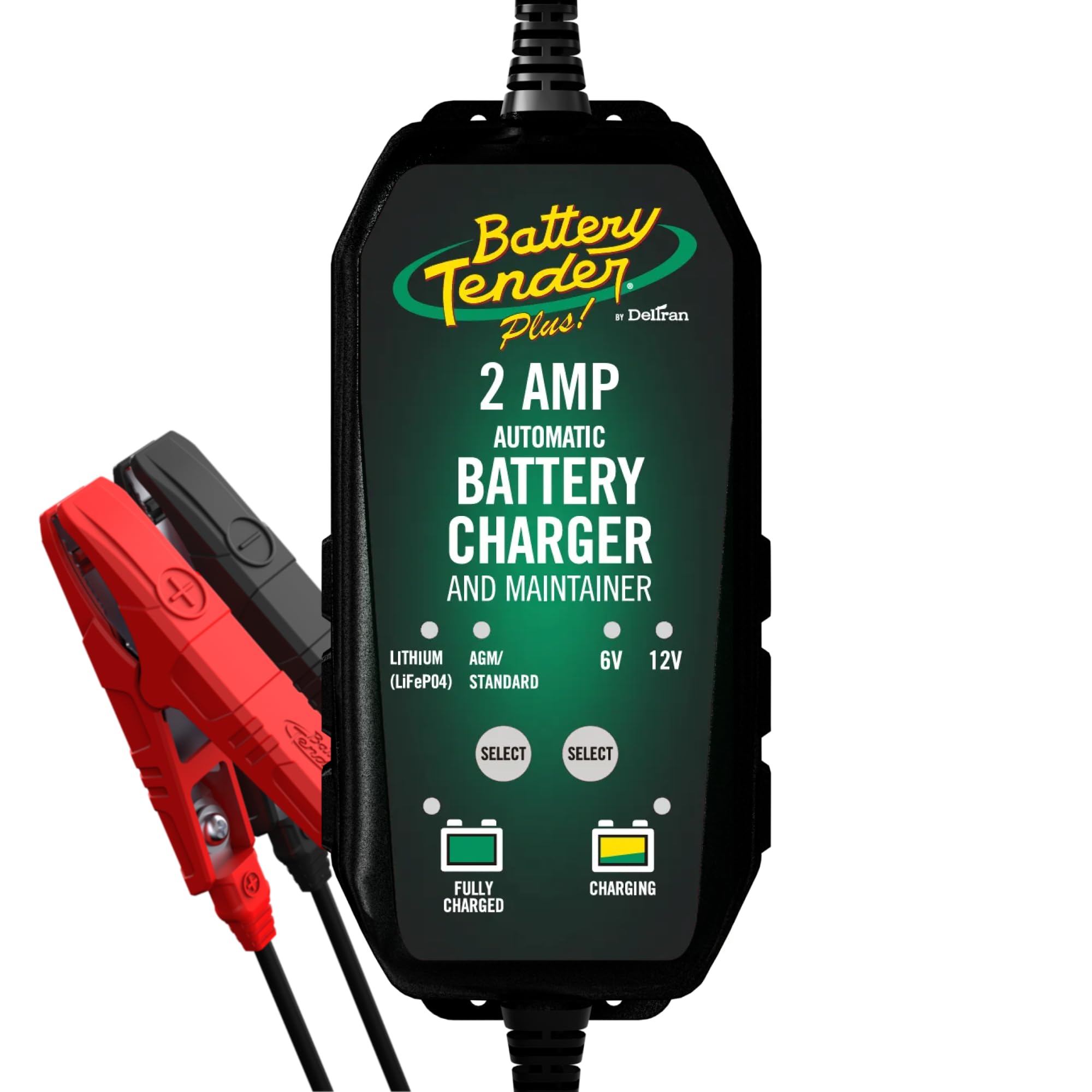
Selectable 6V/12V charging at 2A, backed by a 7-year warranty
Anyone juggling a 6V mower battery and a 12V car battery in the same garage should start here. The selectable 6V/12V setup at 2 amps means a single unit handles both voltages without swapping devices. The 4-step charging program (initialization, bulk charge, float mode) tune power without overcharging, and it’s compatible with all 12V lead-acid, flooded, AGM, and gel cell batteries.
Where it pulls ahead of the CRAFTSMAN CMXCESM259 is warranty muscle: a 7-year manufacturer’s warranty against the CRAFTSMAN’s shorter coverage, plus lifetime customer support. It’s ETL US/CSA, FCC, ICES, and BC certified, and the solid-state LED indicator reports charging state — red turning to green in seconds once a healthy battery is topped up, as buyers report on everything from mower batteries to a Honda scooter. The included ring terminal and alligator clip combo cable covers both permanent and temporary hookups.
Two things to know. It’s certified for 12V batteries, so a true 6V battery will run the correct 6V profile — but the 2A rate still means slow going on a dead battery. And it uses a polarity-reversing connector, which owners discovered is exactly what a Ford Escape’s cargo port needs; that same connector can confuse a first-timer, so read the quick-start before plugging into a car’s accessory socket.
The dual-voltage advantage: a 6V/12V toggle plus a 7-year warranty — you buy it once and it covers multiple vehicles and equipment types.
The trade-off: at 2 amps it’s still a slow maintainer, and its specialized connector needs a moment of familiarization.
Reach for this if: you own both 6V small-equipment batteries and 12V car batteries and want one trusted unit to cover all of them.
Look elsewhere if: your only goal is reviving a completely dead large battery quickly.
6. ECO-WORTHY 12V 5A Battery Charger for Lead Acid, Lithium (LiFePO4) Battery

5A charging with a live LCD readout of current, voltage, and charge rate
Buyers who want to watch the numbers, not just a colored light, get their payoff here. At 5 amps this pushes far more current than the 2A NOCO GENIUS2, enough to charge a mid-sized battery in a couple of hours rather than overnight. The LCD display reports current charge, voltage, and charging rate in real time — a genuine step up from the two-color LEDs on the cheaper maintainers, and the feature that engineers and tinkerers gravitate toward.
It handles both 12V lead-acid and 12V lithium (LiFePO4) chemistries, with fully-automated multi-stage charging that moves through bulk, absorption, and float stages to prevent overcharging. There’s a desulfation-style maintenance mode plus a “repair” prompt that flags when a battery shows low voltage, sulfation, or lost capacity. A 10A fused SAE connector means the cabling is protected against a surge, and the O-ring terminal cables let you bolt on a permanent pigtail.
The honest caveat is reliability consistency. Most owners find it dependable and well-made, but a subset report units failing early — one dying within an hour, another stopping after a couple of sessions. It also runs warm during the bulk phase, so give it ventilation. The display and amperage make it a strong pick; just keep the warranty handy and don’t bury it under a pile of rags.
Strong points
- 5A output charges noticeably faster than 2A trickle units
- LCD display shows charge, voltage, and rate in real time
- Handles both lead-acid and lithium (LiFePO4) 12V batteries
- Fused SAE connector and ring terminal cables included
Honest notes
- Occasional units arrive defective and fail within sessions
- Runs warm during bulk charging — needs airflow
- 12V only, no 6V support
Good fit for: the detail-oriented owner who wants a live voltage reading and enough amperage to charge rather than merely maintain.
Reconsider if: you need to charge a 6V battery, or you want zero reliability risk — a simpler unit may suit better.
7. Schumacher Electric 15A Car Battery Charger & Maintainer, 6V/12V – SC1280

15A rapid charging that refills a deeply discharged 6V or 12V battery overnight
When a battery is genuinely flat and a small maintainer just laughs at it, this is the unit that gets the job done. The SC1280 delivers a 15A rapid charge — roughly seven times the flow of the NOCO GENIUS2’s 2A — which is enough to fill a discharged battery overnight rather than over a week. It’s the 4-in-1 that charges, maintains, tests, and restores, with a 3A trickle mode for ongoing upkeep once the heavy lifting is done.
It’s microprocessor-controlled with auto voltage detection, so it figures out whether it’s connected to a 6V or 12V battery and adjusts without you flipping anything. It handles standard, AGM, gel, and deep-cycle chemistries, and the desulfation mode works on restoring sulfated batteries. Schumacher’s been building automotive power products since 1947, and the display cycles between charge percentage, voltage, and readings, plus there’s a start/stop button and long clamp cords. The whole unit weighs 2.7 pounds.
The trade-off owners flag most is reliability consistency. Most find it dependable and fast, but a minority report it stopping at 80% or quitting after minimal use. It’s also reported to charge at around 15.5V and taper down, continuing briefly after the “complete” indicator — so if you want a pure leave-it-plugged-in maintainer, the lower-amp picks are more predictable. For bringing a dead battery back fast, though, the 15A output is the whole point.
What makes it the reviver: a 15A rapid charge paired with a 3A trickle mode covers both the emergency and the long-term, all in one automatic box.
The trade-off: owners mention it can behave unpredictably near the end of a charge — better used as a fast charger than a permanent maintainer.
Pick this if: you’ve got a dead battery now and need serious amperage to revive it, plus a trickle mode for later.
Look elsewhere if: you want a set-and-forget storage maintainer — a lower-amp unit is steadier for that.
8. CRAFTSMAN 12A Car Battery Charger & Maintainer, 6V/12V – CMXCESM258

12A rapid charging with LiFePO4 support and 12 feet of total cord reach
For a garage that hosts everything from a gas truck to a diesel rig with a lithium battery, this is the do-it-all pick. It delivers 12A of rapid charging — close to the Schumacher SC1280’s 15A but with the added bonus of lithium (LiFePO4) support, which the Schumacher lacks. That means it covers standard, AGM, deep-cycle, and lithium batteries for both gas and diesel vehicles, all from one box.
The practical details are strong: a 6-foot power cord plus 6-foot battery cables give 12 feet of total reach — enough to hook up without contorting under the hood. It’s the 4-in-1 that charges, maintains, tests, and restores, with microprocessor control, a digital display, auto voltage detection for 6V and 12V, reverse hook-up protection, and desulfation mode. It weighs 3.4 pounds and includes both the charger and a user manual.
The honest limitation is straightforward: this is a fast charger and multi-chemistry workhorse, not a delicate electronics preserver. And like its Schumacher-built siblings, most units perform well, but a handful report early failures. For the buyer who needs to charge a wide range of batteries quickly, the amperage and lithium support justify the footprint.
Why it covers more ground: 12A charging plus LiFePO4 compatibility and 12 feet of total reach make it a one-box solution for a mixed fleet.
Worth knowing: it’s a rapid charger rather than a gentle maintainer, so for long-term storage a slower unit is kinder to a small battery.
Good fit for: the multi-vehicle household that needs one charger covering lead-acid, AGM, deep-cycle, and lithium batteries in 6V and 12V.
Not ideal if: you only own one small battery — the amperage and size are overkill for that.
9. NOCO GENIUS5 5A 6V/12V Smart Battery Charger, Trickle Charger & Maintainer

Five amps, Force Mode for totally dead batteries, and a repair mode that fights sulfation
This is the fastest NOCO in the lineup here, and the one that actually brings dead batteries back rather than just nursing healthy ones. At 5 amps it moves two and a half times the current of the NOCO GENIUS2’s 2A, which makes recovering a deeply discharged battery a matter of hours instead of days. It charges from as low as 1 volt, or uses Force Mode to manually charge a battery down to zero volts — the feature that rescues a battery other chargers won’t even acknowledge.
The repair mode is the other headline act: precision pulse charging automatically detects and reverses sulfation and acid stratification, the chemical wear that quietly kills a neglected battery. An integrated thermal sensor adjusts charging based on ambient temperature, preventing overcharging in heat and undercharging in cold. It handles 6V and 12V lead-acid (AGM, Gel, SLA, VRLA) and lithium-ion (LiFePO4) batteries, and it’s safe to leave connected indefinitely. The package includes a 72-inch AC cable and an 80-inch DC cable with battery clamps and integrated eyelet terminals, plus a mounting bracket and 3-year warranty.
Two honest notes. First, its proprietary connector fuses differ across NOCO models, and mixing up a 2A fuse with a 10A one on a different model’s cable blows the fuse — keep your leads straight. Second, the 5A rate is still moderate for very large batteries, and repair mode can run hot on a completely flat one, so ventilate. For the broad middle of car owners, though, this is the balance of speed, battery support, and revival features.
The revivalist: Force Mode from zero volts plus an automatic repair mode make it the unit that turns a “dead” battery back into a working one.
The detail that bites: identical-looking NOCO cables carry different fuse ratings — cross them and you’ll blow a fuse, so label your leads.
Reach for this if: you want one charger that both revives flat batteries and maintains healthy ones, across lead-acid and lithium in 6V and 12V.
Look elsewhere if: you only need a bare-bones storage maintainer and don’t want to pay for repair and Force features.
Understanding the Specs
Amperage, explained plainly
Amperage is the rate at which current flows into the battery, measured in amps (A). A low-amp charger (think 0.75A to 2A) is a maintainer: it holds a healthy battery at full charge over months of storage but won’t refill a dead one quickly. A high-amp charger (5A to 15A) pushes enough current to actually recharge a discharged battery, often overnight or faster. Match the amp number to your real need — maintenance or recovery.
Charging stages and float mode
Modern smart chargers run a multi-step program rather than dumping constant power. They typically move through an initialization or analysis phase, a bulk charge that delivers the main power, an absorption phase that tops off gently, and finally a float mode that holds the battery at a steady voltage indefinitely without overcharging. More stages (4 to 6) usually means gentler, more precise charging — which is safer for a battery left connected all winter.
Battery chemistry compatibility
Lead-acid comes in several flavors — flooded, AGM, and gel — plus deep-cycle versions, and each wants slightly different charging voltages. Lithium batteries (LiFePO4) are a separate category entirely and need a charger that explicitly supports them. A unit that lists your battery’s exact chemistry is the safe choice; using the wrong profile can shorten battery life over time.
Safety features worth having
Reverse polarity protection stops damage when clamps are hooked to the wrong terminal, spark-proof circuitry prevents an arc at connection, and short-circuit protection guards against internal faults. On vehicles with sensitive electronics, a charger that won’t damage onboard systems when left connected is worth prioritizing. Desulfation modes are also worth having if your batteries sit unused for long stretches.
FAQ
Will a 0.75 amp charger revive a completely dead car battery?
Can I leave a battery charger connected to my car all winter?
What is the difference between a trickle charger and a maintainer?
Will these chargers work on both 6V and 12V batteries?
Do these chargers support lithium LiFePO4 batteries?
How long does it take to charge a car battery with a 2 amp charger?
Do I need to disconnect my car battery before charging?
What size battery charger do I need for a large truck or SUV battery?
Do I need to disconnect my charger when the battery is full?
Will a smart charger work if my battery reads below 1 volt?
Final Thoughts: The Verdict
For most people, the winner is the Battery Tender Junior 12V because it’s the safest, most forget-about-it way to keep a seldom-driven battery healthy all year — 4.8 stars across tens of thousands of owners, a 5-year warranty, and a 12-foot cord that reaches where bigger units can’t. If you need to actually charge and revive a dead battery, the NOCO GENIUS5 is the pick, with its 5A output, Force Mode from zero volts, and repair mode for sulfated batteries. And if a mixed fleet of 6V and 12V batteries lives in your garage, the dual-voltage Battery Tender 2 AMP covers both from one box.
Whichever you choose, match the amperage to your actual problem — a maintainer for a battery that sits, a higher-amp charger for a battery that’s already flat — and you’ll never be stuck jump-starting in a cold parking lot again.
How We Picked
We do not accept paid placement. Every pick is matched to a real buyer and a real use-case; we do not hands-on test units.
Sources & Methodology
Specifications: manufacturer listings and product documentation. Review insights: verified customer reviews, as of September 2026. Pricing: not shown on this page (it changes often); check the current price via the retailer link.
As an Amazon Associate, Gadgets Feed earns from qualifying purchases. This does not affect which products we feature.