
Disposable alkaline batteries are a financial drain that never stops. A quality charger paired with NiMH cells transforms that recurring expense into a one-time investment, but not all chargers handle the chemistry properly — cheap models can overheat cells, miss the charge termination point, or fail to revive deeply discharged batteries.
I’m Min — the co-founder and writer behind Gadgets Feed. I’ve spent countless hours analyzing charge curves, measured slot-to-slot consistency, and cross-referenced real-world customer data to separate the chargers that quietly damage cells from those that actually extend cycle life.
Whether you need a fast top-up for high-drain controllers or a 16-bay unit for a household full of devices, this guide evaluates the best battery charger for rechargeable batteries across budget-friendly, mid-range, and premium tiers.
How To Choose The Best Battery Charger For Rechargeable Batteries
A charger is more than a power delivery device — its control logic determines whether your NiMH cells degrade after 50 cycles or survive past 1,200. Focus on three decision points to avoid buyer’s remorse.
Independent Slots vs. Series Charging
Series chargers treat a pair of batteries as a single load, meaning one fully charged cell forces the other to keep accepting current, accelerating wear. Independent-slot chargers let you mix partially drained cells, different capacities, and even AA with AAA without risking overcharge. Every product in this list uses independent bays — never settle for less.
Charge Termination Method
The safest NiMH chargers use negative delta V detection, which senses the voltage dip that signals full charge and cuts power immediately. Timed chargers and dumb trickle units lack this intelligence and will cook cells left in overnight. LCD-equipped chargers often also display per-slot voltage, giving you diagnostic insight into cell health.
Input Power and Current Rating
Older chargers rely on a wall wart, but modern units accept USB-C or Micro-USB input, letting you charge from a laptop, power bank, or car adapter. Higher charge current (600mA vs 250mA) reduces charge time dramatically — a 600mA charger tops off a 2000mAh AA in roughly 3.5 hours, while a 250mA unit takes over 8. Keep in mind that very high current (1A+) can heat cells and shorten life unless the charger has active cooling.
Quick Comparison
On smaller screens, swipe sideways to see the full table.
| Model | Category | Best For | Key Spec | Amazon |
|---|---|---|---|---|
| Panasonic BQ-CC65 | LCD Premium | Eneloop Pro / diagnostics | LCD voltage & mAh display | Amazon |
| Bonai 16-Bay | High Capacity | Households with many devices | 16 AA/AAA independent slots | Amazon |
| Tenergy TN486U | Universal | Mixed battery sizes (C, D, 9V) | 600mA charge current | Amazon |
| Eneloop Panasonic K-KJ55 | Branded Bundle | Eneloop AA + 3-hour charge | Independent LED indicators | Amazon |
| Amazon Basics 8-Bay | Value Bundle | New NiMH users / starter kit | USB-C input / 8 slots | Amazon |
| BEVIGOR 8-Bay | Budget Starter | Low-cost AA + AAA bundle | Type-C input / 1500 cycles | Amazon |
| POWEROWL 8-Bay | Entry Combo | 2800mAh high capacity cells | Micro-USB / 250mA trickle | Amazon |
In‑Depth Reviews
1. Panasonic BQ-CC65AKBBA Super Advanced eneloop pro Charger

The BQ-CC65 is the most technically complete NiMH charger on the market. Its LCD panel reports real-time slot voltage, elapsed charge time, and mAh discharge capacity during the refresh cycle — information that lets you grade individual cells and retire weak ones before they cause device issues. Each of the four bays operates completely independently, so a tired 800mAh AAA cell charges at its own pace next to a 2550mAh Eneloop Pro without interference.
Charge speed is practical: four AA Eneloop Pro cells reach full in about four hours, two hit full in two hours, and standard Eneloop cells finish even faster. The integrated USB-A output (5V/1A) turns the charger into a backup power bank for a smartphone or earbuds case, adding real utility for travel. Overheat protection and negative delta V cutoff ensure the charger never pushes current into a full cell.
Two considerations stand out. The unit does not include batteries — this is a charger-only purchase aimed at Eneloop users who already own cells. The LCD backlight is always on when power is present, which some find distracting in a dark room. For users who want per-cell diagnostics, refresh recovery for old NiMH cells, and the ability to charge a phone in a pinch, this is the definitive choice.
Why it’s great
- LCD shows voltage, time, and mAh per slot — real diagnostic data
- Refresh mode revives deeply discharged and sulfated cells
- USB output turns it into an emergency phone charger
Good to know
- Batteries not included; designed for Eneloop/Eneloop Pro cells
- Backlight stays lit during charging, may annoy in dark bedrooms
- Premium price reflects advanced feature set, not raw capacity
2. Bonai Rechargeable AA Batteries with Charger 16-Pack
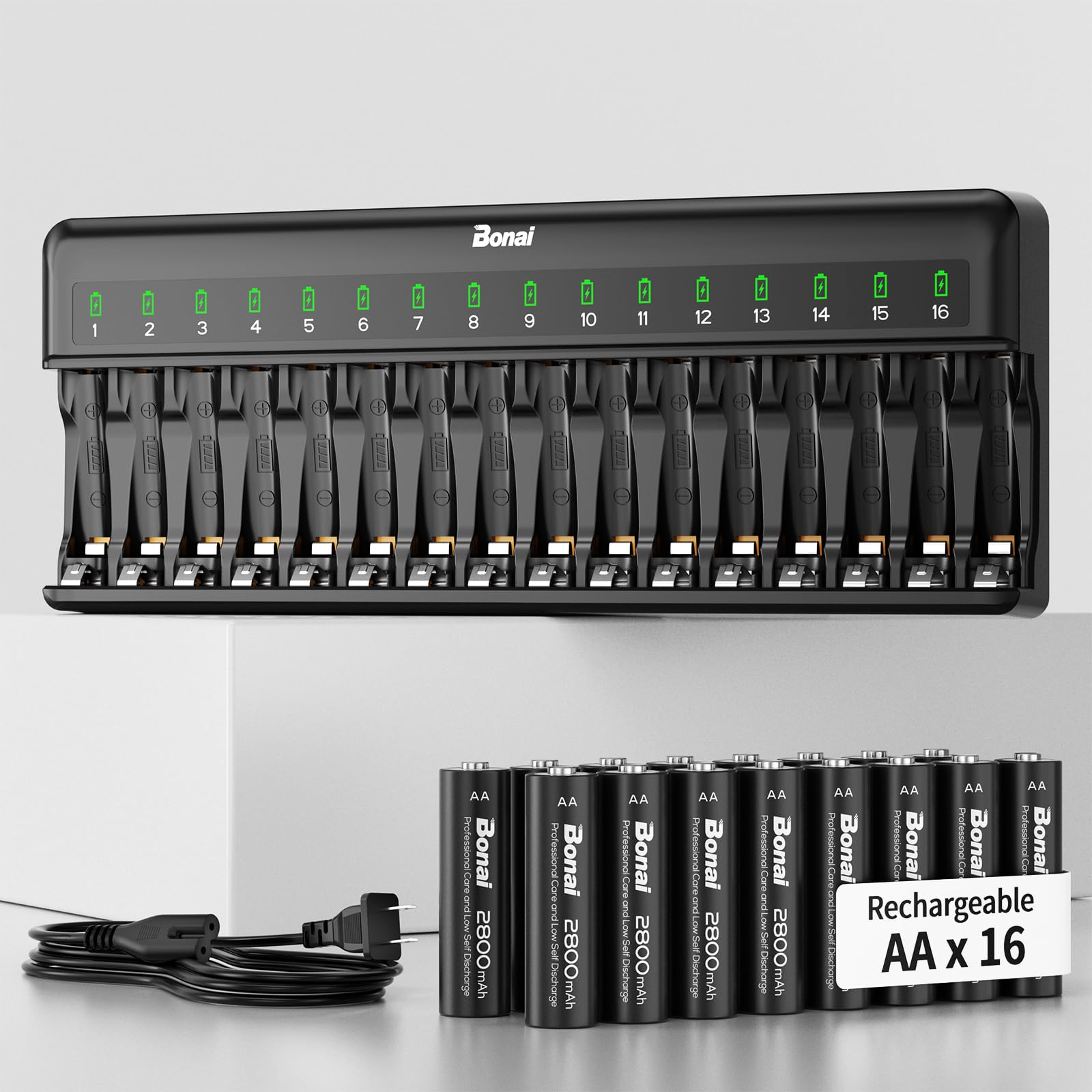
Sixteen independent slots make this the go-to charger for households running a fleet of controllers, flashlights, and toys simultaneously. Each bay uses red/green LED feedback to indicate charging status, and the unit accepts both AA and AAA NiMH cells in any combination. The included AC wall plug means no hunting for a USB brick, and the 110V-240V range makes it travel-ready for international trips.
The bundled 16-pack of 2800mAh AA cells uses low self-discharge chemistry that retains about 80% capacity after one year of storage. Real-world feedback confirms the batteries handle high-drain loads like guitar wireless systems and smart-home sensors without voltage sag. Charge time hovers around two to three hours for a full set of AA cells, which is competitive for a 16-bay unit.
The charger’s size (9.8 inches wide) occupies significant desk or counter space. The bundled cells are rated for 1,200 cycles, which is slightly behind the 2,100-cycle Eneloop standard, but the per-battery cost in this bundle is aggressively low. If your primary need is charging a large number of cells at once and you are starting from zero, this kit delivers the highest battery-to-charger ratio in the lineup.
Why it’s great
- Sixteen independent slots charge AA/AAA in any mix
- Includes AC wall adapter with 110V-240V compatibility
- 2800mAh cells hold charge for up to one year in storage
Good to know
- Wide footprint — needs 10 inches of counter space
- Cycle life (1,200) trails premium Eneloop cells
- No LCD readout; status is limited to red/green LEDs
3. Tenergy TN486U 5-Bay Universal LCD Charger

The Tenergy TN486U solves a specific pain point: it handles AA, AAA, C, D, and 9V NiMH/NiCD batteries in a single five-bay chassis, including 9V rechargeable cells that standard AA-focused chargers cannot touch. Each slot gets a 600mA charge current — higher than the 250mA or 500mA found on entry-level units — which translates to faster top-offs for larger D cells that can otherwise take two days on weaker chargers.
The LCD screen provides per-slot charge status, and the charger accepts both Micro-USB and USB-C input cables, giving flexibility to power it from a laptop, wall adapter, or car USB port. Build quality feels solid, and the unit carries UL and FCC safety certifications. Owners report it fully charged four D batteries in under 20 hours, significantly faster than competing universal chargers.
Notably, the TN486U lacks a discharge or refresh function, meaning it cannot attempt to revive deeply aged cells the way the Panasonic BQ-CC65 can. The box also does not include a USB power adapter — you supply your own 5V brick. For users who own a mix of odd-sized NiMH cells and want a single, fast charger that covers all of them, this is the most practical universal option.
Why it’s great
- Charges C, D, and 9V cells that standard chargers skip
- 600mA current reduces charge time for large batteries
- Micro-USB and USB-C dual input for flexible power sources
Good to know
- No discharge/refresh mode for reviving old cells
- USB power adapter not included in the package
- Only five slots — less capacity than 8 or 16 bay units
4. Eneloop Panasonic K-KJ55MCA4BA Quick Charger

This is the charger that made Eneloop a household name. The K-KJ55MCA4BA bundle pairs four pre-charged 2000mAh Eneloop AA cells (made in Japan) with a four-bay smart charger that delivers a full charge in about three hours — roughly half the time of older trickle chargers. Four individual LED indicators report charge status per slot: green for 80%+, orange for 20-80%, red for 20% or less, letting you check each cell’s state at a glance.
The Eneloop cells themselves are the real star. They retain 70% of their charge after ten years of storage, survive over 2,100 recharge cycles, and consistently test above their rated capacity — owners report test results between 2200mAh and 2300mAh. The charger uses negative delta V detection and independent bay control, so you can charge just one cell or a mixed set of AA and AAA without issues.
The charger does not support C, D, or 9V cells, and its four-bay capacity is modest compared to 8- or 16-bay alternatives. The bundled cells are 2000mAh rather than the 2800mAh found in budget-focused bundles. For users who prioritize long-term cycle life, storage stability, and consistent performance over raw mAh numbers, this kit remains the gold standard in the mid-range tier.
Why it’s great
- Japanese Eneloop cells tested to 2200-2300mAh actual capacity
- 70% charge retention after 10 years in storage — best in class
- Multi-color LED per slot shows exact charge state
Good to know
- Four bays only — no 8-slot or universal support
- Bundled cells are 2000mAh, not high-capacity 2800mAh
- Slot variance on some units can cause false weak readings
5. Amazon Basics 8-Bay NiMH Charger with AA & AAA Batteries
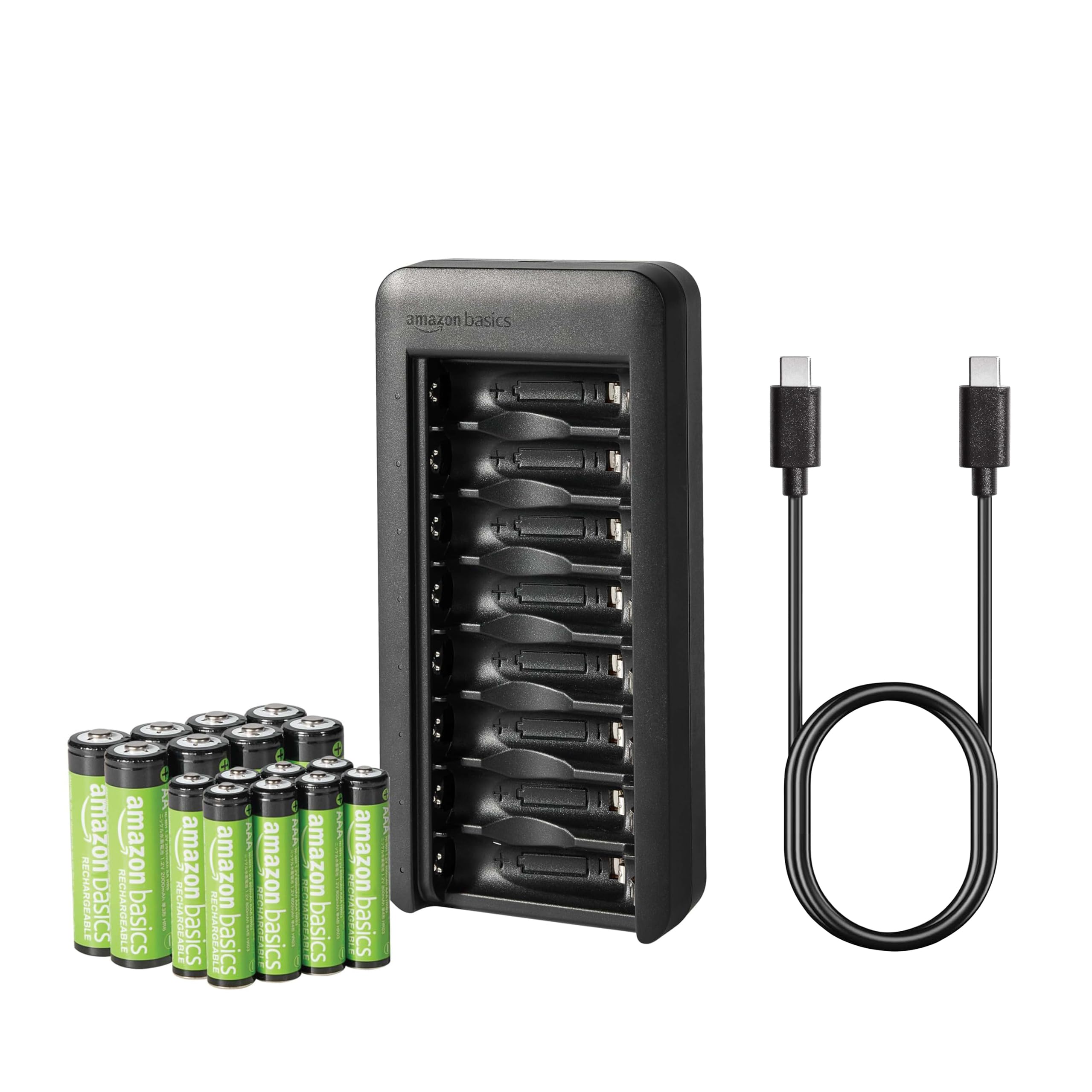
Amazon Basics delivers a straightforward, high-value entry point with this 8-bay charger that handles both AA and AAA NiMH cells. The bundled cells are 2000mAh (AA) and 800mAh (AAA), rated for 1,000 recharge cycles, and pre-charged at the factory so they work immediately. The charger uses USB-C input — a thoughtful modern touch that lets you reuse your phone charger instead of hunting for a proprietary cable.
Each bay operates independently, with a slow-blink white LED for charging and a solid white LED when full. A fast-blink pattern signals a defective or alkaline battery, which prevents confusion. Charge time for eight AA cells lands around ten hours at the supplied current, which is slower than the 600mA units but acceptable for overnight charging. The low self-discharge design maintains 80% capacity after 12 months of storage.
Build quality is adequate for the price point, but some users report that charging more than two AA cells can trigger inconsistent LED behavior, and the USB-C cable does not come with a power adapter. If you are moving from disposable alkaline to rechargeable and want the most cells per dollar, this bundle offers excellent value — just supply your own 5V charging brick.
Why it’s great
- Eight AA and eight AAA cells included — enough for a full household
- USB-C input works with any modern phone charger
- Low self-discharge holds 80% charge for 12 months
Good to know
- LED behavior can be confusing with mixed AA/AAA loads
- USB power adapter not included in the box
- Charge time (~10 hours) is slower than premium chargers
6. BEVIGOR Rechargeable AA & AAA Batteries with 8 Bay Charger
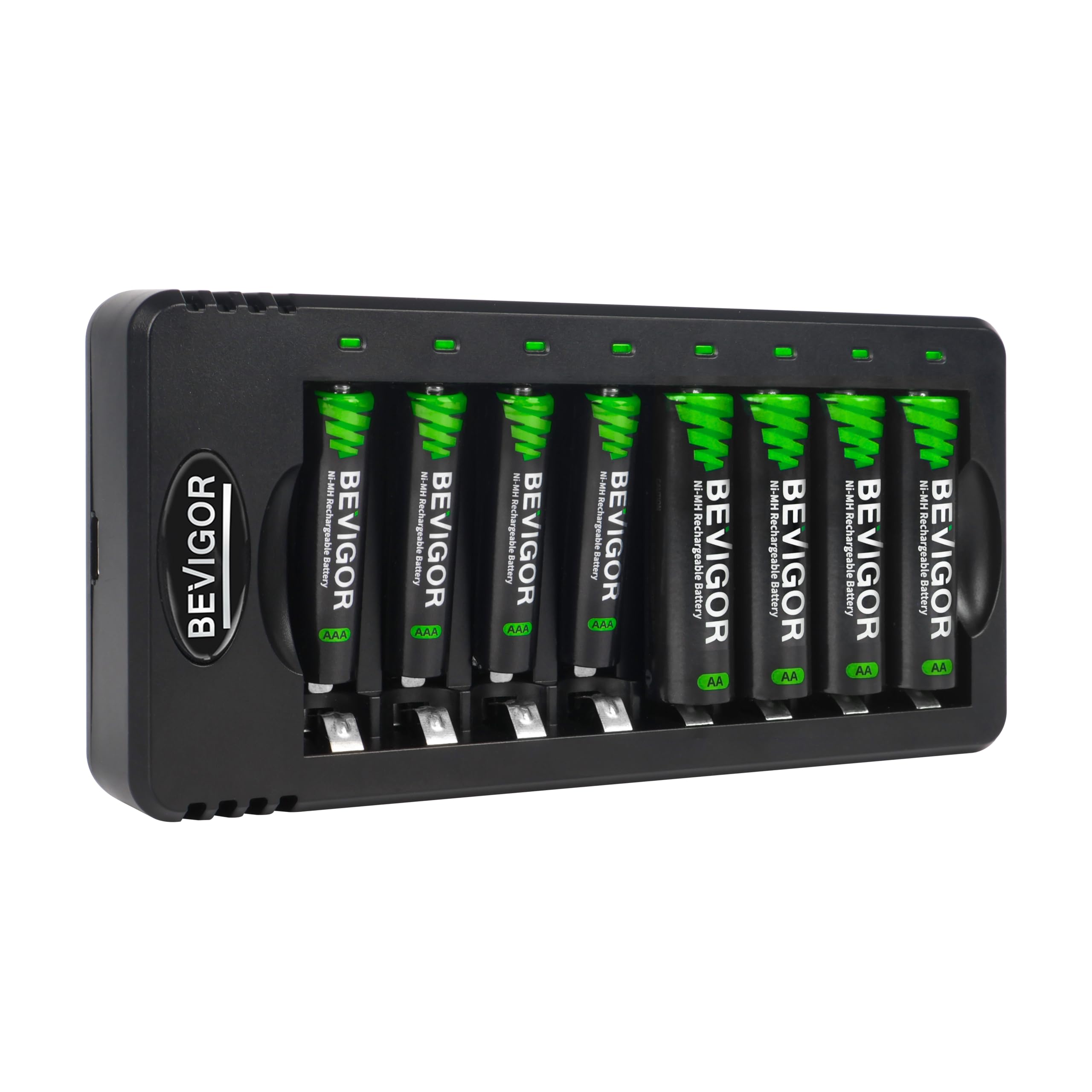
BEVIGOR’S bundle competes directly with Amazon Basics on price while offering higher claimed cycle life — rated at 1,500 recharge cycles per cell. The charger uses Type-C input for modern convenience, and the independent eight bays accept any mix of AA and AAA NiMH/NiCD cells. Red/green LEDs indicate charging and completion, and trickle charge mode helps maintain cell health once the batteries reach full capacity.
The bundled cells are 2800mAh (AA) and 1100mAh (AAA), which are slightly above the Amazon Basics capacity. Low self-discharge design retains 80% after three years of storage — a stronger claim than the 12-month spec from Basics. Real-world reviews note the batteries last more than three weeks in continuous-use devices like speed lights, and the charger handles all eight slots without the occasional LED confusion reported on the Basics unit.
The charger lacks an LCD or any advanced diagnostics, so you cannot monitor per-slot voltage or mAh throughput. Build quality feels appropriate for the price tier, and the company backs the product with a two-year warranty, which is better than most budget offerings. For users who want a reliable, Type-C-powered eight-bay charger with slightly higher battery capacity than the entry-level standard, this is a strong economy choice.
Why it’s great
- 2800mAh AA cells exceed typical 2000mAh budget batteries
- Type-C input with two-year warranty backs the product
- Trickle charge mode extends cell life after full charge
Good to know
- No LCD or per-slot voltage display
- Charge time for full set is moderate, not fast
- Some users report inconsistent battery life across cells
7. POWEROWL Rechargeable AA Batteries with 8 Bay Charger

The POWEROWL bundle is the most affordable entry point in this guide, pairing eight 2800mAh AA cells with an eight-bay smart charger. The charger uses Micro-USB input — an older connector standard but still widely available — and each slot operates independently with trickle charge logic to extend cell lifespan. The red/green LED indicators turn green when a cell is full, and the unit automatically stops charging to prevent overvoltage damage.
The bundled cells claim 1,200 recharge cycles and use low self-discharge chemistry. Owners report the batteries perform well in high-drain devices like digital cameras and electric toothbrushes, and the charger reliably identifies and charges just one cell without needing a full set. The included USB-Micro cable is short but functional, and the overall package is compact enough for a desk drawer.
Feedback indicates that some cells begin to discharge faster after about a month of heavy use, and the trickle charge continues after the LED turns green, which can heat batteries left in the charger overnight. The Micro-USB input feels dated compared to the Type-C found on the BEVIGOR and Amazon Basics units. For the absolute lowest upfront cost, this kit works — but expect to eventually upgrade cells or switch to a charger with negative delta V termination.
Why it’s great
- Lowest entry price for eight AA cells plus charger
- 2800mAh capacity is competitive with mid-range bundles
- Independent charging slots work with 1 to 8 cells
Good to know
- Some cells show capacity drop after extended use
- Continues trickle charging after full — avoid leaving overnight
- Micro-USB input is dated compared to Type-C alternatives
FAQ
Can a NiMH charger also charge lithium-ion or alkaline batteries?
Why do my rechargeable batteries die faster in high-drain devices like cameras?
How can I tell if my rechargeable batteries need to be replaced?
Final Thoughts: The Verdict
For most users, the battery charger for rechargeable batteries winner is the Panasonic BQ-CC65 because its LCD diagnostics, refresh mode, and USB output make it the only charger that actively manages cell health instead of just dumping current. If you want a universal charger that handles C, D, and 9V cells, grab the Tenergy TN486U. And for a high-volume household with many devices, nothing beats the Bonai 16-Bay in slot count and ready-to-use battery supply.