
Our readers keep the lights on and my morning glass full of iced black tea. As an Amazon Associate, I earn from qualifying purchases.
Specs are compiled from manufacturer listings and verified buyer reviews and can change over time — please confirm the key details on the product page before buying.
The charger that keeps your trolling batteries alive is the cheapest part of your boat’s whole electrical system — and the one most likely to strand you on the water with two dead batteries and a cranking engine that will not turn over. Buy the wrong one and you find out the hard way: banks that fail, a trickle too slow to top off before the next trip, or a unit that is not sealed against the splash that comes over the bow. Every pick below was vetted to clear the same bar: it must be built for marine deep-cycle and trolling motor batteries, not a car charger pressed into boat duty.
I’m Min — the founder and writer behind Gadgets Feed. This guide is built by comparing the manufacturers’ published specifications and the patterns across verified customer reviews, so you get each pick’s real strengths and trade-offs instead of marketing spin.
Marine chargers split cleanly into bank counts and per-bank amps, and that distinction drives almost every buying decision here. You get an onboard unit that charges each battery independently and holds it at full readiness between trips — the single upgrade that outlasts every other gadget on the boat — when you use a proper battery charger for trolling motor batteries.
Our Picks at a Glance

How To Choose The Best Battery Charger For Trolling Motor Batteries
Your trolling motor runs on a bank of batteries — often two for a 24V system or three for 36V — and each battery wants its own charging channel. The mistake most first-time buyers make is buying a single-output charger and rotating it between batteries by hand. That works on paper and fails in practice: one battery stays undercharged, the weakest cell drifts, and the whole pack dies earlier. An onboard multi-bank charger solves this by living in the boat and charging every battery at once, independently, every time you plug in at the dock.
Bank count is your first filter
Count your batteries: trolling motor bank plus a cranking or house battery. A two-bank charger covers a 24V trolling setup with no dedicated cranking battery. A three-bank handles a 36V trolling bank plus one cranking battery. A four-bank covers a 36V trolling bank plus cranking plus an electronics battery. Buy the bank count that matches your rig exactly — an extra unused bank is harmless, but a missing one forces you back into the rotate-by-hand problem you are trying to escape.
Per-bank amps set your overnight recharge window
The amps printed per bank determine how quickly each battery refills after a full day of trolling. Higher amps per bank means a shorter overnight charge and less risk of heading out on a partly charged pack. Lighter users who top off frequently do fine with lower per-bank amps; anglers who drain their batteries hard on back-to-back days tend to want more output per channel. Match the amp output to your typical depth of discharge, not the biggest number on the page.
Look for the IP rating, not the word “marine”
Water kills chargers faster than anything else on a boat. An IP rating (Ingress Protection, a two-digit score for how well a housing blocks dust and water) is the honest spec: IP68 means sealed against extended immersion, IP67 means sealed against short immersion, IP65 means protected against water jets from any direction. Any onboard charger in a bilge or console needs at least IP65, and IP68 is the safer target if you run in rough water or store the boat uncovered. Pair that with a thermal sensor — a built-in probe that adjusts charge output to ambient temperature — so hot summer afternoons do not overcharge and cold mornings do not undercharge your batteries.
Quick Comparison
| Model | Best For | Bank Count | Amps Per Bank | Input Voltage | Amazon |
|---|---|---|---|---|---|
| NOCO GEN5X2★ Best Overall | Two-battery boats wanting sealed reliability | 2 | 5A | 240V | Amazon |
| ECO-Worthy 5X2Best Value | Budget-conscious two-battery owners | 2 | 5A | 12V | Amazon |
| FirstPower Pro 5X3Compact Pick | 36V trolling banks needing a third channel | 3 | 5A | 120V | Amazon |
| Guest 2707A | Flooded and AGM lead-acid boats wanting rugged build | 2 | 4A | 120V | Amazon |
| FirstPower Pro 10X3 | Big trolling banks needing faster per-bank output | 3 | 10A | 120V | Amazon |
| LiTime 2 Bank 10A | LiFePO4 trolling batteries wanting a dedicated profile | 2 | 10A | 120V | Amazon |
| ProMariner ProSport HD 20A | Three-battery rigs wanting distributed amp delivery | 3 | 20A | 120V | Amazon |
| Minn Kota MK 330D | Three-battery boats wanting all-digital control | 3 | 10A | 240V | Amazon |
| Minn Kota MK-440PCL | Four-battery boats wanting per-bank chemistry selection | 4 | 10A | 120V | Amazon |
In‑Depth Reviews
1. NOCO GEN5X2 12V 10A 2-Bank OnBoard Marine Battery Charger & Maintainer
Our pick — over 4.5★ from 6,500+ verified ratings; the strongest balance of quality and price.
The fully sealed, mount-anywhere two-bank charger that keeps a 24V trolling pair topped up trip after trip.
For a two-battery setup — which covers most 24V trolling motors — the GEN5X2 does the job without asking you to think about it. This is a 2-bank onboard marine charger rated at 10 amps total, split evenly at 5 amps per bank, and it handles flooded, AGM, gel, and lithium-ion (LiFePO₄) batteries on separate modes. That means a lead-acid cranking battery and a lithium trolling battery can sit on the same unit, each getting the profile it needs. Its input voltage runs to 240 volts, which is worth knowing if you charge from a 240V dock pedestal or a travel trailer hookup — a spec that quietly matters for anyone running mixed-power marinas.
What wins owners over is the build. It is IP68 rated (fully sealed against dust and extended immersion) and carries an integrated thermal sensor that dials the charge up or down with ambient temperature — so a 95-degree summer afternoon at the dock does not cook the plates, and a 40-degree morning does not leave your batteries short. It charges batteries down to 1 volt and uses Force Mode to attempt recovery from zero volts. Case dimensions land at 7.2″D x 9.15″W x 5.39″H, and it weighs 4.2 pounds, light enough to mount vertically or upside down on a console wall with the integrated anti-vibration backing.
The recurring gripe is the reliability story. Despite very strong praise for quality, several long-term buyers report that one bank eventually failed after a season or two — and NOCO’s warranty department, in the reviews that talk about it, replaced units quickly with new ones shipped in about a week. The 3-year warranty backs that up. That unusual support response is the reason this pick still sits at the top: a component with a serviceable warranty landed with a brand that honors it is worth more on a boat than a spec-sheet upgrade. It is the pick for the buyer who wants one sealed unit mounted once and forgotten, and who can tolerate the occasional warranty claim.
What earns the top spot
- IP68 fully sealed, rated to survive extended underwater immersion — the strongest waterproofing score in this list
- Five charging modes across each of its two banks, covering lead-acid and lithium-ion profiles on one unit
- Thermal sensor adjusts output with ambient temperature so hot and cold docks do not throw the charge off
- Force Mode revives deeply discharged batteries down to zero volts, saving the ones other chargers give up on
What to weigh before buying
- Reliability is the mixed-topic in the review data — some units have failed a bank after a year or so, though NOCO’s warranty response is documented as fast and replacement-based
- 5 amps per bank is on the slower side — a fully drained large battery may want more time overnight
- Two banks only, so a 36V rig or a boat with a separate electronics battery needs a bigger unit
Best for: Two-battery boat owners who want a sealed, mount-anywhere charger with real lithium support and a warranty that actually answers the phone.
Think twice if: You run three or more batteries — the GEN5X2’s two banks will leave you rotating.
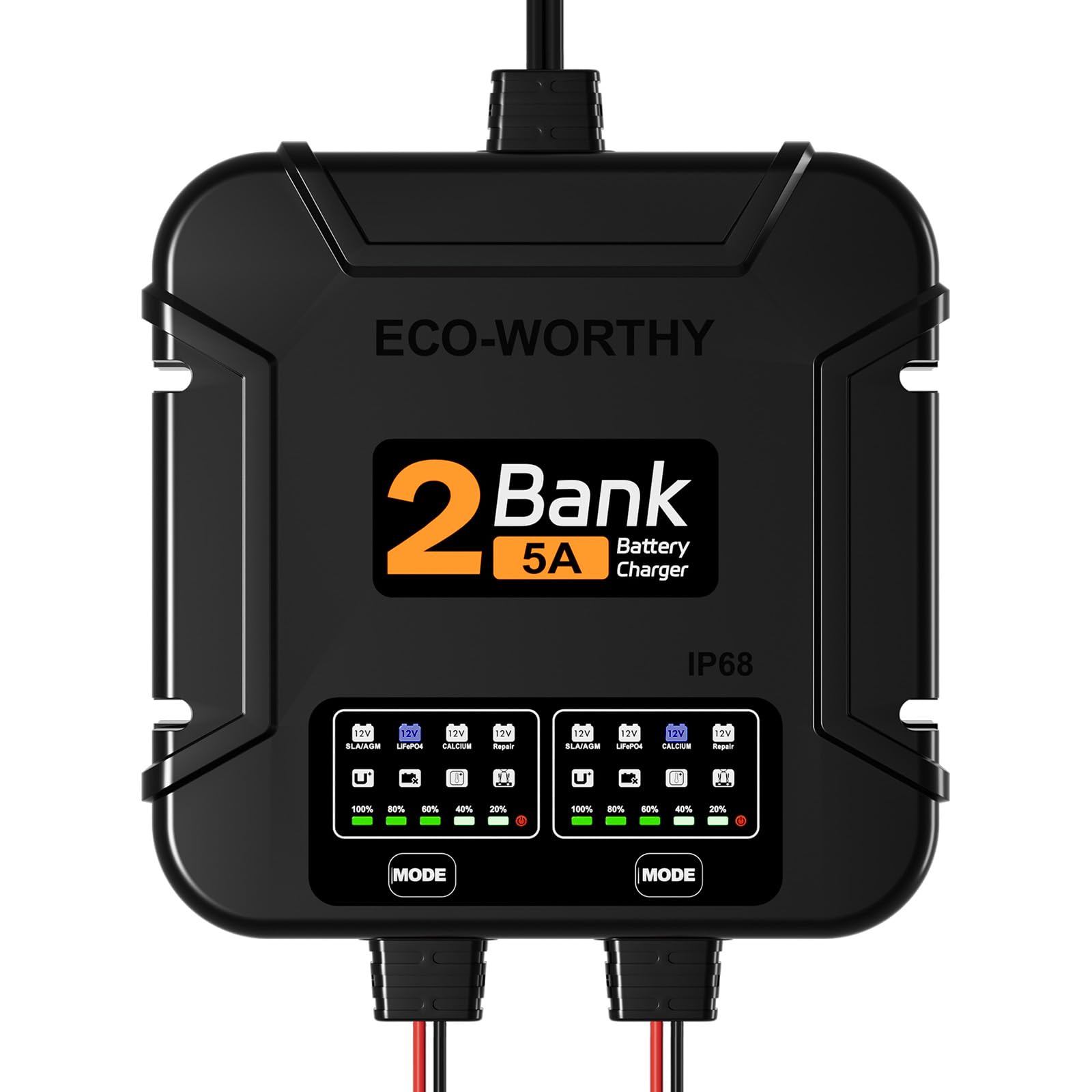
2. ECO-Worthy 2 Bank Marine Battery Charger 5X2, 12V 10A (5A/Bank)
The budget-friendly two-bank that covers lead-acid, LiFePO4, and calcium chemistries on one compact unit.
The ECO-Worthy 5X2 runs two 12V batteries at 5 amps each — 10 amps total — and it handles Lead-Acid, LiFePO4, and Calcium chemistries from three independent modes. That is a wider chemistry roster than most chargers at this level offer, and the design makes it a natural fit for mixed setups where one channel runs an AGM cranking battery and the other a calcium or lithium trolling battery. Its footprint is remarkably small — 6.61″D x 6.3″W x 2.12″H — which is less than half the volume of the NOCO GEN5X2 above at 7.2″D x 9.15″W x 5.39″H. On a small console or a tight battery tray, that difference is the reason buyers pick this one.
Reliability is the story owners tell most, and it comes through in the direct-connect detail — “Installed terminals on two batteries, plugged in, selected correct battery type; both charged and monitored within 24 hours.” That is the whole point of an onboard charger: hook up once, leave it. A rapid repair mode for lead-acid kicks in automatically when the “12v Repair” light comes on, and a 5-second press of the MODE button activates Force Mode for LiFePO4 batteries below 1 volt. Full protective coverage is on board: over-voltage, over-temperature, overcurrent, short-circuit, and reverse polarity.
The honest catch here is documentation and support reach. The instruction manual has drawn complaints for reading like a rough translation and not matching the unit cleanly, and one buyer trying to reach technical support by phone never got a returned call — though email-based support has been praised as quick and pleasant. This is a two-battery, three-chemistry workhorse at a very budget-friendly tier. If you value a well-illustrated manual and a live phone line over the lowest possible entry price, step up. If you know your way around a battery, this is a genuinely strong option.
Where it earns its place: Three charging modes covering SLA/AGM, Lithium, and Calcium chemistries, plus IP68 waterproofing and a sub-7-inch footprint — specs that fit tight consoles where bigger chargers cannot go.
What to expect going in: Chinese-to-English manual translation is imperfect and phone-based support has been inconsistent, so self-reliance with the settings menu helps here.
Reach for this if: You want a proper 2-bank onboard charger with Calcium support at a budget-friendly tier and can figure out the modes without hand-holding.
Look elsewhere if: Reading a manual is your setup method of choice — that is the one soft spot in this package.
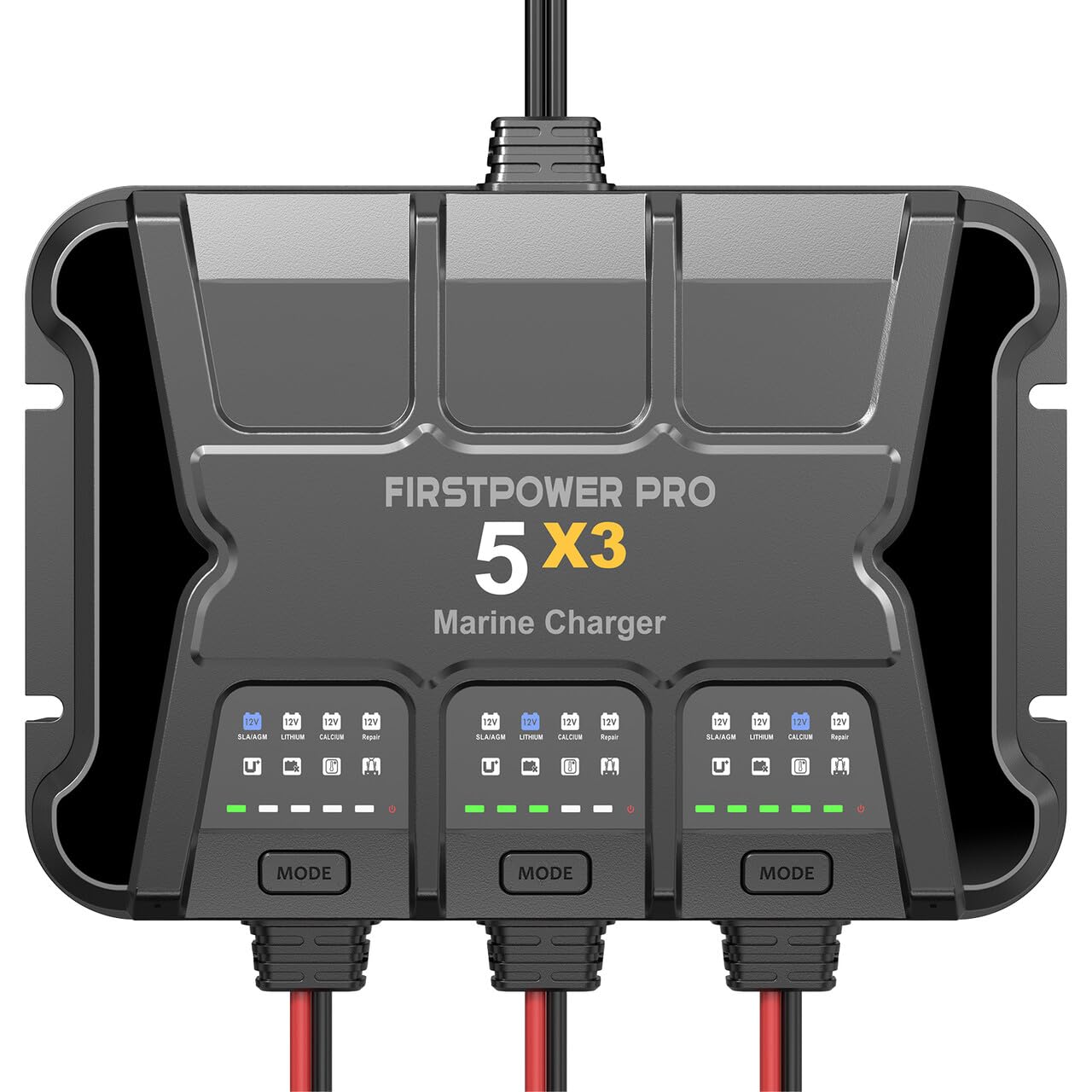
3. FirstPower Pro 3 Bank Marine Battery Charger 5X3, 15A (5A/Bank) – 12V Boat Charger
Three independent banks at 5 amps each, sized to keep a 36V trolling setup and a cranking battery topped off.
The 5X3 adds a third channel to the two-bank formula without jumping into the premium price tier — which matters the moment your boat runs a 36V trolling bank plus a separate cranking battery. At 5 amps per bank and 15 amps total, it charges all three batteries at once and lets you pick the mode (SLA/AGM lead-acid, Lithium, or Calcium) separately for each. Every channel has its own MODE button, so a flooded lead-acid cranking battery and two LiFePO4 trolling batteries can all live on this one unit with the profiles they need.
Install simplicity is where owners consistently light up. The install has been called a breeze, the hookups correct right from the start, and the vertical-mount option gets used to replace old units in the same footprint. A thermal sensor handles the hot-dock, cold-morning problem, sealed IP68 construction means it can be charged 24/7 onboard without worry, and a 5-grid power display (20%, 40%, 60%, 80%, 100%) shows you where each bank stands at a glance. Included in the box: three battery clips, three battery connectors, three spare fuses, four mounting screws, and a bag. It carries a 3-year warranty for the charger.
This is not the pick for someone charging a large bank of 100Ah-plus deep-cycle batteries overnight — at 5 amps per bank, a deeply drained big battery will take its time. It is the right call for the middle case: three batteries of moderate capacity, mounted onboard, charged continuously, and rarely drained to zero. Owners repeatedly frame it as a worthy replacement for older units, and the price tier makes the third bank feel less like an upgrade tax and more like the sensible default.
Why owners keep coming back
- Three independent banks with per-bank mode selection — SLA/AGM, Lithium, or Calcium on each channel
- IP68 sealed so it can charge 24/7 onboard without water intrusion
- 5-grid power display shows charge progress on each battery at a glance
- 3-year warranty and a generous in-box kit including spare fuses and mounting hardware
Where it fits and where it does not
- 5 amps per bank is a light-to-moderate charge rate — a deeply drained large battery will want the overnight window
- Ventilation is required during use, so mounting in a fully closed compartment is not advised
- Takes up real console wall space at 9.45″ wide — check your mounting area before ordering
Suits you when: You have three batteries to keep topped off — typically a 36V trolling bank plus cranking — and want onboard living without premium pricing.
Skip it for: Big deep-cycle batteries you routinely drain to zero; the per-bank amps are modest.
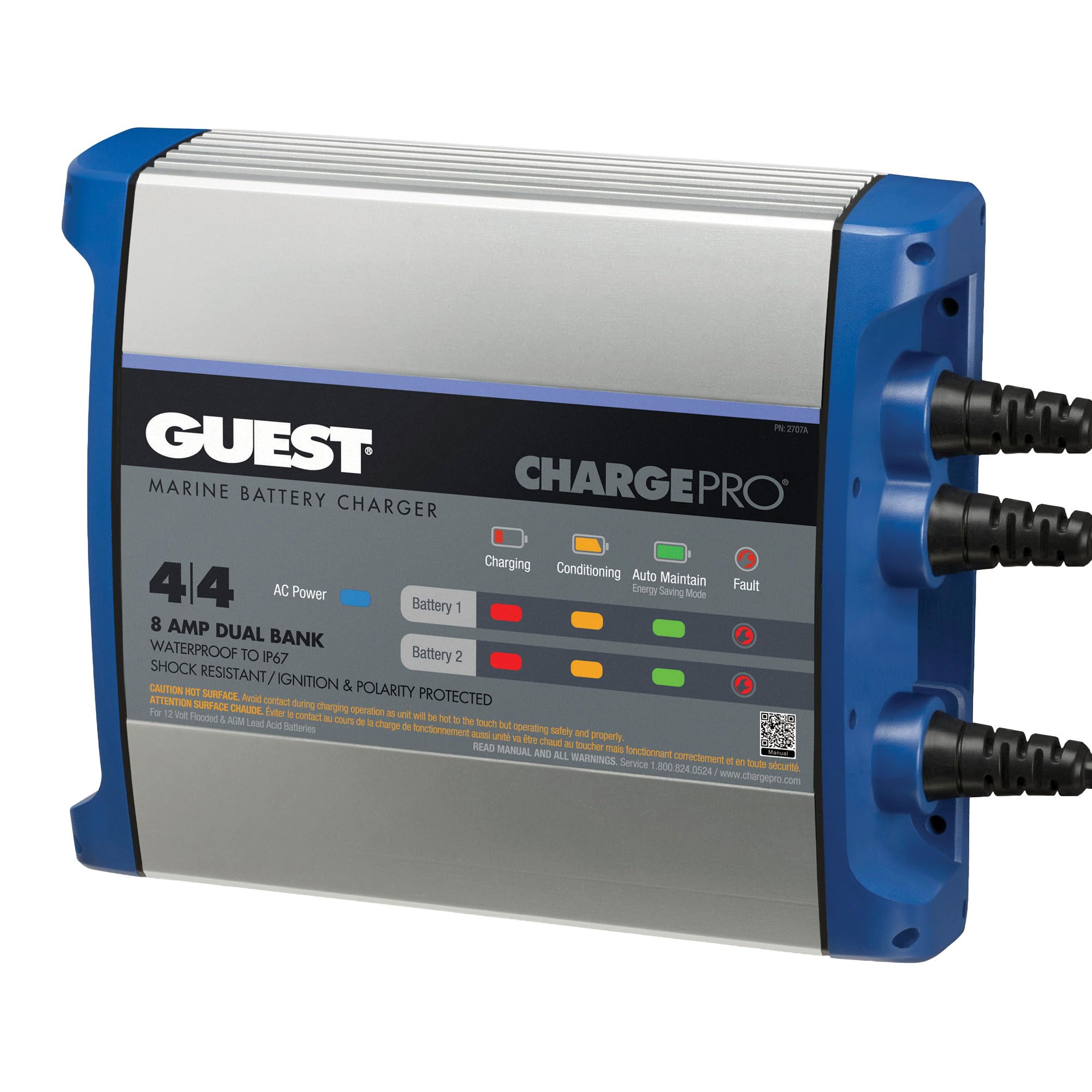
4. Guest 2707A Guest On-Board Battery Charger 8A / 12V, 2 Bank, 120V Input
A 4-amp-per-bank metal-bodied charger built to survive bilge splashes and long dock seasons in one spot.
Guest has been in the marine charger business long enough that owners treat this unit as a known quantity, and the reviews back it — reliability and build quality are the top two things the data shows buyers discussing. The 2707A is a 2-bank, 8-amp total charger feeding 4 amps per bank from a 120V AC dock connection. Its IP67 rating means it survives short immersion, and its shock-resistant housing with in-line fuse protection and ignition protection is the safeguard that separates this from a bare automotive unit. Safety features on board cover reverse polarity, over-current, over-voltage, and over-temperature — the four classic ways an unattended charger ruins a battery.
Chemistry-wise, this is deliberately a lead-acid machine: 12V flooded and AGM batteries only. That is actually a strength for the buyer with a pair of matching deep-cycle AGM trolling batteries, because it means less menu navigation and more just-plug-it-in behavior. The LEDs are readable from across a dim engine compartment, and dual-bank independence means each battery gets its own charge status. Owners routinely report mounting it with four screws, walking away, and finding both batteries full weeks later. One detail worth knowing: some owners mention that 4 amps per bank takes a long time to charge both batteries to full when they arrive deeply discharged — the upside is that nobody reports it damaging a battery from too fast a charge.
For a 24V trolling setup with a cranking battery, it is a workhorse with an old-school build that feels reassuringly solid. If you need lithium support, look to the LiTime pick — this charger does not cover LiFePO₄. If your batteries are flooded or AGM and you want a husky metal-housed unit that shrugs off a wet mounting location, this remains a strong choice with a genuinely well-tested track record behind it.
What earns the money: IP67 sealing, four independent protective circuits (reverse polarity, over-current, over-voltage, over-temperature), and a metal-bodied housing that keeps its shape in rough-mounted installs.
The honest limitation: 4 amps per bank is the slowest in this lineup, so plan an overnight charge window on deeply drained batteries — and lithium chemistry is off the menu here.
A good fit for: Flooded or AGM lead-acid boats running a 24V trolling setup who want a rugged, no-nonsense charger that will not quit mid-season.
Not the one for: LiFePO₄ trolling batteries — the 2707A sticks to lead-acid chemistry.
5. FirstPower Pro 3 Bank Marine Battery Charger 10X3, 30A (10A/Bank) – 12V Boat Charger

Three banks at 10 amps each — 30 amps total — so all three batteries refill fast enough to be ready by morning.
This is the same 5X3 platform pushed to double the per-bank output: 10 amps per channel, 30 amps total, aimed squarely at the angler who drains a 36V trolling bank hard and wants it topped up overnight. The extra current does real work — lithium customers note the unit detects LiFePO₄ batteries automatically when they are hooked up, applies the right profile, and completes a full charge on three batteries in a few hours rather than overnight. It shares the 5X3’s core traits: three independent banks, three mode selections per bank (SLA/AGM, Lithium, Calcium), IP68 sealing for 24/7 onboard use, thermal compensation, and the same 5-grid power display at 20/40/60/80/100 percent.
For the buyer moving from a slower unit, the difference is time. This is the one pick that makes a fully-drained three-battery pack feel routine instead of an all-night event. Owners talk about moving from chargers that failed on them to this platform and finding the build, the display, and the cords all improved — a jump up in feel that matches the price tier. At 10.4 pounds and 10.9 inches wide, it is a bigger unit to mount, so plan the console or locker space before ordering, but the footprint earns its keep in the amp output.
The main thing to know: this is the same family as the cheaper 5X3, so if you are buying for a lighter setup, the 30A version is overkill and the 15A version is the smarter spend. For anyone running three batteries that see heavy daily discharge, the extra amps are the difference between a full pack the next morning and a compromise. Owners describe it as a smart charger that handles “anything,” matching the three-chemistry coverage; the honesty is that a 30-amp charger on small batteries is more current than they need.
Where it shines
- 10 amps per bank across three channels — fast overnight turnaround on a fully drained 36V trolling bank
- Auto-detects lithium and applies the LiFePO₄ profile without manual menu work
- IP68 sealed for 24/7 onboard charging and thermal compensation for hot and cold docks
- Same three-chemistry coverage (SLA/AGM, Lithium, Calcium) on the 5X3 at double the per-bank output
What to keep in mind
- Heavier and larger than the 5X3 at 10.4 pounds — mounting space needs measuring first
- Overkill for small batteries or a light-duty setup where the 15A version is more appropriate
- Requires a ventilated mounting location per the manufacturer’s own instructions
The pick for: Anglers running three big deep-cycle or LiFePO₄ batteries who want them fully charged by morning without a two-night wait.
Save the upgrade if: You only charge occasionally or your batteries are small — the 15A version is your smarter spend.
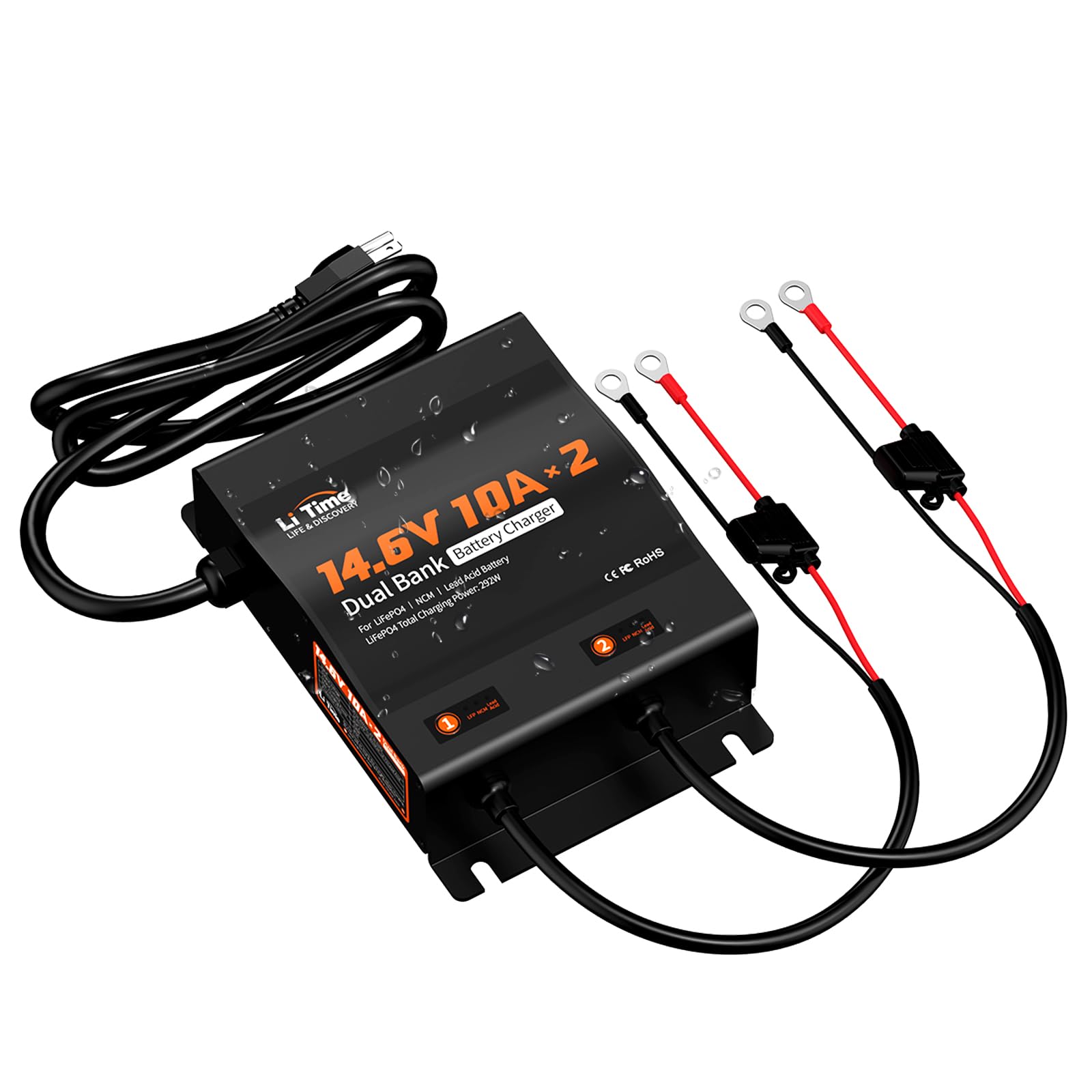
6. LiTime 2 Bank 12V 10A LiFePO4 Battery Charger, Waterproof, 14.6V Output
A charger built around the 14.6V profile that LiFePO4 batteries actually want — two banks at 10 amps apiece.
Most of the chargers on this list handle LiFePO4 as one mode among several. The LiTime makes it the headline: 14.6 volts output, 10 amps per bank across two banks, and a 90V–260V AC input range (with 47Hz–63Hz frequency coverage) so it works from both 120V and 240V dock power without a step-down transformer. It charges 12V LiFePO4, other lithium batteries, and lead-acid batteries. An M8 terminal upgrade replaces the usual small connector, which makes the battery-to-charger connection more solid and reduces the chance of a loose contact arcing at the terminal.
Where this shines is lithium-first use. Reviewers point out charging two 12V 300Ah LiFePO4 batteries overnight at 10 amps per bank — a moderate rate that suits big lithium cells. A full charge on a pair of deep trolling batteries lands within about 12 hours, and per-bank programming lets a lead-acid cranking battery and a LiFePO4 trolling pair share the same onboard charger. The charger is IP65-rated (resistant to water jets from any direction — not full immersion), protective circuitry covers over-temperature, over-current, reverse polarity, short-circuit, and output over-voltage, and LiTime offers a 2-year quality warranty with AIG Product Liability Insurance on the unit.
The two caveats to plan around: the charger runs warm — one battery-focused review notes it gets noticeably hot during use, which is normal for a 20-amp total lithium charger but worth accounting for with ventilation — and the mode buttons need to be held for selection rather than just tapped, and the setting does not save between uses, so every charge starts with a couple of seconds of button-pressing. Neither is a dealbreaker for a boat owner who leaves it permanently mounted; both are the small frictions of the format. If you run LiFePO4 trolling batteries and want a purpose-built charger rather than a universal one, this one treats them right.
Why lithium owners reach for it: 14.6V output tune for LiFePO4 chemistry, 10 amps per bank, dual-mode versatility across lithium and lead-acid, and an M8 terminal upgrade for a more reliable connection.
What to plan for: The unit runs warm under load, and mode selection requires a press-and-hold every time since the setting does not persist — a small habit for the return of correct lithium charging behavior.
Worth it for: Boat owners running LiFePO4 trolling batteries who want the correct lithium charging profile on every charge cycle without menu hand-offs.
Not a match for: Buyers who want a charger to survive full submersion — IP65 covers water jets, not extended immersion.
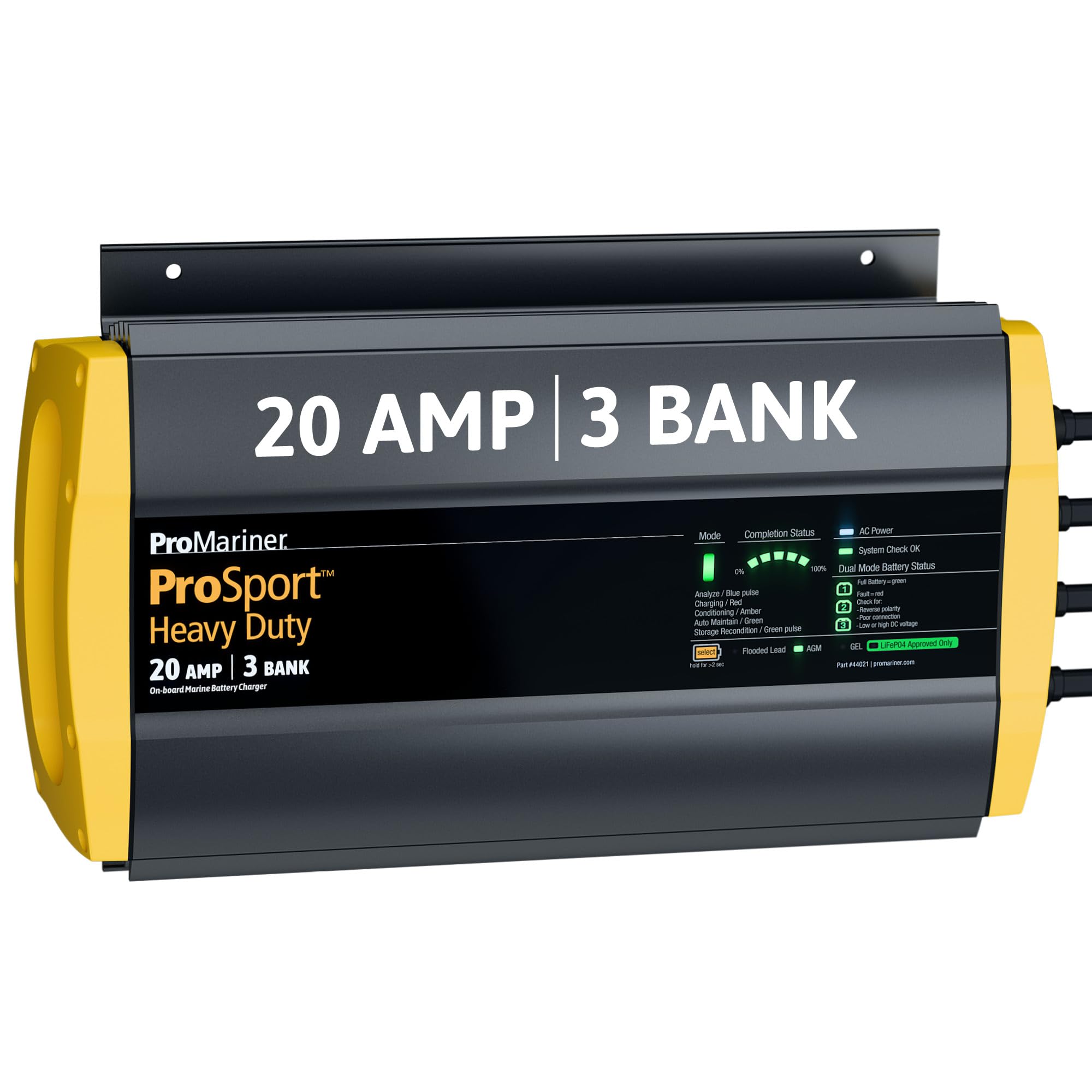
7. ProMariner 44021 ProSport HD Waterproof Marine Battery Charger, 20 Amp, 3 Bank
Three banks and 20 amps that dynamically redistribute charge — the flexible middle ground between standard and premium tiers.
ProMariner rings the bell here because of a single clever behavior: Distributed-On-Demand Technology. Instead of splitting 20 amps evenly across three banks at about 6.7 amps each, it slides unused current from an already-full battery onto one that needs more. Practically, that means the trolling pair that ran hard all day can pull more than its equal share while the lightly used cranking battery tops off and releases its spare amps. Full charge on three batteries happens in under 8 hours in normal use — a welcome trait when the boat sits in the slip overnight. ProMar Digital Technology — microprocessor and software-controlled charging — handles the transition through stages so voltage and current stay in the safe range.
The build backs this up with a tri-surface extruded heat sink (top, bottom, and rear fins) that keeps the unit cool even when it is delivering its rated 20 amps continuously, and the LED display uses a fuel-gauge style completion status bar plus a four-color multi-stage mode indicator and per-battery status. This is longevity-styled gear — One owner is on their third ProSport unit, replacing an 11-year-old predecessor that the manufacturer’s customer service said was still serviceable. Another cites full charging as the thing that extends battery life. The 5-hour rated charge time is fast enough that a hard-used 24V bank is ready the night before without an overnight wait.
The recurring wrinkle is the rare unit that fails — one long-running owner had a unit stop working and reported the warranty department replaced it without friction, and the replacement has run clean. That is the honest picture: a fast, flexible, well-built charger with a warranty that has been documented as honoring its claims. The install is straightforward, the packaging is clean, and the amps are where anglers with three batteries and limited dock time want them.
What makes it different
- Distributed-On-Demand Technology routes unused amps from a full battery to one still charging — the only pick in this list with that behavior
- 20 amps total across 3 banks, with 5-hour rated charge time and sub-8-hour full-bank turnarounds in normal use
- Tri-surface extruded heat sink keeps temps in check at full output
- Expanded LED display with completion gauge, four-color mode bar, and per-battery status
Where owners have hit friction
- Reliability is well-praised overall, but failures do occur — the documented response has been a prompt warranty replacement
- Heavier and taller than cheaper 3-bank options at 7.2 pounds and 6.3 inches high
- Leads-only design means you are buying into ProMariner’s ecosystem of cables and connectors
Best for: Three-battery boat owners who want fast, flexible charging that reallocates amps toward whatever battery needs them most.
Look elsewhere if: You are charging two batteries or a single trolling bank — a 3-bank unit leaves a channel unused.
8. Minn Kota 1823305 MK 330D Digital On-Board Marine Battery Charger, 3 Bank x 10 Amps

A microprocessor-controlled 3-bank charger that mines owned-by-anglers testing well into its second decade of service.
Minn Kota’s MK 330D is a different kind of pick: the fanbase here is genuinely long-term. Shoppers say running the same family of Minn Kota chargers for 14 years, and the pattern reads as a rig builder’s charger — digital control, automatic multi-stage charging, and waterproof shock- and vibration-resistant construction. Three banks at 10 amps each, 8-hour rated charge time, and an input voltage of 240 volts, which matters if you charge from a 240V pedestal. The digital control uses a microprocessor-based design to deliver a precise charge, and automatic temperature compensation adjusts the current as the ambient temperature swings.
The experience reads very cleanly: easy install, keeps batteries charged through the winter, LED lights that show you exactly where the charge is and if the unit has hit maintenance mode, an error notification when something is wrong. It charges two 24V trolling batteries and a cranking battery simultaneously — the profile it is built for. Owners running the 4-bank version are also in the same family, and mention that upgrading from 3 to 4 batteries is a natural step as their rigs grow. The trade-offs are physical: this is one of the heaviest picks at 13.5 pounds, and its 16.25-inch width is the widest in this list, so a flat dry mount area is required. Owners note it is heavier than they expected and larger than anticipated.
The honest read: this is a premium-priced charger with old-school reliability and a very long life in the data. If you have the mounting real estate and want a charger that is engineered by the same company that makes the trolling motor it powers, this is a well-tested choice. If your boat has a tight console and you value a lighter footprint, the 10X3 platform is the more space-friendly path to the same bank count and per-bank output.
The case for it: Microprocessor-based digital control, automatic temperature compensation, 3 banks at 10 amps each, and a genuinely decade-plus track record in boaters’ hands.
The physical reality: At 13.5 pounds and 16.25 inches wide, this one wants a flat dry bulkhead and mounting screws — plan and measure before it ships.
Land on this if: Your rig has the space and you value a charger that has racked up years of service on the same boats it powers.
Choose the 10X3 instead if: Console space is limited — this unit wants a full bulkhead.
9. Minn Kota Precision MK-440PCL On-Board Marine Battery Charger – 4 Banks, 10 Amps Each

Four banks, per-bank chemistry selection, and battery equalization — the pick for maximally loaded fishing rigs.
The MK-440PCL is what a charger looks like when bank count is no longer a compromise. Four banks, 10 amps each, and — the feature that separates it from everything else here — every individual bank can be set to its own chemistry: 12V AGM, Flooded Lead Acid, Gel, or Lithium LiFePO₄. That means a boat running three lithium trolling batteries in series plus a flooded lead-acid cranking battery can put all four on the same unit and dial in the profile each one actually wants. Owners’ reviews focus on that exact scenario: multiple LiFePO₄ batteries in series get charged independently, which prevents the imbalance that shortens a pack’s life.
Automatic multi-stage charging with microprocessor control runs the cycle, and automatic temperature compensation handles not just ambient heat and cold but also low-line voltage — useful at marinas where incoming dock voltage sags under load. The equalization feature is unusual at this level: it automatically cleans flooded lead-acid batteries on every charge, and a push-button activation triggers a more rigorous cycle for a deeper clean, which extends battery life. Waterproof, shock-resistant, vibration-resistant construction and full LEDs — charge stage, maintenance mode status, error notifications, and complete — round out the package. Rated charge time is 4 hours, making this the fastest bank-per-hour unit in the lineup.
This is a big footprint and a big-ticket pick — the four-bank unit is larger than any 3-bank alternative and will need a clean bulkhead or locker space, and the heaviest charging layouts see real weight. But if you have four batteries to maintain — a 36V trolling bank, cranking, and electronics — the MK-440PCL eliminates the monitoring bottleneck. You plug in once, and every battery is looked after with the chemistry it needs. Owners describe it as a super charger that handles all types on the same chassis, and it earns that label from the spec sheet alone. For less-loaded boats, the MK 330D is the smaller-footprint path — the same Minnesota engine, one bank fewer.
The winning traits
- Four independent banks with per-bank chemistry selection across AGM, Flooded Lead Acid, Gel, and Lithium LiFePO₄
- Automatic battery equalization cleans flooded lead-acid batteries on every cycle for longer life
- Temperature compensation plus low-line voltage handling keeps charging consistent on imperfect dock power
- 4-hour rated charge time — the quickest per-bank turnaround in this comparison
- Waterproof, shock-resistant, vibration-resistant construction with full per-battery LED status
The trade-offs to weigh
- Four banks is more than most boats need — a 3-bank rig wastes a channel here
- Larger footprint demands a real mounting area, not a corner shelf
- Premium price tier — the value only lands if all four banks are actually used
Made for: Loaded rigs with four batteries — a 36V trolling bank, cranking, and electronics — where you want each battery on the exact chemistry profile it needs.Skip if: You run three or fewer batteries — the extra bank becomes unused capacity you paid premium tier for.
Understanding the Specs
Bank count and per-bank amps
A “bank” is one independent charging channel — one battery gets one bank. If your boat runs a 24V trolling setup plus a cranking battery, you want at least three banks. Per-bank amps determine how fast each battery refills: 4–5 amps per bank suits frequent top-offs and lighter batteries, while 10 amps per bank handles larger deep-cycle or LiFePO4 packs that arrive drained after a hard day. Distributed-On-Demand designs on some units (like the ProMariner ProSport HD) can shift unused amps from a full battery to one still charging, so the total output follows the need rather than splitting evenly across all banks.
IP ratings and thermal compensation
An IP rating is a two-digit score for how well the housing keeps out dust and water — IP68 means sealed against extended immersion, IP67 short immersion, and IP65 water jets from any direction. Any charger living in a bilge or an open console should carry at least IP65; IP68 is the safer pick if the boat is stored uncovered or run in rough chop. Thermal compensation (a sensor that reads ambient temperature and adjusts the charge current) keeps the charger from overcharging on a hot summer dock and undercharging in cold weather. Both specs show up across this entire list, and they matter far more than the marketing phrase “marine grade.”
FAQ
How many banks do I need for a 24V or 36V trolling motor setup?
Can a trolling motor battery charger stay plugged in all the time?
Will these chargers work with LiFePO4 lithium trolling batteries?
What IP rating do I need if the charger is mounted in a bilge or console?
How long does it take to charge a deep-cycle trolling battery?
Can a marine charger revive a completely dead battery?
Do I need a cranking battery charger too, or will a trolling bank charger cover it?
Is a metal-cased charger better than a plastic-cased one for marine use?
What happens if I plug a two-bank charger into a three-battery boat?
Do these chargers work on 240V dock power or only 120V?
Final Thoughts: The Verdict
If you run a two-battery boat and want one sealed charger that handles both lead-acid and lithium-ion while living on the console, the NOCO GEN5X2 is the pick to beat — it carries the IP68 sealing, the 5-amp-per-bank output, and the warranty response anglers rely on when a bank does finally fail, and It holds 4.6 stars across more than 6,000 ratings. If your rig has three batteries and you want the fastest, most flexible amps on the dock, reach for the ProMariner ProSport HD 20A, whose Distributed-On-Demand behavior pushes unused amps toward the battery still charging. For a lithium-first setup where 14.6V precision matters more than universal coverage, the LiTime 2 Bank 10A is the specialized option. And for four-battery boats that want every battery on the exact chemistry profile it needs, the Minn Kota MK-440PCL is the one to reach for. Match your charger to your battery count first, your chemistry second, and your dock’s voltage third — the rest is comfort.
How We Picked
We do not accept paid placement. Every pick is matched to a real buyer and a real use-case; we do not hands-on test units.
Sources & Methodology
Specifications: manufacturer listings and product documentation. Review insights: verified customer reviews, as of September 2026. Pricing: not shown on this page (it changes often); check the current price via the retailer link.
As an Amazon Associate, Gadgets Feed earns from qualifying purchases. This does not affect which products we feature.