
Our readers keep the lights on and my morning glass full of iced black tea. As an Amazon Associate, I earn from qualifying purchases.
Specs are compiled from manufacturer listings and verified buyer reviews and can change over time — please confirm the key details on the product page before buying.
If you are still dragging a compressor and an air hose up a ladder, the fix is a battery coil nailer that drives shingle nails from a rechargeable pack. The four picks below cover the whole spectrum: bump-fire workhorses, bag-and-battery kits, and premium brushless units. The DeWalt 20V MAX 15 Degree Coil Battery Powered Roofing Nailer wins on owner experience.
I’m Min — the founder and writer behind Gadgets Feed. This guide is built by comparing the manufacturers’ published specifications and the patterns across verified customer reviews, so you get each pick’s real strengths and trade-offs instead of marketing spin.
Every entry below is an actual cordless, battery-powered roofing nailer, not a pneumatic or corded unit wearing a cordless label. That distinction matters when you are picking the best battery coil nailer for real roof work.
Our Picks at a Glance

How To Choose The Best Battery Coil Nailer
Buying a cordless roofing nailer is really a battery-ecosystem decision wrapped in a nail-compatibility decision. Get those two wrong and the tool sits in the truck.
Match the coil angle and nail length first
A coil nailer holds nails in a spiral wire coil, and the angle of that coil is standardized. A 15-degree coil nailer takes 15-degree coil roofing nails, while Metabo HPT frames its unit around 16-degree wire coil nails. Nail length matters too: the Metabo accepts fasteners from 7/8 inch up to 1-3/4 inch, and the DeWalt runs standard 1-1/2 inch nails. Check that your local supply house stocks the right coil before you commit to a platform.
Decide whether you are buying a bare tool or a kit
A “tool only” listing means you supply the battery and charger yourself. That is the cheap entry point if you already own packs for that brand — the 20V MAX 15-Degree Electric Cordless Roofing Nailer (Tool Only) is exactly this. A kit like the Metabo HPT NV1845DA includes the battery, charger, a vinyl siding adapter, safety glasses, and a bag, so you can shingle the day it lands.
Weigh the trigger mode against your pace
Bump mode fires a nail every time you tap the nose against the deck, which is faster for production shingling. Sequential mode fires one nail per full trigger pull, which is slower but gives you controlled placement. Most experienced installers want both modes; a first-time roof owner is usually fine with one.
Quick Comparison
| Model | Best For | Voltage | Weight | Battery Included | Amazon |
|---|---|---|---|---|---|
| DeWalt 20V MAX 15 Degree Coil Battery Powered Roofing Nailer★ Best Overall | All-day production work | 20 volts | 6.7 pounds | No — tool only | Amazon |
| 20V MAX 15-Degree Electric Cordless Roofing Nailer (Tool Only) | Small repair jobs | 20 volts | 7.78 pounds | No — tool only | Amazon |
| Metabo HPT Roofing Nailer, 18V MultiVolt Brushless, Coil Kit, NV1845DA | First-time cordless buyers | 18 volts | 8.6 pounds | Yes — 2.0Ah included | Amazon |
| Milwaukee Electric – M18 Fuel Coil Roofing Nailer | Contractors on the M18 platform | 18 volts (M18) | — | No — tool only | Amazon |
In-Depth Reviews
1. DeWalt 20V MAX 15 Degree Coil Battery Powered Roofing Nailer
Our pick — 4.5★ from 600+ verified ratings; the strongest balance of quality and price.
One coil after another, all day, without a hose tangling your feet.
At 6.7 pounds bare, it is the lightest nailer in this lineup. That is the bare weight of this DeWalt, and it makes it the lightest nailer in this lineup — the Metabo HPT NV1845DA weighs 8.6 pounds by comparison. If you are roofing solo and reaching over a ridge line, those pounds are the difference between a controlled placement and a wobble.
Under the shell sits a brushless motor, which means the tool gets more runtime and motor life out of the same battery charge because there are no carbon brushes to wear down. The nail tray is tool-free, so switching the full range of roofing nails and the 15-degree coil angle is a hands-only job. Bump mode is there for production speed.
What owners keep coming back to is the reliability — it is the most-praised trait about this nailer, with durability and build quality close behind. A typical report reads: “works great. not even one jam after using all day. used BHTOP coil nails from amazon. easy to load. small 20V battery lasted all day.” The consistent theme is that the cordless convenience offsets the heft. Be honest about the other side too: some buyers find it heavy to shoulder for hours, and a few have run into jamming or nail depth that drifts under sustained hard use. A small number question whether the price is justified. For a roof crew that already owns DeWalt 20V batteries, this is the strongest all-round pick on this list.
What earns it the top slot
- 6.7 pounds — the lightest coil nailer here, and lighter than the Metabo HPT NV1845DA at 8.6 pounds
- Brushless motor stretches runtime and motor life per charge
- Tool-free nail tray handles the full roofing-nail range and 15-degree coil angle
- Bump mode keeps production shingling fast
- Reliability is the trait owners praise most, with build quality right behind it
Where it asks something back
- Bare tool only — your 20V MAX batteries and charger are not in the box
- Shoulder fatigue sets in for some owners on long shifts
- Jamming and drifting nail depth show up in a slice of feedback under hard, continuous use
- A few buyers question whether it earns its premium-tier price
Reach for this if: you already run 20V MAX batteries and want the lightest, most reliable coil nailer for a full day of shingling.
Look elsewhere if: you have no DeWalt packs yet — the bare-tool listing means you are buying the platform from scratch.
2. 20V MAX 15-Degree Electric Cordless Roofing Nailer (Tool Only)

The patch-and-repair nailer that spares you hauling a compressor onto a small roof.
This is the pick for the homeowner who has a leaky ridge and a bundle of shingles, not a week of production work. Reach for it when the job is a few squares of flashing and patch, and you would rather not hear a compressor run all afternoon. Owners sum that up well: “Not sure why anyone would still haul up to the roof an air compressor, extension cord & air hose for pneumatic nail guns when you can just bring this cordless nail gun.”
It takes a 15-degree coil angle and runs on the 20V MAX platform. It is tool only, so your existing 20V batteries are what power it. Where it gets comfortable is that same small-job niche: a roofing company owner called it durable and suited to repair work.
Know the weight before you buy. On the scale, one owner measured it at exactly 9 pounds with a 20V battery attached, and several describe it as heavy. That is heavier than the 6.7-pound DeWalt coil nailer above. There is also a minority who find it less durable and slower than they hoped for the outlay. If your work is occasional and you already hold 20V packs, the convenience still wins.
Stripped-back tool, honest trade: no battery, no charger, no case — just the nailer and a 15-degree coil angle, which keeps the entry cost down if the platform is already in your truck.
What it is really for: small roofing and repair jobs where the alternative is dragging air equipment up a ladder. Owners rate it as a great-value tool for exactly that scenario.
Pick it when: you have 20V MAX batteries on the shelf and roof jobs are repair-sized, not production-sized.
Think twice if: you want a tool you can use right from the start or need low carry weight — at 9 pounds with a battery it is a handful.
3. Metabo HPT Roofing Nailer, 18V MultiVolt Brushless, Coil Kit, NV1845DA

The only nailer here that arrives with the battery, charger, and a siding adapter in the box.
Metabo HPT calls this the first air spring coil roofing nailer, and the mechanism is meant to reproduce pneumatic-tool punch without gas, hose, or compressor. It fires 16-degree wire coil roofing nails from 7/8 inch up to 1-3/4 inch in length. For a first-time cordless buyer with no battery platform yet, the included 18V 2.0Ah pack and charger get you shingling the day it lands.
The kit is unusually complete: battery, charger, a vinyl siding adapter for installing siding without over-driving nails, wrench, bag, and safety glasses. Metabo HPT rates the included 2.0Ah battery for 500 nails per charge, and a dust-and-tar resistant mechanism is built to keep debris out of the driver blade. Newer owners cite exactly this — an entire job finished on the standard battery, with no setup trouble and quick shipping.
Here is the honest trade-off. This 8.6-pound nailer is the heaviest in the article, 2.2 times deeper front-to-back than the 20V MAX 15-Degree tool above at 6 x 13.8 x 13.2 inches versus 12.97 x 1 x 12.57 inches, and setup info lives mostly in videos and the manual rather than a clear quick-start. Most owners are thrilled — a non-professional reported no perceivable power gap versus the pneumatic nailer they used before — but a run of reports flags a pack that can work loose, single-shot firing that stalls, and a charge that quits after a couple of minutes idle. That said, the lifetime tool body warranty backs it, and the battery and charger carry their own coverage.
Who it suits: a first cordless nailer buyer who wants one box with everything and values the included vinyl siding adapter for mixed roofing and siding work.
The honest caveat: at 8.6 pounds it is the heaviest pick on this page and the widest front-to-back, and most of the setup lives in a video rather than a printed quick-start.
Good fit for: anyone starting from zero who wants the tool, battery, charger, siding adapter, and bag in a single order.
Less ideal for: roofers carrying the tool overhead all day, where the 8.6-pound weight and longer body notice most.
4. Milwaukee Electric – M18 Fuel Coil Roofing Nailer
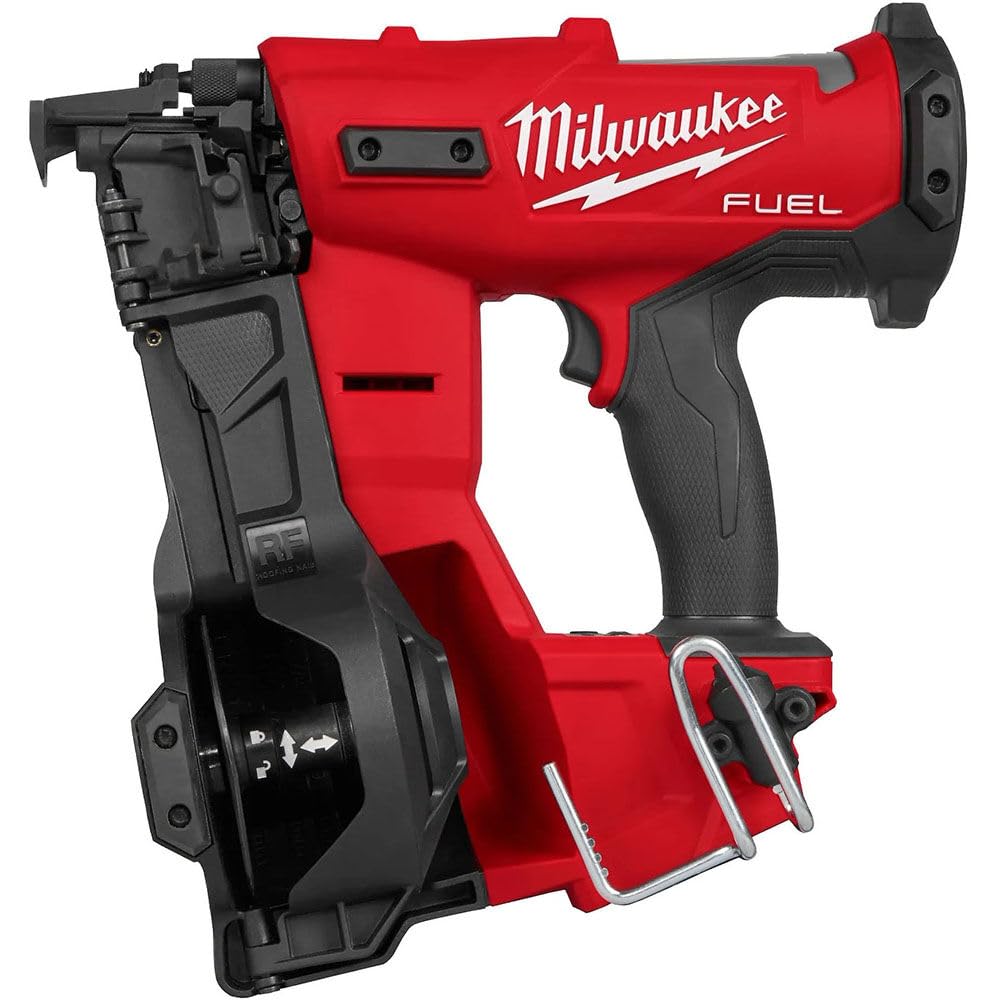
A 120-nail magazine that lets you work a whole stretch before you reload.
Two specs set this M18 Fuel nailer apart. The magazine holds up to 120 nails in a coil, and it accepts 15-degree coil roofing nails, driving them up to 1-3/4 inches. Sequenced against the DeWalt above, which runs lighter at 6.7 pounds, this one trades some of that portability for capacity and a depth dial you can set without tools.
A sequential trigger mode and a tool-free depth dial put placement under your control. A sequential trigger mode places each nail one pull at a time, and the tool-free depth dial sets how deep the nail seats without hunting for a wrench. Owners on roofing crews have put it through long days and come away impressed by how steady it holds — it does not slide down the deck when you set it aside, and one contractor with years on the tools rates it above the three yellow-brand models they had used. Fast loading and consistent nail drives get frequent mentions.
The drive is where it stumbles. A minority report nails that will not seat all the way and need a finishing tap with a hammer, and the premium-tier price plus the tool-only listing means you need M18 batteries already in your kit. For a crew already on the M18 platform, the 120-nail magazine and tool-free depth dial justify the premium price.
Why crews favor it
- Holds up to 120 nails in the magazine for long stretches between reloads
- Tool-free depth dial sets seat depth without extra tools
- Sequential trigger mode gives one-nail-per-pull control
- Stays put on the deck instead of sliding when you set it down
- Drives coil roofing nails up to 1-3/4 inches
The costs to weigh
- Bare tool only — M18 battery and charger sold separately
- Some users report nails that fail to seat fully and need a hammer tap
- Premium-tier pricing puts it at the top of this list
Best matched to: contractors already on the M18 platform who want the biggest magazine here and tool-free depth control.
Not the pick if: you have no M18 batteries and count on every nail seating clean in one pass.
Understanding the Specs
Voltage and battery platform
Voltage tells you which battery family the tool belongs to — 20V MAX for the two DeWalt units, 18V MultiVolt for the Metabo HPT, and M18 for the Milwaukee. Sticking to a platform you already own saves you from buying packs and chargers again, and it also means the tool takes every battery you already carry. Higher voltage does not automatically mean more power; runtime is delivered by the battery capacity and the motor design working together.
Coil angle and nail length
A coil nailer feeds nails wound into a wire spiral, and the coil angle must match the tool. The DeWalt and Milwaukee units both run 15-degree coil nails, while the Metabo HPT is built for 16-degree wire coil roofing nails. Nail length is the second gate: a roofing nailer generally drives nails from around 7/8 inch up to 1-3/4 inch. Confirm your supply house carries the matching coil before you buy.
Brushless motor vs standard motor
A brushless motor removes the carbon brushes that physically wear inside a standard motor. That yields more runtime per charge and longer motor life, which is why the DeWalt DCN45RNB and Metabo HPT NV1845DA both use brushless motors. On an all-day roofing tool, that means fewer battery swaps and less downtime.
Weight and tool-free adjustment
Carry weight is what you feel, not a spec-sheet footnote: the DeWalt 20V MAX nailer weighs 6.7 pounds bare, compared with 8.6 pounds for the Metabo HPT kit, and that gap shows up in your shoulders by the end of the day. Tool-free features — the DeWalt’s nail tray, the Milwaukee’s depth dial — cut the little interruptions that otherwise break your rhythm.
FAQ
What is the difference between a battery coil nailer and a pneumatic roofing nailer?
Will a 15-degree nailer take 16-degree coil nails?
How long does a battery last on a coil roofing nailer?
Do I need to buy a battery and charger separately?
What is the difference between bump mode and sequential firing?
Can a coil roofing nailer handle vinyl siding?
Is a brushless motor worth it on a roofing nailer?
How heavy are battery coil nailers compared with pneumatic ones?
What nail length should I use for roofing with a cordless coil nailer?
Final Thoughts: The Verdict
For most people shopping a battery coil nailer, the DeWalt 20V MAX 15 Degree Coil Battery Powered Roofing Nailer is the pick — it is the lightest here at 6.7 pounds, carries a brushless motor and a tool-free nail tray, and its reliability is the trait owners value most. If you want a ready-to-work kit with the battery, charger, and siding adapter included, grab the Metabo HPT NV1845DA. And if you already run the M18 platform and want the largest magazine here, the Milwaukee M18 Fuel Coil Roofing Nailer is the one to reach for. One practical nudge: if you already own packs for one of these three platforms, buy the tool that matches that battery family rather than starting a new one — that single choice keeps you working and cuts the gear you carry.
How We Picked
We do not accept paid placement. Every pick is matched to a real buyer and a real use-case; we do not hands-on test units.
Sources & Methodology
Specifications: manufacturer listings and product documentation. Review insights: verified customer reviews, as of September 2026. Pricing: not shown on this page (it changes often); check the current price via the retailer link.
As an Amazon Associate, Gadgets Feed earns from qualifying purchases. This does not affect which products we feature.