
Our readers keep the lights on and my morning glass full of iced black tea. As an Amazon Associate, I earn from qualifying purchases.
Specs are compiled from manufacturer listings and verified buyer reviews and can change over time — please confirm the key details on the product page before buying.
You are standing in a cold garage holding a cable that will not reach the battery post, or worse, one that fits but heats up under load because the copper inside is thinner than the listing promised. A battery connection cable is the one part of your solar, RV, marine, or inverter setup where a wrong pick shows up immediately as a hot lug, a slow crank, or a dead house bank. The single most important decision is wire gauge — the thickness of the copper — because that number, not the lug colour or the brand logo, decides whether current flows cleanly or cooks the insulation. Match the gauge and lug size to your studs and a budget pair will outlast the vehicle; mismatch them and a premium set will still overheat.
I’m Min — the founder and writer behind Gadgets Feed. This guide is built by comparing the manufacturers’ published specifications and the patterns across verified customer reviews, so you get each pick’s real strengths and trade-offs instead of marketing spin.
Below you’ll find eight sets sorted by how they actually handle real jobs, from short battery-bank jumpers to longer inverter runs. Every pick states its gauge, lug hole size, and length so you can match it to your studs before you buy — a quick way to sort through the noise of the battery connection cable market.
Our Picks at a Glance


How To Choose The Best Battery Connection Cable
Most buyers make the same mistake: they buy the longest cable they can find, then discover the thinner wire inside it sags under load. The fix is to pick gauge first, lug size second, and length last. Here is what each of those three decisions actually does for you.
Start with wire gauge, because that sets the current ceiling
Gauge is printed as AWG, and the number runs backwards — a 2 AWG cable carries far more current than a 6 AWG one because the copper core is thicker. For a starter, a winch, or an inverter pulling serious amperage, thin wire turns into a heater. A 2 AWG set is the safer choice for high-draw jobs. A 6 AWG set suits lighter duties like small solar runs or trickle connections. If you are unsure, size up rather than down.
Match the lug hole to your stud before anything else
The ring terminal is the metal eyelet at each cable end that bolts onto the battery or inverter post. A 5/16 inch ring slides over a 5/16 inch stud; a 3/8 inch ring needs the wider post. Order the wrong one and the cable simply will not seat flat, which means a loose connection and heat. Measure your stud with a wrench or calipers first — it takes a minute and saves a return.
Choose length for the run, not for the spare
A 1-foot pair is ideal for parallel battery-bank jumper duty where the posts sit close together. A 2-foot or 3-foot run gives you reach between a battery and an inverter mounted further away. Extra length adds resistance, so buy the shortest cable that reaches cleanly with a little slack. Owners regularly flag length as the part that surprises them, so dry-fit the route before you order.
Quick Comparison
| Model | Best For | Gauge | Lug Size | Length | Amazon |
|---|---|---|---|---|---|
| A ABIGAIL 4 AWG 1FT★ Best Overall | Short battery-to-inverter jumpers | 4 AWG | 5/16 in | 1 ft | Amazon |
| TOPDC 4 AWG PairBest Build | Automotive and truck starting runs | 4 AWG | 3/8 in | 2 ft | Amazon |
| TUELETFU 4 AWG 1ftBest Value | Compact solar and marine wiring | 4 AWG | 3/8 in | 1 ft | Amazon |
| ALFFAA 2 AWG Set | High-current inverter installs | 2 AWG | 3/8 in | 1 ft | Amazon |
| A ABIGAIL 6 AWG 3FT | Longer low-draw solar runs | 6 AWG | 5/16 in | 3 ft | Amazon |
| Linkstyle 6PCS 2 AWG | Battery bank series and parallel | 2 AWG | 3/8 in | 6 in | Amazon |
| KEDAKEJI 2 AWG 2FT | Dual battery and solar charging | 2 AWG | 5/16 in | 2 ft | Amazon |
| Spartan Power 2 AWG Set | Made-in-USA premium DC wiring | 2 AWG | 5/16 in | 2 ft | Amazon |
In‑Depth Reviews
1. A ABIGAIL 4 AWG Battery Cable 1FT Pair
Our pick — 4.5+★ from 500+ verified ratings; the strongest balance of quality and price.
The short red-and-black pair that makes a clean inverter job feel almost too easy.
For a 1-foot run between a battery post and a nearby inverter, this A ABIGAIL set is the pick that keeps delivering. It uses a 4 AWG gauge, so it handles a steady 85 A maximum current without the jacket getting warm — enough for a mid-sized inverter or a starter connection. The pair arrives as one red positive and one black negative, each with a 5/16 inch ring terminal crimped at every end, so both posts bolt straight up.
Where it pulls ahead of the TUELETFU 4 AWG set is the lug bore: this one gives you 5/16 inch rings, and it reaches just 1 ft — the same length as the TUELETFU, so if your studs are 3/8 inch you want that one instead. Owners praise the simple function: the 5/16 inch rings seat flat on the post, hold tight, and need no fussing. The tinned copper lugs fend off the oxidation that eats bare copper in damp garages, and the PVC jacket is sealed with heat-shrink at the ends so moisture stays out.
The honest limit is the length itself. Buyers report that 1 ft is perfect for parallel battery jumpers and tight inverter bays, but it will not stretch to a rear-mounted battery. If your run is longer, size up to the KEDAKEJI 2-foot pair or the A ABIGAIL 3-foot 6 AWG.
What it nails
- 4 AWG pure copper rated to 85 A — more headroom than most 1-foot jobs ask for
- 5/16 inch ring terminals crimped on both ends, ready to bolt down
- Tinned lugs resist corrosion in damp, outdoor, and marine bays
- Heat-shrink seals keep moisture out of the cable ends
Where it stops short
- The 1 ft length leaves no slack for longer battery-to-inverter runs
- 5/16 inch studs only — will not fit a 3/8 inch post without a swap
Reach for this if: you have 5/16 inch studs sitting close together and want a clean, tight pair that will not loosen.
Look elsewhere if: your battery-to-inverter run needs more than a foot of reach.
2. TOPDC 4 AWG Battery Cable Pair, 24 Inch
Built like a starter cable, sized for the truck bay, and it has been on the shelf since 2016.
The thing that sells this TOPDC pair is the wire itself: a 4 AWG pure copper core in a 24 inch length, versus the 1-foot reach of the TUELETFU set below. That extra foot is what you need to swing from a battery post to a starter motor or an RV house panel without straining the stud. The 3/8 inch ring terminals are crimped at each end, so it bolts onto the wider posts common on truck and marine batteries.
Construction is where it earns its keep. A flexible PVC jacket shrugs off abrasion and moisture, and the ends are sealed in heat-shrink so water cannot creep into the copper. Owners rave about the build — heavy-duty 4 AWG copper, sealed heat-shrink ends, and a bolt-up install with no fighting. Exactly what you ordered is the phrase that keeps coming back in the reviews, because the length matches the listed spec rather than falling short.
Cable length is the one thing to check against your own layout — that 24 inches is generous for a starter but could leave clutter in a tight bay. It is a fair fit-note rather than a flaw. For the buyer whose studs are 3/8 inch and whose run is around two feet, this is the safest order in the group.
The strong call: a starter, truck, or RV install that needs a 2-foot run onto 3/8 inch posts, with a jacket tough enough for the engine bay.
The honest caveat: measure before you buy — 24 inches can feel long in a cramped inverter box.
3. TUELETFU 4 AWG Battery Cable 1ft Pair
A compact 3/8 inch pair for solar and marine jobs where the stud is wide and the space is not.
Here is the pick for the buyer whose battery and inverter sit almost flush but whose posts are the wider 3/8 inch style. This TUELETFU set carries a 4 AWG pure copper core in a 1-foot length, with 3/8 inch lugs crimped at both ends — matching the 3/8 inch width of the TOPDC pair but at 1 foot instead of 24 inches. Each copper lug wears a tin plating to fight corrosion, and the cable ends are sealed with heat-shrink for heat insulation.
Owners keep returning to the build quality — clean crimps, tin-plated lugs, and a jacket that bends without kinking. It is well-made, the fit on the posts is clean, and it handles a lithium battery hookup as easily as a lead-acid one. Reduced power loss gets called out by people running inverters, which is exactly what you want from pure copper over a budget alloy. The jacket is flexible enough to bend into a tight bay without kinking.
Use the A ABIGAIL pair instead if your studs are 5/16 inch — the two are the same price tier and the same 1-foot reach, but the lug bore is the deciding split. This one is the right answer whenever the post is 3/8 inch and the run is short. It is a small, tidy pair that does its one job well.
The fit-first read: buy this for a 3/8 inch stud and a sub-foot run, and the install is a five-minute job; the tin-plated lugs and heat-shrink ends give it enough corrosion resistance for a damp marine or outdoor bay.
Pick this one when: your studs measure 3/8 inch and the gap between battery and inverter is short.
Pass when: you need reach beyond a foot, or your posts are the narrower 5/16 inch.
4. ALFFAA 2 AWG Battery Inverter Cable Set

Thick 2 AWG copper wrapped in a soft silicone skin that folds into spaces PVC cannot reach.
When your inverter pulls hard, gauge is the whole game — and this ALFFAA set jumps straight to 2 AWG, a much heavier copper core than the 4 AWG pairs above. It ships as one red positive and one black negative, each 1 foot long and tipped with 3/8 inch stud lugs. The pure oxygen-free copper carries maximum conductivity, and the tinned terminals cut down on corrosion. The manufacturer’s spec rates it for currents in excess of 200A, which is what separates a 2 AWG set from the lighter 4 and 6 AWG cables.
What sets this apart from the other short 1-foot sets is the jacket: a soft silicone sheath instead of PVC. Silicon bends easily around tight corners, so it slips into a compact inverter bay without forcing the cable. Owners are happy using it for re-routing ground cables and for smaller solar or battery systems, and flexibility gets singled out as a real plus.
The trade-off is that weight and stiffness in a tight stud placement can be fiddly, and the 1-foot length is fixed. If your studs are wider or your run is longer, look at the KEDAKEJI 2-foot pair. For a hard-working inverter that needs real amperage handling, though, the 2 AWG core is the reason to pick this one.
Why it earns its place
- 2 AWG oxygen-free copper rated for currents in excess of 200A
- Soft silicone jacket flexes into tight inverter bays
- Tinned copper terminals resist corrosion
- 3/8 inch stud lugs crimped on both ends, ready to fit
The fit notes
- Heavier build makes tight stud placement more fiddly
- Fixed 1-foot length — no slack for longer runs
Go this way if: your inverter draws serious current and you want a soft, flexible jacket to thread it into a small space.
Reconsider if: you need a longer reach or a lighter, more maneuverable pair.
5. A ABIGAIL 6 AWG Battery Cable 3FT Pair

Three feet of reach when the posts are far apart and the current is lighter.
If your inverter is bolted across the bay rather than right beside the battery, 1-foot sets will not make it and 2-foot sets come up short. This A ABIGAIL pair reaches a full 3 feet, compared with the 1-foot TUELETFU set, so it spans a longer route with room for gentle bends. It delivers one red positive and one black negative cable, each with a 5/16 inch ring terminal crimped at both ends.
The gauge is the number to weigh here. This is 6 AWG, a thinner copper core than the 2 AWG and 4 AWG sets, so it is built for lighter duties — small solar runs, trickle connections, or low-draw accessories — not for a high-amperage starter. The pure copper and tinned lugs still carry conductivity well, and the PVC jacket is abrasion-resistant with heat-shrink seals at the ends.
Cable size and length both draw mixed feedback, and that tracks: three feet of 6 AWG is the right tool for a long low-draw run and the wrong one for a hungry inverter. Match the gauge to your current and the length to your layout, and this pair quietly does the job. For a solar panel feeding a controller across the RV, the reach is the whole reason to choose it.
The honest verdict: the 3-foot reach is the standout, and 6 AWG pure copper is perfectly capable for light solar and accessory wiring — but this is not the set for a high-draw starter or a large inverter.
Best matched to: a long, low-current run — solar panels, small accessories, or a spread-out battery bay — where the extra foot of length earns its keep.
Not for you if: you are wiring a starter or a heavy inverter that wants a thicker 2 AWG or 4 AWG core.
6. Linkstyle 6PCS 2 AWG Battery Cable Set
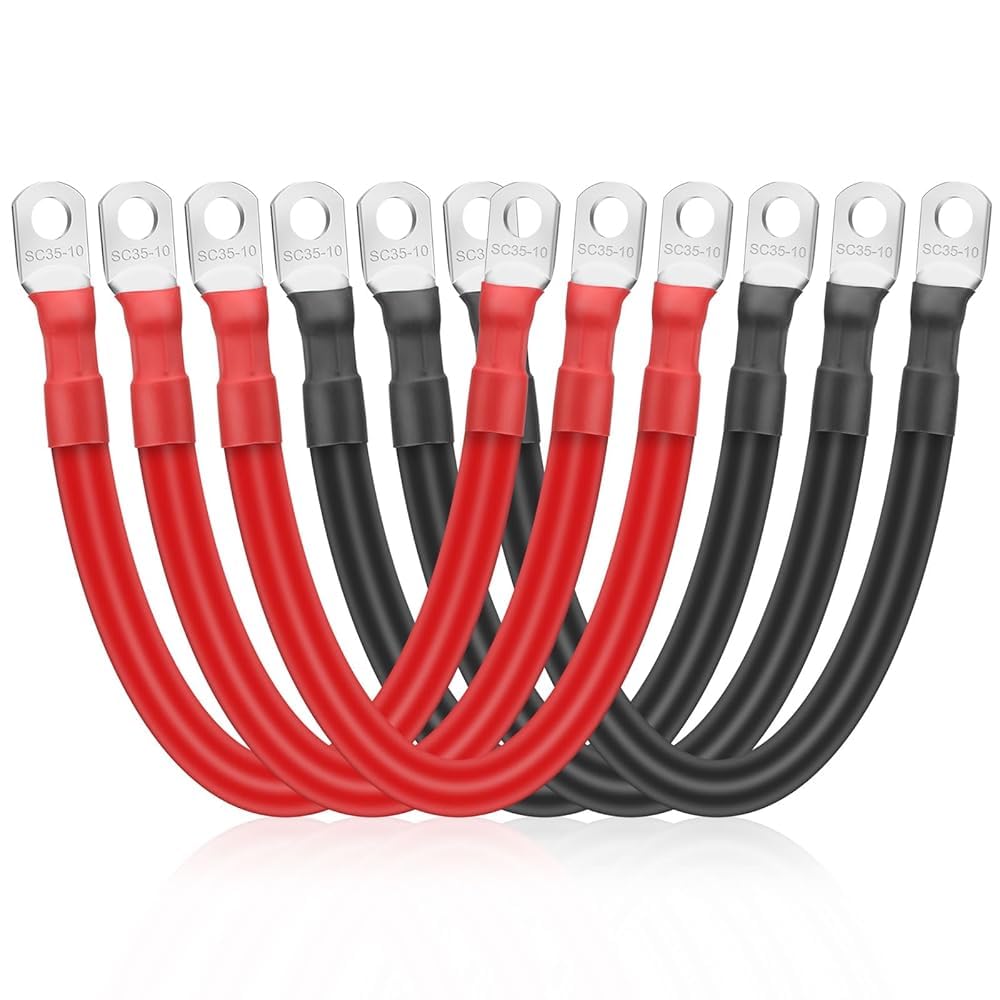
Six short 2 AWG jumpers built for wiring a whole battery bank, not just one post.
This Linkstyle set is a different animal from the two-cable pairs — it arrives as six 2 AWG cables, each 6 inch (15 cm) long, in red and black. That is the setup you want when you are linking several batteries into a bank, running parallel or series connections, or grounding two batteries together. Short 6-inch jumpers keep the wiring tidy between adjacent posts, and the 2 AWG core means each jumper carries serious current.
The material spec is where it stands out: 99.9% pure copper wire with nickel-plated copper terminals and a PVC insulation shell, and each end pre-terminated with 3/8 inch tin-plated copper crimped lugs. That pre-crimped finish makes quick work of a battery-bank build, so you are not crimping six cables by hand. Owners rate the build highest — six pre-crimped 2 AWG jumpers that turn a battery bank into a clean, tidy result. The PVC sheath handles wear, water, and heat, so it holds up in a harsh bay.
The catch is the length. Six inches is exactly right for a tight bank and too short for anything else — length is the most-discussed point in the reviews, and it splits hard. For a compact bank where the posts line up close, the six-pack is the efficient buy.
The case for the six-pack
- Six 2 AWG cables in one set — a full battery-bank wiring kit, red and black included
- 99.9% pure copper wire with nickel-plated, corrosion-resistant terminals
- Pre-crimped 3/8 inch tin-plated lugs save install time
- 6-inch length keeps parallel connections tidy
The bit to weigh
- The 6-inch length is short — will not reach batteries spaced further apart
- Value draws split opinions, so match it to a real multi-battery job
Your pick if: you are wiring a compact battery bank and want six pre-crimped 2 AWG jumpers in one box.
Skip if: your batteries are spread out and need longer than 6-inch links.
7. KEDAKEJI 2 AWG Battery Cable 2FT Pair
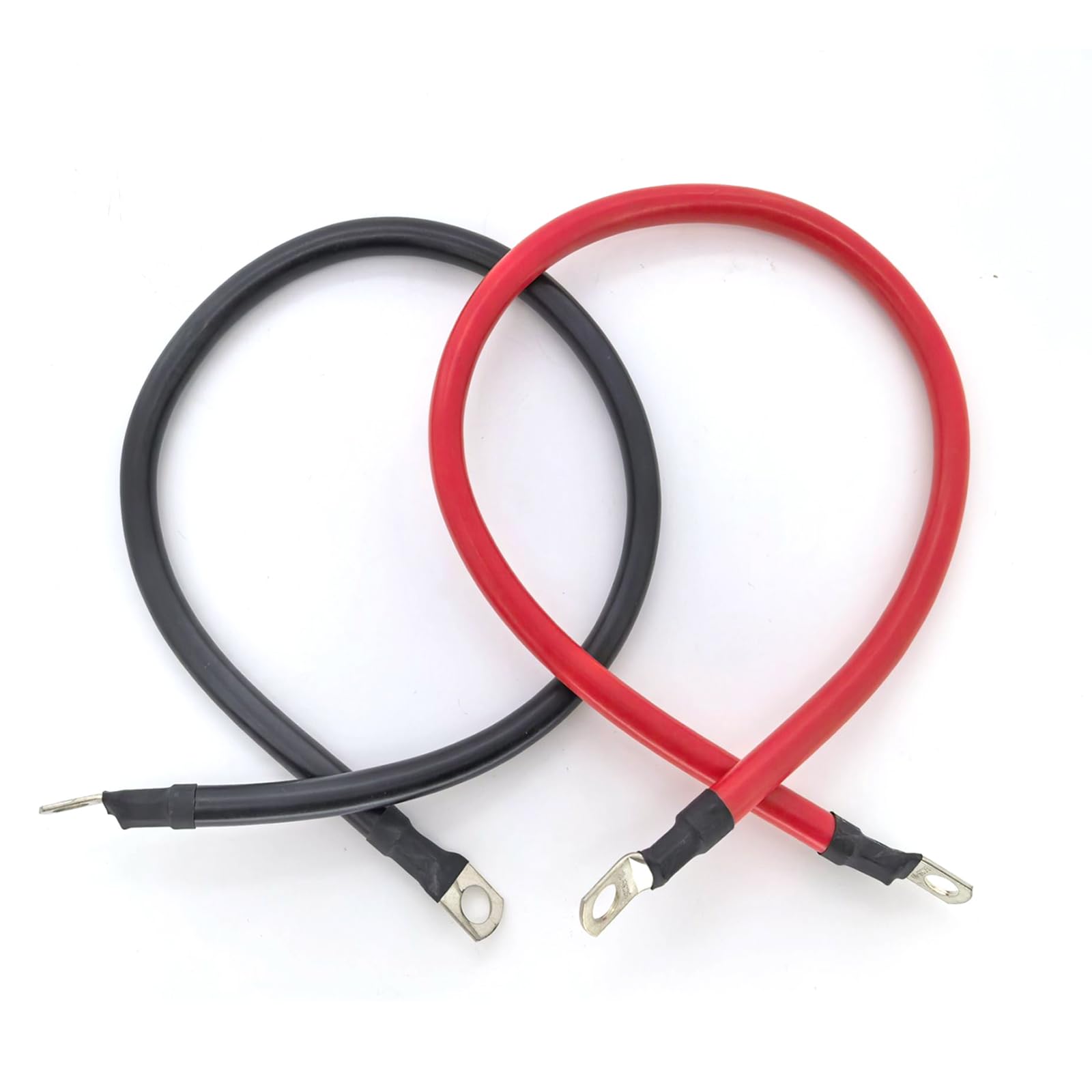
Heavy 2 AWG copper with two feet of reach and a 115 A rating that covers most dual-battery jobs.
This KEDAKEJI pair hits the combination a lot of dual-battery and solar-charging builds actually want: 2 AWG gauge for real current, 2 feet of length for a comfortable run, and 5/16 inch lugs on both ends. Each cable carries up to 115 A and up to 48 volts, so it handles a battery-to-inverter or battery-to-battery link without the sag of thinner wire. The oxygen-free copper and tin-plated terminals keep conductivity high and corrosion low.
The jacket is a 105 degree flame-retardant outer skin over flexible PVC, rated wear-resistant, waterproof, and heat-insulating. Build quality is the headline — 2 AWG oxygen-free copper with both ends crimped and heat-shrunk, ready to bolt up. Owners run them in dual-battery setups and solar charging systems, and the proper fit and appropriate length come up again and again. The flexibility is a bit of a split: some find it very flexible, some find it stiffer than advertised.
Contrast this with the ALFFAA set above — same 2 AWG core, but the ALFFAA goes silicone-flexible at 1 foot while this one gives you a second foot of reach in a stiffer PVC jacket. If you want the extra length for a dual-battery link, that second foot matters; if you want maximum bend for a cramped bay, the ALFFAA wins. Otherwise this is the balanced middle ground.
The balanced read: 2 AWG at 115 A with 2 feet of reach covers most dual-battery and solar setups; the only note is that the jacket leans stiffer than the marketing suggests, so plan the bends.
The right fit: a dual-battery or solar-charging install that wants heavy 2 AWG copper with a couple of feet of reach onto 5/16 inch studs.
The wrong fit: if you need soft silicone flexibility, or 3/8 inch posts, choose a different set.
8. Spartan Power 2 AWG Battery Cable Set, 2 ft

Hand-crimped in Nevada, rated to 1000 volts DC, and backed by a lifetime crimp warranty.
For the buyer who wants the wiring done once and forgotten, this Spartan Power set is the premium end of the group. It ships as one 2 AWG red and one 2 AWG black cable, each 2 feet long, with 5/16 inch (M8) tinned copper ring terminals crimped on both ends. The pure copper core is intended for DC use up to 1000V, so it covers everything from a 12V car battery to a 48V solar bank and beyond. It pairs naturally with the maker’s ANL fuse kits, too.
What pushes it to the top of the premium pile is the finish and the promise. Each cable is cut, crimped, and heat-shrunk by professionals, and the maker is explicit that the tinned terminals resist oxidation. Build quality is the strongest point — hand-crimped 2 AWG copper with tinned terminals and heat-shrink at every end. There is also a lifetime crimp warranty — if a crimp ever fails, Spartan Power repairs or replaces the cable. A lifetime crimp warranty is rare at this price, and the cable is made in Reno, Nevada, for buyers who want to know where their wiring came from.
Crimp quality draws mixed word-of-mouth even here, so give each terminal a firm tug before you bolt it down — it is a one-minute check that catches any loose end. Set that aside and the 2-foot reach, pure copper core, and 1000-volt DC rating make this the set you buy when reliability outweighs everything else.
What sets it above
- Pure 2 AWG copper rated for DC use up to 1000V
- Lifetime crimp warranty — a failed crimp gets repaired or replaced
- Tinned copper ring terminals fight oxidation
- Made in the USA in Reno, Nevada
Before you bolt it
- Crimp quality draws mixed feedback — tug-test each terminal
- Premium-tier build, so expect to pay for the warranty and finish
Choose it for: a long-life DC install — RV, solar, marine, or a car you plan to keep — where pure copper, a 1000V rating, and a lifetime crimp warranty are worth the premium.
Choose something cheaper if: you only need a quick 1-foot jumper and do not care about the warranty.
Understanding the Specs
Wire Gauge (AWG) and Current
AWG is the thickness of the copper core, and the number runs backwards — a 2 AWG cable carries far more current than a 6 AWG one. Each set here lists its maximum current, from 85 A on the 4 AWG A ABIGAIL to currents in excess of 200A on the 2 AWG ALFFAA. Pick the gauge by what your job draws: high-amp inverters and starters want 2 AWG, while small solar and accessory wiring can use 6 AWG. Going up a gauge never hurts; going down risks a hot, sagging connection.
Lug Size and Length
The ring terminal is the metal eyelet that bolts onto your post, and its bore has to match your stud — 5/16 inch or 3/8 inch. Measure the stud before ordering, because a mismatched ring will not seat flat and creates heat. Length then covers the run: 6-inch jumpers suit battery banks where posts sit close, 1-to-2-foot pairs cover battery-to-inverter gaps, and 3-foot runs reach across a bay. Buy the shortest cable that reaches with a little slack, since extra length adds resistance.
FAQ
How do I know if I need 2 AWG or 4 AWG battery cable?
Will a 5/16 inch lug fit my 3/8 inch battery stud?
What is the difference between pure copper and tinned copper lugs?
Can I use a 1-foot battery cable for a solar inverter install?
How many cables come in a battery cable set?
Are these battery cables safe for marine and outdoor use?
What length battery cable do I need for a dual-battery setup?
How do I install a battery cable so the connection stays tight?
Can I trim a 3-foot battery cable down to a shorter length?
Final Thoughts: The Verdict
For most buyers, the battery connection cable winner is the A ABIGAIL 4 AWG 1FT Pair because it pairs a rated 85 A copper core with 5/16 inch lugs crimped on both ends, ready to bolt onto a nearby inverter or battery post. If your studs are the wider 3/8 inch style, grab the TOPDC 4 AWG Pair for its 24 inch reach and heavier build. And for a whole battery bank wired in series or parallel, the Linkstyle 6PCS 2 AWG Set is the one to reach for, with six pre-crimped jumpers in a single box.
How We Picked
We do not accept paid placement. Every pick is matched to a real buyer and a real use-case; we do not hands-on test units.
Sources & Methodology
Specifications: manufacturer listings and product documentation. Review insights: verified customer reviews, as of November 2026. Pricing: not shown on this page (it changes often); check the current price via the retailer link.
As an Amazon Associate, Gadgets Feed earns from qualifying purchases. This does not affect which products we feature.