
Our readers keep the lights on and my morning glass full of iced black tea. As an Amazon Associate, I earn from qualifying purchases.
Specs are compiled from manufacturer listings and verified buyer reviews and can change over time — please confirm the key details on the product page before buying.
A battery can show a full 12.6 volts and still be dead — the only way to know is to put it under load and watch what happens. That is exactly what a battery cycle tester does, and it is the difference between buying a battery you did not need and finding the one bad cell that was ruining your morning starts.
I’m Min — the founder and writer behind Gadgets Feed. This guide is built by comparing the manufacturers’ published specifications and the patterns across verified customer reviews, so you get each pick’s real strengths and trade-offs instead of marketing spin.
Some tools measure mAh (milliamp-hours, a unit of battery capacity) on a bench charger, while others apply a real 100-amp load to a car battery. Knowing which job you need is what separates a wasted purchase from a battery cycle tester that earns its shelf space every single time.
Our Picks at a Glance


How To Choose The Best Battery Cycle Tester
First, decide what kind of battery you are testing. The tools in this guide split into two camps, and mixing them up is the fastest way to buy the wrong thing.
Bench chargers vs load testers
A bench analyzer charges, discharges, and refreshes individual cells — like the Opus BT-C2400, which handles AA and AAA rechargeables and measures true capacity in mAh. A load tester clamps onto a car, truck, or golf cart battery and applies a fixed current to see whether the voltage holds. If you are sorting Eneloops, you need the first kind. If you are chasing a car that cranks slowly, you need the second.
Load current and voltage range
Automotive load testers apply a set amperage — 100A is common for 12V, with 50A for 6V. Some cover 6V, 8V, 12V, 16V, and 24V; others stick to 12V or 24V. Match the voltage range to the vehicles you actually own, because an 8V golf cart battery is its own animal.
Analog vs digital readouts
Analog meters with a needle are simple and hard to misread. Digital testers add CCA ratings, internal resistance, SOH, SOC, and waveform graphs. Neither is automatically better — analog is faster for a yes/no call, digital gives you numbers you can record and compare over time.
Quick Comparison
| Model | Best For | Voltage Range | Load / Test Type | Weight | Amazon |
|---|---|---|---|---|---|
| BT-C2400 Battery Charger Analyzer★ Best Overall | AA/AAA cell capacity testing | NiMH / NiCd rechargeables | 4-channel charge/discharge/test | 8 oz | Amazon |
| KAIHENG Battery Load Tester CSY-4Budget Champion | Budget car battery testing | 6V / 12V | 100A / 50A fixed load | 0.45 kg | Amazon |
| AUTTGINN AT008Most Versatile | Multi-voltage garage use | 6/8/12/16/24V | 100A load test | 16 oz | Amazon |
| KONNWEI KW218 | Digital diagnostics with waveform | 6V / 12V | 100-2000 CCA digital analyzer | 200 g | Amazon |
| TOPDC 100A Battery Load Tester | Roadside and garage quick checks | 6V / 12V | 100A / 50A analog load | 2 lb | Amazon |
| Veepeak BT24 | 12V/24V fleet diagnostics | 9V / 24V | 100-2000 CCA analyzer | 10.4 oz | Amazon |
| VEHLIVE BT911 | Lithium and multi-voltage testing | 6V / 12V / 24V | 5-3000 CCA dual-channel | 0.35 kg | Amazon |
| TOPDON BT100 | All-round 12V workhorse | 12V | 100-2000 CCA analyzer | 9 oz | Amazon |
| ANCEL BT410 | Lead-acid and lithium dual testing | 12V / 24V | 100-2000 CCA analyzer | 0.4 kg | Amazon |
In‑Depth Reviews
1. BT-C2400 Battery Charger Analyzer Tester
Our pick — over 4.5★ from 700+ verified ratings; the strongest balance of quality and price.
The bench analyzer that brings dead NiMH cells back from the recycling bin.
If you run flashlights, cameras, or game controllers on AA and AAA rechargeables, this is the tool that tells you the truth about every one of those cells. Each of its four bays works independently, so you can charge, discharge, refresh, or test four batteries at once — the equivalent of four separate chargers sharing one housing. The backlit LCD shows capacity, voltage, time elapsed, and current for each channel separately, so you never have to guess which cell is the weak link.
Capacity tops out at 20,000 mAh, which covers every consumer NiMH and NiCd battery you are likely to own. A 1400 milliamp current rating means the outer two bays can push harder, while an adaptive low trickle charge keeps cells cool — buyers report batteries finishing near room temperature, not hot to the touch. At 8 ounces it sits on a bench without taking up real estate, and it runs from a DC power jack with 240-volt input support.
What wins people over is the restore function — as owners put it, the device “effectively restores life to old NiMH batteries,” including one case of 15-year-old units coming back. Its 8-ounce build versus the 16-ounce AUTTGINN above is a reminder that a bench charger and an automotive load tester are different tools, even if both carry the “battery tester” label. The honest catch: refresh mode is slow and does not report which cycle it is on, and the manual is thin on explaining the diagnostic modes.
What owners rely on
- Four independent bays — charge four cells at different rates simultaneously
- Per-slot readout of voltage, current, and capacity
- Adaptive current rescues high-resistance cells other chargers reject
- 20,000 mAh ceiling handles any consumer NiMH or NiCd
- Handles Charge, Discharge, Refresh, and Test modes in one unit
What to expect
- Manual is thin — diagnostic modes need trial and error
- Refresh mode gives no cycle counter
- Four-battery max per session
- NiMH and NiCd only — no lithium support
Made for flashlight and camera owners: anyone running a drawer full of Eneloops or NiCd cells who wants real capacity numbers instead of guesses.
Not the tool for: car, truck, or golf cart batteries — those need a load tester, not a bench charger.
2. KAIHENG Battery Load Tester CSY-4
The no-frills analog box that tells you in ten seconds whether a battery is done.
This is the simplest tool in the roundup: clamp the copper leads to your terminals, hold the load switch, and watch the voltmeter needle. A fixed 100-amp load current drains the battery the way a starter motor would, so you see how the voltage holds under real demand rather than at rest. Voltage accuracy is rated at ±0.2V, and the 50-amp load test handles 6V batteries while the full 100 amps is reserved for 12V units.
The insulated carry handle and color-coded copper clips with red and black rubber grips make it safe to handle in a garage. It weighs 0.45 kg, so it stores on a shelf or in a toolbox without fuss. Owners mention it caught a golf cart battery that read 12.3V at rest but failed under load — the exact scenario where a resting voltage reading would have said “fine” and left you stranded.
Functionality is what people talk about most, and the analog meter has essentially nothing to break or misinterpret. The trade-off is durability: the clamps are the recurring weak point, with several buyers reporting breakage within about seven months. The instructions also have errors — they call the analog meter an “LCD Display” and reference polarity LEDs that do not exist on the unit. It may smoke on first use as manufacturing oils burn off, which is normal but startling if you are not expecting it.
Who this rewards: someone who wants a cheap, readable yes/no on a car, ATV, or golf cart battery and does not need digital numbers or CCA values.
The honest caveat: those clamps are the part to watch — handle them gently and it will serve you well for years.
Grab it if: you want the lowest-commitment way to load-test a 6V or 12V battery in your own garage.
Pass if: you need digital CCA readings, alternator diagnostics, or clamps built for daily shop abuse.
3. AUTTGINN AT008 Battery Load Tester
Five voltage settings in one handheld box, from 6V motorcycles to 24V trucks.
Most load testers pick a lane — 6V and 12V, or 12V and 24V. This one covers 6V, 8V, 12V, 16V, and 24V, which means it can follow you from a motorcycle to a golf cart to a commercial truck without a second purchase. The 3-step LED display and polarity test function give you a quick read on battery condition, and the 100-amp load capacity handles the heavier end of that range.
At 16 ounces it is noticeably heftier than the 8-ounce Opus bench charger, but that weight comes from the heavy leads and copper-plated steel clamps with strain relief — the parts that take the abuse. The cable is 24cm long, which keeps it compact enough to store in a car without tangling, though that short length means you need to be close to the battery terminals.
Build quality earns the most praise here. It has found bad cells: a Club Car 8V battery reading 8.3V at rest dropped to 7.1V under load, and in a four-battery 12V golf cart bank the first three held around 10.8V under load while the last dropped to nothing. That kind of fault-finding saves a shop visit. Just know the voltage range is the loose end — one owner found it did not suit their particular 8V golf cart batteries, and the English instructions are garbled, with the real guidance printed on a rear decal. Hold the load switch no more than 5 to 10 seconds, and do not be alarmed by initial smoke as protective oils burn off.
Where it delivers
- Five voltage ranges: 6V, 8V, 12V, 16V, and 24V
- Heavy leads with strain relief and copper-plated steel clamps
- 3-step LED display plus polarity test
- 16 ounces — solid enough to feel like a real tool
Known friction points
- Instructions are garbled — read the rear decal instead
- Short 24cm cable limits reach
- Occasional 8V golf cart compatibility complaints
- Load switch max 5 to 10 seconds
Best matched to: a home garage with a mix of 6V, 12V, and 24V vehicles where one tester needs to cover all of them.
Look elsewhere if: your fleet is all 8V golf cart batteries and you need confirmed compatibility from the start.
4. KONNWEI KW218 Car Battery Tester

A digital analyzer that reads a battery like a lab instrument, down to the waveform.
Instead of draining your battery, this tester reads its internal resistance and voltage to calculate health, charge, cold cranking amps, and AH capacity. It handles all 6V and 12V batteries rated 100-2000 CCA, including regular flooded, AGM flat plate, AGM spiral, and gel. It also runs cranking, charging, alternator, and starter tests in the same device.
What separates it from the analog load testers is the waveform analysis — it tracks real-time voltage change, which is useful when you want to see how the charging system behaves rather than just whether the battery passes. The large color screen and enhanced alloy clips are the other differentiators; the clips increase contact area for faster, more accurate readings. It supports 8 languages and weighs 200 grams, small enough to tuck in a glovebox.
Reliability is what buyers talk about most, with repeatable results when the battery type and CCA rating are entered correctly. The unit only powers on when clipped to a battery and the summary page keeps your last result even after power is cut. The catch is the 2-foot leads — too short to run a charging test solo, since you need to rev the engine to around 2,500 RPM while watching the screen. It also self-powers from the tested battery, so a fully dead battery may not wake it up. A handful of units arrive with a dead screen, so test yours before the return window closes.
Why it earns a look: the waveform function is rare at this end of the market, and the cranking and charging tests together cover the full starting system, not just the battery.
What to know going in: budget for a helper or a longer reach — those 2-foot leads are the limiting factor for solo charging tests.
It suits: the home mechanic who wants digital numbers and waveform data rather than a needle swing.
Skip past it if: you mostly want a one-hand load test and do not care about CCA or internal resistance readouts.
5. TOPDC 100A Battery Load Tester
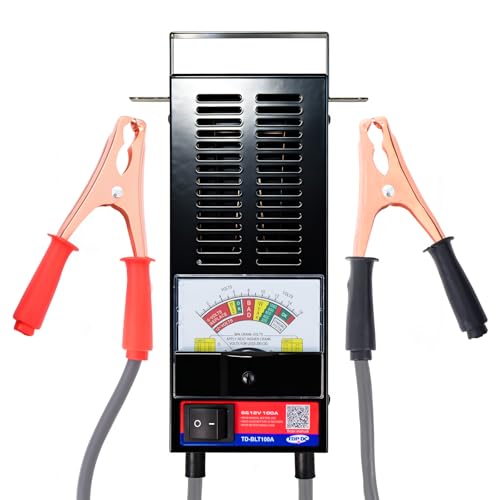
The old-school dial tester built for roadside work, not bench tinkering.
A shock-resistant analog meter is the heart of this one, wrapped in a perforated housing that vents heat during load tests. It works with 6V and 12V batteries across cars, motorcycles, RVs, boats, and ATVs, and it reads Cold Cranking Amps from 100 to 1000 — the number you compare against your battery’s spec plate. Load test specs run 50 amps for 6V and 100 amps for 12V.
At 2 pounds it is the heaviest tool here, but that weight is deliberate: the shock-resistant meter survives being tossed in a truck bed, and the rubber insulated carrying handle makes it easy to haul. Heavy-duty alligator clips with red and black color coding keep connections clean, and circular cooling holes let heat escape during extended load tests. The 13.8-volt maximum operating voltage covers a healthy charging system reading.
Customers note it works well for roadside assistance work — it is a tool you grab and use without menus. Functionality is the standout across the reviews, with buyers noting it did exactly what was needed. Two things to size up before you commit: it is bulky to store, and one unit reportedly stopped working after two months and smoked on each use. Those are outliers, but they are the reason the analog simplicity is paired with a shorter track record than the digital units.
Reach for it if: you want an analog tester heavy enough to survive a garage or roadside toolkit and simple enough to read at a glance.
Think twice if: shelf space is tight or you want digital CCA and SOH numbers you can write down.
6. Veepeak BT24 12V 24V Car Battery Tester
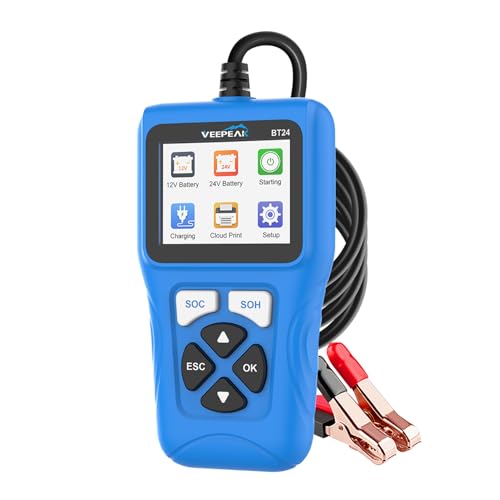
A 10.4-ounce analyzer that turns battery health into plain numbers and status codes.
This is a diagnostic tool, not a load bank. It reads voltage, capacity, internal resistance, State of Health (SOH, a percentage of remaining battery life), and State of Charge (SOC, how full the battery is) to give you a fast verdict instead of a reading you have to interpret. It covers 100-2000 CCA (cold cranking amps, the power needed to start an engine in cold weather) and works with AGM, EFB, GEL, and flooded lead-acid batteries across 12V and 24V systems, with a minimum operating voltage of 9V and a 24V ceiling.
The cranking test watches voltage drop during engine start to catch a battery that is aging but still passing a static check, while the charging test looks for overcharging, undercharging, and unstable alternator output. The unit powers itself from the battery under test — just connect the reverse-polarity-protected clamps and go. At 10.4 ounces it is light enough to hold against a battery one-handed, and it carries a one-year replacement warranty.
Buyers routinely compare it to professional shop testers and come away satisfied, with readings validated against a separate ohm meter. The one real annoyance is the cable length: the charging test asks you to hold the engine above 2,500 RPM for three seconds, and a 1-meter cable makes that a two-person job. The cranking-test instruction screen also uses reversed wording from a translation error, which trips up first-timers. Set the CCA value correctly and it delivers on the promise.
The case for it
- Reads SOH, SOC, internal resistance, and capacity
- 12V and 24V coverage from the start
- Reverse-polarity protection and self-powering from the tested battery
- 10.4 ounces — genuinely pocketable
Where it pinches
- 1-meter cable is short for the charging test
- Cranking instruction wording is reversed — translation issue
- No lithium support — lead-acid only
- Clips are fair, not shop-grade
It fits: a DIY owner with several 12V or 24V vehicles who wants professional-grade numbers without a shop price.
Not the best fit if: you need to test lithium batteries or want a load bank that drains the battery rather than measures it.
7. VEHLIVE BT911 Car Battery Tester
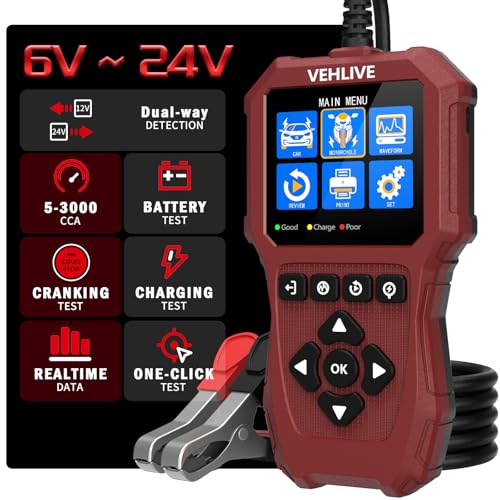
The one tester here that reads lithium packs as well as lead-acid, up to 3000 CCA.
Most battery testers stop at lead-acid. This one handles lithium in addition to flooded, AGM, AGM screw-type, GEL, and EFB, and extends the CCA ceiling to 3000 — higher than the 2000 CCA that most of its rivals top out at. A free firmware upgrade on the manufacturer’s website enables the lithium detection system, so check that step before your first test.
The dual-channel design is the technical centerpiece: it calibrates 12V and 24V batteries on separate circuits so the readings do not interfere with each other. It reads SOH, SOC, CCA, voltage, internal resistance, starting voltage, starting time, alternator output, no-load voltage, and load voltage — a full starting-system picture in one pass. There is also a dedicated 6V motorcycle mode with 325 battery models in its database, useful if you service small bikes.
Functionality and quality lead the feedback, and owners note it is compact enough to live in a glovebox. The build is light-duty compared to shop-grade gear, the cable is short at 3.28 feet, and the instructions are basic — one buyer had to search online to figure out how to power it on. Its waveform analysis tracks real-time voltage change for diagnosing intermittent faults. For all but the most demanding shop use, that is plenty.
The standout: lithium testing on a unit that also covers 6V, 12V, and 24V lead-acid — no other pick here spans that range.
The reality check: light-duty housing and a short 3.28-foot cable mean it is a glovebox tool, not a daily-driver shop instrument.
Worth it for: anyone running lithium batteries alongside traditional lead-acid who wants one tester that handles both.
Overkill for: a single 12V car battery where a basic 12V analyzer would do the job at lower cost.
8. TOPDON BT100 12V Car Battery Tester

The one that has convinced the largest crowd of home mechanics, by a wide margin.
Count the track record first: 4.6 stars across more than five thousand ratings. That is not a small sample — it is the most-reviewed tool in this roundup, and it has built that record on being easy, accurate, and reliable for 12V lead-acid batteries. It handles 100-2000 CCA and supports regular flooded, AGM flat plate, AGM spiral, EFB, and GEL chemistries, roaming across cars, motorcycles, trucks, RVs, and golf carts.
The three-function workflow covers everything you need: a health test for battery condition, a cranking test for whether the electrical system has enough juice to start the engine, and a charging test for the charging current, rectifier diode, and generator. It powers on only when properly attached — a safe passive design that cannot drain the battery under test, and the copper clamps include polarity reverse prevention and spark-proof features. At 9 ounces and sized like a large phone, it tucks into a glove box or center console easily.
Ease of use and accuracy earned that review volume honestly. People report it catching a battery the shop had tested “good,” saving them a tow, and the 3-color LED output makes the go/no-go call readable across a garage. It pairs with a well-written manual, which matters more than you would think. One limitation to know: it is 12V only — no 6V, no 24V — so it will not help with an older motorcycle or a truck with a 24V system.
Where it wins
- 100-2000 CCA across flooded, AGM, EFB, and GEL
- Full battery, cranking, and charging system tests in one unit
- Polarity reverse prevention and spark-proof copper clamps
- 9 ounces, glovebox-sized
Limits to accept
- 12V only — no 6V or 24V testing
- No carbon pile load testing for bad-cell confirmation
- Slight learning curve on the menu system
- Priced above the bare-bones analog units
Perfect for: the driver with one or two 12V vehicles who wants a quick, trustworthy read on battery health without a shop visit.
Choose a different pick if: you also need 6V or 24V coverage — the AUTTGINN above handles those, this one does not.
9. ANCEL BT410 12V 24V Car Battery Tester
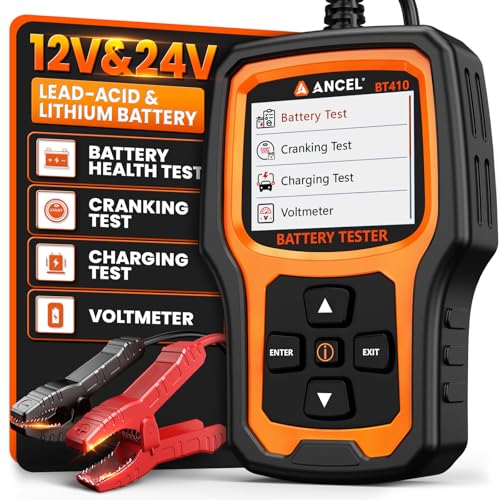
A 31.5-inch-cable tester that reads lithium and lead-acid, then hands you a QR report.
The 800mm cables are the practical differentiator here — that is 31.5 inches of reach, enough to test a battery buried under a hood or in a battery box without playing tug-of-war with the terminals. The tester itself supports 12V and 24V systems and handles both lead-acid (AGM, GEL, regular flooded, EFB) and lithium-ion batteries, so one tool covers the whole driveway. An advanced smart chip drives its rated accuracy above 99.9%.
The 2.4-inch color TFT screen with adjustable contrast and day/night mode is a step up from the LED displays on the budget picks, and it stays readable whether you are testing in sunlight or a dark garage. Diagnostics cover State of Charge, State of Health, voltage, and internal resistance, and the cranking and charging tests pinpoint whether a weak starter, a failing alternator, or excessive ripple voltage is to blame for a rough start. Results come as a clear verdict — [GOOD BATTERY], [GOOD-RECHARGE], or [REPLACE BATTERY] — plus a shareable QR report for your records.
Functionality and quality lead the buyer feedback, which tracks with the comprehensive feature set. It is rated for temperatures from -4°F to 158°F, but stores only 5 results before you must clear memory manually. It powers from the tested battery, so you need a live battery to access the menus. The QR timestamp reflects creation time, not test time, which can confuse record-keeping. Those are small frictions on an otherwise polished premium tool.
Why it earns premium status: the combination of 31.5-inch cables, dual-battery-chemistry support, and QR reports makes it the most complete kit in this roundup for serious record-keeping.
Worth knowing: the 5-result storage limit and manual memory clearing make this a reporting tool, not a data logger — keep that in mind if you test frequently.
Best for: the buyer running a mixed fleet of lead-acid and lithium batteries who wants long reach and shareable reports.
skip it if: you only test one 12V car battery and do not need 24V or lithium coverage — the KONNWEI above covers that narrower need for less.
Understanding the Specs
CCA, SOH, and SOC Explained
CCA stands for Cold Cranking Amps — the current a battery can deliver at cold temperatures to start an engine. A tester reading 100-2000 CCA can handle everything from a lawn mower to a large truck. SOH (State of Health) is a percentage telling you how much of its original capacity the battery still holds; SOC (State of Charge) is how full it is right now. A battery can show high SOC and low SOH — that means it is charged but worn out, and that is the reading a voltage-only check misses.
Load Testing vs Resistance Testing
A load tester applies a real current — typically 100 amps for 12V and 50 amps for 6V — and watches whether the voltage holds. This is the closest thing to simulating a starter motor’s demand. A resistance tester reads internal resistance instead, does not drain the battery, and produces faster results. Load testing is more definitive for a failing battery; resistance testing is quicker, safer, and does not require you to hold a switch for 10 seconds while watching a needle drop.
FAQ
Will a 6V load tester work on my golf cart’s 8V batteries?
What is the difference between a battery load tester and a battery charger analyzer?
How long should I hold the load switch on a battery tester?
Can a battery tester tell me if my alternator is bad?
Do battery cycle testers work on AGM and gel batteries?
Why does my battery read 12.6 volts but the car won’t start?
Can I test a battery without taking it out of the car?
Will a battery tester work on a lithium battery?
How accurate are the CCA readings on digital testers?
How long should a car battery last before I need to replace it?
Final Thoughts: The Verdict
For most people who own a mix of rechargeable cells, the battery cycle tester winner is the Opus BT-C2400 because it measures true capacity in mAh across four independent bays and rescues aging NiMH batteries other chargers refuse to touch. If your job is car, truck, or golf cart batteries instead, the TOPDON BT100 is the one to trust — it has earned the deepest review record here and makes battery health a two-minute check. And for a mixed fleet that includes lithium packs, the ANCEL BT410 is the tool that covers both chemistries with 31.5-inch cables that reach the awkward spots.
How We Picked
We do not accept paid placement. Every pick is matched to a real buyer and a real use-case; we do not hands-on test units.
Sources & Methodology
Specifications: manufacturer listings and product documentation. Review insights: verified customer reviews, as of September 2026. Pricing: not shown on this page (it changes often); check the current price via the retailer link.
As an Amazon Associate, Gadgets Feed earns from qualifying purchases. This does not affect which products we feature.