
Our readers keep the lights on and my morning glass full of iced black tea. As an Amazon Associate, I earn from qualifying purchases.
Specs are compiled from manufacturer listings and verified buyer reviews and can change over time — please confirm the key details on the product page before buying.
You have a drawer full of dead batteries, and you know tossing them in the trash is bad for the planet. Leaving them loose in a drawer can cause a short circuit (when the terminals touch, they can spark) and even start a fire. The right container keeps every dead cell stable and separated, so your trip to the recycling center is simple and safe.
I’m Min — the founder and writer behind Gadgets Feed. This guide is built by comparing the manufacturers’ published specifications and the patterns across verified customer reviews, so you get each pick’s real strengths and trade-offs instead of marketing spin.
Whether you manage a few household AAAs or a serious collection of rechargeables, these are the best battery disposal container options you can buy today.
Our Picks at a Glance


How To Choose The Best Battery Disposal Container
A disposal container is different from a simple storage box. You need something that keeps spent batteries contained, prevents accidental contact between terminals (which can cause a short circuit and even a fire), and makes it easy to transport them to a recycling drop-off. The right choice depends mostly on volume, material safety, and if you want a built-in tester.
Capacity and Volume
Think about how many batteries your household goes through in a year. A small family might fill a 1-gallon pail over twelve months, while an office or a workshop with many power tools could fill a 3.5-gallon container in half that time. A container that is too large tempts you to leave batteries inside for years, while one that is too small means frequent trips to the recycling center.
Material and Fire Safety
Lithium-ion batteries carry a real fire risk, especially if the terminals short-circuit inside a pile of other cells. Look for containers made from non-conductive, durable plastic (like HDPE or PP) that will not spark. Some premium options use fire-resistant materials like a blend of E-glass fiber and silicone, or thick steel. For most households, a sturdy plastic bin with a lid is sufficient, but if you handle many rechargeable lithium cells, consider a fire-rated bag or metal box.
Built-in Tester vs. Pure Storage
A battery tester saves you from accidentally tossing a good cell. Several containers in this guide include a BT-168 or similar tester that checks AA, AAA, C, D, and 9V batteries. If you are the type who keeps batteries until they are truly dead, a container with an integrated tester is very convenient. If you already have a tester or only collect obviously drained batteries, a simpler bin without the extra component is perfectly fine.
Ease of Transport and Disposal
When the container is full, you will need to carry it to a local drop-off or mail it in. A container with a secure lid or seal is essential. Some high-end recycling kits come with a prepaid return label, so you just tape the box shut and send it off. For everyday drop-offs, choose a container that is easy to lift even when it is heavy with batteries.
Quick Comparison
| Model | Best For | Capacity | Material | Includes Tester | Amazon |
|---|---|---|---|---|---|
| ECO Battery Bin★ Best Overall | All-in-one disposal + testing | Large (claims many batteries) | Plastic | Yes (AA, AAA, C, D) | Amazon |
| HAEZU Disposal ContainerBest Value | Compact, simple drop-off | 0.28 gallons | Plastic | No | Amazon |
| Tututry OrganizerUltra-Large Organizer | Storing good + dead batteries | 262+ batteries | PPC w/ sponge insulation | Yes (BT-168) | Amazon |
| BTSKY 4-Drawer | See-through drawer organization | 176 batteries | Acrylic (BPA-free) | No | Amazon |
| QHAND Recycling Bin | Office or home recycling program | 1.32 gallons | Plastic | Yes (AA, AAA, 9V, button) | Amazon |
| PIG Disposal Container | Universal waste compliance | 2 gallons | HDPE / PP | No | Amazon |
| Winkee Volt Vault | Aesthetic desk or kitchen counter | 1.6 liters (~0.42 gal) | Stainless Steel | No | Amazon |
| VLITEX Lipo Bag (L) | High-risk lithium battery storage | Fits 4+ large cells | E-glass fiber & Silicone | No | Amazon |
| EZ on the Earth 3.5 Gal | Mail-in recycling kit | 3.5 gallons | HDPE (liner), Cardboard | No | Amazon |
In‑Depth Reviews
1. ECO Battery Bin (Test, Store & Recycle)
Our pick — over 4.5★ from 150+ verified ratings; the strongest balance of quality and price.
The only bin that tests your stash before you say goodbye to it.
The ECO Battery Bin earns its top spot because it combines a disposal container with a battery tester — so you never guess whether a cell is truly dead. It handles AA, AAA, C, and D batteries (but not 9V). One owner reports that even after three years of steady use, the bin is “still not full.” At 5.04 x 5.04 x 8.98 inches, it is tall enough to swallow a surprising number of batteries without hogging your closet shelf. The tester works on fresh, used, and dead cells, giving you clear confirmation before you toss anything. Buyers consistently praise the build quality, noting it feels sturdy and the lid stays secure. The recurring advice from experienced owners: tape the terminals (the metal ends) of lithium batteries before dropping them in to prevent a short circuit.
Eco drop-and-store: The built-in tester covers four common sizes, making this an all-in-one station for any household that goes through a steady stream of AA and AAA batteries.
Best for quick disposal: Families or individuals who want a no-fuss, test-and-toss workflow that keeps dead batteries out of landfills.
Think if small batch: You need to test 9V batteries or you prefer a reusable container for storage of good cells.
2. HAEZU Battery Disposal Container
A compact, clearly-labeled bin for the occasional battery user.
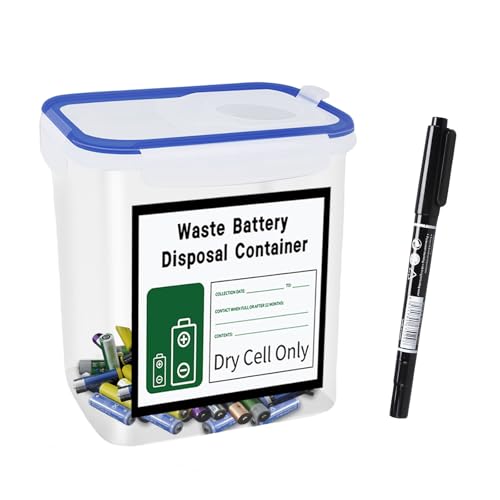
At just 0.28 gallons, the HAEZU container is the smallest dedicated disposal box on this list — and that is exactly why it works for many people. You can date and label the bin with the included sheet and pen, so you know when you started filling it. The 6.4 x 4.7 x 4 inch dimensions make it shorter and squatter than the ECO Battery Bin, so it fits into tight spaces like a kitchen cabinet. Owners note it “holds all our used batteries, except button cells,” calling it handy for consolidating the random dead cells that otherwise end up in multiple junk drawers. A few buyers mention it is not big enough for a high-volume household, but that is by design.
Honest capacity: The compact size means you will fill it and recycle it more often — a good habit for responsible disposal.
Best for clear volume: Light users who recycle a handful of batteries a year and want a tidy, labeled container that fits anywhere.
Think if large load: You have a home workshop or power tools; the 0.28-gallon capacity will fill up quickly.
3. Tututry Battery Organizer Storage Holder (262+ Batteries)
Your entire battery collection — good, bad, and button — in one organized case.
This is not just a disposal container; it is a full battery management station. The Tututry organizer holds 262+ batteries in double-sided, compartmentalized trays, and it includes a BT-168 tester (which checks AA, AAA, C, D, and 9V voltage) so you can instantly sort the keepers from the dead ones. D cells get 6 slots, C cells get 8, 9V gets 8, AA gets 46, AAA gets 42, and button cells (small coin-shaped batteries) get 87 slots across both sides. There are even dedicated spots for 18650, CR123A, 4LR44, and other lithium coin cells. The case uses fireproof PPC material (a type of flame-resistant plastic) with a sponge insulation layer. One owner said, “no more searching drawers for the correct battery.” At 11.8 x 9.1 x 3.8 inches, it is larger than most pure disposal bins.
Maximum organization
- Double-sided design with 17 different slot types, including 18650 and button cells
- Built-in BT-168 tester eliminates guesswork
- Fireproof PPC material plus sponge insulation for safety
No disposal use
- It stores good and dead batteries together; you still need to separate dead ones for recycling
- At 11.8 x 9.1 x 3.8 inches, it is larger than most pure disposal bins
Best for sorting: Anyone with a deep collection of rechargeable and alkaline batteries who wants a permanent home for every cell, with the ability to test and sort on the spot.
Think if recycling: You only want a container to collect dead batteries and do not need storage for good ones.
4. BTSKY Clear Acrylic 4-Drawer Organizer

See every battery at a glance with this transparent, stackable drawer box.
The BTSKY organizer takes a different approach — it is a storage box, not a disposal bin, but it works beautifully for keeping dead batteries separated from live ones until recycling day. The clear acrylic body means you can see the contents of each of the four drawers without pulling them open. Each drawer measures 6.7 x 2.2 x 2.2 inches, and the whole unit holds up to 176 batteries: 80 AAA, 48 AA, 18 9V, and 12 C cells. It does not fit D batteries. The build is BPA-free acrylic (a type of clear plastic that does not contain the chemical BPA). Owners find it “sturdy” and “not too flimsy.” Unlike the Tututry, which requires opening to see inside, this one is fully transparent. The trade-off: the acrylic feels thinner than premium alternatives, and the drawers lack internal partitions, so smaller batteries can slide around.
Clear drawer view: The fully transparent structure eliminates rummaging; you see instantly which drawer has the AA cells and which has the 9V.
Best for visual access: Households that want a clean, desktop-friendly way to store and organize different battery sizes with minimal effort.
Think if leakage: You need a dedicated disposal bin with a sealed lid, or you regularly handle D batteries.
5. QHAND Battery Recycling Container (1.32 Gal)

A complete recycling station with a sealed lid and a tester for your desk or counter.
QHAND designed this 1.32-gallon bin as an all-in-one recycling solution. It comes with a battery tester that works on AA, AAA, C, D, 1.5V, 9V, and 1.5V button types, and the container itself has a sealable lid (a lid that locks shut to prevent spills). At roughly 7.87 inches square and 7 inches tall, it is square and stable. Owners use it to start office recycling programs, praising that it “holds enough and you can still carry it without difficulty.” One reviewer noted the tester “has proven to be handy and very easy to use on all size batteries.” Compared to the ECO Battery Bin, the QHAND tests 9V batteries and button cells too. The main trade-off is the plastic construction, which some feel is average quality.
Seal-and-drop: Test your batteries, drop them in, and seal the lid. The transparent plastic lets you monitor the fill level without opening it.
Best for home recycling: Home offices and small businesses that want a tidy, complete recycling kit with a tester and a secure lid.
Think if high volume: You need a larger capacity for a family of heavy battery users; 1.32 gallons may fill fast.
6. PIG Battery Disposal Container (2 Gallon)

A no-nonsense 2-gallon pail built to meet universal waste regulations.
The PIG container is a straightforward, large-capacity bin for compliance. Its clear polyethylene body lets you see the fill level, and the sealable lid keeps dead batteries contained. With a 9.25 x 7.25 inch opening and a 2-gallon capacity, it can hold months of battery waste for a family. The bottom is made from HDPE (high-density polyethylene, a durable plastic) and the lid from PP (polypropylene, another sturdy plastic). Owners say it is “exactly what it says it is” and “reliable.” The main downsides: it is noticeably more expensive than the QHAND despite being just a bin with no tester, and the perforated pull-tab opening is difficult for some to remove. One buyer called it “flimsy” for the cost, while others consider it a solid value. Choose this over the QHAND only if you need universal waste compliance labels and a larger 2-gallon capacity without a tester.
Regulation compliant: The pail is clearly marked for waste battery collection and eliminates the need for open containers in a workshop or garage.
Best for workplace: Workshops, garages, or any space where you need a large, compliant container that meets universal waste rules.
Think if space tight: You want a tester included or a container that looks good on a kitchen counter; this is purely functional.
7. Winkee Volt Vault Battery Box
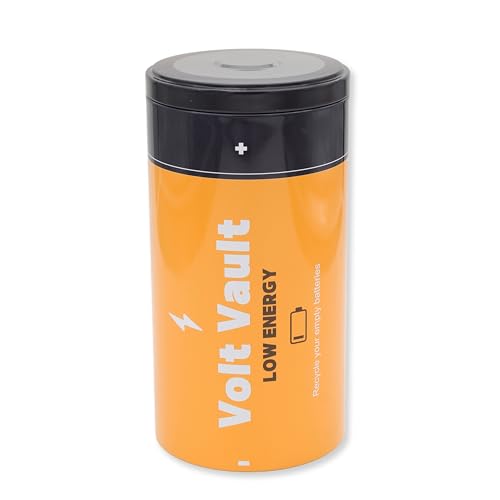
A battery-shaped metal box that turns disposal into a desk accessory.
The Volt Vault is the most visually interesting container on this list. It is made from polished stainless steel and shaped like a giant AA battery, so it looks like a conversation piece rather than a waste bin. At 3.74 x 3.74 x 7.28 inches, it has a 1.6-liter capacity (~0.42 gallons) — enough for a household’s dead batteries but not for heavy users. The pull-out opening is smooth, and the rustproof steel construction means it will not degrade over time. Owners call it “aesthetic” and say it is “more pleasant than a cardboard box for office battery collection.” Unlike the PIG container, this fits on a kitchen counter without looking like industrial equipment. It costs more per gallon than plastic options, but the build quality and design set it apart. One buyer mentioned it is “slightly larger than necessary for storage, but a plus for regular collectors.”
Countertop design: The polished stainless steel and clever battery design make it a gift-worthy piece you will not mind leaving out in the open.
Best for display: Environmentally conscious users who want a attractive, durable container that sits on a desk or kitchen counter without looking like a trash bin.
Think if budget: You need a large capacity or a built-in battery tester.
8. VLITEX Lithium Battery Storage Box L
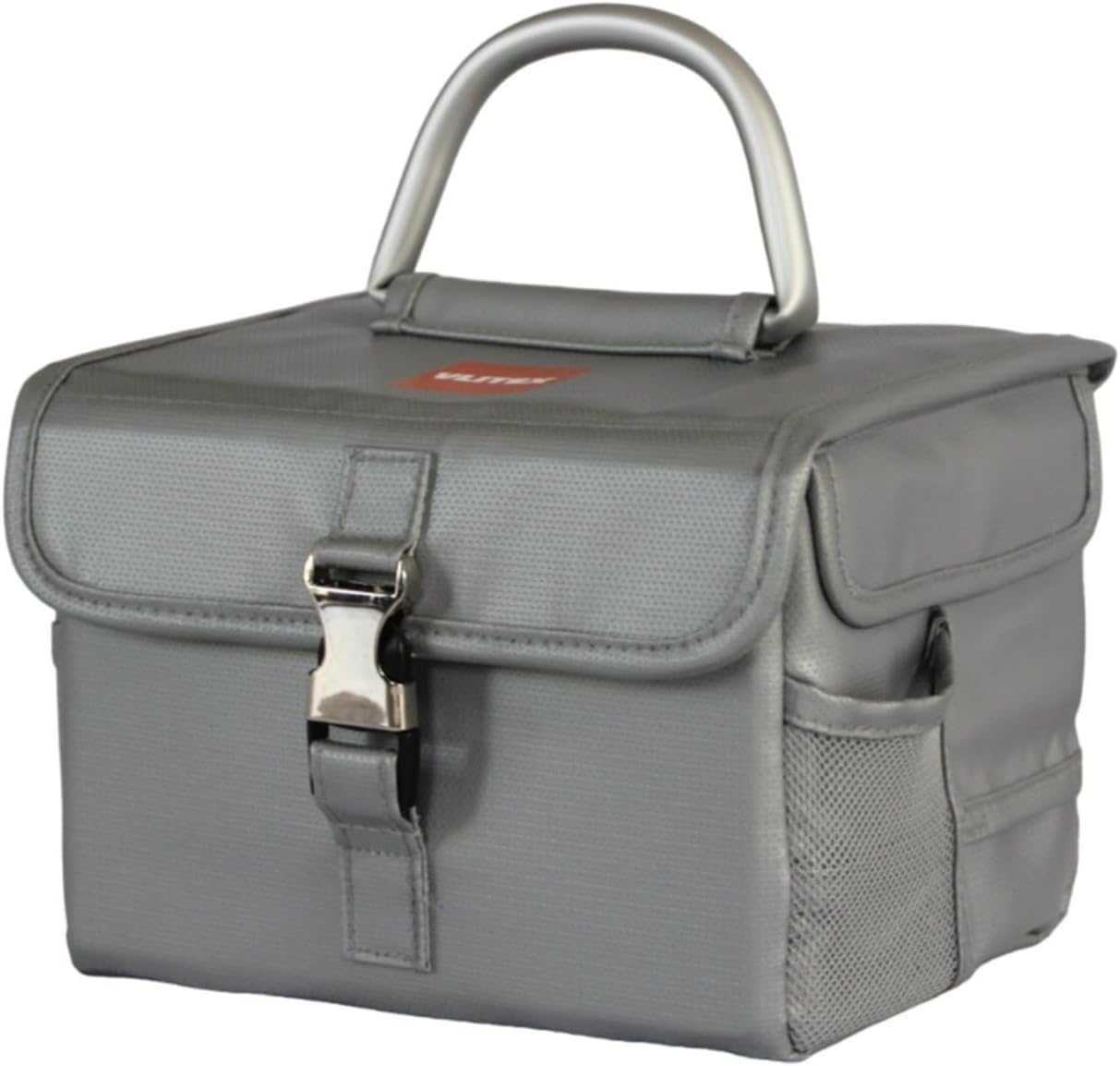
Engineered in Germany for the highest level of lithium battery fire safety.
If you handle lithium-ion batteries regularly — for power tools, e-bikes, drones, or RC hobbies — the VLITEX L box is your safest option. It is made from a multi-layered blend of E-glass fiber and silicone, materials designed to withstand intense fire and slow the spread of flames and smoke. The box measures 17.3 x 5.1 x 4.7 inches, comes with a secure zipper closure, and has three compartments with Velcro dividers so you can organize different battery sizes. It is certified by multiple institutes and tested by fire departments. Buyers confirm the build quality is “wertig” (high-quality) and note the zipper “schließt gut” (closes well). The main catch: the L size is smaller than the photos suggest — one owner says “it only holds four batteries,” meaning large power tool packs. Unlike the Winkee Volt Vault, which is for all battery types, this is a specialized safety device for those who absolutely need fire-containment for lithium cells.
Lithium safe: The E-glass fiber and silicone blend actively reduces fire risk during charging, storage, and transit of lithium batteries.
Best for lithium cells: Hobbyists, drone pilots, and e-bike owners who store and charge lithium-ion batteries and want certified fire protection.
Think if mixed types: You only deal with alkaline household batteries; this is overkill for standard AA and AAA cells.
9. EZ on the Earth Dry Cell Battery Recycling Container (3.5 Gal)

A complete mail-in recycling kit with a 3.5-gallon capacity and a free return label.
This is the only container on the list that functions as a complete recycling service. The 3.5-gallon HDPE pail comes with a plastic liner, zip ties, and a prepaid return label. You fill it with dead dry-cell batteries (alkaline, NiCad, Zinc-Carbon, rechargeable lithium-ion, NiMH, mercury, silver-oxide, AA, AAA, C, D, and 9V), then seal the box and mail it back for proper recycling. It is UN approved for dry cell battery transport — meaning it meets United Nations safety standards for shipping. The container holds up to 41.8 pounds of batteries. One owner reported that a 5-person household filled about half a gallon in 10 months, so the 3.5-gallon pail will last a long time. The kit must be returned within 12 months of purchase. The included label and simplicity are the main draws, though the upfront cost is the highest on this list.
All-in-one kit: Fill it, attach the free return label, and send it off — you never have to find a local drop-off or pay extra fees.
Best for turnkey use: Households or offices that generate a steady volume of mixed battery waste and want the easiest, most responsible disposal process without leaving home.
Think if small area: You prefer to drop batteries at a local recycling center and want to avoid the higher upfront cost of a mail-in kit.
Understanding the Specs
Capacity (Gallons or Liters)
This tells you how much volume the container holds. A 0.28-gallon bin (like the HAEZU) is fine for a few dozen batteries, while a 3.5-gallon pail (like the EZ on the Earth) can hold over 40 pounds of cells. Choose based on how many batteries your household goes through — a family of four typically fills about 0.5 gallons per year.
Material and Fire Resistance
Standard plastic bins (HDPE, PP, acrylic) are non-conductive and safe for alkaline batteries. For lithium-ion cells, you want a container that can contain a fire, such as the VLITEX box made from E-glass fiber and silicone, or a thick stainless steel bin like the Winkee Volt Vault. The fireproof PPC material used in the Tututry organizer is a good middle ground for general safety.
FAQ
Can I store good and dead batteries together in the same container?
Do I need to tape the terminals of all batteries before disposal?
How long does a typical battery disposal container last before it is full?
Can I use a plastic bag or cardboard box instead of a dedicated container?
What is the difference between a storage organizer and a disposal container?
Are all battery testers the same?
Can I throw a full disposal container in the regular trash?
What happens if a battery leaks inside the container?
Is a fireproof bag like the VLITEX one necessary for household batteries?
Which container is best for a large family or office setting?
Final Thoughts: The Verdict
If you want one dependable pick, the battery disposal container winner is the ECO Battery Bin because it combines a reliable built-in tester with a large capacity bin, saving you from guessing whether a battery is truly dead and making proper disposal easy. If you want a compact, clearly-labeled container for occasional use, grab the HAEZU Disposal Container. And for high-volume users or offices that want a complete mail-in solution, the EZ on the Earth 3.5-gallon kit is the one to reach for.
How We Picked
We do not accept paid placement. Every pick is matched to a real buyer and a real use-case; we do not hands-on test units.
Sources & Methodology
Specifications: manufacturer listings and product documentation. Review insights: verified customer reviews, as of July 2026. Pricing: not shown on this page (it changes often); check the current price via the retailer link.
As an Amazon Associate, Gadgets Feed earns from qualifying purchases. This does not affect which products we feature.