
Our readers keep the lights on and my morning glass full of iced black tea. As an Amazon Associate, I earn from qualifying purchases.
Specs are compiled from manufacturer listings and verified buyer reviews and can change over time — please confirm the key details on the product page before buying.
You buy a good battery maintainer or solar panel, and the two-foot factory cord forces you to kneel in the dirt right next to the battery. A proper battery extension cable does more than add length — it decides whether your charger delivers full current or wastes energy as heat in a skinny wire. This roundup covers seven real options, from a compact 6-foot fused harness for motorcycles to a 10-foot marine-grade kit that lets you stash a trolling motor battery at the bow of a canoe.
I’m Min — the founder and writer behind Gadgets Feed. This guide is built by comparing the manufacturers’ published specifications and the patterns across verified customer reviews, so you get each pick’s real strengths and trade-offs instead of marketing spin.
Whether you are wiring a kayak, extending a solar charger on a boat, or hooking up an inverter in an RV, knowing the right gauge (wire thickness) and connector style is everything. This roundup of the best battery extension cable options breaks down exactly what matters for your setup.
Our Picks at a Glance


How To Choose The Best Battery Extension Cable
The wrong cable turns your smart charger into a trickle that never fully tops off the battery. Here are the three specs that separate a reliable power link from a frustrating voltage-sapper.
Wire Gauge: The Most Important Number
AWG (American Wire Gauge, where a smaller number means a thicker wire) works backwards. A 16 AWG cable like the Nilight is fine for a 13-amp battery tender over a long 12-foot run. But a 10 AWG cable like the BFXM handles 15 amps and stays cool under the load of a 50-watt mobile radio. For heavy inverter or starter-motor duty, you want 4 AWG or even 2 AWG — those cables carry serious current with almost no heat buildup.
Connector Type: SAE vs. Ring Terminals
SAE (Society of Automotive Engineers) two-pin connectors are the standard for battery tenders, solar panels, and motorcycles — they snap on and off in seconds and often include a dust cap. Ring terminals (usually 3/8-inch or 5/16-inch lugs) provide a permanent bolted connection to a battery post or bus bar. Pick SAE for convenience and frequent disconnect; pick lug terminals for a fixed installation you want to stay tight.
Length vs. Voltage Drop
A longer cable adds resistance. If you need a 12-foot run, you must step up to a thicker gauge to avoid losing voltage at the far end. A short 6-inch or 12-inch cable can use a moderate gauge, but a 10-foot extension for a trolling motor should be at least 8 AWG to keep the motor spinning at full power.
Quick Comparison
| Model | Best For | Gauge | Length | Connector | Amazon |
|---|---|---|---|---|---|
| BFXM 10AWG 6FT SAE★ Best Overall | SAE Multi-Device | 10 AWG | 6 ft | SAE + O-Ring | Amazon |
| TOPDC 4 AWG PairBest Value | Automotive & Inverter | 4 AWG | 24 in | 3/8″ Ring | Amazon |
| Nilight 2PCS 12FT SAE | Solar & Long Runs | 16 AWG | 12 ft | SAE | Amazon |
| ECO-WORTHY 2AWG | High-Current Links | 2 AWG | 12 in | 5/16″ Ring | Amazon |
| Linkstyle 6PCS 4 AWG | Parallel Battery Banks | 4 AWG | 12 in | 3/8″ Ring | Amazon |
| A ABIGAIL 4 AWG 4FT | Mid-Range Inverter Wire | 4 AWG | 4 ft | 3/8″ Ring | Amazon |
| Newport 10ft Trolling Motor Kit | Marine & Kayak | 8 AWG | 10 ft | Ring + Butt | Amazon |
In‑Depth Reviews
1. BFXM 10AWG 6FT SAE Connector Extension Cables with 15& 20A Fuse
Our pick — over 4.5★ from 550+ verified ratings; the strongest balance of quality and price.
The SAE cable owners swear feels like 10-gauge wire in a 6-foot fused harness.
This is the Swiss Army knife of battery extension cables — a 10 AWG silicone tinned-copper wire that ends in an SAE quick-connect (a standard two-pin plug) on one side and an O-ring terminal (a metal ring that bolts to a battery post) on the other, with both a 15A and a 20A fuse included. The 6-foot length hits the balance between reaching a wall-mounted charger and not coiling up a mess of excess cable. Buyers report using it on Craftsman battery chargers, trailer winch connections, and even RAV4 dash installations for wireless charger pigtails. They keep coming back to the same point: the cable feels properly thick, not the flimsy stuff you see on discount racks.
The waterproof and dustproof cover keeps the SAE port clean in outdoor or marine use, so rain or road grime doesn’t corrode the pins. At 8.1 ounces it is noticeably heavier than the Nilight 12-foot cable (9.9 ounces for a much longer run), which makes sense — the wire cross-section is almost twice as thick. Quality is the aspect owners praise most, with 82 buyers singling it out, and functionality isn’t far behind at 58 mentions. The recurring verdict in the owner community is that this one handles the 50-watt mobile radio test without breaking a sweat.
What It Does Best
- 10 AWG tinned copper wire handles 15A continuously without heat buildup
- Comes with both a 15A and a 20A fuse, so you choose the right protection level
- SAE quick-connect with dust cap keeps the port clean in wet environments
One Thing To Know
- The O-ring terminal side is fixed — you can’t swap it for a different connector without cutting and crimping
Reach for this if: you want one fused SAE cable that works across motorcycles, solar panels, RVs, and cars without buying separate kits.
Look elsewhere if: your setup needs a bare-wire end or a specific terminal size not covered by the included O-ring.
2. TOPDC 4 AWG Battery Cable Pair, 24 Inch Pure Copper
The pure-copper 4-gauge pair that buyers trust for starter motors and inverters alike.
When you need to replace a battery-to-starter cable in a car or run a short power lead to an inverter, a 24-inch 4 AWG wire with 3/8-inch ring terminals is the standard. TOPDC delivers that with pure copper (not copper-clad aluminum) and a flexible PVC insulation jacket that resists abrasion and flame. One owner used it to extend battery cables on a 2007 Pontiac Grand Prix and called it a perfect factory-replacement fit. At 12.3 ounces, this pair is 52% heavier than the BFXM 6-foot cable, which tells you exactly how much copper is packed into that short run.
The cable ends are sealed with heat shrink tubing, which adds moisture-proofing and stops the strands from fraying when you tighten the ring terminal onto a battery post. Quality is the top aspect by a wide margin (32 mentions), followed by functionality (24), and the owner consensus is that the cable delivers excellent conductivity with zero voltage drop or overheating in demanding automotive and solar applications. It also handily beats most store-bought options on value — you are getting professional-grade construction for a fraction of what an auto-parts store charges for a single 4 AWG cable.
Why It Stands Out
- Pure copper conductor with no copper-clad aluminum tricks — full conductivity
- Flexible PVC jacket with heat-shrink sealed ends for moisture and flame resistance
- 24-inch length is a direct replacement for most automotive battery-to-starter runs
Worth Noting
- Only a 2-wire pair (one red, one black) — you’ll need a separate kit if you want multiple spares for a battery bank
Best for: the car or truck owner who needs a no-nonsense 4 AWG replacement set that bolts right up.
Think twice if: you need an SAE quick-disconnect or a longer run — this is a fixed lug cable for permanent connections.
3. Nilight 2PCS 12FT SAE Extension Cable 16AWG for Motorcycle Solar Panel RV
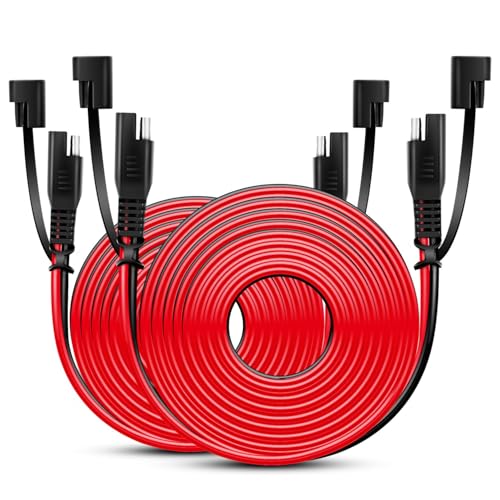
The 12-foot twin-pack that pushes a solar charger across the deck of a boat.
Sometimes you need distance, not thickness — and that is exactly what this Nilight cable delivers. It is a pair of 12-foot 16 AWG SAE extension cables rated at 13 amps per wire, designed to stretch from a battery tender on the wall to a motorcycle parked several feet away or to reposition solar panels on a boat for better sun exposure. The universal SAE connectors click together quickly and the included dust caps keep the pins clean when disconnected. One owner used them to reach all four power-sports toys from a single 4-bank battery tender and called the construction heavy-duty.
Functionality is the top aspect with 23 mentions, beating out quality at 21, which tracks — buyers value the extension capability more than any other trait. At 12 feet each, they are a full 6 feet longer than the BFXM 6-foot cable, making them the go-to for any setup where the charger lives on a shelf and the battery sits on the floor. The 16 AWG gauge is correct for a 13-amp battery-maintainer load, but you should not push it beyond that — running a high-draw device like a winch through this cable would create voltage drop and potentially dangerous heat.
The Big Win
- 12-foot length per cable gives you serious placement flexibility for chargers and panels
- Two cables in one pack — run them in series for 24 feet or separate to two devices
- SAE dust caps protect the connector from rain and dirt
Keep In Mind
- 16 AWG is limited to roughly 13A — not suitable for high-current inverters or starter motors
Grab these when: your battery charger is across the garage from the battery and you need a long, lightweight extension.
Pass on these if: you are powering anything that draws over 13 amps — the thin 16 AWG wire will lose voltage fast.
4. ECO-WORTHY 2AWG Battery Cable with 5/16” Lug Terminals 12inch Cables

The 2-gauge monster that laughs at 150-amp loads in a 12-inch link.
This is the cable you reach for when a starter motor, inverter, or battery bank demands serious power with zero resistance. The ECO-WORTHY 2 AWG cable uses tinned copper for corrosion resistance and nickel-plated 5/16-inch ring terminals that stay stable under high temperature. It is rated for a maximum operating current of 150 amps and a temperature range from -76°F to 392°F, so it shrugs off engine-bay heat and deep-freeze winters alike. At 12 inches, it is half the length of the TOPDC 24-inch cable, and the thickness gap is staggering — 2 AWG is about 8 times the cross-sectional area of 16 AWG.
Owners praise the quality most (36 mentions) and specifically note the thick, durable plastic insulation that feels like it will outlast the vehicle. Several buyers used it for parallel battery connections in RVs and solar banks, where the short run and massive gauge keep the link between batteries nearly lossless. The set comes as one red positive and one black negative cable, pre-crimped and ready to bolt in. Value for money scores 14 mentions — rare for a heavy-gauge cable that usually carries a premium at auto-parts stores.
The Heavyweight Advantage
- 2 AWG tinned copper handles up to 150A with minimal voltage drop
- Nickel-plated 5/16-inch lugs resist corrosion better than bare copper
- Rated for extreme temperatures from -76°F to 392°F
One Limitation
- 12-inch length is very short — only useful for connecting adjacent batteries or a battery to a nearby bus bar
Ideal for: linking two RV or solar batteries in parallel with a cable that won’t heat up at full inverter draw.
Not for: long runs or SAE connections — this is a permanent bolted cable for tight spaces only.
5. Linkstyle 6PCS 4 AWG Battery Cables 12 Inch

A six-cable set that turns a tangled battery bank into a clean series-parallel grid.
If you are building a solar battery bank, wiring golf cart batteries in series, or connecting multiple inverters, buying individual cables adds up fast. Linkstyle solves that with a 6-piece set of 4 AWG cables — three red positive and three black negative, each 12 inches long with pre-crimped 3/8-inch tinned copper ring terminals. The pure copper conductors keep resistance low in 12V, 24V, 36V, and 48V systems, and the flexible PVC insulation resists moisture, flame, and abrasion. Owners call them great for linking LiFePO4 batteries and electric cart battery packs.
Quality leads the aspect counts at 19, and functionality follows at 11. The big selling point here is convenience: you get a matched set that works from the start without cutting, stripping, or crimping. Each terminal is a 3/8-inch M10 eyelet that fits common bus bars, distribution blocks, and battery posts. The 6-pack is also more economical than buying two or three pairs separately, which is why value for money gets 6 mentions despite the mid-range price positioning.
What Makes It Useful
- Six pre-crimped cables in one box — 3 red, 3 black — ready for series or parallel wiring
- 4 AWG pure copper handles high current across 12V to 48V battery systems
- Tinned copper ring terminals resist corrosion better than bare copper
A Consideration
- Each cable is only 12 inches long — fine for adjacent batteries but too short for remote connections
Pick this if: you are wiring a multi-battery setup (solar bank, golf cart, dual RV batteries) and want one purchase to cover all the interconnects.
skip it if: you need a single long cable or an SAE connector — this is strictly short-run lug wiring.
6. A ABIGAIL 4 AWG Battery Cable 4FT
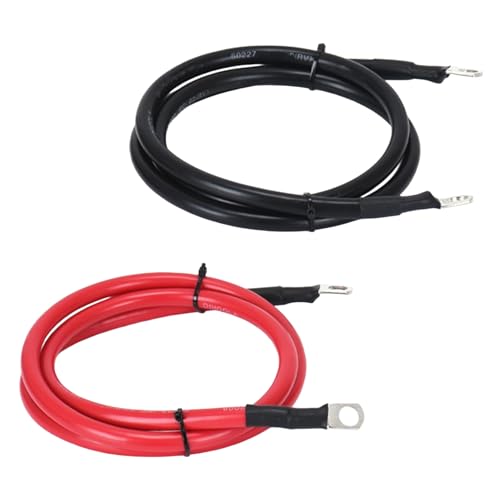
A 4-foot 4-gauge pair that bridges the gap between a battery and a distant inverter.
Sometimes 12 inches is too short and 10 feet is too long — that is where this A ABIGAIL 4 AWG cable fits perfectly. At 4 feet, it gives you enough reach to connect a battery to a power inverter mounted on the wall of an RV compartment or to run from a marine battery to a distribution panel. The cable uses pure copper with tinned copper 3/8-inch ring terminals, and the PVC insulation is flexible enough to route around corners inside a boat console. The maximum current rating is 85 amps at 12 volts, which covers most mid-size inverters and trolling motors.
Quality earns 35 mentions and functionality 22 in buyer reviews, and owners consistently note the tight crimps and durable construction. Buyers used it to connect two batteries in parallel, run a car audio amplifier, and wire up a solar charge controller — and the feedback is that the copper is genuinely thick, not the copper-clad aluminum that plagues some cheap cables. The cable ends are sealed with heat shrink tubing to prevent fraying and resist moisture, a detail that matters in marine and outdoor installations. The 4-foot length is also a significant step up from the 24-inch TOPDC pair, giving you more routing flexibility without the voltage-drop risk of a 10-foot run.
the balance
- 4-foot length is long enough to reach an inverter or distribution block but short enough to avoid voltage drop
- Rated at 85A max current — handles typical 1,000W inverters at 12V
- Heat-shrink sealed ends add moisture and abrasion resistance
What To Check
- Maximum voltage is listed at 12V — verify compatibility for 24V or 48V systems
Best for: the RV or boat owner who needs a 4-gauge extension from battery to inverter without cutting custom cables.
Consider another if: your system runs at 24V or higher and you can’t confirm the cable’s voltage rating covers it.
7. Newport 10ft Trolling Motor Battery Cable Extension Kit

The marine-grade 10-foot extension that lets you shift a battery to balance a canoe or kayak.
Trolling motor setups create a constant battle between keeping the battery near the motor for a short cable run and putting the battery forward for weight distribution. Newport’s 10-foot extension kit solves it with 8 AWG marine-grade wire that stays pliable in cold water and resists abrasion from the inside of a boat hull. The kit includes ring terminals, butt connectors, and heat shrink tubing, so you can attach it to a Minn Kota or Newport motor without any soldering. One owner used it to move the battery to the front of a canoe and reported zero power loss and perfect balance.
The 8 AWG wire is rated at 75 amps, which aligns with most 12V trolling motors. Several owners paired it with a Minn Kota 55-pound thrust motor and said the cable attached directly with no splicing needed. The trade-off is the steep price — the buyer community is split, with some calling it fantastic quality and others saying it is overpriced compared to buying raw marine wire. But the all-in-one convenience (cable + hardware + heat shrink) means you are on the water in 20 minutes instead of hunting for parts at two stores. The build quality earns top marks across the board, and the color-coded electrical tape included for insulation is a small but appreciated touch.
Why It Works On The Water
- Marine-grade 8 AWG wire stays flexible in cold weather and resists saltwater corrosion
- Complete kit with connectors and heat shrink — no extra trip to the hardware store
- 10-foot length lets you reposition the battery for better boat balance
The Catch
- Premium pricing that some owners consider high for what is essentially a 10-foot wire with hardware
Reach for this if: you need a turnkey 10-foot extension for a trolling motor and want everything in one box.
pass on it if: you are comfortable cutting and crimping your own wire — buying bulk 8 AWG marine cable is cheaper.
Understanding the Specs
AWG Gauge and Current Capacity
American Wire Gauge (AWG) is the standard that tells you how much current a wire can safely carry. A lower number means a thicker wire with less resistance. 16 AWG (like the Nilight) is fine for up to about 13 amps — perfect for a battery tender or small solar panel. 10 AWG (like the BFXM) bumps that to 15 amps and handles a 50-watt radio or a larger charger without heating up. 4 AWG (used by TOPDC, Linkstyle, and A ABIGAIL) steps into inverter and starter-motor territory, while 2 AWG (the ECO-WORTHY) is for serious high-current battery bank links rated at 150 amps. Match the gauge to the device you are powering — a mismatch causes voltage drop, slow charging, or even overheated wires.
SAE Connectors vs. Ring Terminals
An SAE (Society of Automotive Engineers) connector is a two-pin quick-disconnect plug commonly found on battery maintainers and solar panels. It snaps on and off in seconds and often includes a dust cap to keep the pins clean. Ring terminals (usually 3/8-inch or 5/16-inch lugs) require bolting to a battery post or bus bar and provide a permanent, vibration-proof connection. SAE is convenient for seasonal use or swapping between devices; ring terminals are the right choice for fixed installations like inverters, starter motors, and battery banks where you want the connection to stay tight for years.
FAQ
Can I use a 16 AWG extension cable for a 50-amp inverter?
Will an SAE extension cable work with any battery maintainer?
How long can a battery extension cable be before voltage drop becomes a problem?
What is the difference between tinned copper and bare copper cable?
Can I cut and re-terminate a pre-crimped battery cable?
Do I need a fuse on a battery extension cable?
Is 4 AWG overkill for a car battery starter cable?
Can I connect two SAE extension cables together for extra length?
What size ring terminal fits most battery posts?
Can I use a marine battery cable for a solar panel installation?
Final Thoughts: The Verdict
Across the board, the best battery extension cable overall is the BFXM 10AWG 6FT SAE because it pairs a genuinely thick 10 AWG wire with the convenience of SAE quick-connect and built-in fusing — it simply handles the widest range of everyday jobs. If you need a heavy-duty bolted link for an inverter or starter motor, the TOPDC 4 AWG pair delivers pure copper construction at a price that beats most auto parts stores. And for the marine angler who needs to balance a canoe or kayak, the Newport 10ft Trolling Motor Kit is the complete drop-in solution that saves you a trip to the hardware store.
How We Picked
We do not accept paid placement. Every pick is matched to a real buyer and a real use-case; we do not hands-on test units.
Sources & Methodology
Specifications: manufacturer listings and product documentation. Review insights: verified customer reviews, as of July 2026. Pricing: not shown on this page (it changes often); check the current price via the retailer link.
As an Amazon Associate, Gadgets Feed earns from qualifying purchases. This does not affect which products we feature.